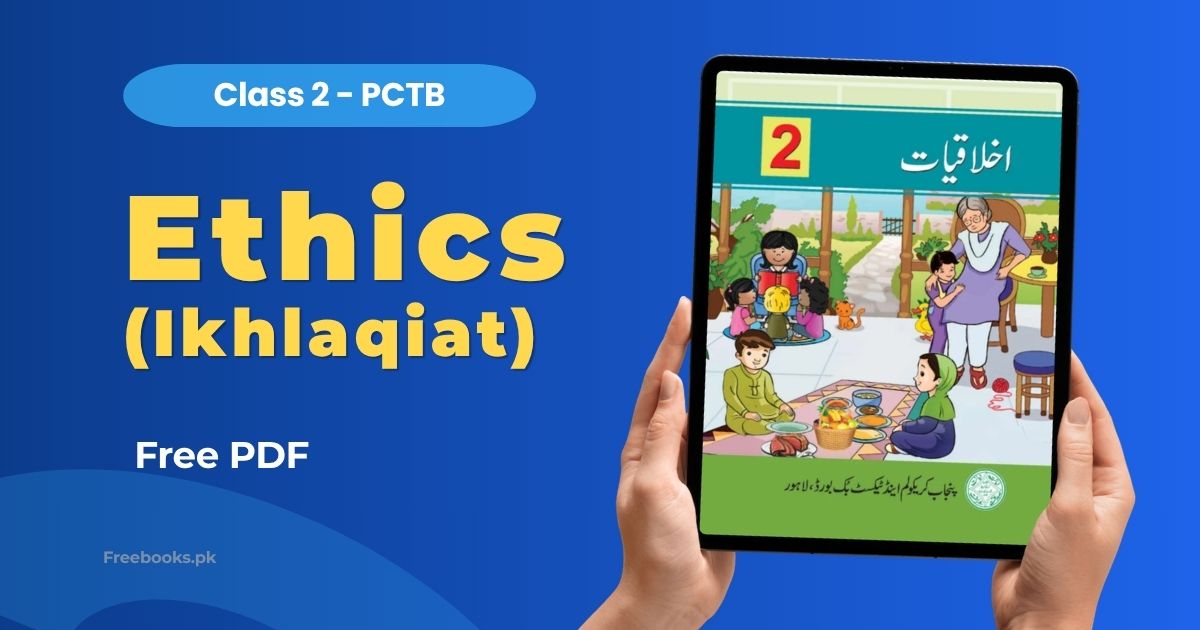
Ethics (Ikhlaqiat) for Class 2 is part of the Punjab Curriculum and Textbook Board (PCTB) syllabus for young students who study Ethics instead of Islamiat. This page covers all 3 chapters of the book, from a first look at the world’s major religions to everyday values like respect and truthfulness, and the stories of two respected religious figures.
For Class 2 students, the book uses simple language, short bullet points, and pictures to introduce big ideas in an age-appropriate way. Each chapter summary and its important questions on this page make revision quicker before class tests, so parents and teachers can go over the key facts with young learners without re-reading the whole chapter.
Book Overview
| Class | 2 |
| Subject | Ethics (Ikhlaqiat) |
| Board | Punjab Curriculum and Textbook Board (PCTB) |
| Total Chapters | 3 (+ Glossary) |
| Total Pages | 34 |
| Medium | Urdu |
| Format | PDF (Free Download) |
Chapter List
Chapter 1: Introduction to Religions (مذاہب کا تعارف)
This chapter gives young students a first, simple introduction to four of the world’s major religions. It covers Hindu Dharm (Sanatan Dharm), including belief in one Ishwar in both seen and unseen forms, the holy books Ramayana and Bhagwat Gita, and worship at temples; Sikhism, founded by Guru Nanak Sahib Ji, with its holy book Sri Guru Granth Sahib written in Punjabi and beliefs like honest livelihood and selfless service (seva); Judaism, where Hazrat Musa (AS) received the Ten Commandments recorded in the Torah; and Christianity, built on the teachings and life of Lord Jesus Christ as recorded in the Holy Bible.
Important Questions:
- Where do Hindus go to worship? Answer: They worship at temples (mandir).
- In which language is the Sikhs’ holy book, Sri Guru Granth Sahib, written? Answer: Punjabi.
- How many commandments did Hazrat Musa (AS) receive from God, as recorded in the Torah? Answer: Ten commandments.
- At what age did Lord Jesus Christ begin preaching, according to this chapter? Answer: At thirty years of age.
Chapter 2: Ethics and Values (اخلاقیات اور اقدار)
This chapter teaches young students why respect and honesty matter in everyday life. It explains why parents, family, and siblings deserve respect, why teachers hold a status like parents and should always be respected, and why classmates should help and be kind to one another instead of fighting over small things. The chapter’s best-known part is the story of an honest woodcutter whose iron axe fell into a river — when an angel offered him gold and silver axes instead, he told the truth each time and was rewarded with all three axes, teaching students that honesty always pays off.
Important Questions:
- Who takes care of and raises children, according to this chapter? Answer: Parents (walidain).
- What does “classmate” (hum-jamaat) mean in this chapter? Answer: Children who study together in the same class, who can be like one’s own brothers and sisters.
- In the story of the honest woodcutter, what was his own axe made of? Answer: Iron.
- What does this chapter say happens when a person tells one lie? Answer: They often end up having to tell many more lies to cover it up.
Chapter 3: God’s Righteous Servants (خدا کے نیک بندے)
This chapter introduces students to two respected religious figures. Shri Krishna Bhagwan was born in Mathura on the banks of the river Yamuna, raised by Nand Baba and Mata Yashoda, and is remembered for his wisdom, his flute playing, his skill in archery and the arts of war, and his teachings recorded in the Bhagwat Gita. Guru Nanak Sahib Ji was born on 14 April 1469 in Talwandi village, now called Nankana Sahib, in Punjab, and founded Sikhism, teaching equality, brotherhood, and goodness. He spent his final days in Kartarpur, Narowal district, where he passed away on 22 September 1539, and is remembered for the message that there is no Hindu or Muslim, only human beings following the path of God.
Important Questions:
- On the banks of which river was Shri Krishna Bhagwan born, in Mathura? Answer: The river Yamuna.
- What is the name of the Sikhs’ holy book? Answer: Sri Guru Granth Sahib.
- Where was Guru Nanak Sahib Ji born? Answer: In Talwandi village, now known as Nankana Sahib, Punjab.
- Where did Guru Nanak Sahib Ji spend the final days of his life? Answer: In Kartarpur, Narowal district.
Download Ethics (Ikhlaqiat) Class 2 PDF
Click the button below to download the free PDF of Ethics (Ikhlaqiat) Class 2 for Punjab Board (PCTB).
Who Should Read This
This book is meant for Class 2 students who study Ethics instead of Islamiat under the Punjab Board (PCTB) syllabus. Parents and teachers introducing young children to the world’s major religions and basic values like honesty and respect will also find the chapter summaries and important questions useful for quick revision.
Applicable Boards
This book is designed for the Punjab Curriculum and Textbook Board (PCTB). Students from other boards with a similar Class 2 Ethics syllabus can use this book too.
FAQs
Is this Ethics book for Class 2 students only?
Yes, this book is designed for Class 2 students who study Ethics under the Punjab Board (PCTB) syllabus.
Can other students use this book?
Yes, students from other boards with a similar Class 2 Ethics syllabus can also use it.
Is this the latest edition?
Yes, this is the PCTB-approved edition currently used in Class 2 Ethics classrooms.
Does the PDF include all 3 chapters?
Yes, the PDF covers all 3 chapters of the book, plus the glossary.
Is the download free?
Yes, the PDF download is completely free.
Does this book include exercises and questions?
Yes, each chapter includes exercises, and this page also lists important questions with short answers for quick revision.
What topics does this Class 2 Ethics book cover?
It introduces four world religions (Hinduism, Sikhism, Judaism, and Christianity), values like respect and truthfulness, and the stories of Shri Krishna Bhagwan and Guru Nanak Sahib Ji.
Related Books
- Ethics (Ikhlaqiat) Class 3 PDF Download – Punjab Board (PCTB)
- Ethics (Ikhlaqiat) Class 4 SNC PDF Download – Punjab Board (PCTB)
- Ethics (Ikhlaqiat) Class 5 SNC PDF Download – Punjab Board (PCTB)
- General Knowledge Class 3 SNC PDF Download – Punjab Board (PCTB)
Related Books
© Copyright Policy
Freebooks.pk is an educational resource for students in Pakistan. Textbooks and other books belong to their respective boards, authors and publishers, and all rights remain with them. If you are the copyright holder of any material on this page and want it changed or removed, please contact us or file a request under our DMCA policy. We review every request and remove reported content promptly.