Reaction kinetics is the branch of chemistry that studies how fast chemical reactions occur and what factors control that speed, from reactions that appear instantaneous, such as sodium chloride reacting with silver nitrate, to reactions that take years, such as iron rusting. Collision theory explains this range: a reaction can only occur when reactant particles collide with the correct orientation and with at least a minimum amount of energy, the activation energy, needed to break existing bonds and begin forming new ones; only a small fraction of all collisions satisfy both conditions and are therefore effective.
Building on this foundation, the chapter introduces the rate law, an experimentally determined equation relating the rate of a reaction to reactant concentrations through a rate constant and an order of reaction, and shows how this rate constant can be calculated using either the initial concentration method or, for first order reactions, the simpler half-life method. It closes by looking beneath the overall balanced equation at the reaction mechanism, the sequence of elementary steps by which a reaction actually proceeds, and shows how the slowest of these steps, the rate-determining step, controls the observed rate law of the whole reaction.
Learning Objectives
- Describe collision theory and explain the role of activation energy and molecular orientation in determining whether a collision is effective
- Define the rate of a reaction and distinguish between its average rate and its instantaneous rate at a point in time
- Describe the chemical and physical methods used to measure the concentration of a reactant or product during a reaction
- Explain, using collision theory and the Maxwell-Boltzmann distribution, how concentration, temperature, surface area, and catalysts each affect reaction rate
- Write and interpret a rate law (rate equation) of the form Rate = k[A]^x[B]^y, and define the rate constant, k
- Define order of reaction with respect to a single reactant and overall, and identify zero, first, second, third, and fractional order reactions
- Derive the units of the rate constant for a reaction of any given order
- Calculate the rate constant of a reaction using the initial concentration (initial rate) method and the half-life method
- Describe a reaction mechanism in terms of elementary steps, molecularity, and reaction intermediates
- Identify the rate-determining step of a proposed mechanism and use it to deduce the reaction's rate law
Key Concepts
7.1 Collision Theory and Activation Energy
Different reactions proceed at vastly different speeds: the precipitation of silver chloride from sodium chloride and silver nitrate solutions is essentially instantaneous, the acid-catalyzed hydrolysis of an ester takes minutes to hours, and the rusting of iron takes months or years. Collision theory explains this range by proposing that a reaction can only occur when reactant particles collide, and that not every collision leads to a reaction: the colliding particles must be oriented correctly relative to one another so that the necessary bonds can break and form, and together they must possess at least a minimum amount of energy, the activation energy (Ea), needed to reach the high-energy transition state between reactants and products. Collisions that satisfy both conditions are called effective or successful collisions, and only a small fraction of all collisions occurring in a reaction mixture typically meet this standard at any given moment.
7.2 Rate of Reaction: Average and Instantaneous Rate
The rate of a chemical reaction is defined as the change in concentration of a reactant or product per unit time, Rate = Delta x / Delta t, where Delta x is the change in concentration (mol dm-3) and Delta t is the time interval (s), giving the rate units of mol dm-3 s-1; because reactant concentration falls and product concentration rises as a reaction proceeds, rate is conventionally reported as a positive quantity regardless of which species is being tracked. The average rate over a stated time interval is simply the total change in concentration divided by that interval, but because the concentration-time graph of a reaction is curved rather than straight, the rate itself changes continuously as the reaction proceeds, generally slowing as reactant concentration falls.
The instantaneous rate at any particular moment is found graphically, by plotting concentration against time and drawing a tangent to the curve at the point of interest; the slope of this tangent gives the instantaneous rate at that instant. This graphical, tangent-slope method was demonstrated historically using the decomposition of hydrogen iodide, where concentration-time data was plotted and a tangent drawn at a chosen point gave an instantaneous rate of about 4 x 10^-4 mol dm-3 s-1, distinct from the average rate calculated over the whole experiment.
7.3 Measuring Concentration During a Reaction
Following a reaction's progress requires measuring how the concentration of a reactant or product changes with time, and this can be done using either chemical or physical methods. The chemical method withdraws a small sample of the reaction mixture at set time intervals and analyzes it by titration, for example titrating the acid produced during ester hydrolysis against sodium hydroxide using phenolphthalein indicator; because each titration takes time and consumes part of the sample, this method gives discontinuous data points and can disturb the reaction being studied.
Physical methods instead monitor a property of the reaction mixture that changes continuously and can be measured without removing or disturbing any sample, making them generally preferable when applicable. These include spectrophotometry or colorimetry, which tracks the change in colour intensity or light absorbance of a coloured reactant or product; electrical conductivity, which tracks the change in concentration of ions in solution; and measurement of volume or pressure change, which is suitable for reactions that produce or consume a gas.
7.4 Factors Affecting Reaction Rate: Concentration, Temperature and Surface Area
Four main factors affect how fast a reaction proceeds. Increasing the concentration of a reactant increases the number of particles present in a given volume, raising the frequency of collisions between reactant particles and therefore increasing the rate; this is the basis of the law of mass action, which states that the rate of a reaction is proportional to the active masses (concentrations) of the reacting substances. For gaseous reactants, increasing pressure has an equivalent effect, since it increases the effective concentration of gas molecules in a given volume.
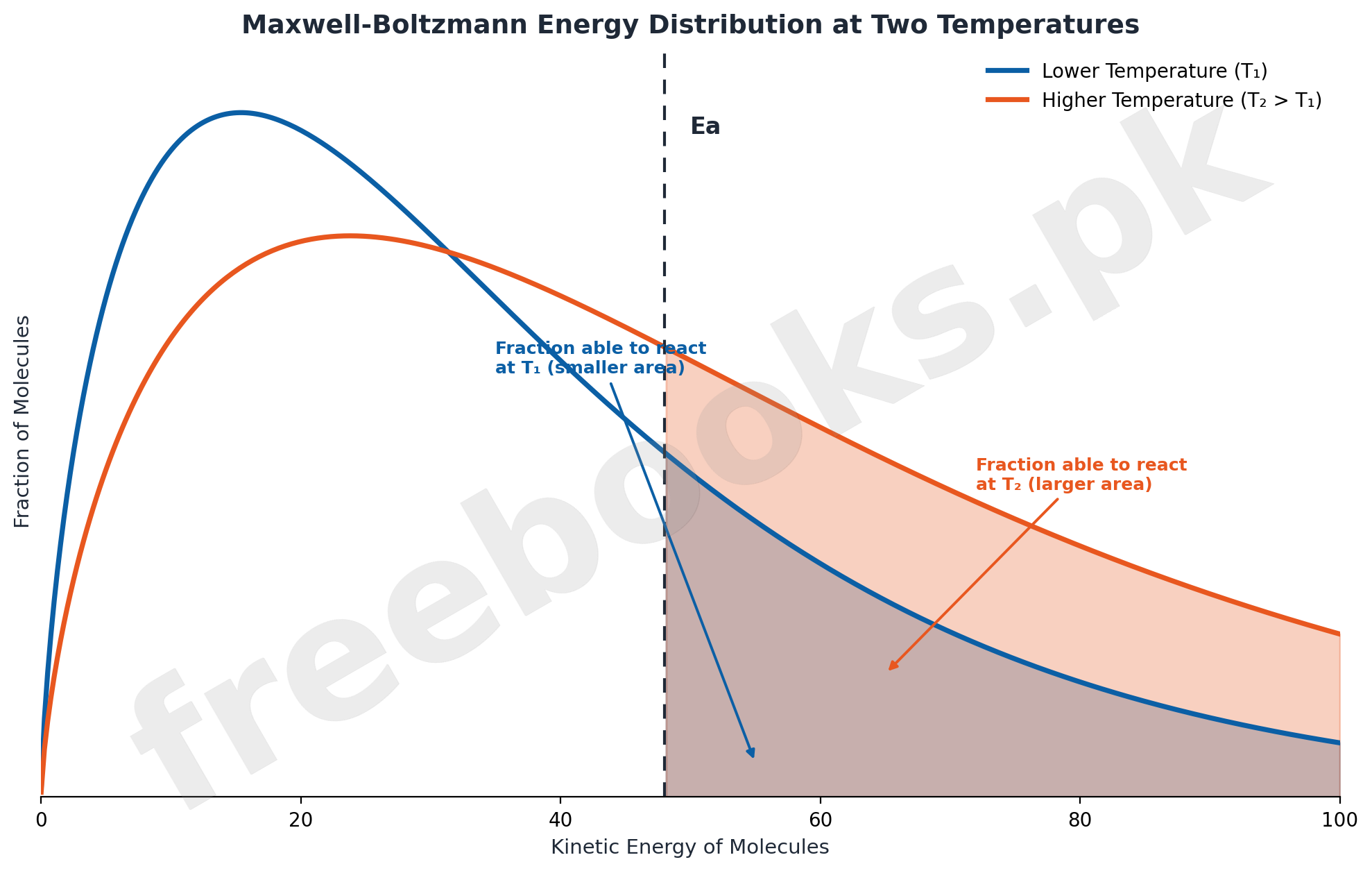
Raising the temperature increases reaction rate far more than a simple increase in collision frequency alone would predict; as a rough rule of thumb, reaction rate roughly doubles or triples for every 10 degrees C rise in temperature. The Maxwell-Boltzmann distribution explains why: raising the temperature shifts the distribution of molecular kinetic energies to higher values and broadens and flattens the curve, so that the area under the curve beyond the activation energy, representing the fraction of molecules with enough energy to react, increases sharply, far more than the modest increase in total collision frequency. Increasing the surface area of a solid reactant, for example by grinding a lump into a powder, exposes far more surface to the other reactant without changing the total amount of solid present, increasing the frequency of effective collisions at the solid's surface and therefore increasing rate.
7.5 Catalysis: Homogeneous and Heterogeneous Catalysts
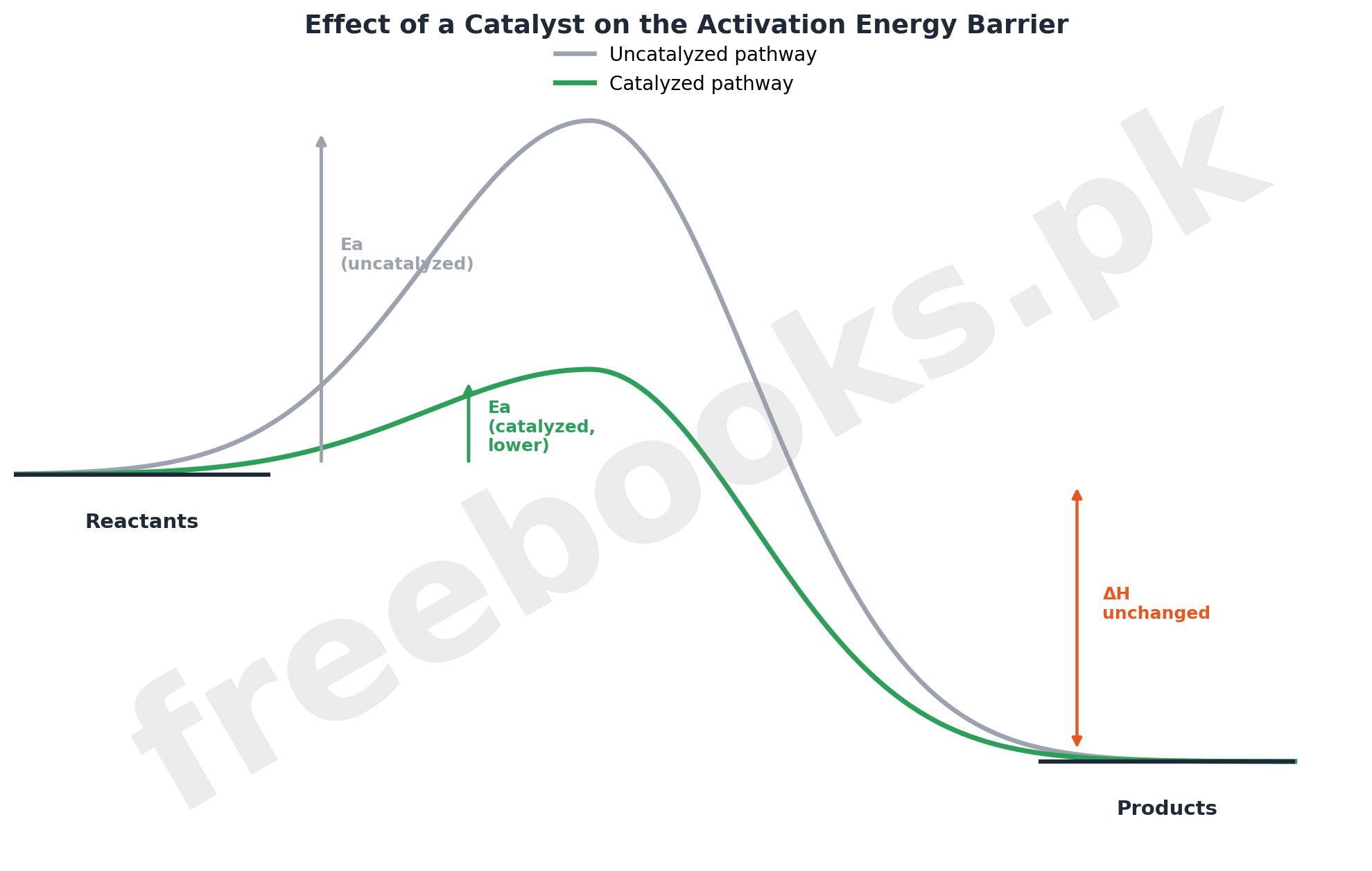
A catalyst is a substance that increases the rate of a reaction without itself being permanently consumed, by providing an alternative reaction pathway, or mechanism, with a lower activation energy than the uncatalyzed route; because more collisions now have sufficient energy to follow this lower-energy pathway, the reaction proceeds faster, while the overall enthalpy change of the reaction, and the relative energies of reactants and products, remain unaffected. Familiar examples include platinum catalyzing the combination of hydrogen and oxygen to form water, manganese dioxide catalyzing the decomposition of potassium chlorate, and copper(II) chloride catalyzing the oxidation of hydrogen chloride to chlorine.
In homogeneous catalysis, the catalyst exists in the same phase as the reactants, as when nitrogen oxide gas catalyzes the gas-phase oxidation of sulfur dioxide to sulfur trioxide in the contact process, or when hydrogen ions catalyze the hydrolysis of an ester in aqueous solution. In heterogeneous catalysis, the catalyst exists in a different phase from the reactants, most commonly a solid catalyst acting on gaseous or liquid reactants, as when platinum gauze catalyzes the industrial oxidation of ammonia to nitric oxide, or when finely divided nickel, palladium, or platinum catalyzes the hydrogenation of an alkene such as ethene to ethane. Enzymes are highly specific biological catalysts that speed up the biochemical reactions of living cells, and vitamins such as vitamin K often act as coenzymes, small molecules that assist an enzyme's catalytic action, in this case in the blood-clotting process.
7.6 Rate Law, Rate Constant and Order of Reaction
For a general reaction aA + bB -> products, the rate law, or rate equation, is the experimentally determined relationship Rate = k[A]^x[B]^y, where k is the specific rate constant of the reaction, and x and y are the orders of reaction with respect to A and B; crucially, x and y must be found from experimental data and are not necessarily equal to the stoichiometric coefficients a and b in the balanced equation, because the rate law depends on the reaction's mechanism, not simply on its overall stoichiometry. The rate constant, k, is numerically equal to the rate of the reaction when every reactant concentration in the rate law is unity (1 mol dm-3); its value depends on temperature and on whether a catalyst is present, but does not itself depend on the concentrations of the reactants.
The order of reaction with respect to a particular reactant is the power to which that reactant's concentration is raised in the experimentally determined rate law, and the overall order of the reaction is the sum of all the individual orders. For example, the oxidation of nitric oxide by ozone, NO + O3 -> NO2 + O2, follows the rate law Rate = k[NO][O3], making it first order in NO, first order in O3, and second order overall; the reaction 2H2 + 2NO -> N2 + 2H2O follows Rate = k[H2][NO]^2, making it first order in H2, second order in NO, and third order overall.
7.7 Types of Reaction Order
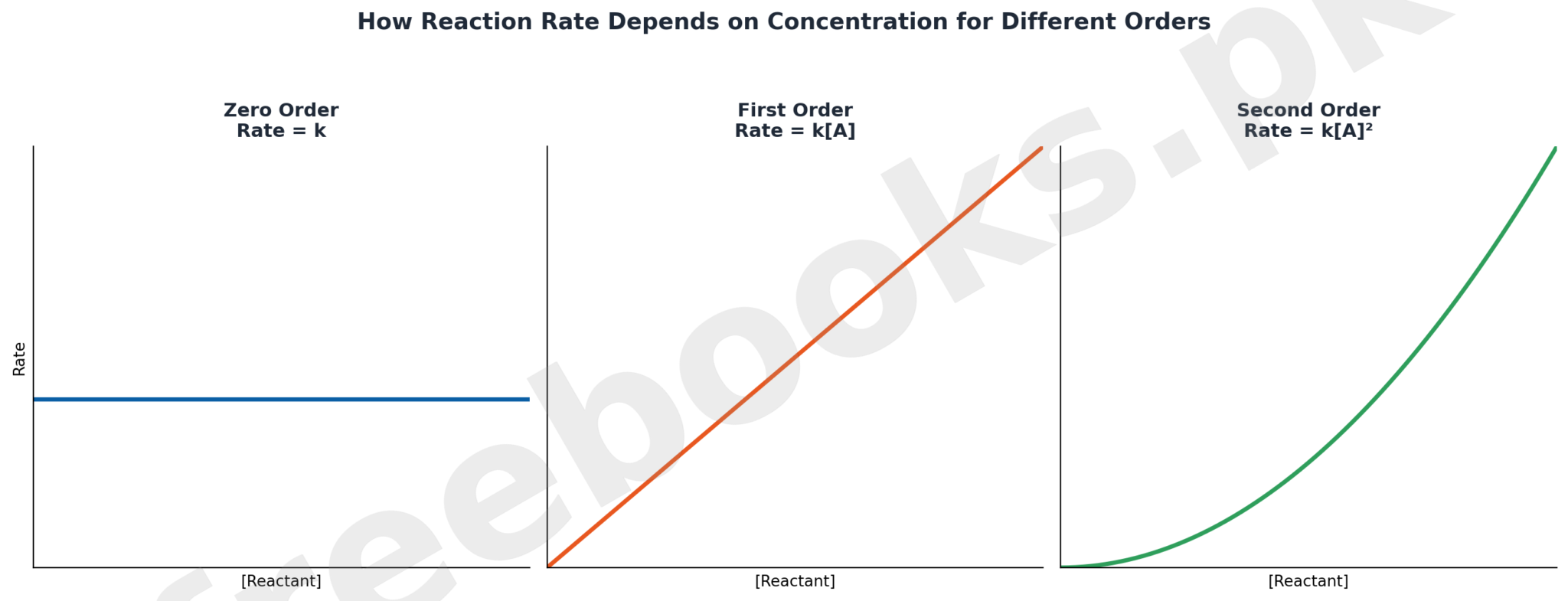
A zero order reaction has a rate that is independent of the concentration of its reactant(s), Rate = k[A]^0 = k, so changing the reactant concentration has no effect on rate; this occurs in some photochemical reactions, such as the sunlight-initiated reaction of hydrogen with chlorine to form hydrogen chloride, and in certain catalyst-surface reactions, such as the decomposition of ammonia on a hot catalyst surface, where the rate is instead limited by the fixed number of active sites available. A first order reaction has a rate law in which the sum of the concentration exponents is 1, as in the decomposition of dinitrogen pentoxide, 2N2O5 -> 2N2O4 + O2, which follows Rate = k[N2O5]^1.
A second order reaction has a rate law in which the sum of the exponents is 2, either from a single reactant squared, Rate = k[A]^2, or from two reactants each raised to the first power, Rate = k[A][B], as in the oxidation of nitric oxide by ozone described above. A third order reaction has a rate law in which the sum of the exponents is 3, as in the reaction between iron(III) chloride and potassium iodide, which experimentally follows Rate = k[FeCl3][KI]^2 despite involving eight reactant molecules in its balanced equation, and in the reaction 2NO + O2 -> 2NO2, which follows Rate = k[NO]^2[O2]. A fractional order reaction has a rate law in which the sum of the exponents is not a whole number, as in the reaction of chloroform with chlorine to form carbon tetrachloride, CHCl3 + Cl2 -> CCl4 + HCl, which follows Rate = k[CHCl3][Cl2]^1/2, an overall order of 1.5; fractional orders occur frequently in reactions that proceed through free-radical mechanisms.
7.8 Units of the Rate Constant
Because rate is always measured in mol dm-3 s-1 while the concentration terms in a rate law are raised to different overall powers for reactions of different orders, the units of the rate constant, k, must themselves change with the order of the reaction to keep the rate law dimensionally consistent. Starting from Rate = k[Reactants]^n, rearranging gives kn = (mol dm-3)^(1-n) s-1, a general formula that can be used to find the units of k for any order n.
For a zero order reaction (n = 0), k0 has units of mol dm-3 s-1, the same units as rate itself. For a first order reaction (n = 1), the concentration term cancels entirely, leaving k1 with units of s-1. For a second order reaction (n = 2), k2 has units of dm3 mol-1 s-1, and for a third order reaction (n = 3), k3 has units of dm6 mol-2 s-1. Because each order of reaction corresponds to a distinct set of units for k, the units of an experimentally measured rate constant can themselves be used to identify the order of an otherwise unknown reaction.
7.9 Determination of the Rate Constant: Initial Rate and Half-Life Methods
The rate constant of a reaction can be calculated experimentally using two main methods. In the initial concentration (initial rate) method, several experiments are carried out using different known initial concentrations of the reactants, and the initial rate of each is measured; once the rate law has been established from how the initial rate changes between experiments, the measured rate and concentrations from any one experiment can be substituted into the rearranged rate law to solve for k. For example, for the reaction of hydrogen peroxide with iodide ions in acid, whose rate law is Rate = k[H2O2]/[I-], substituting an initial rate of 3.50 x 10^-6 mol dm-3 s-1 with [H2O2] = 0.0200 mol dm-3 and [I-] = 0.0100 mol dm-3 gives k = 1.75 x 10^-2 dm3 mol-1 s-1.
The half-life method applies specifically to first order reactions, and relies on the fact that a first order reaction's half-life, t1/2, the time taken for a reactant's concentration to fall to half its original value, is a constant that does not depend on the starting concentration; this gives the direct relationship k = 0.693 / t1/2. For example, a sample of hydrogen peroxide that decomposes by a first order process with a half-life of 2 hours, or 7200 seconds, has a rate constant k = 0.693 / 7200 = 9.6 x 10^-5 s-1; similarly, the first order conversion of cyclopropane to propene, with a half-life of 17.0 minutes (1020 seconds), has a rate constant k = 0.693 / 1020, approximately 6.8 x 10^-4 s-1.
7.10 Reaction Mechanism, Molecularity and Intermediates
The overall balanced equation of a reaction shows only the starting reactants and final products, but many reactions do not occur in a single step; instead they proceed through a reaction mechanism, a sequence of elementary steps, each representing a single molecular event such as the breaking or forming of a bond, that together add up to the overall reaction. The molecularity of an elementary step is the number of reactant particles, atoms, ions, or molecules, that come together and react in that single step. A unimolecular step involves a single reactant molecule, as in the decomposition of N2O5(g) -> NO2(g) + NO3(g); a bimolecular step involves two colliding species, as in CO(g) + NO2(g) -> NO(g) + CO2(g) or NO(g) + O3(g) -> NO2(g) + O2(g); and a termolecular step, involving the simultaneous collision of three species, is rare because the probability of three particles colliding together with the correct energy and orientation at the same instant is much lower than for a two-body collision, as in the stratospheric reaction 2O2(g) + O(g) -> O3(g) + O2(g).
Intermediates are species, often ions or free radicals, that are produced in one step of a mechanism and completely consumed in a later step; because they are formed and then used up within the sequence of elementary steps, intermediates never appear in the overall balanced equation, which only shows what is left once every step has been added together.
7.11 The Rate-Determining Step
In many multi-step reaction mechanisms, one elementary step is significantly slower than all the others; this step, called the rate-determining step, controls the rate of the overall reaction in the same way that the narrowest point of a pipe limits the overall flow of water through it, regardless of how wide the rest of the pipe is. Because any step occurring after the rate-determining step cannot make the reaction go any faster than the rate-determining step already allows, species that only appear in steps after the rate-determining step do not appear in the experimentally observed rate law, while every species involved in, or before, the rate-determining step does appear in it; this means the order of a reaction can, in principle, be deduced directly from the molecularity of its rate-determining step.
For the reaction 2NO(g) + 2H2(g) -> 2H2O(g) + N2(g), experiments show that doubling [H2] doubles the rate while doubling [NO] quadruples the rate, giving the rate law Rate = k[H2][NO]^2, first order in H2, second order in NO, third order overall; this matches a proposed two-step mechanism in which step 1, 2NO + H2 -> N2 + H2O2 (slow, rate-determining), is followed by step 2, H2O2 + H2 -> 2H2O (fast). Similarly, for the reaction 2NO2(g) + F2(g) -> 2NO2F(g), the experimentally observed rate law, Rate = k[NO2][F2], first order in each reactant, matches a mechanism whose first, slow step, NO2 + F2 -> NO2F + F (a fluorine atom), is rate-determining, while the second, fast step, NO2 + F -> NO2F, does not affect the overall rate because the fluorine atoms produced in step 1 react almost as soon as they form.
Important Definitions
What is the rate of a reaction?
The change in the concentration of a reactant or product per unit time, Rate = Delta x/Delta t, usually expressed in mol dm-3 s-1.
What is activation energy (Ea)?
The minimum energy that colliding reactant particles must together possess for a collision to be effective and lead to a reaction.
What is collision theory?
The theory that a reaction occurs only when reactant particles collide with the correct orientation and with at least the activation energy.
What is a rate law (rate equation)?
An experimentally determined equation, Rate = k[A]^x[B]^y, relating the rate of a reaction to the concentrations of its reactants.
What is the rate constant (k)?
The proportionality constant in the rate law, numerically equal to the rate of reaction when every reactant concentration is unity; it depends on temperature but not on concentration.
What is the order of a reaction?
The sum of the powers to which reactant concentrations are raised in the experimentally determined rate law.
What is molecularity?
The number of reactant particles, atoms, ions, or molecules, that collide and react together in a single elementary step of a mechanism.
What is a reaction intermediate?
A short-lived species, often an ion or free radical, produced in one step of a mechanism and consumed in a later step, so it does not appear in the overall equation.
What is the rate-determining step?
The slowest elementary step of a multi-step mechanism, which controls the rate of the overall reaction.
What is half-life (t1/2)?
The time taken for the concentration of a reactant to fall to half of its original value.
Key Facts and Relations
| Topic | Key Fact / Relation |
|---|---|
| Rate of reaction | Rate = Delta x / Delta t (mol dm-3 s-1) |
| General rate law | Rate = k[A]^x[B]^y |
| Order of reaction | n = x + y (sum of exponents in the rate law) |
| General units of rate constant | kn = (mol dm-3)^(1-n) s-1 |
| Zero order rate constant units | k0 = mol dm-3 s-1 |
| First order rate constant units | k1 = s-1 |
| Second order rate constant units | k2 = dm3 mol-1 s-1 |
| Third order rate constant units | k3 = dm6 mol-2 s-1 |
| Half-life relation (first order only) | k = 0.693 / t1/2 |
| Rate-determining step | Order of reaction = molecularity of the rate-determining step |
Diagrams
Maxwell-Boltzmann Energy Distribution at Two Temperatures: A comparison of the distribution of molecular kinetic energies at a lower and a higher temperature, showing how the area under the curve beyond the activation energy (Ea), representing the fraction of molecules able to react, increases sharply as temperature rises
Effect of a Catalyst on the Activation Energy Barrier: An energy profile diagram comparing the catalyzed and uncatalyzed pathways of the same reaction, showing that a catalyst lowers the activation energy without changing the relative energies of reactants and products
How Reaction Rate Depends on Concentration for Different Orders: Three graphs of rate against reactant concentration for zero order (constant rate), first order (rate directly proportional to concentration), and second order (rate proportional to the square of concentration) reactions
Short Questions & Answers
Why do reactions such as the precipitation of silver chloride, the hydrolysis of an ester, and the rusting of iron proceed at such different rates?
These reactions have very different activation energies and involve very different reaction mechanisms; a low activation energy, ionic precipitation reaction like silver chloride formation needs almost no energy input to proceed, while a mechanism requiring bond-breaking and multiple steps, as in ester hydrolysis or the multi-stage oxidation involved in rusting, proceeds far more slowly because far fewer collisions are effective.
Why does only a small fraction of all molecular collisions actually result in a reaction?
For a collision to be effective, the colliding particles must have the correct orientation so the necessary bonds can break and form, and must together possess at least the activation energy; most collisions fail to meet one or both conditions, so only a small proportion of the total number of collisions occurring each second actually leads to a reaction.
Why is a graphical, tangent-slope method needed to find the instantaneous rate of a reaction?
A concentration-time graph for a reaction is curved, not a straight line, because the rate of reaction itself changes continuously as reactant is consumed; only the slope of a tangent drawn at a specific point on the curve gives the true instantaneous rate at that moment, whereas the overall average rate would blur together the faster and slower parts of the reaction.
Why is [H+] left out of the rate law for the reaction between hydrogen peroxide and iodide ions, even though H+ appears in the balanced equation?
Experiments show that changing the concentration of H+ has no measurable effect on the rate of this reaction, meaning the reaction is zero order with respect to H+; since the rate law only includes concentration terms for species whose concentration actually affects the rate, H+ does not appear in it despite being a reactant in the overall stoichiometric equation.
Why does raising the temperature increase reaction rate by more than the increase in collision frequency alone would predict?
The Maxwell-Boltzmann distribution shows that raising temperature not only increases the total number of collisions occurring per second, but also sharply increases the fraction of those collisions with energy equal to or greater than the activation energy; this second effect dominates, which is why reaction rate typically doubles or triples for only a 10 degrees C rise in temperature.
Why can the rate law of a reaction not simply be read off from its balanced chemical equation?
The rate law depends on the actual reaction mechanism, specifically on the species involved in the rate-determining step, not on the overall stoichiometric coefficients of the balanced equation; because most reactions proceed through several elementary steps rather than a single collision matching the overall equation, the orders in the rate law must be determined experimentally.
Why is the half-life method for finding a rate constant only straightforwardly applicable to first order reactions?
For a first order reaction, the half-life is a genuine constant, independent of the starting concentration, so a single measured half-life can be substituted directly into k = 0.693/t1/2; for reactions of other orders, the half-life itself depends on the initial concentration, so a single half-life value is not sufficient on its own to calculate the rate constant.
Why is a termolecular elementary step much rarer than a unimolecular or bimolecular step?
A termolecular step requires three separate reactant particles to collide simultaneously with both the correct orientation and sufficient combined energy; the probability of three independent particles meeting these conditions all at the same instant is far lower than for a two-body collision, so most reaction mechanisms proceed through a series of unimolecular and bimolecular steps instead.
Why do reaction intermediates never appear in the overall balanced equation of a reaction?
An intermediate is generated in one elementary step of the mechanism and then completely used up in a later step; when all the elementary steps of the mechanism are added together to give the overall reaction, the intermediate is produced and consumed in equal amounts, so it cancels out and does not appear among the final reactants or products.
Why does the order of a reaction sometimes match the molecularity of its proposed rate-determining step but not the overall balanced equation?
The rate-determining step is the single elementary step that limits how fast the whole reaction can proceed, so the species and their powers in the experimentally observed rate law reflect only the species involved in, or before, that one step; the overall balanced equation, by contrast, is simply the sum of every step in the mechanism and gives no information about which step is slowest.
Long Questions & Answers
Explain how collision theory accounts for the rate of a chemical reaction, and describe how concentration, temperature, surface area and catalysts each affect that rate.
What conditions must be satisfied for a collision between reactant particles to result in a reaction?
The colliding particles must be oriented correctly relative to one another, so that the bonds that need to break and form are actually able to do so, and together they must possess at least the activation energy needed to reach the transition state; a collision lacking either the correct orientation or sufficient energy is ineffective and does not lead to a reaction.
How does increasing reactant concentration increase reaction rate?
According to the law of mass action, rate is proportional to the active masses, or concentrations, of the reacting substances; increasing concentration packs more particles into the same volume, which raises the frequency of collisions between reactant particles and therefore increases the number of effective collisions occurring per unit time.
How does increasing temperature affect the fraction of molecules able to react?
Raising temperature shifts the Maxwell-Boltzmann distribution of molecular kinetic energies toward higher values and broadens and flattens the curve, so the area beyond the activation energy, representing the fraction of molecules with enough energy to react, increases sharply; this effect, rather than the modest rise in total collision frequency, is why reaction rate typically doubles or triples for every 10 degrees C increase in temperature.
Why does increasing the surface area of a solid reactant increase reaction rate?
Grinding a solid into smaller pieces or a fine powder exposes far more of its surface to the other reactant without changing the total amount of solid present; because reaction can only occur at the exposed surface, this greatly increases the frequency of effective collisions at the solid-reactant interface and therefore increases rate.
How does a catalyst increase reaction rate without being permanently consumed?
A catalyst provides an alternative reaction pathway, or mechanism, with a lower activation energy than the uncatalyzed route, so a larger fraction of collisions now have enough energy to react via this new pathway; because the catalyst takes part in an early step of this alternative mechanism but is regenerated in a later step, it re-emerges chemically unchanged at the end and does not appear in the overall stoichiometric equation.
Describe how the rate law, rate constant and order of a reaction are determined experimentally, and explain the role of the rate-determining step in a reaction mechanism.
What is a rate law, and how does it differ from the balanced chemical equation of a reaction?
A rate law, Rate = k[A]^x[B]^y, is an experimentally determined relationship between the rate of a reaction and the concentrations of its reactants; unlike the coefficients in a balanced chemical equation, the exponents x and y must be measured rather than assumed, because the rate law reflects the reaction's actual mechanism, not simply its overall stoichiometry.
How can the initial concentration method be used to determine a reaction's rate constant?
Several experiments are carried out using different known initial concentrations of the reactants, and the initial rate of each experiment is measured; comparing how the initial rate changes as each concentration is varied reveals the order with respect to that reactant, and once the full rate law is known, the measured rate and concentrations from any one experiment can be substituted into the rearranged rate law to solve for the rate constant, k.
How does the half-life method give the rate constant of a first order reaction?
The time taken for the reactant's concentration to fall to half its original value, the half-life, is measured experimentally; because a first order reaction's half-life is a constant that does not depend on the starting concentration, the rate constant can be found directly from k = 0.693/t1/2 without needing any further concentration data.
What is meant by the rate-determining step of a reaction mechanism?
It is the slowest of the elementary steps that together make up a multi-step reaction mechanism; because this step acts as a bottleneck, comparable to the narrowest point of a pipe limiting the overall flow of water through it, it controls the rate of the entire reaction regardless of how fast the other steps are.
How can the identity of the rate-determining step be confirmed using the experimentally observed rate law?
A proposed mechanism is only considered valid if the species and their powers in its rate-determining step reproduce the rate law actually measured in the laboratory; if the rate-determining step's molecularity does not match the experimentally observed orders of reaction, the proposed mechanism must be rejected or revised.
Multiple Choice Questions (MCQs)
As a reaction proceeds and its reactants are gradually consumed, the rate of reaction typically: (A) Increases steadily throughout (B) Decreases as the reaction proceeds (C) Stays exactly constant at every order of reaction (D) Increases sharply and then stops abruptly
Correct answer: (B) Decreases as the reaction proceeds. As reactant concentration falls, the frequency of effective collisions generally falls too, so rate decreases over the course of most reactions; a zero order reaction is the main exception, since its rate does not depend on concentration.
Raising the temperature of a reaction increases its rate mainly because: (A) Activation energy increases with temperature (B) Activation energy decreases with temperature (C) Both the frequency and the energy of effective collisions increase (D) Only the total number of collisions increases, not their energy
Correct answer: (C) Both the frequency and the energy of effective collisions increase. The Maxwell-Boltzmann distribution shows that a higher temperature increases both the overall collision frequency and, more significantly, the fraction of collisions with energy at or above the activation energy.
Comparing two reactions at the same temperature, the one with the lower activation energy will have: (A) A smaller rate constant (B) A larger rate constant (C) Exactly the same rate constant (D) A rate constant that depends only on enthalpy change
Correct answer: (B) A larger rate constant. A lower activation energy means a larger fraction of collisions possess enough energy to react at a given temperature, giving that reaction a larger rate constant.
A reaction whose rate does not change when the concentration of a particular reactant is changed is: (A) Second order with respect to that reactant (B) First order with respect to that reactant (C) Zero order with respect to that reactant (D) Impossible to classify by order
Correct answer: (C) Zero order with respect to that reactant. Zero order with respect to a reactant means that reactant's concentration term has an exponent of 0 in the rate law, so changing its concentration has no effect on the measured rate.
On a Maxwell-Boltzmann distribution curve, the shaded area beyond the activation energy represents: (A) The total number of molecules in the sample (B) The fraction of molecules with enough energy to react (C) The average kinetic energy of all the molecules (D) The value of the rate constant
Correct answer: (B) The fraction of molecules with enough energy to react. The area under the curve beyond Ea corresponds to the proportion of molecules that possess at least the minimum energy needed for an effective collision.
If doubling the concentration of a reactant causes the reaction rate to increase four-fold, the reaction is: (A) Zero order with respect to that reactant (B) First order with respect to that reactant (C) Second order with respect to that reactant (D) Third order with respect to that reactant
Correct answer: (C) Second order with respect to that reactant. Doubling the concentration raised the rate by a factor of 2^2 = 4, so the exponent, and therefore the order, with respect to that reactant is 2.
In a multi-step reaction mechanism, the rate-determining step is: (A) Always the first step written in the mechanism (B) Always the final step of the mechanism (C) The slowest of the elementary steps (D) The fastest of the elementary steps
Correct answer: (C) The slowest of the elementary steps. Whichever elementary step happens to be slowest acts as the bottleneck and limits the overall rate of the reaction, regardless of its position within the mechanism.
The units of a reaction's rate constant, k, depend primarily on: (A) The activation energy of the reaction (B) The temperature at which the reaction is carried out (C) The overall order of the reaction (D) The stoichiometric coefficients of the balanced equation
Correct answer: (C) The overall order of the reaction. Because kn = (mol dm-3)^(1-n) s-1, the units of k are determined entirely by n, the overall order of the reaction, not by activation energy, temperature, or stoichiometric coefficients.
A first order reaction has a half-life of 20 minutes. Its rate constant is closest to: (A) 0.05 min-1 (B) 0.0173 min-1 (C) 0.0347 min-1 (D) 13.86 min-1
Correct answer: (C) 0.0347 min-1. Using k = 0.693/t1/2 = 0.693/20 minutes gives k = 0.0347 min-1.
On an energy profile diagram, the effect of adding a catalyst is shown as: (A) A higher activation-energy peak (B) A lower activation-energy peak, with reactant and product energy levels unchanged (C) A change in the enthalpy of the reactants (D) A shift in the position of chemical equilibrium
Correct answer: (B) A lower activation-energy peak, with reactant and product energy levels unchanged. A catalyst provides an alternative pathway with a lower activation energy; it does not alter the relative energies of reactants and products, so the overall enthalpy change of the reaction is unaffected.
Quick Revision Summary
- Collision theory: a reaction occurs only when particles collide with the correct orientation and with at least the activation energy (Ea)
- Rate of reaction = Delta x/Delta t, units mol dm-3 s-1; instantaneous rate = slope of tangent on a concentration-time graph, distinct from average rate
- Concentration measured chemically (titration, discontinuous data) or physically (spectrophotometry, conductivity, volume/pressure change; continuous data)
- Rate increases with concentration (law of mass action), temperature (Maxwell-Boltzmann distribution), surface area, and presence of a catalyst
- Catalysts lower Ea via an alternative pathway without being consumed; homogeneous catalysis (same phase) vs heterogeneous catalysis (different phase)
- Rate law: Rate = k[A]^x[B]^y; x and y are found experimentally, not read off the balanced equation's coefficients
- Order of reaction = sum of exponents in the rate law; can be zero, first, second, third, or fractional
- Units of rate constant: kn = (mol dm-3)^(1-n) s-1; k0 = mol dm-3 s-1, k1 = s-1, k2 = dm3 mol-1 s-1, k3 = dm6 mol-2 s-1
- Rate constant found via the initial concentration method (multiple experiments, rearranged rate law) or the half-life method (first order only, k = 0.693/t1/2)
- Reaction mechanism = sequence of elementary steps; molecularity = number of species colliding in one step (unimolecular, bimolecular, termolecular)
- Intermediates form in one step and are consumed in a later step; they never appear in the overall balanced equation
- Rate-determining step = the slowest elementary step; controls the overall rate; species only appearing after it do not appear in the rate law
- Order of reaction can often be deduced directly from the molecularity of the proposed rate-determining step
Exam Tips
- When identifying reaction order from experimental data, check exactly how the rate changes when one concentration is doubled while the others are held constant, rather than assuming order matches the stoichiometric coefficients
- Always convert time values to seconds before substituting into k = 0.693/t1/2 if the rate constant is required in s-1
- State the units alongside any calculated rate constant, since those units change with the order of the reaction and are themselves a clue to identifying an unknown order
- When proposing a reaction mechanism, check that the elementary steps sum to the correct overall balanced equation and that the rate-determining step reproduces the experimentally observed rate law
- Do not confuse molecularity (the number of species in one elementary step, always a whole number) with order of reaction (found experimentally, and can be zero, fractional, or otherwise unrelated to any single step's molecularity)
- Keep concentration and rate units consistent throughout a calculation, mol dm-3 for concentration and mol dm-3 s-1 for rate, so that the units of k obtained match the reaction's order