Nitrogen, a group 15 element making up most of Earth's atmosphere, is remarkably unreactive because of its strong, non-polar N-N triple bond, which requires a very large amount of energy to break; despite this inertness, nitrogen forms the important base ammonia through the Haber-Bosch process, and a range of oxides (NO, N2O, NO2, N2O4, N2O5) that arise from both natural and human sources and play a central role in forming photochemical smog and peroxyacyl nitrates (PANs). Catalytic converters use precious metal catalysts to remove these harmful nitrogen oxides from vehicle exhaust, while the natural nitrogen cycle continually interconverts ammonia, nitrite, nitrate, and nitrogen gas through nitrification and denitrification.
Sulfur, a group 16 chalcogen, is similarly unreactive at room temperature, forming stable S8 crown-shaped rings through catenation rather than double bonds, and displaying a range of oxidation states from -2 to +6 whose relative stability depends on pH, temperature, and the surrounding chemical environment. Sulfur and its compounds have extensive industrial uses, from vulcanizing rubber and manufacturing fertilizers and gunpowder to serving as the backbone of countless drugs, dyes, and fragrances, but by far its most important industrial application is the manufacture of sulfuric acid via the Contact Process, a acid whose versatile chemical properties as an autoionizing solvent, strong acid, powerful dehydrating agent, and moderate oxidizing agent make it one of the most widely used industrial chemicals in the world.
Learning Objectives
- Explain the lack of reactivity of nitrogen due to its triple bond strength and lack of polarity
- Describe the basicity of ammonia using the Bronsted-Lowry theory, and identify the structure of the ammonium ion and how it forms through an acid-base reaction
- Describe how ammonia can be displaced from ammonium salts through an acid-base reaction
- Describe natural and man-made occurrences of oxides of nitrogen and their catalytic removal from exhaust gases
- Explain the role of NO and NO2 in the formation of photochemical smog, specifically their reaction with unburned hydrocarbons to form peroxyacetyl nitrate (PAN)
- Differentiate between nitrification and denitrification
- Explain the lack of reactivity of sulfur, with reference to its bonding and the stability of its compounds
- Describe the different oxidation states of sulfur and their relative stability
- Describe the properties, production, and industrial applications of sulfuric acid
- Describe the chemical reactions and processes involving sulfur, and explain the uses of sulfur compounds in industry, everyday life, and organic synthesis
Key Concepts
12.1 Reactivity of Nitrogen (N2)
Nitrogen (group 15, electronic configuration [He] 2s2 2p3) is obtained industrially by cooling air until it liquefies, and in the laboratory by gently heating ammonium nitrite solution. Nitrogen's low reactivity comes from two factors: its small, symmetrical electron cloud lets the two atoms form a triple bond with a very high bond enthalpy of +944 kJ/mol, requiring a large energy input to break; and since both atoms are identical, the bond is completely non-polar, with the three bonding electron pairs shared perfectly equally. This inertness makes nitrogen useful for diluting oxygen in the air (preventing every spark from causing fire), blanketing flammable cargo such as hydrocarbons or edible oils, and providing an inert atmosphere for laboratory reactions.
12.2 Ammonia (NH3): Basicity, Structure, and Preparation
Ammonia, prepared industrially by the Haber-Bosch process (N2 + 3H2 <=> 2NH3), behaves as a Bronsted-Lowry base by accepting a proton from an acid to form the ammonium ion, NH3 + H+ <=> NH4+. Dissolved in water it forms ammonium hydroxide, establishing the equilibrium NH3 + H2O <=> NH4+ + OH-, with a small basicity constant Kb = 1.8 x 10^-5, meaning ammonia is a weak base because this equilibrium lies far to the left.
The ammonia molecule is pyramidal because of nitrogen's lone pair, but when that lone pair is used to accept a proton and form the ammonium ion, the resulting NH4+ ion becomes tetrahedral, with all four N-H bonds equal in length and strength. In the laboratory, ammonia gas is prepared by heating an ammonium salt such as ammonium chloride with a base like calcium hydroxide: 2NH4Cl + Ca(OH)2 -> CaCl2 + 2H2O + 2NH3; in this acid-base reaction, NH4+ acts as an acid (donating H+) and OH- acts as a base (accepting H+), and the released ammonia, identifiable by its pungent smell and its ability to turn moist red litmus paper blue, is used as a standard test for ammonium ions in salt analysis.
12.3 Oxides of Nitrogen
Nitrogen forms a series of oxides, NO, N2O, NO2, N2O4, and N2O5, with oxidation states ranging from +1 to +5; N2O4 and N2O5 both decay quickly to other oxides, and NO together with NO2 are collectively known as NOx. Nitrous oxide (N2O, laughing gas, +1 state) is a colourless, water-soluble, sweet-smelling gas used as a dental anaesthetic and whipped-cream propellant; nitric oxide (NO, +2 state) is a paramagnetic, slightly soluble gas that acts as a biochemical messenger (lowering blood pressure) and is both an oxidizing and reducing agent; and nitrogen dioxide (NO2, +4 state) is a reddish-brown, paramagnetic gas that reacts with water to form nitric and nitrous acids, and cools reversibly to colourless dinitrogen tetroxide (N2O4), used in rocket propellants and the Ostwald process for making nitric acid.
12.4 Sources of Oxides of Nitrogen
Natural sources of NOx include lightning (which fuses atmospheric N2 and O2 directly into NO), volcanic eruptions, forest fires, and denitrifying soil bacteria that produce N2O. Anthropogenic (human-made) sources are dominated by the combustion of fossil fuels in vehicles and power plants, along with chemical plants, biomass burning, and welding.
12.5 Role of NO and NO2 in Smog and PAN Formation
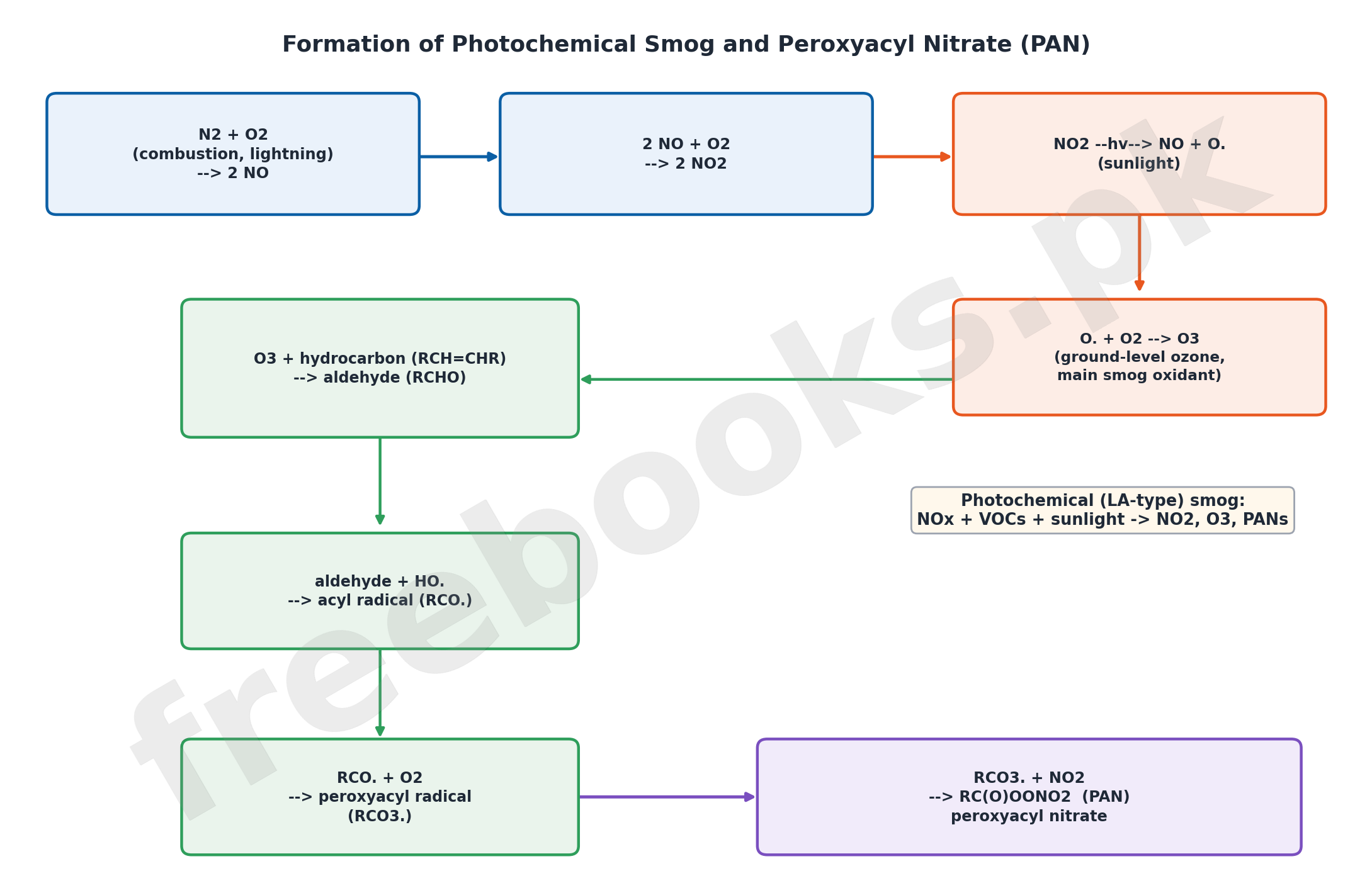
Photochemical (Los Angeles-type) smog forms when NOx and volatile organic compounds (VOCs) react in sunlight, producing an oxidizing mixture of photochemical oxidants including NO2, ozone, and peroxyacyl nitrates (PANs); it is becoming more common than classical (London-type) smog as NOx emissions rise. The formation sequence begins with N2 and O2 reacting (from combustion or lightning) to form NO, which is further oxidized by O2 to NO2; sunlight then photolyzes NO2 back into NO plus an oxygen atom, which combines with O2 to form ground-level ozone (O3), the main oxidant driving the rest of the smog chemistry.
Peroxyacyl nitrates (PANs) form when ozone oxidizes a hydrocarbon to an aldehyde, which reacts with a hydroxyl radical to form an acyl radical; this acyl radical then reacts with O2 to form a peroxyacyl radical, which finally reacts with NO2 to form the peroxyacyl nitrate itself, RC(O)OONO2 (in peroxyacetyl nitrate specifically, R = CH3). This mechanism explains directly why NO and NO2, together with unburned hydrocarbons and sunlight, are essential ingredients of photochemical smog.
12.6 Catalytic Converters
A catalytic converter is a ceramic or metallic honeycomb structure coated with a high-surface-area alumina layer, on which the precious metals platinum, palladium, and rhodium are dispersed; these expensive metals can later be recycled. The converter catalyzes three simultaneous redox reactions to remove harmful exhaust gases: a reduction reaction converting NO and CO into N2 and CO2 (2NO + 2CO –Pt/Rh–> N2 + 2CO2), and two oxidation reactions converting remaining CO and unburned hydrocarbons into CO2 and water (2CO + O2 –Pt/Pd–> 2CO2; 2C2H4 + 6O2 –Pt/Pd–> 4CO2 + 4H2O), together turning three harmful pollutants into far less harmful products.
12.7 Nitrification and Denitrification
Nitrification and denitrification are complementary phases of the nitrogen cycle. Nitrification converts ammonium (NH4+) into nitrite (NO2-) and then nitrate (NO3-), carried out by nitrifying bacteria under aerobic conditions (pH 6.5-8.0, 20-30 degrees C); plants absorb these nitrites and nitrates for nutrition since they cannot assimilate atmospheric nitrogen directly. Denitrification reverses this, converting nitrate back through nitrite, NO, and N2O into N2 gas released to the atmosphere, carried out by denitrifying bacteria under anaerobic conditions (pH 7.0-9.0, 26-38 degrees C); it is important in wastewater treatment and, together with the Anammox process (which oxidizes NH4+ with NO2- to form N2 gas directly), supports healthy aquatic ecosystems.
12.8 Sulfur: Physical Properties, Reactivity, and Oxidation States
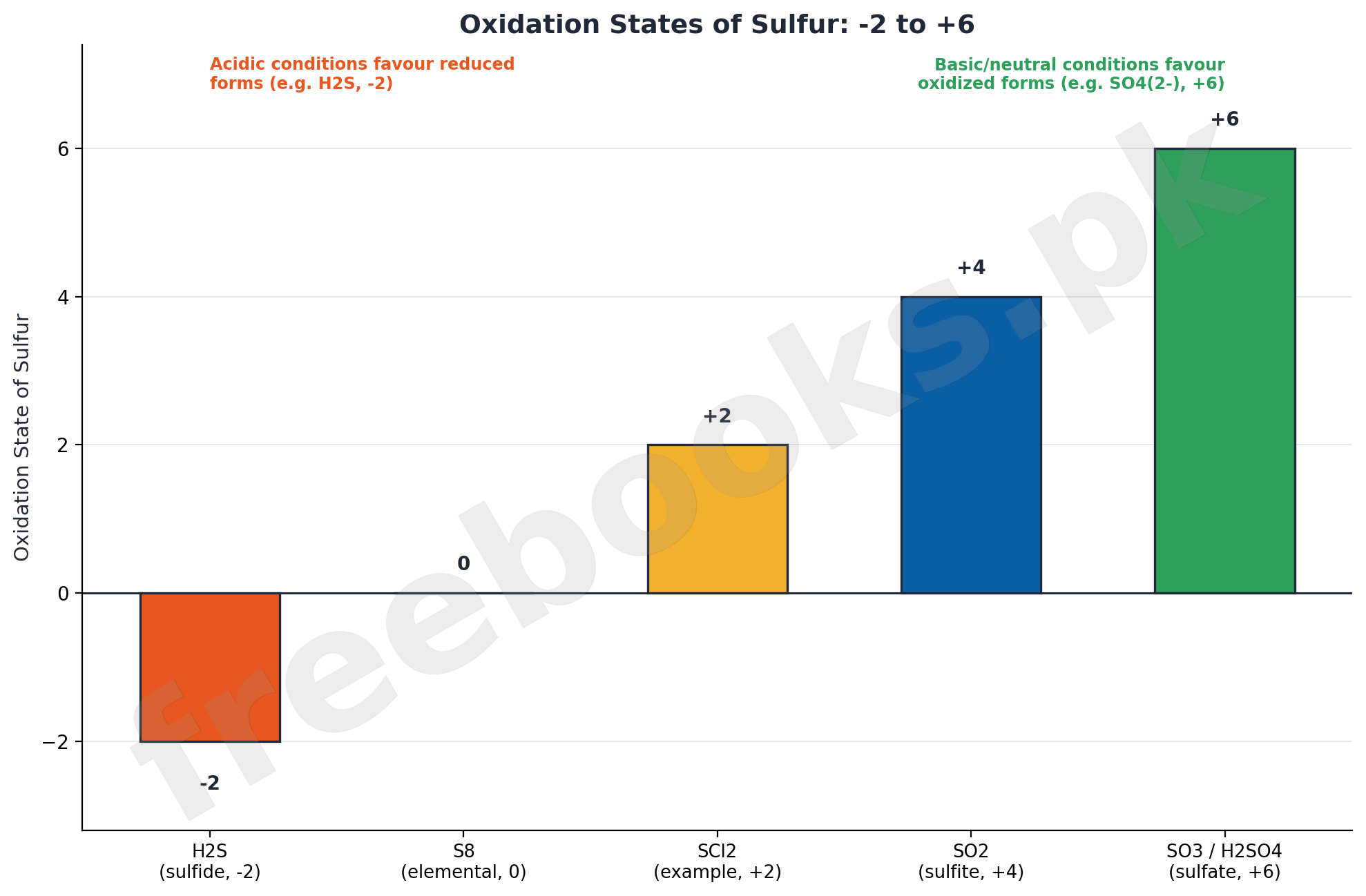
Sulfur (group 16, the chalcogen family, [Ne] 3s2 3p4) usually forms single S-S bonds rather than double bonds because of poor p-orbital overlap between larger sulfur atoms, leading it to catenate into larger structures; its most common form is S8, a crown-shaped ring of eight sulfur atoms. Sulfur displays oxidation states of -2, 0, +2, +4, and +6, determined by how many unpaired electrons are available: unlike oxygen, sulfur's third shell has accessible d-orbitals, allowing it to become excited into states with 4 or 6 unpaired electrons and giving oxidation states of +4 (as in SO2) and +6 (as in SO3, which requires more energy to form).
The relative stability of sulfur's oxidation states depends on several factors: under acidic conditions, reduced forms like H2S (-2) are more stable, while under basic or neutral conditions, oxidized forms like SO4^2- (+6) are more stable in water; thermodynamically, sulfur(+6) as SO3 is the most stable form, but kinetic limitations often prevent it from forming readily at ordinary temperatures, making sulfur(+4) as SO2 the more commonly observed form; the nature of the compound and its bonding environment matters too, since SO4^2- is kinetically stabilized in acidic environments by strong O-S bonds; and catalysts, such as vanadium in the Contact Process, can significantly speed up the formation of a particular oxidation state such as SO3.
12.9 Reactions and Uses of Sulfur
Sulfur is unreactive toward water, dilute non-oxidizing acids, and noble gases under normal conditions, but combines readily with many elements: it burns in air with a blue flame to form SO2 (with SO3 requiring higher temperature and a catalyst), can be oxidized by nitric acid to H2SO4 and NO2, acts as an oxidizing agent toward less electronegative metals such as silver, mercury, and copper to tarnish them with a metal sulfide coating, converts cyanide into thiocyanate (a pseudohalide), and reacts directly with fluorine to form SF6 (an unreactive gas used as an electrical insulator) or with chlorine to form S2Cl2 and then SCl2.
Industrially and domestically, sulfur is used to vulcanize rubber by forming disulfide (S-S) cross-links between polymer chains, which strengthens the rubber; as a soil nutrient supplied via ammonium sulfate, elemental sulfur, sulfur-coated urea, or gypsum fertilizer; and as an ingredient in gunpowder (a blend of 75% potassium nitrate, 15% charcoal, and 10% sulfur, in which nitrate is the oxidizer, charcoal the main fuel, and sulfur an additional fast-burning fuel). Sulfur is also central to organic synthesis, forming carbon-sulfur bonds in thiols, thioethers, sulfoxides, and sulfones found in sulfa drugs such as penicillins and the sulfoxide-containing drug omeprazole, in sulfur dyes made by thionating nitro- or amino-containing organic compounds, and in mercaptans and thiols used as odorants (giving natural gas its smell) and fragrances.
12.10 Sulfuric Acid: Contact Process, Properties, and Applications
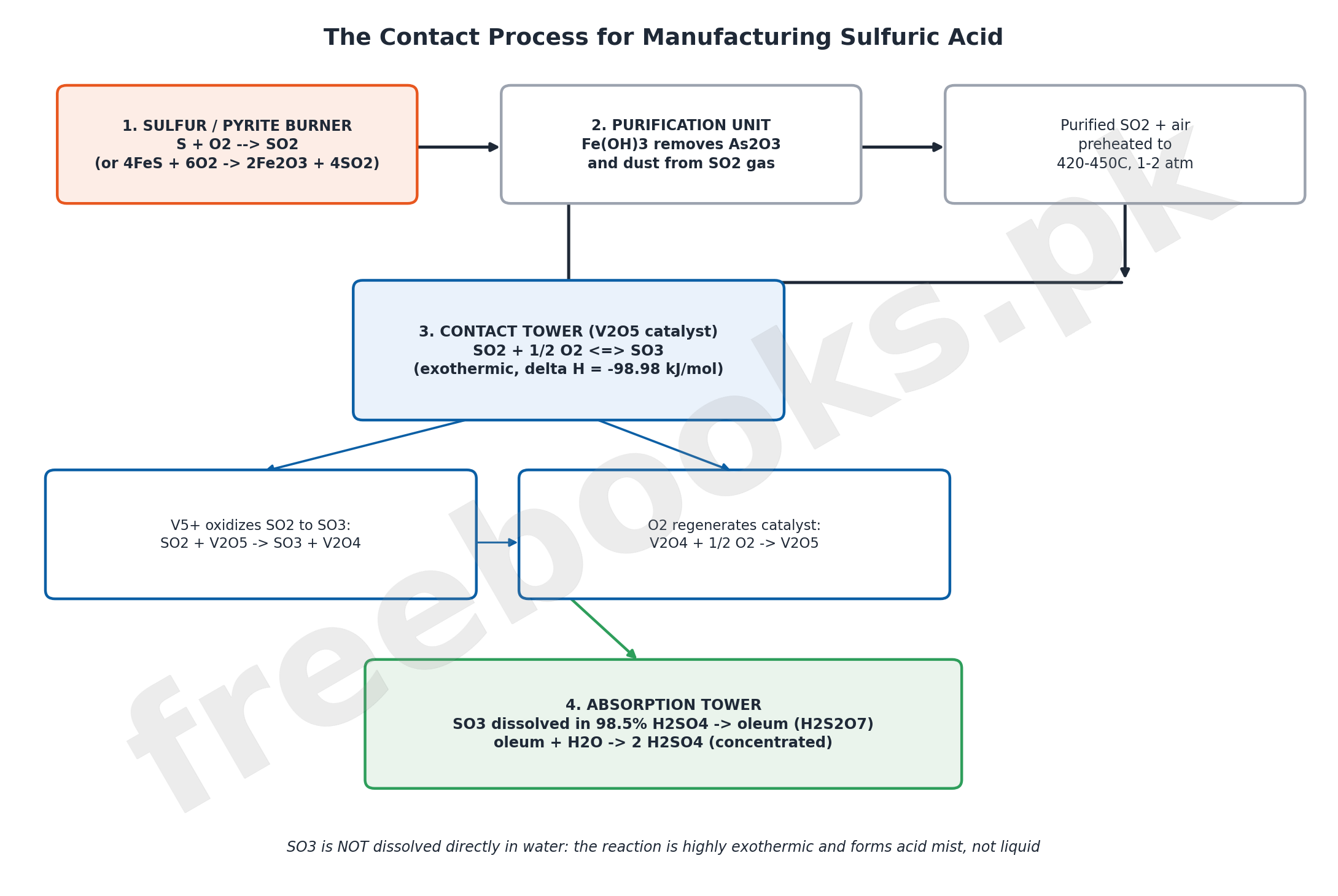
About 85% of sulfur produced is used to manufacture sulfuric acid (H2SO4), a tetrahedral molecule with two S-O and two S=O bonds, via the Contact Process. The process begins by burning molten sulfur or roasting iron pyrite in excess air to form SO2; if pyrite is the source, the gas is purified (an arsenic purifier using gelatinous Fe(OH)3 removes contaminating As2O3); the purified SO2 and preheated air (420-450 degrees C, 1-2 atm) then pass over a vanadium pentoxide (V2O5) catalyst in the contact tower, where SO2 + 1/2 O2 <=> SO3 (V2O5 first oxidizes SO2 to SO3 while being reduced to V2O4, then is reoxidized back to V2O5 by O2); finally, in the absorption tower, SO3 is dissolved in recirculating 98.5% sulfuric acid (not water directly, since that reaction is dangerously exothermic and produces acid mist rather than liquid) to form oleum (fuming sulfuric acid, H2S2O7), which is then diluted with water to give concentrated H2SO4 of adjustable strength.
Sulfuric acid is a colourless, odourless, hygroscopic, highly corrosive, and very polar liquid; it self-ionizes (autoprotolysis) and is a strong acid in its first ionization (pKa1 = -2) but a much weaker acid in its second ionization to give sulfate (pKa2 = 1.92, as HSO4-). Concentrated sulfuric acid is a powerful dehydrating agent, removing water from sucrose, starch, wood, and paper to leave carbon, and dehydrating ethanol to ethene; it reacts with NaCl to release HCl gas, reacts with reactive metals (above hydrogen in the electrochemical series) in dilute form to release H2 gas, and in hot concentrated form acts as a moderate oxidizing agent capable of oxidizing metals like copper, releasing SO2. Sulfuric acid's major industrial uses include fertilizer manufacture (digesting phosphate rock and reacting with ammonia to make ammonium sulfate), metal extraction, catalysis in oil and coal refining and polymer manufacture, paper production, pesticide and dye manufacture, explosive nitration (TNT, nitroglycerine), sugar processing, TiO2 pigment production, industrial gas drying, and lead-acid batteries, making it one of the most widely produced industrial chemicals in the world.
Important Definitions
Why is nitrogen gas (N2) so unreactive?
Because its two atoms are held together by a strong, non-polar triple bond with a bond enthalpy of +944 kJ/mol, requiring a very large amount of energy to break before new bonds can form.
What is the basicity constant (Kb) of ammonia?
Kb = 1.8 x 10^-5, a small value that shows ammonia is a weak base because its equilibrium with water lies far toward the unreacted ammonia side.
What is the shape of the ammonium ion (NH4+), and why does it differ from ammonia's shape?
The ammonium ion is tetrahedral, with four equal N-H bonds; this differs from ammonia's pyramidal shape because nitrogen's lone pair, which caused the pyramidal distortion in NH3, is used to form the fourth N-H bond in NH4+.
What are NOx gases?
The collective name for nitric oxide (NO) and nitrogen dioxide (NO2), the two nitrogen oxides most responsible for photochemical smog and related atmospheric pollution.
What is a catalytic converter?
A ceramic or metallic honeycomb device coated with platinum, palladium, and rhodium on a high-surface-area alumina layer, which catalyzes redox reactions converting harmful exhaust gases (CO, NO, hydrocarbons) into CO2, N2, and water.
What is nitrification?
The conversion of ammonium (NH4+) into nitrite (NO2-) and then nitrate (NO3-) by nitrifying bacteria under aerobic conditions, making nitrogen available for plant nutrition.
What is denitrification?
The conversion of nitrate (NO3-) back through nitrite, NO, and N2O into nitrogen gas (N2), carried out by denitrifying bacteria under anaerobic conditions.
Why does sulfur form S8 rings instead of double bonds like oxygen?
Sulfur atoms are larger than oxygen atoms, giving poorer p-orbital overlap for pi bonding, so sulfur instead catenates through single S-S bonds, forming the crown-shaped eight-membered S8 ring as its most stable structure.
What is oleum?
Fuming sulfuric acid, formed by dissolving sulfur trioxide (SO3) in concentrated (98.5%) sulfuric acid; it is diluted with water in a controlled way to produce concentrated sulfuric acid of adjustable strength.
Why is sulfuric acid described as a 'king of chemicals'?
Because its production and consumption are used as an indicator of a country's industrial progress, reflecting its enormous range of uses across fertilizers, metal extraction, catalysis, paper, dyes, explosives, food processing, pigments, gas drying, and batteries.
Key Facts and Relations
| Topic | Key Fact / Relation |
|---|---|
| N2 bond enthalpy | +944 kJ/mol (very strong, non-polar triple bond) |
| Basicity of ammonia | NH3 + H2O <=> NH4+ + OH-, Kb = 1.8 x 10^-5 |
| Ammonia from ammonium salt | 2NH4Cl + Ca(OH)2 -> CaCl2 + 2H2O + 2NH3 |
| Photochemical smog: NO/NO2/O3 formation | N2 + O2 -> 2NO; 2NO + O2 -> 2NO2; NO2 –hv–> NO + O.; O. + O2 -> O3 |
| PAN formation | RCO3. + NO2 -> RC(O)OONO2 (peroxyacyl nitrate) |
| Catalytic converter (reduction) | 2NO + 2CO –Pt/Rh–> N2 + 2CO2 |
| Sulfur oxidation states | -2, 0, +2, +4, +6 (d-orbitals allow +4 and +6 via excitation) |
| Contact Process (SO2 to SO3) | SO2 + 1/2 O2 <=> SO3 (V2O5 catalyst), delta H = -98.98 kJ/mol |
| Absorption tower (oleum) | H2SO4 + SO3 -> H2S2O7 (oleum); H2S2O7 + H2O -> 2H2SO4 |
| Sulfuric acid ionization | H2SO4 <=> H3O+ + HSO4- (pKa1 = -2); HSO4- <=> H3O+ + SO4^2- (pKa2 = 1.92) |
Diagrams
The Contact Process for Manufacturing Sulfuric Acid: A flow diagram of the four stages of the Contact Process: the sulfur/pyrite burner, purification unit, contact tower with V2O5 catalyst regeneration cycle, and absorption tower producing oleum and concentrated sulfuric acid
Oxidation States of Sulfur: A bar chart showing sulfur's oxidation states from -2 (H2S) to +6 (SO3/H2SO4), illustrating how acidic conditions favour reduced forms and basic or neutral conditions favour oxidized forms
Formation of Photochemical Smog and Peroxyacyl Nitrate (PAN): A step-by-step flow diagram showing how NO, NO2, and ground-level ozone form from nitrogen and oxygen in sunlight, and how ozone then reacts with hydrocarbons through a series of radical intermediates to form PAN
Short Questions & Answers
Why is nitrogen gas used to create an inert atmosphere for storing flammable cargo such as hydrocarbons and edible oils?
Nitrogen's strong, non-polar triple bond makes it extremely unreactive under ordinary conditions, so it does not support combustion or react with the stored material; blanketing flammable cargo with nitrogen displaces oxygen and moisture from the storage space, removing the conditions needed for a fire or oxidative spoilage to start.
Why is ammonia classified as a weak base rather than a strong base?
When ammonia dissolves in water it establishes the equilibrium NH3 + H2O <=> NH4+ + OH-, but this equilibrium lies far toward the left, as reflected in its small basicity constant, Kb = 1.8 x 10^-5; because only a small fraction of dissolved ammonia molecules actually accept a proton to form ammonium and hydroxide ions at any given time, ammonia solutions are only weakly basic.
Why does the ammonium ion (NH4+) have a tetrahedral shape while the ammonia molecule (NH3) is pyramidal?
Ammonia's shape is pyramidal because nitrogen's lone pair of electrons occupies one of the four positions around the nitrogen atom, distorting the molecule away from a symmetrical shape; when this lone pair is used to accept a proton and form a fourth N-H bond in the ammonium ion, all four positions around nitrogen become equivalent bonding pairs, giving the ion a fully symmetrical tetrahedral shape.
Why is heating an ammonium salt with a base used as a standard test for ammonium ions in salt analysis?
This acid-base reaction reliably displaces ammonia gas from any ammonium salt, and ammonia gas has two easily observable diagnostic properties: a strong, distinctive pungent smell, and the ability to turn moistened red litmus paper blue because of its basicity; the simultaneous appearance of both signs upon heating a suspected ammonium compound with a base provides clear, unambiguous confirmation of ammonium's presence.
Why does the conversion of NO and CO into N2 and CO2 in a catalytic converter count as a reduction reaction?
In the reaction 2NO + 2CO -> N2 + 2CO2, the nitrogen in NO, which starts with a positive oxidation state, ends up in N2 with an oxidation state of zero, meaning nitrogen has gained electrons and been reduced; this reduction of NO to harmless N2 gas is precisely the transformation the catalytic converter's platinum/rhodium catalyst is designed to promote.
Why does sulfur typically form single S-S bonds and catenate into rings like S8, rather than forming double bonds the way oxygen does in O2?
Sulfur atoms are considerably larger than oxygen atoms, which weakens the sideways overlap of their p-orbitals needed to form a strong pi bond; because this poor orbital overlap makes double-bond formation energetically unfavourable for sulfur, it instead forms a series of single S-S sigma bonds, catenating into stable ring structures such as the eight-membered crown-shaped S8 molecule.
Why are reduced sulfur species like H2S more stable under acidic conditions, while oxidized species like SO4^2- are more stable under basic or neutral conditions?
The relative stability of different sulfur oxidation states in water depends strongly on pH, because the availability of protons and hydroxide ions shifts the equilibria between sulfur species; under acidic conditions, an abundance of protons favours the reduced, less oxygenated form (H2S, -2 state), while under basic or neutral conditions, favourable conditions for the highly oxygenated sulfate ion make SO4^2- (+6 state) the thermodynamically preferred species.
Why is sulfur trioxide not dissolved directly in water during the Contact Process?
The reaction between SO3 and water is extremely exothermic, and rather than forming a manageable liquid solution, the heat released causes the sulfuric acid product to form as a fine, difficult-to-collect acidic mist or vapour instead; to avoid this problem, SO3 is instead dissolved in recirculating concentrated (98.5%) sulfuric acid to form oleum, which can then be safely and controllably diluted with water to give concentrated sulfuric acid.
Why is hot, concentrated sulfuric acid able to oxidize copper, even though sulfuric acid is not generally regarded as a strong oxidizing agent?
The sulfate ion (SO4^2-) itself is only weakly oxidizing because of its high stability, which is why sulfuric acid is not classified as a typical strong oxidizing agent; however, under hot and concentrated conditions, the high temperature, high concentration of protons, and generation of nascent oxygen combine to give the acid enough oxidizing power to oxidize a moderately unreactive metal like copper, releasing SO2 gas in the process.
Why is concentrated sulfuric acid effective at dehydrating sucrose to leave behind a black carbon residue?
Concentrated sulfuric acid is strongly hygroscopic and has a powerful chemical affinity for water molecules; when applied to sucrose, it forcibly removes the hydrogen and oxygen atoms from the sugar molecule in the same 2:1 ratio as water, releasing them as steam and leaving behind only the carbon skeleton of the original sucrose molecule as a black, porous solid.
Long Questions & Answers
Explain how oxides of nitrogen contribute to the formation of photochemical smog and peroxyacyl nitrates (PANs), describing the full reaction sequence from nitrogen and oxygen to the final PAN product.
How does nitric oxide (NO) first form in the atmosphere, and how is it converted to nitrogen dioxide (NO2)?
Nitric oxide forms when atmospheric nitrogen and oxygen react at the high temperatures generated by combustion in vehicle engines and power plants, or by lightning strikes, via N2 + O2 -> 2NO; this NO is then further oxidized by more atmospheric oxygen, 2NO + O2 -> 2NO2, converting it into the reddish-brown nitrogen dioxide that gives photochemical smog its characteristic haze.
How does sunlight convert NO2 into ground-level ozone (O3)?
Sunlight supplies enough energy to photolyze (break apart) the NO2 molecule, NO2 –hv–> NO + O., regenerating NO and releasing a highly reactive oxygen atom; this oxygen atom immediately combines with molecular oxygen in the air, O. + O2 -> O3, producing ground-level ozone, which is itself a major component and oxidant of photochemical smog.
How does ozone initiate the formation of an aldehyde from an unburned hydrocarbon?
Ground-level ozone is highly reactive and readily attacks the carbon-carbon double bonds present in unburned volatile organic compounds (VOCs) released from vehicle exhaust and other sources, oxidatively cleaving the hydrocarbon; this oxidation converts the hydrocarbon into a smaller aldehyde molecule (RCHO), the first organic intermediate on the pathway toward PAN formation.
What sequence of radical intermediates leads from the aldehyde to the peroxyacyl radical?
The aldehyde reacts with a hydroxyl radical (HO.), a highly reactive species present in the atmosphere, to form an acyl radical (RCO.); this acyl radical then reacts rapidly with molecular oxygen to form a peroxyacyl radical (RCO3.), the final reactive intermediate before PAN itself is formed.
How is the final PAN molecule formed, and why does this make NOx central to PAN formation?
The peroxyacyl radical reacts directly with nitrogen dioxide, RCO3. + NO2 -> RC(O)OONO2, to form the peroxyacyl nitrate (PAN) product; because NO2 is required as the direct reactant in this final step, and NO/NO2 are also essential to generating the ozone that starts the whole sequence, oxides of nitrogen are involved at multiple stages of PAN formation, making NOx emissions a central driver of photochemical smog toxicity.
Describe the industrial production of sulfuric acid by the Contact Process, and explain how each stage is designed to maximize yield, purity, and safety.
What happens in the first stage of the Contact Process, and what determines which raw material is used?
The process begins by burning molten sulfur directly in air, S + O2 -> SO2, or, if pyrite ore is the sulfur source instead, by roasting iron pyrite in excess air, 4FeS + 6O2 -> 2Fe2O3 + 4SO2; either route produces the sulfur dioxide gas that is the essential starting material for the rest of the process.
Why is a purification unit needed when pyrite ore is used as the sulfur source, and how does it work?
SO2 gas produced from roasting pyrite ore often contains contaminants such as dust particles, vapours, and arsenic oxide (As2O3), which can poison or reduce the efficiency of the vanadium pentoxide catalyst used later in the process; an arsenic purifier containing gelatinous ferric hydroxide, Fe(OH)3, absorbs the arsenic oxide contaminant, As2O3 + 2Fe(OH)3 -> 2FeAsO3 + 3H2O, protecting the catalyst downstream.
How does the vanadium pentoxide (V2O5) catalyst convert SO2 into SO3 in the contact tower?
The catalyst works through a two-step redox cycle: first, V5+ in V2O5 oxidizes SO2 to SO3 while itself being reduced to V2O4, SO2 + V2O5 -> SO3 + V2O4; then, atmospheric oxygen reoxidizes the V2O4 back to V2O5, V2O4 + 1/2 O2 -> V2O5, regenerating the catalyst so it can repeat the cycle indefinitely without being consumed.
Why is SO3 not simply dissolved directly in water in the absorption tower?
Dissolving SO3 directly in water is an extremely exothermic reaction that generates so much heat so quickly that the product forms as a fine, hard-to-collect corrosive acid mist rather than a controllable liquid solution; to avoid this hazard, SO3 is instead dissolved in recirculating hot, concentrated (98.5%) sulfuric acid, a much safer and more controllable absorption medium.
How is oleum converted into usable concentrated sulfuric acid of a desired strength?
The SO3 absorbed into concentrated sulfuric acid first forms oleum (fuming sulfuric acid, H2S2O7), via H2SO4 + SO3 -> H2S2O7; this oleum is then reacted with a carefully controlled, measured amount of water, H2S2O7 + H2O -> 2H2SO4, which safely converts it into concentrated sulfuric acid, and by controlling how much water is added, the final concentration of the acid can be precisely adjusted to the desired industrial specification.
Multiple Choice Questions (MCQs)
What is the bond enthalpy of the N2 triple bond, and why is this significant? (A) +436 kJ/mol; it makes nitrogen moderately reactive (B) +944 kJ/mol; it makes nitrogen highly unreactive (C) +150 kJ/mol; nitrogen reacts readily at room temperature (D) +944 kJ/mol; but nitrogen is still highly reactive due to polarity
Correct answer: (B) +944 kJ/mol; it makes nitrogen highly unreactive. The N2 triple bond has a bond enthalpy of +944 kJ/mol, an unusually high value that requires a large energy input to break, which combined with the bond's non-polarity makes nitrogen gas highly unreactive under ordinary conditions.
Ammonia dissolves in water to form an equilibrium with ammonium and hydroxide ions. What does its small Kb value of 1.8 x 10^-5 indicate? (A) Ammonia is a strong base, fully ionized in water (B) Ammonia is a weak base, with the equilibrium lying mostly toward unreacted NH3 (C) Ammonia does not dissolve in water at all (D) Ammonia is a strong acid in aqueous solution
Correct answer: (B) Ammonia is a weak base, with the equilibrium lying mostly toward unreacted NH3. A small Kb value of 1.8 x 10^-5 shows that only a small fraction of ammonia molecules accept a proton from water at equilibrium, meaning the equilibrium lies far toward the left (unreacted NH3), which is the hallmark of a weak base.
What shape does the ammonium ion (NH4+) adopt, and why does it differ from ammonia's shape? (A) Pyramidal, same as ammonia, since nitrogen's lone pair is unaffected (B) Tetrahedral, because nitrogen's lone pair becomes a fourth bonding pair (C) Linear, because the positive charge repels all bonding pairs into a line (D) Trigonal planar, because nitrogen loses one bond upon ionization
Correct answer: (B) Tetrahedral, because nitrogen's lone pair becomes a fourth bonding pair. Ammonium is tetrahedral because nitrogen's lone pair, which caused ammonia's pyramidal shape, is used to form a fourth N-H bond upon accepting a proton, making all four positions around nitrogen equivalent bonding pairs.
Which nitrogen oxide is primarily responsible for reversibly dimerizing into a colourless form on cooling? (A) N2O (nitrous oxide) (B) NO (nitric oxide) (C) NO2, which dimerizes to colourless N2O4 on cooling (D) N2O5
Correct answer: (C) NO2, which dimerizes to colourless N2O4 on cooling. Reddish-brown NO2 gas reversibly dimerizes to colourless N2O4 on cooling (and reverts to NO2 on heating), a property specifically described for this nitrogen oxide pair.
In a catalytic converter, which combination of reactions occurs simultaneously to remove harmful exhaust gases? (A) Only reduction of NO to N2 (B) Only oxidation of CO to CO2 (C) Reduction of NO (with CO) to N2, plus oxidation of remaining CO and hydrocarbons to CO2 and water (D) Neutralization of all exhaust gases with a base
Correct answer: (C) Reduction of NO (with CO) to N2, plus oxidation of remaining CO and hydrocarbons to CO2 and water. A three-way catalytic converter performs one reduction reaction (2NO + 2CO -> N2 + 2CO2) and two oxidation reactions (oxidizing remaining CO and hydrocarbons to CO2 and water) simultaneously, using platinum, palladium, and rhodium catalysts.
What is the key structural difference that explains why sulfur forms S8 rings while oxygen forms O2 with a double bond? (A) Sulfur atoms are smaller, allowing stronger double bonds (B) Sulfur atoms are larger, giving poorer p-orbital overlap that disfavours double bonds, favouring single-bond catenation instead (C) Sulfur has no valence electrons available for pi bonding (D) Oxygen cannot form single bonds under any conditions
Correct answer: (B) Sulfur atoms are larger, giving poorer p-orbital overlap that disfavours double bonds, favouring single-bond catenation instead. Sulfur's larger atomic size gives poorer p-orbital overlap for pi-bond formation compared to oxygen, so sulfur favours single S-S sigma bonds and catenates into ring structures like S8 rather than forming a double-bonded diatomic molecule.
Which set of conditions is most likely to stabilize sulfate (SO4^2-, +6 oxidation state) over hydrogen sulfide (H2S, -2 oxidation state) in aqueous solution? (A) Strongly acidic conditions (B) Basic or neutral conditions (C) Anhydrous, non-aqueous conditions only (D) Very low temperature only, regardless of pH
Correct answer: (B) Basic or neutral conditions. Basic or neutral conditions favour the highly oxidized sulfate ion (SO4^2-, +6), while acidic conditions favour the reduced hydrogen sulfide form (H2S, -2), reflecting how pH shifts the relative stability of sulfur's oxidation states in water.
In the Contact Process, what is the role of the V2O5 catalyst in converting SO2 to SO3? (A) It absorbs SO3 directly into oleum (B) It oxidizes SO2 to SO3 while being reduced to V2O4, then is reoxidized by O2 back to V2O5 (C) It reduces SO3 back into SO2 to control the reaction rate (D) It purifies the gas stream of arsenic contaminants
Correct answer: (B) It oxidizes SO2 to SO3 while being reduced to V2O4, then is reoxidized by O2 back to V2O5. V2O5 works through a two-step cycle: V5+ first oxidizes SO2 to SO3 while itself being reduced to V2O4, and atmospheric O2 then reoxidizes V2O4 back to V2O5, regenerating the catalyst for continued use.
Why is SO3 dissolved in concentrated sulfuric acid rather than water during the absorption stage of the Contact Process? (A) Water is too expensive to use industrially (B) The reaction of SO3 with water is highly exothermic and produces an unmanageable acid mist rather than a liquid (C) SO3 does not dissolve in water at all (D) Sulfuric acid is a better solvent for SO3 due to its higher boiling point alone
Correct answer: (B) The reaction of SO3 with water is highly exothermic and produces an unmanageable acid mist rather than a liquid. Dissolving SO3 directly in water releases so much heat so quickly that a fine corrosive acid mist forms instead of a controllable liquid solution; dissolving SO3 in concentrated sulfuric acid instead (forming oleum) avoids this hazard.
Which best describes sulfuric acid's oxidizing behaviour toward copper metal? (A) Dilute sulfuric acid readily oxidizes copper at room temperature (B) Sulfuric acid never oxidizes any metal under any conditions (C) Hot, concentrated sulfuric acid can moderately oxidize copper, releasing SO2, due to high temperature, high proton concentration, and nascent oxygen formation (D) Copper spontaneously dissolves in cold, dilute sulfuric acid to release hydrogen gas
Correct answer: (C) Hot, concentrated sulfuric acid can moderately oxidize copper, releasing SO2, due to high temperature, high proton concentration, and nascent oxygen formation. Although the stability of the sulfate ion generally makes sulfuric acid a weak oxidizing agent, hot concentrated sulfuric acid becomes a moderately strong oxidizing agent under these specific conditions, capable of oxidizing copper metal while itself being reduced to SO2.
Quick Revision Summary
- Nitrogen (N2): unreactive due to strong (+944 kJ/mol), non-polar N-N triple bond; used for inert atmospheres and blanketing flammable cargo
- Ammonia: Haber-Bosch process (N2 + 3H2 <=> 2NH3); weak Bronsted-Lowry base, Kb = 1.8×10^-5; pyramidal NH3 vs tetrahedral NH4+ (lone pair becomes bonding pair)
- Ammonia from ammonium salts: 2NH4Cl + Ca(OH)2 -> CaCl2 + 2H2O + 2NH3 (acid-base reaction, standard test for NH4+)
- Nitrogen oxides: N2O (+1, laughing gas), NO (+2, paramagnetic), NO2/N2O4 (+4, reddish-brown <=> colourless); collectively NOx = NO + NO2
- NOx sources: natural (lightning, volcanoes, forest fires, denitrifying bacteria) vs anthropogenic (vehicle/power plant combustion, chemical plants)
- Photochemical smog: NOx + VOCs + sunlight -> NO2, O3, PANs; sequence: N2+O2->NO -> NO+O2->NO2 -> NO2+hv->NO+O -> O+O2->O3
- PAN formation: O3 + hydrocarbon -> aldehyde -> (+HO.) acyl radical -> (+O2) peroxyacyl radical -> (+NO2) PAN
- Catalytic converter: Pt/Pd/Rh on alumina honeycomb; reduces NO+CO->N2+CO2, oxidizes CO and hydrocarbons to CO2+H2O
- Nitrification (NH4+ -> NO2- -> NO3-, aerobic) vs Denitrification (NO3- -> N2, anaerobic)
- Sulfur: group 16, forms S8 crown rings via catenation (poor p-orbital overlap prevents S=S double bonds)
- Sulfur oxidation states: -2, 0, +2, +4, +6 (d-orbitals allow excitation to +4/+6); acidic favours reduced forms, basic/neutral favours oxidized forms
- Contact Process: S/pyrite burner -> purification (Fe(OH)3 removes As2O3) -> contact tower (V2O5 catalyst, SO2+1/2O2<=>SO3) -> absorption tower (SO3 + conc. H2SO4 -> oleum -> + H2O -> H2SO4)
- Sulfuric acid: strong acid (pKa1=-2) but weak second ionization (pKa2=1.92); autoionizes; powerful dehydrating agent; hot conc. acid is moderate oxidizer
- Sulfur uses: vulcanization (S-S cross-links), fertilizers, gunpowder (KNO3+C+S), sulfa drugs, dyes, fragrances; H2SO4 uses: fertilizers, metal extraction, catalysis, explosives, batteries
Exam Tips
- Remember nitrogen's inertness has TWO causes: high triple-bond enthalpy (kinetic/energy barrier) AND zero bond polarity (no partial charges to attract reagents) — exam questions often ask for both
- For ammonium ion structure questions, always explain the shape change in terms of the lone pair becoming a bonding pair — this is the key mechanistic detail examiners look for
- When tracing photochemical smog/PAN formation, write out the full sequence in order (NO -> NO2 -> O3 -> aldehyde -> acyl radical -> peroxyacyl radical -> PAN) rather than jumping straight to the final equation
- For catalytic converter questions, remember it performs reduction AND oxidation simultaneously — identify which gases are reduced (NO) and which are oxidized (CO, hydrocarbons)
- For sulfur oxidation state questions, connect the number of unpaired electrons (via excitation into d-orbitals) directly to the resulting oxidation state: 2 unpaired = +2, 4 unpaired = +4, 6 unpaired = +6
- For Contact Process questions, always name each of the four stages in order (burner, purification, contact tower, absorption tower) and state why SO3 is absorbed into acid rather than water directly