The halogens (group 17: fluorine, chlorine, bromine, iodine, plus the rare radioactive astatine and tennessine) are a family of highly reactive, similar non-metals that exist as coloured diatomic molecules whose physical state, colour, and volatility change progressively down the group as increasing molecular size strengthens instantaneous dipole-induced dipole (London dispersion) forces. Their bond strength, oxidizing power as elements, and thermal stability as hydrogen halides all follow clear periodic trends (with fluorine as a notable exception in bond strength due to lone-pair repulsion), while halide ions show the opposite trend, becoming progressively stronger reducing agents from fluoride to iodide.
These trends underpin a set of classic qualitative tests: halide ions can be identified by the distinctive colours of their silver halide precipitates and by their differing solubility in aqueous ammonia, and by their differing behaviour with concentrated sulfuric acid, which ranges from simple fume formation with fluoride and chloride to full redox reactions with bromide and iodide. Chlorine additionally demonstrates disproportionation when reacted with cold versus hot sodium hydroxide, and its reaction with water to form the active disinfectant species HOCl and OCl- underlies its widespread use in water purification.
Learning Objectives
- Describe the colours and trends in volatility of chlorine, bromine, and iodine
- Describe the trend in bond strength of halogen molecules
- Interpret the volatility of halogens in terms of instantaneous dipole-induced dipole forces
- Describe the relative reactivity of halogen elements as oxidizing agents
- Describe the reactions of halogens with hydrogen and explain their relative reactivity in these reactions
- Describe the relative thermal stabilities of hydrogen halides and explain these in terms of bond strength
- Describe the relative reactivity of halide ions as reducing agents
- Explain the reactions of halide ions with aqueous silver nitrate and concentrated sulfuric acid
- Describe the reactions of halides with aqueous silver ions followed by aqueous ammonia
- Interpret the reactions of chlorine with cold and hot aqueous sodium hydroxide as disproportionation reactions, and explain the use of chlorine in water purification
Key Concepts
13.1 The Halogen Family: Colours and Physical States
Group 17 elements are called halogens: fluorine (F), chlorine (Cl), bromine (Br), iodine (I), and the rare, radioactive astatine (At) and tennessine (Ts). Halogens exist as diatomic molecules (X2) in all phases and form a group of very reactive, chemically similar non-metals; the name 'halogen' comes from Greek words meaning 'salt-forming'.
At room temperature, fluorine (pale yellow) and chlorine (greenish yellow) are gases, bromine (reddish-brown) is a volatile, corrosive, toxic liquid, and iodine (shiny greyish-black solid) sublimes directly to a violet vapour; colours darken progressively from chlorine to iodine due to changing light absorption from electron transitions within each halogen's molecules.
13.2 Volatility of the Halogens
Volatility decreases from chlorine to iodine (chlorine most volatile, iodine least) due to increasing molecular mass, increasing outer-shell size, and progressively stronger London dispersion (instantaneous dipole-induced dipole, id-id) forces down the group. Since halogens are non-polar, these id-id forces, which depend on molecular size, shape, and polarizability, govern their physical state: small, less polarizable molecules (F2, Cl2) have weak id-id forces, low boiling points, and high volatility, while larger, more polarizable molecules (Br2, I2) have strong id-id forces, high boiling points, and low volatility. Volatility is inversely related to boiling point: stronger intermolecular forces require more energy to separate molecules into the gas phase, giving a lower volatility.
13.3 Bond Strength of Halogen Molecules
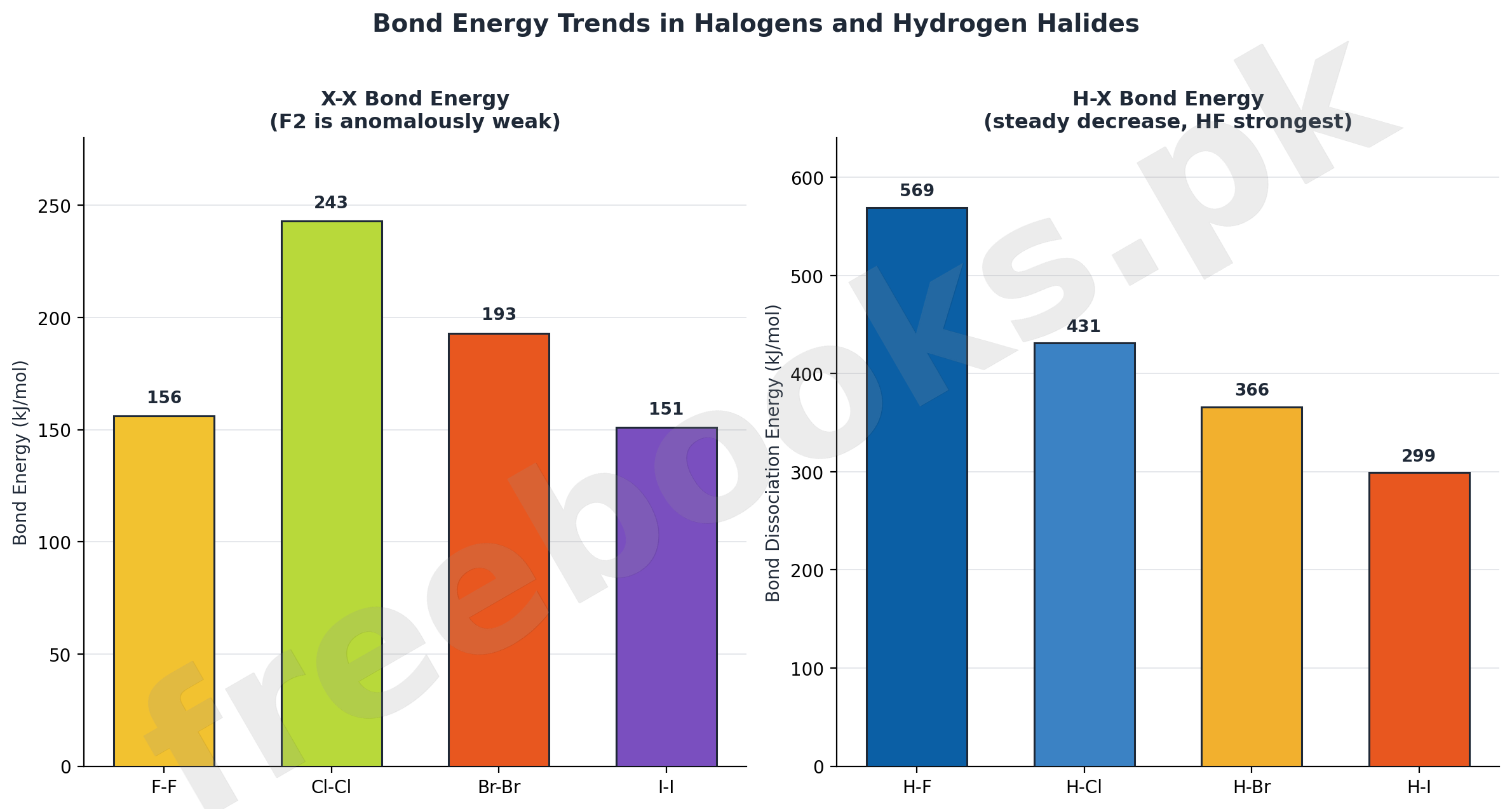
Bond strength in halogens generally decreases down the group from chlorine to iodine, since increasing atomic size gives longer, weaker bonds; however, fluorine is an exception; despite fluorine's very high electronegativity, the F-F bond is relatively weak (156 kJ/mol) because fluorine's very small atomic size causes significant electron-electron repulsion between the lone pairs on the two bonded fluorine atoms, weakening the bond. Chlorine has the strongest X-X bond (243 kJ/mol) among the halogens, with bond energy then decreasing through bromine (193 kJ/mol) to iodine (151 kJ/mol).
13.4 Relative Reactivities of Halogens as Oxidizing Agents
All free halogens act as oxidizing agents toward metals and most non-metals, gaining electrons to form negative halide ions (e.g., 2Na + Cl2 -> 2NaCl). Oxidizing power decreases down the group, F2 > Cl2 > Br2 > I2, reflecting each halogen's decreasing tendency to acquire an electron and form its halide ion; fluorine can oxidize and displace Cl-, Br-, and I- from solution to their free halogens, chlorine can displace Br- and I-, bromine can displace only I-, and iodine cannot displace any halide ion.
This oxidizing power trend correlates with standard electrode potentials E°(X2/X-), which become less positive from fluorine (+2.87 V) to iodine (+0.54 V), and depends on several combined factors: energy of dissociation, electron affinity, hydration energy of the resulting ion, and (for Br2 and I2) heat of vaporization; a halogen with low dissociation energy, high electron affinity, and high hydration energy of its ion will show high oxidizing power.
13.5 Reactions of Halogens with Hydrogen
Halogens react with hydrogen to form hydrogen halides, H2 + X2 -> 2HX, colourless gases that dissolve in water to form hydrohalic acids; reactivity toward hydrogen decreases down the group, F2 > Cl2 > Br2 > I2. Fluorine reacts explosively with hydrogen even at low temperature and in the dark; chlorine reacts readily with hydrogen in UV light or with a spark; bromine reacts with hydrogen only on heating, in an exothermic reaction giving a strong hydrobromic acid on dissolving; and iodine reacts with hydrogen only at high temperature with a catalyst, in a slow, reversible reaction.
13.6 Thermal Stability of Hydrogen Halides
Thermal stability of hydrogen halides decreases down the group, HF > HCl > HBr > HI, directly tracking their decreasing bond dissociation energies (H-F 569 kJ/mol, H-Cl 431 kJ/mol, H-Br 366 kJ/mol, H-I 299 kJ/mol). HF is the most stable because fluorine's high electronegativity and very small atomic radius give strong orbital overlap and a very strong H-F bond; as atomic radius increases down the group (Cl, then Br, then I), orbital overlap with hydrogen becomes progressively poorer, weakening the H-X bond and making the corresponding hydrogen halide progressively less thermally stable, with HI the least stable of the four.
13.7 Relative Reactivity of Halide Ions as Reducing Agents
Reducing power of halide ions increases down the group, opposite to the trend for the elements: I- > Br- > Cl- > F-, because decreasing electronegativity and increasing ionic radius down the group give lower charge density and a greater ease of donating an electron. Fluoride's high electronegativity, strong hold on its extra electron, and small size (high charge density) make it the weakest reducing agent; chloride is a stronger reducing agent than fluoride due to its larger size and lower electronegativity; bromide is stronger still, with a larger ionic radius and lower charge density than chloride; and iodide, with the lowest electronegativity and largest size among the four, is the strongest reducing agent, most easily donating an electron.
13.8 Reactions of Halides with Aqueous Silver Ion and Ammonia
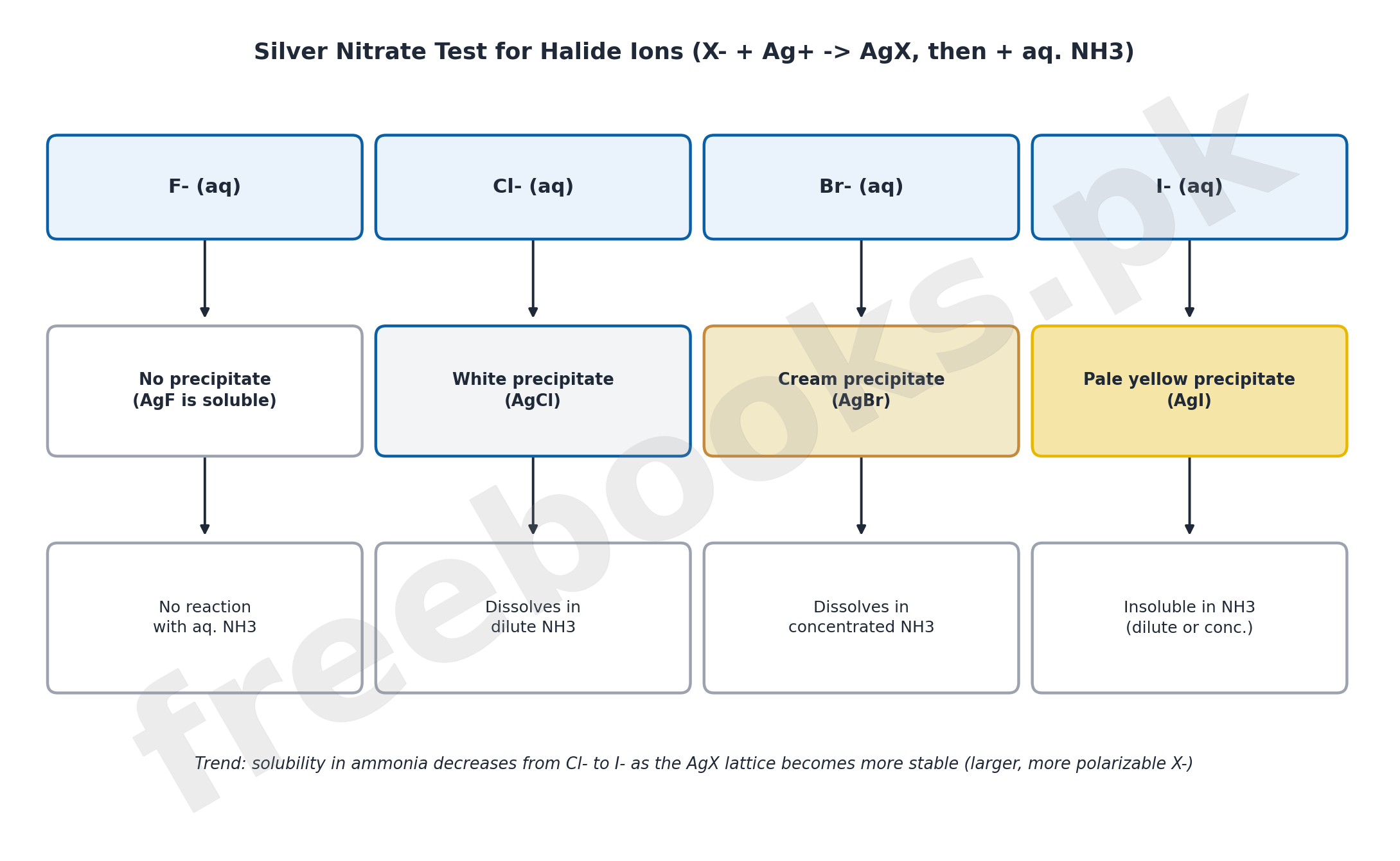
Halide ions react with aqueous silver nitrate to form insoluble silver halides (X- + Ag+ -> AgX), a reaction used in qualitative analysis: F- gives no visible precipitate (AgF is soluble), Cl- gives a white precipitate (AgCl), Br- gives a cream-coloured precipitate (AgBr), and I- gives a yellow precipitate (AgI). Adding aqueous ammonia afterward distinguishes the halides further by testing precipitate solubility: AgF (already soluble, unaffected by ammonia), AgCl dissolves in dilute ammonia to form the colourless diamminesilver(I) complex ([Ag(NH3)2]+ + Cl-), AgBr dissolves only in concentrated ammonia, and AgI remains completely insoluble in ammonia (dilute or concentrated) — together these two steps form the standard silver nitrate test for identifying halide ions.
13.9 Reactions of Halide Ions with Concentrated Sulfuric Acid
The reaction of halide ions with concentrated sulfuric acid changes character down the group as the reducing power of the halide ion increases. Fluoride and chloride, both weak reducing agents, simply produce their hydrogen halide gas by an acid-base (non-redox) reaction (e.g., NaCl + H2SO4 -> NaHSO4 + HCl); bromide, a stronger reducing agent, additionally undergoes a redox side reaction in which HBr reduces H2SO4 to SO2 and is itself oxidized to Br2 (2HBr + H2SO4 -> Br2 + 2SO2 + 2H2O), producing HBr fumes, brown Br2 fumes, and the smell of SO2; and iodide, the strongest reducing agent, reduces H2SO4 all the way to H2S while being oxidized to I2 (8HI + H2SO4 -> 4I2 + H2S + 4H2O), producing HI fumes, purple I2 fumes, and the smell of H2S.
13.10 Disproportionation of Chlorine with Sodium Hydroxide
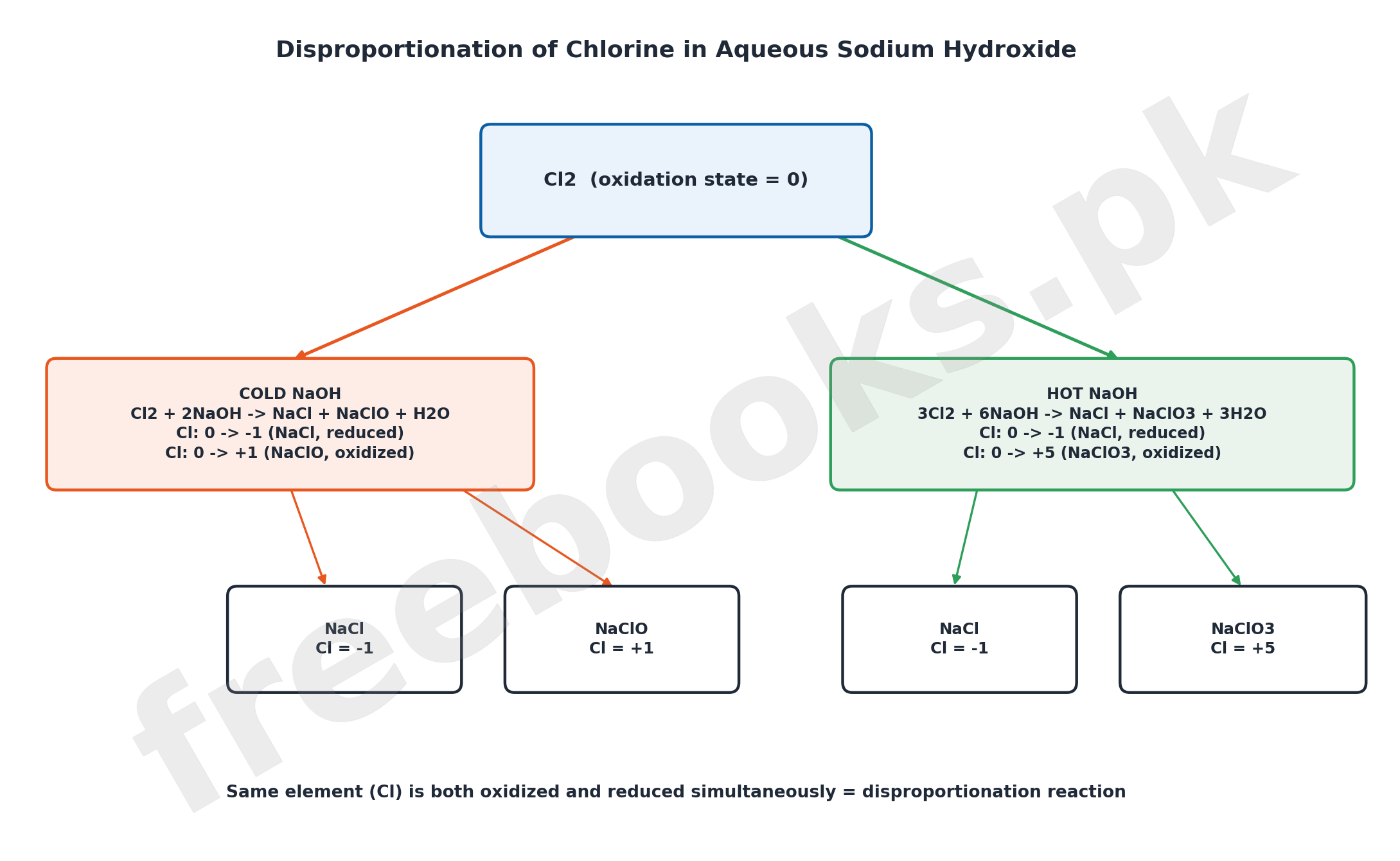
A disproportionation reaction is one in which a single element is simultaneously oxidized and reduced. With cold aqueous NaOH, chlorine disproportionates to sodium chloride and sodium chlorate(I) (Cl2 + 2NaOH -> NaCl + NaClO + H2O), with chlorine's oxidation state changing from 0 in Cl2 to -1 in NaCl (reduction) and to +1 in NaClO (oxidation) simultaneously. With hot aqueous NaOH, chlorine instead disproportionates to sodium chloride and sodium chlorate(V) (3Cl2 + 6NaOH -> NaCl + NaClO3 + 3H2O), with chlorine going from 0 to -1 in NaCl (reduction) and to +5 in NaClO3 (oxidation); this shows how reaction temperature controls which disproportionation products chlorine forms.
13.11 Use of Chlorine in Water Purification
Chlorine is widely used to disinfect drinking water and swimming pool water because, while poisonous in large amounts, small quantities are harmless to humans but lethal to disease-causing bacteria. When chlorine gas is added to water it hydrolyzes to form a mixture of hydrochloric acid and chloric(I) acid (hypochlorous acid), Cl2 + H2O -> HCl + HClO; HClO is a weak acid that partially dissociates to H+ and chlorate(I) (hypochlorite) ion, OCl-, and both HOCl and OCl- are the primary active disinfecting species.
HOCl is the more effective disinfectant of the two because its neutral charge lets it penetrate microorganism cell walls more easily; both HOCl and OCl- oxidize essential cellular proteins, lipids, enzymes, and nucleic acids, disrupting cell function, preventing bacterial replication, and ultimately causing cell death. Disinfection effectiveness depends on pH (HOCl predominates and is more effective around pH 6-7.5, while less-effective OCl- predominates above pH 7.5), chlorine dose (more chlorine gives more active disinfecting species), and contact time (long enough for the disinfectant to penetrate and kill bacteria, viruses, and protozoa); chlorination remains a relatively inexpensive method of water disinfection.
Important Definitions
Why does fluorine's bond enthalpy (F-F) not follow the expected trend for the group?
Fluorine atoms are so small that the lone pairs on each bonded fluorine atom experience significant electron-electron repulsion, which weakens the F-F bond despite fluorine's high electronegativity, making F2's bond energy (156 kJ/mol) anomalously lower than Cl2's (243 kJ/mol).
What is the order of decreasing oxidizing power of the halogens?
F2 > Cl2 > Br2 > I2, reflecting each halogen's decreasing tendency to gain an electron and form its halide ion as the group is descended.
What is the order of increasing reducing power of the halide ions?
F- < Cl- < Br- < I-, the opposite trend to the elements, because decreasing electronegativity and increasing ionic radius down the group make it progressively easier for the halide ion to donate an electron.
What are the colours of the silver halide precipitates?
AgCl is white, AgBr is cream-coloured, and AgI is yellow; AgF does not precipitate because it is soluble in water.
What is a disproportionation reaction?
A reaction in which a single element is simultaneously oxidized and reduced, forming two different products with different oxidation states.
What are the primary active disinfecting species when chlorine is added to water?
Chloric(I) acid (hypochlorous acid, HOCl) and the chlorate(I) (hypochlorite) ion, OCl-, both formed when chlorine hydrolyzes in water.
Why is HOCl a more effective disinfectant than OCl-?
HOCl carries no charge, which allows it to penetrate the cell walls of microorganisms more easily than the negatively charged OCl- ion, making it more effective at reaching and oxidizing essential cellular components.
What is instantaneous dipole-induced dipole (id-id) force?
A weak, temporary intermolecular attractive force (a form of London dispersion force) arising from momentary fluctuations in electron distribution that induce a corresponding dipole in a neighbouring molecule; its strength increases with molecular size and polarizability.
Why does thermal stability of hydrogen halides decrease from HF to HI?
Thermal stability tracks bond dissociation energy directly; as atomic radius increases down the group from fluorine to iodine, orbital overlap between hydrogen and the halogen weakens, giving progressively lower bond dissociation energies and therefore progressively lower thermal stability.
Why is fluoride ion (F-) such a weak reducing agent compared to the other halide ions?
Fluorine's very high electronegativity and fluoride's small ionic size give it a strong hold on its extra electron and a high charge density, both of which make it very difficult for fluoride to donate an electron, so it acts as only a very weak reducing agent.
Key Facts and Relations
| Topic | Key Fact / Relation |
|---|---|
| Order of oxidizing power (halogens) | F2 > Cl2 > Br2 > I2 |
| Order of reducing power (halide ions) | I- > Br- > Cl- > F- |
| Order of thermal stability (hydrogen halides) | HF > HCl > HBr > HI |
| X-X bond energies | F2 = 156, Cl2 = 243, Br2 = 193, I2 = 151 kJ/mol |
| H-X bond dissociation energies | H-F = 569, H-Cl = 431, H-Br = 366, H-I = 299 kJ/mol |
| Standard reduction potential E(X2/X-) | F2 = +2.87 V, Cl2 = +1.36 V, Br2 = +1.07 V, I2 = +0.54 V |
| Silver halide precipitate colours | AgF soluble (no ppt), AgCl white, AgBr cream, AgI yellow |
| Cold NaOH + Cl2 (disproportionation) | Cl2 + 2NaOH -> NaCl + NaClO + H2O (Cl: 0 -> -1 and 0 -> +1) |
| Hot NaOH + Cl2 (disproportionation) | 3Cl2 + 6NaOH -> NaCl + NaClO3 + 3H2O (Cl: 0 -> -1 and 0 -> +5) |
| Chlorine hydrolysis in water | Cl2 + H2O -> HCl + HClO (active disinfectants: HOCl and OCl-) |
Diagrams
Bond Energy Trends in Halogens and Hydrogen Halides: Two side-by-side bar charts comparing X-X bond energies (showing fluorine's anomalous weakness) and H-X bond dissociation energies (showing a steady decrease from HF to HI) across the halogen group
Silver Nitrate Test for Halide Ions: A flow diagram showing the silver halide precipitate colour and subsequent ammonia solubility for each halide ion, the standard qualitative test used to identify F-, Cl-, Br-, and I-
Disproportionation of Chlorine in Aqueous Sodium Hydroxide: A flow diagram comparing the cold and hot NaOH reactions of chlorine, tracking the oxidation state of chlorine in each product to show the simultaneous oxidation and reduction that defines disproportionation
Short Questions & Answers
Why does volatility decrease from chlorine to iodine down the halogen group?
As the halogen group is descended, molecular mass and the size of the outer electron shell both increase, which strengthens the instantaneous dipole-induced dipole (London dispersion) forces between molecules; because stronger intermolecular forces require more energy to separate molecules from the liquid or solid phase into the gas phase, volatility decreases steadily from chlorine through bromine to iodine.
Why is the F-F bond weaker than the Cl-Cl bond, even though fluorine is the most electronegative element?
Bond strength here depends on more than electronegativity; because fluorine atoms are extremely small, the non-bonding lone pairs on each of the two bonded fluorine atoms are forced very close together, creating strong electron-electron repulsion that destabilizes and weakens the F-F bond, an effect that outweighs fluorine's high electronegativity and makes F2's bond energy anomalously low compared to Cl2.
Why does the oxidizing power of the halogens decrease down the group from fluorine to iodine?
Oxidizing power reflects a halogen's ability to gain an electron and be reduced to its halide ion; as the group is descended, atomic size increases and the added electron is captured at a greater distance from the nucleus with more electron shielding, reducing the halogen's overall attraction for that extra electron, so its tendency to be reduced (and therefore its oxidizing power) decreases from fluorine to iodine.
Why does fluorine react explosively with hydrogen even in the cold and dark, while iodine reacts with hydrogen only slowly, reversibly, and with a catalyst?
Fluorine has by far the highest oxidizing power and reactivity among the halogens, and its very weak F-F bond, along with the exceptionally strong H-F bond that forms, makes the reaction with hydrogen highly exothermic and kinetically very fast even without additional activation energy; iodine, by contrast, has the lowest oxidizing power, its I-I bond is comparatively easy to break but the resulting H-I bond is weak, so the reaction proceeds only slowly and reversibly, and needs a catalyst and high temperature to achieve a useful rate.
Why does thermal stability of the hydrogen halides decrease from HF to HI?
Thermal stability of a hydrogen halide is directly determined by the strength of its H-X bond, measured by bond dissociation energy; because atomic radius increases steadily from fluorine to iodine, the overlap between hydrogen's orbital and the halogen's orbital becomes progressively poorer down the group, giving progressively weaker H-X bonds and therefore progressively lower thermal stability, from the strongly bonded and highly stable HF down to the weakly bonded and least stable HI.
Why is iodide ion (I-) the strongest reducing agent among the halide ions?
Iodine has the lowest electronegativity of the common halogens and the iodide ion has the largest ionic radius, giving it the lowest charge density among the halide ions; this low charge density means the extra electron on iodide is held only loosely, making it comparatively easy for iodide to donate that electron to another species, which is exactly what makes it the strongest reducing agent in the group.
Why does silver iodide (AgI) remain insoluble in both dilute and concentrated aqueous ammonia, while silver chloride (AgCl) dissolves even in dilute ammonia?
The solubility of a silver halide in ammonia depends on how strongly the silver and halide ions are held together in the solid lattice compared to how strongly ammonia can compete for the silver ion by forming the diamminesilver(I) complex; AgI has the most stable (least soluble) ionic lattice among the silver halides because iodide's large size and high polarizability favour strong covalent-like interactions with silver, so even concentrated ammonia cannot compete effectively enough to dissolve it, unlike the more ionic and more soluble AgCl lattice.
Why does hydrogen iodide (HI) reduce concentrated sulfuric acid all the way to hydrogen sulfide (H2S), while hydrogen chloride (HCl) does not reduce sulfuric acid at all?
Iodide is a much stronger reducing agent than chloride because of its larger size, lower electronegativity, and lower charge density, giving it a far greater tendency to donate electrons; this greater reducing strength allows HI to reduce sulfur in H2SO4 all the way down from the +6 oxidation state to the -2 oxidation state in H2S, whereas HCl, formed from the much weaker reducing agent chloride, lacks the reducing power to reduce sulfuric acid at all and is simply released as HCl gas.
Why are the reactions of chlorine with cold and hot sodium hydroxide both classified as disproportionation reactions?
In both reactions, chlorine atoms starting at oxidation state 0 in Cl2 end up in two different products with two different oxidation states simultaneously: in the cold reaction, chlorine is reduced to -1 in NaCl and oxidized to +1 in NaClO at the same time, while in the hot reaction, chlorine is reduced to -1 in NaCl and oxidized to +5 in NaClO3 at the same time; because the same starting element is simultaneously oxidized and reduced in each case, both reactions fit the definition of disproportionation.
Why is HOCl considered a more effective disinfectant than OCl- for killing bacteria in water?
HOCl is a neutral, uncharged molecule, which allows it to pass through the cell walls of bacteria far more easily than the negatively charged OCl- ion, which is repelled or blocked more readily by the cell wall; because HOCl can penetrate into the cell interior more effectively, it has greater direct access to oxidize the proteins, lipids, enzymes, and nucleic acids essential to bacterial survival, making it the more potent of the two disinfecting species.
Long Questions & Answers
Explain the trend in oxidizing power of the halogens and the trend in reducing power of the halide ions, and describe how the silver nitrate test and concentrated sulfuric acid reactions can be used to distinguish between the halide ions.
Why does the oxidizing power of the halogens decrease down the group from fluorine to iodine?
Oxidizing power measures how readily a halogen gains an electron to form its halide ion; as atomic size increases down the group, the incoming electron experiences greater shielding and is added at a greater average distance from the nucleus, weakening the halogen's overall pull on that electron, so the tendency to be reduced, and therefore the oxidizing power, decreases steadily from fluorine to iodine.
Why is the trend in reducing power of the halide ions the exact opposite of the trend in oxidizing power of the halogens?
Reducing power measures a halide ion's willingness to lose (donate) an electron, the reverse process of oxidizing power; because ionic radius increases and electronegativity decreases down the group, charge density on the halide ion falls steadily from fluoride to iodide, making it progressively easier for the ion to release its extra electron, so the reducing power of the halide ions increases in the opposite direction (I- > Br- > Cl- > F-) to the oxidizing power of the corresponding elements.
How does the silver nitrate test distinguish between the four halide ions?
Adding aqueous silver nitrate to each halide solution produces a precipitate with a distinctive appearance: no visible precipitate for fluoride (AgF is soluble), a white precipitate for chloride (AgCl), a cream-coloured precipitate for bromide (AgBr), and a yellow precipitate for iodide (AgI); these differing precipitate colours alone can distinguish most of the halide ions from each other.
How does testing the precipitate's solubility in aqueous ammonia add further confirmation?
Following up with aqueous ammonia distinguishes the halides even more precisely by testing how easily each silver halide's ionic lattice can be broken apart by ammonia forming a diamminesilver(I) complex: AgCl dissolves in dilute ammonia, AgBr requires concentrated ammonia to dissolve, and AgI remains completely insoluble in ammonia at any concentration, giving three distinct, unambiguous outcomes.
How does the reaction with concentrated sulfuric acid provide an independent way to distinguish bromide and iodide in particular?
Because bromide and iodide are stronger reducing agents than fluoride and chloride, they trigger visibly different redox side reactions with concentrated sulfuric acid: sodium bromide produces HBr fumes together with brown Br2 fumes and the smell of SO2 (as HBr reduces H2SO4 to SO2), while sodium iodide produces HI fumes together with purple I2 fumes and the smell of H2S (as HI reduces H2SO4 all the way to H2S); these distinct, easily observable colours and smells allow bromide and iodide to be confidently distinguished from each other and from the non-redox fluoride and chloride reactions.
Explain how chlorine's reactions with sodium hydroxide demonstrate disproportionation, and describe how chlorine's chemistry in water underlies its use as a water disinfectant.
What happens to chlorine's oxidation state when it reacts with cold, dilute aqueous sodium hydroxide?
In the reaction Cl2 + 2NaOH -> NaCl + NaClO + H2O, chlorine starts at oxidation state 0 in Cl2 and splits into two different products: one chlorine atom is reduced to oxidation state -1 in NaCl, while the other chlorine atom is oxidized to oxidation state +1 in NaClO, meaning the same starting element is simultaneously reduced and oxidized in a single reaction.
How does the reaction change when hot, concentrated aqueous sodium hydroxide is used instead, and why does this still count as disproportionation?
With hot NaOH, the reaction becomes 3Cl2 + 6NaOH -> NaCl + NaClO3 + 3H2O, and chlorine again splits into two oxidation states from the same starting point of 0: one portion is reduced to -1 in NaCl, while the other portion is oxidized much further, all the way to +5 in NaClO3; because chlorine is still being simultaneously oxidized and reduced from a single starting oxidation state, this reaction is disproportionation as well, just with a more oxidized product favoured at higher temperature.
What happens chemically when chlorine gas is added to water, and what two active species does this produce?
Chlorine gas hydrolyzes in water via Cl2 + H2O -> HCl + HClO, producing hydrochloric acid and chloric(I) acid (hypochlorous acid); the weak acid HClO then partially dissociates further into H+ and chlorate(I) (hypochlorite) ion, OCl-, so the two species responsible for chlorine's disinfecting action in water are HOCl and OCl-.
Why is HOCl generally considered the more effective of these two disinfecting species?
HOCl is electrically neutral, which allows it to pass through the cell walls of bacteria and other microorganisms much more readily than the negatively charged OCl- ion; once inside the cell, HOCl can directly oxidize essential proteins, lipids, enzymes, and nucleic acids, disrupting vital cellular functions and preventing replication, giving it stronger overall disinfecting power than OCl- despite both species being active.
What practical factors determine how effective chlorination is at disinfecting a water supply?
Effectiveness depends on pH (HOCl predominates and disinfection is most effective around pH 6-7.5, while the less effective OCl- predominates above pH 7.5), the dose of chlorine added (more chlorine produces more of the active disinfecting species), and contact time (water must remain in contact with the chlorine disinfectants long enough for them to penetrate and kill bacteria, viruses, and protozoa); all three factors must be adequately controlled for chlorination to reliably disinfect a water supply.
Multiple Choice Questions (MCQs)
Which halogen molecule has the strongest X-X bond? (A) F2 (B) Cl2 (C) Br2 (D) I2
Correct answer: (B) Cl2. Cl2 has the strongest halogen-halogen bond (243 kJ/mol); F2's bond is anomalously weak (156 kJ/mol) due to lone-pair repulsion between the small fluorine atoms, making Cl2, not F2, the strongest in the group.
What happens to the volatility of the halogens as you move down the group from fluorine to iodine? (A) It increases steadily (B) It decreases steadily (C) It remains constant (D) It fluctuates with no clear trend
Correct answer: (B) It decreases steadily. Volatility decreases down the group as increasing molecular size and polarizability strengthen instantaneous dipole-induced dipole (London dispersion) forces, requiring more energy to vaporize the larger halogens.
Which halogen has the strongest oxidizing power? (A) Br2 (B) F2 (C) I2 (D) Cl2
Correct answer: (B) F2. Fluorine (F2) has the strongest oxidizing power among the halogens, decreasing down the group in the order F2 > Cl2 > Br2 > I2.
What is the main reason the thermal stability of hydrogen halides decreases down the group from HF to HI? (A) Increasing electronegativity of the halogen (B) Decreasing bond length between H and X (C) Increasing atomic radius of the halogen, leading to weaker H-X bond overlap (D) Increasing strength of van der Waals forces between HX molecules
Correct answer: (C) Increasing atomic radius of the halogen, leading to weaker H-X bond overlap. As atomic radius increases from fluorine to iodine, orbital overlap between hydrogen and the halogen becomes progressively poorer, weakening the H-X bond and reducing thermal stability, giving the order HF > HCl > HBr > HI.
Which halide ion is the strongest reducing agent? (A) F- (B) Cl- (C) Br- (D) I-
Correct answer: (D) I-. Iodide (I-) is the strongest reducing agent among the halide ions because its low electronegativity and large ionic radius give it the lowest charge density, making it easiest to donate an electron.
A cream-coloured precipitate forms when aqueous silver nitrate is added to a solution. What is this precipitate's solubility in aqueous ammonia? (A) Soluble in dilute ammonia (B) Insoluble in both dilute and concentrated ammonia (C) Soluble only in concentrated ammonia (D) Soluble upon heating with dilute ammonia only
Correct answer: (C) Soluble only in concentrated ammonia. A cream-coloured precipitate indicates silver bromide (AgBr), which is only soluble in concentrated aqueous ammonia, not dilute ammonia.
What is observed when concentrated sulfuric acid is added to solid sodium chloride? (A) Reddish-brown fumes are evolved (B) Purple vapour is evolved (C) Steamy white fumes of hydrogen chloride are evolved (D) A black solid is formed
Correct answer: (C) Steamy white fumes of hydrogen chloride are evolved. NaCl + H2SO4 -> NaHSO4 + HCl is a simple non-redox reaction, producing steamy white fumes of hydrogen chloride gas, with no colour change since chloride is too weak a reducing agent to reduce sulfuric acid further.
In the reaction Cl2 + 2NaOH -> NaCl + NaClO + H2O, what are the oxidation states of chlorine in the two products? (A) -1 in NaCl and +1 in NaClO (B) 0 in NaCl and +1 in NaClO (C) -1 in NaCl and -1 in NaClO (D) +1 in NaCl and -1 in NaClO
Correct answer: (A) -1 in NaCl and +1 in NaClO. Chlorine starts at oxidation state 0 in Cl2 and is simultaneously reduced to -1 in NaCl and oxidized to +1 in NaClO, making this a disproportionation reaction.
Which species is considered the more effective disinfectant in chlorinated water, and why? (A) OCl-, because it is negatively charged and attracts bacteria (B) HOCl, because its neutral charge allows it to penetrate microbial cell walls more easily (C) Cl2 gas itself, because it does not need to dissolve in water (D) NaCl, because it is the most abundant chlorine species in solution
Correct answer: (B) HOCl, because its neutral charge allows it to penetrate microbial cell walls more easily. HOCl is the more effective disinfectant because its neutral charge allows it to penetrate bacterial cell walls more easily than the negatively charged OCl- ion, giving it greater access to oxidize essential cellular components.
Which reaction with concentrated sulfuric acid indicates the strongest reducing power among the halide ions tested? (A) NaF + H2SO4 -> NaHSO4 + HF (B) NaCl + H2SO4 -> NaHSO4 + HCl (C) 2HBr + H2SO4 -> Br2 + 2SO2 + 2H2O (D) 8HI + H2SO4 -> 4I2 + H2S + 4H2O
Correct answer: (D) 8HI + H2SO4 -> 4I2 + H2S + 4H2O. Iodide's reaction reduces sulfur all the way from +6 in H2SO4 to -2 in H2S, a far greater degree of reduction than bromide achieves (reducing sulfur only to +4 in SO2), demonstrating iodide's superior reducing power.
Quick Revision Summary
- Halogens = group 17: F, Cl, Br, I (common), At, Ts (rare, radioactive); exist as diatomic X2 molecules, colours darken F<Cl<Br<I
- Volatility decreases down group (Cl > Br > I) due to increasing molecular size/mass strengthening London dispersion (id-id) forces
- X-X bond energy: Cl2 (243) > Br2 (193) > F2 (156) > I2 (151) — F2 anomalously weak due to lone-pair repulsion (small atoms)
- Oxidizing power of halogens: F2 > Cl2 > Br2 > I2; each can displace halide ions below it from solution
- Reactivity with H2: F2 (explosive, cold/dark) > Cl2 (UV/spark) > Br2 (heat) > I2 (catalyst, slow, reversible)
- Thermal stability of HX: HF > HCl > HBr > HI, tracks H-X bond dissociation energy (569, 431, 366, 299 kJ/mol)
- Reducing power of halide ions (opposite trend): I- > Br- > Cl- > F-, due to decreasing electronegativity/increasing size down group
- AgNO3 test: AgF soluble (no ppt), AgCl white (soluble dil. NH3), AgBr cream (soluble conc. NH3), AgI yellow (insoluble in NH3)
- Conc. H2SO4 + halide: F-/Cl- give simple HX fumes (no redox); Br- gives HBr + Br2 + SO2 (redox); I- gives HI + I2 + H2S (stronger redox)
- Disproportionation: Cl2 + cold NaOH -> NaCl (-1) + NaClO (+1); Cl2 + hot NaOH -> NaCl (-1) + NaClO3 (+5)
- Chlorine in water: Cl2 + H2O -> HCl + HClO; active disinfectants = HOCl and OCl-; HOCl more effective (neutral, penetrates cell walls)
- Disinfection factors: pH (HOCl favoured pH 6-7.5, OCl- above 7.5), chlorine dose, contact time
Exam Tips
- Remember fluorine breaks the 'smooth trend' pattern twice: it has the strongest oxidizing power AND lowest X-X bond energy relative to chlorine — don't assume bond strength and reactivity always move together
- Keep the oxidizing power trend (F2>Cl2>Br2>I2) and reducing power trend (I->Br->Cl->F-) straight — they run in opposite directions because one is about the element gaining an electron and the other is about the ion losing one
- For AgNO3/NH3 test questions, memorize the precipitate colour AND its ammonia solubility together as a pair (e.g. 'cream = concentrated ammonia') rather than separately
- For concentrated H2SO4 + halide reactions, remember only Br- and I- trigger true redox side-reactions (extra fumes/smell); F- and Cl- just give simple HX gas with no redox
- For disproportionation questions, always write out the oxidation state of the element in every species (reactant and all products) before deciding which reaction is oxidation and which is reduction
- When explaining why chlorine is used for disinfection, mention both active species (HOCl and OCl-) and always state WHY HOCl is more effective (neutral charge, easier cell penetration) rather than just naming it