
Every chemical property traces back to how electrons are arranged inside an atom, and this chapter builds that picture from the ground up. It starts with the atom's three fundamental particles — protons, neutrons and electrons — and how counting them from atomic number and mass number lets us describe both neutral atoms and ions, before turning to the experimental evidence, atomic spectra and successive ionization energies, that first revealed electrons occupy distinct shells rather than being spread randomly around the nucleus.
The second half develops the full quantum-mechanical picture: the four quantum numbers that pinpoint every electron's shell, subshell, orbital, and spin; the characteristic shapes of s, p, and d orbitals; and the three rules, the Aufbau principle, Pauli's exclusion principle, and Hund's rule, that together let us write the electronic configuration of any atom or ion. The chapter closes by connecting this configuration back to the periodic table, to species with unpaired electrons called free radicals, and to a practical application: how doping silicon's electronic configuration creates the P-type and N-type semiconductors used in modern electronics.
Learning Objectives
- Describe protons, neutrons and electrons in terms of their relative charge and relative mass
- Determine the number of protons, neutrons and electrons in atoms and ions from atomic number, mass number and charge
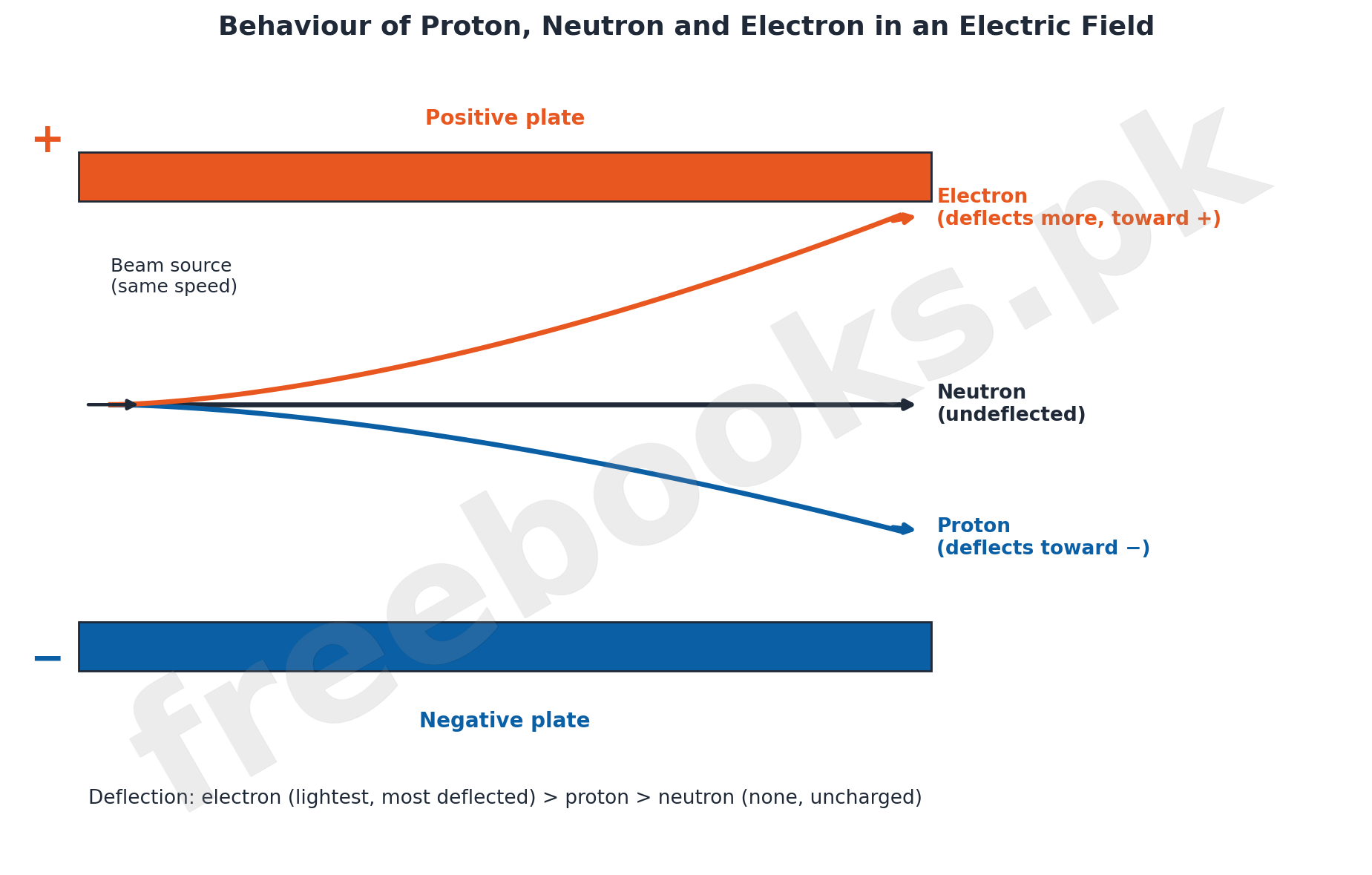
- Describe the behaviour of proton, neutron and electron beams moving through an electric field
- Relate quantum numbers (n, l, m, s) to the electronic distribution of elements
- Account for the variation in successive ionization energies of an element
- Apply the Aufbau principle, Pauli's exclusion principle and Hund's rule to write electronic configurations
- Describe the number of orbitals and electrons that fill s, p, d and f subshells, and the shapes of s, p and d orbitals
- Determine the electronic configuration of atoms and ions from their position in the periodic table
- Describe a free radical as a species with one or more unpaired electrons
- Explain how electronic configuration underlies the formation of P-type and N-type semiconductors
Key Concepts
2.1 Atomic Number, Mass Number, and Particle Counting
Moseley's 1913 X-ray experiments established the atomic number (Z), also called the proton number, as the fundamental identity of an element, related to the mass number (nucleon number, A) by A = Z + N, where N is the number of neutrons. For an atom written as A over Z X, the neutron count is found from N = A – Z; for example, aluminium-27 (mass number 27, atomic number 13) has 13 protons and 27 – 13 = 14 neutrons.
For ions, the proton and neutron counts stay fixed, set by the isotope, but the electron count changes with the charge: a cation has fewer electrons than its neutral atom, equal to the positive charge lost, while an anion has more, equal to the negative charge gained. For example, aluminium-27 loses 3 electrons to form Al3+, leaving 13 – 3 = 10 electrons, while chlorine-35 gains one electron to form Cl-, giving 17 + 1 = 18 electrons — confirming that atomic number and proton number are simply two names for the same concept.
2.2 Fundamental Particles and Behaviour in an Electric Field
Protons, neutrons and electrons differ in charge and mass: the proton carries a relative charge of +1 and a mass of 1.0073 amu, the neutron is uncharged with a very similar mass of 1.0087 amu, and the electron carries a relative charge of -1 but a mass of only about 1/1836 that of a proton. When beams of these particles pass through an electric field at the same speed, neutrons travel straight through undeflected, protons deflect toward the negative plate, and electrons deflect toward the positive plate to a much greater extent, since they are far lighter.
The amount of deflection is described by two related, reciprocal quantities: the angle of deflection is proportional to charge divided by mass, while the radius of the resulting circular path is proportional to mass divided by charge. This behaviour is a direct experimental consequence of each particle's charge-to-mass ratio and is one of the classic pieces of evidence for the existence and properties of subatomic particles.
2.3 Experimental Evidence for Electronic Configuration
Two independent lines of evidence reveal how electrons are arranged in shells: atomic spectra and ionization energies. Each element, when heated or subjected to an electric discharge, emits light at specific wavelengths, its atomic emission spectrum, and absorbs exactly those same wavelengths from white light passed through its vapour, its atomic absorption spectrum — because every element has a unique set of electron energy levels, its spectrum acts as a fingerprint that identifies it.
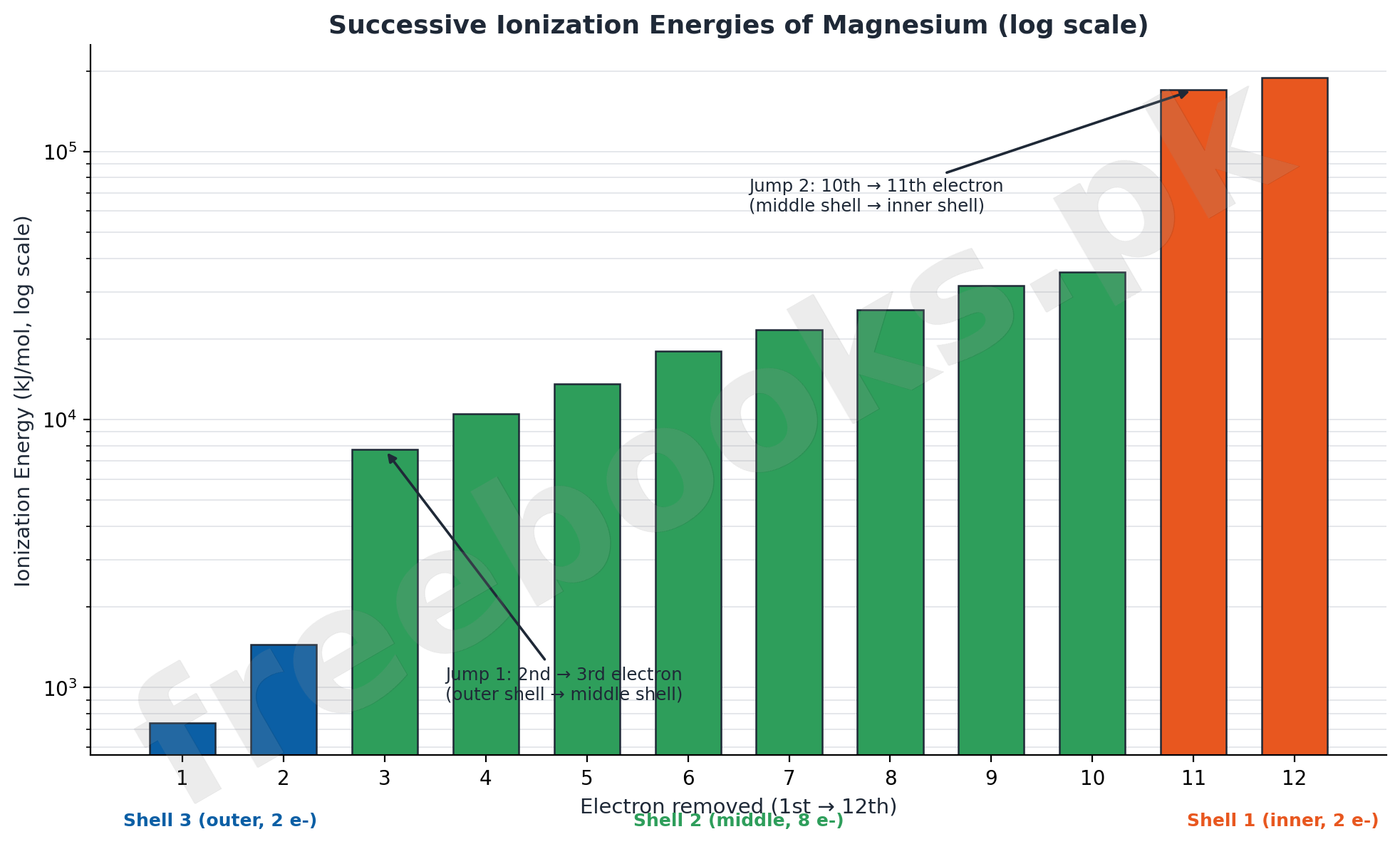
Successive ionization energies, the energy needed to remove the 1st, 2nd, 3rd electron and so on from an atom one at a time, provide direct evidence for shell structure: plotting these values for magnesium shows two large jumps, once after the 2nd electron, where the outer shell is exhausted, and again after the 10th, where the middle shell is exhausted, confirming three distinct electron shells. Separately, comparing the first ionization energies of different elements across the periodic table shows the now-familiar trends: ionization energy decreases down a group as shells and shielding increase, and increases across a period as nuclear charge grows while shell number stays fixed, with alkali metals lowest and noble gases highest in each period.
2.4 Quantum Numbers
Since Schrodinger's wave model treats the electron as occupying three-dimensional space, three quantum numbers are needed to describe each orbital. The principal quantum number (n = 1, 2, 3…), labelled K, L, M, N, describes the shell's size and energy and sets its maximum electron capacity at 2n-squared. The azimuthal quantum number (l = 0 to n-1), labelled s, p, d, f, describes the subshell's shape, with the number of electrons a subshell can hold given by 2(2l+1): 2 for s, 6 for p, 10 for d, and 14 for f.
The magnetic quantum number (m, ranging from -l through 0 to +l) describes an orbital's orientation in space within its subshell, and the number of allowed values of m equals the number of orbitals in that subshell: one for s, three for p, five for d, and seven for f — orbitals of the same subshell, called degenerate orbitals, share the same energy. A fourth quantum number, spin (s = +1/2 or -1/2), distinguishes the two electrons that can occupy the same orbital, since the three spatial quantum numbers alone cannot tell them apart.
2.5 Shapes of Atomic Orbitals
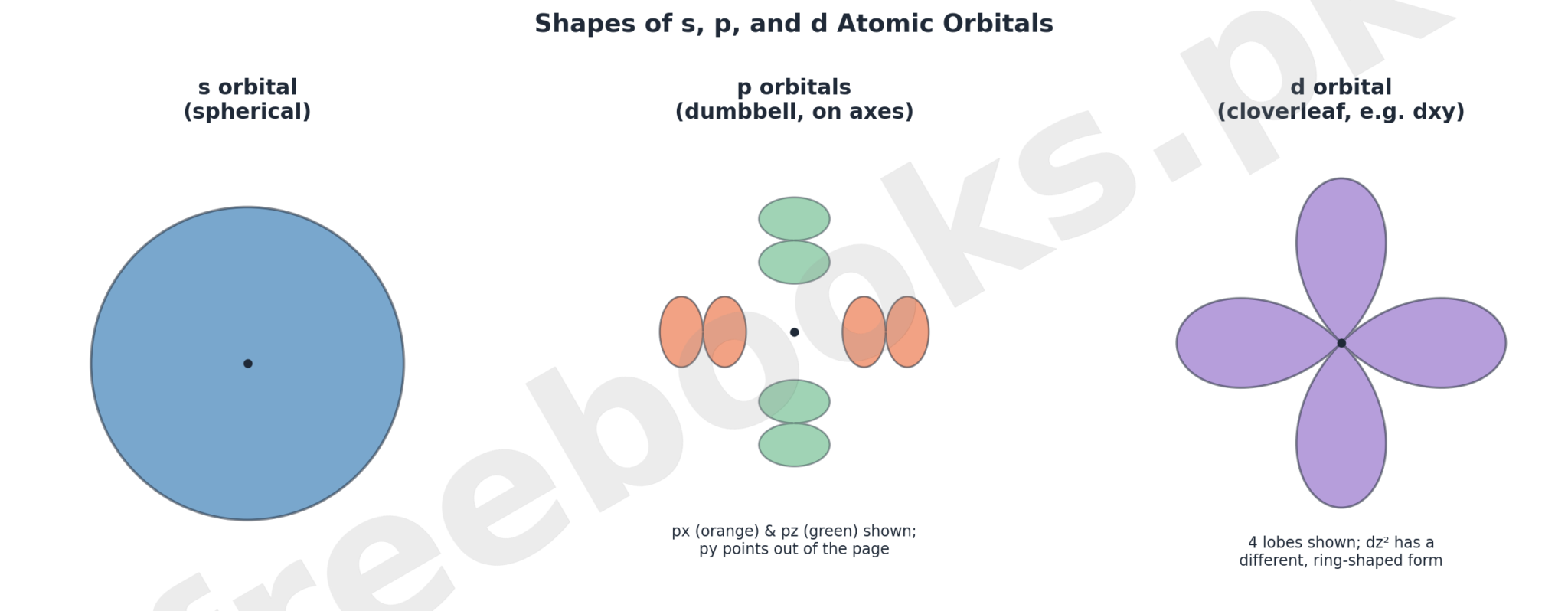
An atomic orbital is the three-dimensional region around the nucleus where an electron is most likely to be found. The s orbital is spherical, with its electron density spread uniformly in all directions, and grows larger as the principal quantum number increases. The p orbitals, px, py, and pz, each have two lobes arranged along one of the three perpendicular axes, giving a dumbbell shape rather than spherical symmetry.
The five d orbitals have more complex shapes: dxy, dxz, and dyz each lie between a pair of axes with four lobes, dx2-y2 has four lobes lying along the x and y axes themselves, and dz2 has two lobes along the z-axis plus a ring of density in the xy plane. The seven f orbitals have still more complicated shapes, but like all orbitals of the same subshell, they are degenerate, equal in energy in the absence of an external field.
2.6 Electronic Configuration: Aufbau, Pauli, and Hund
Electronic configuration describes how electrons are distributed among shells, subshells, and orbitals. The Aufbau, or building-up, principle states that subshells fill in order of increasing energy, determined by the sum (n + l): a subshell with a lower (n + l) value fills first, and when two subshells share the same (n + l) value, the one with the lower n fills first — explaining why 4s (n + l = 4) fills before 3d (n + l = 5), giving the familiar order 1s, 2s, 2p, 3s, 3p, 4s, 3d, 4p, 5s, 4d, 5p, 6s, 4f, 5d, 6p, 7s.
Two further rules govern how electrons occupy orbitals within a subshell. Pauli's exclusion principle states that no two electrons in an atom can share all four quantum numbers, so any two electrons occupying the same orbital must have opposite spins. Hund's rule states that when degenerate orbitals, such as the three p orbitals, are available, electrons occupy separate orbitals singly, with parallel spins, before any orbital receives a second electron, minimizing electron-electron repulsion and giving the lowest-energy, most stable arrangement.
2.7 Electronic Configuration and the Periodic Table
An element's position in the periodic table directly mirrors its electronic configuration: elements in Groups 1 and 2 are filling an ns subshell, elements in Groups 13-18 are filling an np subshell, the transition metals in the middle block are filling an (n-1)d subshell, and the lanthanides and actinides below the main table are filling an (n-2)f subshell — and since these subshells hold a maximum of 2, 6, 10, and 14 electrons respectively, they define the exact widths of the s-block, p-block, d-block, and f-block.
The electrons in an atom's outermost shell, its valence electrons, are primarily responsible for chemical behaviour, and elements in the same group share the same valence-shell configuration pattern, such as ns1 for Group 1 or ns2np1 for Group 13, which is why they show similar chemical properties. Because this pattern can be read directly from an element's row and column, a full or valence electron configuration can be deduced from the periodic table without memorization.
2.8 Electronic Configuration of Ions and Free Radicals
Positive ions form when atoms lose electrons, and negative ions form when atoms gain electrons; in both cases the resulting configuration often matches that of the nearest noble gas — Na+ (10 electrons) has the configuration of neon, and S2- (18 electrons) has the configuration of argon. For main-group elements, electrons are lost from the outermost subshell first, but d-block elements behave differently: although the 4s subshell fills before 3d when building up an atom, electrons are lost from 4s first when a d-block atom forms a cation, so titanium (1s2 2s2 2p6 3s2 3p6 3d2 4s2) forms Ti2+ by losing both 4s electrons, giving 1s2 2s2 2p6 3s2 3p6 3d2.
A free radical is a species with one or more unpaired electrons, such as the free chlorine atom, configuration 1s2 2s2 2p6 3s2 3p5, which has one unpaired electron in its 3p subshell, or polyatomic radicals such as OH and CH3. Free radicals are typically highly reactive because an unpaired electron readily seeks a partner to pair with in a new bond.
2.9 Electronic Configuration and Semiconductors
Semiconductors are materials whose ability to conduct electricity depends on their specific electronic configuration. Pure silicon, electron configuration 2, 8, 4, has four valence electrons and forms four bonds to neighbouring silicon atoms in its crystal lattice, leaving no free charge carriers and therefore no conduction pathway in its pure form.
Doping silicon with trivalent impurity atoms such as aluminium, with 3 valence electrons, creates electron-deficient holes that act as positive charge carriers, producing a P-type semiconductor, while doping with pentavalent impurity atoms such as phosphorus, with 5 valence electrons, contributes extra, loosely-held electrons that act as negative charge carriers, producing an N-type semiconductor — both are the basis of the diodes and transistors used in modern electronic devices.
Important Definitions
What is atomic number (proton number)?
The number of protons in the nucleus of an atom; it is the fundamental property that defines an element's identity.
What is mass number (nucleon number)?
The total number of protons and neutrons in the nucleus of an atom, related to atomic number by A = Z + N.
What is the principal quantum number (n)?
A positive integer describing the size and energy of a shell; the maximum number of electrons it can hold is 2n-squared.
What is the azimuthal quantum number (l)?
A quantum number ranging from 0 to (n-1) that describes the shape of a subshell, designated s, p, d, or f.
What is the magnetic quantum number (m)?
A quantum number ranging from -l to +l that describes the spatial orientation of an individual orbital within a subshell.
What is the spin quantum number (s)?
A quantum number with value +1/2 or -1/2 that distinguishes the two electrons that can occupy the same orbital.
What is the Aufbau principle?
The principle that subshells fill with electrons in order of increasing energy, found using the (n + l) rule.
What is Pauli's exclusion principle?
No two electrons in an atom can have identical values for all four quantum numbers, so electrons sharing an orbital must have opposite spins.
What is Hund's rule?
When degenerate orbitals are available, electrons occupy separate orbitals singly, with parallel spins, before any orbital is doubly occupied.
What is a free radical?
A species that has one or more unpaired electrons, making it typically highly reactive.
Key Facts and Relations
| Topic | Key Fact / Relation |
|---|---|
| Mass/nucleon number relation | A = Z + N, so N = A – Z |
| Maximum electrons in a shell | 2n-squared (K=2, L=8, M=18, N=32) |
| Electrons in a subshell | 2(2l+1): s=2, p=6, d=10, f=14 |
| Orbitals in a subshell | (2l+1): s=1, p=3, d=5, f=7 |
| Angle of deflection in an electric field | Proportional to charge / mass |
| Radius of deflection in an electric field | Proportional to mass / charge |
| Aufbau filling order | 1s<2s<2p<3s<3p<4s<3d<4p<5s<4d<5p<6s<4f<5d<6p<7s |
| Na+ electronic configuration | 1s2 2s2 2p6 (same as neon) |
| S2- electronic configuration | 1s2 2s2 2p6 3s2 3p6 (same as argon) |
| d-block cation rule | 4s electrons are lost before 3d electrons when a transition metal forms a cation |
Diagrams
Behaviour of Proton, Neutron and Electron in an Electric Field: Three particle paths passing between charged plates: the neutron travels straight, the proton deflects toward the negative plate, and the electron deflects sharply toward the positive plate
Shapes of s, p, and d Atomic Orbitals: A spherical s orbital, dumbbell-shaped p orbitals lying along perpendicular axes, and the characteristic four-lobed cloverleaf shape of a d orbital
Successive Ionization Energies of Magnesium: A log-scale plot of the twelve successive ionization energies of magnesium against the number of electrons removed, showing two large jumps that reveal its three electron shells
Short Questions & Answers
Why does an electron deflect more than a proton when both pass through the same electric field at the same speed?
Deflection depends on the charge-to-mass ratio; although the electron and proton carry equal and opposite charge magnitudes, the electron's mass is about 1/1836 that of the proton, giving it a far larger charge-to-mass ratio and therefore a much greater deflection toward the positive plate.
What do the two large jumps in magnesium's successive ionization energy graph reveal?
They mark the points where electron removal moves to a shell that is closer to the nucleus — the first jump occurs after the 2nd electron, once the outer shell is exhausted, and the second after the 10th, once the middle shell is exhausted, together confirming magnesium's electrons occupy three distinct shells.
Why is the third ionization energy of magnesium so much larger than its second?
The first two electrons are removed from magnesium's outer, third shell, but the third electron must be removed from the full, more tightly-bound second shell that is much closer to the nucleus, requiring far more energy.
Why does the 4s subshell fill before the 3d subshell according to the Aufbau principle?
The (n + l) value for 4s is 4 + 0 = 4, while for 3d it is 3 + 2 = 5; since a lower (n + l) value means lower energy, 4s fills first even though its principal quantum number is higher than 3d's.
Why do transition metal atoms lose their 4s electrons before their 3d electrons when forming cations?
Once the 3d subshell is occupied, its effective energy drops below that of 4s in the resulting ion, so the 4s electrons, now higher in energy, are removed first, even though 4s filled before 3d when the atom was originally built up.
How many orbitals and electrons can a d subshell hold, and why?
A d subshell has l = 2, giving 2l + 1 = 5 orbitals, each holding up to 2 electrons, for a maximum of 2(2l+1) = 10 electrons in total.
What does Hund's rule say about filling the three 2p orbitals of carbon, nitrogen, and oxygen?
Electrons occupy separate degenerate orbitals singly, with parallel spins, before any orbital is doubly occupied; carbon's two 2p electrons therefore sit in separate orbitals, and only oxygen's fourth 2p electron is forced to pair up.
Why is a free chlorine atom classed as a free radical?
Its configuration, 1s2 2s2 2p6 3s2 3p5, leaves one 3p electron unpaired, and a species with one or more unpaired electrons is defined as a free radical.
Why does silicon conduct no electricity in its pure crystalline form?
Each silicon atom has four valence electrons and forms four covalent bonds to its neighbours, using up all its valence electrons in bonding and leaving no free charge carriers to conduct current.
What is the difference between a P-type and an N-type semiconductor?
A P-type semiconductor is formed by doping with a trivalent impurity such as aluminium, creating electron-deficient holes that carry positive charge; an N-type semiconductor is formed by doping with a pentavalent impurity such as phosphorus, which contributes extra, loosely-held electrons that carry negative charge.
Long Questions & Answers
Describe the evidence for electronic shell structure provided by successive ionization energies, and explain how quantum numbers describe the arrangement of electrons within those shells.
What are successive ionization energies, and how do they provide evidence for electron shells?
Successive ionization energies are the energies required to remove the 1st, 2nd, 3rd, and further electrons from an atom, one at a time. Because each removed electron leaves behind a smaller, more positively charged ion, successive values always increase; but large jumps occur specifically when an electron must be removed from a shell that is closer to the nucleus, and these jumps reveal exactly how many electrons occupy each shell.
How does the graph of magnesium's successive ionization energies confirm three electron shells?
Plotting magnesium's twelve successive ionization energies against the number of electrons removed shows a gradual rise for the first two electrons in the outer shell, a large jump for the third electron entering the middle shell, a gradual rise through electrons three to ten, and a much larger jump for the eleventh electron entering the innermost shell — two large jumps confirming three distinct shells.
What is the principal quantum number, and what does it describe?
The principal quantum number, n, takes positive integer values 1, 2, 3 and so on, and describes the size and energy of a shell; larger n means a greater average distance from the nucleus, higher energy, and a maximum electron capacity of 2n-squared for that shell.
What do the azimuthal and magnetic quantum numbers describe?
The azimuthal quantum number, l, ranges from 0 to (n – 1) and describes the shape of a subshell, s, p, d, or f; the magnetic quantum number, m, ranges from -l to +l and describes the spatial orientation of each individual orbital within that subshell.
Why is a fourth quantum number needed, and what does it describe?
The three quantum numbers n, l, and m fully describe an orbital's size, shape, and orientation, but each orbital can hold two electrons; the spin quantum number, s, with values of +1/2 or -1/2, is needed to distinguish between these two electrons, which must have opposite spins according to Pauli's exclusion principle.
Explain the Aufbau principle, Pauli's exclusion principle, and Hund's rule, and describe how they are applied to write the electronic configuration of an atom.
What does the Aufbau principle state, and how is the filling order determined?
The Aufbau principle states that subshells fill with electrons in order of increasing energy. This order is found using the (n + l) rule: a subshell with a lower (n + l) sum is filled first, and if two subshells share the same sum, the one with the lower n value fills first, giving the sequence 1s, 2s, 2p, 3s, 3p, 4s, 3d, 4p, 5s, 4d, 5p, 6s, 4f, 5d, 6p, 7s.
What does Pauli's exclusion principle state?
No two electrons in the same atom can have identical values for all four quantum numbers; in practice, this means any orbital, fully specified by n, l, and m, can hold at most two electrons, and those two electrons must have opposite spin quantum numbers.
What does Hund's rule state, and why does it apply?
When degenerate orbitals of equal energy are available, electrons occupy them singly, with parallel spins, before any orbital receives a second electron; this minimizes the electron-electron repulsion that would otherwise occur if two electrons were forced into the same orbital, giving the atom its lowest-energy, most stable configuration.
How are these three rules applied together to write an atom's electronic configuration?
Electrons are added one at a time following the Aufbau energy order; each orbital is checked against Pauli's exclusion principle so no orbital exceeds two electrons of opposite spin; and whenever a subshell has multiple degenerate orbitals available, Hund's rule is applied so each orbital gains one electron before any is doubly occupied.
Why do d-block elements form an exception when they lose electrons to form ions?
Although the Aufbau (n + l) rule fills 4s before 3d when building up a neutral atom, once electrons occupy the 3d subshell its energy drops below that of the now-outermost 4s subshell in the resulting species, so 4s electrons, being higher in energy in the ion, are always removed first when a transition metal atom forms a cation.
Multiple Choice Questions (MCQs)
An atom of an element X has atomic number Z and mass number A. The number of neutrons in this atom is: (A) Z + A (B) A – Z (C) Z – A (D) A x Z
Correct answer: (B) A – Z. N = A – Z, since mass number equals the sum of protons and neutrons.
When beams of protons, neutrons and electrons pass through an electric field at the same speed, which particle is undeflected? (A) Proton (B) Neutron (C) Electron (D) All are deflected equally
Correct answer: (B) Neutron. Neutrons carry no charge, so they experience no force in an electric field and travel straight through.
The two large jumps in magnesium's successive ionization energy graph occur after removing which electrons? (A) 1st and 2nd (B) 2nd and 10th (C) 3rd and 11th (D) 8th and 10th
Correct answer: (B) 2nd and 10th. The jumps occur after the 2nd electron, leaving the outer shell, and after the 10th, leaving the middle shell, confirming three shells.
The maximum number of electrons a p subshell can hold is: (A) 2 (B) 6 (C) 10 (D) 14
Correct answer: (B) 6. A p subshell has l = 1, giving 2(2l+1) = 6 electrons across 3 orbitals.
According to the Aufbau (n + l) rule, which subshell is filled first? (A) 4s (n+l=4) (B) 3d (n+l=5) (C) 4p (n+l=5) (D) 4d (n+l=6)
Correct answer: (A) 4s (n+l=4). 4s has the lowest (n+l) value of 4, so it fills before 3d and 4p, both of which equal 5.
Pauli's exclusion principle states that two electrons occupying the same orbital must have: (A) The same spin (B) Opposite spins (C) The same value of l (D) Different values of n
Correct answer: (B) Opposite spins. No two electrons in an atom can share all four quantum numbers, so two electrons in the same orbital, sharing n, l, and m, must differ in spin.
According to Hund's rule, three electrons filling three degenerate p orbitals will: (A) Pair up in one orbital first (B) Occupy separate orbitals with parallel spins (C) Occupy separate orbitals with opposite spins (D) Skip the p orbitals entirely
Correct answer: (B) Occupy separate orbitals with parallel spins. Hund's rule places one electron in each degenerate orbital, with parallel spins, before any pairing occurs.
The electronic configuration of Na+ is the same as that of which noble gas? (A) Helium (B) Neon (C) Argon (D) Krypton
Correct answer: (B) Neon. Na+ has 10 electrons (1s2 2s2 2p6), identical to neon's configuration.
When a transition metal atom such as titanium forms a cation, which electrons are lost first? (A) 3d electrons (B) 4s electrons (C) 1s electrons (D) 2p electrons
Correct answer: (B) 4s electrons. Despite filling after 3d in the neutral atom, 4s electrons become higher in energy once 3d is occupied, so they are lost first when the ion forms.
A P-type semiconductor is formed by doping pure silicon with an impurity that has how many valence electrons? (A) 3 (B) 4 (C) 5 (D) 8
Correct answer: (A) 3. Trivalent impurities such as aluminium, with 3 valence electrons, create electron-deficient holes that act as positive charge carriers, forming a P-type semiconductor.
Quick Revision Summary
- Atomic number (Z) = proton number = number of protons; defines an element's identity
- Mass number (A) = nucleon number = protons + neutrons; N = A – Z
- Ion electron count: cation = protons – charge; anion = protons + charge (proton and neutron count unchanged)
- In an electric field: neutrons undeflected, protons deflect toward the negative plate, electrons deflect more toward the positive plate
- Angle of deflection is proportional to charge/mass; radius of deflection is proportional to mass/charge
- Atomic spectra (emission and absorption) act as an element's fingerprint, unique to its electron energy levels
- Successive ionization energies show large jumps between shells; first ionization energies across elements show the standard periodic trends
- Principal quantum number (n): shell size/energy, max electrons = 2n-squared
- Azimuthal quantum number (l): subshell shape (s, p, d, f); electrons per subshell = 2(2l+1)
- Magnetic quantum number (m): orbital orientation; orbitals per subshell = 2l+1
- Spin quantum number (s): +1/2 or -1/2, distinguishes the 2 electrons in one orbital
- Aufbau principle: fill lowest (n+l) first, lower n breaks ties | Pauli's principle: max 2 electrons per orbital, opposite spins | Hund's rule: singly occupy degenerate orbitals first
- Valence electron configuration repeats down a group, explaining similar chemical properties; blocks (s, p, d, f) match the subshell being filled
- d-block cations lose 4s electrons before 3d electrons; free radicals have 1 or more unpaired electrons; semiconductor type depends on dopant valence electron count (3 for P-type, 5 for N-type)
Exam Tips
- Practice the (n+l) rule directly — most Aufbau-order exam questions can be solved by comparing two (n+l) sums rather than memorizing the whole sequence
- When counting electrons in an ion, always start from the neutral atom's proton count, then add electrons for a negative charge or subtract for a positive charge — protons and neutrons never change
- Remember the special order-of-removal rule for d-block cations: it is the opposite of the order of filling (4s comes out first, even though it filled first)
- For Hund's rule questions, draw the orbital boxes and fill them singly, left to right, before pairing any — this avoids common configuration mistakes for elements like carbon, nitrogen, and oxygen
- Link quantum numbers to real quantities: n to shell size/energy, l to subshell shape, m to orbital orientation, s to which of the two electrons in an orbital
- Successive ionization energy graphs are a favourite exam diagram — practice explaining WHY each jump occurs (a shell change) rather than just describing that a jump happens