Analytical chemistry is the science of chemical characterization, combining qualitative analysis (identifying which elements or compounds are present) and quantitative analysis (determining their relative amounts); a complete quantitative determination proceeds through sampling, separation of the desired constituent, measurement and calculation, and drawing conclusions. This chapter introduces five basic physical methods used to separate the components of a mixture: filtration, crystallization, simple distillation, fractional distillation, and paper chromatography.
Filtration separates an insoluble solid from a liquid using a filter medium such as filter paper, a Gooch crucible, or a sintered glass crucible; crystallization purifies a solid by dissolving it hot in a suitable solvent and allowing pure crystals to form on cooling; simple distillation separates a dissolved solid from its solvent, while fractional distillation separates two miscible liquids of different boiling points using a fractionating column; and paper chromatography separates a mixture of soluble substances based on their differing distribution between a stationary and a mobile phase, characterized quantitatively by the retardation factor (Rf). Together with melting-point and boiling-point comparisons, these techniques let a chemist both separate a mixture and verify the purity of the resulting product.
Learning Objectives
- Define important terms associated with creating chemical solutions: solvent, solute, solution, residue, and filtrate
- Explain the methods of separation and purification: filtration, crystallization, simple distillation, and fractional distillation
- Identify substances and assess their purity using melting and boiling point information
- Suggest suitable separation and purification techniques given information about substances and their daily-life usage
- Describe how paper chromatography is used to separate mixtures of soluble substances using a suitable solvent
- Describe the use of locating agents when separating mixtures containing colourless substances
- Interpret simple chromatograms to identify unknown substances by comparison with known pure and impure substances
- State and use the formula for the retardation factor (Rf)
Key Concepts
15.1 Filtration
Filtration separates one component of a two-component heterogeneous mixture from a solution, using a solvent in which one component dissolves completely while the other remains insoluble. For example, dissolving a mixture of common salt and sand in distilled water gives a homogeneous solution in which salt (the solute) distributes throughout water (the solvent, the component present in excess), while sand remains undissolved and settles at the bottom; filtration then separates the sand.
Filtration can use filter paper (folded simply, or as fluted filter paper for faster flow through a conical funnel) or a crucible. With filter paper, the liquid that passes through is called the filtrate, and the solid left behind on the paper is called the residue; the filter paper should end up one-fourth to one-half full of precipitate, and porosity is chosen based on particle size. Two types of filtering crucibles are used: the Gooch crucible, porcelain with a perforated bottom covered by paper pulp or filter paper (useful for precipitates that must be ignited at high temperature, and usable with asbestos matting for solutions like concentrated HCl or KMnO4 that would react with paper), and the sintered glass crucible, which has a porous glass disc sealed into the bottom and needs no preparation.
15.2 Crystallization
Crystallization relies on the principle that a solute is more soluble in a solvent at high temperature than at low temperature, so excess solute is thrown out as crystals on cooling. An ideal solvent for crystallization dissolves a large amount of the substance hot but only a little at room temperature, does not react chemically with the solute, does not dissolve the impurities (or lets them stay in solution rather than crystallizing with the solute), deposits well-formed crystals on cooling, and is inexpensive, safe, and easily removed; common choices include water, absolute ethanol, chloroform, carbon tetrachloride, and acetic acid, or a combination of miscible solvents if none alone is suitable. If the solvent is flammable, a water bath is used for heating.
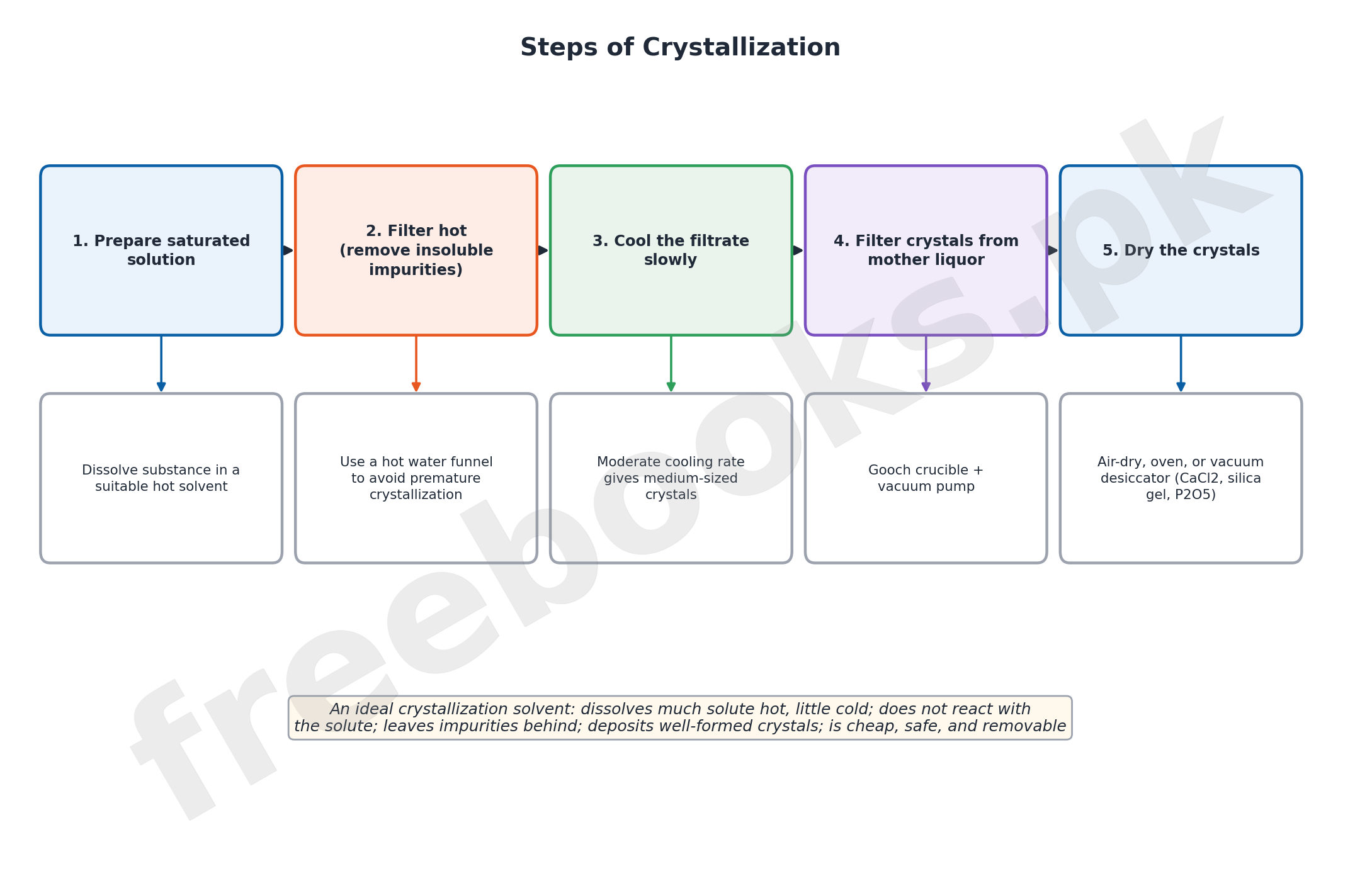
The steps of crystallization are: prepare a saturated solution of the substance in a suitable solvent at the experimental temperature; filter the hot saturated solution to remove insoluble impurities (using a hot water funnel if necessary, to avoid premature crystallization choking the filter paper or funnel); cool the hot filtered solution at a moderate rate so medium-sized crystals form; filter the resulting mixture of crystals and mother liquor through a Gooch crucible using a vacuum pump; and finally dry the crystals, either air-dried, in an oven (only if the substance does not melt or decompose at 100 degC), or safely in a vacuum desiccator using a drying agent such as CaCl2, silica gel, or phosphorus pentaoxide. Coloured or resinous impurities can be removed by boiling with powdered animal charcoal, which adsorbs the colour, before filtering the hot solution.
15.3 Simple and Fractional Distillation
Simple distillation separates a solvent from a solution — for example, distilling sea water (a mixture of many soluble inorganic compounds in water) to make it drinkable. Boiling chips are added to prevent bumping, and the apparatus is made airtight; the flask is heated gently, cold water circulates around the condenser, and the vapours that reach their boiling point pass through the condenser and condense back into liquid, collected as the distillate in the receiving flask, while the components left behind in the distillation flask are called the residue.
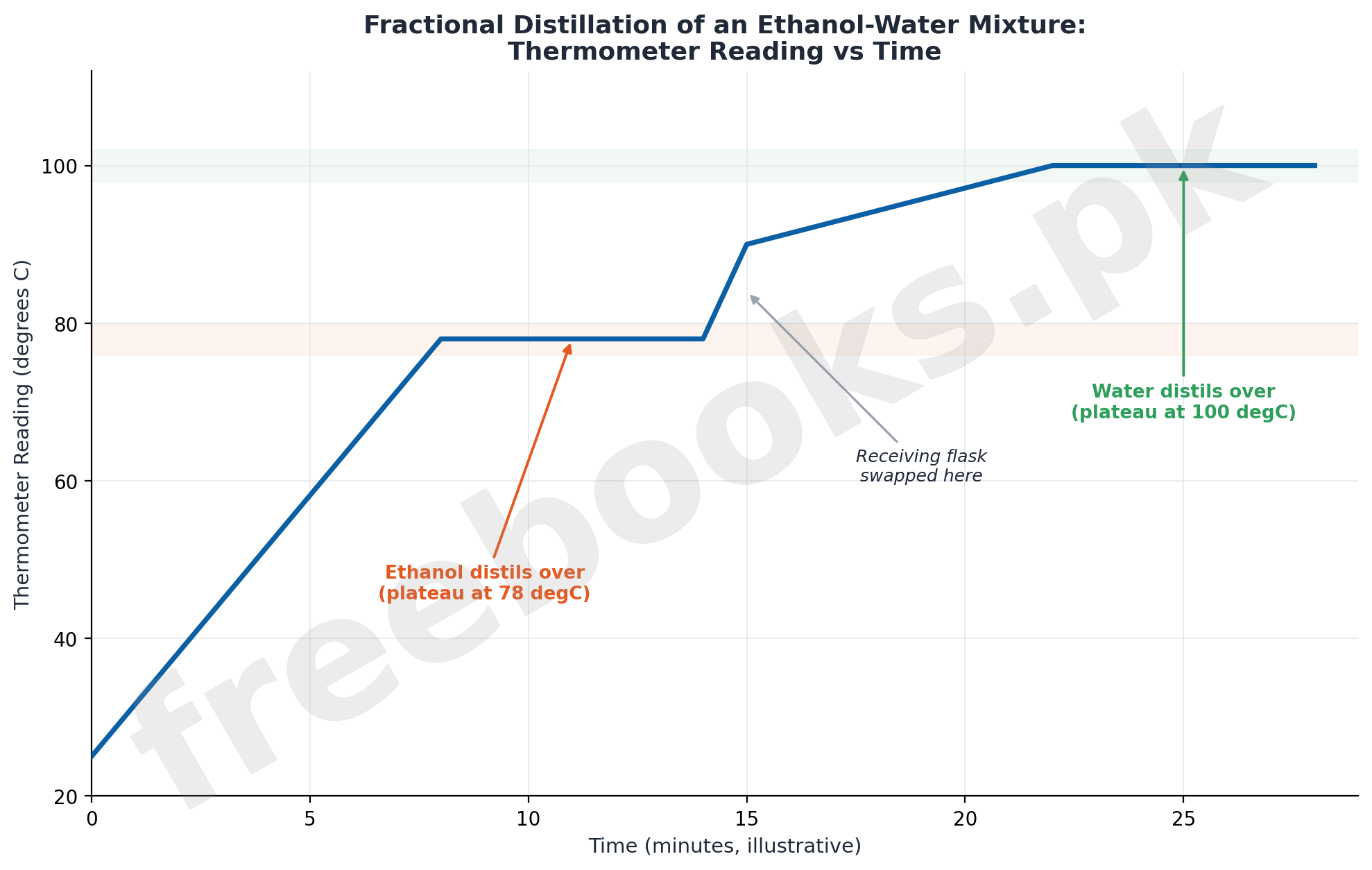
Fractional distillation separates two miscible liquids of different boiling points, and works successfully only when the boiling points differ by around 25 degC or more; it uses a distillation column packed with glass beads to increase the surface area for condensing vapour. For an ethanol-water mixture, ethanol (boiling point 78 degC) distils over first while the thermometer stays at 78 degC; when the temperature begins rising above 78 degC, the receiving flask is swapped, and heating continues until the temperature reaches 100 degC, at which point water distils over and is collected as the second distillate, giving both components in pure form. Petroleum, a natural mixture of fuels (petrol, diesel, kerosene, furnace oil) with closely spaced boiling points, is separated into these fractions by fractional distillation in an industrial fractionating column.
15.4 Chromatography: Principles and Types
Chromatography separates a mixture by distributing its components (the solute) between a stationary phase (a solid, or a liquid supported as a thin film on an inert solid) and a mobile phase (a gas or liquid flowing over the stationary phase). When the stationary phase is a solid, the technique is called adsorption chromatography (e.g., thin layer chromatography and column chromatography), in which a substance leaves the mobile phase to become adsorbed on the solid surface; when the stationary phase is a liquid, the technique is called partition chromatography (e.g., paper chromatography and gas-liquid chromatography), in which the substances distribute throughout both phases.
Paper chromatography is a type of partition chromatography in which the entrapped water in cellulose fibres of the paper acts as the (immiscible) stationary phase against an organic mobile phase. It can be run as ascending, descending, or radial/circular chromatography; in the ascending method, the solvent travels upward by capillary action. A sample spot is placed on a pencil line about 2.5 cm from one end of a strip of Whatman's chromatographic paper No.1, alongside spots of known compounds if desired; the paper is suspended with the impregnated end dipping 5-6 mm into solvent inside a covered chromatographic tank, and as the solvent front rises, different components move at different rates, separating the mixture; when the solvent front nears the top, the strip is removed, the front is marked, and the strip is dried.
15.5 Locating Agents and the Retardation Factor (Rf)
The dried, developed pattern on the paper is called a chromatogram. Coloured components can be identified visually, but colourless components must be developed by chemical or physical methods — viewing under UV light (spots appear coloured) or using a locating agent such as ninhydrin, a chemical that reacts with colourless substances like amino acids to give visible coloured products.
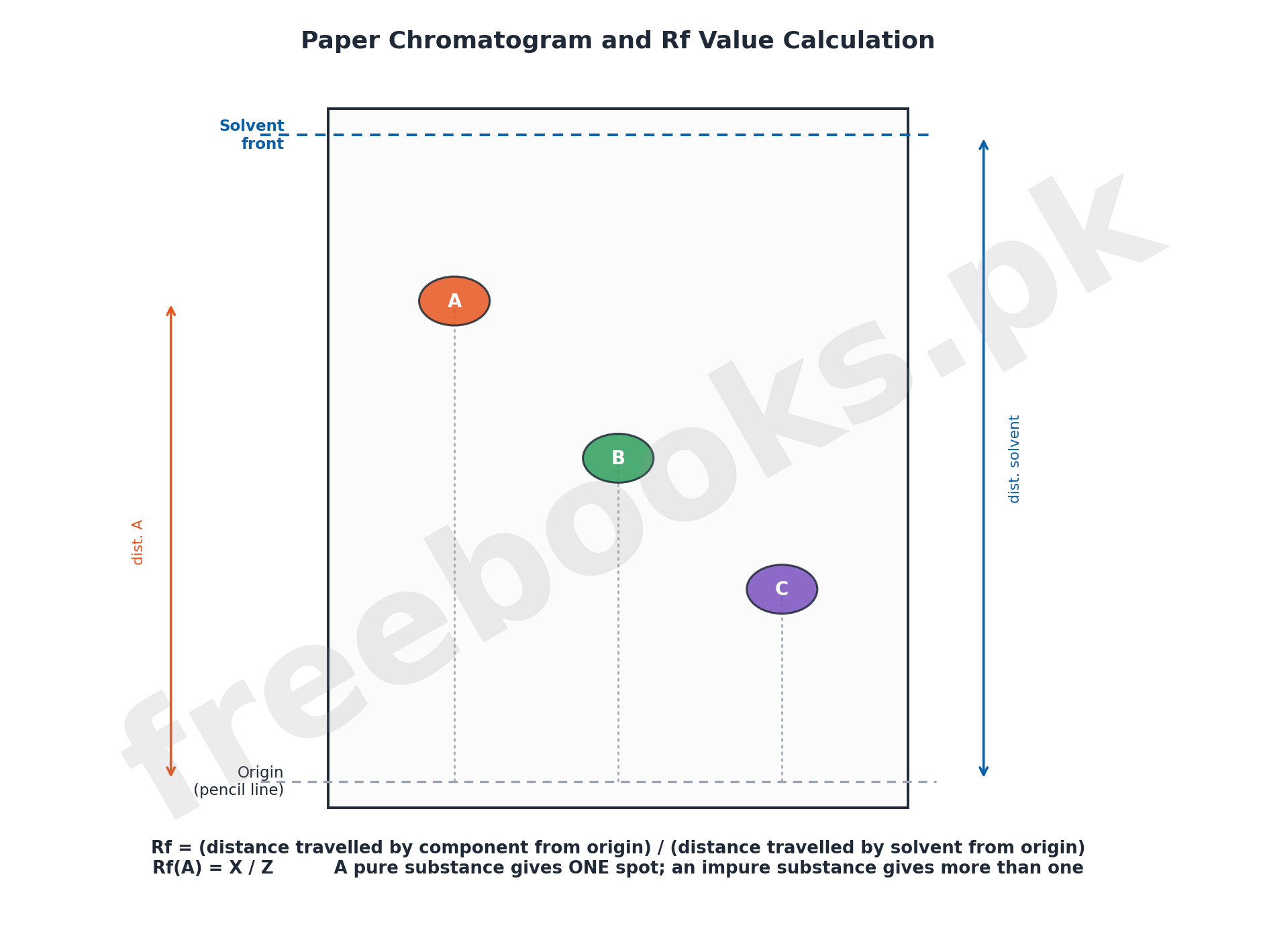
Each component has a characteristic retardation factor, Rf = (distance travelled by the component from the origin) / (distance travelled by the solvent from the origin). Paper chromatography checks purity: a pure substance gives one spot on the chromatogram, while an impure substance gives more than one; comparing Rf values against known pure samples also allows identification, since two substances with the same Rf under the same conditions are likely identical. Whatman filter paper No.1, made from selected cotton cellulose with medium retention, medium flow rate, and 11 micrometer pore size, is used for routine paper chromatography.
Chromatography is widely used in organic synthesis for separation, isolation, and purification of products, in qualitative and quantitative analysis, for determining the purity of a substance, and for identifying complicated chemicals such as dyes, drugs, and pesticides — for example, comparing the inks used at different points in a document.
15.6 Checking the Purity of a Product
Liquids are typically purified by distillation (at normal pressure or under vacuum) and their purity checked by comparing the measured boiling point with the literature value. Solids are often purified by crystallization and checked by melting point. As a worked example: aspirin, prepared by reacting salicylic acid with excess acetic anhydride in the presence of a few drops of concentrated H2SO4, is precipitated by adding water, filtered as a crude product, and then crystallized from water.
The crude aspirin may still be mixed with unreacted salicylic acid. Purity is assessed in three ways: (i) melting point — a pure product melts sharply at exactly 136 degC, while an impure product melts over a range of temperatures rather than sharply; (ii) mixed melting point — mixing the product with a pure sample of aspirin and re-measuring the melting point; if it is still sharp, the product is pure; (iii) paper chromatography — running the sample alongside pure samples of aspirin and salicylic acid and comparing Rf values.
Important Definitions
What is the difference between a solute and a solvent?
The solute is the substance that dissolves and is present in a smaller amount, while the solvent is the substance in which it dissolves and is present in excess; together they form a homogeneous solution.
What are the filtrate and the residue?
The filtrate is the liquid that passes through the filter medium during filtration, while the residue is the solid material left behind on the filter medium.
What is the basic principle of crystallization?
A solute is more soluble in a suitable solvent at high temperature than at low temperature, so when a hot saturated solution is cooled, the excess solute separates out as pure crystals.
What is a fluted filter paper, and why is it used?
A filter paper folded into a fan-like arrangement with alternate elevations and depressions, which increases the surface area in contact with a conical funnel and considerably speeds up the rate of filtration.
What is the difference between a Gooch crucible and a sintered glass crucible?
A Gooch crucible is porcelain with a perforated bottom that must be covered with paper pulp or filter paper before use and is suited to precipitates that need high-temperature ignition, while a sintered glass crucible has a porous glass disc sealed permanently into the bottom and needs no preparation before use.
What is the essential condition for fractional distillation of two liquids to succeed?
The boiling points of the two liquids being separated must differ by around 25 degC or more; if they are closer than this, a fractionating column cannot cleanly separate them into pure fractions.
What are the stationary phase and mobile phase in paper chromatography?
The stationary phase is the water entrapped within the cellulose fibres of the paper, while the mobile phase is the organic solvent that moves over the paper by capillary action, carrying the sample's components at different rates.
What is a locating agent?
A chemical, such as ninhydrin, that reacts with an otherwise colourless separated substance (like an amino acid) to produce a visible coloured product, allowing its spot on a chromatogram to be identified.
What is the retardation factor (Rf)?
The ratio of the distance travelled by a component from the origin to the distance travelled by the solvent from the origin in a chromatogram; it is a characteristic value for a given substance under given conditions.
How does the number of spots on a paper chromatogram indicate purity?
A pure substance produces exactly one spot on the chromatogram, while an impure substance, being a mixture of two or more components, produces more than one spot.
Key Facts and Relations
| Topic | Key Fact / Relation |
|---|---|
| Retardation factor | Rf = (distance travelled by component from origin) / (distance travelled by solvent from origin) |
| Fractional distillation feasibility condition | Boiling points of the two liquids should differ by about 25 degC or more |
| Ethanol-water fractional distillation plateaus | Ethanol distils at 78 degC; water distils at 100 degC |
| Aspirin pure melting point | Sharp melting point at exactly 136 degC indicates a pure product |
| Crystallization drying agents (vacuum desiccator) | CaCl2, silica gel, or phosphorus pentaoxide (P2O5) |
| Crystallization solvent examples | Water, absolute ethanol, chloroform, carbon tetrachloride, acetic acid |
| Whatman filter paper No.1 (chromatography) | Medium retention, medium flow rate, pore size 11 micrometers |
| Filter paper fill guideline | Filter paper should be one-fourth to one-half full of precipitate at the end of filtration |
| Paper chromatography spotting distance | Sample spotted about 2.5 cm from one end, on a pencil (not ink) line |
| Solvent immersion depth (ascending chromatography) | Paper dips 5-6 mm into the solvent in the chromatographic tank |
Diagrams
Fractional Distillation of an Ethanol-Water Mixture: Thermometer Reading vs Time: A temperature-time plot showing the characteristic plateau at 78 degC while ethanol distils over, the point at which the receiving flask is swapped, and the second plateau at 100 degC while water distils over
Steps of Crystallization: A five-step flow diagram showing the crystallization process from preparing a saturated solution through hot filtration, controlled cooling, filtering the crystals from the mother liquor, and drying
Paper Chromatogram and Rf Value Calculation: A labelled chromatogram showing the origin, solvent front, and three separated spots, illustrating how the distance travelled by a component and by the solvent are measured and used to calculate the Rf value
Short Questions & Answers
Why must the hot saturated solution be filtered before it is allowed to cool during crystallization?
If insoluble impurities are left in the solution while it cools, they can act as extra surfaces for crystal nucleation or become trapped within the growing crystals, contaminating the final product; filtering the solution while it is still hot removes these impurities first, and a hot water funnel is used for this step specifically to prevent the dissolved solute from crystallizing prematurely and choking the filter paper or funnel.
Why does the thermometer reading stay constant at 78 degC while ethanol is distilling over in a fractional distillation of ethanol and water?
As long as liquid ethanol is present and boiling, the vapour above it remains at ethanol's boiling point because the energy supplied by heating goes into vaporizing more ethanol rather than raising the temperature further; only once essentially all of the ethanol has distilled over does the remaining liquid start behaving more like pure water, allowing the thermometer reading to rise toward 100 degC.
Why is a Gooch crucible sometimes covered with an asbestos mat instead of paper pulp?
Ordinary filter paper or paper pulp can chemically react with strongly oxidizing or corrosive solutions such as concentrated HCl or KMnO4, damaging the filter medium and contaminating the filtrate; covering the perforated crucible bottom with an asbestos mat instead provides a chemically inert filtering surface that can safely be used with such reactive solutions.
Why does paper chromatography rely on the paper's water content rather than the paper itself as the stationary phase?
In partition chromatography, separation depends on how a component distributes between two immiscible liquid phases; the actual stationary phase in paper chromatography is the water trapped within the cellulose fibres of the paper (which is immiscible with the usually organic mobile phase), not the solid cellulose fibres themselves, so it is this entrapped water layer that governs how strongly each component is retained as the mobile phase moves past it.
Why would water generally be an unsuitable solvent to use as the mobile phase in paper chromatography?
Since the stationary phase in paper chromatography is itself water held within the cellulose fibres, using water as the mobile phase as well would eliminate the two-phase partition system the technique depends on, because the mobile and stationary phases would then be miscible (in fact identical) rather than immiscible, preventing the differential distribution of components that produces separation.
Why is a fractionating column packed with glass beads rather than left as a plain, empty tube?
Packing the column with glass beads greatly increases the internal surface area available for vapour to repeatedly condense and re-evaporate as it rises through the column; each cycle of condensation and re-evaporation enriches the vapour in the more volatile component, so a packed column achieves a much sharper separation between two liquids with similar boiling points than an empty tube would.
Why does a sharp, well-defined melting point indicate that a solid product is pure, while a broad melting range suggests it is impure?
A pure crystalline solid has a uniform, well-ordered lattice in which every particle experiences essentially identical intermolecular forces, so the entire sample melts within a very narrow temperature range; the presence of an impurity disrupts this uniform lattice structure at various points throughout the solid, weakening it unevenly and causing melting to begin at a lower temperature and continue gradually over a broader range rather than sharply at one exact temperature.
Why is a mixed melting point test more conclusive than measuring the melting point of the sample alone?
If an unknown or impure-looking sample is mixed with a genuine pure sample of the suspected substance and the melting point remains just as sharp as before, this confirms the two samples are the same substance, because mixing two different substances would normally lower and broaden the melting point through mutual lattice disruption; a sharp mixed melting point rules out this depression effect and provides stronger evidence of both identity and purity than a single melting-point measurement alone.
Why can two substances with different chemical identities sometimes need more than just their Rf value to be confidently distinguished?
Rf values, while characteristic of a substance under a fixed solvent system and set of conditions, can coincidentally match between two chemically different substances or can shift slightly with small variations in solvent composition, temperature, or paper batch, so matching Rf values alone provides strong but not absolute evidence of identity; running known reference spots alongside the unknown on the very same chromatogram under identical conditions strengthens the comparison considerably.
Why is filtration through a Gooch or sintered glass crucible generally faster than filtration through an ordinary filter paper and funnel?
Suction filtration through a crucible uses a vacuum pump to actively draw the liquid through the porous crucible bottom, creating a pressure difference that pulls the filtrate through far more quickly than gravity alone can achieve with an ordinary filter paper and funnel, where the liquid can only pass through as fast as gravity drains it.
Long Questions & Answers
Describe the process of crystallization in detail, including the choice of solvent and the individual steps involved, and explain how crystallization differs from simple filtration as a purification technique.
What features should an ideal solvent for crystallization have?
An ideal crystallization solvent should dissolve a large amount of the substance at its boiling point but only a small amount at room temperature (so cooling throws out plenty of pure solute as crystals), should not react chemically with the solute, should either not dissolve the impurities or should not let them crystallize alongside the solute, should deposit well-formed crystals of the pure compound on cooling, and should be inexpensive, safe to use, and easily removable from the final product.
What is the first step of crystallization, and why must the solution be saturated?
The first step is to prepare a saturated solution of the crude substance in a suitable solvent at the temperature of the experiment; the solution must be saturated because crystallization depends on there being more dissolved solute than the solvent can hold once it cools, so starting from a saturated hot solution ensures that cooling will force a substantial, purifiable amount of solute out of solution as crystals rather than leaving it all dissolved.
Why is the hot solution filtered before it is allowed to cool, and what precaution prevents this step from failing?
The hot saturated solution is filtered to remove any insoluble impurities before crystallization begins, since leaving them in the solution during cooling could trap them within the forming crystals or use them as extra nucleation sites; because crystals can sometimes begin forming during this filtration step itself and choke the filter paper or funnel, a hot water funnel is used to keep the solution hot enough to filter cleanly.
What happens during the cooling and final filtration steps, and why does cooling rate matter?
The hot filtered solution is cooled at a moderate rate, which allows medium-sized, well-formed crystals to grow (cooling too quickly tends to produce many small, impure crystals, while cooling too slowly is impractical); once crystallization is complete, the mixture of crystals and mother liquor is filtered through a Gooch crucible using a vacuum pump to separate the crystals from the remaining liquid.
How does crystallization as a purification technique differ fundamentally from simple filtration?
Filtration separates an insoluble solid from a liquid based purely on particle size and solubility, physically trapping undissolved particles on a filter medium while dissolved substances pass through in the filtrate; crystallization, by contrast, purifies a solid that is itself soluble by exploiting the difference in its solubility at high versus low temperature, converting a dissolved impure solute into a solid of much higher purity through controlled cooling, rather than simply separating dissolved and undissolved material as filtration does.
Explain how paper chromatography separates a mixture of soluble substances, how the retardation factor (Rf) is defined and used, and how these principles allow the purity of a product like aspirin to be checked.
What physical principle allows paper chromatography to separate the components of a mixture?
Paper chromatography is a form of partition chromatography in which the water entrapped in the cellulose fibres of the paper acts as an immiscible stationary phase against an organic mobile phase that moves up the paper by capillary action; because different components of the sample have different relative affinities for the stationary versus the mobile phase, they are carried up the paper at different rates, separating them into distinct spots.
How is a paper chromatogram practically set up and run using the ascending method?
A sample is spotted on a pencil line about 2.5 cm from one end of a strip of Whatman No.1 chromatographic paper, often alongside spots of known reference compounds; once the spots have dried, the paper is suspended in a covered chromatographic tank with the spotted end dipping 5-6 mm into a solvent mixture, and as the solvent rises up the paper by capillary action, the different components move upward at their own characteristic rates, separating the original mixture into distinct spots.
How is the Rf value calculated, and what does it represent?
The Rf value is calculated as the distance travelled by a given component from the origin divided by the distance travelled by the solvent front from the same origin; because this ratio is characteristic of a particular substance under a particular set of solvent and paper conditions, it provides a reproducible numerical fingerprint that can be used to identify or compare substances between different chromatography runs.
How does the number of spots and their Rf values help determine whether a product is pure?
A pure substance, since it consists of only one chemical species, produces exactly one spot on the finished chromatogram, whereas an impure product, containing more than one substance, produces two or more spots at different positions corresponding to their different Rf values; comparing the Rf value of an unknown spot to that of a known pure reference run on the same chromatogram under the same conditions also allows the identity of an unknown substance to be confirmed.
How would paper chromatography specifically be used to check whether a sample of crude aspirin is pure?
The crude aspirin sample would be run on the same chromatogram alongside pure reference samples of both aspirin and its likely contaminant, unreacted salicylic acid, using a suitable solvent system; if the aspirin sample produces only a single spot that matches the Rf value of the pure aspirin reference spot exactly, with no separate spot appearing at the Rf value of salicylic acid, this indicates the sample is free of unreacted starting material and is chromatographically pure.
Multiple Choice Questions (MCQs)
After crystals are formed, they are typically separated from the mother liquor by: (A) Evaporation (B) Decantation or filtration (C) Sublimation (D) Distillation
Correct answer: (B) Decantation or filtration. Once crystallization is complete, the mixture of solid crystals and remaining liquid (mother liquor) is separated by filtration (commonly through a Gooch crucible with a vacuum pump) or by carefully decanting off the liquid, not by evaporation, sublimation, or distillation.
The comparative rates at which solutes move in paper chromatography depend on: (A) Size of filter paper (B) Rf values of solutes (C) Temperature of the room only (D) Size of the chromatographic jar
Correct answer: (B) Rf values of solutes. Each solute moves at a rate characteristic of its own retardation factor (Rf), which reflects how it partitions between the stationary and mobile phases; this is what differentiates the movement rates of different components in the mixture.
Which method can be used to separate two solid compounds with different solubilities in a solvent? (A) Distillation (B) Isolation (C) Crystallization (D) Filtration
Correct answer: (C) Crystallization. Crystallization exploits the difference in solubility of two solid compounds in a given solvent, particularly the difference between their solubility at high versus low temperature, to selectively crystallize out one compound in pure form while the other remains dissolved.
Which technique would be used to check whether the inks used at different points of a hand-written document are the same? (A) Distillation (B) Chromatography (C) Solvent extraction (D) Crystallization
Correct answer: (B) Chromatography. Chromatography (typically paper or thin layer chromatography) can separate the dye components of different inks and compare their patterns and Rf values, revealing whether the inks used at different points of a document match or differ.
In chromatography, the components of a mixture are separated based on: (A) Their molecular masses only (B) The interaction of the components with stationary and mobile phases (C) The type of solvent used only (D) The filter paper used only
Correct answer: (B) The interaction of the components with stationary and mobile phases. Separation in chromatography arises from the differing degree to which each component interacts with (partitions between or adsorbs onto) the stationary phase versus the mobile phase, causing components to move at different rates.
The porous material used to separate the solid from the liquid during filtration is called the: (A) Filtrate (B) Residue (C) Filter medium (D) Solvent
Correct answer: (C) Filter medium. The filter medium (such as filter paper, a Gooch crucible, or a sintered glass crucible) is the porous material through which the liquid passes; the liquid that passes through is the filtrate and the solid left behind is the residue.
The key difference between simple distillation and fractional distillation is the presence of a: (A) Condenser with a larger surface area (B) More powerful heat source (C) Fractionating column (D) Vacuum pump
Correct answer: (C) Fractionating column. Fractional distillation adds a fractionating column, typically packed with glass beads to increase surface area for repeated condensation and re-evaporation, allowing it to separate two miscible liquids of similar boiling points; simple distillation has no such column.
The essential requirement for separating two liquids by simple distillation (as opposed to needing fractional distillation) is that their boiling points should differ by at least: (A) 5 degC (B) 10 degC (C) 25 degC (D) 50 degC
Correct answer: (C) 25 degC. A boiling point difference of around 25 degC or more is generally needed for the components to be separated cleanly; below this, a plain distillation setup cannot resolve the two liquids and a fractionating column (fractional distillation) becomes necessary.
What is the mobile phase in paper chromatography usually composed of? (A) Water entrapped in the paper fibres (B) An organic liquid solvent (C) A solid adsorbent (D) Compressed inert gas
Correct answer: (B) An organic liquid solvent. The mobile phase in paper chromatography is usually an organic liquid solvent that moves up (or across) the paper by capillary action, while the stationary phase is the water held within the cellulose fibres of the paper itself.
A crude sample of aspirin is found to melt gradually over a range of temperatures rather than sharply at 136 degC. What does this most likely indicate? (A) The sample is completely pure (B) The sample is impure, likely still containing some starting material (C) The sample has an unusually high molecular weight (D) The measurement was taken at the wrong pressure
Correct answer: (B) The sample is impure, likely still containing some starting material. A pure crystalline substance melts sharply at one exact temperature; a broad, gradual melting range instead indicates the presence of impurities (such as unreacted salicylic acid) disrupting the crystal lattice, so the sample is impure.
Quick Revision Summary
- Filtration separates insoluble solid from solution; filtrate = liquid that passes through, residue = solid left behind on the filter medium
- Filter media: filter paper (plain or fluted for speed), Gooch crucible (porcelain, needs paper pulp/asbestos, for high-temp/reactive solutions), sintered glass crucible (porous glass disc, no prep needed)
- Crystallization: dissolve hot in a suitable solvent -> filter hot (remove insoluble impurities) -> cool slowly (medium crystals) -> filter crystals from mother liquor (Gooch crucible + vacuum) -> dry (air/oven/vacuum desiccator with CaCl2, silica gel, or P2O5)
- Ideal crystallization solvent: dissolves much hot, little cold; doesn't react with solute; doesn't dissolve/co-crystallize impurities; gives well-formed crystals; cheap, safe, removable
- Simple distillation separates dissolved solid from solvent (e.g. sea water -> drinking water); distillate collected, residue left in flask
- Fractional distillation separates two miscible liquids (boiling points differ by ~25 degC+) using a glass-bead-packed fractionating column; e.g. ethanol (78 degC) distils before water (100 degC)
- Chromatography: distributes solute between stationary phase (solid = adsorption chromatography; liquid = partition chromatography) and mobile phase (gas or liquid)
- Paper chromatography = partition chromatography; stationary phase = water in cellulose fibres; mobile phase = organic solvent; ascending type most common (capillary action)
- Colourless spots located via UV lamp or a locating agent (e.g. ninhydrin, reacts with amino acids to give colour)
- Rf = distance travelled by component / distance travelled by solvent (both measured from the origin); pure substance = 1 spot, impure = more than 1 spot
- Purity checks: liquids by comparing boiling point to literature value; solids by sharp melting point (e.g. pure aspirin melts sharply at 136 degC) or mixed melting point; either can also use matching Rf values
Exam Tips
- Keep the four key terms straight: solute (dissolves, minor amount), solvent (dissolves it, major amount), filtrate (liquid through the filter), residue (solid left on the filter) — exam questions often test these definitions directly
- For Gooch vs sintered glass crucible questions, remember Gooch needs paper pulp/asbestos prep and suits high-temperature ignition, while sintered glass needs zero preparation and is simply reusable
- For crystallization, always list the steps in the correct order: dissolve hot -> filter hot -> cool slowly -> filter crystals -> dry — questions often ask 'what step comes next' or 'why filter while hot'
- Remember the numeric threshold for fractional vs simple distillation: liquids need a boiling point difference of about 25 degC or more to be separated by fractional distillation with a packed column
- For chromatography, don't confuse the two classifications: adsorption chromatography = solid stationary phase; partition chromatography = liquid stationary phase (paper chromatography is partition, not adsorption)
- Always write the Rf formula as component distance over solvent distance, both measured from the same origin — and remember Rf has no units, since it is a ratio of two distances