Stoichiometry, from the Greek for ‘measuring elements,’ is the quantitative side of chemistry: given a balanced chemical equation, it lets you calculate exactly how much of each reactant is needed and how much of each product will form. Every calculation in this chapter rests on a single connecting idea, the mole, defined as the amount of substance containing as many elementary particles as there are atoms in exactly 12 grams of carbon-12, a number known as Avogadro's number, 6.02 x 10^23.
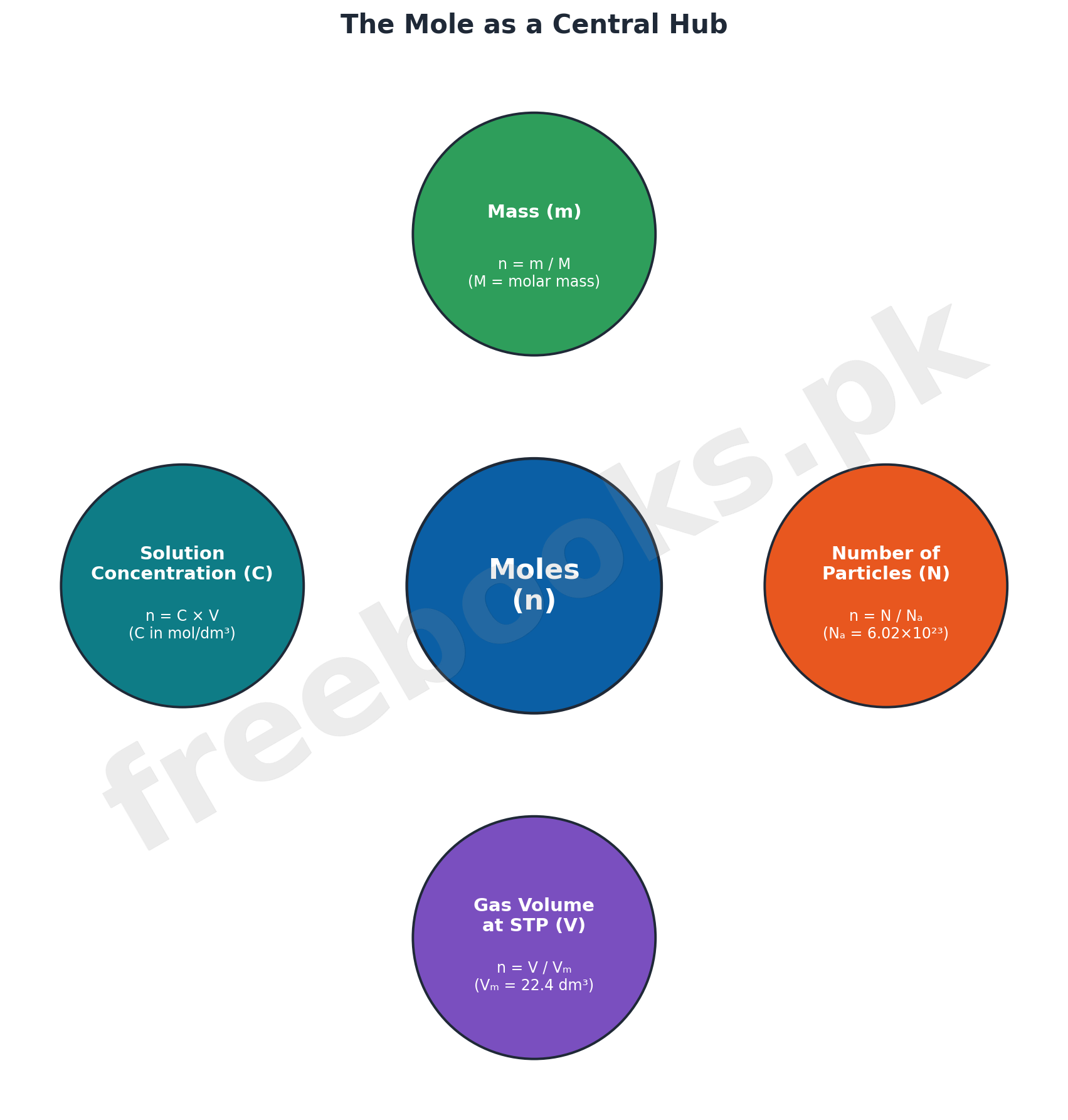
The mole links four otherwise very different quantities, mass (via molar mass), number of particles (via Avogadro's number), gas volume at STP (via molar volume, 22.4 dm3/mol), and solution concentration (via molar concentration), so that any one of them can be converted into moles and then, using the ratios locked into a balanced equation, into the moles, and then the mass, volume, or concentration, of any other substance in the reaction. The chapter closes with three practical extensions of this idea: identifying the limiting reactant that caps how much product can form, comparing theoretical and actual yield through percentage yield, and recognizing why precise stoichiometric control is essential in the production and dosing of medicine.
Learning Objectives
- Derive measurements of mass, volume, and number of particles using moles
- State and use the volume of one mole of a gas at STP to solve mole-volume problems
- Calculate the molar mass of a gas from its density at STP
- Express balanced chemical equations in terms of moles, particles, masses, and gas volumes at STP
- Explain the concept of a limiting reagent and identify it from given reactant quantities
- Calculate the maximum amount of product and the amount of unreacted excess reagent
- Calculate theoretical yield, actual yield, and percentage yield
- Calculate the quantities of reactants and products involved in a reaction using stoichiometric principles
- Explain, with examples, the importance of stoichiometry in the production and dosage of medicine
- Perform mole-mole, mass-mass, volume-volume, mole-mass, mole-volume, and mass-volume stoichiometric conversions
Key Concepts
4.1 The Mole Concept and Molar Mass
A mole is the amount of substance containing as many elementary entities, atoms, molecules, ions, or other particles, as there are atoms in exactly 12 g of carbon-12; this number, Avogadro's number, is 6.02 x 10^23 per mole. Chemists use the mole as their standard counting unit because atoms and molecules are far too small and numerous to count individually, but a mole of any substance always contains exactly this same number of particles, whatever the substance.
The molar mass of a substance, the mass of one mole expressed in grams, is numerically equal to its atomic, molecular, formula, or ionic mass and is found by summing the masses of its component atoms; for example, the molar mass of CCl4 is (1 x 12.0) + (4 x 35.5) = 154.0 g/mol. The number of moles in a given mass of a substance is then found from n = m/M, where m is the given mass and M is the molar mass — for instance, 20 g of NaOH (molar mass 40 g/mol) is 20/40 = 0.5 mol.
4.2 Mole-Particle-Mass Relationships
Although one mole of any substance always contains the same number of particles, Avogadro's number, different substances need very different masses to reach that one mole, since the mole simply counts particles while mass reflects how heavy each individual particle is: 1.0 g of hydrogen, 23.0 g of sodium, and 238.0 g of uranium each contain exactly one mole, 6.02 x 10^23 atoms, because a uranium atom is 238 times heavier than a hydrogen atom. The number of moles in a sample can equally be found from its particle count using n = (number of particles) / NA, and this relationship applies identically to atoms, molecules, formula units, or ions — one mole of SO4 2- ions, for example, contains 6.02 x 10^23 ions, just as one mole of water contains 6.02 x 10^23 molecules.
4.3 Molar Volume of Gases at STP
The molar volume is the volume occupied by one mole of any ideal gas at standard temperature and pressure (STP), and its value, 22.4 dm3, is the same for every gas regardless of its identity, a direct consequence of Avogadro's law that equal volumes of gases at the same temperature and pressure contain equal numbers of molecules. This gives a single powerful equivalence at STP: 22.4 dm3 of any gas equals its molar mass in grams equals 6.02 x 10^23 molecules equals one mole, so the volume of a gas sample at STP can be found directly from its number of moles using V = n x Vm, and conversely the number of moles can be found from a known volume.
4.4 Molar Mass and Density of Gases
Since one mole of every ideal gas occupies the same volume at STP, a gas's density, its mass per unit volume, depends directly on its molar mass: gases with larger, heavier molecules are denser than gases with smaller, lighter ones at the same conditions. This relationship means that measuring the density of an unknown gas at STP is enough to calculate its molar mass, using molar mass = density x molar volume; a gas with a density of 1.97 g/dm3 at STP, for example, has a molar mass of 1.97 x 22.4 = 44.1 g/mol.
4.5 Molar Concentration of Solutions
Molar concentration expresses how many moles of a dissolved substance are present per unit volume of solution, in units of mol/dm3, and is calculated as C = n/V, where n is the number of moles of solute and V is the volume of solution in dm3; rearranged, this also gives n = C x V, letting the number of moles in a solution of known concentration and volume be calculated directly. This relationship is essential for solution stoichiometry, since reactions in aqueous solution are far more commonly measured out by volume and concentration than by mass.
4.6 Stoichiometric Relationships from Balanced Equations
A balanced chemical equation encodes several equivalent relationships simultaneously: for N2 + 3H2 -> 2NH3, one can equally say that 1 mole of N2 reacts with 3 moles of H2 to form 2 moles of NH3, that 1 molecule reacts with 3 molecules to form 2 molecules, that 22.4 dm3 of N2 reacts with 67.2 dm3 of H2 to form 44.8 dm3 of NH3 at STP, or that 28.0 g of N2 reacts with 6.0 g of H2 to form 34.0 g of NH3. Six distinct types of stoichiometric calculation follow from these relationships: mole-mole, mass-mass, volume-volume, mole-mass, mole-volume, and mass-volume, and all rest on the same three assumptions, that reactants convert completely to products, that mass is conserved, and that no side reactions occur.
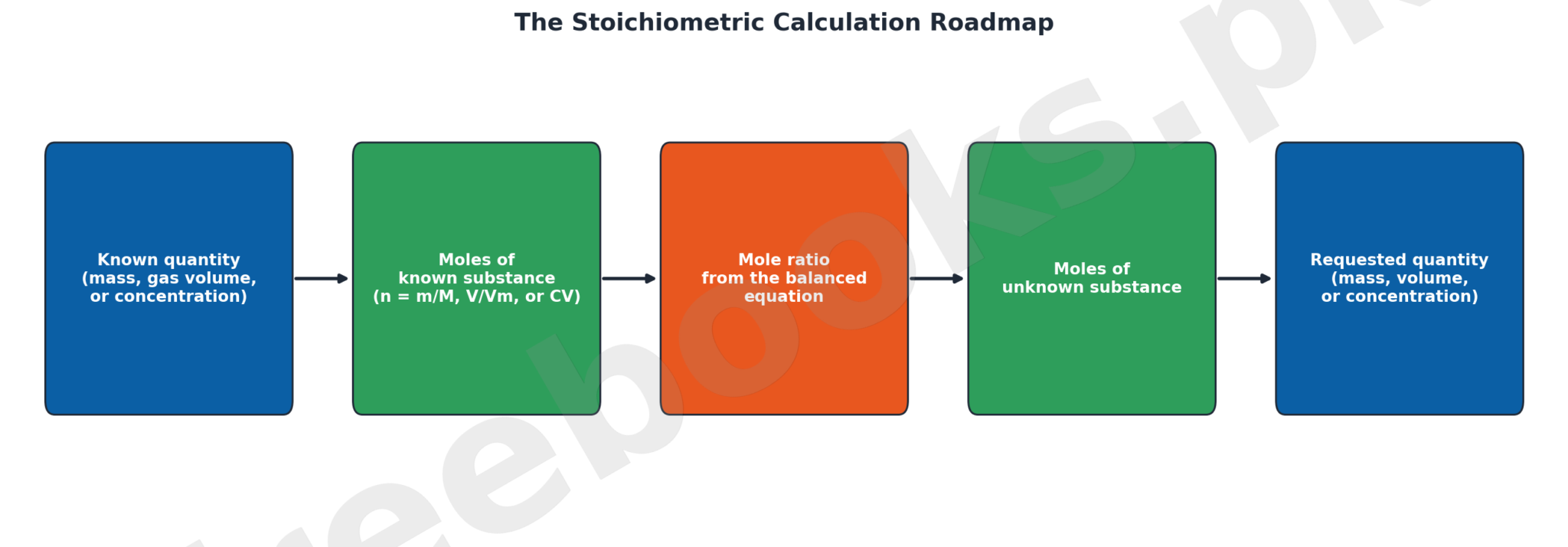
Every stoichiometric calculation follows the same general path regardless of which quantities are given or asked for: first, convert the known quantity, mass, gas volume, or solution concentration, of a known substance into moles using the relevant formula (n = m/M, n = V/Vm, or n = CV); second, use the mole ratio from the balanced equation to find the moles of the unknown substance; and third, convert those moles of the unknown back into whatever quantity, mass, volume, or concentration, the question asks for.
4.7 Limiting and Excess Reactants
Reactants in a real reaction mixture are rarely present in the exact ratio given by the balanced equation; the reactant that is completely consumed first is called the limiting reactant, and it determines the maximum amount of product that can form, since the reaction simply stops once the limiting reactant runs out, regardless of how much of the other reactant, the excess reactant, remains. Excess reactant is often deliberately supplied in large amounts to ensure that a more expensive or reaction-critical reactant is fully converted, to maximize product yield, or to speed up the reaction.
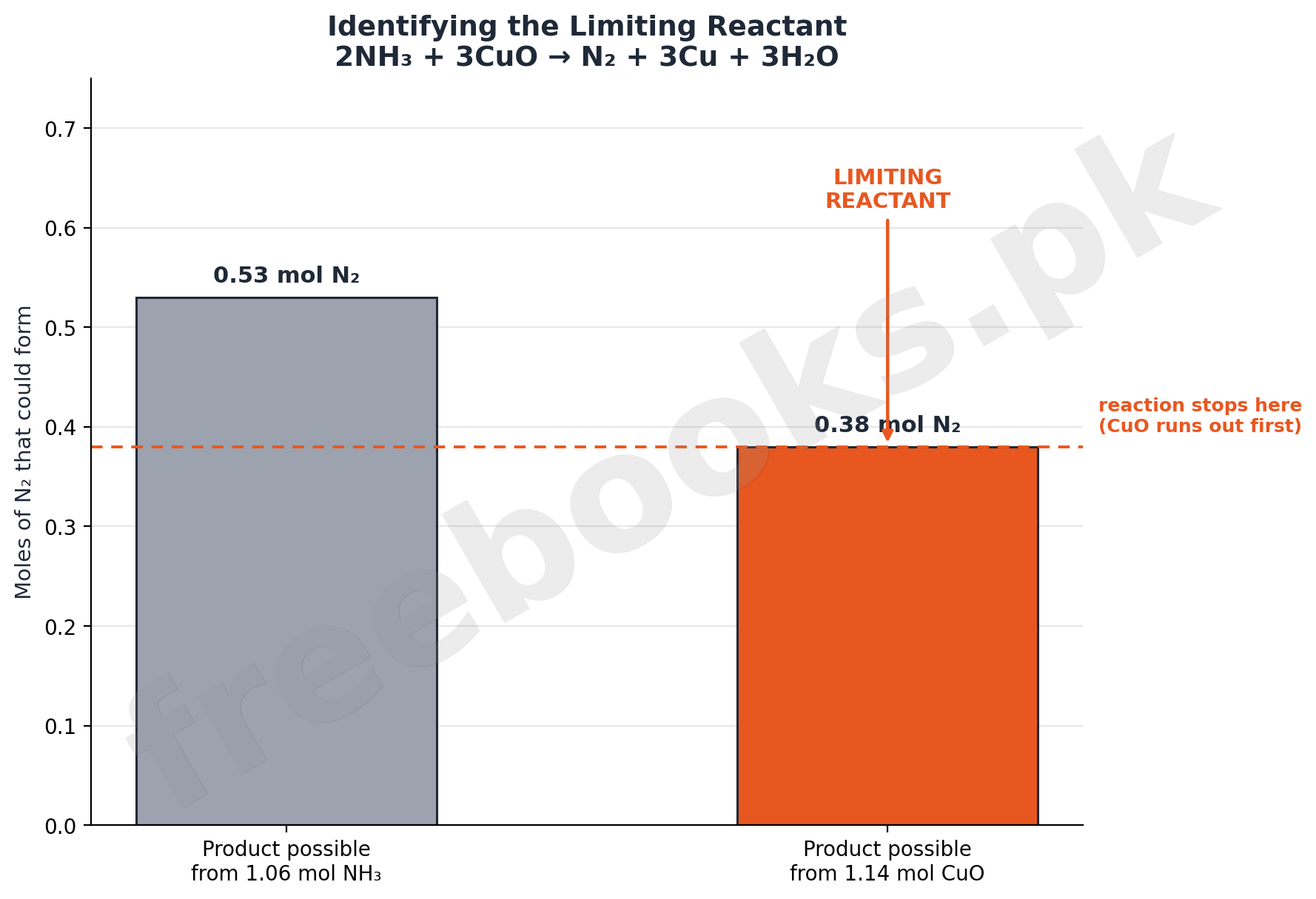
The limiting reactant is identified by calculating, from the moles of each reactant actually available, how much product each one alone could theoretically produce using the balanced equation's mole ratios; whichever reactant yields the smaller amount of product is the limiting reactant, since it will run out first and cap the reaction at that lower amount. Once the limiting reactant is identified, the same mole ratio can be used in reverse to calculate exactly how much of the excess reactant was actually consumed, and subtracting this from the amount originally supplied gives the mass of excess reactant left over.
4.8 Theoretical Yield, Actual Yield, and Percentage Yield
Theoretical yield is the maximum amount of product a reaction can produce, calculated directly from the balanced equation and the amount of limiting reactant, while actual yield is the amount of product actually recovered in practice, and it is almost always smaller because of incomplete reactions, competing side reactions, reversible reactions running backward, or losses during purification steps like filtration, distillation, or crystallization. The efficiency of a reaction is expressed as its percentage yield, calculated as (actual yield / theoretical yield) x 100, with a higher percentage yield indicating a more efficient reaction.
4.9 Importance of Stoichiometry in Medicine
Precise stoichiometric control is essential throughout the production and dosing of medicine, since a drug typically has no therapeutic effect when under-dosed but can become toxic or fatal when over-dosed. Stoichiometric principles ensure that antibiotic doses match their target bacteria, allow accurate measurement of cholesterol and blood glucose levels for diagnosis and insulin dosing, are used in doping tests to detect steroids and stimulants in athletes' urine, ensure vaccines contain the correct concentration of viral antigen, and guarantee that medicines such as paracetamol are dosed accurately, since an overdose can cause severe, even fatal, organ damage.
Important Definitions
What is a mole?
The amount of substance containing 6.02 x 10^23 (Avogadro's number) elementary entities, the same number of atoms as in 12 g of carbon-12.
What is molar mass?
The mass of one mole of a substance, expressed in g/mol, numerically equal to its atomic, molecular, or formula mass.
What is Avogadro's number?
The number of elementary entities contained in one mole of any substance, equal to 6.02 x 10^23 per mole.
What is molar volume?
The volume occupied by one mole of any ideal gas at STP, equal to 22.4 dm3.
What is molar concentration?
The number of moles of solute dissolved per dm3 of solution, expressed in mol/dm3.
What is a limiting reactant?
The reactant that is completely consumed first in a reaction, capping the maximum amount of product that can form.
What is an excess reactant?
The reactant that remains partially unreacted once the limiting reactant has been fully used up.
What is theoretical yield?
The maximum amount of product calculable from the balanced equation and the amount of limiting reactant available.
What is actual yield?
The amount of product actually obtained when a reaction is carried out in practice.
What is percentage yield?
Actual yield divided by theoretical yield, multiplied by 100, expressing how efficiently a reaction converts reactants into product.
Key Facts and Relations
| Topic | Key Fact / Relation |
|---|---|
| Number of moles from mass | n = m / M |
| Mass from number of moles | m = n x M |
| Number of moles from particle count | n = N / NA (NA = 6.02 x 10^23 /mol) |
| Molar volume at STP | Vm = 22.4 dm3/mol |
| Volume of a gas at STP | V = n x Vm |
| Molar mass from gas density | Molar mass = density x Vm |
| Molar concentration | C = n / V, so n = C x V |
| Percentage yield | % Yield = (Actual yield / Theoretical yield) x 100 |
| STP equivalence | 22.4 dm3 of any gas = its molar mass in g = 6.02 x 10^23 molecules = 1 mole |
| Limiting reactant rule | The reactant that produces the LEAST amount of product, by calculation, is the limiting reactant |
Diagrams
The Stoichiometric Calculation Roadmap: A flowchart showing the standard path for any stoichiometry problem: a known mass, gas volume, or concentration is converted to moles, then to moles of the unknown substance using the balanced equation's mole ratio, then converted to the requested mass, volume, or concentration
The Mole as a Central Hub: A hub-and-spoke diagram showing how the mole connects mass (via molar mass), number of particles (via Avogadro's number), gas volume at STP (via molar volume), and solution concentration (via C = n/V)
Identifying the Limiting Reactant: A bar comparison showing how much product two different reactants in the reaction 2NH3 + 3CuO could each produce if they reacted completely, with the smaller value identifying CuO as the limiting reactant and the reaction stopping there
Short Questions & Answers
Why do 1.0 g of hydrogen and 23.0 g of sodium both contain the same number of atoms?
Both quantities represent exactly one mole, and one mole of any element always contains Avogadro's number of atoms, 6.02 x 10^23; sodium simply requires 23 times more mass than hydrogen to reach one mole, because a single sodium atom is 23 times heavier than a single hydrogen atom.
Why do 4 g of helium, 17 g of ammonia, and 64 g of sulfur dioxide all occupy 22.4 dm3 at STP, despite having very different molecular masses?
According to Avogadro's law, equal volumes of gases at the same temperature and pressure contain equal numbers of molecules, regardless of what the gas is; since each of these masses represents exactly one mole of its respective gas, each one contains Avogadro's number of molecules and therefore occupies the same molar volume, 22.4 dm3, at STP.
How can the molar mass of an unknown gas be found from its density at STP?
Since one mole of any gas occupies 22.4 dm3 at STP, multiplying the gas's density, mass per dm3, by the molar volume, 22.4 dm3/mol, gives the mass of one mole directly, which is the molar mass.
What is the difference between a limiting reactant and an excess reactant?
The limiting reactant is completely consumed first and therefore determines the maximum amount of product that can form; the excess reactant is supplied in a greater amount than stoichiometrically required and has some quantity left unreacted once the limiting reactant runs out.
Why is excess reactant often deliberately used in industrial reactions?
Supplying a large, often inexpensive, excess of one reactant helps ensure that a more expensive or critical reactant is converted as completely as possible, maximizes the amount of product formed, and can also increase the rate of reaction.
How is the limiting reactant identified when given the masses of two reactants?
Convert each reactant's mass to moles, then use the balanced equation's mole ratios to calculate how much product each reactant could produce on its own if it reacted completely; the reactant that yields the smaller amount of product is the limiting reactant, since it runs out first.
Why is the actual yield of a reaction usually less than its theoretical yield?
Actual yield falls short of theoretical yield because of losses during purification steps like filtration or crystallization, because some reactant may be diverted into a competing side reaction, or because a reversible reaction runs partly backward, reducing the net amount of product formed.
How is percentage yield calculated, and what does a higher value indicate?
Percentage yield equals actual yield divided by theoretical yield, multiplied by 100; a higher percentage yield indicates a more efficient reaction, with less product lost to side reactions, incomplete conversion, or purification losses.
Why is precise stoichiometry critical when dosing a medicine like paracetamol?
A medicine typically has no therapeutic effect if under-dosed, but can become toxic, causing effects such as severe liver damage, if over-dosed; stoichiometric calculations ensure that each dose contains precisely the amount of active ingredient needed to be both effective and safe.
Why does 22.4 dm3 of CO2 at STP have the same number of molecules as 22.4 dm3 of H2 at STP, despite CO2 being a much heavier molecule?
Avogadro's law states that equal volumes of any gas at the same temperature and pressure contain equal numbers of molecules, regardless of the individual molecule's mass or size; molar volume depends only on the number of gas particles present, not on their identity or mass.
Long Questions & Answers
Describe the mole concept and explain how it connects mass, number of particles, and gas volume, using worked relationships.
What is the mole, and why do chemists use it?
A mole is the amount of substance containing as many elementary entities as there are atoms in exactly 12 g of carbon-12, a fixed number known as Avogadro's number, 6.02 x 10^23. Chemists use it because atoms and molecules are too small and numerous to count directly, and the mole provides a convenient, universal counting unit that works identically for atoms, molecules, ions, or any other particle.
How is the number of moles calculated from a given mass?
The number of moles is found using n = m/M, where m is the given mass of the substance and M is its molar mass in g/mol; for example, 20 g of NaOH, with a molar mass of 40 g/mol, contains 20/40 = 0.5 mol.
How is the number of moles related to the number of particles?
The number of moles equals the number of particles divided by Avogadro's number, n = N/NA; this relationship holds for atoms, molecules, formula units, or ions alike, since one mole of any of these always contains exactly 6.02 x 10^23 particles.
How is the number of moles of a gas related to its volume at STP?
At standard temperature and pressure, one mole of any ideal gas occupies 22.4 dm3, the molar volume; the volume of a gas sample is therefore found using V = n x Vm, and conversely the number of moles can be calculated from a measured volume by dividing by 22.4 dm3/mol.
How can molar mass be determined from a gas's density at STP?
Since density is mass per unit volume, and one mole of any gas occupies the same 22.4 dm3 at STP, multiplying a gas's density at STP by the molar volume gives the mass of exactly one mole, which is its molar mass: molar mass = density x 22.4 dm3/mol.
Explain how to identify the limiting reactant in a reaction and how to calculate the theoretical, actual, and percentage yield of a reaction.
What is a limiting reactant, and why does it control the amount of product formed?
The limiting reactant is the reactant that is completely consumed first during a reaction; because a reaction stops once any one reactant runs out, the amount of product that can form is capped by however much of that limiting reactant was available, regardless of how much of the other, excess, reactant remains.
What steps are used to identify the limiting reactant from given reactant quantities?
First, convert the given mass, or volume, or concentration and volume, of each reactant into moles. Second, use the balanced equation's mole ratios to calculate how many moles of product each reactant could produce on its own, assuming it reacted completely. Third, compare these values: the reactant that yields the smaller amount of product is the limiting reactant.
How is the mass of excess reactant remaining after a reaction calculated?
Once the limiting reactant is identified, its mole ratio with the excess reactant, from the balanced equation, is used to calculate how many moles of the excess reactant were actually consumed during the reaction; subtracting this consumed amount from the excess reactant's original number of moles, then converting to mass, gives the mass of excess reactant left over.
What is the difference between theoretical yield and actual yield?
Theoretical yield is the maximum amount of product that calculation from the balanced equation and the limiting reactant predicts should form; actual yield is the amount of product actually recovered when the reaction is carried out in the laboratory or industrially, and is almost always somewhat lower due to side reactions, reversibility, or purification losses.
How is percentage yield calculated, and why is it a useful measure?
Percentage yield is calculated as actual yield divided by theoretical yield, multiplied by 100; it is useful because it expresses, as a single comparable number, how efficiently a reaction converts its reactants into the desired product, letting chemists compare the efficiency of different reaction conditions or procedures.
Multiple Choice Questions (MCQs)
Which of the following statements about one mole of ozone gas, O3, is correct? (A) It contains Avogadro's number of O3 molecules (B) It contains half of Avogadro's number of O3 molecules (C) It contains twice Avogadro's number of O3 molecules (D) It contains no fixed number of molecules
Correct answer: (A) It contains Avogadro's number of O3 molecules. One mole of any substance, including ozone gas, always contains exactly Avogadro's number, 6.02 x 10^23, of its formula unit, in this case O3 molecules.
Which of the following samples has the greatest mass? (molar masses: N2 = 28, NH3 = 17, He = 4, CO2 = 44 g/mol) (A) 0.5 mol of N2 (B) 0.5 mol of NH3 (C) 0.5 mol of He (D) 0.5 mol of CO2
Correct answer: (D) 0.5 mol of CO2. Mass = moles x molar mass; with equal moles, 0.5 mol, the sample with the highest molar mass, CO2 at 44 g/mol, has the greatest mass, 22 g.
Which of the following gas samples has the greatest volume at STP? (molar masses: CO2 = 44, N2O = 44, CO = 28, N2 = 28 g/mol) (A) 22 g of CO2 (B) 88 g of N2O (C) 28 g of CO (D) 28 g of N2
Correct answer: (B) 88 g of N2O. Converting each to moles: 22 g CO2 = 0.5 mol, 88 g N2O = 2.0 mol, 28 g CO = 1.0 mol, 28 g N2 = 1.0 mol; since volume at STP is proportional to moles, 88 g of N2O, 2.0 mol, has the greatest volume.
A container holds 0.5 moles of an ideal gas at STP. What is its volume? (A) 11.2 dm3 (B) 22.4 dm3 (C) 44.8 dm3 (D) 12.2 dm3
Correct answer: (A) 11.2 dm3. V = n x Vm = 0.5 mol x 22.4 dm3/mol = 11.2 dm3.
A solution contains 4.0 g of NaOH, molar mass 40 g/mol, in 250 cm3 of solution. What is its molar concentration? (A) 0.10 mol/dm3 (B) 0.20 mol/dm3 (C) 0.40 mol/dm3 (D) 0.80 mol/dm3
Correct answer: (C) 0.40 mol/dm3. Moles of NaOH = 4.0/40 = 0.1 mol; volume = 0.250 dm3; C = n/V = 0.1/0.250 = 0.40 mol/dm3.
A gas has a density of 1.43 g/dm3 at STP. What is its molar mass? (A) 14.3 g/mol (B) 22.4 g/mol (C) 32.0 g/mol (D) 64.0 g/mol
Correct answer: (C) 32.0 g/mol. Molar mass = density x molar volume = 1.43 g/dm3 x 22.4 dm3/mol = 32.0 g/mol.
In the reaction N2 + 3H2 -> 2NH3, if 2 moles of N2 and 3 moles of H2 are mixed, which reactant is limiting? (A) N2 (B) H2 (C) Neither, they react completely (D) Cannot be determined
Correct answer: (B) H2. 2 mol N2 would require 6 mol H2 to react completely, but only 3 mol H2 is available; H2 therefore runs out first and is the limiting reactant.
Which of the following best describes the theoretical yield of a reaction? (A) The amount of product actually recovered in the lab (B) The maximum amount of product calculated from the balanced equation (C) The amount of excess reactant remaining (D) The percentage efficiency of the reaction
Correct answer: (B) The maximum amount of product calculated from the balanced equation. Theoretical yield is the maximum amount of product predicted by stoichiometric calculation from the balanced equation and the limiting reactant, before accounting for real-world losses.
A reaction has a theoretical yield of 10.0 g and an actual yield of 7.5 g. What is the percentage yield? (A) 25% (B) 75% (C) 1.33% (D) 133%
Correct answer: (B) 75%. Percentage yield = (actual/theoretical) x 100 = (7.5/10.0) x 100 = 75%.
Why is stoichiometric precision especially critical in drug dosage, such as with paracetamol? (A) Because drugs are always more effective in larger doses (B) Because an underdose or overdose can be ineffective or dangerously toxic (C) Because stoichiometry only applies to solid drugs (D) Because drug reactions do not follow the law of conservation of mass
Correct answer: (B) Because an underdose or overdose can be ineffective or dangerously toxic. A medicine typically produces no therapeutic effect if underdosed but can be toxic or even fatal if overdosed, making precise stoichiometric control of the active ingredient essential.
Quick Revision Summary
- Mole = amount of substance containing Avogadro's number, 6.02 x 10^23, of elementary entities
- Molar mass (M) = mass of 1 mole in g/mol; n = m/M
- n = N/NA relates moles to number of particles
- Molar volume (Vm) = 22.4 dm3/mol for any ideal gas at STP (Avogadro's law); V = n x Vm
- Molar mass from gas density: molar mass = density x Vm
- Molar concentration: C = n/V (mol/dm3); n = C x V
- STP equivalence: 22.4 dm3 of any gas = molar mass in g = 6.02 x 10^23 molecules = 1 mole
- Stoichiometric calculation path: known quantity -> moles -> mole ratio from equation -> moles of unknown -> requested quantity
- 6 types of stoichiometric relationships: mole-mole, mass-mass, volume-volume, mole-mass, mole-volume, mass-volume
- Limiting reactant: consumed first, caps maximum product; excess reactant: remains unreacted
- Identify limiting reactant by comparing product yield calculated from each reactant separately; smaller value wins
- Theoretical yield = maximum product from calculation; actual yield = product actually obtained (usually less)
- % Yield = (actual yield / theoretical yield) x 100
- Stoichiometry is essential in medicine: dosing accuracy, antibiotic potency, blood glucose/cholesterol testing, vaccine antigen concentration
Exam Tips
- Always convert every given quantity to moles FIRST, no matter what units the question gives, mass, volume, concentration, or particle count — moles are the universal bridge between all stoichiometric quantities
- For limiting reactant problems, never assume the reactant with the smaller mass or fewer moles is automatically limiting — always calculate how much product each reactant would produce and compare
- Remember molar volume, 22.4 dm3/mol, applies ONLY at STP — don't use it for gas volumes at other temperatures or pressures
- For percentage yield questions, always calculate theoretical yield using the limiting reactant, never the excess reactant
- Keep track of units carefully throughout multi-step conversions, g, mol, dm3, mol/dm3 — most stoichiometry errors come from dropped or mismatched units, not wrong formulas
- Practice the standard roadmap, quantity -> moles -> mole ratio -> moles of unknown -> requested quantity, until it becomes automatic; nearly every numerical question in this chapter follows this same shape