Hydrocarbons are organic compounds composed of only carbon and hydrogen, and are broadly divided into aliphatic hydrocarbons, which include the open-chain and cyclic families of alkanes and cycloalkanes as well as the unsaturated alkenes and alkynes, and aromatic hydrocarbons, a special class of cyclic compounds based on benzene. Alkanes are saturated hydrocarbons named systematically through a fixed set of IUPAC rules, adopt a tetrahedral shape around each sp3 carbon, and are largely unreactive toward polar reagents because of their strong, non-polar sigma bonds, reacting mainly through free radical substitution mechanisms such as halogenation, which proceeds through initiation, propagation, and termination steps.
Alkenes, by contrast, are unsaturated hydrocarbons containing a reactive carbon-carbon double bond formed from sp2 hybridized carbons, and undergo electrophilic addition reactions readily because their loosely held pi electrons are exposed to attack by electrophiles; reactions such as halogenation, hydrohalogenation, hydrogenation, hydration, halohydration, epoxidation, ozonolysis, and polymerization all proceed through a carbocation intermediate whose stability, and therefore the reaction's regiochemistry as summarized by Markovnikov's rule, depends on the electron-donating inductive effect of attached alkyl groups. This chapter also introduces conjugated dienes, the concept of isomerism in its structural and stereochemical forms, and organic oxidation-reduction reactions, rounding out the essential framework for understanding hydrocarbon reactivity.
Learning Objectives
- Classify hydrocarbons as aliphatic and aromatic, and describe the nomenclature of alkanes and cycloalkanes
- Explain the tetrahedral shape of alkanes and cycloalkanes, exemplified by ethane and cyclopropane, and explain the unreactive nature of alkanes toward polar reagents
- Define homolytic and heterolytic fission, and describe free radical initiation, propagation, and termination in the substitution of alkanes by halogens
- Identify organic redox reactions and explain the nomenclature of alkenes using the IUPAC system
- Explain the shape of the ethene molecule in terms of sigma and pi carbon-carbon bonds, and describe the structure and reactivity of alkenes
- Explain the terms isomerism, structural isomerism, and stereoisomerism with suitable examples
- Explain the dehydration of alcohols and dehydrohalogenation of alkyl halides for the preparation of ethene
- Describe the chemistry of alkenes through hydrogenation, hydrohalogenation, hydration, halogenation, halohydration, epoxidation, ozonolysis, and polymerization reactions of ethene
- Explain the concept of conjugation in alkenes with alternating double bonds, and describe the mechanism of electrophilic addition using bromine/ethene and hydrogen bromide/propene as examples
- Explain the inductive effect of alkyl groups on the stability of primary, secondary, and tertiary carbocations, and use this to explain Markovnikov addition
Key Concepts
11.1 Aliphatic and Aromatic Hydrocarbons
Hydrocarbons are broadly divided into two classes: aliphatic and aromatic. Compounds that are not aromatic are called aliphatic hydrocarbons; they may be open-chain or cyclic, and saturated or unsaturated. Alkanes are acyclic aliphatic hydrocarbons, cycloalkanes are cyclic aliphatic hydrocarbons, and alkenes and alkynes are acyclic, unsaturated aliphatic hydrocarbons.
Aromatic hydrocarbons are a special class of cyclic hydrocarbons with a high carbon-to-hydrogen ratio, based on benzene (C6H6) or resembling compounds; benzene is the parent aromatic compound, with toluene and phenol among its derivatives. The term 'aromatic' derives from the Greek word for fragrance, reflecting the characteristic odour of many early-studied members of this class.
11.2 Nomenclature of Alkanes and Cycloalkanes
Alkanes (paraffins) are saturated hydrocarbons with general formula CnH2n+2, with methane (CH4) the simplest member; successive members (ethane, propane, butane, pentane, and so on) each add one CH2 unit. Removing one hydrogen atom from an alkane gives an alkyl group, named by replacing the '-ane' ending with '-yl' (e.g., methane becomes methyl, ethane becomes ethyl); alkanes with three or more carbons can yield more than one possible alkyl group (e.g., n-propyl and isopropyl from propane).
Branched alkanes are named systematically by locating the longest continuous carbon chain as the parent name; numbering the chain from the end nearer a substituent; using these numbers to specify substituent positions, with the substituent name placed before the parent name; listing multiple substituents alphabetically (ignoring multiplying prefixes like di- and tri-); repeating a locant number when two substituents share one carbon; and using di-, tri-, tetra- prefixes for identical repeated substituents. When two chains of equal length compete as the parent chain, the one with more substituents is chosen; when branching starts at equal distance from both ends, the numbering giving the lower locant at the first point of difference is used. Cycloalkanes are named by attaching the prefix 'cyclo' to the alkane name with the same number of ring carbons.
11.3 Shapes and Physical Properties of Alkanes and Cycloalkanes
Each carbon in an alkane is sp3 hybridized, forming four single sigma bonds equidistant from each other, giving alkane molecules a tetrahedral shape with bond angles of 109.5 degrees and a C-C bond length of 1.54 angstroms. Cycloalkanes are cyclic and saturated, with all ring carbons singly bonded; cyclopropane, cyclobutane, and cyclopentane are common examples.
Alkanes with up to four carbons are gases, C5 to C17 are liquids, and C18 and above are waxy solids; alkanes are colourless, odourless, non-polar or very weakly polar, insoluble in water but soluble in non-polar solvents such as hexane and benzene. Boiling points, melting points, and density increase with increasing carbon number, while solubility decreases with increasing molecular mass; branched-chain alkanes have lower boiling points than their straight-chain isomers, since straight chains pack more closely and experience stronger intermolecular forces.
11.4 Bond Fission, Unreactive Nature of Alkanes, and Free Radical Substitution
Covalent bonds can break in two ways: homolytic fission, in which the bond breaks evenly to produce two free radicals (species with an unpaired electron, very reactive because of the drive to pair that electron), and heterolytic fission, in which the shared electron pair is retained entirely by one atom, producing oppositely charged ions. Alkanes are largely inert toward acids, alkalis, and oxidizing or reducing agents under ordinary conditions, because the electronegativities of carbon (2.5) and hydrogen (2.1) are similar, making C-H and C-C bonds nearly non-polar, and because sigma bonds hold their electrons tightly, making them strong and hard to break.
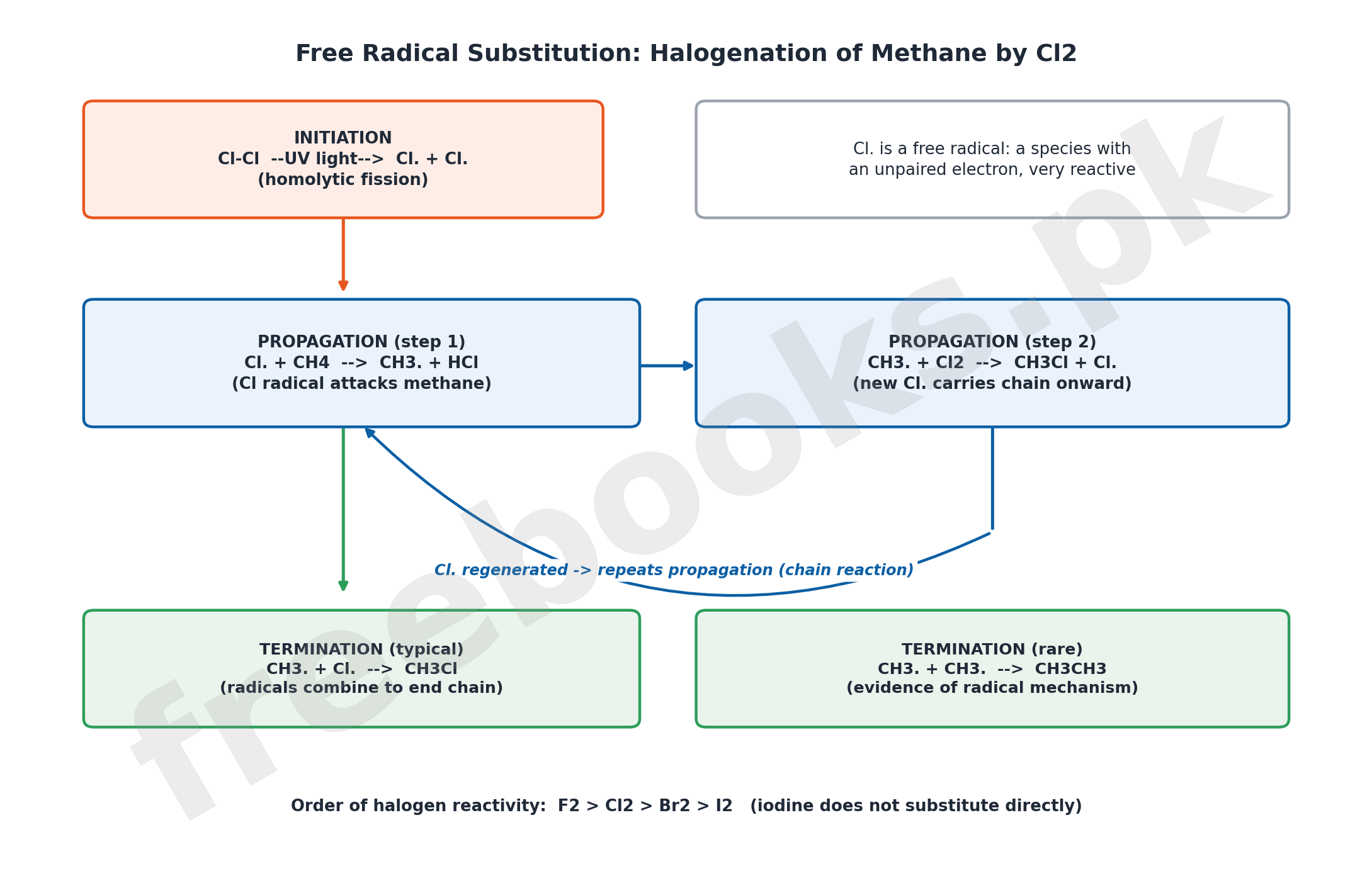
Under suitable conditions, alkanes undergo thermal/catalytic reactions such as combustion and cracking, and free radical substitution reactions, in which one atom or group is replaced by another via a free-radical mechanism; halogenation (reaction with Cl2 or Br2 in sunlight or UV light) is the classic example, and proceeds in three steps: initiation, in which UV light homolytically breaks the halogen-halogen bond to form two halogen radicals; propagation, in which a halogen radical abstracts a hydrogen from the alkane to form an alkyl radical and HX, and the alkyl radical then reacts with another halogen molecule to form the haloalkane product and regenerate a halogen radical, sustaining a chain reaction; and termination, in which two radicals combine (most often an alkyl radical with a halogen radical, or occasionally two alkyl radicals, giving a rare double-carbon alkane byproduct that provides direct evidence of the radical mechanism). Halogen reactivity follows the order F2 > Cl2 > Br2 > I2, with fluorine reacting violently and iodine not substituting directly because the reaction is too slow and reversible.
11.5 Nomenclature and Preparation of Alkenes
Alkenes are unsaturated hydrocarbons containing at least one carbon-carbon double bond, with general formula CnH2n, having two fewer hydrogens than the corresponding alkane. IUPAC naming follows rules similar to alkanes: select the longest chain containing the C=C bond as the parent, changing the '-ane' ending to '-ene'; number the chain from the end nearer the double bond so both double-bond carbons get the lowest possible locants; designate the double bond's position using the locant of its first carbon as a prefix; and indicate substituent positions by the carbons to which they are attached.
Alkenes are prepared by elimination reactions, which remove a small molecule (such as H2O or HX) from adjacent carbons of a saturated compound to create a double bond. Ethene can be prepared by dehydration of ethanol, heating it with excess concentrated sulfuric acid at 180 degrees C (via an ethyl hydrogen sulfate intermediate that decomposes on heating), or by dehydrohalogenation of ethyl bromide, heating it with alcoholic KOH to remove H and Br from adjacent carbons.
11.6 Physical Properties, Structure, and Reactivity of Alkenes
The first three alkenes (ethene, propene, butene) are gases at room temperature, C5 to C15 are liquids, and higher members are solids; alkenes are insoluble in water but soluble in alcohol, have a characteristic smell, burn with a luminous flame, and show weak polarity due to sp2 hybridization (unlike the essentially non-polar alkanes).
In ethene, each carbon is sp2 hybridized, forming three coplanar sp2 orbitals (two used for C-H sigma bonds, one for a C-C sigma bond by linear overlap) plus one unhybridized p-orbital perpendicular to this plane on each carbon; lateral overlap of these two parallel p-orbitals forms a pi bond, giving the C=C double bond a sigma-plus-pi character, a trigonal planar geometry with roughly 120-degree bond angles, and a fully planar molecule. Because pi electrons lie away from the internuclear axis and are less firmly held than sigma electrons, the pi bond is comparatively weak and breaks easily, exposing alkenes to attack by electrophiles and making electrophilic addition their characteristic reaction.
11.7 Carbocations and the Inductive Effect
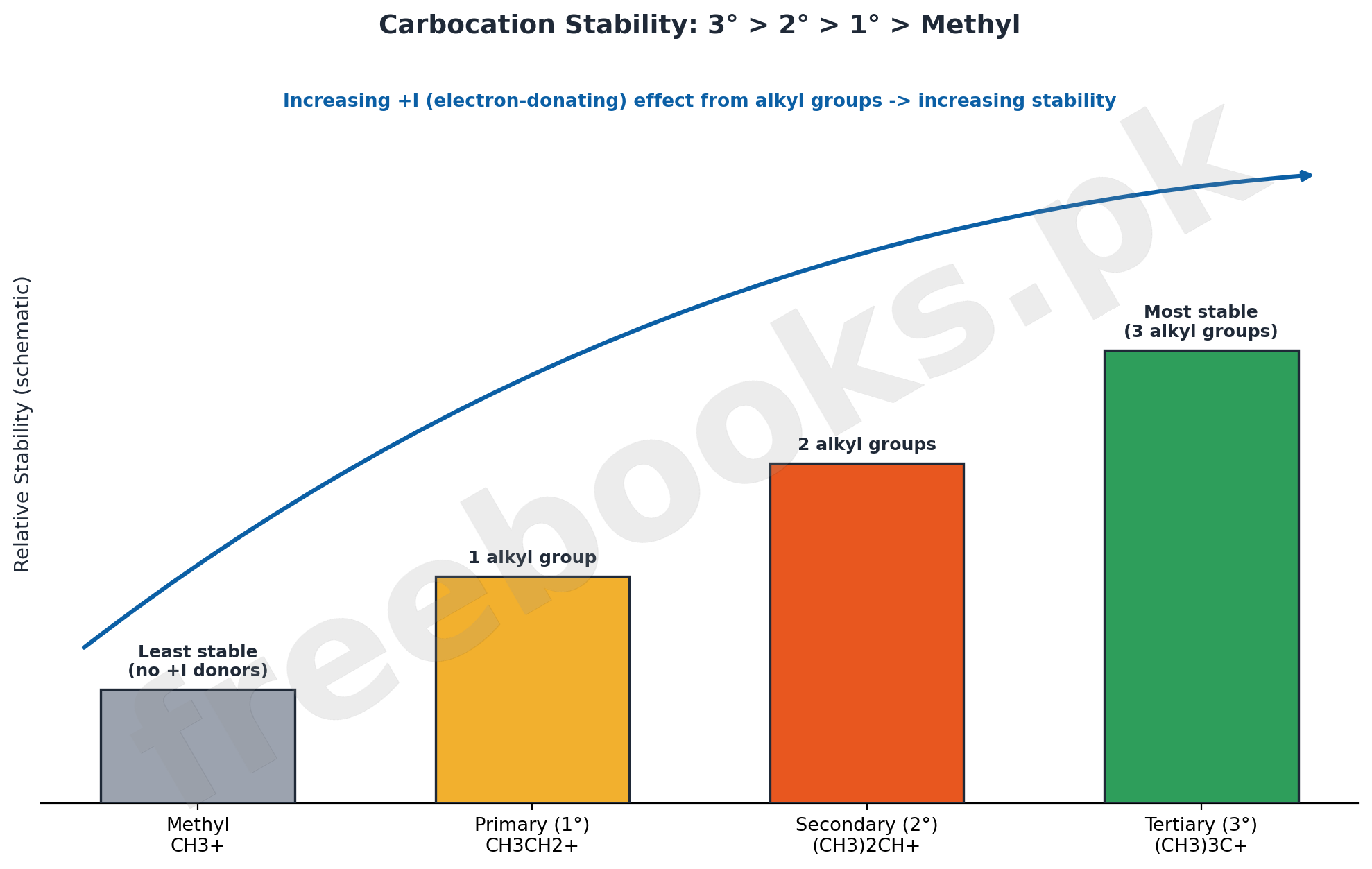
A carbocation is an alkyl species bearing a single positive charge on one carbon atom; carbocations are classified by how many carbon (alkyl) substituents are directly bonded to that positive carbon: none (methyl carbocation), one (primary, 1 degree), two (secondary, 2 degree), or three (tertiary, 3 degree). The inductive effect, the polarization of a sigma bond due to the electron-withdrawing or electron-donating character of neighbouring groups, governs carbocation stability: alkyl groups have a positive inductive effect (+I), donating electron density toward the positively charged carbon and thereby reducing its charge and increasing its stability, so stability increases with the number of attached alkyl groups, making tertiary carbocations the most stable and methyl carbocations the least stable (3 degree > 2 degree > 1 degree > methyl).
Electron-withdrawing groups, such as halogen atoms, show a negative inductive effect (-I): a halogen pulls bonded electrons away from the adjacent C-C bond, creating a permanent dipole in which the halogen carries a partial negative charge and the adjacent carbon becomes partially positive. This inductive withdrawal makes a nearby carbocation less stable, the opposite effect of an electron-donating alkyl group.
11.8 Electrophilic Addition Reactions of Alkenes
Alkenes react mainly through electrophilic addition, in which an electrophile adds across the C=C double bond. The C=C bond is a region of high electron density, making it attractive to electrophiles; in the generalized mechanism, an electrophile X+ first adds to the double bond to generate a carbocation intermediate, which is then attacked by a nucleophile Y- to give the final addition product.
In halogenation, bromine's own electron cloud is polarized as it approaches the electron-rich double bond, making the near bromine atom act as an electrophile that accepts a pair of pi electrons to form a carbocation intermediate, which the resulting bromide ion (nucleophile) then attacks to complete the addition, decolourizing bromine water and providing a simple test for unsaturation. In hydrohalogenation, a hydrogen halide's pi-bond-attacking hydrogen adds to one alkene carbon to form a carbocation, which the halide ion then attacks; for a symmetrical alkene like ethene only one product is possible, but for an unsymmetrical alkene like propene, Markovnikov's rule (the negative part of the reagent attaches to the carbon bearing fewer hydrogens) predicts that the more stable secondary carbocation forms preferentially, explaining why 2-bromopropane is the major product and 1-bromopropane the minor one.
11.9 Further Reactions of Alkenes: Hydrogenation to Polymerization
Hydrogenation adds molecular hydrogen across the double bond in the presence of a nickel or platinum catalyst at 250-300 degrees C to give a saturated alkane, an industrially important reaction used to convert vegetable oil into margarine. Hydration adds steam across the double bond in the presence of concentrated sulfuric acid catalyst to form an alcohol, proceeding through the same carbocation-intermediate mechanism as hydrohalogenation, while halohydration adds a halogen together with water to give a halohydrin.
Epoxidation converts an alkene into a three-membered cyclic ether (epoxide) using an oxidizing agent, and epoxides can be hydrolyzed under acidic conditions to diols. Ozonolysis oxidatively cleaves an alkene's double bond using ozone, forming an ozonide intermediate that is reduced to carbonyl compounds (aldehydes or ketones), a reaction useful for locating the position of a double bond in an unknown alkene. Polymerization (addition polymerization) joins many alkene monomers, each contributing one broken pi bond, into a long-chain polymer whose repeating unit matches the monomer with its C=C converted to a C-C single bond; ethene is polymerized industrially to make polyethylene, one of the world's most common plastics.
11.10 Conjugated Dienes
A diene is a molecule containing two C=C double bonds. In a conjugated diene, these double bonds are separated by exactly one single bond, allowing the p-orbitals on three or more consecutive carbon atoms to overlap; this extended overlap delocalizes the pi electrons across the whole conjugated system, which stabilizes the molecule and influences its reactivity compared to isolated (non-conjugated) dienes. Conjugated dienes such as 1,3-butadiene are industrially important as monomers for synthetic rubber, since their conjugated structure supports the polymerization needed to build long, rubber-like polymer chains.
11.11 Isomerism and Organic Redox Reactions
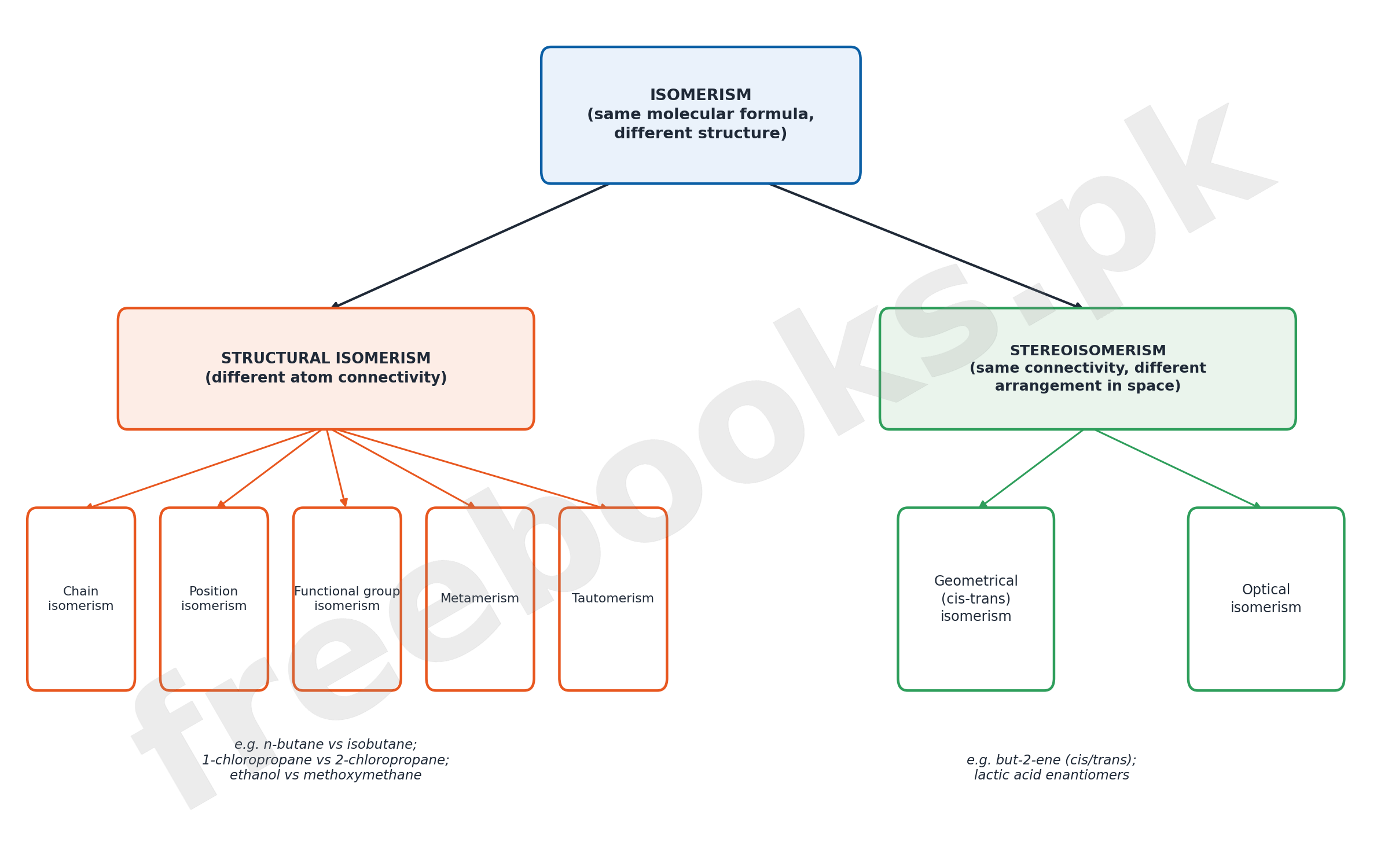
Isomers are two or more compounds sharing the same molecular formula but differing in structural formula and properties, a phenomenon called isomerism; the simplest hydrocarbon showing structural isomers is butane (C4H10), and the number of possible isomers rises rapidly as carbon number increases. Structural isomerism, arising from different atom connectivity, appears in five forms: chain isomerism (different carbon-chain branching, e.g., n-butane vs isobutane), position isomerism (same functional group at different chain positions, e.g., 1-chloropropane vs 2-chloropropane), functional group isomerism (same molecular formula, different functional groups, e.g., ethanol vs methoxymethane), metamerism (unequal carbon distribution on either side of a functional group within the same homologous series, e.g., diethyl ether vs methoxypropane), and tautomerism (a proton shifts between atoms within the same molecule, as seen in the zwitterion form of amino acids). Stereoisomerism, in which compounds share the same structural formula but differ in the spatial arrangement of identical groups, appears as geometrical (cis-trans) isomerism and optical isomerism.
Organic redox reactions involve the oxidation or reduction of organic compounds, generally recognized by the addition or removal of oxygen or hydrogen: oxidation typically adds oxygen or removes hydrogen (as in combustion, ozonolysis, epoxidation, or the oxidation of a primary alcohol to a carboxylic acid by acidified potassium dichromate), while reduction typically adds hydrogen or removes oxygen (as in the hydrogenation of a C=C double bond to an alkane, using reducing agents such as LiAlH4, NaBH4, or tin with concentrated HCl).
Important Definitions
What are aliphatic hydrocarbons?
Hydrocarbons that are not aromatic; they may be open-chain or cyclic, and saturated or unsaturated, and include alkanes, cycloalkanes, alkenes, and alkynes.
What is an alkyl group?
The group obtained by removing one hydrogen atom from an alkane, named by replacing the '-ane' ending of the alkane with '-yl'.
What is homolytic fission?
The breaking of a covalent bond evenly, so that each atom retains one electron of the shared pair, producing two free radicals.
What is heterolytic fission?
The breaking of a covalent bond unevenly, so that one atom retains both electrons of the shared pair, producing oppositely charged ions.
What is a free radical?
A species containing an unpaired electron, which is very reactive because of the unpaired electron's tendency to become paired.
What is Markovnikov's rule?
When a polar reagent adds to an unsymmetrical alkene, the negative part of the reagent attaches to the double-bonded carbon bearing the lesser number of hydrogens.
What is a carbocation?
An alkyl group bearing a single positive charge on one of its carbon atoms, classified as methyl, primary, secondary, or tertiary based on the number of attached alkyl groups.
What is the inductive effect?
The polarization of a sigma bond caused by the electron-withdrawing or electron-donating effect of adjacent groups or atoms.
What is isomerism?
The phenomenon in which two or more compounds share the same molecular formula but have different structural formulas and properties.
What is a conjugated diene?
A molecule containing two C=C double bonds separated by a single bond, allowing delocalization of pi electrons across the system.
Key Facts and Relations
| Topic | Key Fact / Relation |
|---|---|
| General formula of alkanes | CnH2n+2 |
| General formula of alkenes | CnH2n |
| Halogen reactivity order (alkane substitution) | F2 > Cl2 > Br2 > I2 |
| Carbocation stability order | 3 degree > 2 degree > 1 degree > methyl |
| Alkane C-C bond angle / length | 109.5 degrees, 1.54 Angstrom (tetrahedral, sp3) |
| Alkene C=C bond angle | ~120 degrees (trigonal planar, sp2) |
| Dehydration of ethanol | CH3CH2OH –H2SO4, 180C–> CH2=CH2 + H2O |
| Dehydrohalogenation of ethyl bromide | CH3CH2Br + KOH(alcoholic) –heat–> CH2=CH2 + KBr + H2O |
| Hydrogenation of ethene | CH2=CH2 + H2 –Ni, 250-300C–> CH3CH3 |
| Markovnikov addition (HBr + propene) | Major product: 2-bromopropane (via more stable 2 degree carbocation) |
Diagrams
Free Radical Substitution: Halogenation of Methane: A step-by-step flow diagram of the initiation, propagation, and termination steps in the free radical chlorination of methane, showing the chain-reaction cycle and the order of halogen reactivity
Carbocation Stability Comparison: A bar chart comparing the relative stability of methyl, primary, secondary, and tertiary carbocations, showing how the +I inductive effect of increasing numbers of alkyl groups increases stability
Classification of Isomerism: A tree diagram classifying isomerism into structural isomerism (chain, position, functional group, metamerism, tautomerism) and stereoisomerism (geometrical and optical), with worked examples of each
Short Questions & Answers
Why are alkanes largely unreactive toward acids, alkalis, and oxidizing or reducing agents under ordinary conditions?
The electronegativities of carbon (2.5) and hydrogen (2.1) are close enough that the C-H and C-C bonding electrons are shared almost equally, making these bonds nearly non-polar; in addition, sigma bonds hold their electrons tightly between the nuclei, making them strong and requiring a large amount of energy to break, so alkanes resist attack by most reagents under normal conditions.
Why does iodine not directly substitute into alkanes the way chlorine and bromine do?
The reaction of alkanes with iodine is both too slow and reversible under ordinary conditions to give a useful substitution product; this places iodine at the bottom of the reactivity order for halogenation, F2 > Cl2 > Br2 > I2, well below chlorine and bromine, which react readily in the presence of sunlight or UV light.
Why do branched-chain alkanes have lower boiling points than their straight-chain isomers?
Straight-chain alkane molecules can pack together more closely and have a greater surface area of contact with neighbouring molecules, allowing stronger van der Waals forces to develop between them; branched isomers are more compact and spherical, reducing this contact area and weakening the intermolecular forces, so less thermal energy is needed to separate the molecules and boil the branched compound.
Why are alkenes more reactive than alkanes, even though both contain only carbon and hydrogen?
Alkenes contain a carbon-carbon pi bond in addition to a sigma bond; because pi electrons lie away from the direct line joining the two nuclei, they are less firmly held than sigma electrons, making the pi bond comparatively weak and easy to break during a reaction, and exposing the electron-rich double bond to attack by electrophiles, which alkanes' strong, non-polar sigma bonds do not permit.
Why does tertiary carbocation have greater stability than a primary carbocation?
A tertiary carbocation is bonded to three alkyl groups, each of which has a positive inductive effect (+I) that donates electron density toward the positively charged carbon; with three such electron-donating groups pushing electron density toward it, a tertiary carbocation carries a smaller effective positive charge and is therefore energetically more stable than a primary carbocation, which has only one alkyl group donating electron density.
Why does the addition of HBr to propene give 2-bromopropane as the major product rather than 1-bromopropane?
When the pi electrons of propene attack the partially positive hydrogen of HBr, hydrogen adds to the terminal carbon (with more hydrogens already attached), generating a secondary carbocation on the middle carbon rather than a less stable primary carbocation; because the secondary carbocation intermediate is more stable and therefore forms preferentially, the bromide ion subsequently attacks it to give 2-bromopropane as the major product, consistent with Markovnikov's rule.
Why is the decolourization of bromine water used as a test for carbon-carbon double bonds?
Bromine water has a characteristic red-brown colour due to dissolved Br2; when it is added to a compound containing a C=C double bond, the electrophilic addition reaction consumes the bromine as it adds across the double bond to form a colourless dibromo product, so the rapid loss of the red-brown colour signals the presence of unsaturation in the tested compound.
Why can ozonolysis be used to determine the position of a double bond in an unknown alkene?
Ozonolysis cleaves the C=C double bond exactly at its location, converting each half of the original alkene into a separate carbonyl compound (an aldehyde or ketone); by identifying the specific carbonyl products formed and working out which carbon atoms they correspond to in the original structure, chemists can deduce precisely where the double bond was located in the unknown alkene.
Why do conjugated dienes such as 1,3-butadiene show greater stability than non-conjugated (isolated) dienes?
In a conjugated diene, the p-orbitals on three or more consecutive carbon atoms can overlap because the two double bonds are separated by only one single bond, allowing the pi electrons to become delocalized across the whole conjugated system rather than being confined to two separate, isolated double bonds; this delocalization spreads the electron density over a larger region and lowers the overall energy of the molecule, making it more stable.
Why is the oxidation of ethanol to ethanoic acid by acidified potassium dichromate classified as an organic oxidation reaction?
Organic oxidation is generally recognized by the addition of oxygen or the removal of hydrogen from a compound; converting ethanol (C2H5OH) to ethanoic acid (CH3COOH) using acidified K2Cr2O7 as the oxidizing agent adds oxygen atoms to the carbon skeleton while removing hydrogen atoms, fitting the definition of organic oxidation and explaining why K2Cr2O7 is described as an oxidizing agent in this reaction.
Long Questions & Answers
Describe the mechanism of free radical substitution in alkanes, using the chlorination of methane as an example, and explain how the initiation, propagation, and termination steps fit together as a chain reaction.
What happens during the initiation step of methane's chlorination?
Ultraviolet light supplies enough energy to break the Cl-Cl bond homolytically, meaning each chlorine atom retains one electron of the originally shared pair; this produces two highly reactive chlorine free radicals (Cl.), each with an unpaired electron, ready to attack the methane molecule.
What happens in the first propagation step, and what does it produce?
A chlorine radical collides with a methane molecule and abstracts one hydrogen atom, forming HCl and a methyl free radical (CH3.); this step converts the highly reactive Cl. into an equally reactive carbon-centred radical, keeping the chain of reactive species going without consuming any additional energy input.
What happens in the second propagation step, and why is it essential to the chain reaction?
The methyl radical (CH3.) reacts with a fresh Cl2 molecule, forming the substitution product chloromethane (CH3Cl) and regenerating a new chlorine radical (Cl.); because this new Cl. can immediately re-enter the first propagation step and attack another methane molecule, this step is what allows the reaction to repeat itself many times over as a continuing chain reaction.
What are the possible termination steps, and why is termination necessary?
Termination occurs when two free radicals combine to form a stable, non-radical product, ending that particular chain: most commonly a methyl radical combines with a chlorine radical to give chloromethane directly, but occasionally two methyl radicals combine to give ethane (CH3CH3); termination is necessary because without it the radical chain would in principle continue indefinitely, and these combination steps are what eventually consume the reactive radical species and bring the reaction to completion.
Why is the formation of a small amount of ethane considered evidence for the free radical mechanism?
Ethane can only form if two separate methyl radicals happen to collide and combine directly with each other, which is a distinct, rare termination pathway with no other plausible explanation in this reaction system; because this particular product cannot be explained by any purely ionic or molecular mechanism, its detection, even in trace amounts, is taken as direct experimental evidence that free methyl radicals genuinely exist as intermediates during the reaction.
Explain the mechanism of electrophilic addition in alkenes, using the reaction of ethene with bromine and the reaction of propene with hydrogen bromide as examples, and explain how Markovnikov's rule follows from carbocation stability.
Why does a non-polar bromine molecule act as an electrophile when it approaches an alkene's double bond?
As a non-polar Br2 molecule approaches the electron-rich C=C double bond, the high electron density of the double bond repels the shared electron pair within the Br-Br bond away from the nearer bromine atom; this induces a temporary dipole in which the nearer bromine atom becomes slightly positively charged, allowing it to act as an electrophile even though the isolated Br2 molecule itself has no permanent polarity.
What intermediate forms when bromine adds to ethene, and how is the final product formed?
The pi electrons of the double bond attack the partially positive bromine atom, forming a new C-Br bond and generating a carbocation intermediate on the other alkene carbon, while a free bromide ion (Br-) is released; this bromide ion then acts as a nucleophile, attacking the carbocation to form the second C-Br bond and complete the addition product, 1,2-dibromoethane.
What is the first step when propene reacts with HBr, and what carbocation does it form?
The pi electrons of propene's C=C double bond attack the partially positive hydrogen atom of HBr, breaking the H-Br bond heterolytically to release a bromide ion; hydrogen adds to the terminal carbon (the one already bearing more hydrogens), which places the resulting positive charge on the middle carbon, forming a secondary carbocation rather than a primary one.
Why does the reaction favour formation of the secondary carbocation over the primary carbocation?
The middle carbon of the secondary carbocation is directly bonded to two alkyl (methyl and ethyl-fragment) groups, each of which donates electron density toward the positive charge through their +I inductive effect, spreading out and reducing the effective positive charge; a primary carbocation, formed if hydrogen instead added to the middle carbon, would have only one such electron-donating alkyl group and would therefore be markedly less stable and less likely to form.
How does this carbocation stability preference explain Markovnikov's rule and the major product formed?
Because the reaction proceeds through whichever carbocation intermediate is more stable, and the secondary carbocation is favoured for the reasons above, the bromide ion then attacks this more abundant secondary carbocation to give 2-bromopropane as the major product, with only a small amount of 1-bromopropane formed via the less-favoured primary carbocation pathway; this outcome, in which the negative part of the reagent ends up on the carbon that already had fewer hydrogens, is exactly what Markovnikov's rule predicts.
Multiple Choice Questions (MCQs)
An alkane has the molecular formula C6H14. Which classification correctly describes it? (A) Aromatic hydrocarbon (B) Aliphatic, saturated hydrocarbon (C) Aliphatic, unsaturated hydrocarbon (D) Cyclic hydrocarbon
Correct answer: (B) Aliphatic, saturated hydrocarbon. C6H14 fits the general alkane formula CnH2n+2, so it is a saturated hydrocarbon; since it is not based on benzene, it belongs to the aliphatic (not aromatic) class.
What products form when a covalent bond undergoes homolytic fission? (A) Two oppositely charged ions (B) A cation and an anion (C) Two free radicals (D) A carbene and a carbanion
Correct answer: (C) Two free radicals. Homolytic fission breaks a bond evenly, with each atom retaining one electron of the originally shared pair, producing two free radicals, each bearing an unpaired electron.
Which step in free radical halogenation of an alkane involves breaking the halogen-halogen bond using UV light? (A) Propagation (B) Initiation (C) Termination (D) Substitution
Correct answer: (B) Initiation. The initiation step is the first step of the mechanism, in which UV light supplies the energy needed to homolytically break the halogen-halogen bond, generating the initial halogen radicals.
Which carbocation is the most stable, according to the inductive effect of alkyl groups? (A) Methyl carbocation (B) Primary (1 degree) carbocation (C) Secondary (2 degree) carbocation (D) Tertiary (3 degree) carbocation
Correct answer: (D) Tertiary (3 degree) carbocation. A tertiary carbocation is bonded to three alkyl groups, each donating electron density through the +I inductive effect, giving it the greatest stability among the four carbocation types.
Ethene reacts with HBr to form bromoethane. What type of intermediate forms during this reaction? (A) A free radical (B) A carbanion (C) A carbocation (D) An epoxide
Correct answer: (C) A carbocation. The pi electrons of the C=C double bond attack the partially positive hydrogen of HBr, forming a carbocation intermediate that is subsequently attacked by the bromide ion to complete the addition.
According to Markovnikov's rule, when HBr adds to propene, the major product is: (A) 1-Bromopropane, because hydrogen adds to the more substituted carbon (B) 2-Bromopropane, because the negative part of the reagent adds to the carbon with fewer hydrogens (C) 1-Bromopropane, because bromide is a strong nucleophile (D) A 50:50 mixture of 1-bromopropane and 2-bromopropane
Correct answer: (B) 2-Bromopropane, because the negative part of the reagent adds to the carbon with fewer hydrogens. Markovnikov's rule states that the negative part of the reagent (Br-) attaches to the double-bonded carbon bearing fewer hydrogens, which in propene is the middle carbon, giving 2-bromopropane as the major product via the more stable secondary carbocation.
Which of the following reactions of ethene converts it directly into a three-membered cyclic ether? (A) Hydrogenation (B) Ozonolysis (C) Epoxidation (D) Halohydration
Correct answer: (C) Epoxidation. Epoxidation of an alkene produces an oxygen-containing three-membered cyclic ether called an epoxide, distinct from ozonolysis (which cleaves the double bond) and hydrogenation (which saturates it).
Which pair of compounds is an example of chain isomerism? (A) Ethanol and methoxymethane (B) n-Butane and isobutane (2-methylpropane) (C) 1-Chloropropane and 2-chloropropane (D) But-1-ene and but-2-ene
Correct answer: (B) n-Butane and isobutane (2-methylpropane). Chain isomerism arises from differences in the branching of the carbon chain while keeping the same molecular formula; n-butane and isobutane both have the formula C4H10 but differ in chain branching.
1,3-Butadiene is described as a conjugated diene because: (A) Its two double bonds are separated by two single bonds (B) Its two double bonds are separated by exactly one single bond, allowing p-orbital overlap (C) It contains a triple bond adjacent to a double bond (D) Its double bonds are on non-adjacent carbons with no p-orbital overlap possible
Correct answer: (B) Its two double bonds are separated by exactly one single bond, allowing p-orbital overlap. A conjugated diene has its two C=C double bonds separated by exactly one single bond, which allows the p-orbitals on three or more consecutive carbons to overlap and delocalize the pi electrons across the system.
Which of the following is classified as an organic reduction reaction? (A) Combustion of ethane to CO2 and H2O (B) Oxidation of ethanol to ethanoic acid using K2Cr2O7 (C) Addition of H2 across a C=C double bond using a Ni catalyst (D) Ozonolysis of an alkene using O3
Correct answer: (C) Addition of H2 across a C=C double bond using a Ni catalyst. Organic reduction is generally recognized by the addition of hydrogen (or removal of oxygen); adding molecular hydrogen across a C=C double bond in the presence of a nickel catalyst converts an alkene to a saturated alkane, which is a reduction reaction.
Quick Revision Summary
- Hydrocarbons = only C and H; divided into aliphatic (alkanes, cycloalkanes, alkenes, alkynes) and aromatic (benzene-based)
- Alkanes: CnH2n+2, saturated, tetrahedral (sp3, 109.5 degrees); named by longest chain + lowest locants + alphabetical substituents
- Alkanes are unreactive toward polar reagents: nearly non-polar C-H/C-C bonds, strong sigma bonds
- Free radical substitution (halogenation): initiation (UV breaks X-X homolytically) -> propagation (X. + alkane -> alkyl radical + HX; alkyl radical + X2 -> haloalkane + X.) -> termination (radicals combine)
- Halogen reactivity: F2 > Cl2 > Br2 > I2 (I2 too slow/reversible to substitute directly)
- Alkenes: CnH2n, unsaturated, C=C from sp2 carbons (120 degrees, planar); sigma + pi bond, pi bond weaker and more reactive
- Ethene preparation: dehydration of ethanol (conc. H2SO4, 180C) or dehydrohalogenation of ethyl bromide (alcoholic KOH, heat)
- Carbocation stability: 3 degree > 2 degree > 1 degree > methyl, due to +I (electron-donating) effect of alkyl groups; halogens show -I (electron-withdrawing) effect
- Electrophilic addition mechanism: electrophile (X+) attacks C=C -> carbocation intermediate -> nucleophile (Y-) attacks -> addition product
- Markovnikov's rule: negative part of unsymmetrical reagent adds to the carbon with fewer hydrogens (via the more stable carbocation)
- Alkene reactions: halogenation, hydrohalogenation, hydrogenation (Ni/Pt catalyst), hydration (H2SO4 catalyst), halohydration, epoxidation, ozonolysis, polymerization
- Conjugated dienes: two C=C separated by one single bond, allowing p-orbital overlap and pi-electron delocalization, increasing stability
- Isomerism: same molecular formula, different structure; Structural (chain, position, functional group, metamerism, tautomerism) vs Stereoisomerism (geometrical, optical)
- Organic oxidation: adds O / removes H (e.g. combustion, K2Cr2O7 oxidation of alcohols); Organic reduction: adds H / removes O (e.g. hydrogenation, LiAlH4/NaBH4)
Exam Tips
- When naming a branched alkane, first find the longest continuous chain (it may not be drawn in a straight line), then number from whichever end gives the lowest locants to the substituents as a set
- Remember alkyl groups are always named by dropping '-ane' and adding '-yl' from the corresponding alkane, and are listed alphabetically in a name (ignoring di-, tri-, tetra- prefixes)
- For free radical mechanisms, always identify which step is initiation (bond-breaking by light/heat), which two steps are propagation (chain-sustaining, net atoms/radicals balance), and which is termination (radicals combine, chain ends)
- For alkene addition reactions, always draw the carbocation intermediate first and check which carbon it forms on — the more substituted (more stable) carbocation determines the major product under Markovnikov's rule
- Remember the C=C double bond in alkenes consists of one sigma bond (strong, from head-on sp2 orbital overlap) and one pi bond (weaker, from sideways p-orbital overlap) — it is always the pi bond that breaks first during addition reactions
- When identifying isomerism type in an exam question, first check if molecular connectivity differs (structural isomerism, and if so which of the five subtypes) or if only spatial arrangement differs (stereoisomerism)