
This unit presents 'The Devoted Friend' by the Irish writer Oscar Wilde, a story told within a frame narrative in which a Green Linnet tells the Water-rat, the Duck, and their pond companions a tale about a kind-hearted little man named Hans and his so-called 'devoted friend,' the rich Miller.
Within the story, the Miller repeatedly asks little Hans for favours and labour, always justifying it with fine words about friendship while never actually giving him the promised wheelbarrow — until, on a stormy night, Hans loses his life while running an errand for the Miller.
These notes summarise the story as given in the textbook and provide comprehension questions, vocabulary, and exam-oriented material for this unit, including the skill-based Vocabulary/Grammar (sentence structure), Oral Communication (collaborative discussion), and Writing Skills (descriptive composition) sections that accompany it.
Learning Objectives
- Engage effectively in a range of collaborative discussions (one-on-one, in groups, and teacher-led) with diverse partners on grade-level topics, texts, and issues.
- Examine how an author develops and contrasts the points of view of different characters or narrators in a text.
- Critique the plot development with respect to different aspects of the story.
- Apply knowledge of parts of speech, tenses, sentence structure, and other features of grammar and vocabulary to understand how language functions in different contexts.
- Write a descriptive composition giving physical description and characteristics of a person, object, or place, moving from general to specific, using the process approach of brainstorming, mind mapping, and drafting.
- Write formal letters and emails to people in extended academic and professional environments for various purposes.
Key Concepts
About the Author
Oscar Wilde was a famous Irish writer, poet, and playwright known for his wit, humour, and sharp criticism of society. He was born in 1854 in Dublin, Ireland, and became one of the most popular literary figures of his time.
Wilde is best known for his plays, fairy tales, and short stories that often carry deep moral lessons beneath their entertaining style. His writing is marked by clever dialogue, imaginative storytelling, and a focus on human nature and hypocrisy. Some of his well-known works include The Happy Prince and Other Tales and The Importance of Being Earnest.
The Frame Story: The Water-rat and the Linnet
The story begins at a pond, where the Water-rat declares that friendship is nobler than love, believing a devoted friend should simply be devoted to him. When the Green Linnet asks what the Water-rat would give in return, he doesn't understand the question, so the Linnet offers to tell 'the story of The Devoted Friend' to illustrate the idea.
Little Hans and the Miller
The story concerns an honest, kind-hearted little man named Hans, who lived alone in a cottage and tended the loveliest garden in the countryside. His most devoted friend, he believed, was big Hugh the Miller, a wealthy man who often took flowers and fruit from Hans's garden but never gave anything back, always insisting that 'real friends should have everything in common.'
In winter, when Hans had no flowers to sell, he suffered greatly from cold and hunger, forced to sell his silver buttons, silver chain, pipe, and finally his wheelbarrow just to survive. The Miller never visited him during this time, reasoning that people in trouble should be left alone.
The Promised Wheelbarrow
When spring came, the Miller visited Hans and offered him his old, broken wheelbarrow as a gift, calling it an act of great generosity. In exchange, he asked Hans to fill his large basket with primroses, taking nearly all the flowers Hans needed to sell for income.
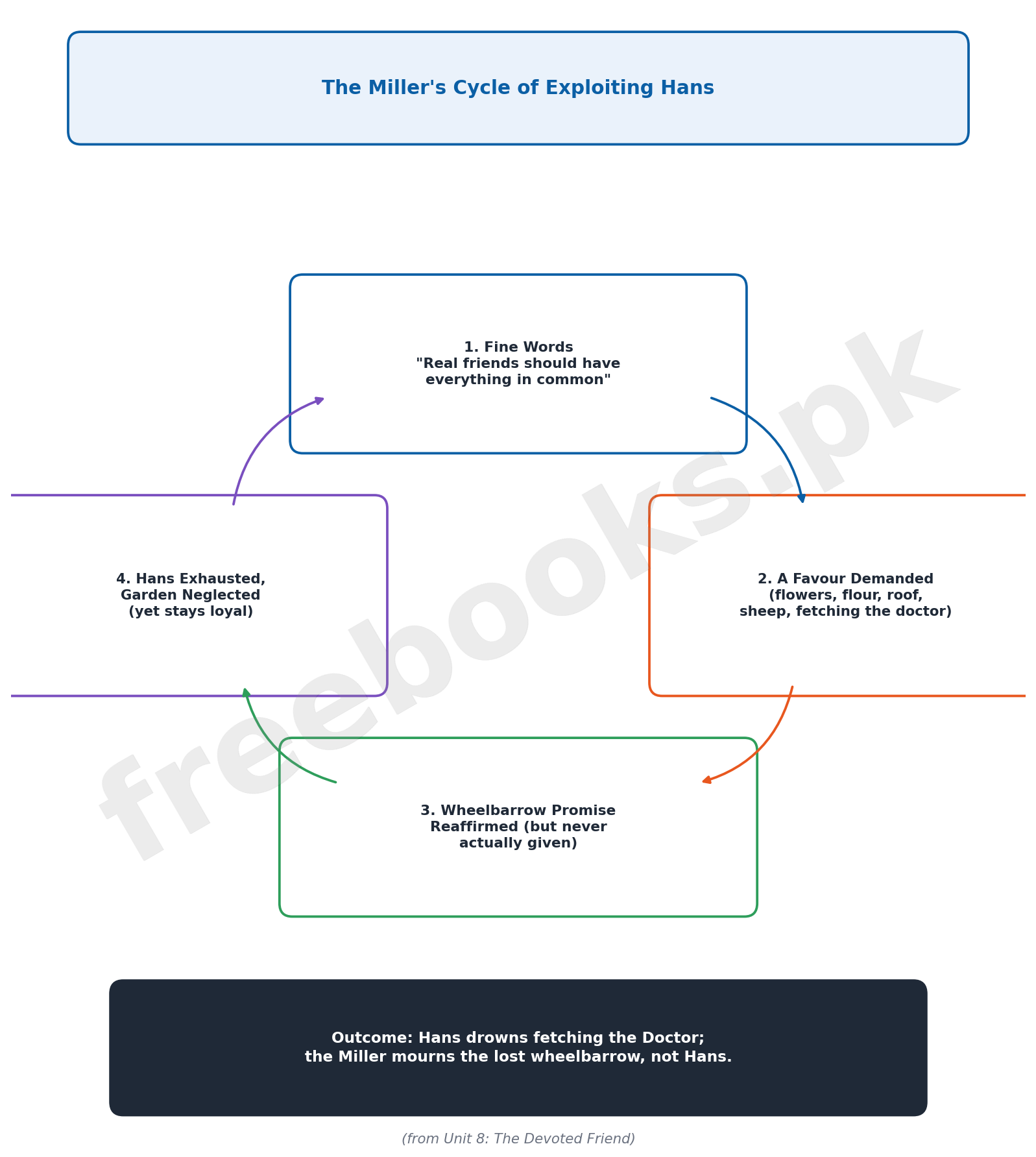
From then on, the Miller repeatedly asked Hans for favours — carrying flour to market, mending his barn roof, driving his sheep to the mountain — each time reminding Hans that he was 'going to give him his wheelbarrow,' even though the wheelbarrow was never actually delivered. Hans, trusting and loyal, always agreed, neglecting his own garden and health in the process.
The Stormy Night and Hans's Death
One wild, stormy night, the Miller came to Hans's door asking him to fetch the Doctor because his son had fallen and hurt himself, saying it was only fair since he was going to give Hans his wheelbarrow. The Miller refused to lend Hans his lantern for the dangerous journey, fearing it might be damaged.
Hans bravely set off in the storm, found the Doctor, but lost his way home on the moor and drowned in a pool of water. At Hans's funeral, the Miller insisted on walking at the head of the procession as 'chief mourner' and 'best friend,' and afterward complained that Hans's death left him not knowing what to do with the now-useless wheelbarrow, vowing never to be generous again.
Theme
The theme of 'The Devoted Friend' is the difference between true and false friendship. The story shows how selfish people often use kind-hearted individuals for their own benefit while pretending to be loyal friends.
Through the character of the Miller, Wilde criticises those who talk about generosity and friendship but never practise it. Little Hans represents innocence and kindness, but his blind trust leads to his suffering and tragic end. Overall, the story teaches that true friendship requires honesty, sacrifice, and mutual care, not just empty words.
Important Definitions (Glossary)
afraid
feeling fear or worry about something
anxious
feeling nervous, worried, or eager about something
deserve
to be worthy of something because of one's actions
distressed
very upset, worried, or unhappy
envious
jealous of someone else's possessions or qualities
flatter
to praise someone too much, often insincerely, to gain favour
moor
a large open area of land, often covered with grass and very wet
obliged
grateful or thankful
opinion
a personal belief or view about something
privilege
a special right or advantage given to someone
whisk
to move quickly or suddenly, like a tail moving swiftly
Key Facts
| Item | Detail |
|---|---|
| Author | Oscar Wilde (born 1854), Dublin, Ireland |
| Author's other famous works | The Happy Prince and Other Tales; The Importance of Being Earnest |
| Main characters (frame story) | The Water-rat, the Green Linnet, the Duck |
| Main characters (inner story) | Little Hans and the Miller |
| What the Miller repeatedly promises Hans | His old wheelbarrow (never actually delivered) |
| What happens to Hans on the stormy night | He is sent to fetch the Doctor and drowns in a moor on the way home |
| The Miller's behaviour at the funeral | He insists on walking as 'chief mourner' as Hans's 'best friend' |
| Central theme | The difference between true and false friendship |
Diagram
The Miller's Pattern of Exploiting Hans: A cyclical diagram showing the Miller's repeated pattern: fine words about friendship, a favour demanded of Hans, a promise of the wheelbarrow reaffirmed, and Hans exhausted and neglecting his own garden — repeating until his death.
Short Questions & Answers
How did the Miller treat little Hans during the different seasons, especially in winter?
During spring, summer, and autumn, the Miller often took flowers and fruit from Hans's garden while visiting him, but in winter, when Hans had no fruit or flowers to offer, the Miller never visited at all, reasoning that people in trouble should be left alone.
What did the Miller say about true friendship, and how did his actions differ from his words?
The Miller often spoke beautifully about friendship, generosity, and sharing everything in common, but in practice he never gave Hans anything of real value, constantly took advantage of his labour, and only offered a broken wheelbarrow he never actually delivered.
Why did little Hans sell his belongings during the winter?
Hans sold his silver buttons, silver chain, pipe, and finally his wheelbarrow because he had no money to buy bread during the harsh winter, when he had no flowers or fruit to sell.
What promise did the Miller make about the wheelbarrow, and how did he use it to take advantage of Hans?
The Miller promised to give Hans his old, broken wheelbarrow as a generous gift, but he used this promise repeatedly to guilt Hans into doing favours for him — carrying flour, mending the barn roof, tending sheep — without ever actually delivering the wheelbarrow.
How did Hans respond to the Miller's constant demands and requests?
Hans always agreed to the Miller's requests out of loyalty and gratitude, even when it meant neglecting his own garden, health, and needs, believing the Miller was truly his best friend.
What happened on the stormy night when the Miller asked Hans to fetch the doctor?
The Miller asked Hans to fetch the Doctor for his injured son, refusing to lend him his lantern; Hans bravely went through the storm, found the Doctor, but lost his way home on the moor and drowned.
How did the Miller behave after Hans' death, and what does it reveal about his character?
The Miller insisted on being chief mourner at Hans's funeral, calling himself his best friend, but afterward complained only about the inconvenience of the now-useless wheelbarrow, revealing his complete selfishness and lack of genuine care for Hans.
What moral lesson does the story teach about friendship and selfishness?
The story teaches that true friendship requires honesty, sacrifice, and mutual care, not just fine words, and warns against selfish people who exploit the kindness and trust of others while pretending to be devoted friends.
Long Questions & Answers
Trace how the Miller exploits little Hans's kindness throughout the story, and explain what this reveals about the Miller's character.
How does the Miller behave toward Hans before winter?
Before winter, the Miller frequently visits Hans's garden, taking flowers and fruit while praising the idea that 'real friends should have everything in common,' though he never gives Hans anything of value in return.
How does the Miller behave toward Hans during winter?
During winter, the Miller stops visiting altogether, reasoning that people in trouble should be left alone, even as Hans suffers from cold and hunger and is forced to sell his possessions.
How does the Miller use the promised wheelbarrow to control Hans?
The Miller repeatedly reminds Hans that he is 'going to give him' his wheelbarrow, using this unfulfilled promise to pressure Hans into doing increasingly demanding favours, from filling his flower basket to mending his barn roof and driving his sheep.
What does this pattern reveal about the Miller's character?
It reveals that the Miller is deeply selfish and hypocritical, using flowery language about friendship and generosity to disguise his exploitation of Hans's trust and labour for his own benefit.
Discuss the significance of the story's ending and how it reinforces the theme of true versus false friendship.
What happens to Hans on the stormy night?
The Miller asks Hans to fetch the Doctor for his injured son, refusing to lend his lantern; Hans bravely undertakes the dangerous journey through the storm but loses his way on the moor and drowns.
How does the Miller behave at Hans's funeral?
The Miller insists on walking at the head of the funeral procession as chief mourner, calling himself Hans's best friend, performing grief while giving no real acknowledgment of his own role in Hans's death.
What does the Miller say afterward, and what does it reveal?
Afterward, the Miller complains only that Hans's death has left him with a useless wheelbarrow he cannot get rid of, revealing that his concern was never for Hans but for his own convenience and possessions.
How does this ending reinforce the story's theme?
The ending sharply contrasts Hans's genuine, selfless loyalty with the Miller's empty words and self-interest, reinforcing the theme that true friendship requires honesty and sacrifice, while false friendship exploits kindness and offers nothing real in return.
Multiple Choice Questions (MCQs)
What was little Hans known for? (A) great wealth (B) kind heart (C) clever tricks (D) strong body
Correct answer: (B) kind heart. Little Hans was known for his kind heart and good-humoured face, not for wealth or distinction.
What did the Miller promise to give Hans? (A) a sack of flour (B) a horse (C) a wheelbarrow (D) a house
Correct answer: (C) a wheelbarrow. The Miller repeatedly promised to give Hans his old wheelbarrow, though he never actually delivered it.
Why did Hans suffer during the winter? (A) He was ill. (B) He lost his garden. (C) He had no work or income. (D) He moved away.
Correct answer: (C) He had no work or income.. Hans suffered during winter because he had no fruit or flowers to sell, leaving him with no income.
What task did the Miller ask Hans to do on the stormy night? (A) fix the roof (B) carry flour (C) fetch the doctor (D) take care of sheep
Correct answer: (C) fetch the doctor. On the stormy night, the Miller asked Hans to fetch the Doctor for his injured son.
What happened to little Hans at the end of the story? (A) He became rich. (B) He moved to another village. (C) He was rewarded. (D) He drowned.
Correct answer: (D) He drowned.. Little Hans drowned in a pool on the moor after losing his way in the storm.
Quick Revision Summary
- 'The Devoted Friend' is a story by Oscar Wilde, told within a frame narrative between the Water-rat, the Green Linnet, and the Duck.
- Little Hans is a kind-hearted man with a beautiful garden; the Miller is his supposedly 'devoted friend' who takes from him but rarely gives back.
- During winter, the Miller abandons Hans, who is forced to sell his silver buttons, chain, pipe, and wheelbarrow to survive.
- In spring, the Miller offers his old, broken wheelbarrow as a gift, then uses this unfulfilled promise to demand repeated favours from Hans.
- On a stormy night, the Miller sends Hans to fetch the Doctor without lending him a lantern; Hans loses his way and drowns on the moor.
- At Hans's funeral, the Miller poses as chief mourner but later complains only about the inconvenience of the unused wheelbarrow.
- The central theme is the difference between true and false friendship — true friendship requires honesty, sacrifice, and mutual care, not empty words.
Exam Tips
- Learn the frame-story structure (Water-rat and Linnet at the pond) and how it introduces the inner story of Hans and the Miller.
- Practise tracing the sequence of favours the Miller demands from Hans, since this pattern is central to most long-answer questions.
- Review the glossary words with their exact textbook meanings; synonym-in-context questions are commonly drawn from unit glossaries.
- Be ready to explain the significance of the wheelbarrow as a symbol of the Miller's empty promises throughout the story.
- Revise the story's ending and the Miller's reaction to Hans's death, as this is the story's most frequently tested contrast between true and false friendship.
- When answering theme-based questions, connect Hans's selfless loyalty to the story's broader moral about honesty and sacrifice in real friendship.