This unit presents an informative essay, 'The Power of Digital Learning,' which explores how MOOCs (Massive Open Online Courses), Twitter, and LinkedIn have reshaped how people learn, share ideas, and build professional careers in the 21st century.
The essay explains each platform's features and educational value, discusses the advantages and limitations of digital learning, and shows how the three platforms work together to create a powerful ecosystem for lifelong learning and career growth.
These notes summarise the essay as given in the textbook and provide comprehension questions, vocabulary, and exam-oriented material for this unit, including the skill-based Reading (organisational patterns), Vocabulary/Grammar (denotative-connotative meaning), Oral Communication, and Writing Skills sections that accompany it.
Learning Objectives
- Use complex questions for a range of audiences.
- Analyse organisational patterns in a text: list/sequence, comparison-contrast, cause-effect, problem-solution, and reasons/assumptions-conclusion.
- Distinguish between the connotative and denotative meanings of words, including similar and dissimilar denotations, and their appropriate use in a variety of writing and texts.
- Write multiple paragraphs, essays, or stories, poems, or playscripts using correct mechanics for written English.
- Develop and strengthen writing by planning, revising, editing, rewriting, or trying a new approach, focusing on what is most significant for a specific purpose and audience.
Key Concepts
Introduction: Learning Beyond the Classroom
The essay opens by noting that in the 21st century, education and career development are no longer confined to classrooms and traditional workplaces. The rise of the internet and digital platforms has reshaped how people acquire knowledge, build skills, and connect with professional communities.
Among these innovations, MOOCs, Twitter, and LinkedIn stand out as transformative tools that together represent a powerful blend of learning, sharing, and networking, changing the very meaning of education and career growth.
MOOCs: Learning Without Borders
MOOCs (Massive Open Online Courses) are online courses accessible to anyone with an internet connection, offered by universities and organisations such as Coursera, edX, and Future Learn, featuring courses from institutions like Harvard, MIT, and Oxford.
Their key advantages are accessibility (learners anywhere can access world-class education) and flexibility (most MOOCs are self-paced, with recorded lectures, readings, forums, and interactive quizzes). MOOCs teach valuable 21st-century skills like digital literacy, problem-solving, and critical thinking, and often provide certificates for résumés and LinkedIn profiles.
Their main limitations are the lack of personal interaction compared to face-to-face classrooms and low completion rates, as learners often drop out before finishing. Despite these challenges, MOOCs have had a profound impact on global education by offering affordable or free learning opportunities.
Twitter: The Micro-University of Ideas
Twitter, with its short-form character limit, encourages concise communication and functions as a 'micro-university of ideas,' where experts, thought leaders, and learners share ideas in digestible pieces. Students and professionals can follow academics and organisations to receive updates in their fields, and hashtags like #EdTech create learning communities.
Twitter's strength is real-time learning: breaking news, discoveries, and live discussions are instantly accessible. It also lets students build a professional voice by sharing insights, though professionalism and critical thinking are essential since posts become part of one's public identity.
Its risks include information overload, misinformation, and unproductive arguments, meaning users must develop strong digital literacy skills to filter reliable sources from unreliable ones.
LinkedIn: The Professional Network
LinkedIn is described as 'the global career fair and networking event rolled into one' — a professional networking platform where individuals showcase skills, experience, and achievements, connecting job seekers with employers and professionals with industry peers.
A well-structured LinkedIn profile serves as a dynamic online résumé, listing education, internships, certifications (including MOOC certificates), and skills, and can include posts, articles, and recommendations. LinkedIn also enables networking with industry leaders and alumni, and functions as a powerful job and internship search engine.
LinkedIn Learning offers professional development courses from leadership to coding, with certificates that signal competence to employers.
How the Platforms Work Together
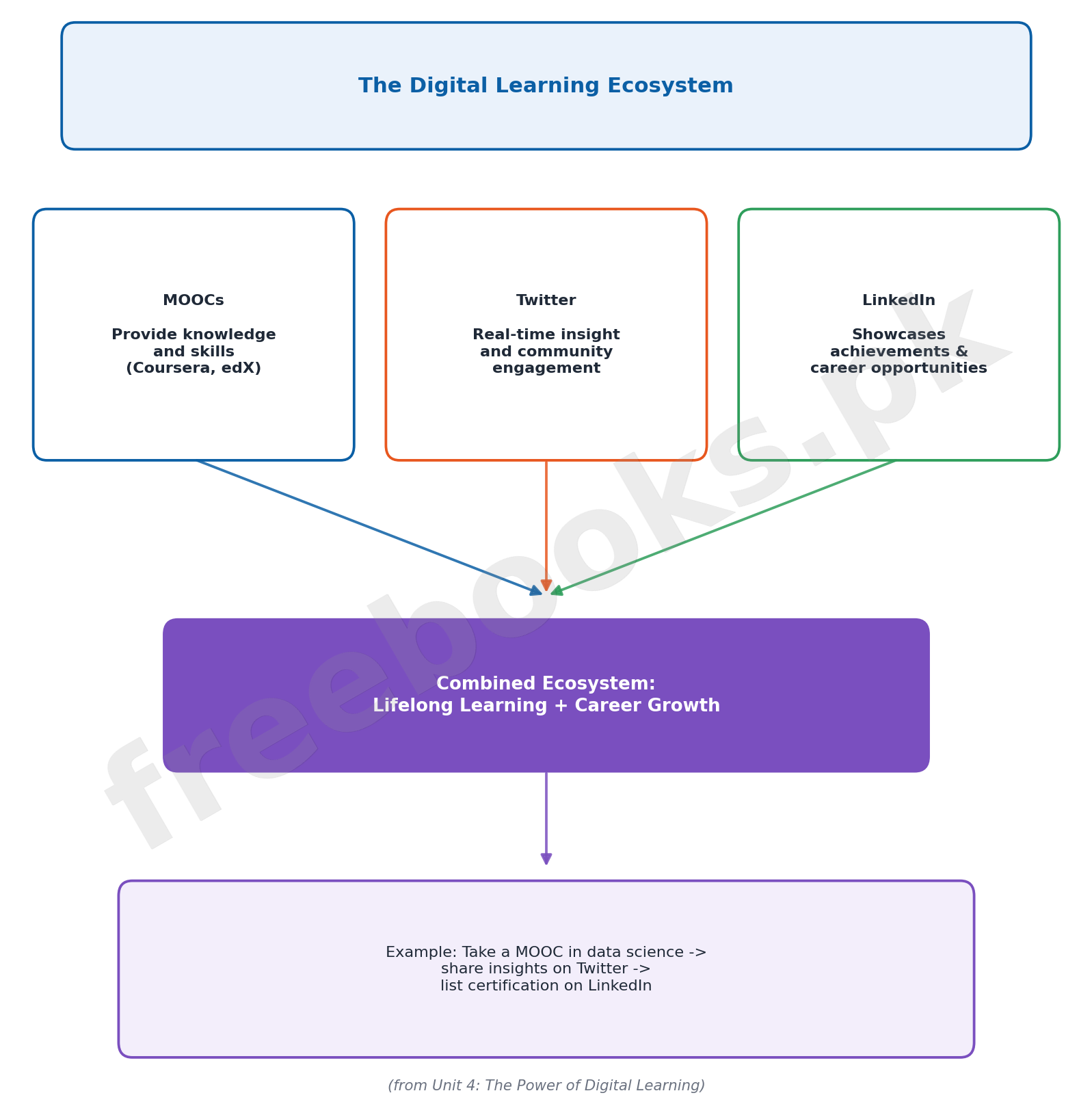
The essay explains that MOOCs, Twitter, and LinkedIn form a powerful ecosystem: MOOCs provide knowledge and skills, Twitter offers real-time insight and community engagement, and LinkedIn showcases achievements and connects learners to career opportunities.
For example, a student could take a MOOC in data science, share insights on Twitter to engage with the community, and list the certification on LinkedIn to attract recruiters — turning passive learning into an active career-building strategy.
Digital Literacy, Responsibility, and the Future
The essay stresses that these platforms demand digital literacy and responsible use: students must evaluate sources, protect personal information, and balance online engagement with offline life, since overuse causes distraction while underuse means missed opportunities.
Tips for students include setting clear goals for each platform, allocating specific times for online activities, verifying information before sharing, and maintaining a professional and respectful tone.
Looking ahead, the essay predicts greater integration of learning and networking through virtual reality classrooms, AI-powered career guidance, and personalised course recommendations, with adaptability becoming the most valuable skill of all.
Conclusion and Theme
The essay concludes that MOOCs, Twitter, and LinkedIn are gateways to opportunity, enabling anyone to learn from world-class educators, engage with global communities, and connect with industry leaders. The key is to use these platforms wisely, with purpose, curiosity, and integrity.
The theme of the unit is the transformative role of digital platforms in modern education and career development, showing how MOOCs, Twitter, and LinkedIn together create a powerful ecosystem for lifelong learning while emphasising digital literacy and responsible online behaviour.
Important Definitions (Glossary)
acquire
to gain or get something, especially knowledge or skills
adaptability
the ability to change and adjust to new situations easily
collaborate
to work together with others to achieve a goal
concise
giving a lot of information clearly and in a few words
curiosity
the strong desire to know or learn something
dynamic
constantly changing, active, and full of energy
integration
combining different parts into a whole so they work well together
interactive
allowing two-way communication or active participation
motivated
having a strong reason or desire to do something
offline
not connected to the internet or a network
reliable
able to be trusted or depended on
remote
far away
traditional
following old customs and beliefs
visibility
the state of being seen or noticed easily
Key Facts
| Item | Detail |
|---|---|
| MOOCs stands for | Massive Open Online Courses |
| Major MOOC platforms | Coursera, edX, Future Learn (courses from Harvard, MIT, Oxford, etc.) |
| Twitter's role | 'Micro-university of ideas' — concise, real-time learning and discussion |
| LinkedIn's role | Professional networking platform and online résumé; also offers LinkedIn Learning |
| Key advantage of MOOCs | Accessibility and flexibility (self-paced learning) |
| Key limitation of MOOCs | Lack of personal interaction; low completion rates |
| Central theme | The transformative role of digital platforms in modern education and career development |
| Most valuable future skill (per essay) | Adaptability |
Diagram
How MOOCs, Twitter, and LinkedIn Work Together: A three-part diagram showing MOOCs providing knowledge and skills, Twitter offering real-time insight and community engagement, and LinkedIn showcasing achievements and connecting learners to career opportunities — combining into one digital-learning ecosystem.
Short Questions & Answers
What does the term MOOCs stand for, and what is its main purpose?
MOOCs stands for Massive Open Online Courses. Their main purpose is to provide online courses accessible to anyone with an internet connection, allowing large numbers of learners worldwide to access quality education.
Name two major platforms that provide MOOCs and the universities they partner with.
Two major platforms are Coursera and edX, which offer courses from universities such as Harvard, MIT, and Oxford.
List two key advantages of MOOCs mentioned in the essay.
Two key advantages are accessibility (learners anywhere can access world-class education) and flexibility (most MOOCs are self-paced, fitting around learners' other responsibilities).
What is one major limitation of MOOCs that can affect learners' success?
One major limitation is the lack of personal interaction compared to face-to-face classrooms, which can make it harder for learners to stay motivated, leading to low completion rates.
How does Twitter act as a 'micro-university of ideas'?
Twitter's character limit encourages concise communication, allowing experts, thought leaders, and learners to share ideas in digestible pieces, so users can follow academics and organisations to receive the latest updates in their fields.
Give two examples of how students can use Twitter for educational purposes.
A computer science student can follow AI researchers for updates, and students can use hashtags like #EdTech or #ScienceTwitter to join communities that share resources and discuss ideas.
What is the main purpose of LinkedIn for students and professionals?
LinkedIn's main purpose is professional networking — it lets individuals showcase their skills, experience, and achievements, connecting job seekers with employers and professionals with industry peers.
Besides networking, what learning opportunity does LinkedIn provide?
LinkedIn offers LinkedIn Learning, a library of professional development courses covering skills from leadership to coding, with certificates that can be displayed on profiles.
According to the essay, how can MOOCs, Twitter, and LinkedIn work together to benefit a student's career growth?
MOOCs provide knowledge and skills, Twitter offers real-time insight and community engagement, and LinkedIn showcases achievements and connects learners to career opportunities — together turning passive learning into an active career-building strategy.
List two tips given in the essay for students to use these platforms responsibly.
Two tips are: set clear goals for each platform (learning, networking, or sharing), and verify information before sharing or acting on it.
Long Questions & Answers
Discuss how MOOCs, Twitter, and LinkedIn each contribute to modern education and career development.
What role do MOOCs play in modern education?
MOOCs provide accessible, flexible online courses from world-class universities, teaching 21st-century skills like digital literacy, problem-solving, and critical thinking, while offering certificates that strengthen résumés and profiles.
What role does Twitter play in learning and professional engagement?
Twitter functions as a 'micro-university of ideas,' offering real-time learning through breaking news and live discussions, and letting students build a professional voice by following experts and joining topic-based communities.
What role does LinkedIn play in career development?
LinkedIn serves as a dynamic online résumé and professional network, enabling users to showcase skills and achievements, connect with industry leaders, search for jobs and internships, and take LinkedIn Learning courses.
How do these three platforms combine into one ecosystem?
Together they form a powerful ecosystem: MOOCs supply knowledge and skills, Twitter provides real-time insight and community engagement, and LinkedIn showcases achievements and connects learners to career opportunities, turning passive learning into active career-building.
Explain the advantages, limitations, and responsible use of digital learning platforms as presented in the essay.
What are the main advantages of MOOCs discussed in the essay?
The essay highlights accessibility, since learners anywhere can access world-class education, and flexibility, since most MOOCs are self-paced with recorded lectures, readings, forums, and quizzes suited to busy schedules.
What limitations do MOOCs and Twitter present?
MOOCs suffer from a lack of personal interaction and low completion rates, while Twitter's fast flow of information can lead to misinformation and unproductive arguments, requiring strong digital literacy to filter reliable sources.
Why does the essay emphasise digital literacy and responsibility?
Because these platforms demand that students evaluate sources critically, protect personal information, and balance online engagement with offline life, since overuse causes distraction while underuse means missed opportunities.
What tips does the essay give for responsible platform use?
The essay advises setting clear goals for each platform, allocating specific times for online activities, verifying information before sharing, and maintaining a professional and respectful tone at all times.
Multiple Choice Questions (MCQs)
What does MOOCs stand for? (A) massive open online courses (B) massive open (C) major online (D) modern open
Correct answer: (A) massive open online courses. MOOCs stands for Massive Open Online Courses.
Which platform offers courses from Harvard and MIT? (A) Twitter space (B) Coursera EdX (C) LinkedIn jobs (D) Future Network
Correct answer: (B) Coursera EdX. Platforms like Coursera and edX offer courses from Harvard, MIT, and other top universities.
Which is a key advantage of MOOCs? (A) limited access (B) flexible schedule (C) fixed timing (D) restricted entry
Correct answer: (B) flexible schedule. MOOCs are typically self-paced, offering learners a flexible schedule.
Which is a major challenge of MOOCs? (A) low-cost (B) high quality (C) low completion (D) wide access
Correct answer: (C) low completion. A major challenge of MOOCs is their low completion rates, as learners often drop out before finishing.
How is Twitter described in the essay? (A) micro university (B) digital library (C) online college (D) virtual school
Correct answer: (A) micro university. The essay describes Twitter as a 'micro-university of ideas.'
What feature makes Twitter useful for learning? (A) paid ads (B) real time (C) long posts (D) private groups
Correct answer: (B) real time. Twitter's real-time nature makes breaking news and discussions instantly accessible.
What does LinkedIn primarily focus on? (A) social gaming (B) professional networking (C) music sharing (D) video streaming
Correct answer: (B) professional networking. LinkedIn is primarily a professional networking platform.
What is LinkedIn Learning known for? (A) entertainment news (B) skill development (C) political debate (D) sports update
Correct answer: (B) skill development. LinkedIn Learning offers professional development courses for skill development.
How can MOOCs, Twitter, and LinkedIn work together? (A) learn share (B) post photos (C) play games (D) sell products
Correct answer: (A) learn share. Together they let students learn (MOOCs), share and engage (Twitter), and showcase achievements (LinkedIn).
Which skill is essential for using these platforms effectively? (A) digital literacy (B) manual writing (C) physical strength (D) cooking skills
Correct answer: (A) digital literacy. The essay emphasises that digital literacy is essential for using these platforms responsibly and effectively.
Quick Revision Summary
- MOOCs (Massive Open Online Courses) offer accessible, flexible online education from platforms like Coursera and edX, partnering with universities such as Harvard, MIT, and Oxford.
- MOOCs' main advantages are accessibility and flexibility; their main limitations are low interaction and low completion rates.
- Twitter functions as a 'micro-university of ideas,' offering real-time learning, community engagement via hashtags, and a platform for building a professional voice — but also carries risks of misinformation.
- LinkedIn is a professional networking platform serving as a dynamic online résumé, job/internship search engine, and source of LinkedIn Learning courses.
- MOOCs, Twitter, and LinkedIn work together: MOOCs provide knowledge, Twitter offers real-time engagement, and LinkedIn showcases achievements and career opportunities.
- Responsible digital learning requires digital literacy, verifying information, protecting personal data, and balancing online and offline life.
- The essay predicts future integration through virtual reality classrooms and AI-powered career guidance, with adaptability as the most valuable future skill.
- The central theme is the transformative role of digital platforms in modern education and career development.
Exam Tips
- Learn the three platforms (MOOCs, Twitter, LinkedIn) and one key advantage plus one key limitation of each — these are commonly tested individually.
- Practise explaining how the three platforms work together as an ecosystem, since this integration point is a frequent long-answer question.
- Review the glossary words carefully; synonym-in-context questions are commonly drawn from unit glossaries.
- Revise the five organisational patterns (list/sequence, comparison-contrast, cause-effect, problem-solution, reasons-conclusion) from the Reading skill section, as this essay itself uses several of these patterns.
- Be ready to distinguish denotative and connotative meanings of words, using the paired examples from the Vocabulary and Grammar section.
- When answering theme-based questions, connect the essay's discussion of individual platforms to its broader message about digital literacy and responsible use.