
This unit presents 'A Letter to God' by the Mexican writer Gregorio Lopez Fuentes, a short story about a poor farmer, Lencho, whose crop is destroyed by a hailstorm and who writes a literal letter to God asking for a hundred pesos to survive until the next harvest.
The story follows the postmaster and his colleagues, who are so moved by Lencho's unwavering faith that they collect money among themselves and send it anonymously, signed 'GOD' — only for Lencho's gratitude to turn to anger when he assumes the post office employees stole part of the sum.
These notes summarise the story as given in the textbook and provide comprehension questions, vocabulary, and exam-oriented material for this unit, including the skill-based Vocabulary/Grammar (correlative conjunctions, word meanings), Oral Communication (group discussion), and Writing Skills (objective summary) sections that accompany it.
Learning Objectives
- Listen to texts and critically analyse the situations and events they present.
- Evaluate two or more central ideas of a text and analyze their development over the course of the text, including how they interact and build on one another.
- Use summary skills to extract salient points and develop a mind map, table, diagram, or flowchart summarising informational texts.
- Summarise complex concepts, processes, or information by paraphrasing them using correct language structure, transitional devices, and relevant punctuation, and make inferences to draw conclusions from contextual information.
- Recognize and use correlative conjunctions, including pairs such as both/and, either/or, neither/nor, not/but, and not only/but also.
- Use summary skills to write an objective summary of a given text or poem.
Key Concepts
About the Author
Gregorio Lopez Fuentes stands as a seminal figure in the landscape of Mexican literature, celebrated for his profound and empathetic portrayals of rural life and the struggles of indigenous peoples during the early 20th century.
A master of narrative simplicity and emotional depth, his works bridge the personal and the political, offering readers a window into the soul of a nation in transformation. Through novels and short stories rich with authenticity, Lopez Fuentes gave voice to the marginalised, exploring universal themes of justice, resilience, and human dignity.
Lencho's Hopeful Harvest
The story opens with Lencho, a farmer, anxiously watching the sky for rain to save his ripening corn and kidney bean crop. When rain finally begins to fall during dinner, Lencho happily compares the raindrops to coins, delighted at the prospect of a good harvest.
The Hailstorm and Its Destruction
The rain quickly turns into a violent hailstorm that lasts an hour, destroying the entire crop and stripping the trees bare. Lencho, devastated, tells his sons that even a plague of locusts would have left more than the hailstorm did, leaving the family with no corn or beans for the year.
Lencho's Letter to God
Despite his despair, Lencho holds onto a single hope: help from God, whose eyes 'see everything, even what is deep in one's conscience.' Trusting this faith completely, Lencho writes a literal letter addressed 'To God,' asking for a hundred pesos to re-sow his field and survive until the next crop, and mails it himself.
The Postmaster's Response
The postal employees are amused, then moved, by the letter's sincerity; the postmaster, struck by Lencho's remarkable faith, decides to answer it himself rather than let it go undelivered. He collects money from his own salary and from colleagues and friends as 'an act of charity,' but can only gather a little more than half of the hundred pesos requested.
He sends the money to Lencho in an envelope signed simply 'GOD.'
The Ironic Twist
Lencho shows no surprise at receiving the money, since his faith was so complete — but grows angry upon counting it, certain that God could not have made a mistake or denied his full request. He writes a second letter to God, saying only seventy pesos reached him and asking for the rest, but insisting it not be sent through the mail, since 'the post office employees are a bunch of crooks.'
Theme
The theme of communication and collaboration is explored through a lens of profound irony and human fallibility. Lencho's earnest letter to God, pleading for financial aid after a devastating hailstorm, represents a form of direct, faith-driven communication that transcends conventional means.
The postmaster and his colleagues, moved by Lencho's unwavering belief, collaborate to collect money and send it anonymously, embodying collective human empathy in action. However, the resulting miscommunication — when Lencho receives only part of the requested sum and accuses the post office employees of theft — reveals the fragile and often misinterpreted nature of human interactions. Ultimately, the narrative underscores that while collaboration can spring from noble intentions, imperfect communication can lead to unintended misunderstandings.
Important Definitions (Glossary)
amiable
friendly and pleasant
conscience
sense of right and wrong that guides a person's actions
correspondence
communication by exchanging letters or messages
crest
the top or highest point of something, like a hill or a wave
intimately
in a close, personal, or detailed way
moment
a very short period of time
obliged
thankful or grateful; also means required to do something
wrinkling
forming small lines or folds, especially on skin or cloth
Key Facts
| Item | Detail |
|---|---|
| Author | Gregorio Lopez Fuentes, Mexican writer |
| Main character | Lencho, a poor farmer |
| What destroys Lencho's crop | A violent hailstorm |
| Amount Lencho requests from God | One hundred pesos |
| Who answers the letter, and how | The postmaster, by collecting money from staff and friends and signing it 'GOD' |
| Amount actually sent to Lencho | A little more than half (seventy pesos, per Lencho's second letter) |
| Central irony | Lencho blames the post office employees for 'stealing' money they generously gave him |
| Central theme | Communication and collaboration, explored through irony and human fallibility |
Diagram
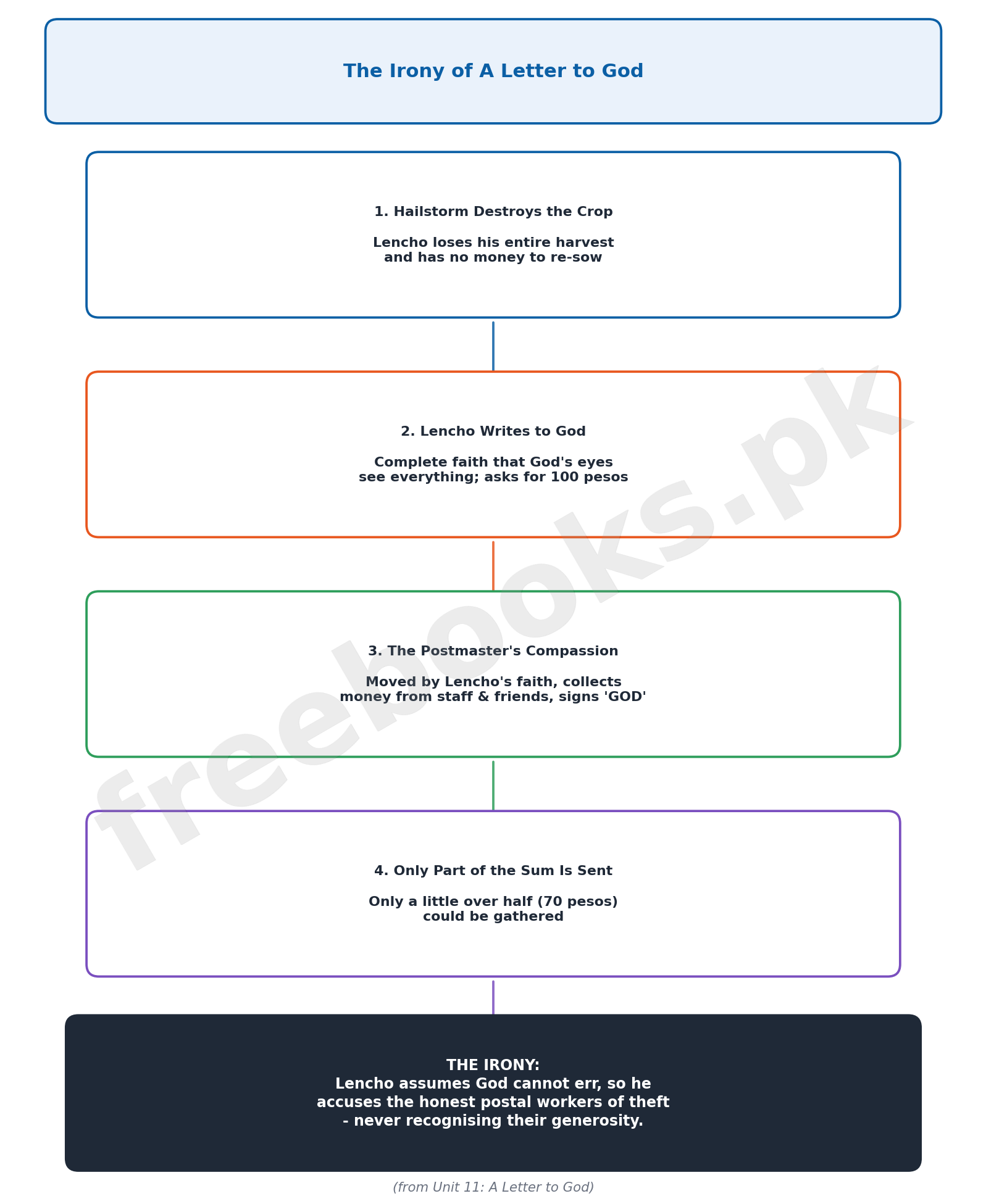
The Irony of A Letter to God: A diagram showing the story's central irony: Lencho's complete faith leads him to write to God, the postmaster's compassion leads him to collect and send money anonymously as 'GOD,' and Lencho's assumption of theft (rather than gratitude) reveals the story's central misunderstanding.
Short Questions & Answers
What was the 'only thing the earth needed' in the beginning of the story, and why was it so crucial?
The earth needed rainfall or at least a shower, since it was crucial for Lencho's ripening corn and kidney bean crop to produce a good harvest.
How did Lencho react when he received the letter? Why was his reaction surprising?
Lencho showed no surprise at seeing the money, since his faith was so complete, but he grew angry upon counting it — a surprising reaction because most people would feel grateful, not angry, upon receiving unexpected help.
What did Lencho's second letter reveal about his faith and his perception of the post office employees?
It revealed that Lencho's faith in God remained completely unshaken, since he assumed God could not have made a mistake, while he instead blamed and accused the innocent post office employees of being 'a bunch of crooks' who had stolen part of the money.
Why was Lencho so certain that it would rain at the start of the story?
Lencho was certain because he knew his fields intimately and had spent the morning scanning the sky toward the northeast, showing his deep, experienced connection with nature and farming.
Describe the event that transformed Lencho's hopeful anticipation into despair.
The gentle rain suddenly turned into a violent hailstorm that lasted an hour, destroying the entire cornfield and stripping the kidney bean plants and trees bare, turning his hope of a good harvest into total loss.
What was the postmaster's initial reaction to Lencho's letter, and why did he decide to help him?
The postmaster initially laughed at the letter but quickly turned serious, deeply moved by Lencho's remarkable faith; he decided to help so as not to discourage that faith, since the letter could not otherwise be delivered.
Why was Lencho not surprised or grateful when he received the money? What emotion did he feel instead?
Lencho was not surprised because his faith was absolute and he had expected the money to come; instead of gratitude, he felt anger, since the amount was less than what he had requested.
Explain the contradiction between what Lencho believes happened to the money and what actually happened.
Lencho believes the post office employees stole part of the money God sent him, when in reality the postmaster and his colleagues generously gave their own money out of compassion and could only gather a little more than half of what was requested.
Long Questions & Answers
Discuss the theme of faith and its consequences as portrayed in 'A Letter to God.'
How is Lencho's faith established at the beginning of the story?
Lencho's faith is shown through his complete trust that God's eyes 'see everything,' leading him to write a literal letter asking for a hundred pesos after his crop is destroyed by hail, fully believing his request will be answered.
How do the postal employees respond to this display of faith?
The postmaster and his colleagues, moved by the sincerity of Lencho's faith, collect money among themselves as an act of charity and send it to him, signed simply 'GOD,' so as not to disappoint his belief.
How does Lencho's faith lead to an unintended consequence?
Because Lencho's faith is so absolute that he believes God could never make a mistake or deny his request, he assumes the shortfall in money must be due to theft by the post office employees rather than any limitation in what could be collected.
What does this outcome suggest about the story's message on faith?
It suggests that while faith can inspire remarkable generosity and compassion in others, blind or absolute faith can also lead to misplaced blame and misunderstanding when reality does not match expectation.
Explain the central irony of the story and how it reveals the fragile nature of human communication.
What is the central irony of 'A Letter to God'?
The central irony is that the postmaster and his colleagues act with genuine compassion and self-sacrifice to help Lencho, yet Lencho responds by accusing them of theft rather than recognising their generosity.
How does this irony develop over the course of the story?
It develops as Lencho's unwavering faith initiates a chain of kind actions from strangers, but the resulting gap between what was requested and what could be gathered creates a misunderstanding that undermines the goodwill behind it.
What does Lencho's accusation reveal about human interpretation and perception?
It reveals that even well-intentioned actions can be misinterpreted when the recipient's expectations do not align with reality, showing how communication can break down despite the best intentions on both sides.
What broader lesson does this irony teach about collaboration and goodwill?
It teaches that while collaboration can spring from noble intentions, imperfect communication and unmet expectations can lead to unintended misunderstandings, highlighting the delicate balance between goodwill and how it is perceived.
Multiple Choice Questions (MCQs)
The house sat on the crest of a low hill. (A) base (B) top (C) side (D) shadow
Correct answer: (B) top. 'Crest' means the top or highest point of something, such as a hill.
The field was dotted with kidney bean flowers. (A) erased (B) sprinkled (C) coloured (D) replaced
Correct answer: (B) sprinkled. 'Dotted' means scattered or sprinkled across an area.
He was mortified by the turn of events. (A) excited (B) embarrassed (C) humiliated (D) amused
Correct answer: (B) embarrassed. 'Mortified' means feeling deeply embarrassed or distressed.
He experienced the contentment of a good deed. (A) sadness (B) satisfaction (C) confusion (D) regret
Correct answer: (B) satisfaction. 'Contentment' means a state of happiness and satisfaction.
He needed to re-sow the field. (A) plant again (B) water (C) harvest (D) sell
Correct answer: (A) plant again. 'Re-sow' means to plant seeds again.
He made a resolution to answer the letter. (A) joke (B) promise (C) decision (D) mistake
Correct answer: (C) decision. 'Resolution' here means a firm decision to do something.
Lencho had an unyielding faith in God. What is the best synonym for 'unyielding'? (A) Flexible (B) Adamant (C) Temporary (D) Questioning
Correct answer: (B) Adamant. 'Unyielding' means firm and unchanging, similar to 'adamant.'
Lencho's field needed a downpour to have a good harvest. Which word could replace 'downpour'? (A) Drizzle (B) Deluge (C) Breeze (D) Drought
Correct answer: (B) Deluge. 'Downpour' means a heavy fall of rain, similar to 'deluge.'
The postmaster and his employees made a conscientious effort to help Lencho. What does 'conscientious' mean? (A) Careless (B) Meticulous (C) Secret (D) Quick
Correct answer: (B) Meticulous. 'Conscientious' means careful and thorough, similar to 'meticulous.'
When Lencho found only a portion of the money, he assumed the post office employees were a 'bunch of crooks.' What is a synonym for 'crooks'? (A) Heroes (B) Benefactors (C) Swindlers (D) Officials
Correct answer: (C) Swindlers. 'Crooks' refers to dishonest people, similar to 'swindlers.'
Quick Revision Summary
- 'A Letter to God' is a short story by the Mexican writer Gregorio Lopez Fuentes.
- Lencho, a poor farmer, loses his entire crop to a violent hailstorm after hoping for rain.
- Trusting completely in God, Lencho writes a letter asking for a hundred pesos to survive until the next harvest.
- The postmaster, moved by Lencho's faith, collects money from himself, staff, and friends, sending it signed 'GOD.'
- Only a little more than half the requested amount could be gathered.
- Lencho, certain God would not err, angrily accuses the post office employees of stealing the rest in his second letter.
- The central theme is communication and collaboration, explored through irony and the fragile, often misinterpreted nature of human interaction.
Exam Tips
- Learn the story's key sequence: hope for rain, the hailstorm's destruction, Lencho's letter, the postmaster's response, and the ironic second letter.
- Practise explaining the central irony — genuine charity mistaken for theft — since this is the story's most frequently tested concept.
- Review the glossary words with their exact textbook meanings; synonym-in-context questions are commonly drawn from unit glossaries.
- Be ready to discuss Lencho's character (his connection to nature, his unwavering faith) as this is central to most long-answer questions.
- Revise the postmaster's motivations and actions, since his compassionate response is equally important to the story's theme.
- When answering theme-based questions, connect the story's irony to its broader message about the fragile, easily misunderstood nature of human communication and goodwill.