
This unit presents 'The Giving Tree,' a well-known story by American writer and illustrator Shel Silverstein, about a tree that loves a little boy and gives him everything she has throughout his life, asking nothing in return.
The story follows the boy from childhood to old age, showing how his needs change over time — from play, to money, to a house, to a boat, and finally to a quiet place to rest — while the tree keeps giving until only a stump remains.
These notes summarise the story as given in the textbook and provide comprehension questions, vocabulary, and exam-oriented material for this unit, including the skill-based Reading (inference and deduction), Vocabulary/Grammar (figurative language), Oral Communication, and Writing Skills (narrative writing) sections that accompany it.
Learning Objectives
- Speak confidently and fluently in a wide range of contexts (conflict resolution, panel discussion, role-play, dialogue) to fulfil different purposes such as exposition and argumentation.
- Read and use inference and deduction to recognise implicit meaning, using prior knowledge and contextual cues effectively.
- Link new facts, terms, and concepts with prior knowledge, and choose words and phrases for effect.
- Demonstrate understanding of figurative language, word relationships, and nuances in word meanings, including figures of speech such as euphemism and oxymoron.
- Write narratives to develop real or imagined experiences or events, using effective techniques, well-chosen details, and well-structured event sequences, with a conclusion that reflects on what is resolved over the course of the narrative.
Key Concepts
About the Author
Shel Silverstein was an American writer, poet, and illustrator known for his unique and imaginative style. He was born in 1930 in Chicago, USA, and became famous for writing children's literature.
Besides writing, he was also a cartoonist, songwriter, and musician. Some of his well-known books include The Giving Tree and Where the Sidewalk Ends. His writing often combines playful language with serious themes, making it appealing to both children and adults.
Childhood: Play and Companionship
The story begins with a tree who loved a little boy. Every day the boy would gather her leaves to make crowns and play king of the forest, climb her trunk, swing from her branches, eat her apples, play hide-and-go-seek, and sleep in her shade. The boy loved the tree very much, and the tree was happy.
As time passed, the boy grew older and the tree was often alone, marking the first sign of the changing relationship between them.
Youth: The Boy Wants Money
When the boy returns as a young man, he says he is 'too big to climb and play' and wants money to buy things and have fun. The tree, having no money, offers her apples for the boy to sell in the city. The boy gathers and carries away her apples, and the tree is happy — though she is left alone again for a long time, and sad.
Adulthood: The Boy Wants a House
The boy returns wanting a house to keep him warm, since he now wants a wife and children. The tree offers her branches to be cut off and used to build a house. The boy cuts off her branches and carries them away, and the tree is happy, though again left alone for a long time.
Middle Age: The Boy Wants a Boat
When the boy returns, he says he is 'too old and sad to play' and wants a boat to sail far away. The tree offers her trunk to be cut down and made into a boat. The boy cuts down her trunk, and the tree is happy — 'but not really,' signalling the cost of her endless giving.
Old Age: The Boy Needs Rest
In the end, the boy returns as an old man. The tree, now just a stump with nothing left to give — no apples, no branches, no trunk — apologises that she has nothing left. The boy says he no longer needs much, just 'a quiet place to sit and rest,' since he is very tired.
The stump straightens herself up as much as she can and invites the boy to sit and rest. The boy does, and the tree is happy — completing the cycle of giving that defines her relationship with the boy throughout his life.
Theme
The theme of 'The Giving Tree' centres on unconditional love and selfless sacrifice. The tree represents a figure who gives everything without expecting anything in return, while the boy takes from the tree at different stages of his life, reflecting changing human desires and priorities.
The tree's happiness in giving highlights the idea that true love often involves sacrifice, while the story also suggests the imbalance that can exist in relationships where one side only takes, reflecting how people may overlook or take for granted those who care for them deeply. Overall, the story teaches the importance of love, generosity, and appreciating those who give selflessly.
Important Definitions (Glossary)
quiet
calm, silent, not noisy
sail
to travel on water in a boat
shade
a cool, dark area protected from the sun
shook
moved quickly back and forth
sighed
breathed out slowly, often showing tiredness or sadness
stump
the remaining part of a tree after it has been cut down
trunk
the main, thick stem of a tree
warm
having a comfortable, slightly hot temperature
whispered
spoke very softly or quietly
Key Facts
| Item | Detail |
|---|---|
| Author | Shel Silverstein (1930-1999), Chicago, USA |
| Author's other famous work | Where the Sidewalk Ends |
| Main characters | The tree and the boy |
| What the boy takes over his life | Leaves/play, apples (for money), branches (for a house), trunk (for a boat), and finally a stump to rest on |
| What the tree becomes at the end | An old stump |
| Central theme | Unconditional love and selfless sacrifice |
| Reading skill focus | Inference and deduction |
| Writing skill focus | Narrative writing |
Diagram
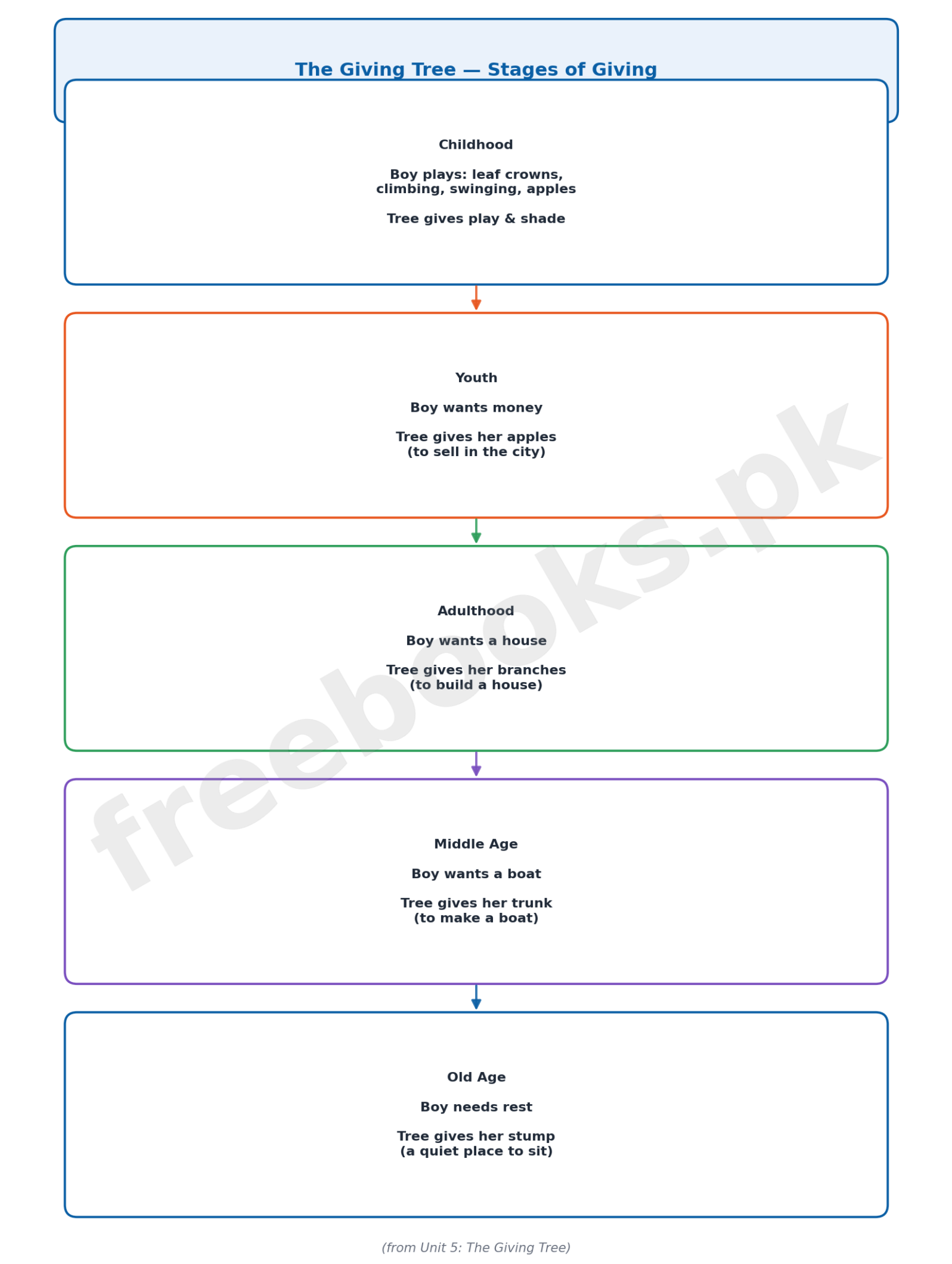
The Giving Tree — Stages of Giving: A five-stage diagram showing what the boy asks for at each stage of his life (play, money/apples, a house/branches, a boat/trunk, and finally rest/stump) and what the tree gives in return.
Short Questions & Answers
Who are the main characters in the story?
The main characters are the tree, who loves and gives to the boy throughout his life, and the boy, who takes from the tree at each stage of his life.
How did the boy first play with the tree?
As a child, the boy gathered the tree's leaves to make crowns and play king of the forest, climbed her trunk, swung from her branches, ate her apples, played hide-and-go-seek, and slept in her shade.
Why was the tree happy when the boy took her apples, branches and trunk?
The tree was happy because giving to the boy, whom she loved, brought her joy — her happiness came from being able to help him, even though each gift cost her a part of herself.
What did the boy want when he grew older?
As he grew older, the boy wanted money to buy things and have fun, then a house for his wife and children, then a boat to sail far away, and finally just a quiet place to rest.
How did the boy use the tree's apples, branches, and trunk?
He sold the apples in the city for money, used the branches to build a house, and used the trunk to make a boat to sail away.
How did the tree feel when the boy stayed away for a long time?
The tree felt sad and lonely when the boy stayed away for long periods, though she remained happy and welcoming whenever he returned.
What lesson does the story teach us about love and giving?
The story teaches that true love often involves selfless sacrifice, and that those who give generously deserve to be appreciated rather than taken for granted.
How does the boy's needs change as he grows older?
The boy's needs shift from play as a child, to money as a young man, to a house as an adult, to a boat in middle age, and finally to rest in old age.
What does the stump symbolize at the end of the story?
The stump symbolises the tree's complete self-sacrifice — having given everything she had, all that remains is a humble resting place, showing that even in having nothing left, she still has something to offer.
Why is the story considered a tale of selfless friendship?
It is considered a tale of selfless friendship because the tree continually gives to the boy throughout his life without ever asking for anything in return, embodying unconditional love and generosity.
Long Questions & Answers
Trace the boy's relationship with the tree across the different stages of his life and explain what this reveals about the story's theme.
How does the boy relate to the tree in childhood?
As a child, the boy plays freely with the tree — making leaf crowns, climbing her trunk, swinging from her branches, eating her apples, and sleeping in her shade — and the tree is happy in this companionship.
How does the boy's relationship with the tree change as he grows older?
As the boy grows older, he visits less often and each time asks for something material — money from her apples, a house from her branches, and a boat from her trunk — taking a part of the tree with each visit.
How does the tree respond to the boy's changing demands?
The tree responds by giving whatever she has, whether apples, branches, or her trunk, finding happiness in helping the boy even as she is left with progressively less of herself and often long periods of loneliness.
What does this pattern reveal about the story's theme?
It reveals the story's central theme of unconditional love and selfless sacrifice, while also showing the imbalance in a relationship where one side only takes — a reminder to appreciate those who give without expecting anything in return.
Discuss the ending of 'The Giving Tree' and what it suggests about the nature of the tree's happiness.
What does the tree have left to offer by the end of the story?
By the end, the tree has given her apples, branches, and trunk, leaving her as just an old stump with nothing more to give the boy, who has also grown old.
What does the boy ask for in his final visit?
In his final visit, the boy, now old and tired, says he no longer needs much — just a quiet place to sit and rest.
How does the tree respond, and what is significant about this response?
The tree straightens herself up as much as she can and invites the boy to sit and rest on her stump, showing that even with nothing material left, she still finds a way to give something of herself.
What does the final line 'and the tree was happy' suggest about her happiness throughout the story?
It suggests that the tree's happiness was never really about what she had, but about being able to give to and be with the boy she loved — reinforcing the theme that true love finds fulfilment in selfless giving, even when what is given seems small.
Multiple Choice Questions (MCQs)
Who is happy in the story? (A) the boy (B) the tree (C) both (D) neither
Correct answer: (B) the tree. Throughout the story, it is the tree who repeatedly expresses happiness through her acts of giving.
What does the boy first play with? (A) apples (B) leaves (C) stump (D) boat
Correct answer: (B) leaves. As a child, the boy first gathered the tree's leaves to make crowns and play king of the forest.
Why does the boy take the tree's branches? (A) to sell (B) to build a house (C) to eat (D) to play
Correct answer: (B) to build a house. The boy takes the tree's branches to build a house for his wife and children.
What does the tree become in the end? (A) apple tree (B) stump (C) branches (D) boat
Correct answer: (B) stump. By the end of the story, the tree has given everything and become just an old stump.
What lesson does the story teach? (A) honesty (B) friendship & love (C) hard work (D) adventure
Correct answer: (B) friendship & love. The story teaches a lesson about selfless friendship and unconditional love.
Quick Revision Summary
- 'The Giving Tree' is a story by Shel Silverstein, author of Where the Sidewalk Ends.
- The tree loves the boy and gives to him at every stage of his life: play in childhood, apples for money, branches for a house, and her trunk for a boat.
- Each time the boy returns after a long absence, the tree is happy to give, even though she is often left sad and lonely in between visits.
- By the end of the story, the tree has given everything and become just an old stump.
- In old age, the boy needs only a quiet place to rest, and the stump offers itself for this purpose.
- The central theme is unconditional love and selfless sacrifice, alongside the imbalance that can exist when one side only takes.
- The story's reading skill focus is inference and deduction; its writing skill focus is narrative writing.
Exam Tips
- Learn the five stages of the boy's requests (play, money/apples, house/branches, boat/trunk, rest/stump) in order — this sequence is frequently tested.
- Practise explaining the story's theme of unconditional love and selfless sacrifice, along with the idea of imbalance in giving relationships.
- Review the glossary words with their exact textbook meanings; synonym-in-context questions are commonly drawn from unit glossaries.
- Be ready to distinguish inference from deduction using the textbook's own example, since this is the unit's key reading skill.
- Revise the concept of figurative language (oxymoron, simile) covered in the Vocabulary and Grammar section, since this unit uses a Shakespeare example to illustrate it.
- When answering theme-based questions, connect the tree's repeated self-sacrifice to the story's broader message about appreciating those who give selflessly.