This unit presents 'On His Blindness' by John Milton, a Petrarchan sonnet in which the poet reflects on the loss of his eyesight and his fear that he can no longer serve God (referred to in the textbook alongside 'Allah (ﷻ)') effectively through his talent.
The poem moves from an anguished, questioning octave — in which the poet worries that his 'one talent' now lies useless — to a calm, reassuring sestet, voiced by the personified figure of Patience, which teaches that faithful, humble waiting is itself a form of service.
These notes summarise the poem as given in the textbook and provide comprehension questions, vocabulary, and exam-oriented material for this unit, including the skill-based Reading, Vocabulary/Grammar, Oral Communication, and Writing sections that accompany it.
Learning Objectives
- Ask and answer questions for a range of communicative purposes.
- Critique reading interpretations, taking account of others' views on reading.
- Provide an objective summary of a range of texts.
- Clarify the meaning of unknown and multiple-meaning words and phrases using context clues, word patterns, and reference materials such as dictionaries and thesauruses.
- Write and critique (self/peer checking) a final draft after editing and proofreading, ensuring each paragraph's topic sentence supports the main idea.
- Apply skills and strategies for idea generation, selection, development, organisation, and revision across a variety of writing purposes and text types.
Key Concepts
About the Poem and Poet
'On His Blindness' is a sonnet by John Milton, a major English poet and intellectual of the seventeenth century. Born in 1608 in London and educated at Cambridge University, Milton is best known for his epic poem Paradise Lost, one of the greatest works in English literature.
Milton became completely blind during his life, yet continued to write with remarkable determination. His poetry often deals with themes of faith, morality, and human struggle, and he remains one of the most influential poets in the history of English literature.
The Octave: The Poet's Doubt and Complaint
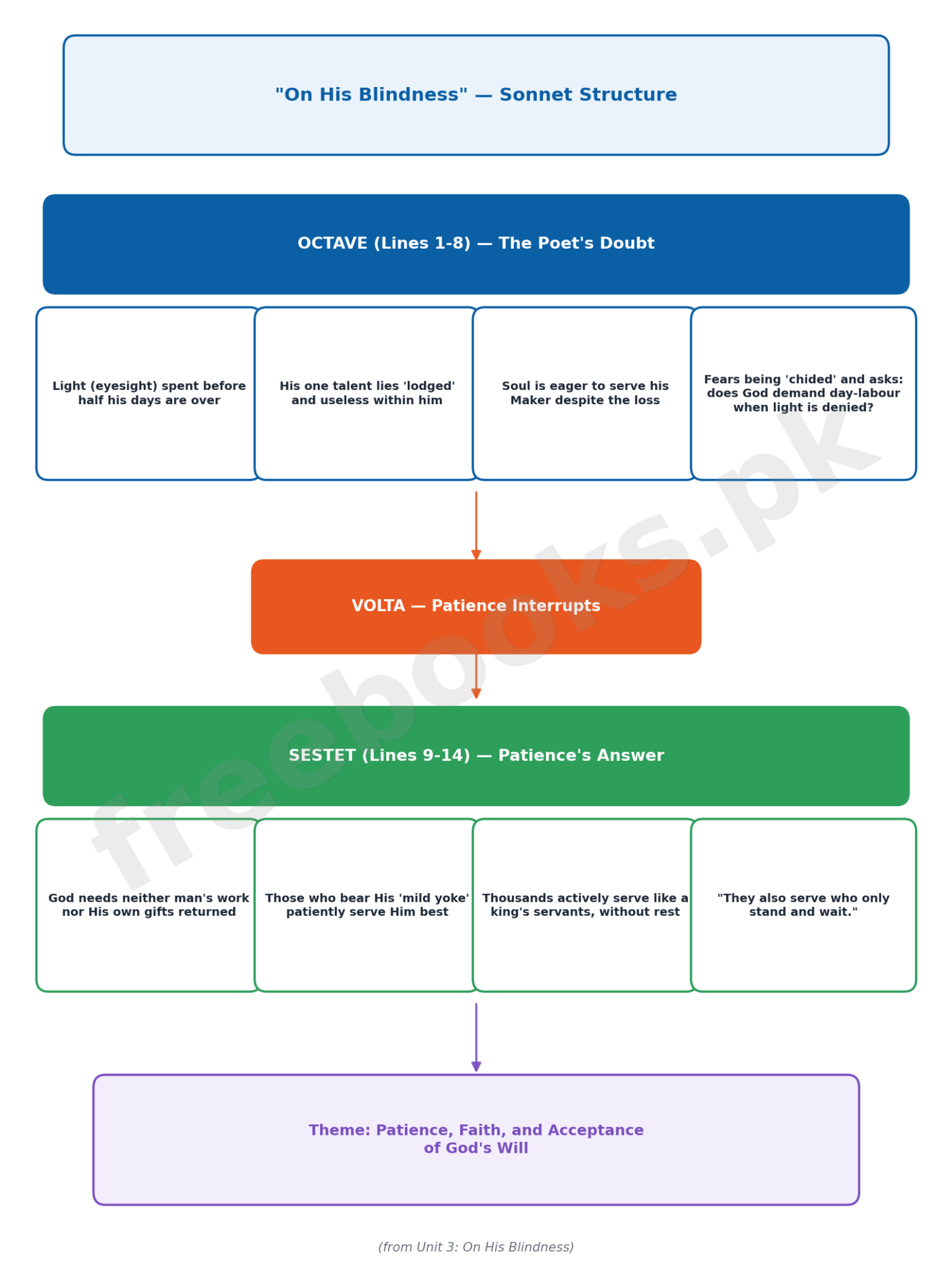
In the opening lines, the poet considers how his 'light' (eyesight) has been spent before half his days are over, in this 'dark world and wide.' He reflects on the 'one talent' given to him — his God-given ability, likely his gift for poetry — which now feels 'lodged' uselessly within him, even though his soul is eager to use it to serve his Maker and present a true account of his life's work.
The poet fears being scolded ('chide') by God upon His return if he fails to use this talent, and so he fondly (foolishly) asks whether God 'exact[s] day-labour' even when 'light' (sight) has been denied to him — questioning whether God truly demands active work from someone who physically cannot perform it.
The Volta and the Sestet: Patience's Reply
Before this 'murmur' (complaint) can fully form, the personified figure of Patience interrupts to prevent it, replying that God does not need either man's labour or His own gifts back. Rather, those who best 'bear his mild yoke' — who accept God's will patiently and without resistance — serve Him best.
Patience explains that God's state is 'kingly': thousands of others rush at His command across land and ocean without rest, actively carrying out His will. But this does not mean patient waiting is worthless — the poem concludes with its most famous line: 'They also serve who only stand and wait,' affirming that quiet, humble endurance is itself a valid and valuable form of service.
Theme
The theme of 'On His Blindness' revolves around patience, faith, and acceptance of God's will. The poet expresses his inner struggle after losing his eyesight and fears that he can no longer serve God effectively, worrying that his talent has become useless and that he may be judged for not using it.
However, the poem shifts from doubt to reassurance through the voice of Patience. It teaches that God does not demand great deeds from everyone, especially from those who are unable to act, and that true service lies in obedience, humility, and trust in the divine will.
Form and Poetic Devices
The poem is a Petrarchan (Italian) sonnet of fourteen lines, structured as an octave (the first eight lines, presenting the poet's problem and doubt) followed by a sestet (the final six lines, offering Patience's resolving answer) — a turn in tone and argument known as the volta.
Milton uses personification (Patience as a speaking figure), a biblical allusion (the parable of the talents, in which a servant who buries rather than uses his talent is rebuked), and the extended metaphor of 'light' for both physical sight and spiritual/creative capacity throughout the poem.
Important Definitions (Glossary)
chide
to scold, rebuke
denied
refused, not allowed
ere
before (an old English word)
lodged
kept, placed in a particular position
mild
gentle, not harsh
murmur
a soft complaint; low, unclear sound
stand
to remain firm, stay in a position, to remain patient
talent
intellect (here, a God-given ability or gift)
wait
to stay calm patiently
Key Facts
| Item | Detail |
|---|---|
| Poet | John Milton (1608-1674), London |
| Poem form | Petrarchan (Italian) sonnet — octave + sestet |
| Poet's best-known work | Paradise Lost |
| Central image | The poet's lost 'light' (eyesight) and his 'one talent' |
| Speaker of the sestet's answer | The personified figure of Patience |
| Most famous line | 'They also serve who only stand and wait.' |
| Central theme | Patience, faith, and acceptance of God's will |
Diagram
On His Blindness — Structure of the Sonnet: A purely textual/schematic diagram contrasting the octave (the poet's doubt and complaint about his lost sight and useless talent) with the sestet (Patience's reassuring answer), showing the volta (turn) between them.
Short Questions & Answers
What does the poet mean by 'my light is spent'?
He means that his eyesight has been used up or lost — he has gone blind — before half of his expected lifespan ('days') has passed.
Why does the poet feel that his 'talent' is useless?
He feels his God-given talent, likely his gift for writing, now lies 'lodged' and unused within him because his blindness prevents him from actively working with it, even though his soul is eager to serve.
What fear does the poet express about serving God?
He fears that God will return and 'chide' (scold) him for not having used his talent, and worries about presenting a 'true account' of a life in which his gift went to waste.
What question does the poet ask about God's expectations?
He fondly (foolishly) asks, 'Doth God exact day-labour, light denied?' — questioning whether God truly demands active daily work from someone whose sight, and thus ability to work, has been taken away.
Who answers the poet's doubt in the poem?
The personified figure of Patience answers the poet's doubt, interrupting before his complaint (murmur) can fully form.
What is meant by 'bear his mild yoke'?
It means to accept God's will and guidance patiently and without resistance, as one would carry a gentle burden placed upon them.
How does the poem describe those who actively serve God?
It describes thousands who rush at God's command, travelling swiftly over land and ocean without rest, actively carrying out His will like a king's many servants.
What is the meaning of the line 'They also serve who only stand and wait'?
It means that patient, humble waiting and quiet endurance — not just active labour — is itself a valid and valuable form of service to God.
What is the central message or moral of the poem?
The central message is that true service to God does not always require visible action; patience, humility, and acceptance of one's circumstances are equally valuable forms of devotion.
Long Questions & Answers
Explain the poet's inner conflict in the octave of 'On His Blindness' and how it is resolved in the sestet.
What problem does the poet describe in the octave?
The poet describes how his eyesight ('light') has been spent before half his life is over, leaving his one talent 'lodged' uselessly within him, even though his soul remains eager to use it to serve his Maker and account for his life's work.
What fear and question arise from this problem?
He fears being scolded by God for failing to use his talent, and fondly asks whether God really demands active 'day-labour' from someone whose sight, and so ability to work, has been denied to him.
How does Patience answer the poet's doubt?
Patience explains that God does not need man's work or His own gifts returned; rather, those who bear God's 'mild yoke' patiently, accepting His will, serve Him best, since God's state is 'kingly' and does not depend on any one servant's active labour.
What is the resolution, and what does it reveal about the poem's theme?
The resolution comes in the famous closing line, 'They also serve who only stand and wait,' revealing that patient acceptance is itself valuable service — reflecting the poem's central theme of faith, humility, and trust in God's will even amid personal loss.
Discuss the poetic form and devices used in 'On His Blindness' and their effect on its meaning.
What form does the poem take, and how is it structured?
The poem is a Petrarchan sonnet made up of an octave (the first eight lines) and a sestet (the final six lines), with a turn in tone and argument, called the volta, occurring between them.
How does personification contribute to the poem?
Patience is personified as a speaking figure who interrupts the poet's complaint and delivers the poem's resolving message, giving an abstract virtue a voice and authority within the poem.
What role does the image of 'light' play throughout the poem?
'Light' serves as an extended metaphor for both the poet's physical eyesight and his spiritual or creative capacity, linking his literal blindness to his deeper anxiety about being unable to fulfil his God-given purpose.
How does the poem's structure support its overall theme?
The octave's doubt and the sestet's calm reassurance mirror the poem's movement from spiritual anxiety to acceptance, reinforcing the theme that patience and humility are themselves meaningful forms of service.
Multiple Choice Questions (MCQs)
What does 'my light is spent' mean? (A) lost hope (B) lost sight (C) lost wealth (D) lost friends
Correct answer: (B) lost sight. 'My light is spent' refers to the poet's loss of eyesight (blindness).
The poet worries his talent is… (A) useful still (B) completely lost (C) useless now (D) overrated gift
Correct answer: (C) useless now. He worries his God-given talent now lies 'lodged' uselessly within him due to his blindness.
"Doth God exact day-labour, light denied?" shows the poet… (A) expresses anger (B) asks doubt (C) seeks wealth (D) plans travel
Correct answer: (B) asks doubt. This line shows the poet questioning, in doubt, whether God demands active labour from someone denied sight.
"Bear his mild yoke" means… (A) carry burden (B) obey patiently (C) work actively (D) suffer silently
Correct answer: (B) obey patiently. To 'bear his mild yoke' means to accept and obey God's will patiently.
People unable to serve actively… (A) are useless (B) can serve (C) must work (D) should cry
Correct answer: (B) can serve. The poem teaches that people unable to serve actively can still serve through patience and acceptance.
The main lesson of the poem is _______ matters. (A) wealth (B) patience (C) courage (D) strength
Correct answer: (B) patience. The poem's central lesson is that patience, not just active labour, matters in serving God.
"Ere half my days" means… (A) early life (B) midlife point (C) night time (D) noon hour
Correct answer: (B) midlife point. 'Ere half my days' means before half of the poet's expected lifespan had passed — around midlife.
"They also serve who only stand and wait" means… (A) active work (B) patient service (C) physical standing (D) tireless effort
Correct answer: (B) patient service. This famous line means that patient, humble waiting is itself a valid form of service.
Quick Revision Summary
- 'On His Blindness' is a Petrarchan sonnet by John Milton, author of Paradise Lost.
- The octave presents the poet's doubt: his 'light' (eyesight) is spent, and his 'one talent' lies useless.
- He fears God's rebuke and asks whether God demands 'day-labour' when sight has been denied.
- The personified figure of Patience answers in the sestet, preventing his complaint (murmur).
- Patience explains that bearing God's 'mild yoke' — patient acceptance — is itself the best service.
- God's state is 'kingly'; thousands actively serve Him, but active labour is not the only valid service.
- The poem ends with its most famous line: 'They also serve who only stand and wait.'
- The central theme is patience, faith, and acceptance of God's will despite personal loss.
Exam Tips
- This unit is a sonnet — learn its structure (octave + sestet, divided by the volta) since exams often test recognition of poetic form.
- Learn the glossary words with their exact textbook meanings; synonym-in-context questions are commonly drawn from unit glossaries.
- Practise explaining the famous closing line 'They also serve who only stand and wait' in your own words, as it is the poem's most frequently tested line.
- Be ready to identify poetic devices used in the poem — personification (Patience), extended metaphor (light), and biblical allusion (the parable of the talents).
- Review context-clue and word-pattern strategies from the Vocabulary and Grammar section, since this unit's skill focus is on clarifying unfamiliar word meanings.
- When answering theme-based questions, connect the poet's personal loss of sight to the universal lesson about patience and humble service.