Monohydroxy alkanes, or alcohols, are an important class of organic compounds carrying a single -OH group. This chapter focuses on ethyl alcohol (ethanol), which is manufactured on a large scale by two very different routes — fermentation of glucose using yeast, a biological process, and catalytic hydration of ethene, an industrial chemical process — and compares their conditions, costs and starting materials.
The chapter also covers how alcohols burn to release energy, why they are considered as an alternative fuel to petrol and diesel with real advantages and disadvantages, and the many roles ethanol plays beyond the fuel tank: as a solvent, disinfectant and preservative in the pharmaceutical industry, as a volatile, deodorising ingredient in cosmetics, and as an everyday antiseptic and solvent in ordinary households.
Learning Objectives
- Describe the manufacture of ethanol by fermentation of aqueous glucose using yeast, and by catalytic hydration of ethene.
- Compare the advantages and disadvantages of fermentation and hydration as methods of ethanol production.
- Describe the combustion of alcohols and write balanced equations for their complete combustion.
- Discuss the advantages and disadvantages of using alcohols as fuels compared with fossil fuels.
- Explain the role of ethanol in the pharmaceutical and cosmetic industries.
- Discuss the impact of alcohols on daily life, including their use as solvents and disinfectants.
Key Concepts
23.1 Manufacture of Ethyl Alcohol (CH3-CH2-OH)
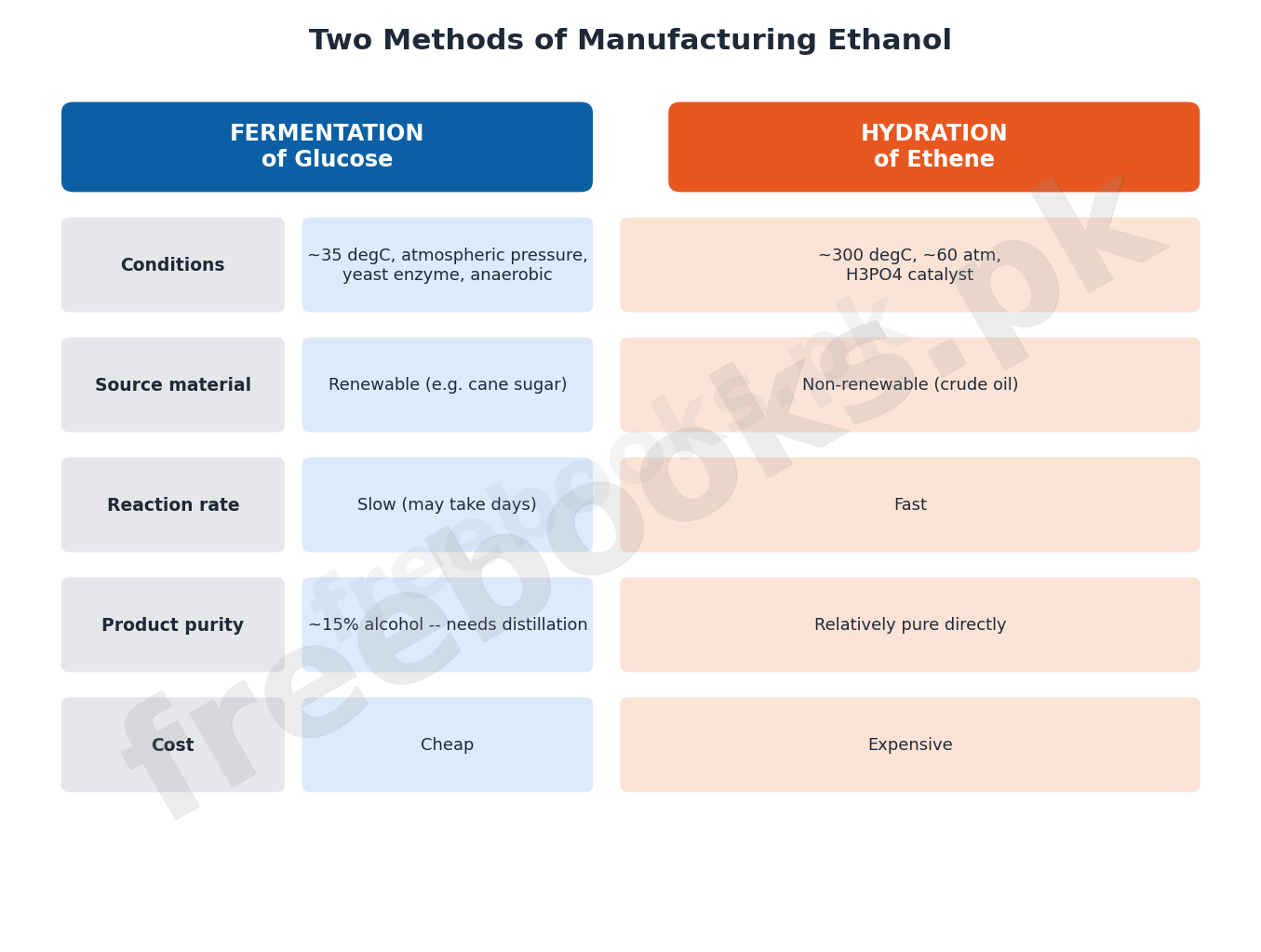
Ethanol is manufactured by fermentation of glucose using yeast. Fermentation is a reaction in which a substance breaks down into simpler substances using enzymes present in yeast, and is also how yogurt and bread are made. Glucose is converted to ethanol by yeast at around 35 degC in a neutral or acidic solution, under anaerobic conditions (absence of air): C6H12O6 –Yeast, 35 degC–> 2 C2H5OH + 2 CO2. The temperature must stay near 35 degC — lower temperatures slow the reaction, while higher temperatures inactivate the enzyme. Oxygen is excluded because it would oxidise the ethanol to ethanoic acid, and yeast itself becomes inactive once ethanol concentration exceeds about 15%, since ethanol is toxic to yeast at high concentration.
Ethanol is also manufactured by hydration of ethene, an addition reaction in which water adds across ethene’s double bond. A mixture of ethene and steam is passed over hot phosphoric acid (H3PO4) as catalyst at about 300 degC and 60 atm pressure: CH2=CH2 + H2O –H3PO4, 300 degC, 60 atm–> CH3-CH2-OH. The gaseous ethanol produced is then condensed to liquid. Compared with fermentation, hydration runs at high temperature and pressure using a non-renewable crude-oil-derived starting material, but reacts quickly and gives relatively pure, though expensive, alcohol; fermentation runs at atmospheric pressure and around 35 degC using a renewable starting material such as cane sugar, reacts slowly (often taking days), and gives only about 15% alcohol that needs energy-intensive distillation to concentrate, but the resulting ethanol is cheap.
23.2 Combustion of Alcohols
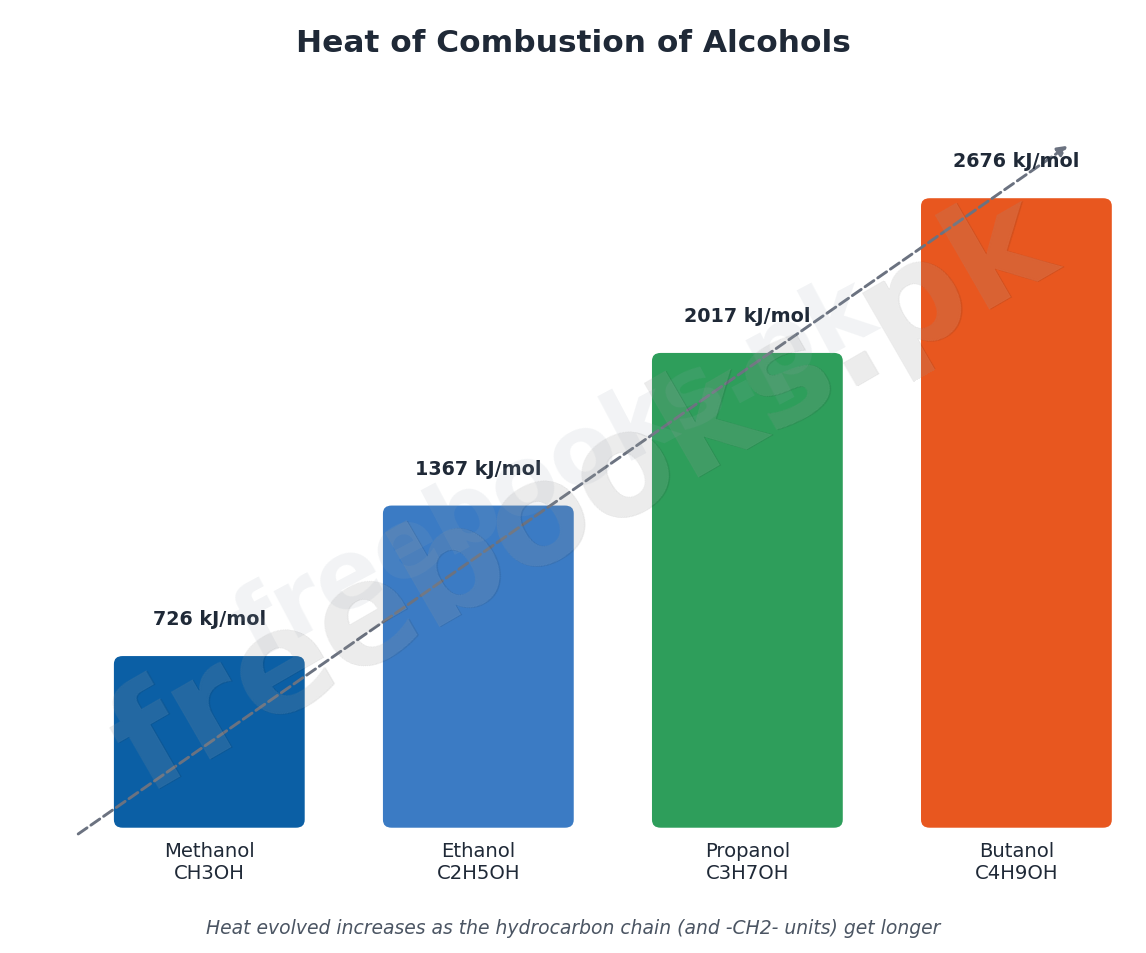
Alcohols are flammable and burn completely in excess air (because of their hydrocarbon chain) to produce carbon dioxide and water, releasing a large amount of heat. For example: 2CH3OH + 3O2 -> 2CO2 + 4H2O, deltaH = -726 kJ/mol (methanol); C2H5OH + 3O2 -> 2CO2 + 3H2O, deltaH = -1367 kJ/mol (ethanol); 2C3H7OH + 9O2 -> 6CO2 + 8H2O, deltaH = -2017 kJ/mol (propanol); 2C4H9OH + 12O2 -> 8CO2 + 10H2O, deltaH = -2676 kJ/mol (butanol).
During combustion, the weaker C-H bonds in the alcohol’s -CH2- groups break, and the stronger C=O and O-H bonds of CO2 and H2O form in their place. Because each additional -CH2- unit in the homologous series adds more C-H bonds to break and more C=O/O-H bonds to form, the amount of heat evolved increases steadily from methanol through ethanol, propanol and butanol.
23.3 Applications of Alcohols as Fuels
The first four aliphatic alcohols — methanol, ethanol, propanol and butanol — have properties suitable for use as fuel in internal combustion engines, instead of petrol or diesel. Advantages of alcohol fuels include: they come from renewable sources; their combustion produces no oxides of sulphur, making them more environmentally friendly than fossil fuels; and they have higher fuel efficiency than petrol or diesel. Because bioalcohols are made from plant material that absorbed CO2 during photosynthesis, and burning them releases that same CO2 back, the overall process is considered carbon-neutral — it does not add extra CO2 to the atmosphere.
Disadvantages include: alcohols carry less energy per unit volume than gasoline, so more fuel volume is needed to travel the same distance; alcohols can increase wear and tear on engine components; and land used to grow crops for alcohol production competes with land needed to grow food crops.
23.4 Role of Ethanol in Industries
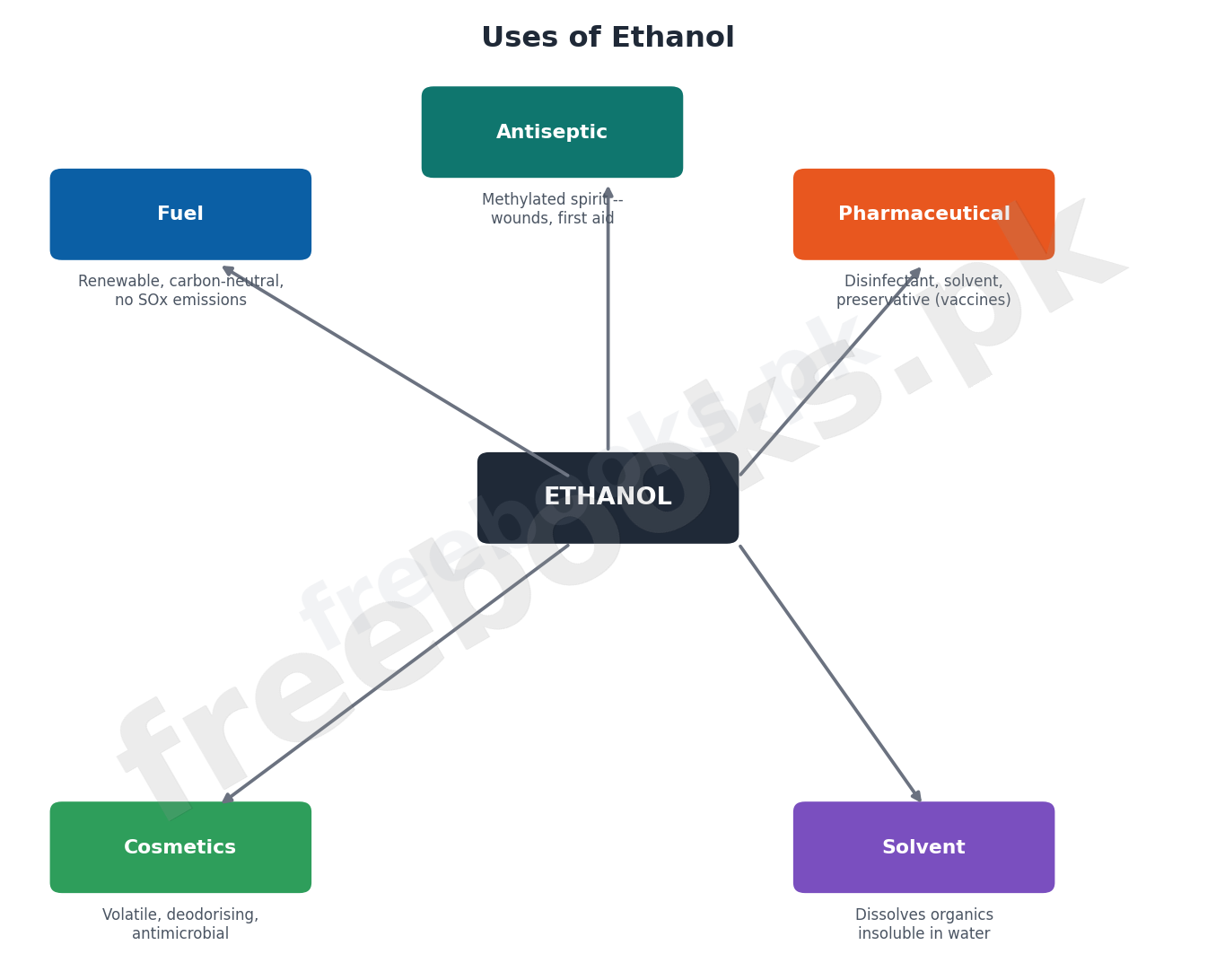
In the pharmaceutical industry, ethyl alcohol is a very common ingredient thanks to its bactericidal activity: it is used as a disinfectant in hand sanitiser and methylated spirit, and as a solvent and preservative in many pharmaceutical preparations, including vaccines. Ethanol and isopropanol are also active ingredients in some oral and topical drug products, where they help solubilise other drugs. Ethanol as a fuel additionally reduces greenhouse gas emissions by 44-52% compared with petrol, and also cuts down on other pollutants such as CO, NOx and particulate matter.
In the cosmetic industry, ethanol’s high volatility (fast evaporation), deodorising and anti-inflammatory properties, and refreshing, antimicrobial character make it an important ingredient in hair styling products, foundation creams, perfumes, deodorants and aftershave lotions.
23.5 Impact of Alcohols on Daily Life
Ethyl alcohol is a staple of the household first-aid kit in the form of methylated spirit, used as an antiseptic, for dressing wounds, and as an antidote for snake bites. In many parts of the world, ethanol also serves as a high-efficiency vehicle fuel. As a solvent, ethanol is widely used in perfumes and is relatively safe for dissolving many organic compounds that are insoluble in water. At the same time, ethanol as a drink can cause hangovers, alcohol poisoning, accidents and risky behaviour, and long-term alcohol use is linked to more than 200 different diseases.
Important Definitions
Fermentation
A reaction in which a substance (such as glucose) breaks down into simpler substances using enzymes present in a living catalyst such as yeast.
Ethanol (ethyl alcohol)
CH3-CH2-OH, the most important member of the alcohol homologous series, manufactured by fermentation or by hydration of ethene.
Enzyme
A biological catalyst, such as the one present in yeast, that speeds up a specific reaction like fermentation.
Anaerobic conditions
Conditions in which oxygen (air) is absent; required for the fermentation of glucose to ethanol.
Hydration of ethene
An addition reaction in which water adds across the double bond of ethene, using a phosphoric acid catalyst at high temperature and pressure, to give ethanol.
Combustion
The burning of a fuel such as an alcohol in oxygen/air to produce carbon dioxide, water and heat energy.
Methylated spirit
Ethanol used as a household antiseptic and first-aid product, and for dressing wounds.
Disinfectant
A substance, such as ethanol in hand sanitiser, that kills or inhibits harmful microbes on surfaces or skin.
Antiseptic
A substance, such as methylated spirit, applied to living tissue to prevent infection.
Solvent
A substance, such as ethanol, that dissolves other substances (solutes) to form a solution; ethanol dissolves many organic compounds insoluble in water.
Renewable source
A starting material, such as cane sugar used in fermentation, that can be replenished naturally and is not depleted by use.
Non-renewable source
A starting material, such as crude oil used to make ethene for hydration, that exists in a limited supply and is not naturally replenished on a human timescale.
Carbon-neutral process
A process, such as burning bioalcohol fuel, in which the CO2 released equals the CO2 absorbed during the production of the fuel, so atmospheric CO2 does not increase.
Biofuel (bioalcohol)
A fuel, such as ethanol, produced from plant material via fermentation, used as an alternative to fossil fuels.
Key Facts & Relations
| Topic | Relation |
|---|---|
| Fermentation of glucose | C6H12O6 –Yeast, ~35 degC, anaerobic–> 2 C2H5OH + 2 CO2 |
| Hydration of ethene | CH2=CH2 + H2O –H3PO4, ~300 degC, ~60 atm–> CH3-CH2-OH |
| Combustion of methanol | 2 CH3OH + 3 O2 -> 2 CO2 + 4 H2O, deltaH = -726 kJ/mol |
| Combustion of ethanol | C2H5OH + 3 O2 -> 2 CO2 + 3 H2O, deltaH = -1367 kJ/mol |
| Combustion of propanol | 2 C3H7OH + 9 O2 -> 6 CO2 + 8 H2O, deltaH = -2017 kJ/mol |
| Combustion of butanol | 2 C4H9OH + 12 O2 -> 8 CO2 + 10 H2O, deltaH = -2676 kJ/mol |
| Yeast tolerance limit | Fermentation stops once ethanol concentration exceeds about 15% (toxic to yeast) |
| Ethanol as fuel (vs petrol) | Reduces greenhouse gas emissions by about 44-52%; also cuts CO, NOx and particulate matter |
Diagrams
Fermentation vs Hydration of Ethene: A side-by-side comparison diagram of the two methods of manufacturing ethanol — fermentation of glucose and catalytic hydration of ethene — showing conditions, starting materials, rate and purity for each.
Heat of Combustion of Alcohols: A bar-style diagram showing the increasing heat of combustion from methanol to ethanol to propanol to butanol as the hydrocarbon chain lengthens.
Uses of Ethanol: A hub-and-spoke chart showing ethanol’s major uses — as a fuel, in pharmaceuticals, in cosmetics, as a solvent, and as an antiseptic/disinfectant.
Short Questions & Answers
Give two advantages of burning alcohols over burning fossil fuels.
Burning alcohols does not produce oxides of sulphur (unlike many fossil fuels), making them more environmentally friendly, and alcohols come from renewable sources rather than the non-renewable crude oil that fossil fuels are refined from.
Which properties of ethyl alcohol make it useful for the cosmetic industry?
Ethanol’s high volatility (it evaporates quickly), its deodorising and anti-inflammatory properties, and its refreshing, antimicrobial character make it useful in hair styling products, foundation creams, perfumes, deodorants and aftershave lotions.
How is ethyl alcohol important for the pharmaceutical industry?
Ethanol’s bactericidal activity makes it a common disinfectant (in hand sanitiser and methylated spirit) and it is also used as a solvent and preservative in many pharmaceutical preparations, including vaccines, and as an active ingredient that helps solubilise other drugs.
Give any two disadvantages of the fermentation reaction.
Fermentation is slow and may take days to complete, and it produces only about 15% alcohol, which then needs energy-intensive distillation to concentrate it into more usable, purer ethanol.
Write the conditions involved in the hydration of ethene.
Ethene and steam are passed over hot phosphoric acid (H3PO4) catalyst at about 300 degC and about 60 atm pressure to produce ethanol.
How is ethanol obtained as a by-product in the sugar industry?
Cane sugar (or its by-product molasses) provides the glucose/sugars that yeast ferments anaerobically at around 35 degC into ethanol and carbon dioxide, making ethanol a natural by-product of sugar production.
Why do we get relatively impure alcohol from the fermentation process?
Fermentation produces a dilute mixture of only about 15% ethanol in water along with other by-products, because yeast becomes inactive once the ethanol concentration rises too high, so the product must be distilled further to obtain purer, more concentrated alcohol.
How do the properties of ethyl alcohol help us use it as a fuel?
Ethanol is flammable and burns completely to release a large amount of heat, it is renewable and carbon-neutral as a bioalcohol, and it produces no sulphur oxides on combustion, all of which make it a practical, cleaner alternative fuel for internal combustion engines.
Why is oxygen excluded when the fermentation reaction is carried out?
Oxygen must be excluded because, in its presence, the ethanol produced would be further oxidised into ethanoic acid instead of accumulating as the desired product.
Why does butanol evolve a higher amount of heat than propanol when burnt in oxygen?
Butanol has one more -CH2- unit than propanol, so more C-H bonds are broken and more C=O and O-H bonds are formed during its combustion, releasing correspondingly more heat energy.
Long Questions & Answers
Give a comparison of the fermentation reaction and catalytic hydration of ethene for the preparation of ethanol.
How do the reaction conditions of the two methods differ?
Hydration of ethene is carried out at high temperature (~300 degC) and high pressure (~60 atm) using a phosphoric acid catalyst, while fermentation is carried out at a much gentler ~35 degC and atmospheric pressure using yeast’s natural enzymes.
How do the starting materials differ?
Hydration uses ethene derived from crude oil, a non-renewable source, while fermentation uses glucose from sources such as cane sugar, a renewable source that can be regrown.
How do the reaction rate and product purity compare?
Hydration reacts quickly and produces relatively pure ethanol directly, while fermentation is slow (often taking days) and produces only about 15% alcohol that needs further distillation, which itself requires additional energy, to reach a usable concentration.
How does the cost of the ethanol produced compare?
Ethanol from hydration is relatively expensive because of the energy-intensive high-temperature, high-pressure process and non-renewable feedstock, whereas ethanol from fermentation is cheap, since it uses inexpensive renewable raw materials and mild reaction conditions, despite needing extra distillation.
Describe the applications of ethanol in the pharmaceutical and cosmetic industries, and its role in daily life.
What roles does ethanol play in the pharmaceutical industry?
Ethanol’s bactericidal activity makes it a widely used disinfectant, for example in hand sanitiser and methylated spirit, and it also serves as a solvent and preservative in pharmaceutical preparations including vaccines, and as an active ingredient that helps solubilise other drugs in oral and topical products.
What roles does ethanol play in the cosmetic industry?
Because ethanol is highly volatile (evaporates quickly) and has deodorising, anti-inflammatory, refreshing and antimicrobial properties, it is a key ingredient in hair styling products, foundation creams, perfumes, deodorants and aftershave lotions.
How does ethanol feature in everyday household and first-aid use?
Ethanol, in the form of methylated spirit, is a staple of the household first-aid kit, used as an antiseptic, for dressing wounds, and as an antidote for snake bites; it is also a widely used, relatively safe solvent in perfumes for dissolving organic compounds that do not dissolve in water.
What risks are associated with ethanol’s daily-life role as a drink?
Ethanol consumed as an alcoholic drink can cause hangovers, alcohol poisoning, accidents and risky behaviour, and long-term use of alcohol is linked to more than 200 different diseases, showing that the same compound useful in medicine and industry carries real health risks when consumed.
Multiple Choice Questions (MCQs)
Which conditions are considered best for the fermentation of glucose? (A) 35 degC, fresh yeast, absence of oxygen (B) 45 degC, yeast (C) 45 degC, absence of oxygen (D) 35 degC, fresh yeast
Correct answer: (A) 35 degC, fresh yeast, absence of oxygen. Fermentation needs a temperature of about 35 degC (not too low or the enzyme becomes inactive at higher temperatures), fresh active yeast, and anaerobic (oxygen-free) conditions to prevent the ethanol being further oxidised.
Which catalyst other than H3PO4 can also be used for hydration of alkenes? (A) NaOH (B) H2SO4 (C) CH3COOH (D) Ni
Correct answer: (B) H2SO4. Concentrated sulphuric acid (H2SO4) can also act as an acid catalyst for the hydration (addition of water) of alkenes, just like phosphoric acid.
Which alcohol has the maximum heat of combustion? (A) CH3CH2CH2OH (propanol) (B) CH3CH2OH (ethanol) (C) CH3OH (methanol) (D) CH3CH2CH2CH2OH (butanol)
Correct answer: (D) CH3CH2CH2CH2OH (butanol). Heat of combustion increases with chain length in the alcohol homologous series, so butanol, having the longest chain of the four listed, releases the most heat.
The most environmentally friendly fuel among the following is: (A) Coal (B) Kerosene oil (C) Ethanol (D) Wood
Correct answer: (C) Ethanol. Ethanol is a renewable, carbon-neutral bioalcohol that produces no sulphur oxides on combustion, making it more environmentally friendly than fossil fuels like coal and kerosene, or wood.
Which property or properties of ethanol make it suitable for use in the cosmetic industry? (A) Easily flammable (B) Highly volatile and deodorising (C) Antipyretic (D) Sedative
Correct answer: (B) Highly volatile and deodorising. Ethanol’s high volatility (fast evaporation) and deodorising property make it valuable in cosmetics such as perfumes, deodorants and aftershave lotions.
What is the correct IUPAC name for CH3-CH(OH)-CH2-CH(CH3)-CH3? (A) 2-Methylpentan-4-ol (B) 4-Methylpentan-2-ol (C) Hexan-2-ol (D) Hexan-4-ol
Correct answer: (B) 4-Methylpentan-2-ol. The longest chain has five carbons (pentane) with -OH on carbon 2 and a methyl branch on carbon 4, numbered to give the principal -OH group the lowest locant, giving 4-methylpentan-2-ol.
Which property of ethanol makes it suitable for cleaning wounds? (A) Good solvent (B) Volatility (C) Antiseptic (D) Deodorizing
Correct answer: (C) Antiseptic. Ethanol’s antiseptic (bactericidal) property is what allows it, as methylated spirit, to clean and disinfect wounds and prevent infection.
Which alcohol is added to petrol to improve combustion and also serves as a feedstock to prepare vinegar and other organic compounds? (A) Propanol (B) Propan-2-ol (C) Ethanol (D) Methanol
Correct answer: (C) Ethanol. Ethanol is commonly blended into petrol to improve combustion and is also the starting material used to manufacture vinegar (ethanoic acid) and many other organic compounds.
Quick Revision Summary
- Ethanol is made by fermentation of glucose (yeast, ~35 degC, anaerobic) or by hydration of ethene (H3PO4, ~300 degC, ~60 atm).
- Fermentation: renewable source, slow, cheap, gives ~15% impure alcohol needing distillation. Hydration: non-renewable source, fast, expensive, gives relatively pure alcohol directly.
- Alcohols combust completely in air to CO2 + H2O + heat; heat evolved rises from methanol to butanol as chain length (and C-H bonds broken) increases.
- Alcohol fuel advantages: renewable, no SOx emissions, higher efficiency, carbon-neutral. Disadvantages: less energy per volume, engine wear, competes with food-crop land.
- Ethanol in pharmaceuticals: disinfectant (hand sanitiser, methylated spirit), solvent and preservative (including in vaccines).
- Ethanol in cosmetics: volatile, deodorising, anti-inflammatory, antimicrobial — used in hair products, creams, perfumes, deodorants, aftershave.
- Daily life: methylated spirit as first-aid antiseptic/wound dressing/snakebite antidote; ethanol as vehicle fuel and perfume solvent.
- Ethanol as a drink carries real risks — hangover, poisoning, accidents, and long-term links to 200+ diseases.
Exam Tips
- Remember fermentation conditions with ’35-yeast-no air’: ~35 degC, yeast enzyme, anaerobic — all three must hold for good yield.
- Contrast the two ethanol methods on FOUR axes: conditions (mild vs harsh), source (renewable vs non-renewable), rate/purity, and cost.
- For combustion equations, always balance CO2 and H2O against the number of carbons and hydrogens in the alcohol first, then balance oxygen last.
- Heat of combustion trend: more carbons = more bonds broken/formed = more heat released, going up the alcohol homologous series.
- Keep ‘renewable’ and ‘non-renewable’ tied to their sources: fermentation/crops = renewable; hydration/crude oil = non-renewable.
- Group ethanol’s real-world roles into three buckets to remember them fast: medicine (disinfectant/solvent), cosmetics (volatile/deodorising), and fuel (renewable/carbon-neutral).