Polymers, or macromolecules, are extremely large molecules formed by linking together a very large number of simple molecular units called monomers, in a process called polymerisation. Carbohydrates, proteins and nucleic acids are everyday natural polymers, while plastics, synthetic fibres and rubber are man-made ones — and one of the most significant changes across the modern world has been the gradual replacement of metals, wood and cotton with synthetic polymers, prized for their high strength, flexibility, and resistance to heat and chemicals.
This chapter covers the two main routes to building a polymer — addition and condensation polymerisation — how to deduce a polymer’s repeat unit from its monomers and vice versa, what plastics are and why they are so widely used, the importance of synthetic fibres in the textile industry, and the serious environmental problems caused by plastic waste, from landfill and ocean accumulation to the toxic gases released when it is burned.
Learning Objectives
- Define polymers as large molecules built up from many smaller molecules called monomers, and describe the differences between addition and condensation polymerisation.
- Identify the repeating units and/or linkages in addition polymers and in condensation polymers, and deduce the structure or repeating unit of a condensation polymer from its monomers and vice versa (polyamides from a dicarboxylic acid and a diamine; polyesters from a dicarboxylic acid and a diol).
- State that plastics are made from polymers, and describe how the properties of plastics have implications for their disposal.
- Describe the environmental challenges caused by plastics, including disposal in landfill sites, accumulation in oceans, and the formation of toxic gases from burning.
- Describe the structure of nylon (a polyamide) and PET (a polyester), and state that PET can be converted back into monomers and repolymerised.
- Outline the importance of polymers in the textile industry.
Key Concepts
26.1 Types of Polymers: Addition and Condensation
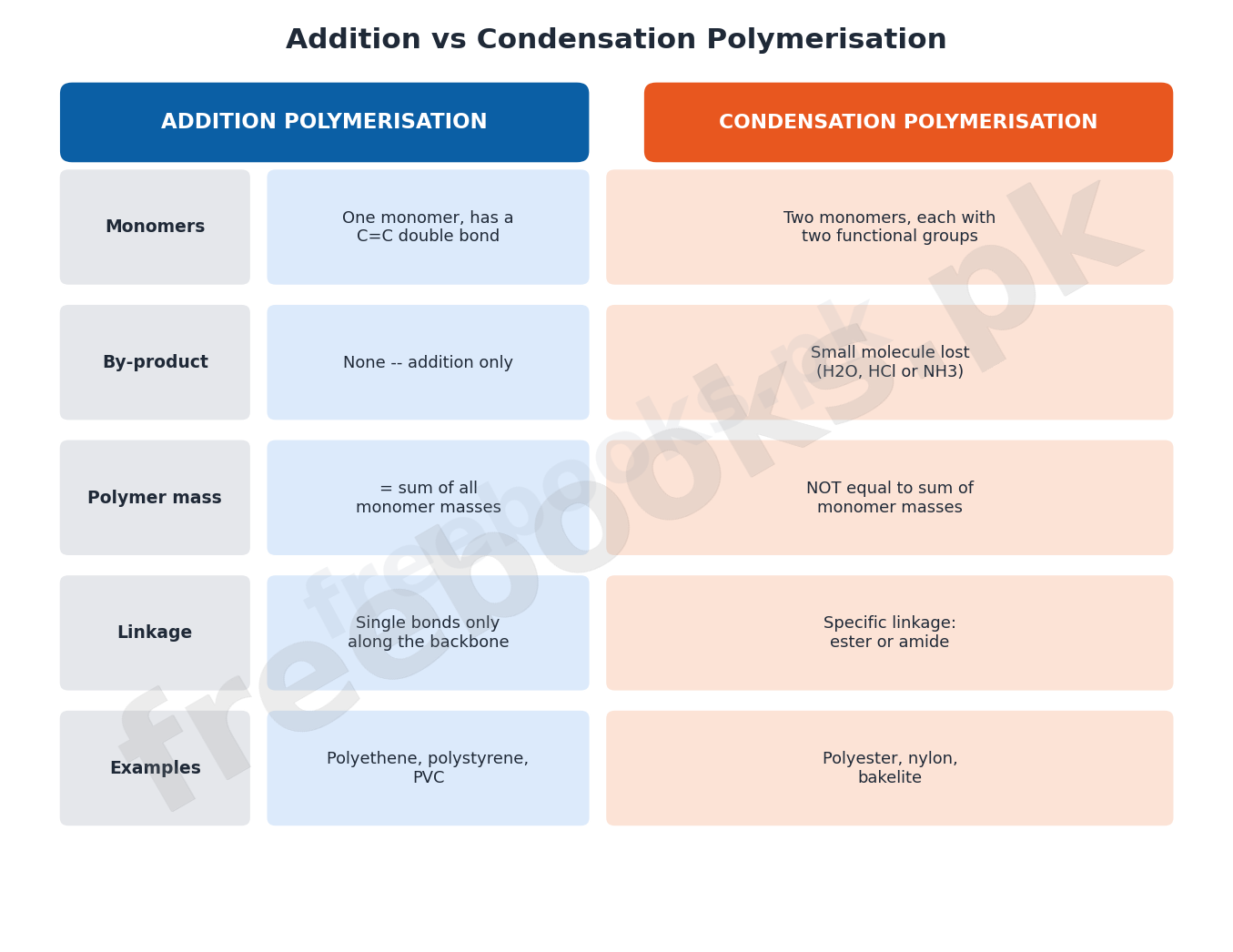
Addition polymers form when monomer molecules containing a double bond join together through covalent bonds to give one very large molecule, with the C=C double bond breaking to let monomers link up. For example, a large number of ethene molecules add together to give polyethene (polythene). No molecule is eliminated and no by-product forms during addition polymerisation, which usually happens at high pressure with a catalyst present.
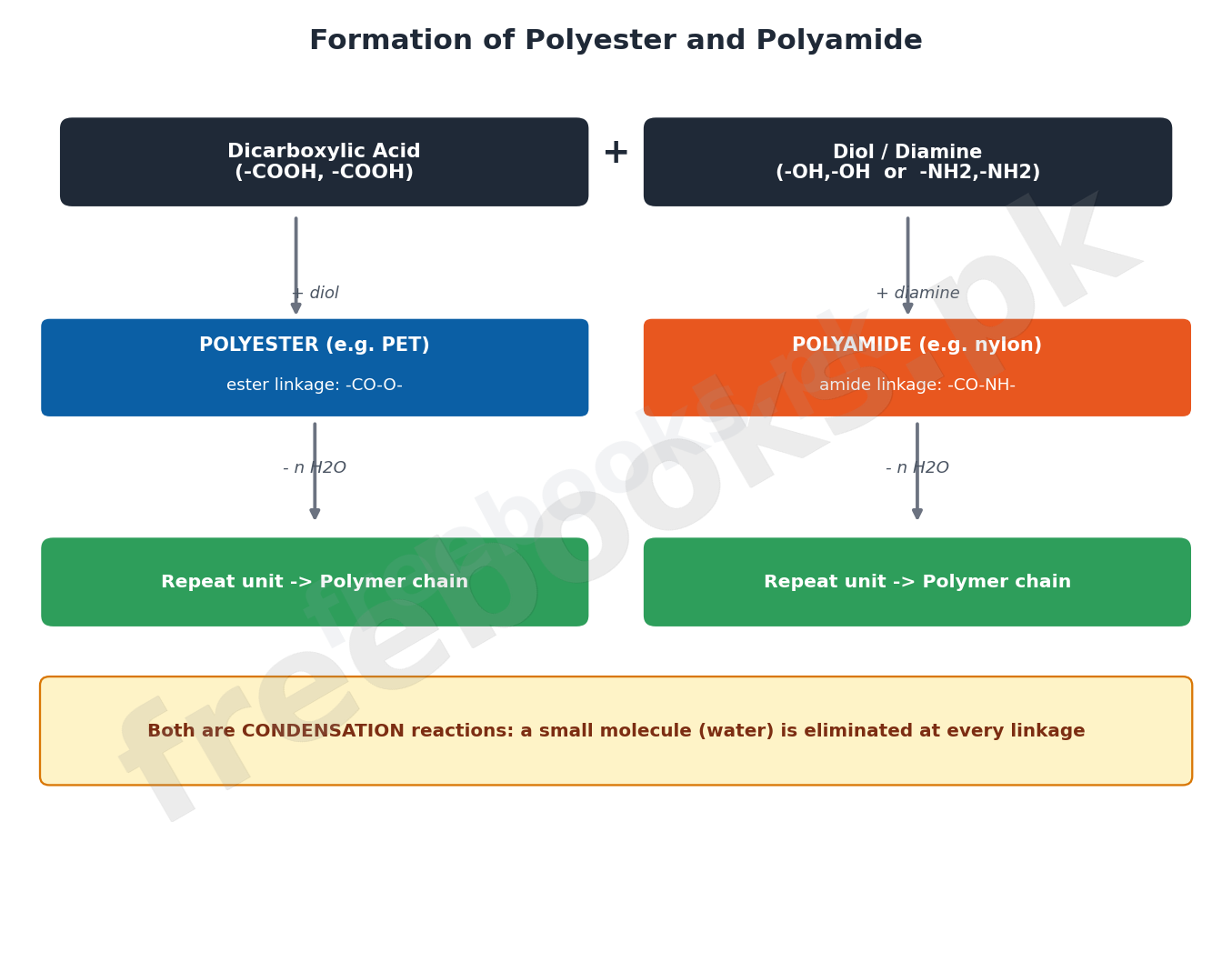
Condensation polymers form when two different molecules, each carrying two different functional groups, react together with the elimination of a small molecule such as H2O, HCl or NH3, usually in the presence of an acid or base. For example, ethane diol reacts with a dicarboxylic acid (terephthalic acid) to give Polyethylene Terephthalate (PET) — the carboxyl group of the acid reacts with the hydroxyl group of the diol to form an ester linkage. Because the functional groups sit at both ends of the resulting molecule, polymerisation continues at both ends to build a very large molecule. A polyamide forms similarly when a dicarboxylic acid reacts with a diamine: each -COOH group reacts with an -NH2 group to form an amide linkage, losing a water molecule each time.
26.2 Deducing Monomer and Polymer Structures
To find the repeating unit of an addition polymer from its structure, remove the brackets, the extended bonds on each side, and the subscript n, then change the single bond back to a double bond — for example, [CH2-CH2]n becomes CH2=CH2 (ethene), the monomer of polyethene.
For a condensation polymer such as a polyester, remove the brackets, extended bonds and subscript n, then break the bond within the linkage (the ester C-O bond, or the amide CO-NH bond for a polyamide); add -OH to each end of the dicarboxylic acid fragment, and add -H to each end of the diol (for a polyester) or diamine (for a polyamide) fragment. This recovers the two original monomers — the dicarboxylic acid and the diol or diamine — that combined to form the polymer’s repeat unit.
26.3 Plastics
Polymerising monomers like ethylene, propylene and styrene gives polyethylene (PE), polypropylene (PP) and polystyrene (PS) respectively — these are a few examples of plastics. Plastics are used to make carry-home food containers, soft-drink and water bottles, shopping bags, kitchenware, buckets, tables, chairs, food wrappers, cups and plates. Being lightweight, flexible and durable, and easily moulded into almost any shape, plastics have found their way into nearly every sphere of daily life, and since the early 20th century, millions of tonnes of plastic have been produced every year.
26.4 Importance of Polymers in the Textile Industry
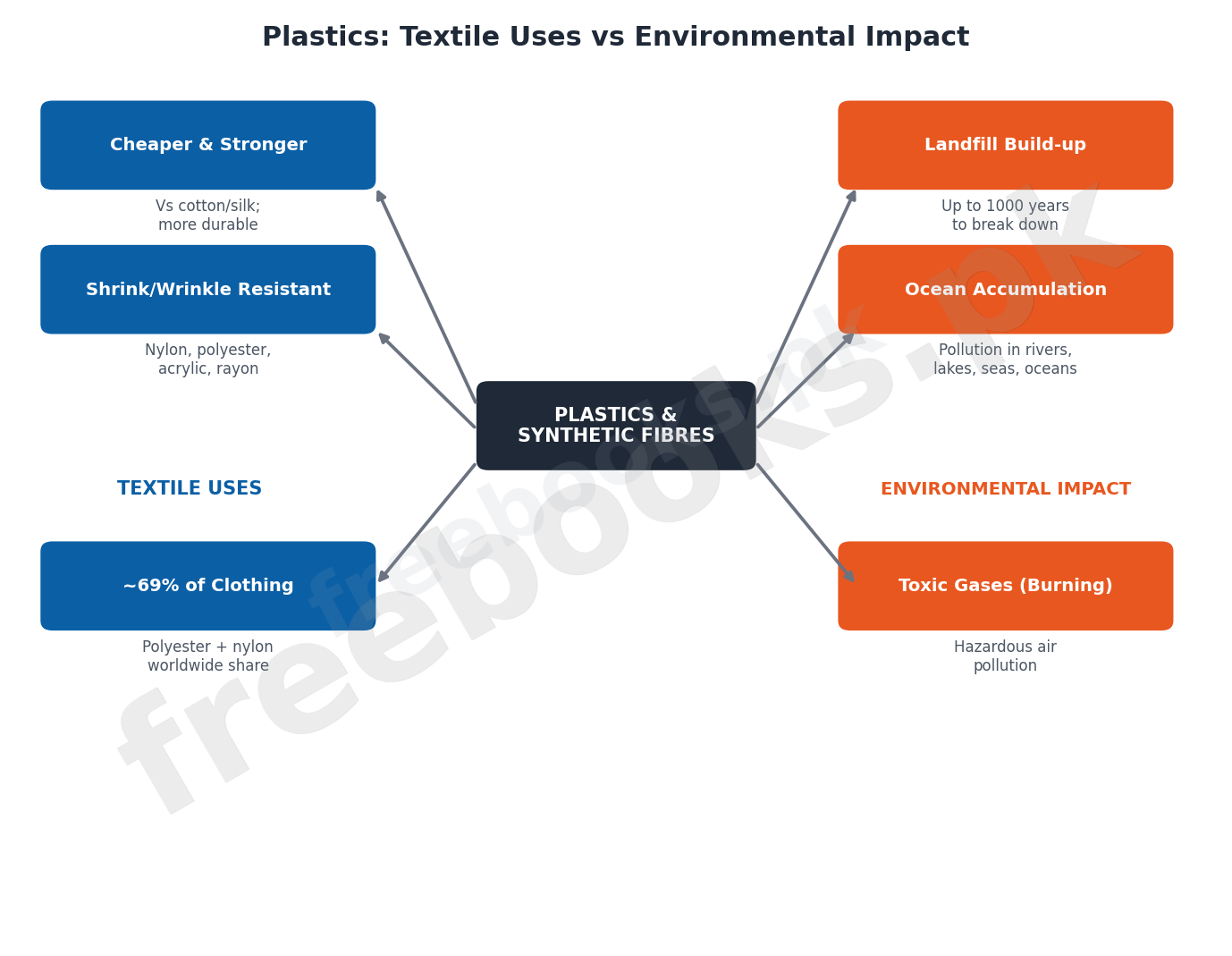
Polymers used in the textile industry are called synthetic fibres — examples include nylon, polyester, rayon and acrylic. Synthetic fibres are cheaper than natural fibres like cotton and silk, stronger and more durable, do not shrink, resist wrinkling, are lightweight and quick-drying, and resist moths and insects. Polyester and nylon together account for about 69% of all material used in the global clothing industry — polyester is prized for its strength and resistance to shrinking and is common in sportswear and hosiery, while acrylic is lightweight, soft, and provides warmth.
26.5 Adverse Effects of Plastics
Unlike most other materials, plastics do not biodegrade — discarded plastic articles can take up to 1000 years to break down, leading to a huge build-up of plastic in the environment. Plastic pollution is now found almost everywhere, on land, in the air, and in every kind of water body from rivers and lakes to seas and oceans, and it has reached an alarming level, causing serious health problems. Discarded plastics are disposed of by burning, dumping in landfill, or being thrown into drains, from where they often end up in rivers and oceans; burning discarded plastic is especially hazardous, since it releases dangerous toxic gases into the air.
Important Definitions
Polymer (macromolecule)
An extremely large molecule formed by linking together many simple molecular units called monomers.
Monomer
A small, simple molecular unit that links together with many others to form a polymer.
Polymerisation
The process by which a polymer is formed from its monomers.
Addition polymer
A polymer formed when monomers containing a double bond join together by covalent bonds, with no molecule eliminated and no by-product formed, e.g. polyethene.
Condensation polymer
A polymer formed when two different monomers, each with two functional groups, react together with the elimination of a small molecule such as H2O, HCl or NH3, e.g. polyester or polyamide.
Repeat unit
The smallest structural unit that, repeated many times, makes up the full polymer chain.
Ester linkage
The -CO-O- linkage formed between a carboxyl group and a hydroxyl group during the formation of a polyester such as PET.
Amide linkage
The -CO-NH- linkage formed between a carboxyl group and an amino group during the formation of a polyamide such as nylon.
Plastic
A synthetic material made from polymers such as polyethylene, polypropylene or polystyrene, valued for being lightweight, flexible, durable and easily moulded.
Synthetic fibre
A man-made polymer, such as nylon, polyester, rayon or acrylic, used in the textile industry.
Biodegradation
The natural breakdown of a material by living organisms; most plastics do not biodegrade and can persist for up to 1000 years.
PET (polyethylene terephthalate)
A common polyester, formed from ethane diol and terephthalic acid, that can be chemically recycled back into its monomers and repolymerised.
Nylon
A polyamide synthetic fibre formed from a dicarboxylic acid and a diamine, widely used in the textile industry.
Chemical recycling
Breaking a polymer such as PET back down into its monomer units, for example by heating it in the absence of oxygen, so it can be repolymerised.
Key Facts & Relations
| Topic | Relation |
|---|---|
| Addition polymerisation (polyethene) | n CH2=CH2 –high pressure, catalyst–> [-CH2-CH2-]n (no by-product) |
| Condensation polymerisation (PET, polyester) | Dicarboxylic acid + Diol –acid/base catalyst–> Polyester (ester linkage) + n H2O |
| Condensation polymerisation (polyamide) | Dicarboxylic acid + Diamine –acid/base catalyst–> Polyamide (amide linkage) + n H2O |
| Deducing addition monomer | [CH2-CH2]n -> remove brackets/n, single->double bond -> CH2=CH2 |
| Deducing condensation monomers | Break ester/amide linkage; add -OH to acid fragment ends, -H to diol/diamine fragment ends |
| Addition polymer molecular mass | = sum of the molecular masses of all monomers used (no mass lost) |
| Plastic degradation time | Discarded plastic can take up to 1000 years to break down (non-biodegradable) |
| Textile share of polyester + nylon | About 69% of all material used in the global clothing industry |
Diagrams
Addition vs Condensation Polymerisation: A comparison diagram of the two main types of polymerisation, showing monomer requirements, by-products, and example polymers for each.
Formation of Polyester and Polyamide: A diagram showing a dicarboxylic acid reacting with a diol to form a polyester (ester linkage), and with a diamine to form a polyamide (amide linkage), releasing water in each case.
Uses and Environmental Impact of Plastics: A hub-and-spoke chart showing the textile-industry uses of synthetic fibres alongside the environmental problems caused by plastic waste — landfill, ocean accumulation, and toxic gases from burning.
Short Questions & Answers
Give an example of a commercial product formed using polyethene.
Shopping bags, water bottles, buckets and food-wrapper films are all common commercial products made from polyethene (polythene).
Write three properties of synthetic polymers.
Synthetic polymers are generally lightweight, flexible, and resistant to heat and chemicals — properties that make them useful across a huge range of applications.
How is an ester linkage between two monomers formed?
An ester linkage forms when the carboxyl group (-COOH) of a dicarboxylic acid reacts with the hydroxyl group (-OH) of a diol, joining them through a -CO-O- linkage and releasing a water molecule.
How does condensation polymerisation occur?
Condensation polymerisation occurs when two different monomers, each carrying two functional groups, react repeatedly at both ends of the growing chain, eliminating a small molecule such as water at each linkage, to build up a long polymer chain.
What do you understand by the term ‘repeating unit’?
A repeating unit is the smallest structural fragment of a polymer that, when repeated n times and joined end to end, reproduces the full polymer chain.
Give two examples each of addition polymers and condensation polymers.
Addition polymers: polyethene and polystyrene (also polyvinyl chloride/PVC). Condensation polymers: polyester and nylon (also bakelite).
How are polymers useful to us?
Polymers are useful because of their high strength, flexibility, and resistance to heat and chemicals, which make them suitable for products ranging from packaging and containers to textiles, and they have widely replaced heavier or more limited materials like metal, wood and cotton.
How are synthetic fibres different from natural fibres?
Synthetic fibres are generally cheaper, stronger, more durable, resistant to shrinking and wrinkling, lightweight, quick-drying, and moth/insect resistant compared with natural fibres such as cotton and silk.
Are natural polymers hazardous for the environment? Explain why.
No — unlike synthetic plastics, natural polymers such as starch, cellulose and proteins are biodegradable and break down naturally through the action of living organisms, so they do not accumulate as long-term pollution the way synthetic plastics do.
Why is it dangerous to burn discarded plastic articles?
Burning discarded plastic releases dangerous, toxic gases into the air, creating hazardous environmental and health conditions for people and wildlife nearby.
Long Questions & Answers
Describe the two main types of polymerisation and how condensation polymers like PET and nylon are formed.
What is addition polymerisation and how does polyethene form?
In addition polymerisation, monomers containing a double bond (like ethene) join together through covalent bonds as the double bond breaks, with no molecule eliminated and no by-product formed; a very large number of ethene molecules combine this way, usually at high pressure with a catalyst, to give polyethene.
What is condensation polymerisation and how is PET formed?
In condensation polymerisation, two different monomers, each with two functional groups, react with the elimination of a small molecule such as water; PET forms when ethane diol reacts with terephthalic acid (a dicarboxylic acid), with the acid’s carboxyl group reacting with the diol’s hydroxyl group to form an ester linkage, and this repeats at both ends of the growing chain.
How is a polyamide such as nylon formed?
A polyamide forms when a dicarboxylic acid reacts with a diamine: each -COOH group of the acid reacts with an -NH2 group of the diamine to form an amide linkage, with a water molecule lost at each linkage, and the resulting repeat unit is built up into the full polymer chain.
How can the repeating unit or monomer be deduced from a given polymer structure?
For an addition polymer, remove the brackets, extended bonds and subscript n from the repeat unit and change the single bond back to a double bond to recover the monomer; for a condensation polymer, break the ester or amide linkage and add -OH to each end of the acid fragment and -H to each end of the diol or diamine fragment to recover the original monomers.
What are plastics, why are they important in the textile industry, and what environmental problems do they cause?
What are plastics and why are they so widely used?
Plastics are polymers such as polyethylene, polypropylene and polystyrene that are lightweight, flexible, durable, and easily moulded into almost any shape, which is why they are used for food containers, bottles, bags, kitchenware, furniture and countless other everyday products.
Why are synthetic fibres important in the textile industry?
Synthetic fibres such as nylon, polyester, rayon and acrylic are cheaper, stronger, more durable, shrink- and wrinkle-resistant, lightweight, quick-drying and insect-resistant compared with natural fibres, and polyester and nylon alone account for about 69% of all material used in clothing worldwide.
What environmental problems does plastic disposal cause?
Because plastics do not biodegrade and can persist for up to 1000 years, discarded plastic accumulates in landfill sites and in oceans, rivers, lakes and seas, causing widespread pollution on land, in water and in the air, and leading to serious health and ecological problems.
Why is burning plastic dangerous, and can any plastics be recycled?
Burning discarded plastic releases dangerous toxic gases into the air, making it a hazardous disposal method; however, some plastics such as PET can be chemically recycled by heating them in the absence of oxygen to break them back down into their monomers, which can then be repolymerised into new material.
Multiple Choice Questions (MCQs)
Which of the following polymers is a synthetic polymer? (A) Starch (B) Cellulose (C) Animal fat (D) Polyester
Correct answer: (D) Polyester. Polyester is a man-made (synthetic) condensation polymer, whereas starch, cellulose and animal fat are all naturally occurring polymers/biomolecules.
Which polymer has an amide linkage? (A) Polyester (B) Polyamide (C) Polyethene (D) Polystyrene
Correct answer: (B) Polyamide. A polyamide, such as nylon, is defined by its amide (-CO-NH-) linkage, formed between a dicarboxylic acid and a diamine.
Identify an ester linkage: (A) R-C(=O)-O-R (B) R-C(=O)-R (C) R-C(=O)-NH-R (D) R-C-NH-R
Correct answer: (A) R-C(=O)-O-R. An ester linkage has the form R-C(=O)-O-R, with a carbonyl carbon bonded to an oxygen that connects to a second R group — distinct from the amide linkage, R-C(=O)-NH-R.
A polymer has the repeat unit [-CH2-CH(OCOCH3)-]n. What is the structure of its monomer? (A) CH2=CH2 (B) CH2=CH2-CH3 (C) CH2=CH-OCOCH3 (D) CH2=CH-CO-O-CH3
Correct answer: (C) CH2=CH-OCOCH3. Removing the brackets/subscript n and converting the single C-C bond back to a double bond gives CH2=CH-OCOCH3 as the monomer (vinyl acetate).
Which of the following polymers can be recycled? (A) PET (B) Polystyrene (C) PVC (D) Epoxy
Correct answer: (A) PET. PET is a condensation polymer that can be chemically broken back down into its monomers (by heating in the absence of oxygen) and repolymerised, making it recyclable in this way.
Which of the following polymers is biodegradable? (A) Polyamide (B) Polyester (C) Starch (D) PET
Correct answer: (C) Starch. Starch is a naturally occurring polysaccharide and is biodegradable, unlike the synthetic polymers polyamide, polyester and PET, which persist in the environment for very long periods.
Which of the following polymers is obtained by condensation polymerisation? (A) Polyvinyl chloride (B) Polystyrene (C) Polyamide (D) Polyethene
Correct answer: (C) Polyamide. Polyamide (such as nylon) is a condensation polymer, formed with the elimination of water between a dicarboxylic acid and a diamine, unlike polyvinyl chloride, polystyrene and polyethene, which are all addition polymers.
In addition polymerisation, the molecular mass of the polymer can be found by: (A) Subtracting the mass of water lost (B) Adding the molecular masses of all monomers used (C) Dividing the monomer mass by n (D) It cannot be calculated at all
Correct answer: (B) Adding the molecular masses of all monomers used. Because addition polymerisation eliminates no molecule and forms no by-product, the polymer’s molecular mass equals the sum of the molecular masses of all the monomer units used to build it.
Quick Revision Summary
- Polymers are large molecules (macromolecules) built from repeating monomer units through polymerisation; natural examples include carbohydrates, proteins and nucleic acids, man-made examples include plastics and synthetic fibres.
- Addition polymerisation: single monomer with a double bond, no by-product, polymer mass = sum of monomer masses (e.g. polyethene, polystyrene, PVC).
- Condensation polymerisation: two different monomers with two functional groups each, eliminates a small molecule (H2O/HCl/NH3), forms ester or amide linkages (e.g. polyester/PET, nylon, bakelite).
- To deduce a monomer: addition polymer -> remove brackets/n, restore double bond; condensation polymer -> break the linkage, add -OH to the acid fragment and -H to the diol/diamine fragment.
- Plastics (PE, PP, PS etc.) are lightweight, flexible, durable and mouldable, used in containers, bags, kitchenware and furniture.
- Synthetic fibres (nylon, polyester, rayon, acrylic) are cheaper, stronger, shrink/wrinkle-resistant, and light; polyester + nylon = ~69% of world clothing material.
- Plastics are non-biodegradable (up to 1000 years to break down) — major problems: landfill accumulation, ocean pollution, and toxic gases released when burned. PET can be chemically recycled back to monomers.
Exam Tips
- Tell addition vs condensation apart fast: addition = ONE monomer + double bond + NO by-product; condensation = TWO monomers + two functional groups EACH + small molecule eliminated.
- To deduce an addition monomer: strip brackets/n, turn the single bond back into a double bond — that’s it.
- To deduce condensation monomers: find the linkage (ester = -CO-O-, amide = -CO-NH-), break it, then add -OH to the acid side and -H to the diol/diamine side.
- Remember polyester and nylon by their linkage: polyester = ester linkage (acid + diol); nylon/polyamide = amide linkage (acid + diamine).
- Three-part environmental problem to remember: landfill (takes up space), oceans (marine pollution), burning (toxic gases) — plastics fail all three because they don’t biodegrade.
- PET is the one ‘exception’ worth remembering: unlike most plastics, it can be chemically recycled back into its monomers by heating without oxygen.