This chapter covers two of the most important industrial chemicals — ammonia, made by the Haber process, and sulphuric acid, made by the Contact process — along with the sources, conditions and equations used in each. It then classifies oxides as acidic, basic, neutral or amphoteric based on how they behave with acids, bases and water, connecting this classification to whether an element is metallic or non-metallic in character.
The chapter then surveys the general chemical properties of metals — their reactions with cold water, steam, dilute acids and oxygen — and uses these reactions to build the reactivity series of metals. It closes by examining the environmental role of oxides of nitrogen (NOx), explaining how they contribute to photochemical smog (through peroxyacetyl nitrate, PAN) and to acid rain, both directly and through their catalytic role in oxidizing atmospheric sulphur dioxide.
Learning Objectives
- Recognize that atmospheric oxides of nitrogen (NO and NO2) can react with unburned hydrocarbons to form peroxyacetyl nitrate (PAN), a component of photochemical smog
- Describe the role of NO and NO2 in the formation of acid rain, both directly and through their catalytic role in the oxidation of atmospheric sulphur dioxide
- State the symbol equation for the production of ammonia in the Haber process, and the sources of nitrogen (air) and hydrogen (methane), along with the typical conditions (450 degC, about 20000 kPa/20 atm, iron catalyst)
- State the symbol equation for the conversion of sulphur dioxide to sulphur trioxide in the Contact process, and the sources of sulphur dioxide (burning sulphur or roasting sulphide ores) and oxygen (air), along with the typical conditions (450 degC, about 200 kPa/atm, vanadium(V) oxide catalyst)
- Describe amphoteric oxides as oxides that react with both acids and bases to produce a salt and water, and classify oxides as acidic (SO2, CO2), basic (CuO, CaO) or amphoteric (Al2O3, ZnO), relating this to metallic and non-metallic character
- Identify the general chemical properties of metals in their reactions with dilute acids, cold water, steam and oxygen, and arrange metals in order of reactivity given relevant information
Key Concepts
19.1 Ammonia (The Haber Process)
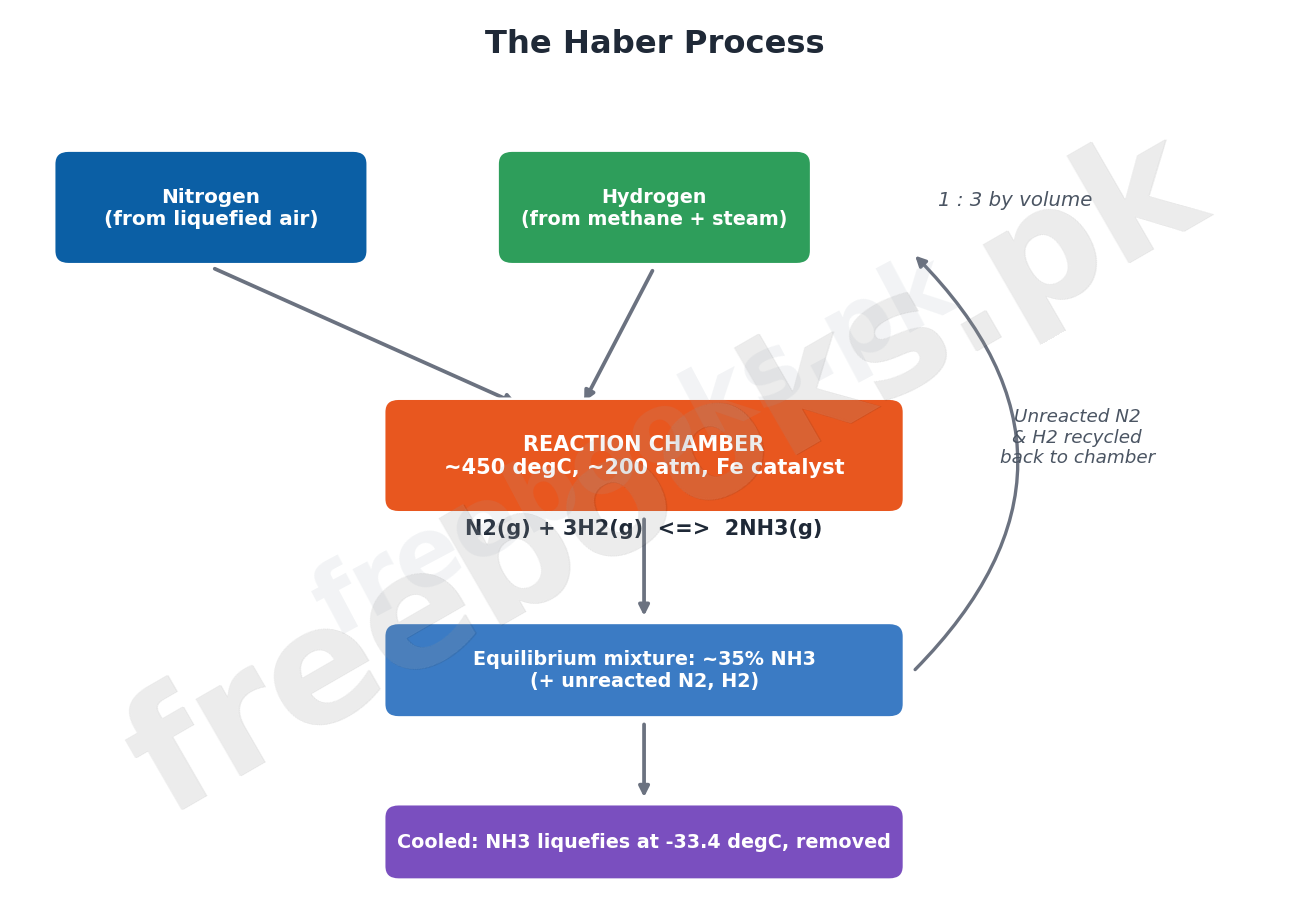
Ammonia is one of the most important chemicals produced globally, with about 80% of it used to make urea and other ammonium salts as fertilizers; it is also used in plastics, pharmaceuticals and as a refrigerant. It is manufactured industrially by the Haber process: nitrogen and hydrogen gases, in a 1:3 ratio by volume, are heated to about 400-500 degC under about 200 atmospheres of pressure in the presence of an iron-based catalyst (Fe/Al2O3): N2(g) + 3H2(g) <=> 2NH3(g).
The equilibrium mixture contains about 35% ammonia by volume. This mixture is cooled by refrigeration until ammonia liquefies at -33.4 degC and is removed, while the unreacted nitrogen and hydrogen are recycled back into the reaction chamber. Nitrogen is obtained from the fractional distillation of liquefied air, since it boils off at -196 degC before oxygen does; hydrogen is obtained by heating methane in a limited supply of oxygen (giving mainly CO and H2), then reacting the carbon monoxide produced with steam to release more hydrogen: CH4(g) + H2O(g) -> CO(g) + 3H2(g), followed by CO(g) + H2O(g) -> CO2(g) + H2(g).
19.2 Sulphuric Acid (The Contact Process)
Sulphuric acid, sometimes called the 'king of chemicals', is used directly or indirectly in almost every manufacturing process, and is prepared industrially by the Contact process in four stages. First, sulphur dioxide is produced either by burning elemental sulphur in air, S(s) + O2(g) -> SO2(g), or by roasting the sulphide ore iron pyrite in excess air, 4FeS2(s) + 11O2(g) -> 2Fe2O3(s) + 8SO2(g); the gas is then purified (removing dust and arsenic compounds that would poison the catalyst) and dried using concentrated sulphuric acid.
Second, the clean, dry SO2 and O2 gases are passed over a vanadium(V) oxide catalyst at about 450 degC and 2-3 atmospheres in a contact chamber; although the reaction is reversible, about 98% of the SO2 is converted to SO3 under these conditions: 2SO2(g) + O2(g) -> 2SO3(g). Third, the SO3 gas is absorbed into 98% sulphuric acid (rather than water, to avoid a dangerous, hard-to-condense acid mist) to give oleum: SO3(g) + H2SO4(l) -> H2S2O7(l). Finally, the oleum is diluted with the appropriate amount of water to give sulphuric acid of the desired concentration: H2S2O7(l) + H2O(l) -> 2H2SO4(l).
19.3 Oxides
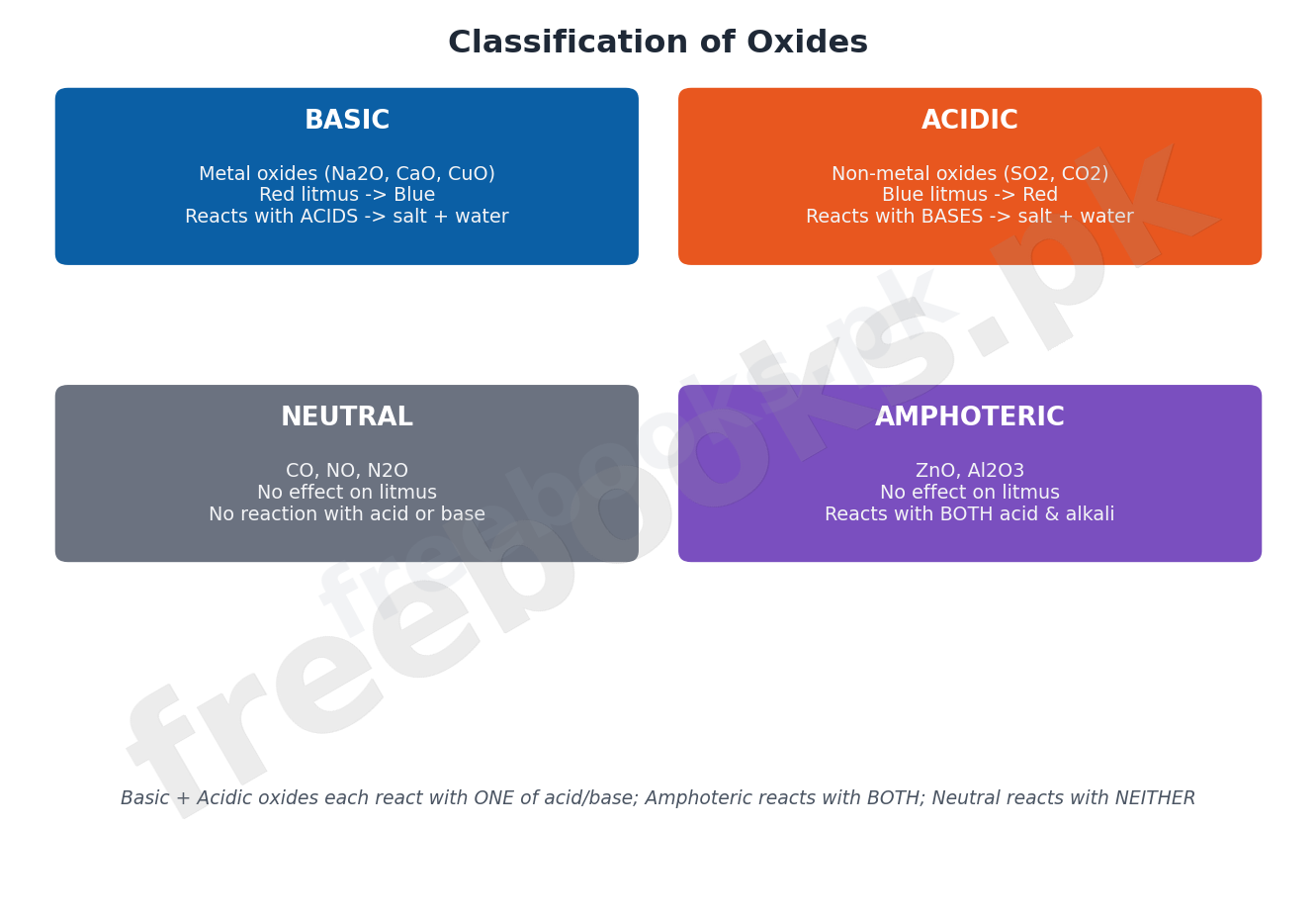
An oxide is a binary compound of an element with oxygen, in which oxygen usually shows an oxidation state of -2. Metal oxides are typically ionic and are commonly basic or amphoteric, while non-metal oxides are typically covalent and acidic; both form when the corresponding element is heated in air or oxygen. Basic oxides are formed by metals; when dissolved in water they produce hydroxides that turn red litmus blue, and they react with acids to give a salt and water — for example Na2O(s) + H2O(l) -> 2NaOH(aq), and CaO(s) + 2HCl(aq) -> CaCl2(aq) + H2O(l).
Acidic oxides are formed by non-metals such as sulphur, carbon and nitrogen; they react with water to give acids that turn blue litmus red, and react with bases to give a salt and water — for example SO2(g) + H2O(l) -> H2SO3(l) (sulphurous acid), and SO2(g) + 2NaOH(aq) -> Na2SO3 + H2O (sodium sulphite). Neutral oxides, such as carbon monoxide, nitric oxide and nitrous oxide, produce neither an acid nor a base with water and have no effect on litmus paper.
Amphoteric oxides, usually formed by less electropositive metals such as zinc and aluminium, react as a base in the presence of an acid and as an acid in the presence of an alkali, giving a salt and water either way — for example ZnO(s) + 2HCl(aq) -> ZnCl2(aq) + H2O(l) (acting as a base), and ZnO(s) + 2NaOH(aq) + H2O(l) -> Na2Zn(OH)4(aq) (sodium zincate, acting as an acid). Amphoteric oxides are insoluble in water and have no effect on litmus paper by themselves.
19.4 Metals
Nearly three-quarters of the elements in the periodic table are metals, most occurring in the earth's crust as oxides, hydroxides, carbonates or sulphides; metals tend to lose electrons to form cations and usually form ionic bonds. Reaction with cold water: group 1 and most group 2 metals react vigorously with cold water to give a hydroxide and hydrogen gas, for example 2Na(s) + 2H2O(l) -> 2NaOH(aq) + H2(g); magnesium reacts only slowly with cold water.
Reaction with steam: the more reactive the metal, the more readily it reacts with steam — lithium, sodium, potassium and calcium react violently (and dangerously) with steam; beryllium and aluminium react with steam only at high temperature (about 700 degC) to give an oxide and hydrogen, for example Be(s) + H2O(g) -> BeO(s) + H2(g); magnesium, iron and zinc react moderately with steam to give their oxides and hydrogen.
Reaction with oxygen: metals react with oxygen to give metal oxides, with the ease of reaction and flame colour depending on the metal's reactivity — sodium burns with a yellow flame to give both sodium oxide and sodium peroxide, while magnesium burns with an intense white flame, calcium with a white flame tinged red, strontium with a crimson flame and barium with a pale green flame, each giving its characteristic oxide. Reaction with dilute acids: the more reactive the metal, the more vigorous its reaction with dilute acids, giving a salt and hydrogen gas — sodium and potassium react violently and dangerously, for example 2Na(s) + 2HCl(aq) -> 2NaCl(aq) + H2(g), while all group 2 metals react, generally more vigorously further down the group, for example Mg(s) + 2HCl(aq) -> MgCl2(aq) + H2(g).
19.5 Reactivity Series of Metals
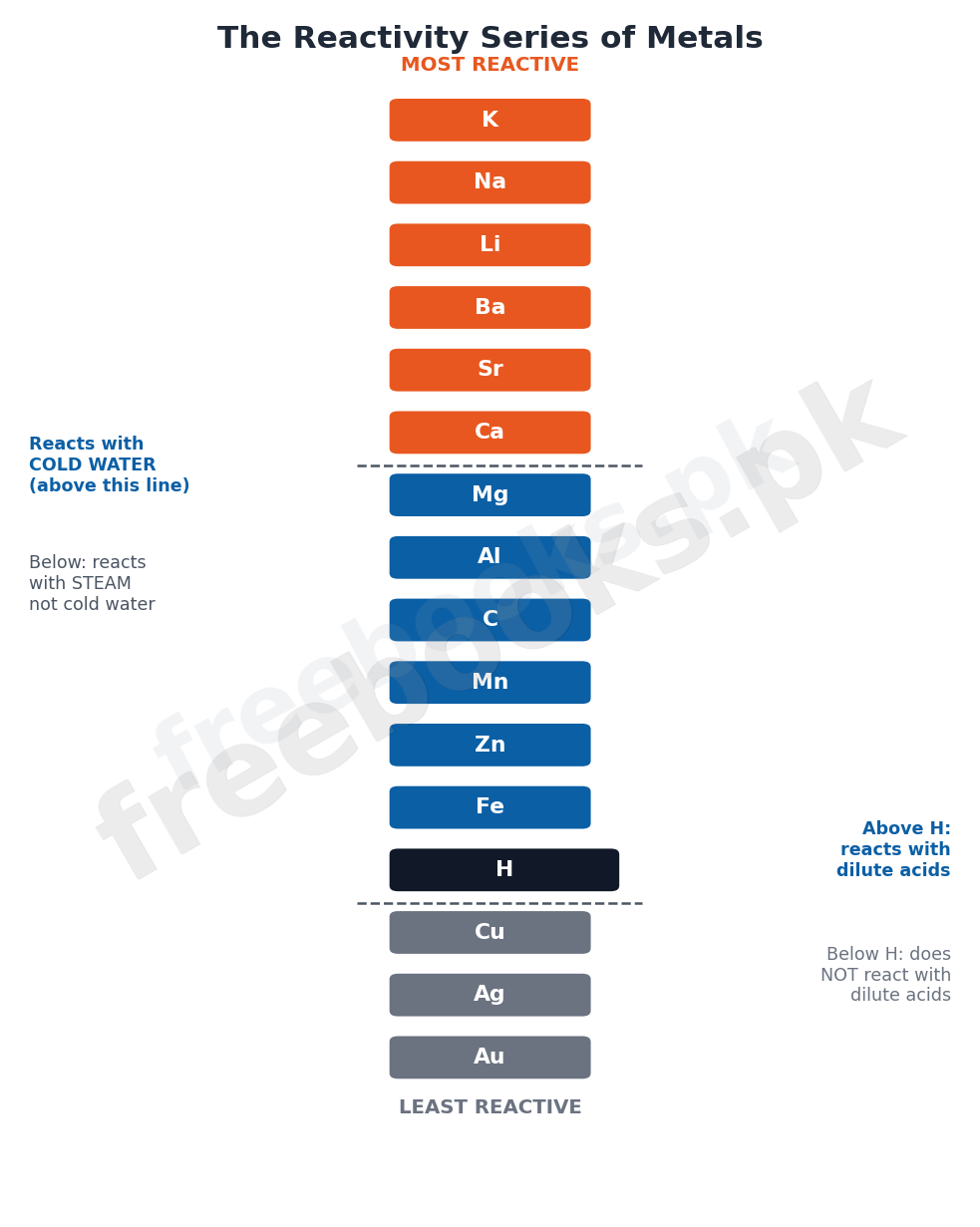
Based on their reactions with water and acids, metals can be arranged in decreasing order of reactivity, called the reactivity series: potassium, sodium, lithium, barium, strontium, calcium, magnesium, aluminium, carbon, manganese, zinc, iron, hydrogen, copper, silver, gold (from most to least reactive; carbon and hydrogen are included as reference points even though they are non-metals). Calcium and the metals above it react with cold water to give a metal hydroxide and hydrogen; metals below calcium do not react with cold water but do react with steam to give a metal oxide and hydrogen.
Only metals above hydrogen in the series can liberate hydrogen gas when reacting with dilute acids, and the more reactive the metal, the more vigorous this reaction is; unreactive metals below hydrogen, such as copper, silver and gold, do not react with dilute acids at all. Similarly, more reactive metals react with oxygen more readily than less reactive ones. Because the metals at the top of the series are easily oxidized (they readily lose electrons), they act as powerful reducing agents, and this reducing ability decreases going down the series — allowing a more reactive metal to displace a less reactive one from its salt solution, for example Zn(s) + CuSO4(aq) -> ZnSO4(aq) + Cu(s).
19.6 Role of Oxides of Nitrogen in Air Pollution
Primary pollutants such as oxides of nitrogen, sulphur and carbon, along with various hydrocarbons, are converted by reactions in the atmosphere into secondary pollutants, including ozone, peroxyacetyl nitrate (PAN) and sulphuric acid — all of which are toxic and need to be controlled. Oxides of nitrogen (NOx, meaning NO and NO2) come from both natural sources (electrical discharges during lightning, which convert atmospheric nitrogen and oxygen into nitric oxide that is then rapidly oxidized to nitrogen dioxide) and human sources (combustion of fossil fuels in vehicles, industrial processes, power plants, and agricultural activities and fertilizers).
Ultraviolet radiation in sunlight drives a complex series of reactions between NOx and volatile organic compounds (VOCs, especially unburned hydrocarbons) to produce secondary pollutants such as ozone, aldehydes and peroxyacetyl nitrate (PAN) — together forming photochemical smog. Oxides of nitrogen also contribute directly to acid rain: NO2 reacts with water vapour and other atmospheric chemicals to form nitric and nitrous acid vapours, 2NO2(g) + H2O(l) -> HNO3(g) + HNO2(g), which then mix with water vapour and fall as acid rain.
In addition to this direct role, NOx acts as a catalyst that speeds up the oxidation of another primary pollutant, sulphur dioxide, into sulphur trioxide, which then reacts with water vapour to form sulphuric acid — another major component of acid rain: 2SO2(g) + O2(g) -[oxides of nitrogen]-> 2SO3(g), followed by SO3(g) + H2O(g) -> H2SO4(g). Acid rain, with a pH below 5.6, damages ecosystems, corrodes materials and can cause respiratory problems.
Important Definitions
Define the Haber process.
The industrial process for manufacturing ammonia by reacting nitrogen and hydrogen gas in a 1:3 ratio at about 400-500 degC and about 200 atmospheres pressure, using an iron-based catalyst: N2(g) + 3H2(g) <=> 2NH3(g).
Define the Contact process.
The industrial process for manufacturing sulphuric acid, in which sulphur dioxide is produced, purified, oxidized to sulphur trioxide over a vanadium(V) oxide catalyst, absorbed into concentrated sulphuric acid to form oleum, and then diluted with water.
Define oleum.
A concentrated, fuming form of sulphuric acid (H2S2O7) formed when sulphur trioxide gas is absorbed into 98% sulphuric acid during the Contact process.
Define an oxide.
A binary compound of an element with oxygen, in which oxygen usually shows an oxidation state of -2.
Define a basic oxide.
An oxide, usually formed by a metal, that dissolves in water to form a hydroxide (turning red litmus blue) and reacts with an acid to form a salt and water.
Define an acidic oxide.
An oxide, usually formed by a non-metal, that reacts with water to form an acid (turning blue litmus red) and reacts with a base to form a salt and water.
Define a neutral oxide.
An oxide that produces neither an acid nor a base when in contact with water and has no effect on litmus paper, such as carbon monoxide, nitric oxide and nitrous oxide.
Define an amphoteric oxide.
An oxide that reacts with both acids and bases to produce a salt and water, behaving as a base towards an acid and as an acid towards an alkali; examples are zinc oxide and aluminium oxide.
Define the reactivity series of metals.
An arrangement of metals in decreasing order of reactivity, based on their reactions with cold water, steam, dilute acids and oxygen.
Define a reducing agent (in the context of metals).
A substance, such as a reactive metal, that is easily oxidized (loses electrons readily) and thereby causes another substance to be reduced.
Define a displacement reaction (of a metal).
A reaction in which a more reactive metal displaces a less reactive metal from a solution of its salt, as in Zn(s) + CuSO4(aq) -> ZnSO4(aq) + Cu(s).
Define a primary pollutant.
A pollutant, such as oxides of nitrogen, sulphur or carbon, or unburned hydrocarbons, that is released directly into the atmosphere.
Define a secondary pollutant.
A pollutant, such as ozone, peroxyacetyl nitrate (PAN) or sulphuric acid, formed in the atmosphere by chemical reactions between primary pollutants.
Define peroxyacetyl nitrate (PAN).
A secondary air pollutant and major component of photochemical smog, formed when oxides of nitrogen react with unburned hydrocarbons in the presence of sunlight.
Define acid rain.
Rainfall with a pH below 5.6, made acidic mainly by nitric acid and sulphuric acid formed from atmospheric oxides of nitrogen and sulphur, which damages ecosystems, corrodes materials and can cause respiratory problems.
Define photochemical smog.
A type of air pollution formed when oxides of nitrogen and volatile organic compounds react in the presence of ultraviolet sunlight to produce secondary pollutants such as ozone, aldehydes and PAN.
Key Facts & Relations
| Topic | Relation |
|---|---|
| Haber process (ammonia) | N2(g) + 3H2(g) <=> 2NH3(g); ~450 degC, ~200 atm, Fe/Al2O3 catalyst |
| Contact process, key step (SO3 formation) | 2SO2(g) + O2(g) -> 2SO3(g); 450 degC, 2-3 atm, V2O5 catalyst |
| Basic oxide + water example | Na2O(s) + H2O(l) -> 2NaOH(aq) |
| Acidic oxide + water example | SO2(g) + H2O(l) -> H2SO3(l) (sulphurous acid) |
| Amphoteric oxide + acid example | ZnO(s) + 2HCl(aq) -> ZnCl2(aq) + H2O(l) |
| Amphoteric oxide + alkali example | ZnO(s) + 2NaOH(aq) + H2O(l) -> Na2Zn(OH)4(aq) |
| Metal displacement example | Zn(s) + CuSO4(aq) -> ZnSO4(aq) + Cu(s) |
| Acid rain formation (from NO2) | 2NO2(g) + H2O(l) -> HNO3(g) + HNO2(g) |
Diagrams
The Haber Process: A flow diagram of ammonia production: nitrogen (from liquefied air) and hydrogen (from methane) combined over an iron catalyst at high temperature and pressure, with unreacted gases recycled and ammonia liquefied and removed.
Classification of Oxides: A summary chart classifying oxides as acidic, basic, neutral or amphoteric, with examples of each and how they behave with acids, bases and water.
The Reactivity Series of Metals: A ladder diagram of the reactivity series from potassium (most reactive) down to gold (least reactive), marking where metals react with cold water versus only steam, and where reaction with dilute acids stops (at hydrogen).
Short Questions & Answers
How is nitrogen obtained from air?
By fractional distillation of liquefied air: air is compressed, cooled and expanded repeatedly until it liquefies, then distilled; since nitrogen boils at a lower temperature (-196 degC) than oxygen, it evaporates first and is collected separately.
How is hydrogen produced from methane?
Methane is heated with a limited supply of oxygen (not enough to fully oxidize it), producing mainly hydrogen and carbon monoxide; the carbon monoxide is then reacted with steam to release additional hydrogen gas, along with carbon dioxide.
Which conditions are used to oxidize SO2 to SO3?
A temperature of about 450 degC, a pressure of about 2-3 atmospheres, and a vanadium(V) oxide (V2O5) catalyst, in the contact chamber of the Contact process.
Why is CO2 called an acidic oxide while CO is called a neutral oxide?
Carbon dioxide reacts with water to form carbonic acid, which turns blue litmus red, making it acidic; carbon monoxide does not react with water to form an acid or a base and has no effect on litmus, making it neutral.
How do magnesium and calcium differ in their reactions with cold water?
Calcium reacts readily with cold water to form calcium hydroxide and hydrogen gas, since it is above magnesium in the reactivity series; magnesium reacts only slowly with cold water, though it reacts more readily with steam.
How are the reactivities of metals determined?
By observing and comparing how vigorously different metals react with cold water, steam, dilute acids and oxygen; the more vigorous the reaction, the higher (more reactive) the metal is placed in the reactivity series.
Which secondary pollutants are produced by oxides of nitrogen?
Ozone, peroxyacetyl nitrate (PAN) and aldehydes are produced when oxides of nitrogen react with volatile organic compounds in sunlight; oxides of nitrogen also contribute to the formation of nitric acid and sulphuric acid in acid rain.
Which will react faster with dilute HCl, zinc or iron?
Zinc, because it is placed above iron in the reactivity series and is therefore more reactive, giving a more vigorous reaction with dilute hydrochloric acid.
Name one metal which will displace zinc from its salt solution.
Magnesium (or any metal above zinc in the reactivity series, such as aluminium or calcium) will displace zinc from a solution of its salt, since it is more reactive than zinc.
Why is SO3 absorbed into concentrated H2SO4 rather than directly into water?
Because the reaction of SO3 with water is highly exothermic and produces a fine, difficult-to-condense mist of sulphuric acid; absorbing SO3 into concentrated sulphuric acid instead forms oleum safely, which can then be diluted with water in a controlled way.
Long Questions & Answers
Explain the industrial production of ammonia by the Haber process.
Where do the raw materials, nitrogen and hydrogen, come from?
Nitrogen is obtained by fractional distillation of liquefied air, since it boils off at -196 degC before oxygen does; hydrogen is obtained by heating methane in a limited amount of oxygen to give hydrogen and carbon monoxide, with the carbon monoxide then reacted with steam to release further hydrogen.
What are the reaction conditions used in the Haber process, and why?
Nitrogen and hydrogen, in a 1:3 ratio by volume, are reacted at about 400-500 degC and about 200 atmospheres pressure in the presence of an iron-based catalyst; the high pressure and catalyst help achieve a reasonable rate and yield despite the reaction being reversible and not going to completion.
What happens to the equilibrium mixture leaving the reaction chamber?
The mixture, which contains only about 35% ammonia by volume, is cooled by refrigeration coils; ammonia gas liquefies at -33.4 degC and is removed from the mixture as a liquid, while the unreacted nitrogen and hydrogen gases remain gaseous and are separated out.
What happens to the unreacted nitrogen and hydrogen, and why does this matter economically?
The unreacted nitrogen and hydrogen gases are recycled back into the reaction chamber rather than being wasted, since the reaction does not convert all of the starting gases into ammonia in a single pass; recycling makes the overall process far more efficient and economical on an industrial scale.
Describe the classification of oxides as acidic, basic, neutral or amphoteric, using examples.
What is a basic oxide, and how does it behave?
A basic oxide is usually formed by a metal; it dissolves in water to give a hydroxide that turns red litmus blue, and reacts with an acid to give a salt and water — for example, calcium oxide reacts with hydrochloric acid: CaO(s) + 2HCl(aq) -> CaCl2(aq) + H2O(l).
What is an acidic oxide, and how does it behave?
An acidic oxide is usually formed by a non-metal such as sulphur, carbon or nitrogen; it reacts with water to give an acid that turns blue litmus red, and reacts with a base to give a salt and water — for example, sulphur dioxide reacts with water to give sulphurous acid: SO2(g) + H2O(l) -> H2SO3(l).
What is a neutral oxide, and how does it differ from acidic and basic oxides?
A neutral oxide, such as carbon monoxide, nitric oxide or nitrous oxide, produces neither an acid nor a base on contact with water and has no effect on litmus paper at all, unlike acidic oxides (which turn litmus red) or basic oxides (which turn litmus blue).
What is an amphoteric oxide, and how does it behave differently from the other types?
An amphoteric oxide, such as zinc oxide or aluminium oxide, can behave as both an acid and a base depending on what it reacts with: it acts as a base when reacted with an acid (ZnO(s) + 2HCl(aq) -> ZnCl2(aq) + H2O(l)) and as an acid when reacted with an alkali (ZnO(s) + 2NaOH(aq) + H2O(l) -> Na2Zn(OH)4(aq)), unlike acidic or basic oxides, which react in only one of these two ways.
Multiple Choice Questions (MCQs)
The reason for maintaining a higher temperature for the production of ammonia is: (A) Activation energy of the reaction is very high (B) Activation energy of the reaction is very low (C) Nitrogen and hydrogen are both gases (D) At low temperature, nitrogen and hydrogen change into liquids
Correct answer: (A) Activation energy of the reaction is very high. A higher temperature is needed to give the reacting particles enough energy to overcome the reaction's high activation energy and react at a reasonable rate.
The Contact process is sensitive to impurities present in SO2 and O2 because the impurities: (A) Affect the capability of the catalyst (B) Affect the purity of H2SO4 only (C) Do not let SO2 react with oxygen at all (D) Decrease the rate of reaction appreciably but do not affect the catalyst
Correct answer: (A) Affect the capability of the catalyst. Impurities such as arsenic compounds poison (deactivate) the vanadium(V) oxide catalyst, which is why the gases are carefully purified before entering the contact chamber.
Which of the following oxides is neutral in character? (A) Al2O3 (B) SO2 (C) CO2 (D) NO
Correct answer: (D) NO. Nitric oxide (NO) is a neutral oxide — it has no effect on litmus and forms neither an acid nor a base with water, unlike SO2 and CO2 (acidic) or Al2O3 (amphoteric).
Sodium is considered more reactive than magnesium because: (A) It is more electropositive than magnesium (B) It reacts with water slowly (C) It is present in the second group (D) It is less metallic
Correct answer: (A) It is more electropositive than magnesium. Sodium is more electropositive than magnesium, meaning it loses its outer electron more readily, making it more reactive and placing it higher in the reactivity series.
Secondary pollutants present in the atmosphere include: (A) Oxides of nitrogen (B) Oxides of sulphur (C) Ozone and PAN (D) Oxides of carbon
Correct answer: (C) Ozone and PAN. Ozone and peroxyacetyl nitrate (PAN) are secondary pollutants, formed in the atmosphere from primary pollutants; oxides of nitrogen, sulphur and carbon are themselves primary pollutants.
SO3 is absorbed in H2SO4 rather than H2O during the production of sulphuric acid because: (A) SO3 does not react with H2O at all (B) Reaction of SO3 with H2O is highly exothermic, producing a mist of H2SO4 that is difficult to condense (C) It gives a better yield of H2SO4 for economic reasons (D) Reaction of SO3 with H2O can cause an explosion
Correct answer: (B) Reaction of SO3 with H2O is highly exothermic, producing a mist of H2SO4 that is difficult to condense. SO3 reacting directly with water releases a large amount of heat and forms a fine acid mist that is difficult to condense safely, so it is absorbed into concentrated H2SO4 to form oleum instead.
Oxides formed when oxygen reacts with metals are generally: (A) Acidic (B) Basic (or amphoteric for less electropositive metals) (C) Always neutral (D) Always amphoteric
Correct answer: (B) Basic (or amphoteric for less electropositive metals). Metal oxides are typically basic, though less electropositive metals such as zinc and aluminium form amphoteric oxides instead.
Major components of acid rain are: (A) H2SO4 and HNO3 (B) H2SO3 and HNO2 (C) H2SO4 and HCl (D) Acetic acid and HNO3
Correct answer: (A) H2SO4 and HNO3. Acid rain's main acidic components are sulphuric acid (from oxidized SO2) and nitric acid (from oxidized NO2), both formed from atmospheric pollutants.
Which metal reacts with steam only at a high temperature of about 700 degC? (A) Sodium (B) Potassium (C) Aluminium (D) Calcium
Correct answer: (C) Aluminium. Aluminium (along with beryllium) reacts with steam only at high temperature, unlike the far more reactive sodium, potassium and calcium, which react readily or violently.
Which of the following metals will NOT react with dilute hydrochloric acid to produce hydrogen gas? (A) Zinc (B) Magnesium (C) Copper (D) Iron
Correct answer: (C) Copper. Copper lies below hydrogen in the reactivity series, so it cannot displace hydrogen from a dilute acid and does not react with dilute HCl.
Quick Revision Summary
- Haber process: N2 + 3H2 <=> 2NH3, at ~450 degC, ~200 atm, iron catalyst; nitrogen from liquefied air, hydrogen from methane; unreacted gases recycled, ammonia liquefied out at -33.4 degC.
- Contact process: SO2 is made, purified, oxidized to SO3 (V2O5 catalyst, ~450 degC, 2-3 atm), absorbed into H2SO4 to form oleum, then diluted with water to give H2SO4.
- Oxides: basic (mostly metal oxides, react with acids), acidic (mostly non-metal oxides, react with bases), neutral (no reaction with litmus, e.g. CO, NO), amphoteric (react with BOTH acids and bases, e.g. ZnO, Al2O3).
- Metals react with cold water, steam, dilute acids and oxygen with a vigour that depends on their reactivity; more reactive metals react more violently and with milder conditions.
- Reactivity series (most to least reactive): K, Na, Li, Ba, Sr, Ca, Mg, Al, C, Mn, Zn, Fe, H, Cu, Ag, Au — only metals above H liberate H2 from dilute acids.
- A more reactive metal displaces a less reactive metal from its salt solution; the top of the reactivity series contains the strongest reducing agents.
- NOx contributes to photochemical smog (via PAN, formed with unburned hydrocarbons in sunlight) and to acid rain, both directly (forming HNO3/HNO2) and by catalysing the oxidation of SO2 to SO3, which becomes H2SO4.
- Acid rain (pH below 5.6) damages ecosystems, corrodes materials, and can cause respiratory problems.
Exam Tips
- For the Haber and Contact processes, always be ready to state all three together: the equation, the source of each raw material, and the exact conditions (temperature, pressure, catalyst) — exam questions often ask for all three.
- When classifying an oxide, check what it does to litmus AND how it behaves with an acid or base — amphoteric oxides are the ones that react with BOTH an acid and an alkali; neutral oxides react with neither.
- Learn the reactivity series in order (K, Na, Li, Ba, Sr, Ca, Mg, Al, C, Mn, Zn, Fe, H, Cu, Ag, Au) as a single memorized sequence — most questions about metal reactivity can be answered directly from its order.
- Remember the position of hydrogen in the reactivity series as the dividing line: metals above it react with dilute acids to release H2; metals below it do not react with dilute acids at all.
- For acid rain questions, name BOTH acids involved (nitric acid from NOx directly, and sulphuric acid from NOx catalysing SO2 oxidation) rather than only one.
- Connect flame colours to specific metals as a quick recall aid: Mg = intense white, Ca = white with red tinge, Sr = crimson, Ba = pale green — useful for both descriptive and MCQ-style questions.