Organic chemistry is the branch of chemistry that studies compounds of carbon and hydrogen (hydrocarbons) and their derivatives. Organic compounds are covalently bonded structures built mainly from carbon, almost always combined with hydrogen, and often with oxygen, nitrogen, sulphur or halogens as well. Because carbon can form four strong covalent bonds and link with itself in chains, branches and rings, millions of organic compounds exist — far more than all known inorganic compounds combined — so chemists classify them into families to make their properties predictable and easy to study.
This chapter introduces the basic vocabulary used throughout organic chemistry: how compounds are classified by the shape of their carbon skeleton (open chain or closed ring), how structural formulae represent the exact arrangement of atoms in a molecule, what a homologous series is and why members of one behave so similarly, how structural isomerism allows the same molecular formula to represent more than one real compound, what a functional group is and how it fixes a compound’s chemical behaviour, and finally how the IUPAC system builds a systematic name for any organic compound from its carbon-chain length and functional group.
Learning Objectives
- Classify organic molecules as straight-chained, branched or cyclic.
- Explain that a structural formula unambiguously describes how atoms in a molecule are arranged.
- Interpret general formulae of alkanes, alkenes, alkynes, alcohols and carboxylic acids.
- Define structural isomers and identify isomer pairs such as the two forms of C4H10 and C4H8.
- Identify the functional group of alcohols, aldehydes, ketones, phenols, carboxylic acids, amines, esters and amides.
- Describe the general characteristics shared by every homologous series.
- Distinguish saturated compounds (all single carbon-carbon bonds) from unsaturated compounds (one or more multiple bonds).
- Name and draw structural formulae of unbranched alkanes, alkenes, alcohols, carboxylic acids and esters using IUPAC rules.
Key Concepts
21.1 Classification of Organic Compounds
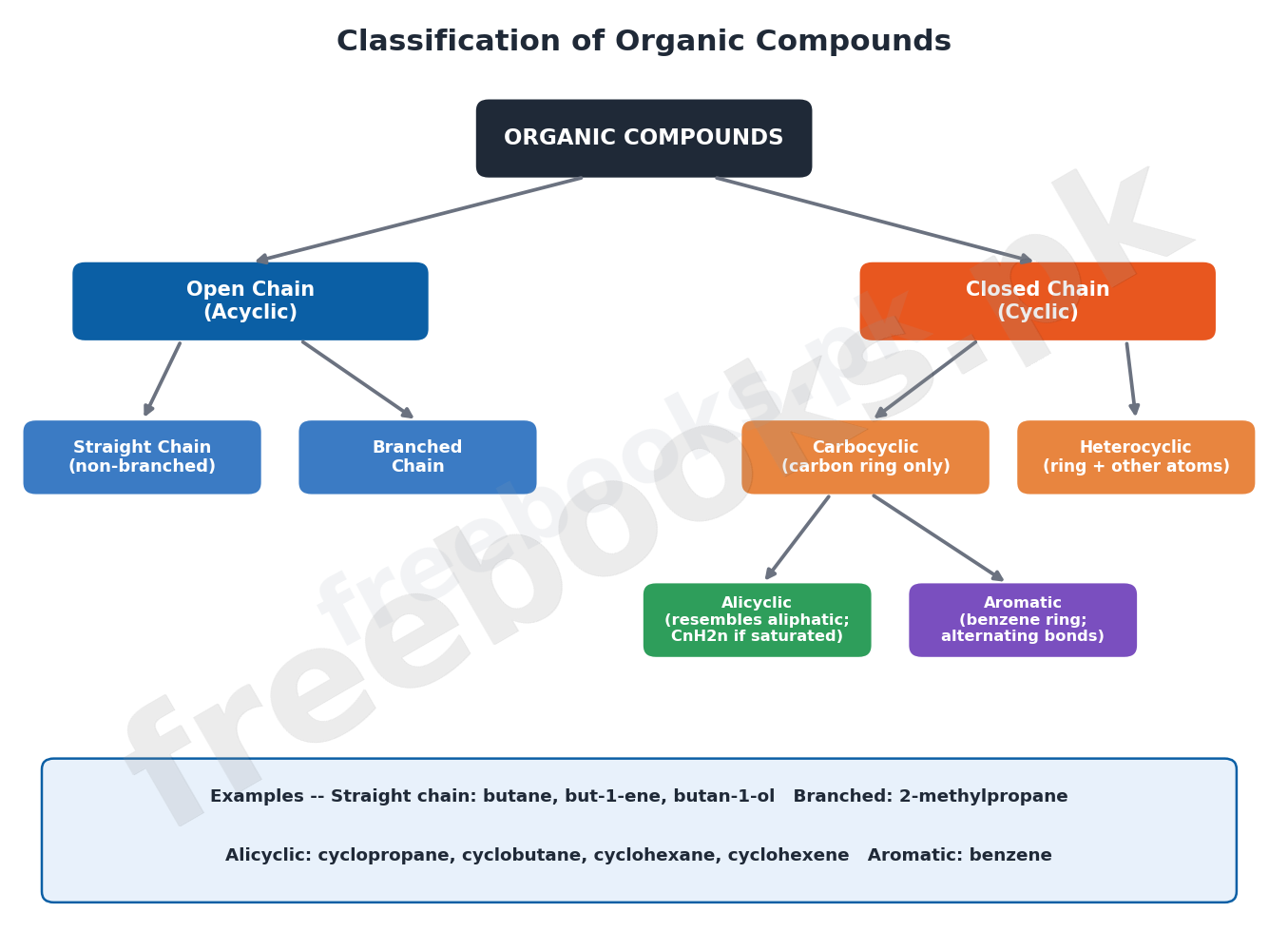
Organic compounds are broadly divided into two classes based on the shape of their carbon skeleton: open chain (acyclic) compounds, in which the carbon atoms form a chain with two free ends, and closed chain (cyclic) compounds, in which the carbon atoms (or carbon plus other atoms) form a closed ring.
Open chain compounds may be straight chain (non-branched), such as butane CH3-CH2-CH2-CH3, but-1-ene, and butan-1-ol, or branched chain, such as 2-methylpropane and 2,2-dimethylpropane, where a side chain of carbon atoms hangs off the main chain. Open chain compounds together with certain cyclic compounds are also called aliphatic compounds.
Closed chain (cyclic) compounds contain one or more rings of atoms. If the ring is made of carbon atoms only, the compound is carbocyclic; if the ring also contains other atoms such as oxygen or nitrogen, it is heterocyclic. Carbocyclic compounds are further divided into alicyclic compounds (such as cyclopropane, cyclobutane, cyclohexane and cyclohexene, which resemble aliphatic compounds and follow the general formula CnH2n for the saturated ones) and aromatic compounds, the simplest of which contain a benzene ring of six carbon atoms with three alternating double and single bonds, often drawn as a circle inside a hexagon.
21.2 Structural Formula
A structural formula shows the arrangement of atoms and bonds within a molecule clearly enough to identify its structure without ambiguity. Because writing out every single bond is repetitive, chemists commonly use two shorthand styles.
The displayed formula (or full structural formula) shows every atom and every bond as a separate line, giving the most detailed picture of a molecule’s structure. The condensed structural formula still shows bonds between the main-chain atoms as lines or as juxtaposed symbols, but omits the individual carbon-to-hydrogen bonds — for example, ethane is written CH3-CH3 instead of drawing each C-H bond separately, and ethanoic acid’s -COOH group is written showing only the C=O and C-OH connections.
21.3 Homologous Series
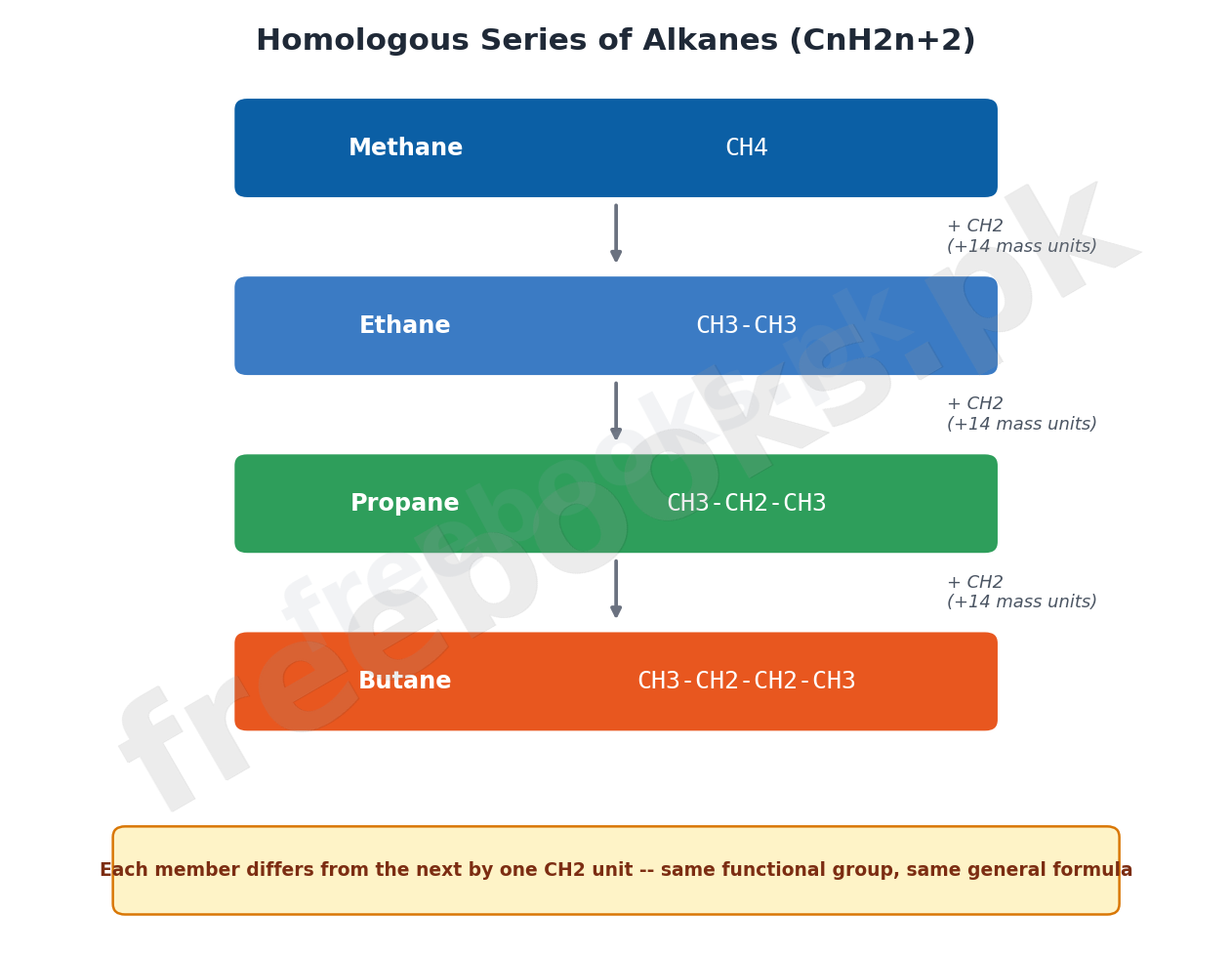
Organic compounds are grouped into families called homologous series, where every member shares a similar structure and similar chemical behaviour. A homologous series is defined by several shared characteristics: every member fits a single general formula (alkanes CnH2n+2, alkenes CnH2n, alkynes CnH2n-2, alcohols CnH2n+1OH, carboxylic acids CnH2n+1COOH); successive members differ from the next by exactly one CH2 unit, which adds 14 to the relative molecular mass each time; every member carries the same functional group, which gives the whole family near-identical chemical properties; and physical properties such as melting point, boiling point, density and solubility change in a smooth, predictable trend as molecular mass increases. Members of a series can also usually be prepared by similar general methods.
21.4 Isomerism
Two or more compounds that share the same molecular formula but have different structural formulae — and therefore different physical and chemical properties — are called structural isomers, and the phenomenon is called structural isomerism. Methane, ethane and propane exist in only one structural form each, so they show no isomerism, but butane (C4H10) is the simplest hydrocarbon with isomers: it can be arranged as the straight chain CH3-CH2-CH2-CH3 (butane) or as the branched CH3-CH(CH3)-CH3 (2-methylpropane), two real compounds with different physical properties despite sharing the same molecular formula.
The number of possible isomers grows very rapidly as chain length increases: pentane (five carbons) already has three isomers, while a thirty-carbon alkane has over four billion possible isomers. Isomerism is not limited to alkanes — unsaturated compounds show it too. Butene (C4H8) has two structural isomers depending on where the double bond sits: but-1-ene (CH3-CH2-CH=CH2) and but-2-ene (CH3-CH=CH-CH3).
21.5 Functional Groups
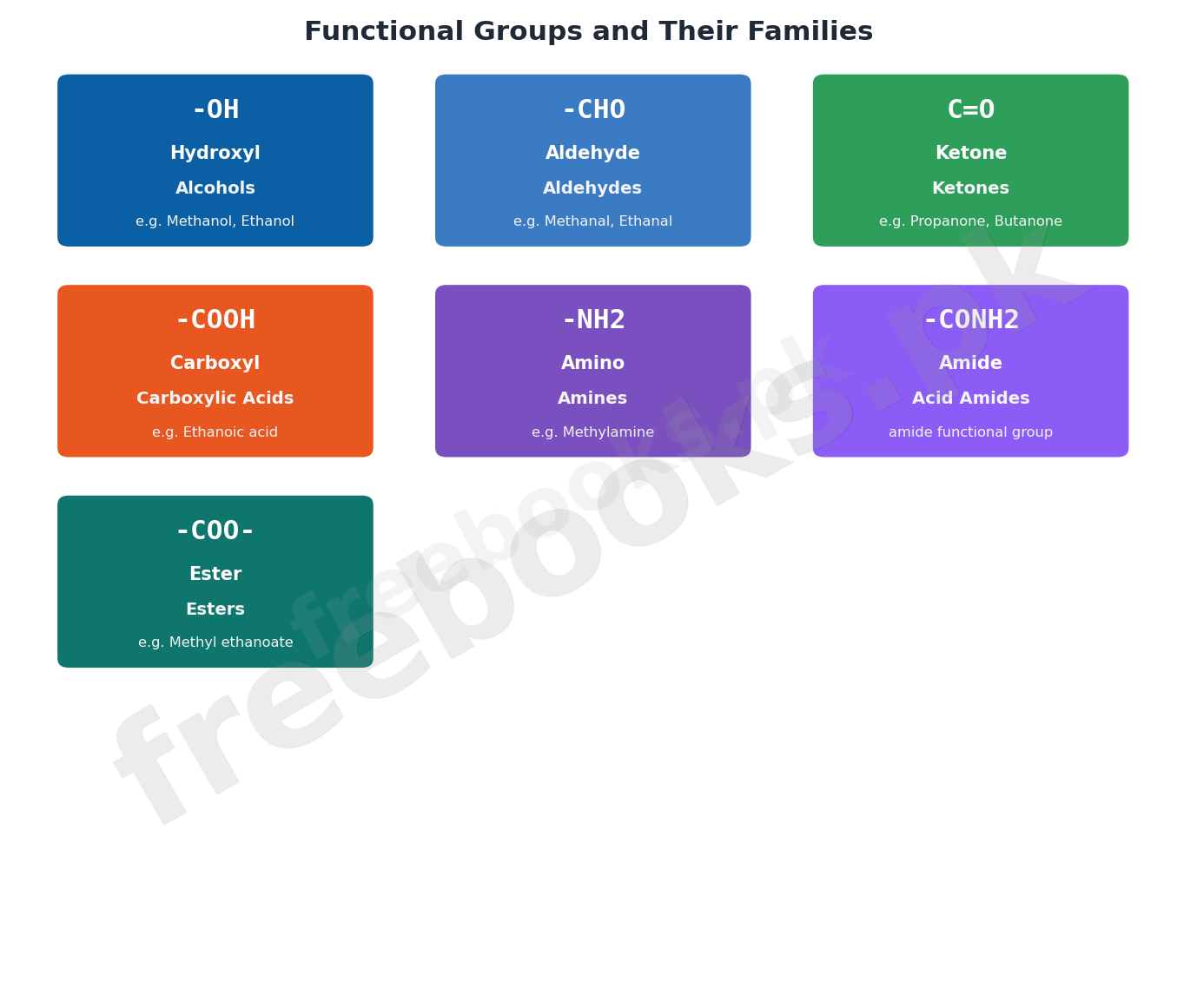
A functional group is an atom or group of atoms that determines the characteristic chemical properties of an organic compound; members of a homologous series behave alike because they all carry the same functional group. The hydroxyl group (-OH) defines alcohols such as methanol (CH3-OH) and ethanol (CH3-CH2-OH); when -OH is attached directly to a benzene ring instead of a chain, the compound is a phenol rather than an alcohol.
The aldehyde group (-CHO) defines aldehydes such as methanal (formaldehyde) and ethanal (acetaldehyde); the ketone group (>C=O attached to two carbon chains) defines ketones such as propanone (acetone) and butanone. The carboxyl group (-COOH) defines carboxylic acids; the amino group (-NH2) defines amines such as methylamine and ethylamine; the amide group (-CONH2) defines acid amides; and the ester group (-COO-) defines esters such as methyl ethanoate and ethyl ethanoate.
21.6 Naming Organic Compounds (IUPAC Nomenclature)
Early chemists used simple common (trivial) names for organic compounds, but as millions of compounds became known, the International Union of Pure and Applied Chemistry (IUPAC) introduced a systematic naming method. Every IUPAC name has three parts: a root that tells the number of carbon atoms in the longest continuous chain (Meth- =1, Eth- =2, Prop- =3, But- =4, Pent- =5, Hex- =6, Hept- =7, Oct- =8, Non- =9, Dec- =10), a suffix added after the root that tells the class of compound, and a prefix before the root that names any group attached to the main chain.
Alkanes (saturated hydrocarbons, all single bonds) take the suffix -ane: methane, ethane, propane, butane, pentane and so on, following the general formula CnH2n+2. An alkyl group (R-) forms when an alkane loses one hydrogen atom. Alkenes (containing at least one C=C double bond) take the suffix -ene, with the position of the double bond numbered from the end nearest to it — for example but-1-ene and but-2-ene. Alcohols (general formula ROH) replace the alkane’s final ‘e’ with ‘-ol’ and number the chain so the carbon bearing -OH gets the lowest possible number, giving names such as propan-1-ol, propan-2-ol, butan-1-ol and butan-2-ol. Carboxylic acids replace the alkane’s final ‘e’ with ‘-oic acid’, giving methanoic acid (formic acid), ethanoic acid (acetic acid), propanoic acid and butanoic acid. Esters (general formula RCOOR’, made by reacting an alcohol with a carboxylic acid using an acid catalyst) are named as ‘alkyl alkanoate’, for example ethyl propanoate from propanoic acid and ethanol.
Important Definitions
Organic compound
A chemical compound made mainly of carbon atoms covalently bonded to each other and usually to hydrogen, and often also to oxygen, nitrogen, sulphur or halogens.
Hydrocarbon
An organic compound containing only carbon and hydrogen atoms.
Acyclic (open chain) compound
An organic compound whose carbon atoms form a chain with two open ends, which may be straight or branched.
Cyclic (closed chain) compound
An organic compound whose atoms form one or more closed rings.
Alicyclic compound
A carbocyclic compound with a ring of three or more carbon atoms that resembles aliphatic (open chain) compounds in its properties.
Aromatic compound
A cyclic compound containing a benzene ring or similar ring with alternating double and single bonds.
Structural formula
A formula that shows the arrangement of atoms and bonds within a molecule clearly enough to describe its structure without ambiguity.
Displayed formula
A structural formula that draws every atom and every bond in a molecule as a separate line.
Condensed structural formula
A structural formula that omits the individual carbon-to-hydrogen bonds, showing atoms grouped together for brevity.
Homologous series
A family of organic compounds with the same functional group and general formula, each member differing from the next by a CH2 unit.
Structural isomerism
The existence of two or more compounds with the same molecular formula but different structural formulae and different properties.
Functional group
An atom or group of atoms in an organic molecule that determines its characteristic chemical properties.
Saturated compound
A compound in which all carbon-carbon bonds are single bonds.
Unsaturated compound
A compound containing one or more carbon-carbon double or triple bonds.
Alkyl group
The group (R-) formed when an alkane molecule loses one hydrogen atom.
IUPAC nomenclature
The International Union of Pure and Applied Chemistry’s systematic method for naming organic compounds using a root, suffix and prefix.
Key Facts & Relations
| Topic | Relation |
|---|---|
| Alkanes (saturated hydrocarbons) | General formula CnH2n+2; suffix -ane |
| Alkenes | General formula CnH2n; suffix -ene |
| Alkynes | General formula CnH2n-2; suffix -yne |
| Alcohols | General formula CnH2n+1OH; suffix -ol |
| Carboxylic acids | General formula CnH2n+1COOH; suffix -oic acid |
| Esters | General formula RCOOR’ (alkyl alkanoate) |
| Successive homologues | Differ by one CH2 unit = 14 units in relative molecular mass |
| Alicyclic saturated hydrocarbons | General formula CnH2n (ring compounds) |
Diagrams
Classification of Organic Compounds: A classification tree showing organic compounds dividing into open chain (straight and branched) and closed chain (carbocyclic: alicyclic and aromatic; and heterocyclic) compounds.
Homologous Series of Alkanes: The first four alkanes — methane, ethane, propane and butane — shown with their condensed formulae, each differing from the next by one CH2 unit, illustrating the CnH2n+2 general formula.
Functional Groups and Their Families: A summary chart of the main functional groups — hydroxyl, aldehyde, ketone, carboxyl, amino, amide and ester — with the homologous series each one defines.
Short Questions & Answers
What is the difference between saturated and unsaturated hydrocarbons?
A saturated hydrocarbon has only single bonds between its carbon atoms (as in alkanes), while an unsaturated hydrocarbon has at least one carbon-carbon double or triple bond (as in alkenes and alkynes).
Write down the structural formula of Butan-2-ol.
CH3-CH(OH)-CH2-CH3, where the hydroxyl group is attached to the second carbon of the four-carbon chain.
Why is ethylamine (CH3-CH2-NH2) called an organic compound?
It is called organic because it is a covalent compound built on a carbon-hydrogen chain (an ethyl group) with an amino functional group attached, fitting the definition of a compound of carbon and hydrogen and their derivatives.
Write down the formula of the ester called ethyl methanoate.
HCOOCH2CH3 — formed from methanoic acid (HCOOH) and ethanol (CH3CH2OH).
Define structural isomerism.
Structural isomerism is the phenomenon in which two or more compounds share the same molecular formula but have different structural formulae, and therefore different physical and chemical properties.
Give the IUPAC name to CH3-CH2-CH2-CH3.
Butane — a four-carbon saturated hydrocarbon (root ‘but-‘ plus suffix ‘-ane’).
What is common in the carboxyl group, amide functional group and ester functional group?
All three contain a carbon atom double-bonded to oxygen (a carbonyl, C=O) as part of the functional group, differing only in what else is attached: -OH for carboxyl, -NH2 for amide, and -O-R for ester.
What is the difference between cyclohexane and benzene?
Cyclohexane is a saturated alicyclic ring (CnH2n) with only single bonds between its six carbon atoms, while benzene is an aromatic ring with three alternating double and single bonds among its six carbon atoms.
Give two examples of branched chain compounds.
2-methylpropane and 2,2-dimethylpropane are both branched chain (branched acyclic) compounds, each having a side chain of carbon atoms attached to the main chain.
Why does butane show isomerism but propane does not?
Butane has four carbon atoms, which is enough to arrange the chain in more than one valid way (straight chain or branched) while still satisfying every carbon’s four bonds; propane’s three carbons can only be arranged in a single valid straight-chain structure, so no isomer exists.
Long Questions & Answers
What is an organic compound, and how are organic compounds classified based on the type of carbon chain present in them?
What is an organic compound?
An organic compound is a chemical compound made mainly of carbon atoms covalently bonded to each other and to other elements, most commonly hydrogen, and often also oxygen, nitrogen, sulphur or halogens. A few simple carbon compounds such as oxides, carbonates and hydrogen carbonates are, for historical reasons, still classed as inorganic. Organic chemistry is the branch of chemistry that studies hydrocarbons and their derivatives.
What are open chain (acyclic) compounds?
Open chain compounds contain a chain of carbon atoms with two free ends, which may be a straight (non-branched) chain, as in butane, but-1-ene and butan-1-ol, or a branched chain with a side chain of carbon atoms, as in 2-methylpropane and 2,2-dimethylpropane. Open chain compounds, along with certain cyclic compounds, are also called aliphatic compounds.
What are closed chain (cyclic) compounds?
Closed chain compounds contain one or more rings of atoms. A ring made of carbon atoms only is called carbocyclic; a ring that also contains other atoms such as oxygen or nitrogen is called heterocyclic. Carbocyclic compounds are further divided into alicyclic compounds, which resemble aliphatic compounds and follow the general formula CnH2n when saturated (such as cyclopropane, cyclobutane and cyclohexane), and aromatic compounds.
What are aromatic compounds?
Aromatic compounds are cyclic compounds whose simplest members contain a single benzene ring: six carbon atoms joined by three alternating double and single bonds, often drawn as a circle inside a hexagon. Other cyclic compounds with alternating double bonds are also grouped as aromatic.
Explain the characteristics of a homologous series, and describe how structural isomerism arises among organic compounds.
What general formula and functional group do members of a homologous series share?
Every member of a homologous series fits a single general formula — for example CnH2n+2 for alkanes or CnH2n+1OH for alcohols — and carries the same functional group throughout the family, which is why the chemical properties of every member are almost identical.
How do successive members of a homologous series differ, and how do their physical properties change?
Successive members differ from the next by exactly one CH2 unit, adding 14 to the relative molecular mass each time. As molecular mass increases through the series, physical properties such as melting point, boiling point, density and solubility change in a smooth, regular trend, and every member can usually be prepared by similar general methods.
What is structural isomerism, and how does butane demonstrate it?
Structural isomerism is the existence of two or more compounds with the same molecular formula but different structural formulae and different properties. Butane (C4H10) is the simplest example: it can be arranged as the straight chain CH3-CH2-CH2-CH3 (butane) or as the branched CH3-CH(CH3)-CH3 (2-methylpropane), two distinct real compounds with different physical properties.
How does isomerism appear in unsaturated compounds such as butene?
Structural isomerism is not limited to saturated hydrocarbons — butene (C4H8) has two isomers depending on where its double bond sits: but-1-ene (CH3-CH2-CH=CH2) and but-2-ene (CH3-CH=CH-CH3). As chain length increases, the number of possible isomers grows very rapidly — pentane already has three, and a thirty-carbon alkane has over four billion.
Multiple Choice Questions (MCQs)
Choose the correct IUPAC name for the compound CH2=CH-CH2-CH3. (A) But-3-ene (B) But-1-ene (C) But-2-ene (D) Butene
Correct answer: (B) But-1-ene. The double bond starts at the first carbon of the four-carbon chain, so it is named but-1-ene, numbering from the end nearest the double bond.
Select a branched chain compound. (A) CH2=CH-CH2-CH3 (B) CH2=C(CH3)-CH-CH3 (C) CH3-CH=CH-CH3 (D) CH3-CH=CH-CH2-CH3
Correct answer: (B) CH2=C(CH3)-CH-CH3. Only the second option has a CH3 side group attached to the main chain, making it a branched compound; the other three are straight chains.
Which is the displayed formula of ethanol? (A) C2H5OH (B) CH3-CH2-OH (C) A full diagram showing every C-H, C-C and O-H bond as separate lines (D) H-C(H)-C(H)-O-H with brackets omitted
Correct answer: (C) A full diagram showing every C-H, C-C and O-H bond as separate lines. The displayed (full structural) formula shows every atom and every bond individually as separate lines, unlike the condensed formula CH3-CH2-OH which omits the C-H bonds.
Identify the aldehydic functional group among the following. (A) -COOH (B) -OH (C) a carbonyl attached to two carbon groups (ketone) (D) -CHO (a carbonyl bonded to one H)
Correct answer: (D) -CHO (a carbonyl bonded to one H). The aldehyde functional group is -CHO: a carbon double-bonded to oxygen and single-bonded to one hydrogen atom, distinguishing it from the ketone’s C=O flanked by two carbon groups.
Select the general formula of the alkyne family. (A) CnH2n+1 (B) CnH2n (C) CnH2n-2 (D) CnH2n-1
Correct answer: (C) CnH2n-2. Alkynes contain a carbon-carbon triple bond and follow the general formula CnH2n-2, two hydrogens fewer than the corresponding alkene.
How many structural isomers are there for a saturated hydrocarbon having five carbon atoms? (A) 2 (B) 3 (C) 4 (D) 5
Correct answer: (B) 3. Pentane (C5H12) has exactly three structural isomers: pentane (straight chain), 2-methylbutane and 2,2-dimethylpropane.
Which ester among the following would be called ethyl propanoate? (A) CH3-CO-OCH3 (B) CH3-CH2-CO-OCH3 (C) CH3-CO-OC2H5 (D) CH3-CH2-CO-OC2H5
Correct answer: (D) CH3-CH2-CO-OC2H5. Ethyl propanoate comes from propanoic acid (CH3-CH2-COOH, three carbons) and ethanol (C2H5OH), giving CH3-CH2-CO-OC2H5.
Which functional group is present in alkenes? (A) No functional group (B) A carbon-carbon triple bond (C) A carbon-carbon double bond (D) A carbon-carbon single bond
Correct answer: (C) A carbon-carbon double bond. Alkenes are defined by having at least one carbon-carbon double bond as their functional group, which is why they undergo addition reactions that alkanes cannot.
Quick Revision Summary
- Organic compounds are covalent compounds built mainly from carbon, almost always with hydrogen, and often oxygen, nitrogen, sulphur or halogens.
- Compounds split into open chain (straight or branched) and closed chain (carbocyclic: alicyclic or aromatic; heterocyclic).
- A displayed formula shows every bond; a condensed structural formula omits C-H bonds for brevity.
- A homologous series shares one general formula and one functional group; successive members differ by CH2 (14 mass units).
- Structural isomers share a molecular formula but differ in structural formula and properties — butane’s simplest example is C4H10.
- Functional groups: -OH (alcohols), -CHO (aldehydes), C=O (ketones), -COOH (carboxylic acids), -NH2 (amines), -CONH2 (amides), -COO- (esters).
- IUPAC names have a root (chain length: Meth-, Eth-, Prop-, But-, Pent- … Dec-), a suffix (class: -ane, -ene, -ol, -oic acid) and a prefix (substituents).
- General formulae: alkanes CnH2n+2, alkenes CnH2n, alkynes CnH2n-2, alcohols CnH2n+1OH, carboxylic acids CnH2n+1COOH.
Exam Tips
- When classifying a compound, first check for a ring (cyclic) versus an open chain (acyclic) — then check straight versus branched, or alicyclic versus aromatic.
- Remember displayed = every bond shown; condensed = C-H bonds hidden, only the main chain and functional groups shown.
- To count isomers or name a compound, always find the LONGEST continuous carbon chain first, even if it isn’t drawn in a straight line.
- Memorise the suffix pattern: -ane (saturated), -ene (one C=C), -yne (one C-triple-bond-C), -ol (alcohol), -oic acid (carboxylic acid).
- For alkenes and alcohols, always number the chain from the end that gives the double bond or -OH group the LOWEST possible number.
- Match functional groups to families by their oxygen/nitrogen pattern: one O (=O only) is ketone/aldehyde; two O’s is carboxylic acid or ester; N with two H’s is amine; N next to C=O is amide.