Matter exists in four physical states — gas, liquid, solid and plasma — and the kinetic particle theory explains not only the behaviour of gases but also the properties of liquids and solids and how they change into one another. This chapter explains internal energy and the interconversion of physical states — melting, boiling, condensation, sublimation and deposition — and how heating and cooling curves represent these changes graphically.
The second half of the chapter applies kinetic particle theory to the gas laws — Boyle's law, Charles' law and Avogadro's law — and to diffusion, including why lighter gases diffuse faster than heavier ones and why the rate of diffusion of medicines inside the human body matters for how quickly a drug takes effect.
Learning Objectives
- Explain changes of state and internal energy in terms of kinetic particle theory (melting, boiling, freezing, condensation, sublimation and deposition)
- Distinguish between evaporation and boiling
- Interpret heating and cooling curves in terms of kinetic particle theory
- Explain Boyle's law, Charles' law and Avogadro's law using kinetic particle theory
- Explain the effect of external pressure on the rate of boiling and evaporation
- Explain diffusion of gases in terms of kinetic particle theory, and the effect of molecular mass and temperature on its rate
- Discuss real-life applications of sublimation, such as solid air fresheners and sublimation printing
- Explain the importance of diffusion rates of medicines in the human body
Key Concepts
14.1 Internal Energy and the Three States of Matter
According to kinetic particle theory, gases are composed of particles in continuous, random motion in all directions; the pressure a gas exerts comes from its particles colliding with the walls of the container, and its average kinetic energy is directly proportional to its absolute (kelvin) temperature. In a liquid, particles are close together and still move in all directions — translational, rotational and vibrational — but inter-particle forces give a liquid a fixed volume even though it has no fixed shape. In a solid, inter-particle forces are so strong that particles are locked into fixed positions and can only vibrate, which is why solids have both a fixed shape and a fixed volume.
The internal energy of a substance is the total energy it contains — the kinetic energy of its particles plus the potential energy arising from the bonding between them. Supplying heat to a substance increases its internal energy, either by raising the kinetic energy (and hence the temperature) of its particles or by weakening the forces holding those particles together during a phase change.
14.2 Interconversion of Physical States: Melting, Boiling and Condensation
Melting: heating a solid increases the kinetic energy of its particles, making them vibrate faster, until at a specific temperature — the melting point — this vibration overcomes the cohesive forces holding the particles in place, and the solid collapses into a liquid. Once melting begins, further heat energy is used entirely to break the remaining forces of attraction, not to raise the temperature, so the temperature stays constant until all the solid has melted.
Boiling: molecules continuously escape from a liquid's surface at all temperatures, a process called evaporation. As a liquid is heated further, its molecules gain enough kinetic energy that bubbles of vapour form throughout the liquid; when the vapour pressure of the liquid becomes equal to the external (atmospheric) pressure, the liquid boils. The boiling point is the temperature at which this happens, and like melting, the temperature stays constant throughout boiling because the heat supplied is used only to overcome the inter-particle forces of attraction.
Condensation: cooling a gas lowers the kinetic energy of its molecules, letting them come closer together under a significant force of attraction until, at a suitably lower temperature, they change into a liquid. This is condensation, and the temperature of the substance stays constant throughout the transition until all the gas has condensed.
14.3 Heating and Cooling Curves
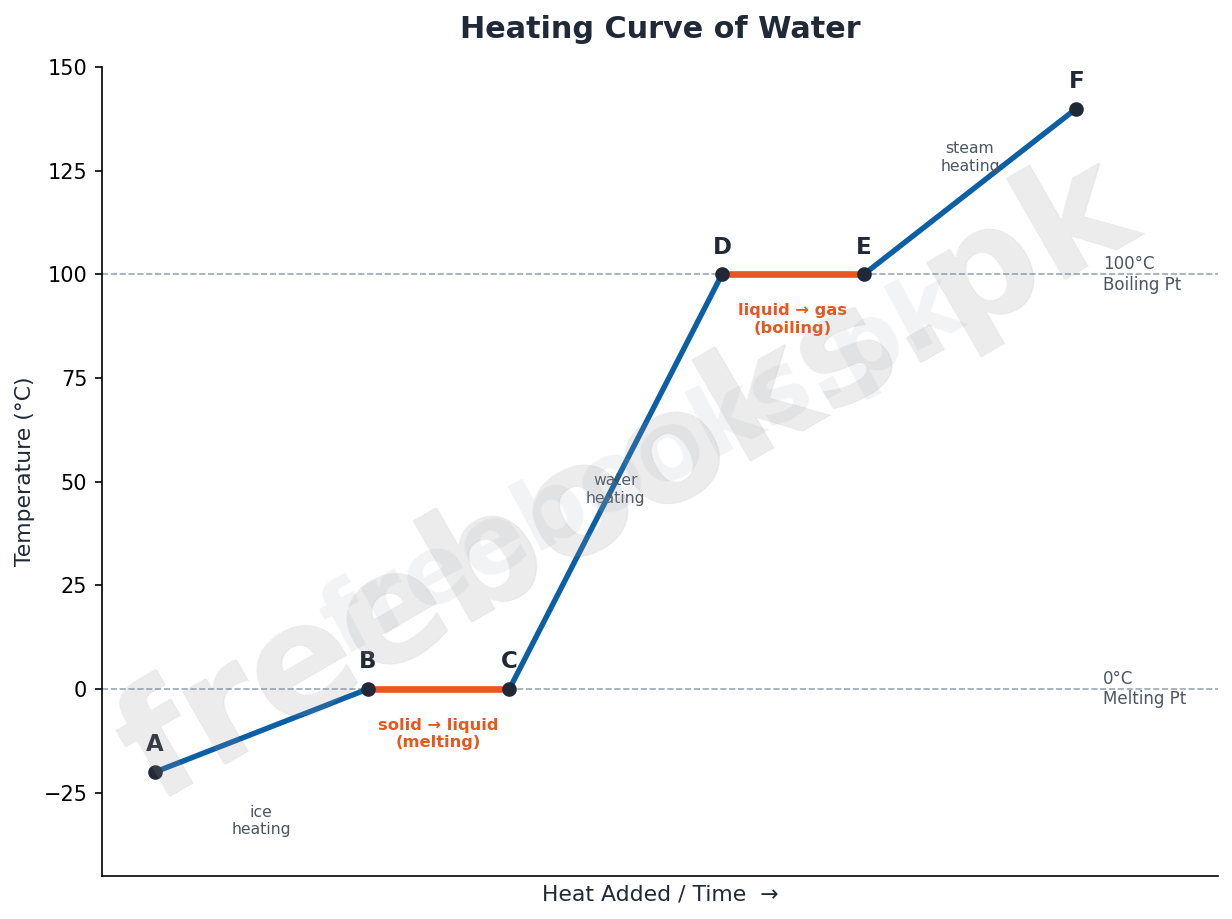
A heating or cooling curve plots the internal energy (or heat supplied) of a substance against its temperature, and it makes the interconversion of physical states easy to visualise. On a heating curve, a solid's temperature rises steadily until it reaches its melting point, where the curve flattens into a plateau while the solid melts at constant temperature; once melting is complete, the temperature rises again until the liquid reaches its boiling point, where a second plateau appears while the liquid turns to gas at constant temperature; after that, the temperature of the gas rises again.
A cooling curve is simply the same graph read in the opposite direction: a gas cools until it reaches its condensation (liquefaction) point — numerically the same temperature as the boiling point — where the temperature stays constant while the gas condenses; further cooling brings the liquid to its freezing point — numerically the same as the melting point — where the temperature again stays constant while the liquid solidifies. For water specifically, the heating curve shows a plateau at 0 degC while ice melts and a second plateau at 100 degC while liquid water turns to steam.
14.4 Evaporation, Boiling and the Effect of External Pressure
Evaporation is a surface phenomenon that occurs slowly, at all temperatures below the boiling point, and produces a cooling effect because the escaping molecules carry away kinetic energy; it needs only a small amount of energy, supplied from within the liquid itself. Boiling, by contrast, is a bulk phase change that occurs throughout the liquid at one specific temperature (the boiling point) under a given external pressure, does not cause cooling, and requires a continuous external energy source.
Both evaporation and boiling are affected by external pressure. Decreasing the external pressure makes evaporation easier, because fewer escaping molecules are forced back into the liquid; it also lowers the boiling point, because the liquid's vapour pressure can then match the (lower) external pressure at a lower temperature. This is why water boils at about 100 degC in Karachi (sea level) but at only about 98 degC in Murree, where the atmospheric pressure is lower.
14.5 Sublimation and Deposition
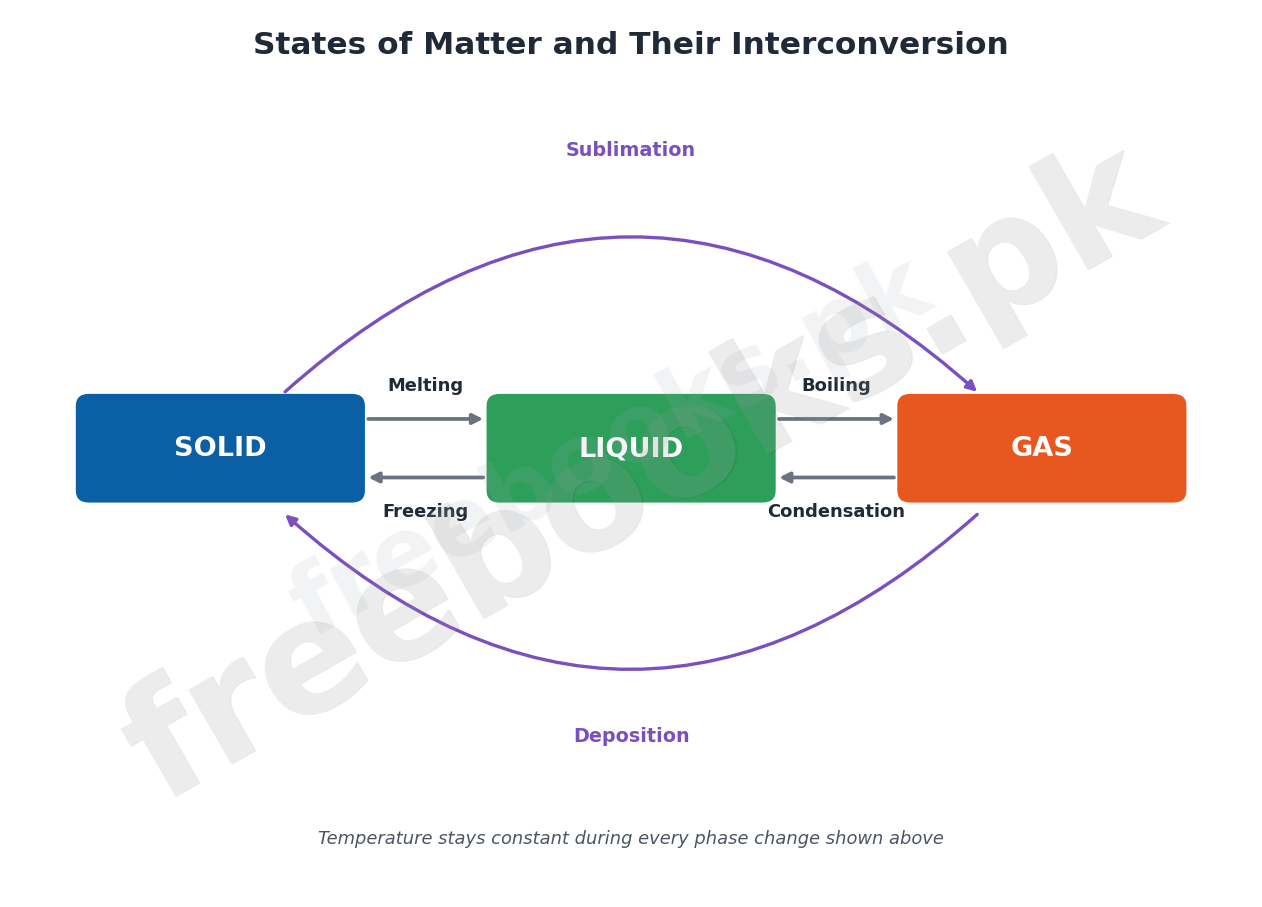
Sublimation is the direct conversion of a solid into vapour without first passing through the liquid state — for example, solid carbon dioxide (dry ice) turns directly into gaseous carbon dioxide at room temperature, and naphthalene balls used to repel insects slowly disappear the same way. As in evaporation, the energy needed for sublimation is absorbed by the substance from its surroundings, and it is enough to overcome the attractive forces between neighbouring particles so they can escape directly into the vapour phase.
Deposition is the reverse of sublimation: a gas changes directly into a solid without passing through the liquid state. The formation of frost on cold surfaces during winter mornings is a common everyday example of deposition.
14.6 Applications of Sublimation
Solid air fresheners rely on sublimation: a scented solid substance, when exposed to air or gently heated, gains enough energy to overcome the attractive forces holding its particles together and disperses sweet-smelling vapours throughout a room, masking unpleasant odours.
Sublimation printing uses the same principle to transfer a design permanently onto a material. A design is first printed onto special paper with sublimation inks; when this paper is pressed onto fabric (or a specially coated surface such as ceramic, wood or metal) under heat and pressure, the ink converts into vapour, enters the pores that the heat has opened up in the material, and then cools back into a solid form embedded within it — which is why the print does not fade or wash off the way ordinary surface printing does.
14.7 Kinetic Theory and the Gas Laws
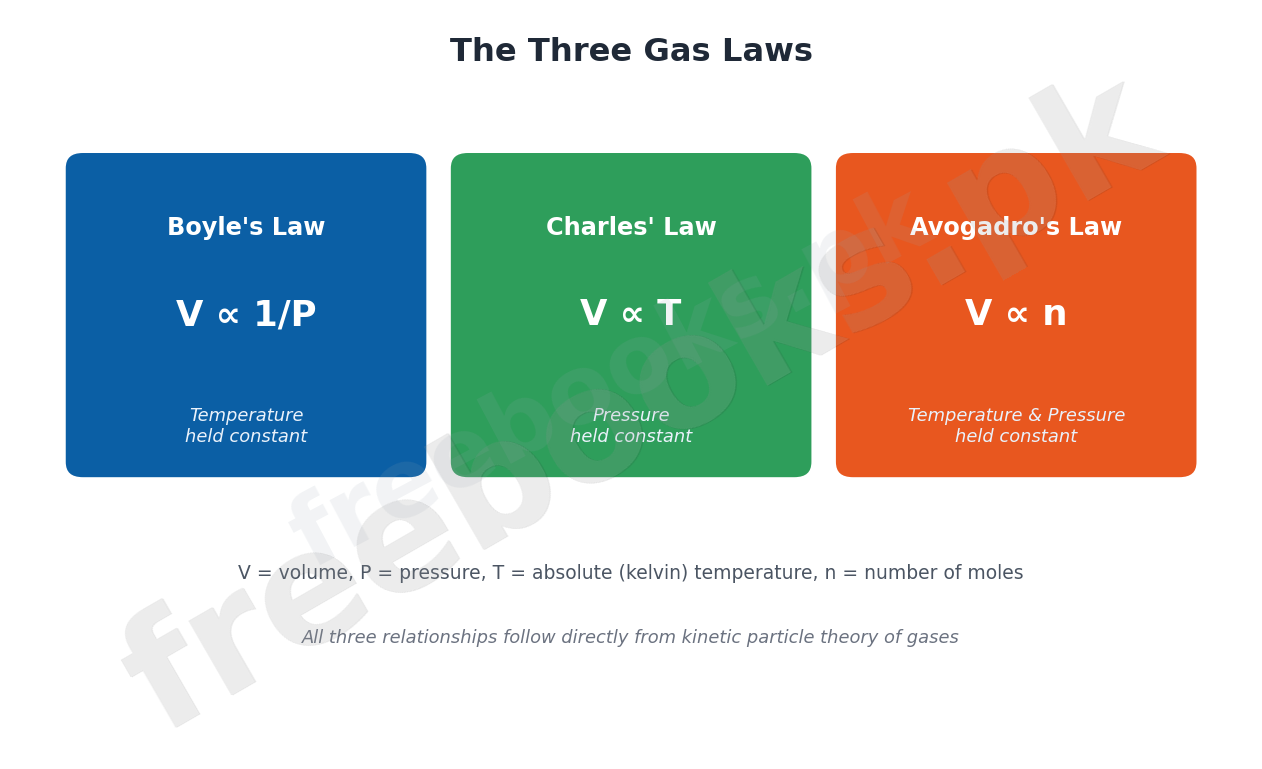
Boyle's law (pressure-volume relationship): according to kinetic theory, increasing the pressure on a fixed mass of gas at constant temperature pushes its molecules closer together, reducing its volume; halving the volume doubles the number of molecules per unit volume and therefore doubles the rate of collisions with the container walls, doubling the pressure. Robert Boyle verified this experimentally and formulated the law: the volume of a given mass of gas is inversely proportional to its pressure at constant temperature, written as V is proportional to 1/P.
Charles' law (temperature-volume relationship): raising the temperature of a gas increases the average speed and kinetic energy of its molecules, causing more frequent and harder collisions with the container walls. If the gas is free to expand so that its pressure stays constant, its volume must increase to accommodate this. Jacques Charles summarised this as: the volume of a given mass of gas varies directly with its absolute (kelvin) temperature at constant pressure, written as V is proportional to T.
Avogadro's law: the pressure a gas exerts depends on how often its particles collide with the container walls, which depends on both the number of particles present and their speed. If more gas is added to a container at constant temperature and pressure, the volume must increase to keep the collision rate — and hence the pressure — unchanged. Avogadro's law states that equal volumes of different gases, at the same temperature and pressure, contain an equal number of molecules, written as V is proportional to n.
14.8 Diffusion and Its Importance in Medicine
Diffusion is the spontaneous spreading and intermixing of gas particles from a region of higher concentration to one of lower concentration, caused by their constant random motion — it is why the smell of a perfume opened in one corner of a room eventually spreads throughout it. Since all gases have the same average kinetic energy at a given temperature, a lighter gas (such as hydrogen) moves faster than a heavier one (such as oxygen) at the same temperature, so it diffuses faster; raising the temperature increases the kinetic energy and speed of all gas particles, further increasing the rate of diffusion.
Diffusion rate matters directly in medicine: when a medicine is taken orally, how quickly it diffuses from the stomach and intestine into the bloodstream determines how fast it is absorbed and how soon it starts acting. Once absorbed, the drug diffuses into different tissues and organs — lipid-soluble drugs, for instance, diffuse more easily through cell membranes and so act faster — and a higher rate of diffusion generally means a higher drug concentration reaching its target organ sooner, giving a more effective response.
Important Definitions
Define internal energy.
The total energy contained in a substance, made up of the kinetic energy of its particles plus the potential energy arising from bonding between them; supplying heat increases it.
What is the melting point of a solid?
The specific temperature at which the vibrational motion of a solid's particles becomes fast enough to overcome the cohesive forces holding them in place, so the solid turns into a liquid.
What is the boiling point of a liquid?
The temperature at which a liquid's vapour pressure becomes equal to the external (atmospheric) pressure, so the liquid boils and turns into a gas.
Define freezing point.
The temperature at which a liquid turns into a solid on cooling; it is numerically the same temperature as the substance's melting point.
Define evaporation.
The continuous escape of molecules from the surface of a liquid at all temperatures below its boiling point; it is a surface phenomenon that produces a cooling effect.
Define condensation.
The change of a gas into a liquid on cooling, as the kinetic energy of its molecules decreases and they are drawn together by increasing forces of attraction.
Define sublimation.
The direct conversion of a solid into vapour without first passing through the liquid state, e.g. dry ice or naphthalene balls.
Define deposition.
The direct conversion of a gas into a solid without passing through the liquid state, e.g. the formation of frost.
What is a heating curve?
A graph of internal energy (or heat supplied) against temperature that shows how a substance's temperature rises and then plateaus during each phase change as it is heated.
What is a cooling curve?
A graph of internal energy against temperature, read in the reverse direction of a heating curve, showing condensation and freezing plateaus as a substance is cooled.
State Boyle's law.
The volume of a given mass of a gas is inversely proportional to its pressure at constant temperature: V is proportional to 1/P.
State Charles' law.
The volume of a given mass of a gas varies directly with its absolute (kelvin) temperature at constant pressure: V is proportional to T.
State Avogadro's law.
Equal volumes of different gases, at the same temperature and pressure, contain an equal number of molecules: V is proportional to n.
Define diffusion.
The spontaneous spreading and intermixing of particles of a gas (or liquid) from a region of higher concentration to one of lower concentration, due to their random motion.
What is vapour pressure?
The pressure exerted by the vapour of a liquid; a liquid boils when its vapour pressure becomes equal to the external atmospheric pressure.
Why do solids have a fixed shape and volume, according to kinetic particle theory?
Because the inter-particle forces in a solid are strong enough to hold its particles in fixed positions, restricting them to vibrational motion only.
Key Formulas
| Topic | Relation |
|---|---|
| Boyle's law (T, mass constant) | V is proportional to 1/P |
| Charles' law (P, mass constant) | V is proportional to T (T on the absolute/kelvin scale) |
| Avogadro's law (T, P constant) | V is proportional to n (n = number of moles/molecules) |
| Melting point = Freezing point | Same numerical temperature, for a given substance |
| Boiling point = Condensation (liquefaction) point | Same numerical temperature, for a given substance |
Diagrams
States of Matter and Their Interconversion: A flowchart showing solid, liquid and gas linked by the six named phase changes — melting, freezing, boiling/vaporisation, condensation, sublimation and deposition.
Heating Curve of Water: A temperature-vs-heat-added graph showing the melting plateau at 0 degC and the boiling plateau at 100 degC, with points A-F matching the stages described in the text.
The Three Gas Laws: A side-by-side comparison of Boyle's law, Charles' law and Avogadro's law, showing the proportionality relationship and the variable held constant in each.
Short Questions & Answers
What is the internal energy of a substance?
It is the total energy a substance contains — the kinetic energy of its particles plus the potential energy from bonding between them; heat increases it.
Why does the temperature of a substance remain constant during melting or boiling?
Because the heat supplied during a phase change is used entirely to break the forces of attraction between particles, not to raise their kinetic energy or temperature.
Differentiate between evaporation and boiling in one line each.
Evaporation is a slow surface process occurring at all temperatures and causing cooling; boiling is a bulk process occurring throughout the liquid at one fixed temperature and does not cause cooling.
Why does water boil at a lower temperature in Murree than in Karachi?
Because Murree is at a higher altitude where atmospheric pressure is lower, so the liquid's vapour pressure matches the external pressure at a lower temperature.
Give one example each of sublimation and deposition.
Sublimation: solid carbon dioxide (dry ice) turning directly into gas. Deposition: frost forming directly from water vapour in cold air.
Why does an evaporating liquid feel cool?
Because the escaping molecules carry away kinetic energy from the liquid's surface, lowering the average kinetic energy — and hence the temperature — of the liquid left behind.
According to Boyle's law, what happens to the volume of a gas when its pressure is doubled at constant temperature?
The volume is halved, since volume is inversely proportional to pressure at constant temperature.
State Charles' law.
The volume of a given mass of gas varies directly with its absolute temperature when the pressure is kept constant.
Why does hydrogen gas diffuse faster than oxygen gas at the same temperature?
Because all gases have the same average kinetic energy at a given temperature, and since hydrogen molecules are lighter than oxygen molecules, they must move faster, so hydrogen diffuses faster.
Why is a faster rate of diffusion important for orally-taken medicines?
Because it allows the drug to move more quickly from the stomach and intestine into the bloodstream, giving faster absorption and a quicker onset of action.
Long Questions & Answers
Explain, with reference to kinetic particle theory, how a solid substance is converted into a liquid and then into a gas, and describe how a heating curve represents this process.
What happens to the particles of a solid as it is heated towards its melting point?
Heating a solid increases the kinetic energy of its particles, making them vibrate more vigorously about their fixed positions. As heating continues, this vibrational motion becomes fast enough that, at the melting point, it overcomes the cohesive forces holding the particles in their fixed arrangement, and the solid begins to collapse into a liquid.
What happens to the heat supplied once melting begins, and why does the temperature stay constant?
Once melting starts, any further heat supplied is used entirely to break the remaining forces of attraction between particles and convert the solid into liquid, rather than to increase kinetic energy. Because no energy is going into raising particle speed during this stage, the temperature of the substance remains constant until the solid has completely melted.
How does a liquid convert into a gas, and what defines its boiling point?
Heating a liquid increases the kinetic energy of its molecules, first increasing the rate of evaporation at the surface and then, as heating continues, causing bubbles of vapour to form throughout the liquid. When the vapour pressure inside these bubbles becomes equal to the external atmospheric pressure, the liquid boils; this temperature is called its boiling point, and it too stays constant while the liquid changes into gas.
How does a heating curve represent melting and boiling together?
A heating curve plots temperature against the heat supplied (or time), and shows the temperature rising steadily through the solid phase until it reaches a flat plateau at the melting point; after the plateau, the temperature rises again through the liquid phase until it reaches a second flat plateau at the boiling point, after which the temperature of the resulting gas rises once more. The two plateaus correspond exactly to the melting and boiling processes, where added heat changes the phase rather than the temperature.
State and explain Boyle's law, Charles' law and Avogadro's law using kinetic particle theory, and explain the factors that affect the rate of diffusion of a gas.
What does Boyle's law state, and how does kinetic theory explain it?
Boyle's law states that the volume of a given mass of gas is inversely proportional to its pressure at constant temperature. Kinetic theory explains this because reducing the volume forces gas molecules closer together, increasing the number of molecules per unit volume and hence the frequency of their collisions with the container walls, which raises the pressure proportionally.
What does Charles' law state, and how does kinetic theory explain it?
Charles' law states that the volume of a given mass of gas varies directly with its absolute temperature at constant pressure. Kinetic theory explains this because heating a gas increases the average speed and kinetic energy of its molecules, causing more frequent and forceful collisions with the container walls; to keep the pressure constant, the volume must expand to reduce the frequency of these collisions back to its original rate.
What does Avogadro's law state?
Avogadro's law states that equal volumes of different gases, measured at the same temperature and pressure, contain an equal number of molecules. This follows because pressure depends on the frequency of molecular collisions with the container walls, so at fixed temperature and pressure, the volume must scale directly with the number of gas particles present.
How do molecular mass and temperature affect the rate of diffusion of a gas?
At a given temperature, all gases share the same average kinetic energy, so a gas with a lower molecular mass must have faster-moving molecules and therefore diffuses more quickly than a heavier gas — which is why ammonia diffuses faster than hydrogen chloride. Raising the temperature of any gas increases the kinetic energy and speed of its particles, which increases its rate of diffusion regardless of its molecular mass.
Multiple Choice Questions (MCQs)
According to kinetic particle theory, solids, liquids and gases mainly differ from one another in: (A) their chemical composition (B) the size of their particles (C) the movement of their particles (D) the colour of their particles
Correct answer: (C) the movement of their particles. Kinetic particle theory explains the three states of matter mainly through the differing freedom of movement of their particles — vibrational only in solids, and increasingly free in liquids and gases.
Increasing the temperature of a liquid causes its rate of evaporation to: (A) decrease (B) increase (C) stay the same (D) first decrease, then increase
Correct answer: (B) increase. Higher temperature gives liquid molecules more kinetic energy, so more of them escape the surface, increasing the rate of evaporation.
Inter-particle forces of attraction are strongest in: (A) gases (B) liquids (C) solids (D) plasma
Correct answer: (C) solids. Solids have the strongest inter-particle forces, which is why their particles are locked into fixed positions and can only vibrate.
The direct change of a gas into a solid, without passing through the liquid state, is called: (A) sublimation (B) condensation (C) deposition (D) evaporation
Correct answer: (C) deposition. Deposition is the reverse of sublimation — a gas converting directly into a solid, as in the formation of frost.
During a phase change such as melting or boiling, the temperature of a substance: (A) increases (B) decreases (C) remains constant (D) fluctuates randomly
Correct answer: (C) remains constant. Heat supplied during a phase change is used entirely to change the phase (breaking or forming inter-particle forces), so the temperature stays constant until the change is complete.
Which of these gases will diffuse fastest under similar conditions of temperature and pressure: SO2, H2S, CO2, NO2? (A) SO2 (B) H2S (C) CO2 (D) NO2
Correct answer: (B) H2S. H2S has the lowest molecular mass (34 g/mol) of the four, and lighter gas molecules move faster and diffuse more quickly at the same temperature.
Boyle's law relates the volume of a fixed mass of gas to its: (A) temperature (B) pressure (C) number of moles (D) density
Correct answer: (B) pressure. Boyle's law states that volume is inversely proportional to pressure at constant temperature.
Charles' law states that, at constant pressure, the volume of a gas is directly proportional to its: (A) pressure (B) absolute (kelvin) temperature (C) number of molecules (D) density
Correct answer: (B) absolute (kelvin) temperature. Charles' law relates volume directly to the gas's absolute temperature, provided pressure is held constant.
Avogadro's law states that equal volumes of different gases, at the same temperature and pressure, contain equal: (A) masses (B) densities (C) numbers of molecules (D) numbers of atoms only
Correct answer: (C) numbers of molecules. Avogadro's law is about the number of molecules (or particles), not their mass, density, or atom count specifically.
The boiling point of water is lower at a higher altitude (such as in Murree) mainly because: (A) the temperature there is naturally lower (B) the atmospheric pressure there is lower (C) the water is purer there (D) gravity is weaker there
Correct answer: (B) the atmospheric pressure there is lower. At higher altitude, atmospheric pressure is lower, so the liquid's vapour pressure can match it at a lower temperature, lowering the boiling point.
Quick Revision Summary
- Kinetic particle theory: solid particles only vibrate in fixed positions; liquid particles move in all three ways but stay close together; gas particles move freely and randomly.
- Melting point = temperature where a solid turns to liquid; Boiling point = temperature where a liquid's vapour pressure equals the external pressure.
- Temperature stays constant during any phase change (melting, boiling, freezing, condensation) — the heat supplied changes the phase, not the temperature.
- Sublimation = solid to gas directly (e.g. dry ice); Deposition = gas to solid directly (e.g. frost) — the reverse of sublimation.
- Evaporation occurs at the surface at all temperatures and causes cooling; boiling occurs throughout the liquid at one fixed temperature and needs external heat.
- Boyle's Law: V is proportional to 1/P (T constant); Charles' Law: V is proportional to T (P constant); Avogadro's Law: V is proportional to n (T, P constant).
- Lower external pressure lowers the boiling point (Murree vs Karachi) and makes evaporation easier.
- Lighter gas molecules diffuse faster than heavier ones at the same temperature (e.g. ammonia diffuses faster than hydrogen chloride).
Exam Tips
- Learn the exact definitions of melting, boiling, freezing, condensation, sublimation and deposition point by point — these are common short-question topics.
- Practice sketching and labelling a heating/cooling curve for water with the correct plateau temperatures (0 degC and 100 degC).
- Remember: temperature always stays constant during a phase change — this is a frequent conceptual MCQ trap.
- Memorise which variable is held constant in each gas law: Boyle's (temperature constant), Charles' (pressure constant), Avogadro's (temperature and pressure constant).
- For diffusion questions, always connect rate to molecular mass — the lighter gas diffuses faster at the same temperature.
- Revise the real-life applications of sublimation (solid air fresheners, sublimation printing) since these often appear as descriptive questions.