Salts are ionic compounds formed when the positive ions from a base and the negative ions from an acid combine, most commonly in a neutralization reaction. This chapter explains why salts arrange themselves into ordered, repeating three-dimensional crystal lattices, using sodium chloride as the model example, and connects this ordered structure to two of the salts' most characteristic properties: very high melting points and the fact that they conduct electricity only when molten or dissolved in water, never as solids.
The chapter then covers the general solubility rules that predict whether a given salt will dissolve in water, before working through the practical laboratory methods used to prepare pure, soluble salts — reacting a soluble acid with a soluble base (titration), and reacting a soluble acid with an excess of an insoluble base, metal or carbonate — including the crystallization, filtration and drying steps needed to isolate pure crystals at the end.
Learning Objectives
- Explain that salts are ionic compounds formed due to electrostatic attraction between oppositely charged ions, with positive ions coming from bases and negative ions from acids
- Explain why salts are solids with high melting points at STP
- Describe that under normal conditions, ionic compounds are usually solids with lattice structures
- Explain why the molten and aqueous solutions of salts conduct electricity, by making reference to the idea of mobile ions
- Describe the general solubility rules for salts (sodium, nitrate, potassium and ammonium salts are soluble; chlorides are soluble except lead and silver; carbonates are insoluble except sodium, potassium and ammonium; hydroxides are insoluble except sodium, potassium, ammonium and calcium, which is partially soluble)
- Describe the preparation, separation and purification of soluble salts by reactions of an acid with an alkali (titration), an excess metal, an excess insoluble base, or an excess insoluble carbonate
Key Concepts
18.1 Arrangement of Ions in Salts
When an acid neutralizes a base or an alkali, a salt and water are formed — for example, sodium hydroxide neutralizes hydrochloric acid to give sodium chloride and water: NaOH(aq) + HCl(aq) -> NaCl(aq) + H2O(l). A salt is a chemical combination of positive and negative ions held together by the electrostatic force of attraction between them; the strength of this attraction depends on the magnitude of the charges on the ions and the distance between them.
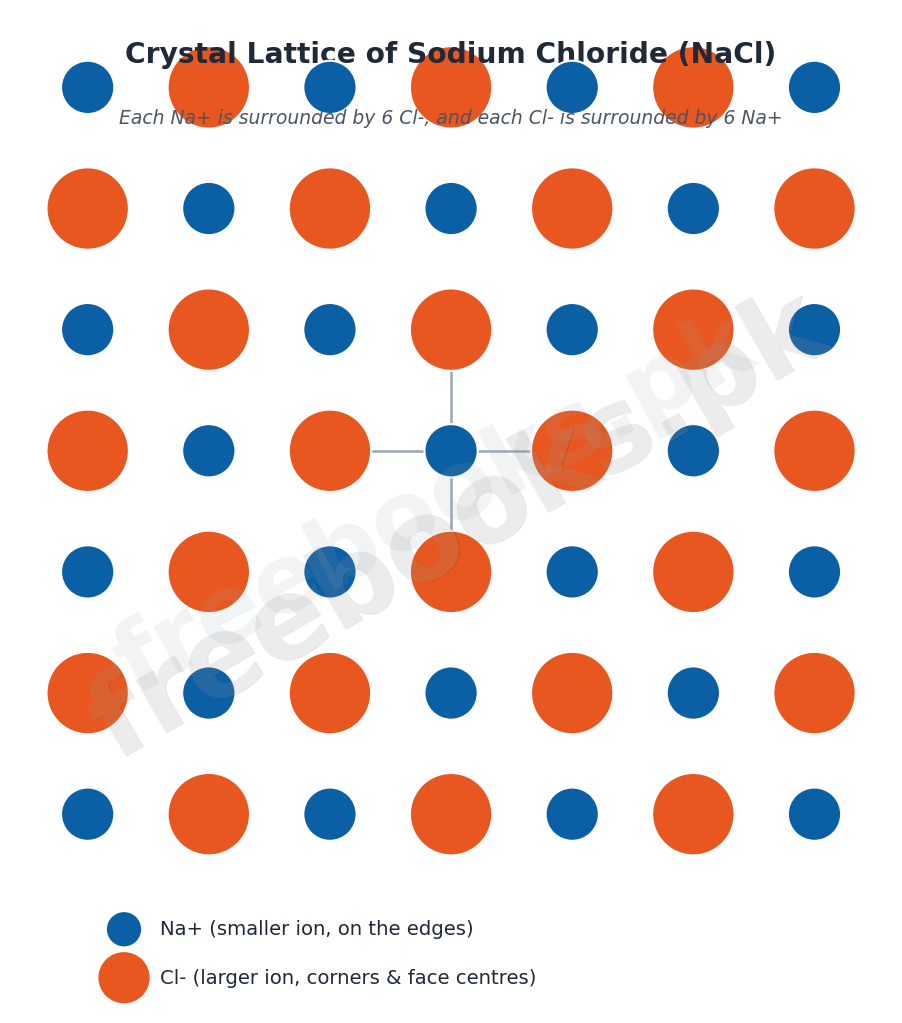
These oppositely charged ions arrange themselves in a regular, repeating pattern to give a three-dimensional network called a crystal lattice, and this ordered structure is responsible for the properties shown by ionic compounds, which exist as crystalline solids under ordinary conditions of temperature and pressure. In sodium chloride, each sodium ion is surrounded by six chloride ions and each chloride ion is surrounded by six sodium ions, forming a face-centred cube in which the larger chloride ions sit at the corners and face-centres of the cube while the smaller sodium ions occupy its edges.
18.2 Melting Points of Ionic Compounds
Very strong electrostatic forces of attraction exist between the ions within a crystal lattice, so a significant amount of energy is needed to break these forces apart — this is why the melting points of ionic compounds are generally very high. During melting, these attractive forces break down and the ions become free to move.
The melting point of a particular ionic compound depends on the charges present on its ions and their sizes: higher charges and smaller ion sizes lead to stronger electrostatic attractions between the ions, and therefore to higher melting points.
18.3 Conduction of Electricity by Ionic Compounds
Ionic compounds do not conduct electricity in the solid state, but they start conducting electricity in the molten state or when dissolved in water. In the solid state, ions are held tightly in place by strong forces of attraction and are not free to move, so they cannot carry a current.
When an ionic compound is heated to its melting point, its ions become free to move around and the compound starts conducting electricity; similarly, when an ionic compound dissolves in water, the forces of attraction between its ions break down and the ions become free to move independently through the solution. Because ionic compounds dissociate completely into ions when dissolved in water, they serve as strong electrolytes.
18.4 Soluble and Insoluble Salts
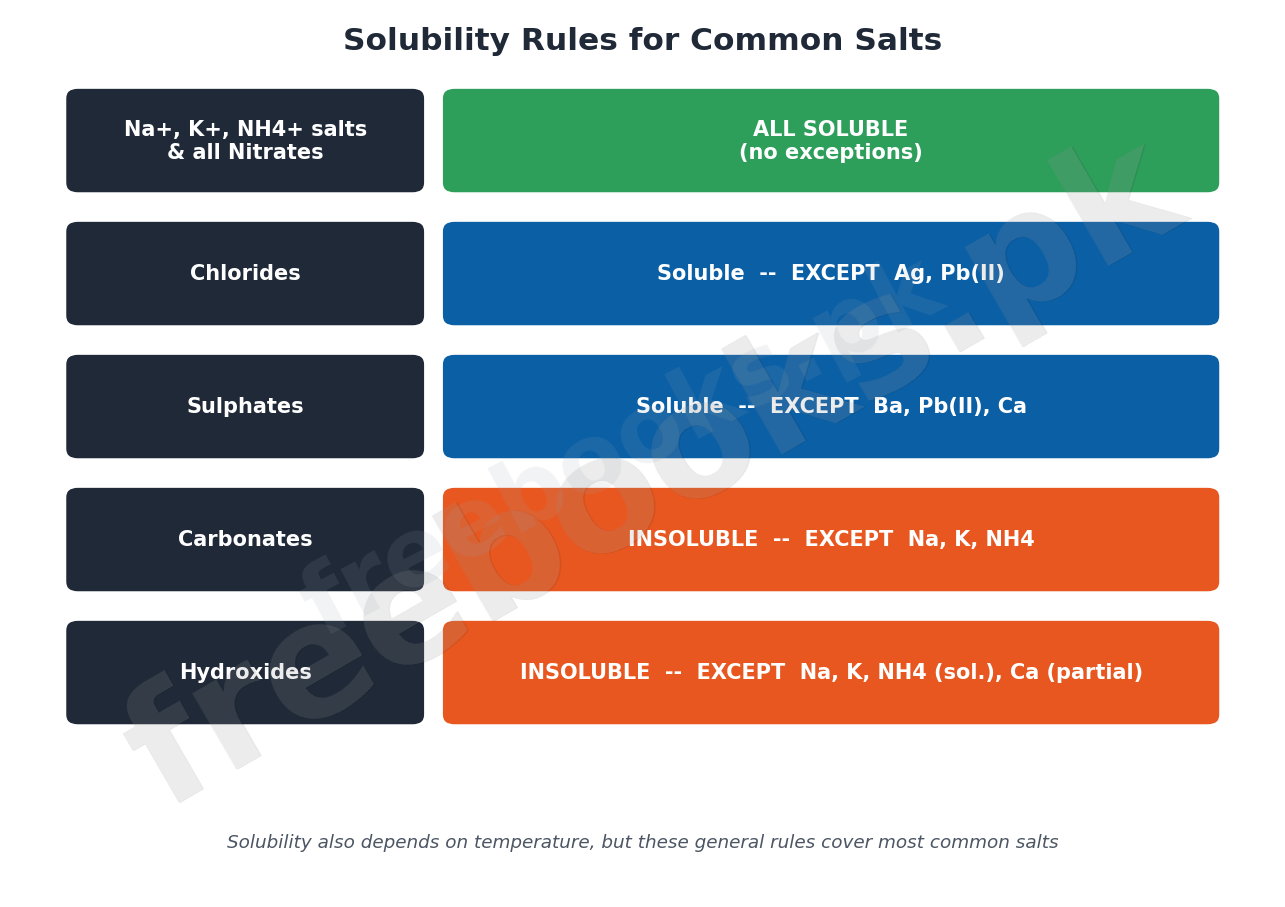
The solubility of a salt in water depends on several factors, including the nature of the salt and the temperature, but general rules can predict solubility for most common salts. All sodium, potassium and ammonium salts are soluble, as are all metallic nitrates; most chlorides and sulfates are also soluble, except for the chlorides of silver and lead, and the sulfates of barium, lead and calcium.
In contrast, all carbonates are insoluble in water except for the carbonates of sodium, potassium and ammonium. Among hydroxides, only sodium hydroxide, potassium hydroxide and ammonium hydroxide are freely soluble, calcium hydroxide is only partially soluble, and all other hydroxides are insoluble in water.
18.5 Preparation of Soluble Salts
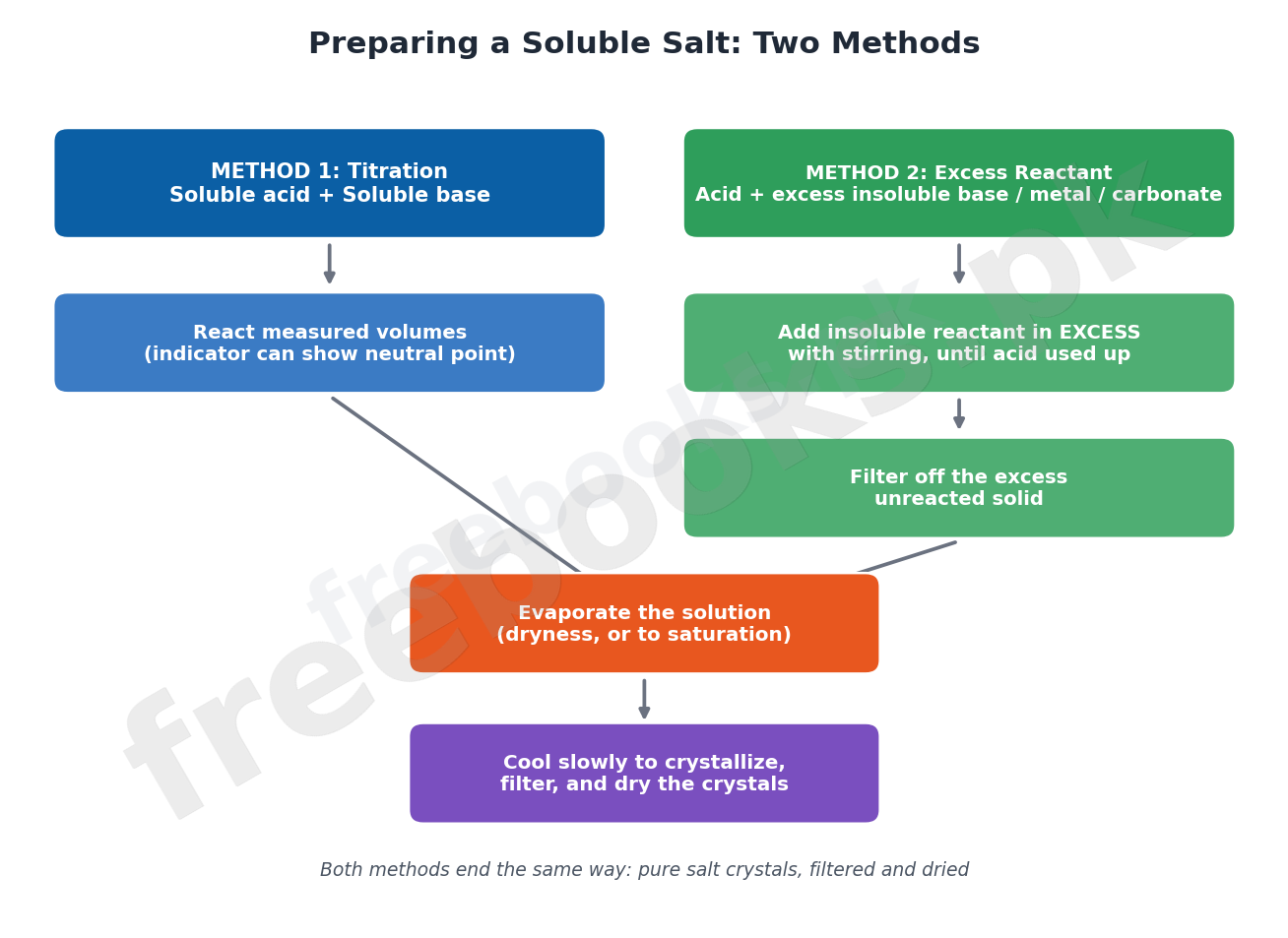
Soluble salts can be prepared by reacting a water-soluble acid with a water-soluble base (a method also called titration): the acid and base are chosen based on the salt required — for example, potassium nitrate is prepared by reacting appropriate volumes of potassium hydroxide and nitric acid: KOH(aq) + HNO3(aq) -> KNO3(aq) + H2O(l). The resulting solution of salt and water is transferred to an evaporating dish and either evaporated to dryness (if the salt is heat-stable) or heated gently until a thin film of crystals forms on the surface, then cooled slowly so that pure crystals form, which are then filtered out and dried between the folds of filter paper.
Alternatively, a soluble acid can be reacted with an excess of an insoluble base, metal or carbonate — also a form of neutralization (or, for a metal, a displacement reaction that also produces hydrogen gas). The insoluble reactant is always added in excess to ensure that all of the acid has reacted completely, then the mixture is filtered to remove the unreacted excess; the filtrate is evaporated to give a saturated solution, which is cooled to allow pure crystals to form, then filtered and dried. Examples include Cu(OH)2(s) + 2HCl(aq) -> CuCl2(aq) + 2H2O(l), Mg(s) + H2SO4(aq) -> MgSO4(aq) + H2(g), and CaCO3(s) + 2HCl(aq) -> CaCl2(aq) + CO2(g) + H2O(l).
In a titration-based preparation, an indicator such as phenolphthalein is often used to judge the exact point of neutralization during a first trial run, and the experiment is then repeated using the same measured volumes but without the indicator, so that the final salt solution is not contaminated by indicator dye before it is evaporated and crystallized.
Important Definitions
Define a salt.
An ionic compound formed by the electrostatic attraction between positive ions, usually from a base, and negative ions, usually from an acid, commonly produced in a neutralization reaction.
Define a neutralization reaction.
A reaction in which an acid reacts with a base or alkali to form a salt and water.
Define a crystal lattice.
A regular, repeating three-dimensional arrangement of positive and negative ions in an ionic solid, held together by electrostatic forces of attraction.
Define electrostatic force of attraction (in an ionic compound).
The force of attraction between oppositely charged ions, whose strength depends on the magnitude of the charges on the ions and the distance between them.
Define an electrolyte.
A substance that, in the molten state or dissolved in water, conducts electricity by allowing its ions to move freely; ionic compounds are strong electrolytes because they dissociate completely into ions in water.
Define solubility (of a salt).
The extent to which a salt dissolves in a given solvent, usually water, under specified conditions; it depends on the nature of the salt and the temperature.
Define titration (as a salt-preparation method).
A method of preparing a soluble salt by reacting measured volumes of a water-soluble acid and a water-soluble base together until they are exactly neutralized.
Define an insoluble base.
A base, such as certain metal oxides, carbonates or hydroxides, that does not dissolve appreciably in water and can be reacted with excess acid to prepare a soluble salt.
Define crystallization.
The process by which pure solid crystals of a salt form and separate out from a cooled, saturated solution.
Define a saturated solution.
A solution that contains the maximum amount of a dissolved solute possible at a given temperature, such that no more solute will dissolve into it.
Define filtration (in salt preparation).
The process of separating an insoluble solid, such as excess unreacted base or metal, or the crystals of a prepared salt, from a liquid by passing the mixture through a filter.
Define an indicator (in salt preparation).
A substance, such as phenolphthalein, that changes colour to show when a titration reaction between an acid and a base has reached the point of exact neutralization.
Define a face-centred cubic lattice.
A crystal lattice arrangement, as seen in sodium chloride, in which ions occupy the corners and the centres of each face of a cube, with other ions occupying the edges between them.
Define evaporation (in salt preparation).
The process of heating a salt solution to drive off water as vapour, concentrating the solution until crystals begin to form or the salt is left completely dry.
Define a strong electrolyte.
An electrolyte that dissociates completely into its constituent ions when dissolved in water, allowing it to conduct electricity efficiently; ionic compounds such as salts are strong electrolytes.
Define the general solubility rule for carbonates.
All carbonates are insoluble in water except the carbonates of sodium, potassium and ammonium.
Key Facts & Relations
| Topic | Relation |
|---|---|
| Neutralization (general) | Acid + Base -> Salt + Water |
| Soluble salts (always) | Salts of sodium, potassium, ammonium; all nitrates |
| Chlorides | Soluble, except silver chloride and lead(II) chloride |
| Sulphates | Soluble, except barium, lead(II) and calcium sulphate |
| Carbonates | Insoluble, except sodium, potassium and ammonium carbonate |
| Hydroxides | Insoluble, except sodium, potassium, ammonium (soluble) and calcium (partially soluble) |
| Titration example | KOH(aq) + HNO3(aq) -> KNO3(aq) + H2O(l) |
| Acid + insoluble base/metal example | Mg(s) + H2SO4(aq) -> MgSO4(aq) + H2(g) |
Diagrams
Crystal Lattice of Sodium Chloride: A schematic of the repeating, alternating arrangement of sodium and chloride ions in the NaCl crystal lattice, showing each ion surrounded by six oppositely charged neighbours.
Solubility Rules for Common Salts: A summary chart of the general solubility rules covering nitrates, chlorides, sulphates, carbonates and hydroxides, with their soluble and insoluble exceptions.
Preparing a Soluble Salt: Two Methods: A flowchart comparing the titration method (soluble acid + soluble base) with the excess-reactant method (soluble acid + excess insoluble base, metal or carbonate), both ending in evaporation, cooling, filtration and drying to obtain pure crystals.
Short Questions & Answers
Which factors are responsible for the strength of electrostatic forces between ions?
The magnitude of the charges on the ions and the distance between them; higher charges and smaller ion sizes (shorter distances) give stronger electrostatic forces.
Is lead(II) chloride soluble in water?
No, lead(II) chloride is one of the two exceptions to the general rule that chlorides are soluble in water, the other being silver chloride.
Which lead salts are insoluble in water?
Lead(II) chloride, lead(II) sulphate and lead(II) carbonate are all insoluble in water, following the general solubility rules for chlorides, sulphates and carbonates respectively.
Name two insoluble carbonates.
Calcium carbonate and magnesium carbonate are both insoluble in water, since only sodium, potassium and ammonium carbonates are soluble.
What is a crystal lattice?
A regular, repeating three-dimensional arrangement of positive and negative ions in an ionic solid, held together by electrostatic forces of attraction between the ions.
Do you expect the melting point of KCl to be higher or lower than that of NaCl?
Lower, because the potassium ion is larger than the sodium ion, giving a greater distance between the oppositely charged ions and therefore a weaker electrostatic attraction and a lower melting point.
Which salts of barium and calcium are soluble in water?
Barium and calcium salts of chloride and nitrate are soluble, but their sulphates and carbonates are insoluble; calcium hydroxide is only partially soluble.
How is barium sulphate prepared in the laboratory?
By mixing solutions containing barium ions and sulphate ions, such as barium chloride and sodium sulphate or dilute sulphuric acid, since barium sulphate is insoluble and precipitates immediately out of solution.
Why don't ionic compounds conduct electricity in the solid state?
Because their ions are held tightly in fixed positions within the crystal lattice by strong electrostatic forces and are not free to move, so no charge can flow through the solid.
Why is an insoluble base or metal always added in excess when preparing a soluble salt this way?
To make sure that all of the acid present has fully reacted, so that the final filtrate contains only the pure salt and water, with no leftover acid to contaminate the crystals.
Long Questions & Answers
Explain the formation and structure of a sodium chloride crystal.
How is sodium chloride formed as a salt?
Sodium hydroxide (a base) reacts with hydrochloric acid in a neutralization reaction, producing sodium ions from the base and chloride ions from the acid, which then combine by electrostatic attraction to form solid sodium chloride and water: NaOH(aq) + HCl(aq) -> NaCl(aq) + H2O(l).
What holds the sodium and chloride ions together in the solid?
The oppositely charged sodium and chloride ions are held together by the electrostatic force of attraction between them; this attraction is strong enough that the ions arrange themselves into a fixed, ordered structure rather than remaining randomly mixed.
How are the ions arranged in the crystal lattice of sodium chloride?
The ions form a regular, repeating three-dimensional network called a crystal lattice, shaped as a face-centred cube; the larger chloride ions occupy the corners and the centres of each face of the cube, while the smaller sodium ions occupy the edges, with each sodium ion surrounded by six chloride ions and each chloride ion surrounded by six sodium ions.
How does this lattice structure explain sodium chloride's physical properties?
Because the electrostatic forces throughout the whole lattice are very strong, a large amount of energy is needed to break them apart, giving sodium chloride a high melting point; and because the ions are fixed in place in the solid lattice, solid sodium chloride cannot conduct electricity, only doing so once melted or dissolved and its ions are set free to move.
Explain the methods used to prepare soluble salts in the laboratory, using an example for each.
How is a soluble salt prepared by titration?
A measured volume of a water-soluble acid is reacted with a measured volume of a water-soluble base until the two exactly neutralize each other, often judged using an indicator such as phenolphthalein in a trial run; for example, potassium nitrate is prepared from potassium hydroxide and nitric acid: KOH(aq) + HNO3(aq) -> KNO3(aq) + H2O(l).
How is a soluble salt prepared using an excess insoluble base, metal or carbonate?
A soluble acid is reacted with an excess of an insoluble base, metal or carbonate, added gradually with stirring, until no more of the acid reacts; for example, magnesium sulphate is prepared from excess magnesium metal and dilute sulphuric acid: Mg(s) + H2SO4(aq) -> MgSO4(aq) + H2(g).
What steps are common to both methods after the reaction is complete?
Any excess unreacted base, metal or carbonate is removed by filtration, and the resulting solution (or filtrate) is evaporated, either to dryness or until a saturated solution forms, so that the salt is concentrated enough to begin crystallizing out as it cools.
Why are the final crystals filtered and dried carefully, and why might the solution be cooled slowly?
Cooling slowly allows large, well-formed, pure crystals to grow out of the saturated solution rather than a mass of small impure ones; filtering separates these crystals from the remaining liquid, and drying them between the folds of filter paper (or in an oven) removes surface moisture without dissolving or damaging the crystals.
Multiple Choice Questions (MCQs)
Which base is not soluble in water? (A) KOH (B) Mg(OH)2 (C) NaOH (D) Na2CO3
Correct answer: (B) Mg(OH)2. Magnesium hydroxide is insoluble in water; only sodium, potassium, ammonium hydroxides are soluble, and calcium hydroxide is only partially soluble.
The shape of the crystal lattice of NaCl is: (A) Cubic (B) Hexagonal (C) Rhombic (D) Trigonal
Correct answer: (A) Cubic. Sodium chloride crystallizes in a cubic (face-centred cubic) lattice structure.
Which salts are always soluble in water? (A) Chlorides (B) Sulphates (C) Nitrates (D) Carbonates
Correct answer: (C) Nitrates. All metallic nitrates are soluble in water without exception, unlike chlorides, sulphates and carbonates, which each have specific insoluble exceptions.
Which salt will be formed when marble chips react with dilute nitric acid? (A) Sodium nitrate (B) Calcium nitrate (C) Potassium nitrate (D) Magnesium nitrate
Correct answer: (B) Calcium nitrate. Marble is calcium carbonate; reacting it with nitric acid produces calcium nitrate, water and carbon dioxide gas.
Which of the following is a water-insoluble salt? (A) Calcium sulphate (B) Sodium sulphate (C) Potassium sulphate (D) Magnesium sulphate
Correct answer: (A) Calcium sulphate. Calcium sulphate is one of the exceptions to the general rule that sulphates are soluble in water.
A salt's melting point tends to be higher when its ions have: (A) Lower charges and larger sizes (B) Higher charges and smaller sizes (C) Higher charges and larger sizes (D) Lower charges and smaller sizes
Correct answer: (B) Higher charges and smaller sizes. Higher ionic charges and smaller ion sizes both increase the strength of electrostatic attraction in the lattice, raising the melting point.
Why does molten NaCl conduct electricity but solid NaCl does not? (A) Molten NaCl contains different ions than solid NaCl (B) In the molten state, ions are free to move and carry charge (C) Solid NaCl has no ions at all (D) Molten NaCl is not really NaCl
Correct answer: (B) In the molten state, ions are free to move and carry charge. Melting breaks down the fixed lattice structure and frees the ions to move, which is what allows a substance to conduct electricity.
In the preparation of a soluble salt using an insoluble base, why is the base added in excess? (A) To make the reaction go faster (B) To ensure all the acid has fully reacted (C) To change the colour of the solution (D) To increase the melting point of the salt
Correct answer: (B) To ensure all the acid has fully reacted. Adding the insoluble base in excess ensures that all of the acid is consumed, so the resulting solution and crystals are not contaminated with unreacted acid.
Which of the following pairs would react to prepare a soluble salt by titration? (A) Nitric acid and copper metal (B) Sulphuric acid and magnesium carbonate (C) Hydrochloric acid and sodium hydroxide solution (D) Nitric acid and calcium carbonate
Correct answer: (C) Hydrochloric acid and sodium hydroxide solution. Titration specifically means reacting a soluble acid with a soluble base/alkali; hydrochloric acid and sodium hydroxide solution are both water-soluble.
Which step in preparing a soluble salt from excess insoluble base removes the unreacted excess? (A) Evaporation (B) Crystallization (C) Filtration (D) Cooling
Correct answer: (C) Filtration. Filtration separates the insoluble unreacted excess base, metal or carbonate from the salt solution before it is evaporated and crystallized.
Quick Revision Summary
- A salt is an ionic compound formed by electrostatic attraction between positive ions from a base and negative ions from an acid, usually in a neutralization reaction.
- Ions arrange themselves into a regular, repeating crystal lattice; in NaCl this is a face-centred cube with each ion surrounded by six oppositely charged neighbours.
- Strong electrostatic forces throughout the lattice give ionic compounds high melting points; stronger attraction (higher charge, smaller ion size) means a higher melting point.
- Ionic compounds do not conduct electricity as solids (ions fixed in place) but do conduct when molten or dissolved in water (ions free to move); they are strong electrolytes.
- Solubility rules: Na/K/NH4 salts and all nitrates are always soluble; chlorides are soluble except AgCl and PbCl2; sulphates are soluble except BaSO4, PbSO4, CaSO4; carbonates are insoluble except Na2CO3, K2CO3, (NH4)2CO3; hydroxides are insoluble except NaOH, KOH, NH4OH (soluble) and Ca(OH)2 (partially soluble).
- Soluble salts are prepared by titration (soluble acid + soluble base) or by reacting a soluble acid with excess insoluble base, metal, or carbonate.
- After the reaction: filter to remove any excess insoluble reactant, evaporate the filtrate to concentrate it, cool to crystallize, filter again, then dry the crystals.
- An indicator such as phenolphthalein helps judge the neutralization point during titration; the reaction is often repeated without indicator so the final crystals are not contaminated.
Exam Tips
- Memorize the solubility rules as a short checklist: Na/K/NH4/nitrate = always soluble; Cl = soluble except Ag, Pb; SO4 = soluble except Ba, Pb, Ca; CO3 = insoluble except Na, K, NH4; OH = insoluble except Na, K, NH4 (soluble), Ca (partial).
- When asked why ionic melting points are high, always mention BOTH ideas: strong electrostatic forces throughout the lattice, AND the amount of energy needed to break them.
- When asked why solid salts don't conduct but molten/dissolved salts do, the key word to include every time is 'mobile' or 'free to move' ions.
- For salt-preparation questions, always name which method fits: soluble acid + soluble base = titration; soluble acid + excess insoluble base/metal/carbonate = the other method (filter off the excess afterward).
- Remember the standard sequence for salt preparation from excess insoluble reactant: react with excess -> filter -> evaporate -> cool/crystallize -> filter -> dry.
- Learn one full worked equation for each preparation method (KOH + HNO3 for titration; Mg + H2SO4 for excess metal) as model answers you can adapt to any similar salt.