Water is essential to all life on earth, and this chapter starts with the practical chemistry of water itself: the sensitive anhydrous copper(II) sulphate test for its presence, and how boiling point and melting point are used to check its purity. It then contrasts distilled water (pure, ion-free, used in laboratories and pharmaceuticals) with tap water (containing dissolved minerals, chlorine and fluoride, and able to conduct electricity), and surveys the useful and harmful substances found in water from natural sources, from dissolved oxygen to heavy metals, microplastics, nitrates and phosphates.
The chapter then covers how domestic water supplies are treated — sedimentation, filtration, chlorination and activated-carbon odour removal — and the negative effects of water pollution on health and ecosystems, along with common water-borne diseases, ways to prevent them, and the specific challenge of water scarcity facing Pakistan. It closes with plant nutrition: the micro- and macro-nutrients plants need, the qualities of a good fertilizer, and the three main classes of NPK (nitrogenous, phosphatic and potassium) fertilizers used in agriculture.
Learning Objectives
- Investigate the chemical test for the presence of water using anhydrous copper(II) sulphate
- Explain how to test the purity of water using its melting point and boiling point
- Distinguish between distilled water and tap water and their applications in practical chemistry
- State that water from natural sources may contain both useful substances (such as dissolved oxygen) and harmful substances (such as heavy metals, plastics, sewage, harmful microbes, nitrates and phosphates)
- Explain the treatment of domestic water supply, including sedimentation and filtration to remove solids, use of carbon to remove tastes and odours, and chlorination to kill microbes
- Describe various water-borne diseases and the steps that can be taken to avoid them, and identify the negative effects of water pollutants on life and ways to avoid them
- Explain water scarcity as an important issue facing Pakistan and the ways in which it can be resolved
- State that urea, ammonium salts and nitrates are used as fertilizers, and explain the use of NPK fertilizers to supply nitrogen, phosphorus and potassium for improved plant growth
Key Concepts
20.1 Testing for Water and Checking Its Purity
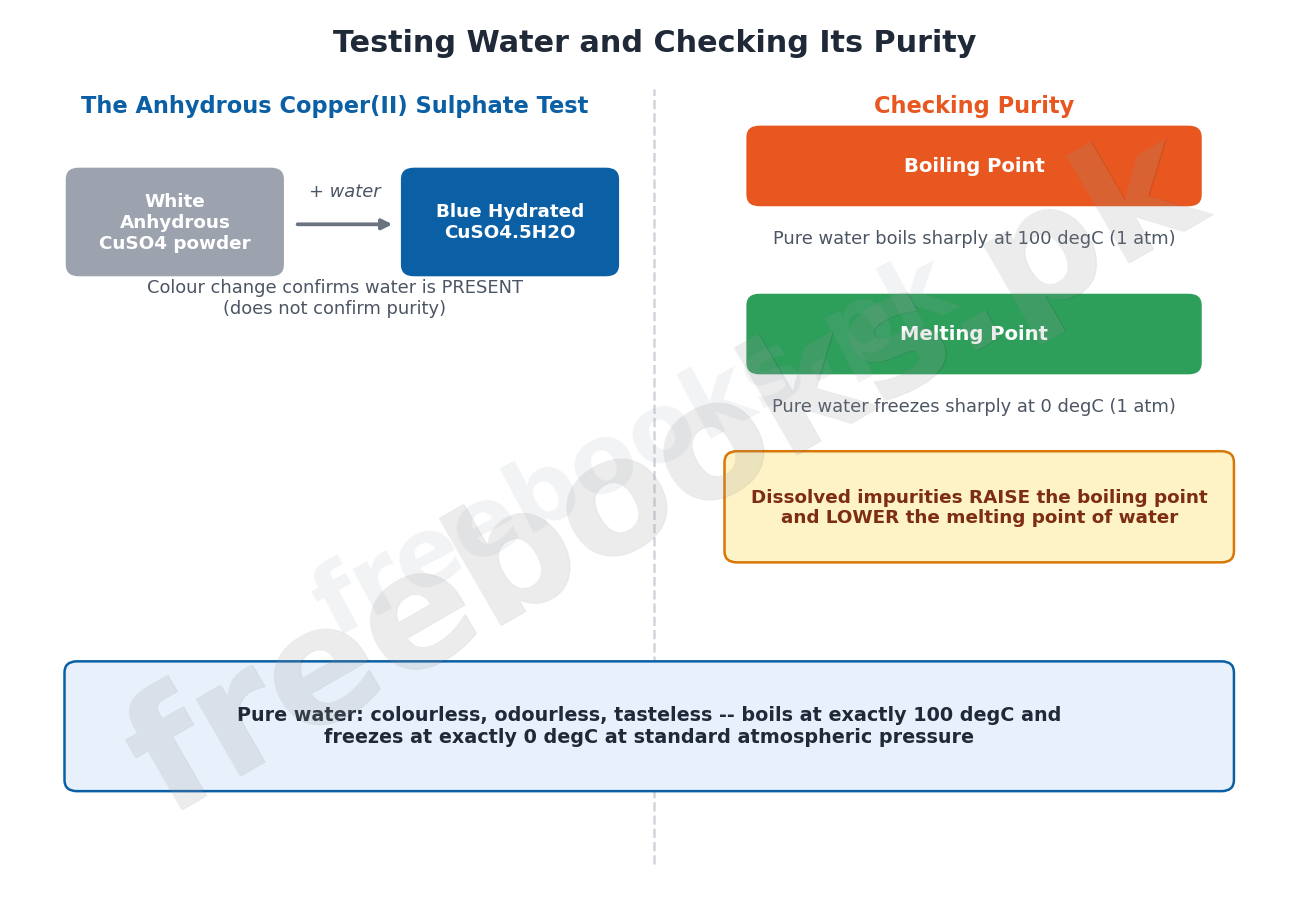
Identifying the presence of water is important for determining the purity of substances and for the food and pharmaceutical industries. Hydrated copper(II) sulphate (CuSO4.5H2O) is blue, but on heating it loses its water of crystallization to become white anhydrous copper(II) sulphate; a drop of water added to the white anhydrous solid turns it blue again: CuSO4 + 5H2O <=> CuSO4.5H2O. This is a very sensitive test that can detect even a small amount of water.
Pure water boils at exactly 100 degC and freezes (melts) at exactly 0 degC under standard conditions; the presence of impurities changes both these physical constants — raising the boiling point slightly and lowering the melting/freezing point. So a sample's purity can be checked by measuring its boiling point at STP (100 degC confirms purity) or by cooling it, freezing it, and recording the temperature at which the ice begins to melt (0 degC confirms purity; a lower melting point suggests impurities). Both constants are specific to standard pressure and will shift at high altitude or lower pressure.
20.2 Distilled Water versus Tap Water
Tap water is supplied to homes and offices from rivers, lakes, ponds or underground sources; it typically contains dissolved minerals such as calcium and magnesium salts (depending on its source), along with chlorine and fluoride added during treatment. Because it contains free ions from these dissolved minerals, tap water conducts electricity, and its pH typically ranges from 6.5 to 8.5 depending on its source.
Distilled water is produced by distillation: heating water to produce steam, then condensing that steam back into liquid, which removes dissolved minerals, microorganisms and other contaminants, leaving only pure water molecules. Its purity makes it ideal for laboratories, medical procedures and the pharmaceutical industry, ensuring accurate measurements, safe sterilization and reduced corrosion. Distilled water has a pH of 7 and, lacking dissolved ions, is a poor conductor of electricity; it is safe to drink but lacks the minerals the body normally obtains from water.
20.3 Substances Present in Water from Natural Sources
Water from rivers, lakes and aquifers contains substances that may be useful or harmful. Dissolved oxygen enters water by diffusion from the atmosphere and from photosynthesis by aquatic plants and algae; it is essential for aquatic organisms to breathe, and the health of an ecosystem depends directly on how much dissolved oxygen its water contains.
Harmful substances include microbes (bacteria, viruses and parasites entering through human and animal waste, landfills, agricultural runoff and industrial wastewater, causing diseases such as dysentery, typhoid, hepatitis and cholera); heavy metals such as lead, mercury, cadmium and chromium (entering through industrial wastewater, mining and the use of fertilizers and pesticides, damaging the liver and kidneys, causing neurological problems, and in the case of arsenic and cadmium, increasing cancer risk); and microplastics (entering through wastewater and rainwater carrying plastic debris, found even in some human organs, and able to disturb the immune and reproductive systems).
Nitrates and phosphates enter natural water both naturally (weathering of rocks) and from human sources (fertilizers, detergents, industrial wastewater); while essential nutrients in small amounts, excess nitrogen and phosphorus trigger eutrophication — excessive growth of algae and aquatic plants that, as it decays, lowers the water's dissolved oxygen level, harming aquatic life and disrupting the whole ecosystem.
20.4 Treatment of Domestic Water Supply
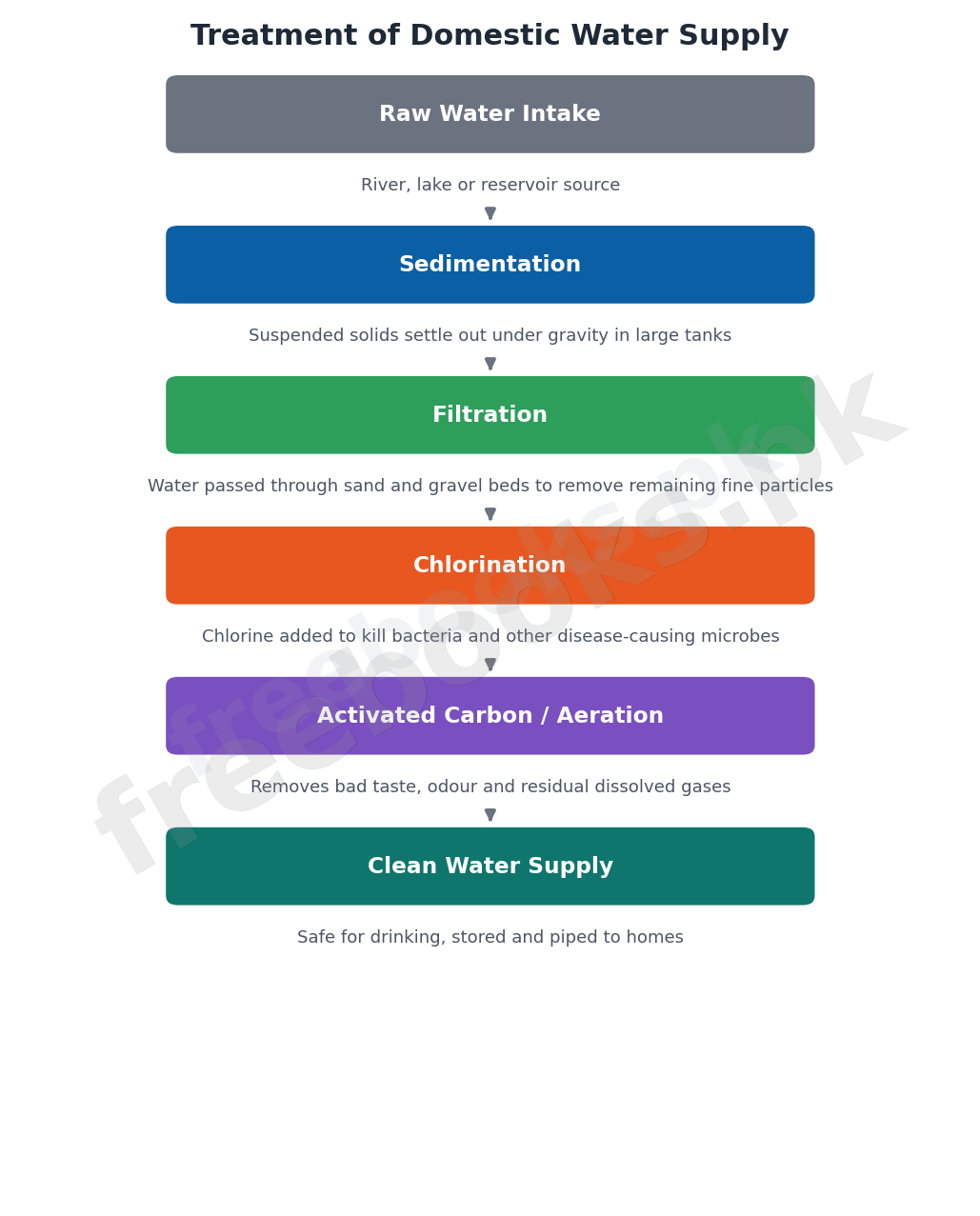
Natural water contains dissolved impurities, suspended impurities and microorganisms, which are removed by a combination of sedimentation, filtration, chlorination and other methods. Sedimentation removes larger insoluble impurities (soil, plant matter, sand): water is pumped into sedimentation tanks and left to stand for a few hours, allowing suspended particles to settle to the bottom by gravity while cleaner water is drawn off the top.
Filtration removes smaller suspended particles not caught by sedimentation, by trickling water through layers of sand and gravel that trap the particles. Chlorination sterilizes the water by adding a small amount of liquid chlorine, which kills harmful bacteria and other microbes. Finally, water is often passed through powdered activated carbon (charcoal) to remove tastes and odours by absorbing a wide range of organic compounds, and odours can also be reduced by aeration — exposing the water to air.
20.5 Water Pollution, Water-Borne Diseases and Water Scarcity in Pakistan
Water pollution affects human health, ecosystems, aquatic organisms and industries; pollutants can disrupt aquatic ecosystems through eutrophication and habitat destruction, and can lower crop yields and contaminate food. Its negative effects can be controlled by treating sewage and industrial wastewater before discharge, reusing and recycling plastics, never pouring chemical cleaners, fats, oils or grease down drains, minimizing pesticide and fertilizer use, raising public awareness through campaigns, and enforcing water-pollution laws strictly.
The World Health Organization estimates that 80% of the world's sickness and disease is caused by polluted water and poor sanitation, with about 500 million people affected by water-borne diseases every year, including cholera, typhoid, malaria, trachoma (a leading cause of blindness, especially in children in developing countries) and viral hepatitis. These diseases can largely be prevented by drinking clean water that has been purified and boiled, and by practising good hygiene and using proper sanitation facilities.
Pakistan lies in a semi-arid region with low annual rainfall — northern Pakistan (including Punjab) typically receives 250-600 mm per year, mostly during the monsoon, while southern Pakistan receives less than 200 mm per year. Combined with a growing population, flood irrigation, climate change, depleting aquifers and poor water management, this has created a severe water scarcity crisis; the situation can be addressed by building reservoirs and storage facilities to collect monsoon rainwater, adopting more efficient crop irrigation techniques, taking measures against climate change impacts, and managing water resources more effectively.
20.6 Plant Nutrients and Fertilizers
Plants need nutrients from the soil for healthy growth, classified as micro-nutrients (trace elements needed in tiny amounts, such as boron, copper, iron, manganese, zinc, molybdenum and chlorine, typically 6-200 grams per acre — too much can be poisonous) and macro-nutrients (needed in larger amounts, such as nitrogen, phosphorus, potassium, calcium, magnesium, sulphur, carbon, hydrogen and oxygen, typically 5-200 kg per acre).
Fertilizers are substances added to soil to make up deficiencies of essential elements, especially nitrogen, phosphorus and potassium (NPK). A good fertilizer must supply its nutrient elements in a water-soluble, readily available form; be stable in soil and storage (not absorbing moisture or hardening); be inexpensive; not harm plants; and not alter soil pH. Fertilizers are classified as nitrogenous, phosphatic or potassium fertilizers, according to which of these three main nutrients they supply.
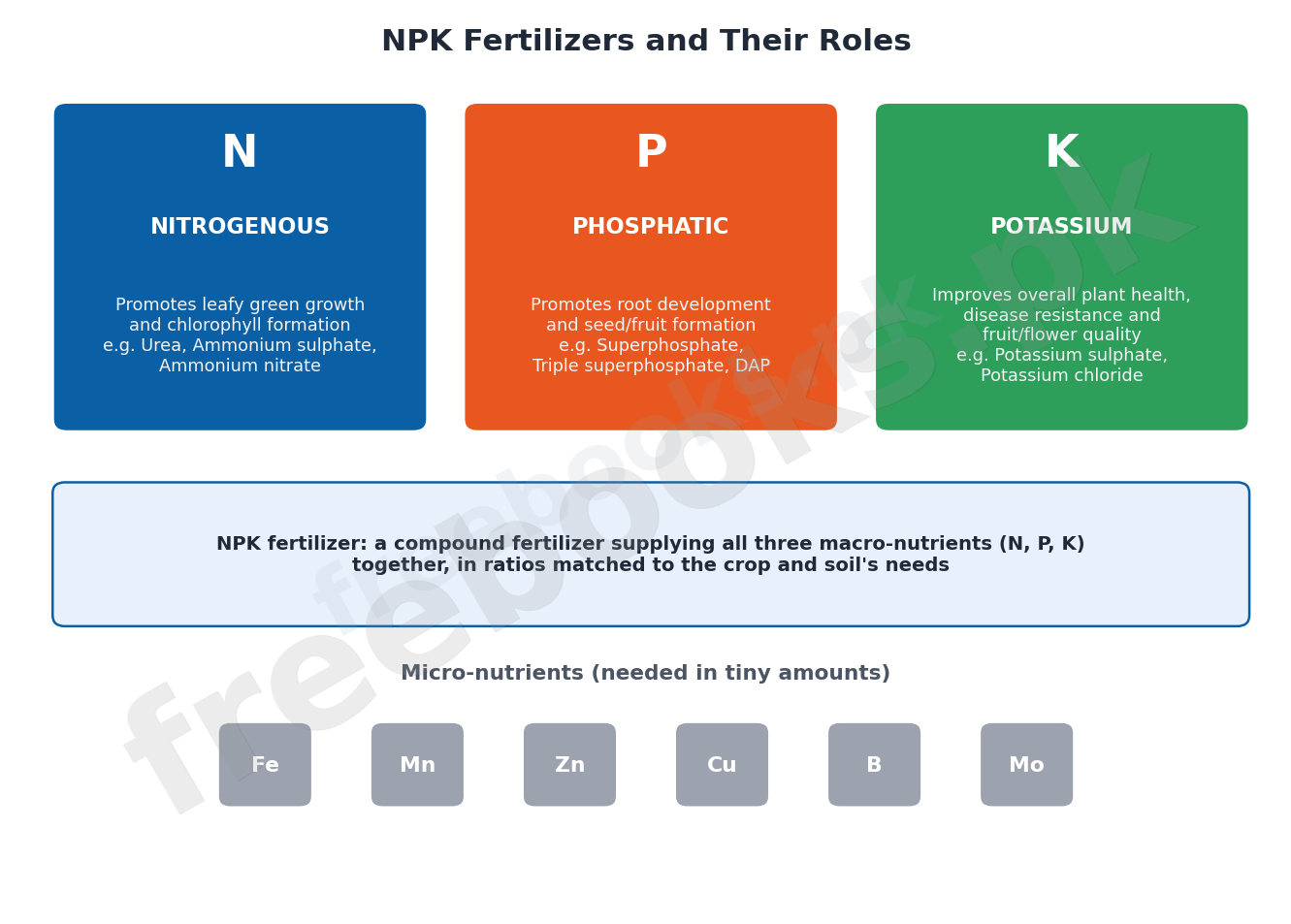
Nitrogenous fertilizers (such as ammonium sulphate, ammonium nitrate and urea) supply nitrogen, needed early in plant growth for stem and leaf development, as the main constituent of proteins, and for green colour and yield; urea is the most concentrated solid nitrogen fertilizer (about 46% nitrogen) and the most widely used in Pakistan, while ammonium nitrate, though hygroscopic, is unsuitable for paddy rice because flooded-field bacteria decompose it to nitrogen gas. Phosphatic fertilizers (such as superphosphate and diammonium phosphate) supply phosphorus, which stimulates early growth, accelerates seed and fruit formation, and increases disease resistance. Potassium fertilizers (such as potassium chloride, potassium sulphate and potassium nitrate) supply potassium, needed for starch and sugar formation, healthy root development, disease resistance and the ripening of seeds and fruit — especially valuable for tobacco, coffee, potato and corn.
Important Definitions
Define the water test using copper(II) sulphate.
A sensitive chemical test in which a drop of water turns white anhydrous copper(II) sulphate blue, as it re-forms hydrated CuSO4.5H2O: CuSO4 + 5H2O <=> CuSO4.5H2O.
Define pure water (in terms of physical constants).
Water that boils at exactly 100 degC and freezes/melts at exactly 0 degC under standard conditions of temperature and pressure, with no dissolved impurities to shift these values.
Define distilled water.
Water purified by distillation (boiling to steam, then condensing), which removes dissolved minerals, microorganisms and contaminants, leaving pure water with a pH of 7 and no ability to conduct electricity.
Define tap water.
Water supplied to homes and offices from rivers, lakes, ponds or underground sources, typically containing dissolved minerals, chlorine and fluoride, with a pH of 6.5 to 8.5 and able to conduct electricity due to dissolved ions.
Define dissolved oxygen (in natural water).
Oxygen present in water from atmospheric diffusion and aquatic photosynthesis, used by aquatic organisms to breathe; its level directly affects the health of the ecosystem.
Define eutrophication.
A process in which excess nitrogen and phosphorus nutrients cause excessive growth of algae and aquatic plants in a water body, which lowers dissolved oxygen levels as the overgrowth decays, harming aquatic life.
Define sedimentation (in water treatment).
A water-treatment process in which water is left to stand in tanks so that larger suspended particles settle to the bottom under gravity, leaving cleaner water at the top.
Define filtration (in water treatment).
A water-treatment process in which water is passed through layers of sand and gravel to trap and remove smaller suspended particles not removed by sedimentation.
Define chlorination.
The addition of a small amount of liquid chlorine to water to kill harmful bacteria and other microbes, sterilizing it for safe use.
Define a water-borne disease.
A disease, such as cholera, typhoid or hepatitis, caused by consuming water contaminated with harmful microbes or pollutants.
Define water scarcity.
A shortage of adequate freshwater resources to meet a region's demand, caused in Pakistan's case by low rainfall, population growth, flood irrigation, climate change and poor water management.
Define a micro-nutrient (for plants).
An element, such as boron, copper, iron, manganese, zinc, molybdenum or chlorine, needed by plants only in very small amounts, with excess amounts potentially toxic.
Define a macro-nutrient (for plants).
An element, such as nitrogen, phosphorus, potassium, calcium, magnesium or sulphur, needed by plants in relatively large amounts for healthy growth.
Define a fertilizer.
A substance added to soil to make up deficiencies of essential elements, especially nitrogen, phosphorus and potassium, needed for healthy plant growth.
Define an NPK fertilizer.
A fertilizer, or a classification of fertilizers, that supplies nitrogen (N), phosphorus (P) and/or potassium (K), the three main nutrient elements plants need in the largest amounts.
Define a nitrogenous fertilizer.
A fertilizer, such as urea or ammonium nitrate, that supplies nitrogen to plants for stem and leaf development, protein formation and improved yield.
Key Facts & Relations
| Topic | Relation |
|---|---|
| Water test reaction | CuSO4 (white) + 5H2O <=> CuSO4.5H2O (blue) |
| Pure water boiling point (STP) | 100 degC (impurities raise it slightly) |
| Pure water melting/freezing point (STP) | 0 degC (impurities lower it) |
| Distilled water pH | 7 (neutral; poor conductor, no dissolved ions) |
| Tap water pH range | 6.5 – 8.5 (conducts electricity; contains dissolved minerals) |
| Urea nitrogen content | About 46% nitrogen; most concentrated solid N fertilizer |
| Superphosphate formula | Ca(H2PO4)2 |
| Diammonium phosphate formula | (NH4)2HPO4 |
Diagrams
Testing Water and Checking Its Purity: A diagram of the anhydrous copper(II) sulphate colour-change test for water (white to blue), alongside the boiling-point and melting-point checks used to confirm a water sample's purity.
Domestic Water Treatment Process: A flow diagram of domestic water treatment: raw water through sedimentation, filtration, chlorination and activated-carbon odour removal to produce clean, safe water.
NPK Fertilizers and Their Roles: A summary chart of the three main fertilizer types — nitrogenous, phosphatic and potassium — showing the nutrient each supplies, its role in plant growth, and common examples.
Short Questions & Answers
Name two methods to check the purity of water.
Measuring its boiling point (pure water boils at exactly 100 degC) and measuring its melting/freezing point (pure water freezes at exactly 0 degC); impurities raise the boiling point and lower the melting point.
What is the main difference between tap water and distilled water?
Tap water contains dissolved minerals, chlorine and fluoride and conducts electricity due to free ions, while distilled water has been purified by distillation to remove all dissolved substances, has a neutral pH of 7, and does not conduct electricity.
How is water distilled in the laboratory?
By heating the water sample to boiling so that it turns to steam, then cooling and condensing that steam back into liquid water in a separate container, leaving dissolved minerals and other impurities behind.
Name one useful and one harmful substance present in natural water.
Dissolved oxygen is useful, since aquatic organisms need it to survive; heavy metals such as lead or mercury are harmful, since they can damage organs and cause neurological problems or cancer.
How would you remove harmful bacteria and other microbes present in water?
By chlorination — adding a small amount of liquid chlorine to the water, which kills the harmful bacteria and other microbes present.
What is the difference between sedimentation and filtration?
Sedimentation removes larger suspended particles by letting them settle to the bottom of a tank under gravity, while filtration removes smaller suspended particles by passing water through layers of sand and gravel that trap them.
Name any three water-borne diseases.
Cholera, typhoid and hepatitis are common water-borne diseases (other accepted examples include dysentery, malaria and trachoma).
Why are fertilizers containing nitrogen added to the soil?
Because nitrogen is essential for the early development of a plant's stem and leaves, is a main constituent of proteins, gives leaves their green colour, and improves the yield and quality of the crop.
What is trachoma?
A water-borne eye disease that is a leading cause of blindness, particularly prevalent among babies and children in developing countries with poor water quality and sanitation.
Why is urea regarded as a good nitrogenous fertilizer?
Because it contains about 46% nitrogen, making it the most concentrated solid nitrogen fertilizer available, and it is relatively cheap and widely used, which is why it is the most common nitrogen fertilizer used in Pakistan.
Long Questions & Answers
Describe how a domestic water supply can be made fit for drinking.
How are larger suspended impurities first removed from natural water?
Water pumped from a natural source is left to stand in sedimentation tanks for a few hours, during which larger insoluble particles such as soil, sand and plant matter settle to the bottom under gravity, and the cleaner water at the top is drawn off for the next stage.
How are smaller suspended particles removed?
The water is passed through filtration beds of sand and gravel, which trap the finer suspended particles that sedimentation alone could not remove, producing visually clear water.
How are harmful microbes killed?
A small, carefully controlled amount of liquid chlorine is added to the filtered water; chlorine kills harmful bacteria, viruses and other microbes, sterilizing the water so it is safe to drink.
How are unwanted tastes and odours removed?
The water is passed through powdered activated carbon (charcoal), which absorbs a wide range of organic compounds responsible for taste and odour; aeration (exposing the water to air) can also help remove odours before the water is distributed for domestic use.
Explain the three main classes of NPK fertilizers and the role each plays in plant growth.
What role does nitrogen play, and which fertilizers supply it?
Nitrogen is needed early in a plant's growth for stem and leaf development, is a key constituent of proteins, gives leaves their green colour and improves yield and quality; nitrogenous fertilizers that supply it include urea (about 46% nitrogen, the most concentrated solid form) and ammonium nitrate (unsuitable for paddy rice, since flooded-field bacteria decompose it to nitrogen gas).
What role does phosphorus play, and which fertilizers supply it?
Phosphorus stimulates early plant growth and accelerates seed and fruit formation in later growth stages, while also increasing disease resistance; phosphatic fertilizers that supply it include superphosphate, Ca(H2PO4)2, and diammonium phosphate, (NH4)2HPO4, both of which are water-soluble.
What role does potassium play, and which fertilizers supply it?
Potassium is needed for forming starch, sugar and fibrous plant material, increases disease resistance, supports healthy root development, and helps ripen seeds, fruit and cereals; potassium fertilizers that supply it include potassium chloride, potassium sulphate and potassium nitrate, and are especially valuable for crops like tobacco, coffee, potato and corn.
What must be true of any compound for it to be used as a good fertilizer, regardless of which nutrient it supplies?
It must supply its nutrient in a water-soluble form that plants can readily absorb, be stable in both soil and storage (not absorbing moisture or hardening over time), be inexpensive to manufacture, not harm the plants it is applied to, and not significantly alter the pH of the soil.
Multiple Choice Questions (MCQs)
The pH of distilled water is: (A) 6.5 (B) 8.5 (C) 7 (D) 7.5
Correct answer: (C) 7. Distilled water is neutral, with a pH of exactly 7, since it contains no dissolved ions or minerals to shift it acidic or alkaline.
The unpleasant odours in water can be removed by: (A) Adding chlorine (B) Treating it with activated charcoal (C) Sedimentation (D) Filtration
Correct answer: (B) Treating it with activated charcoal. Activated charcoal (powdered activated carbon) absorbs the organic compounds responsible for tastes and odours in water; chlorine, sedimentation and filtration serve other purposes.
A major source of harmful microbes in natural water is: (A) Human and animal wastes (B) Fertilizers used for crops (C) Industrial waste-water only (D) Microbes in rocks
Correct answer: (A) Human and animal wastes. Human and animal wastes, along with sewage and agricultural runoff, are major sources of the bacteria, viruses and parasites that contaminate natural water.
Which gases dissolve in natural water from the atmosphere through diffusion? (A) O2 and CO2 (B) N2 and CO2 (C) O2 and N2 (D) O2, N2 and CO2
Correct answer: (D) O2, N2 and CO2. Oxygen, nitrogen and carbon dioxide from the atmosphere all dissolve into natural water through diffusion, though oxygen is the most important for aquatic life.
The fertilizer that is harmful to paddy rice is: (A) Superphosphate (B) Ammonium nitrate (C) Urea (D) Potassium sulphate
Correct answer: (B) Ammonium nitrate. Ammonium nitrate is unsuitable for paddy rice because the microbial bacteria present in flooded fields decompose it into nitrogen gas, wasting the nutrient.
Fertilizers that increase disease resistance and promote healthy root development are mainly: (A) Nitrogenous fertilizers (B) Phosphatic fertilizers (C) Potassium fertilizers (D) Magnesium fertilizers
Correct answer: (C) Potassium fertilizers. Potassium fertilizers strengthen plants by supporting healthy root development and increasing resistance to disease, in addition to helping ripen fruit and seeds.
Water that boils exactly at 100 degC and freezes exactly at 0 degC under standard conditions is: (A) Definitely tap water (B) Definitely distilled water (C) Pure water (D) Water containing dissolved salts
Correct answer: (C) Pure water. These exact boiling and freezing points at STP indicate pure water with no dissolved impurities, regardless of its original source.
Excess nitrates and phosphates in natural water mainly cause: (A) Increased dissolved oxygen (B) Eutrophication and reduced dissolved oxygen (C) Higher water pH permanently (D) Immediate loss of all aquatic life
Correct answer: (B) Eutrophication and reduced dissolved oxygen. Excess nitrates and phosphates trigger eutrophication — excessive algal growth that, as it decays, lowers dissolved oxygen levels and harms aquatic ecosystems.
Quick Revision Summary
- The CuSO4 water test: white anhydrous CuSO4 turns blue on contact with water (forming CuSO4.5H2O) — a very sensitive test.
- Pure water: boils at 100 degC, freezes at 0 degC (STP); impurities raise the boiling point and lower the freezing point.
- Tap water: contains dissolved minerals, chlorine, fluoride; conducts electricity; pH 6.5-8.5. Distilled water: pure, pH 7, does not conduct electricity.
- Natural water contains useful substances (dissolved oxygen) and harmful ones (microbes, heavy metals, microplastics, excess nitrates/phosphates causing eutrophication).
- Domestic water treatment: sedimentation (large particles) -> filtration (smaller particles) -> chlorination (kills microbes) -> activated carbon/aeration (removes taste/odour).
- Water-borne diseases (cholera, typhoid, hepatitis, trachoma) cause about 80% of world sickness (WHO estimate); prevented by clean water, boiling, hygiene, sanitation.
- Pakistan faces severe water scarcity (semi-arid climate, low rainfall, population growth, poor management); addressed by reservoirs, better irrigation, and improved water management.
- NPK fertilizers: Nitrogenous (urea, ammonium nitrate) for stems/leaves/protein; Phosphatic (superphosphate, diammonium phosphate) for early growth/seed formation; Potassium (potassium chloride/sulphate/nitrate) for roots/disease resistance/ripening.
Exam Tips
- For the CuSO4 water test, always state the colour change direction correctly: white (anhydrous) to blue (hydrated) confirms water is present — the reverse (blue to white) happens on heating, removing water.
- Remember both purity tests together: boiling point rises above 100 degC with impurities; melting/freezing point falls below 0 degC with impurities — opposite directions.
- For tap-vs-distilled questions, connect conductivity directly to ions: tap water conducts because it has dissolved ions, distilled water doesn't conduct because it has none.
- Learn the domestic water treatment sequence in order: sedimentation -> filtration -> chlorination -> carbon/aeration for odour — exam questions often ask for the correct order.
- For fertilizer questions, always match nutrient to its main plant function: N = leaves/stems/protein, P = early growth/seeds/fruit, K = roots/disease resistance/ripening.
- For water-scarcity-in-Pakistan questions, mention BOTH the natural cause (low/semi-arid rainfall) and the human causes (population growth, poor water management, flood irrigation) for a complete answer.