
This unit presents 'The Pearl,' a short novel by John Steinbeck, told as a parable about Kino, a poor Mexican pearl-diving fisherman, his wife Juana, and their baby Coyotito, and how the discovery of an extraordinary pearl brings hope, greed, violence, and tragedy into their lives.
The story unfolds across six chapters: it begins with a scorpion sting that sends the family to a prejudiced doctor, follows Kino's discovery of the 'Pearl of the World,' traces the town's growing greed and the family's mounting persecution, and ends with a desperate flight into the mountains and Kino's final rejection of the pearl.
These notes summarise the novel chapter by chapter as given in the textbook and provide the author's background, theme, glossary, and exam-oriented material for this unit, since Unit 13 alone carries the largest weightage in the Section-I short-question paper (any 7 out of 11 questions) among all English 12 units.
Learning Objectives
- Speak confidently and fluently in a wide range of contexts (conflict resolution, panel discussion, role-play, dialogue) to fulfil different purposes such as exposition and argumentation.
- Analyse descriptive, argumentative, and persuasive essays.
- Analyse applications, letters, reports, summaries, biographies, autobiographies, and reviews.
- Evaluate different points of view (first-person, third-person narrative) and examine an author's point of view or purpose in a text.
- Gather relevant information from multiple authentic resources, following research ethics, to write and present an assignment.
- Write a book review.
Key Concepts
About the Author
John Steinbeck (1902-1968), the 1962 Nobel Laureate in Literature, is regarded as one of the towering figures of 20th-century American literature. Raised in the Salinas Valley of California, a landscape that became the backdrop for much of his fiction, Steinbeck wrote with deep sensitivity about the land and its people.
His body of work ranges widely, from the picaresque comedy of Tortilla Flat to the mythic allegory of The Pearl and the unflinching social realism of his masterpiece, The Grapes of Wrath. His close friendship with marine biologist Ed Ricketts gave his writing a strong ecological awareness of humanity's link to the natural world, and his fiction is remembered for bringing the struggles of the dispossessed and the migrant worker into sharp focus, while probing deeper questions of fate, identity, and human consciousness.
Chapter 1: The Scorpion and the Doctor
The story opens with Kino waking at dawn in his brush house, listening to the peaceful 'Song of the Family' as his wife Juana and baby Coyotito begin their morning. This calm is shattered when a scorpion creeps down the rope to Coyotito's hanging box; Kino kills it, but not before it stings the baby.
Juana insists they take Coyotito to the town doctor. The doctor, who belongs to the colonising race that has long exploited Kino's people, refuses to treat a poor family without payment. Kino offers his only wealth, a few small, misshapen seed pearls, but the doctor lies about being called away rather than treat them. Humiliated and enraged, Kino strikes the doctor's gate with his fist, splitting his knuckles.
Chapter 2: The Pearl of the World
The chapter opens with a description of the town, the estuary, and the fishing people's canoes, before Kino and Juana paddle out to the oyster beds. Juana treats Coyotito's swollen shoulder with a seaweed poultice while Kino dives for oysters.
Kino finds an unusually large oyster lying apart from the rest. Back in the canoe, he prises it open and discovers an enormous, flawless pearl, 'as large as a sea-gull's egg' — the greatest pearl anyone has seen. At the very same moment, Juana notices that the swelling in Coyotito's shoulder has begun to recede. Overwhelmed with emotion, Kino throws back his head and howls in triumph.
Chapter 3: The Town's Greed Awakens
News of the pearl spreads through the town almost instantly, reaching the priest, the doctor, the shopkeepers, the beggars, and the pearl buyers, each of whom begins scheming how to profit from Kino's fortune. That evening, as neighbours crowd into his house, Kino dreams aloud of a church wedding, new clothes, a rifle, and above all an education for Coyotito, declaring, 'My son will go to school… these things will make us free.'
The priest visits and blesses the family while hinting at donations for the church. The doctor, now aware of the pearl, arrives and deceives Kino into letting him treat Coyotito with a capsule that deliberately worsens the baby's condition, so that the doctor can then 'cure' the crisis he created and demand payment. That night, an intruder tries to steal the buried pearl in the dark; Kino fights him off but is wounded. A shaken Juana begs Kino to destroy the pearl, calling it 'evil' and 'like a sin,' but Kino refuses, insisting it is their only chance to secure Coyotito's future.
Chapter 4: The Pearl Buyers' Deception
The whole town gathers to watch as Kino takes his pearl to be sold. The pearl buyers, who secretly work for a single patron under the appearance of competition, conspire to cheat him: one dealer calls the pearl 'a curiosity' and offers only a thousand pesos, another dismisses it as 'fool's gold,' and a third claims it is 'soft and chalky' and worthless.
Furious at being cheated, Kino refuses every offer and declares he will take the pearl to the capital to sell it himself, defying the entire local trading system. His brother, Juan Tomas, warns him that he has defied not merely the pearl buyers but 'the whole structure, the whole way of life,' and fears for his safety. That night, Kino is attacked in the dark outside his house.
Chapter 5: Betrayal, Violence, and Flight
Before dawn, Kino wakes to find Juana secretly trying to throw the pearl into the sea to save the family from further harm. He catches her, strikes her, and takes the pearl back. On his way home he is attacked again and kills a man in self-defence.
Returning to his house, Kino finds his canoe deliberately smashed and his brush house burned to the ground — the two things he valued most after his family. With everything destroyed and a dead man on his conscience, the family takes refuge with Juan Tomas, who hides them for a day, gathers supplies, and helps them prepare to flee north under cover of night.
Chapter 6: Pursuit and the Rejection of the Pearl
Kino and Juana flee on foot toward the mountains, hoping to escape north. Kino soon notices they are being followed by two trackers on foot and a horseman carrying a rifle. The family hides in a small cave near a mountain spring, but the trackers draw steadily closer.
Realising he must fight or be caught, Kino creeps down at night to attack the trackers while they sleep. Just as he leaps to attack, a rifle shot rings out, and Kino discovers to his horror that the shot has killed Coyotito, hidden with Juana in the cave. In a desperate, brutal struggle, Kino kills all three men.
The grieving family returns to La Paz together, walking side by side rather than in the traditional single file, carrying Coyotito's body. At the shore, Kino offers the pearl to Juana, but she tells him, 'No, you.' Kino hurls the great pearl with all his strength back into the sea, and it sinks beneath the water as its haunting 'music' fades into silence forever.
Theme
John Steinbeck's The Pearl is a parable exploring how the pursuit of sudden wealth can corrupt human relationships and consciousness. At its heart is Kino's tragic transformation: the pearl, meant to bring his family security and opportunity, instead isolates him from his community, turns a peaceful fisherman into a killer, and estranges him from his own humanity.
The novel exposes how every human value in the town becomes reduced to money: the doctor refuses to treat a sick child without payment, the pearl buyers collude to cheat a poor fisherman, and even Kino comes to see the pearl as an extension of his own pride. In its devastating conclusion, when Kino throws the pearl back into the sea, Steinbeck offers not triumph but sorrowful wisdom — that some possessions cost more than they are worth, and that greed, once awakened, can destroy the very things it promised to protect.
Important Definitions (Glossary)
avarice
extreme greed for wealth or material gain
bulwark
a defensive or protective wall; a source of protection against harm
consolation
comfort received after a loss or disappointment
contemptuous
showing scorn or disdain
cozened
cheated, deceived, or tricked
detachment
a state of being aloof or lacking emotional involvement
dissembling
hiding one's true motives or feelings; lying or misleading
edifice
a large, imposing, or elaborate building or structure
estuary
the wide part of a river where the current meets the sea tides
furtive
secretive; done in a quiet and sneaky way to avoid notice
gloating
dwelling on one's own success or another's misfortune with smugness
incandescence
light emitted from a hot object; a high degree of brilliance
indigent
poor; needy; impoverished
judicious
having or showing good judgment; sensible and wise
malignant
dangerous and harmful; showing great ill will; deadly
parable
a simple story used to illustrate a moral or spiritual lesson
Key Facts
| Item | Detail |
|---|---|
| Author | John Steinbeck (1902-1968), 1962 Nobel Laureate in Literature |
| Main characters | Kino (fisherman), Juana (his wife), Coyotito (their baby son) |
| What stings Coyotito in Chapter 1 | A scorpion |
| Where Kino finds the great pearl | In an unusually large oyster while diving at the oyster bed |
| Nickname given to the pearl | The Pearl of the World |
| Kino's brother who shelters the family | Juan Tomas |
| What Kino loses in the attacks | His canoe (smashed) and his brush house (burned down) |
| How the novel ends | Kino throws the great pearl back into the sea after Coyotito is killed |
| Central theme | How the pursuit of sudden wealth corrupts human relationships and brings tragedy |
Diagram
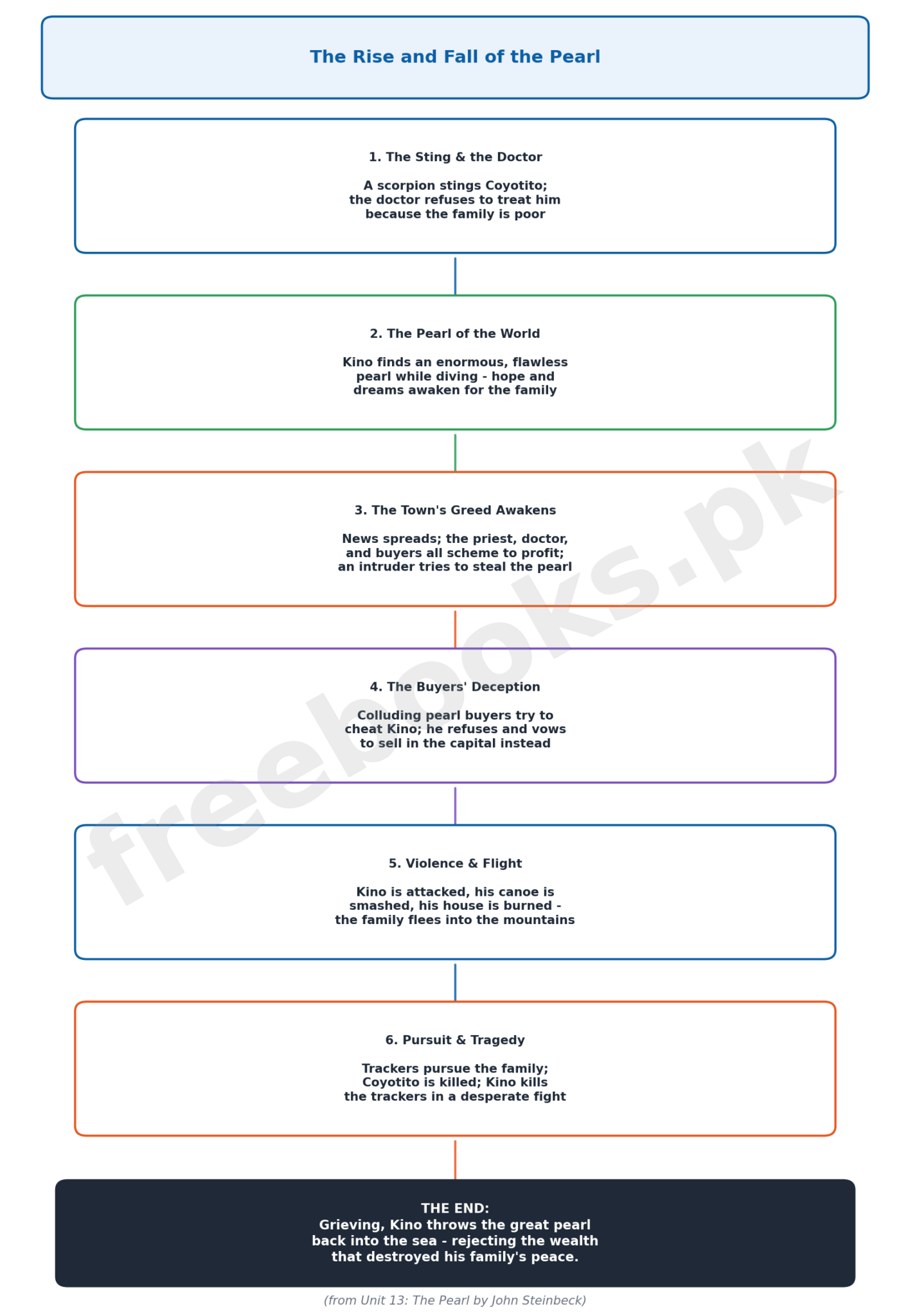
The Rise and Fall of the Pearl: A diagram tracing the pearl's journey through the story: its discovery and the hope it brings, the town's growing greed, the violence and losses the family suffers, and Kino's final rejection of the pearl at the novel's end.
Short Questions & Answers
What is the 'Song of the Family' and what does it represent to Kino?
It is a recurring melody in Kino's mind that represents the safety, warmth, and wholeness of his family life, forming a backdrop to his thoughts throughout the novel.
What happens when the scorpion falls into Coyotito's hanging box?
The scorpion stings the baby on the shoulder before Kino can stop it; Kino kills the scorpion in fury, and Juana sucks the poison from the wound.
Why does the doctor initially refuse to treat Coyotito?
The doctor refuses because Kino's family is poor and cannot pay him, dismissively saying he has better things to do than 'cure insect bites for little Indians.'
Where and how does Kino find the great pearl?
While diving at the oyster bed, Kino finds an unusually large oyster lying apart from the others; when he opens it in the canoe, he discovers an enormous, flawless pearl inside.
What does the town's reaction reveal when news of the pearl spreads?
It reveals widespread greed, as the priest, the doctor, shopkeepers, beggars, and pearl buyers all begin scheming how they might benefit from Kino's sudden fortune.
What future does Kino imagine for Coyotito because of the pearl?
Kino dreams of a church wedding, new clothes, a rifle, and most importantly an education for Coyotito, believing that learning to read and write will make the family free.
How do the pearl buyers try to cheat Kino?
The pearl buyers, who secretly work for one patron, pretend to compete but all undervalue the pearl, calling it a 'curiosity,' 'fool's gold,' and 'soft and chalky,' offering only a fraction of its worth.
What does Juan Tomas warn Kino about after he refuses to sell locally?
Juan Tomas warns that by defying the pearl buyers, Kino has defied 'the whole structure, the whole way of life,' and fears the powerful system will retaliate against him.
What happens to Kino's house and canoe after the second attack?
His canoe, the one thing of value he had inherited from his father, is found deliberately smashed, and his brush house is burned to the ground.
How does the story end for Kino, Juana, and the pearl?
After Coyotito is accidentally killed by the trackers, the grieving family returns to La Paz together, and Kino throws the great pearl back into the sea, where it sinks and disappears.
Long Questions & Answers
Trace how the pearl transforms Kino's family and their relationship with the town, from its discovery to its final rejection.
How does the discovery of the pearl initially bring hope to Kino's family?
The pearl fills Kino with dreams of a better future: a church wedding, new clothes, a rifle, and most importantly an education for Coyotito, which he believes will free the family from poverty and ignorance.
How does the pearl change the town's attitude toward Kino?
Once word spreads, the priest, the doctor, shopkeepers, beggars, and pearl buyers all begin scheming to benefit from the pearl, turning Kino from a respected neighbour into 'every man's enemy.'
What violence and losses does the pursuit of the pearl bring upon the family?
The family suffers repeated attacks, the burning of their house, the destruction of their canoe, forced flight into the mountains, and ultimately the death of their baby son, Coyotito.
Why does Kino finally throw the pearl back into the sea?
After the pearl has cost him his home, his peace, and his son's life, Kino recognises it as the source of his family's ruin and rejects it entirely, choosing to destroy the very dream that destroyed his family.
Discuss the character of Juana and her role throughout the novella.
How does Juana show strength and determination early in the story?
After Coyotito is stung, Juana insists on taking him to the doctor despite knowing the doctor never treats poor families, showing her fierce determination to protect her child.
How does Juana react to the growing danger of the pearl?
As attacks and misfortunes mount, Juana grows increasingly afraid of the pearl, repeatedly urging Kino to destroy it or throw it back into the sea before it destroys the family.
What does Juana's warning about the pearl reveal about her wisdom?
Juana intuitively senses, long before Kino accepts it, that the pearl's promise of wealth is not worth the destruction it brings, showing a clear-eyed practicality that contrasts with Kino's growing obsession.
How does Juana's relationship with Kino change by the end of the story?
By the novel's end, after shared tragedy, Juana walks beside Kino rather than behind him as tradition dictated, symbolising a new equality forged through their common suffering and loss.
Multiple Choice Questions (MCQs)
Why does Kino instinctively sense danger when the doctor is near him? (A) Kino dislikes all authority figures without reason (B) The music warns him only of scorpions (C) The doctor's medicine is genuinely dangerous (D) Kino senses the doctor's exploitative intent toward his people
Correct answer: (D) Kino senses the doctor's exploitative intent toward his people. Kino's rage and fear toward the doctor stem from centuries of his people being exploited by the doctor's race, so he instinctively senses the doctor's exploitative intent.
Why does the doctor give Coyotito a capsule that makes him sick? (A) He accidentally uses the wrong medicine (B) To properly treat the scorpion sting (C) To create a crisis so he can then profit from curing it (D) To punish Kino for his earlier visit
Correct answer: (C) To create a crisis so he can then profit from curing it. The doctor deliberately worsens Coyotito's condition with a harmful capsule so that he can then 'cure' the crisis he created and demand payment.
How does the town change the moment Kino finds the pearl? (A) Every person begins scheming to profit from it (B) The town ignores the news completely (C) The town holds a celebration in Kino's honour (D) The town becomes more peaceful and unified
Correct answer: (A) Every person begins scheming to profit from it. News of the pearl spreads instantly, and the priest, doctor, shopkeepers, beggars, and pearl buyers all begin scheming how they might benefit from Kino's fortune.
Why does Juana call the pearl 'like a sin' early in the story? (A) She wants to keep the pearl for herself (B) The priest told her so in confession (C) She intuitively senses its destructive power (D) She is superstitious without any real reason
Correct answer: (C) She intuitively senses its destructive power. Juana senses early on, through intuition rather than any specific event, that the pearl carries destructive power that will harm the family.
How do the pearl buyers manipulate Kino's understanding of the pearl's value? (A) They refuse to examine it at all (B) They all undervalue it while secretly working for one patron (C) They send him to different buyers daily (D) They openly praise the pearl's beauty and value
Correct answer: (B) They all undervalue it while secretly working for one patron. Although appearing to compete, the pearl buyers secretly work for a single patron and collude to undervalue the pearl, calling it a curiosity or fool's gold.
Why does Kino refuse to sell the pearl to the local buyers? (A) He wants to keep the pearl forever without selling it (B) He refuses to be cheated and decides to sell it in the capital instead (C) He is too afraid to travel anywhere (D) Juana convinces him to keep it at home
Correct answer: (B) He refuses to be cheated and decides to sell it in the capital instead. Furious at being cheated by the colluding local buyers, Kino refuses their offers and declares he will take the pearl to the capital to sell it himself.
How does Juan Tomas's warning about the 'whole structure' function in the story? (A) It reveals Juan Tomas's cowardice (B) It foreshadows the system turning against Kino (C) It convinces Kino to sell the pearl locally (D) It encourages Kino to fight the buyers immediately
Correct answer: (B) It foreshadows the system turning against Kino. Juan Tomas warns that Kino has defied not just the pearl buyers but the entire established system, foreshadowing the violence and persecution that follows.
Why does Kino strike Juana when she tries to throw the pearl into the sea? (A) She stole the pearl without his permission (B) The pearl has corrupted his attachment into possessiveness (C) He has always been violent toward her (D) He values the pearl more than his family, without exception
Correct answer: (B) The pearl has corrupted his attachment into possessiveness. By this point the pearl has so consumed Kino that his growing possessiveness over it overrides his usual gentleness, leading him to strike Juana when she tries to get rid of it.
Quick Revision Summary
- 'The Pearl' by John Steinbeck tells the story of Kino, Juana, and their baby Coyotito, and how a great pearl brings both hope and tragedy into their lives.
- Chapter 1: A scorpion stings Coyotito; the town doctor refuses to treat him because the family is poor.
- Chapter 2: Kino finds an enormous pearl, 'the Pearl of the World,' while diving at the oyster bed.
- Chapter 3: News of the pearl spreads, awakening greed throughout the town; the doctor deceives the family, and an intruder tries to steal the pearl.
- Chapter 4: The colluding pearl buyers try to cheat Kino, who refuses their offers and resolves to sell in the capital instead.
- Chapter 5: Kino is attacked, kills a man in self-defence, and finds his canoe smashed and his house burned; the family flees with Juan Tomas's help.
- Chapter 6: Trackers pursue the family into the mountains; Coyotito is accidentally killed, after which Kino kills the trackers and the family returns home in grief.
- The novel ends with Kino throwing the great pearl back into the sea, rejecting the wealth that destroyed his family's peace.
- The central theme is how the pursuit of sudden wealth can corrupt human relationships and bring tragedy upon those who chase it.
Exam Tips
- Learn the six chapters in sequence, since sequencing and 'what happens in which chapter' questions are common in exams.
- Be ready to explain key symbols: the pearl (both hope and corruption), the canoe (heritage and livelihood), and the recurring 'songs' in Kino's mind (intuition and emotion).
- Revise the glossary words with their exact textbook meanings, since Unit 13 alone contributes 4 synonym-based marks in the objective paper.
- Practise writing balanced answers on Juana's character, since foil/contrast questions comparing her to Kino are frequently asked.
- Review the theme carefully, connecting specific incidents (the doctor's refusal, the buyers' collusion, the burned house) to the novel's broader message about greed and wealth.
- For long questions, always support your answer with specific details from the story (names, events, outcomes) rather than general statements alone.