This unit presents 'A Visit to the Swat Valley' by H. P. Stewart, a travelogue describing a spring journey into the Swat Valley through the Malakand Pass, capturing its snow-capped mountains, blossoming fields, clear rivers, ancient Buddhist ruins, and local village life.
The narrative follows the traveller's route from the dramatic crossing of the Malakand Pass through Saidu Sharif, Mingora, Manglaur, and Miandam, describing encounters with Gujar herders, a colourful wedding procession, and scattered remains of old Buddhist monasteries and stupas, before the journey ends in heavy rain.
These notes summarise the travelogue as given in the textbook and provide comprehension questions, vocabulary, and exam-oriented material for this unit, including the skill-based Vocabulary/Grammar (word meanings), Oral Communication (paraphrasing and discussion), and Writing Skills (analytical paragraph and precis writing) sections that accompany it.
Learning Objectives
- Demonstrate attentive listening skills while working in a whole class setting and taking turns to speak with standard pronunciation and intonation.
- Practice precis writing skills.
- Give an informed personal and analytical response to a variety of texts and provide textual references in support.
- Critique how authors distinguish their position from that of others.
- Demonstrate command of the conventions of Standard English capitalization, punctuation, and spelling, including hyphenation conventions, and produce legible, correctly formatted work.
- Develop precis writing skills, and use paraphrasing skills to paraphrase a poem or descriptive passage.
Key Concepts
About the Author
H. P. Stewart is the author of 'A Visit to the Swat Valley,' a travelogue that reflects a deep appreciation for the cultural and natural richness of the region. With a keen eye for detail and a passion for exploration, Stewart brings to life the landscapes, traditions, and people of Swat through vivid and engaging prose.
The writing serves both as a travelogue and as a thoughtful commentary on the historical and social nuances of the area, inviting readers to experience the beauty and complexity of Swat Valley as though journeying alongside the author.
Crossing the Malakand Pass
The journey begins with a dramatic crossing of the Malakand Pass on a clear day after rain, the steep precipices, winding road, and craggy cliffs making the travellers feel as though 'the giant's castle' had to be stormed before entering the 'enchanted land' beyond — a green and pleasant valley.
The Beauty of the Valley in Spring
The valley is described in rich, colourful detail: willows in pale yellow leaf, mustard fields still in bloom, young wheat, red poppies, fresh snow on the hills, and small forts with towers scattered along the road. The author notes that olive trees survive mainly in graveyards, where sharp stones mark the graves at angles suggesting outstretched arms or wings.
The travellers also observe Gujar herders on the road, wild flowers such as nepeta, sophora, and the rare Hazara lily, and Buddhist remains covering the hilltops, giving the impression that 'time had stood still' in this sheltered valley.
Saidu Sharif and the Journey Onward
Saidu Sharif surprises the travellers with its great white mosque and large, comfortable hotel, unlike the stone hillside villages that blend into the landscape. The next day, they follow the opposite bank of the Swat River through Mingora and Manglaur, visiting a large bas-relief statue of Buddha carved into a rock face, and continue on to Miandam, where medlar trees in full bloom create 'a cascade of lacy white' across the valley.
The Wedding Procession and Buddhist Ruins
On the return journey, the travellers encounter a lively wedding procession, with the bride carried in a doli and women in embroidered black garments dancing and clapping alongside. The following day is spent visiting Buddhist ruins scattered across nearly every hilltop, with the author imagining saffron-clad Buddhist monks who once lived in the valley.
The travellers also spend time shopping in the bazaar for Swat blankets, hats, and embroidered items before the weather turns to rain, cutting short a planned excursion to Pir Baba.
The Rainy Departure
As heavy rain sets in, the travellers abandon plans to visit Bahrein and Kalam, and depart the valley the way they came, via Chakdara and the Malakand Pass, passing bedraggled Gujar families walking in the rain with their animals and belongings. The author closes by comparing the brief visit to 'an afternoon's performance at the cinema' with only two of three parts seen, expressing regret at the roads and hills left unexplored.
Theme
The unit evocatively portrays the enchanting beauty and serene tranquillity of the Swat Valley in spring, capturing a landscape of breathtaking contrasts — snow-capped mountains, vibrant fields of blossoms, and crystal-clear rivers set against ancient ruins and cultural richness.
Through vivid imagery, the narrative conveys a sense of awe and timelessness, celebrating the valley's natural splendour, historical depth, and the gentle rhythm of local life, while also acknowledging the fleeting nature of such an idyllic experience — a tribute to a place where nature, history, and human presence harmonise into an unforgettable tapestry of sights, sounds, and emotions.
Important Definitions (Glossary)
bas-relief
a type of sculpture with slightly raised figures on a flat background
bedraggled
messy and wet, typically from being in the rain
cragginess
the quality of being rough, uneven, and full of rocks
doli
a palanquin used to carry a bride
dowry
property or money brought by a bride to her husband at marriage
mistletoe
a parasitic plant that grows on trees
nepeta
a genus of flowering plants, commonly known as catmint
precipices
very steep rock faces or cliffs
saffron-clad
dressed in robes of a bright orange-yellow colour
schist
a type of rock that splits easily into thin layers
sophora
a genus of trees and shrubs with typically yellow flowers
stupa
a Buddhist shrine, typically a dome-shaped structure
terraced
(of land) shaped into a series of flat areas resembling steps
Key Facts
| Item | Detail |
|---|---|
| Author | H. P. Stewart |
| Mountain pass crossed into Swat | The Malakand Pass |
| City that surprised the travellers | Saidu Sharif, with its great white mosque and hotel |
| Notable ancient sight | A large bas-relief statue of Buddha carved into a rock face |
| Loveliest sight near Miandam | Medlar trees in full bloom |
| How the bride travelled in the wedding procession | In a doli (palanquin) |
| What travellers bought in the bazaar | Swat blankets and hats |
| Central theme | The enchanting beauty, timelessness, and fleeting nature of a spring visit to Swat Valley |
Diagram
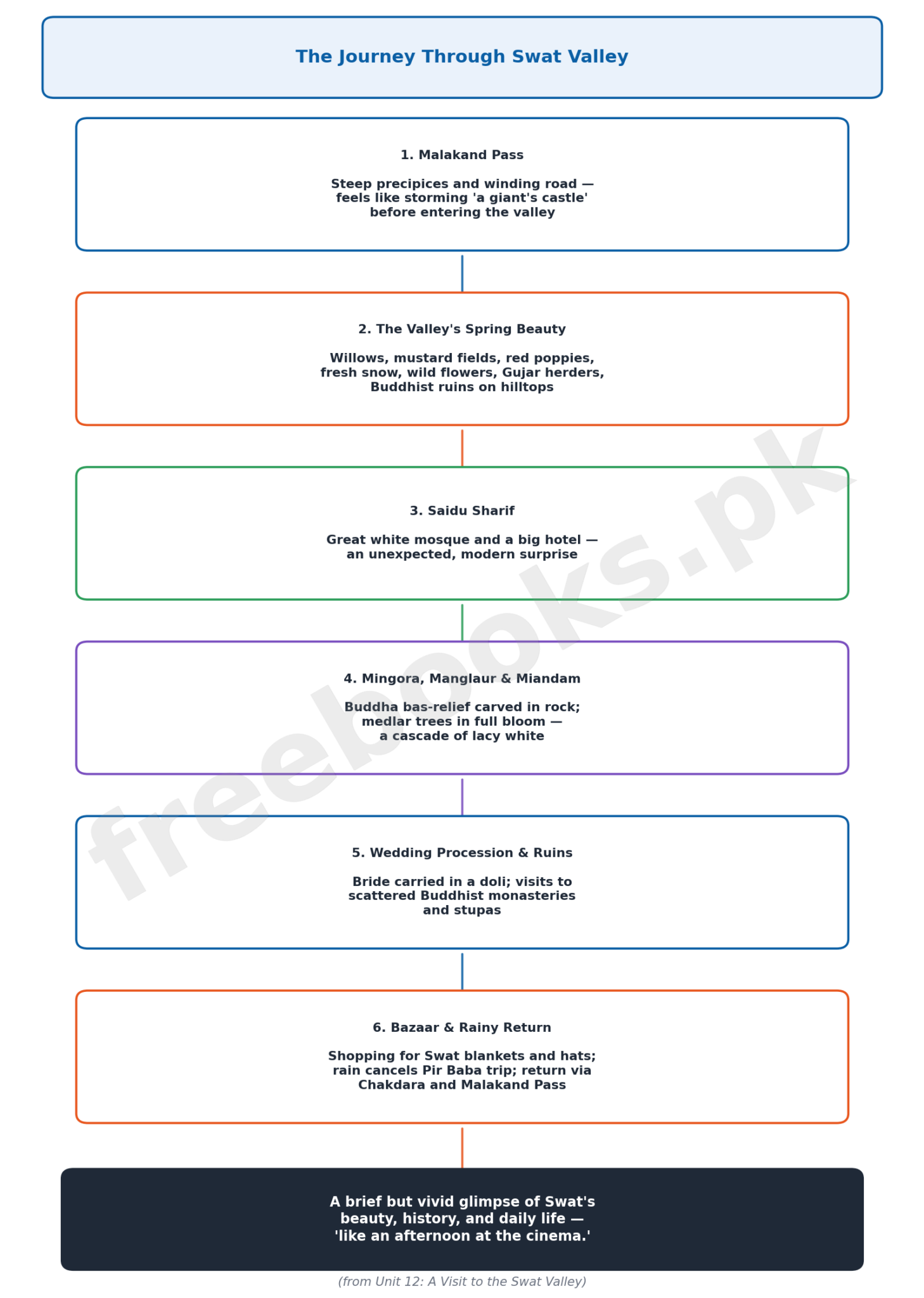
The Journey Through Swat Valley: A diagram showing the traveller's route in sequence: crossing the Malakand Pass, arriving in Saidu Sharif, visiting Mingora and Manglaur, reaching Miandam, encountering the wedding procession and Buddhist ruins, and finally returning through Malakand in the rain.
Short Questions & Answers
What natural setting made the spring scenery of the Swat Valley so beautiful?
The spring scenery was set against snow-capped mountains and a blue river with shining pebbles, framing the young leaves, fruit blossom, and flowers of the fields.
What did the Malakand Pass make the travellers feel as though they had to storm?
The steep, craggy cliffs and winding road made the travellers feel as though they had to storm 'a giant's castle' before entering the enchanted valley beyond.
Where did the author note that groups of olive trees seemed to survive?
The author noted that olive trees survived mainly in the graveyards, where sharp stones marked the graves.
What architectural remains covered the hilltops throughout the valley?
Buddhist monasteries and stupas covered nearly every hilltop, giving the impression that time had stood still in the valley.
What unexpected sight did the travellers encounter in Saidu Sharif?
The travellers were surprised to find a great white mosque and a large, comfortable hotel amid a city that otherwise blended into the stone hillside villages.
What was the 'loveliest sight' on the trip up the valley to Miandam?
The loveliest sight was the medlar trees in full bloom, described as a cascade of lacy white that suddenly filled the valley.
How was the bride transported during the wedding procession the travellers encountered?
The bride was transported in a doli, a palanquin, surrounded by women in embroidered black garments dancing and clapping.
What did the travellers primarily shop for in the bazaar?
The travellers primarily shopped for Swat blankets and hats, along with embroidered scarves and decorative caps.
How did the weather affect the travellers' plans toward the end of their visit?
Heavy rain forced the travellers to abandon their plans to visit Pir Baba, Bahrein, and Kalam, and to leave the valley earlier than intended, retracing their route through the Malakand Pass.
How does the author describe the overall experience of the brief visit at the story's close?
The author compares the visit to 'an afternoon's performance at the cinema' with only two of three parts seen, expressing regret over the roads and hills left unexplored.
Long Questions & Answers
Discuss how H. P. Stewart uses vivid imagery to portray the beauty of the Swat Valley in spring.
How does the author describe the entrance into the valley through the Malakand Pass?
The author describes steep precipices, winding roads, and craggy cliffs that made the crossing feel like storming 'a giant's castle,' building anticipation before revealing the green, pleasant valley beyond.
What specific natural details does the author use to capture the valley's spring beauty?
The author describes willows in pale yellow leaf, mustard fields in bloom, young wheat, red poppies, fresh snow on distant hills, and wildflowers such as nepeta, sophora, and the rare Hazara lily.
How does the author use human and historical elements alongside natural imagery?
The author blends natural beauty with human presence and history, describing Gujar herders on the road, quaint forts along the way, and Buddhist ruins scattered across nearly every hilltop, suggesting a timeless, layered landscape.
What overall impression does this imagery create for the reader?
Together, this imagery creates a vivid, almost dreamlike impression of the valley as a place where natural splendour, history, and daily life harmonise, reinforcing the story's theme of enchantment and timelessness.
Explain how the wedding procession and the sudden change in weather contribute to the narrative's portrayal of local life and the fleeting nature of the visit.
What does the wedding procession reveal about local customs?
The wedding procession reveals rich local customs: the bride carried in a doli, women in beautifully embroidered black garments dancing and clapping, and even the old custom of sending the bridegroom away three weeks before the wedding.
How does the wedding scene add to the narrative's portrayal of Swat's culture?
It adds a vivid, joyful glimpse of community life and tradition, contrasting the valley's natural beauty with its living cultural richness.
How does the weather change affect the ending of the journey?
Heavy rain forces the travellers to cancel planned excursions to Pir Baba, Bahrein, and Kalam, cutting the visit short and turning the once-vivid colours of the valley soft and muted.
What does the ending suggest about the nature of the travellers' experience?
The ending, comparing the trip to an incomplete cinema performance, suggests that the visit was beautiful but fleeting and incomplete, leaving the author with lasting regret over the parts of the valley left unseen.
Multiple Choice Questions (MCQs)
According to the text, what natural feature provides a 'setting' for the beautiful spring scenery? (A) a dense, dark forest (B) a vast, empty desert (C) snow-capped mountains and a blue river (D) a single, towering volcano
Correct answer: (C) snow-capped mountains and a blue river. The spring scenery is set against snow-capped mountains and a blue river with shining pebbles.
The Malakand Pass made the travellers feel as if they had to storm _____. (A) a dragon's lair (B) a giant's castle (C) a fortified city (D) a sacred temple
Correct answer: (B) a giant's castle. The steep, craggy pass made the travellers feel as though they had to storm 'a giant's castle.'
Where did the author note that groups of olive trees seemed to survive? (A) around government buildings (B) in royal gardens (C) in the graveyards (D) along the riverbanks
Correct answer: (C) in the graveyards. The author noted that olive trees survived mainly in the graveyards.
What architectural remains are described as being on 'every hilltop' in the valley? (A) Mughal palaces (B) Greek amphitheatres (C) Buddhist monasteries and stupas (D) Victorian mansions
Correct answer: (C) Buddhist monasteries and stupas. Buddhist monasteries and stupas covered nearly every hilltop in the valley.
What unexpected sight did the travellers encounter in the city of Saidu Sharif? (A) a massive, modern factory (B) a great white mosque and a big hotel (C) a crowded, noisy market (D) an ancient, ruined colosseum
Correct answer: (B) a great white mosque and a big hotel. Saidu Sharif surprised the travellers with its great white mosque and a large, comfortable hotel.
What was the 'loveliest sight' provided during the trip to the valley leading to Miandam? (A) the Swat River (B) Medlar trees in full bloom (C) the snowy mountain range (D) a wedding procession
Correct answer: (B) Medlar trees in full bloom. The loveliest sight was the medlar trees in full bloom, described as a cascade of lacy white.
During the wedding procession, how was the bride transported? (A) on a decorated horse (B) in a doli (palanquin) (C) in a modern car (D) on a flower-covered cart
Correct answer: (B) in a doli (palanquin). The bride was transported in a doli, a traditional palanquin.
What did the travellers primarily shop for in the bazar? (A) spices and local foods (B) antique weapons (C) Swat blankets and hats (D) Buddhist artifacts
Correct answer: (C) Swat blankets and hats. The travellers primarily shopped for Swat blankets and hats in the bazaar.
Quick Revision Summary
- 'A Visit to the Swat Valley' is a travelogue by H. P. Stewart describing a spring journey into the valley through the Malakand Pass.
- The journey passes through Saidu Sharif (with its white mosque and hotel), Mingora, Manglaur, and Miandam, known for its medlar trees in bloom.
- The valley is filled with Buddhist ruins, monasteries, and stupas on nearly every hilltop, alongside a large bas-relief statue of Buddha.
- The travellers encounter Gujar herders and a lively wedding procession, with the bride carried in a doli.
- Heavy rain cuts the visit short, forcing the cancellation of planned trips to Pir Baba, Bahrein, and Kalam.
- The author closes by comparing the brief visit to an incomplete cinema performance, expressing regret over what was left unseen.
- The central theme is the enchanting beauty, timelessness, and fleeting nature of the visit to Swat Valley.
Exam Tips
- Learn the journey's key locations in order (Malakand Pass, Saidu Sharif, Mingora, Manglaur, Miandam, Pir Baba attempt) since sequencing is often tested.
- Practise explaining the significance of key images and metaphors, such as 'the giant's castle' and the closing 'cinema performance' comparison.
- Review the glossary words with their exact textbook meanings; synonym-in-context questions are commonly drawn from unit glossaries.
- Be ready to discuss the wedding procession scene and what it reveals about local customs and community life.
- Revise the descriptions of Buddhist ruins and monuments, since the valley's historical depth is a recurring theme.
- When answering theme-based questions, connect the valley's natural beauty and historical richness to the story's broader message about timelessness and the fleeting nature of travel experiences.