This unit presents 'All the World's a Stage,' a famous speech by William Shakespeare (from the play As You Like It), in which life is compared to a stage and every person to an actor who plays seven distinct roles, or 'ages,' over the course of a lifetime.
The poem moves through the infant, the schoolboy, the lover, the soldier, the justice, the aging pantaloon, and finally second childhood, using vivid imagery and comparisons to capture the changing nature of each stage of human life.
These notes summarise the poem as given in the textbook and provide comprehension questions, vocabulary, and exam-oriented material for this unit, including the skill-based Vocabulary/Grammar (literary devices, grammatical aspects), Oral Communication (dialogue practice), and Writing Skills (a modern 'stages of life' composition) sections that accompany it.
Learning Objectives
- Engage effectively in a range of collaborative discussions (one-on-one, in groups, and teacher-led) with diverse partners on grade-level topics, texts, and issues.
- Evaluate stages of plot development in a fictional text: exposition, setting, climax, character development, and resolution.
- Examine how complex characters develop over the course of a text, interact with other characters, and advance the plot or theme.
- Interpret and integrate information from a variety of sources for comprehension, such as maps, graphs, charts, and diagrams.
- Examine and interpret the use of conjunctions and transitional devices in speech and writing, including subordinating conjunctions connecting independent and dependent clauses.
- Write multiple paragraphs of free writing for fluency, creativity, brainstorming, or pleasure, and proofread and edit texts for errors.
Key Concepts
About the Poet
William Shakespeare (1564-1616) was a renowned English poet, playwright, and actor, widely regarded as the greatest writer in the English language. He was born in Stratford-upon-Avon, England, and studied Latin and classical literature at the local grammar school.
He later became a successful member of the Lord Chamberlain's Men theatrical company, whose plays were performed at the famous Globe Theatre in London. Shakespeare wrote 37 plays, 154 sonnets, and several narrative poems, including tragedies such as Hamlet, Macbeth, and Othello, and comedies like As You Like It and Romeo and Juliet. His writings explore universal themes such as love, ambition, jealousy, power, and the stages of human life, and he greatly enriched the English language by introducing many new words and expressions.
The Central Metaphor: The World as a Stage
The poem opens with Shakespeare's famous metaphor that 'all the world's a stage, and all the men and women merely players,' who have their 'exits and their entrances' — meaning death and birth. Each person, in their time, plays many parts across seven distinct ages of life.
The First Three Ages: Infant, Schoolboy, and Lover
The first age is the infant, 'mewling and puking in the nurse's arms,' representing complete helplessness. The second is the 'whining schoolboy,' reluctant and slow, 'creeping like snail unwillingly to school.'
The third age is the lover, 'sighing like furnace,' composing a 'woeful ballad' for his beloved — representing the emotional intensity of youth and romance.
The Middle Three Ages: Soldier, Justice, and Pantaloon
The fourth age is the soldier, full of 'strange oaths,' bearded 'like the pard' (leopard), quick to quarrel and seeking fame ('the bubble reputation') even in the face of danger ('the cannon's mouth').
The fifth age is the justice, a wise and mature figure with a 'fair round belly,' 'eyes severe,' and a formal beard, full of wise sayings and modern examples. The sixth age shifts into the 'lean and slipper'd pantaloon' — an aging man with spectacles, a pouch, and youthful clothes now 'a world too wide' for his shrunken frame, his once-manly voice turning back toward a childish, high-pitched 'treble.'
The Final Age: Second Childishness
The seventh and final age is 'second childishness and mere oblivion,' a return to complete helplessness — 'sans teeth, sans eyes, sans taste, sans everything' — meaning without teeth, without eyes, without taste, without anything at all, closing the cycle of life exactly where it began.
Theme
The central idea of the poem is that life is like a stage and human beings are merely actors who perform different roles at different stages of life. Shakespeare explains that every person passes through seven stages, from infancy to old age, each with its own characteristics, responsibilities, and behaviour.
The poem highlights the temporary and changing nature of human life, showing that just as actors enter and exit a stage, people are born, grow old, and eventually leave the world. In the final stage, humans return to a helpless condition similar to childhood, emphasising the cycle of life and the inevitability of aging.
Literary Devices
The poem opens with a metaphor directly comparing the world to a stage and humans to players (lines 1-2). It uses similes such as 'creeping like snail,' 'sighing like furnace,' and 'bearded like the pard' to vividly describe the schoolboy, the lover, and the soldier.
Vivid imagery appears in the closing line, 'sans teeth, sans eyes, sans taste, sans everything,' which also uses repetition of the word 'sans' (without) for emphasis, alongside parallel structure across the four phrases. Personification appears in 'the cannon's mouth,' giving the cannon a human feature, and the poem's structure is ironic, since life ends in the same helplessness with which it began.
Important Definitions (Glossary)
entrances
coming onto the stage; here it means birth
exits
leaving the stage; here it means death
justice
judge; a wise and mature person
mewling
crying softly like a baby
oblivion
forgetfulness; loss of awareness
pantaloon
trousers
pard
leopard
players
actors in a play; here it refers to human beings
quarrel
fight or argument
reputation
fame or respect earned by actions
sans
without
satchel
a small bag used for carrying books; a schoolbag
shank
the lower part of the leg
stage
a platform where actors perform; here it means the world
treble
high-pitched voice
woeful
full of sorrow or sadness
Key Facts
| Item | Detail |
|---|---|
| Poet | William Shakespeare (1564-1616), Stratford-upon-Avon, England |
| Source play | As You Like It |
| Poet's other famous works | Hamlet, Macbeth, Othello, Romeo and Juliet |
| Central metaphor | The world is a stage; men and women are merely players |
| The Seven Ages | Infant, Schoolboy, Lover, Soldier, Justice, Pantaloon, Second Childishness |
| Meaning of 'exits and entrances' | Death and birth |
| Closing line | 'Sans teeth, sans eyes, sans taste, sans everything.' |
| Central theme | Life as a temporary, ever-changing performance through seven stages |
Diagram
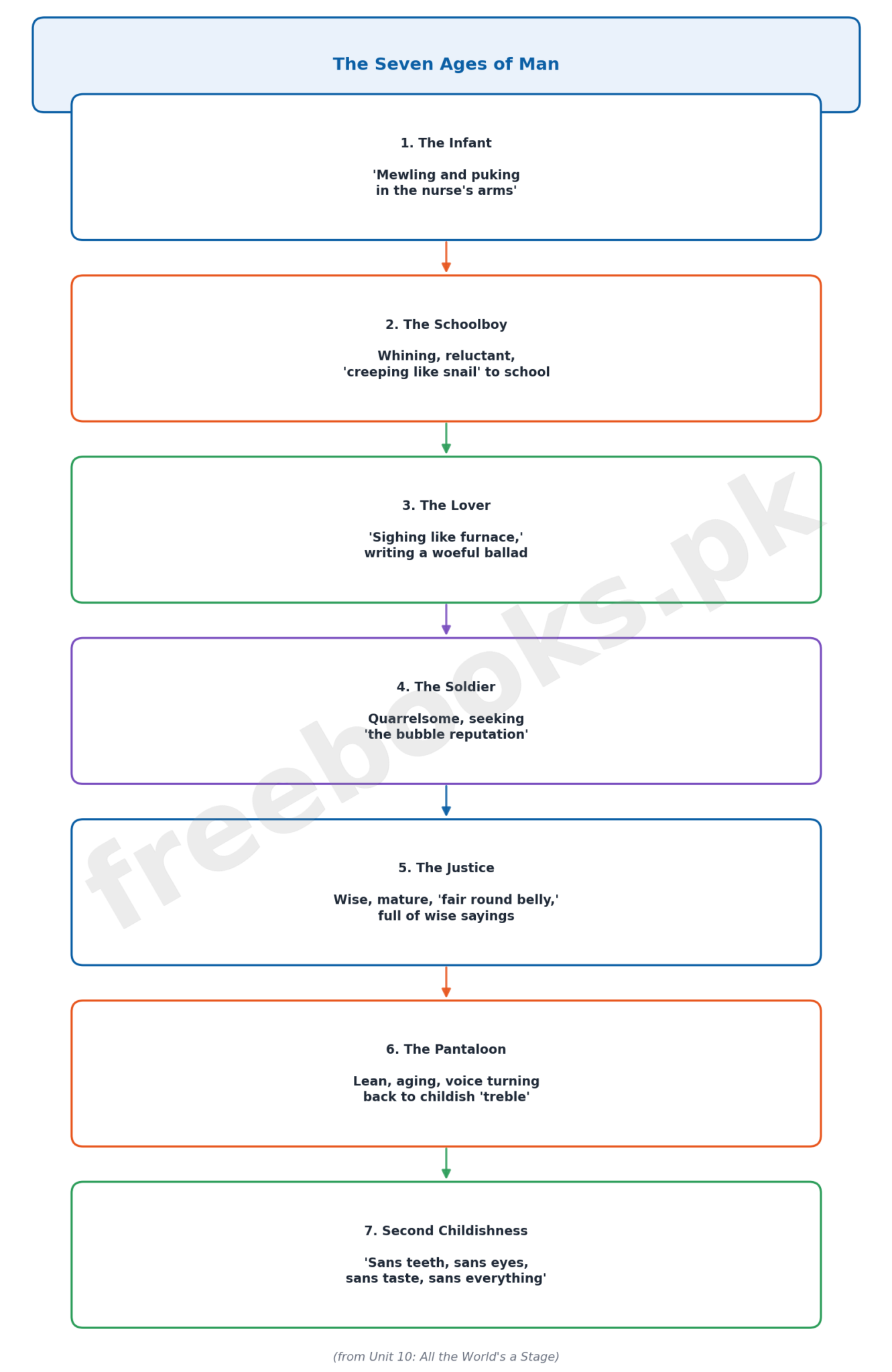
The Seven Ages of Man: A seven-step diagram showing Shakespeare's seven ages of man in order: the Infant, the Schoolboy, the Lover, the Soldier, the Justice, the Pantaloon, and Second Childishness, with a brief description of each stage.
Short Questions & Answers
What is the central metaphor of the poem?
The central metaphor compares the world to a stage and all men and women to actors ('players') who play different roles, entering through birth and exiting through death.
What are the seven ages of man described in the poem?
The seven ages are the infant, the schoolboy, the lover, the soldier, the justice, the pantaloon (aging man), and second childishness.
How is the infant described in the first age?
The infant is described as 'mewling and puking in the nurse's arms,' representing complete helplessness at the start of life.
How is the schoolboy described in the second age?
The schoolboy is described as whining, carrying his satchel, with a 'shining morning face,' 'creeping like snail unwillingly to school,' reflecting reluctance and slow, dragging movement.
How does Shakespeare describe the lover in the third age?
The lover is described as 'sighing like furnace,' composing a 'woeful ballad' about his beloved's eyebrow, capturing intense, dramatic youthful emotion.
What characteristics define the soldier in the fourth age?
The soldier is full of 'strange oaths,' bearded 'like the pard,' quick to quarrel, and seeks fame ('the bubble reputation') even in dangerous situations like 'the cannon's mouth.'
How is the justice portrayed in the fifth age?
The justice is portrayed as a mature, wise figure with a 'fair round belly,' severe eyes, and a formally cut beard, full of wise sayings and modern examples.
What happens in the sixth age, the pantaloon?
In the sixth age, the man becomes 'lean and slipper'd,' wearing spectacles and a pouch, his youthful clothes now too big for his shrunken frame, and his voice turning back to a childish, high-pitched 'treble.'
How does the poem describe the seventh and final age?
The final age is described as 'second childishness and mere oblivion' — a return to complete helplessness, 'sans teeth, sans eyes, sans taste, sans everything.'
What does the poem suggest about the nature of human life overall?
The poem suggests that human life is temporary and constantly changing, moving through distinct stages from helplessness in infancy to helplessness again in old age, much like a play with entrances and exits.
Long Questions & Answers
Explain how Shakespeare uses the metaphor of a stage to describe the seven ages of man.
What is the central comparison Shakespeare makes at the start of the poem?
Shakespeare compares the entire world to a stage and all people to actors, or 'players,' who have their 'exits and their entrances' — meaning death and birth — and who play many different parts over the course of a lifetime.
How does this metaphor structure the rest of the poem?
The metaphor structures the poem as a sequence of seven distinct roles, or 'acts,' that every person plays in turn: the infant, the schoolboy, the lover, the soldier, the justice, the pantaloon, and second childishness.
What do the details of each age contribute to the stage metaphor?
Each age is given vivid, specific details — such as the infant's crying, the schoolboy's reluctant satchel-carrying, or the soldier's quest for reputation — that function like stage directions, making each 'role' distinct and recognisable.
What does the poem's ending reveal about the metaphor's overall meaning?
The poem ends with the seventh age returning to helplessness, just like the first, suggesting that life's 'play' is a complete cycle — reinforcing the idea that human existence, like a performance, is temporary and follows a fixed, universal script.
Discuss the literary devices used in 'All the World's a Stage' and their effect on the poem's meaning.
What is the poem's central literary device, and how is it used?
The poem's central device is metaphor, directly comparing the world to a stage and people to actors in the opening lines, establishing the framework for the entire poem.
How do similes contribute to the poem's descriptions?
Similes such as 'creeping like snail,' 'sighing like furnace,' and 'bearded like the pard' vividly capture the schoolboy's reluctance, the lover's emotional intensity, and the soldier's fierce appearance.
What effect does repetition create in the poem's final line?
The repetition of 'sans' (without) in 'sans teeth, sans eyes, sans taste, sans everything' emphasises the complete loss and emptiness of old age, while its parallel structure gives the line a rhythmic, final quality.
How does the poem's irony reinforce its central theme?
The poem is ironic in that the final stage of 'second childishness' mirrors the helplessness of the first stage of infancy, showing that life ends much as it began — reinforcing the theme that human existence follows an inevitable, cyclical pattern.
Multiple Choice Questions (MCQs)
All the men and women merely players. (A) workers (B) actors (C) teachers (D) leaders
Correct answer: (B) actors. 'Players' means actors, referring to human beings performing roles on the stage of life.
They have their exits and their entrances. (A) successes (B) birthdays (C) departures (D) celebrations
Correct answer: (C) departures. 'Exits' refers to departures from the stage, symbolising death.
Mewling and puking in the nurse's arms. (A) sleeping (B) vomiting (C) laughing (D) crawling
Correct answer: (B) vomiting. 'Puking' means vomiting, describing the helpless infant.
And then the whining schoolboy, creeping like snail. (A) singing happily (B) running quickly (C) complaining in a weak voice (D) studying seriously
Correct answer: (C) complaining in a weak voice. 'Whining' means complaining in a weak, unhappy voice, describing the reluctant schoolboy.
Sighing like furnace, with a woeful ballad. (A) a short humorous story (B) a sad or romantic song (C) a historical speech (D) a dramatic play
Correct answer: (B) a sad or romantic song. A 'woeful ballad' is a sad or romantic song, fitting the lover's sorrowful devotion.
Seeking the bubble reputation. (A) permanent (B) short-lived (C) noble (D) powerful
Correct answer: (B) short-lived. The word 'bubble' suggests reputation is fragile and short-lived, like a bubble that can burst.
And then the justice, in fair round belly. (A) policeman (B) judge (C) soldier (D) farmer
Correct answer: (B) judge. 'Justice' here means a judge, a wise and mature figure in the fifth age.
Quick Revision Summary
- 'All the World's a Stage' is a famous speech by William Shakespeare from his play As You Like It.
- The poem's central metaphor compares the world to a stage and all people to actors, with birth as 'entrance' and death as 'exit.'
- The seven ages are: the Infant, the Schoolboy, the Lover, the Soldier, the Justice, the Pantaloon, and Second Childishness.
- Vivid similes describe each stage: 'creeping like snail' (schoolboy), 'sighing like furnace' (lover), 'bearded like the pard' (soldier).
- The final age returns to complete helplessness, described in the famous line 'sans teeth, sans eyes, sans taste, sans everything.'
- The central theme is that human life is temporary and ever-changing, following a universal cycle from helplessness to helplessness.
Exam Tips
- Memorise the seven ages in order (Infant, Schoolboy, Lover, Soldier, Justice, Pantaloon, Second Childishness), since exams frequently test this sequence.
- Learn the key descriptive phrase for each age (e.g., 'mewling and puking' for the infant, 'sighing like furnace' for the lover), as these are commonly quoted in questions.
- Review the glossary words with their exact textbook meanings; synonym-in-context questions are commonly drawn from unit glossaries.
- Study the literary devices table (metaphor, simile, imagery, repetition, personification, irony) with their exact line references, since this unit's skill focus is literary analysis.
- Be ready to explain the significance of the poem's closing line and its ironic return to infancy-like helplessness.
- When answering theme-based questions, connect the seven ages to the poem's broader message about life's temporary, cyclical nature.