
This unit presents 'The Doll's House' by Katherine Mansfield, a short story in which the Burnell children receive a beautiful doll's house from Mrs. Hay and proudly show it off to their schoolmates, while the poor Kelvey sisters are excluded from this privilege because of their family's low social standing.
Through the children's excitement over the doll's house and the cruel exclusion of Lil and Else Kelvey, the story exposes how deeply social class prejudice runs, being practised by children and adults alike, until a small act of kindness from Kezia briefly crosses the social divide.
These notes summarise the story as given in the textbook and provide comprehension questions, vocabulary, and exam-oriented material for this unit, including the skill-based Vocabulary/Grammar (spot the error), Oral Communication (role-play discussion), and Writing Skills (reimagining the narrative) sections that accompany it.
Learning Objectives
- Engage in extended discussions and critiques, considering other speakers' viewpoints and presenting one's own with clarity and coherence.
- Evaluate the particular elements of a story or drama, such as how the setting shapes the characters or plot.
- Identify rhyme schemes and figurative language in poems.
- Analyze multiple interpretations of a story, drama, or poem, evaluating how each version interprets the source text.
- Identify and use compound prepositions and prepositional phrases in writing.
- Apply skills and strategies for idea generation, selection, development, organization, and revision for a variety of writing purposes and text types.
Key Concepts
About the Author
Katherine Mansfield was a famous modernist short story writer born in 1888 in Wellington, New Zealand. She is well known for her innovative writing style that focuses on human emotions and everyday life.
Mansfield spent much of her life in Europe, especially in England and France, where she became part of the literary modernist movement. Her stories often highlight themes such as class differences, childhood experiences, and social inequalities. Some of her well-known works include The Garden Party and Other Stories and Bliss and Other Stories.
The Doll's House Arrives
Old Mrs. Hay sends the Burnell children a large, elaborate doll's house after her stay with the family. Despite the strong smell of fresh paint, the children are delighted by its detailed rooms, furniture, and decoration — but what captivates Kezia most of all is a small, exquisite amber lamp on the dining-room table, which feels 'real' to her in a way the stiff, oversized dolls do not.
Isabel Takes Charge and Shows It Off
As the eldest, Isabel insists on being the first to tell the school about the doll's house and the one to choose which classmates may come see it. At school, she becomes the center of attention, describing the carpet, beds, and stove in detail — but it is Kezia who has to remind her not to forget the lamp, which Kezia insists is 'best of all.'
The Kelvey Sisters and Social Exclusion
The story introduces Lil and Else Kelvey, daughters of a poor washerwoman and a father believed to be in prison, who are shunned by all the other children, including the Burnells, and treated coldly even by their teacher. Their shabby, secondhand clothing marks their poverty, and they are never included in games, conversations, or invitations — including the excitement over the doll's house.
When Kezia asks her mother if she can invite the Kelveys to see the doll's house, she is firmly told 'Certainly not,' with no real explanation beyond social convention.
Cruelty at the Pine Trees
During the dinner hour, the other girls, led by Emmie Cole and Lena Logan, taunt Lil Kelvey about being 'a servant when she grows up' and her father being in prison. Lil only responds with her usual 'shamefaced smile,' but the other girls feel a thrilling, cruel sense of triumph and solidarity from the humiliation, running off afterward to skip rope with wild excitement.
Kezia's Act of Kindness
Later, alone at the courtyard gate, Kezia impulsively invites the passing Kelvey sisters to see the doll's house, insisting it 'doesn't matter' that they had been forbidden to speak. Lil hesitates, but Else, who rarely speaks or shows emotion, silently urges her sister forward, and the two follow Kezia to see the doll's house — with Kezia opening it and beginning to show them the rooms.
Aunt Beryl's Anger and the Ending
Aunt Beryl discovers the Kelveys in the courtyard and furiously drives them away, scolding Kezia as a 'wicked, disobedient little girl.' Her anger is shown to be linked to her own personal stress from a threatening letter, suggesting her cruelty toward the Kelveys is partly a release of her own frustration rather than genuine moral concern.
As the humiliated Kelvey sisters rest by the roadside afterward, Else quietly tells Lil, 'I seen the little lamp,' smiling her rare smile — showing that despite the cruelty surrounding them, she found genuine joy in the one small, real thing Kezia shared with them.
Theme
The theme of 'The Doll's House' is social class discrimination and the cruelty of prejudice in society. The story shows how children and adults treat others differently based on their social status and wealth.
The Burnell sisters enjoy their privilege, while the Kelvey children are excluded and humiliated because of their lower class. Through the symbol of the beautiful doll's house, Mansfield highlights how material wealth creates division and injustice. Ultimately, the story teaches that kindness and equality are more important than social status.
Important Definitions (Glossary)
astounded
shocked or greatly surprised
boast
to talk with excessive pride and self-satisfaction
congealed
changed from a fluid to a solid or semi-solid state
exquisite
extremely beautiful, delicate, and carefully made
imploring
making an earnest, passionate, and pleading request
propped
supported or held up by placing something underneath or against it
shunned
persistently avoided, ignored, or rejected out of dislike or disapproval
varnish
a hard, clear, glossy liquid applied to wood
wicked
evil or morally wrong
Key Facts
| Item | Detail |
|---|---|
| Author | Katherine Mansfield (born 1888), Wellington, New Zealand |
| Author's other famous works | The Garden Party and Other Stories; Bliss and Other Stories |
| Who sends the doll's house | Old Mrs. Hay, a family friend |
| What Kezia values most in the house | The small amber lamp with a white globe |
| Who are excluded from seeing the doll's house | Lil and Else Kelvey, daughters of a washerwoman |
| Who drives the Kelveys away | Aunt Beryl |
| Else's final line | 'I seen the little lamp' — her one moment of joy |
| Central theme | Social class discrimination and the cruelty of prejudice |
Diagram
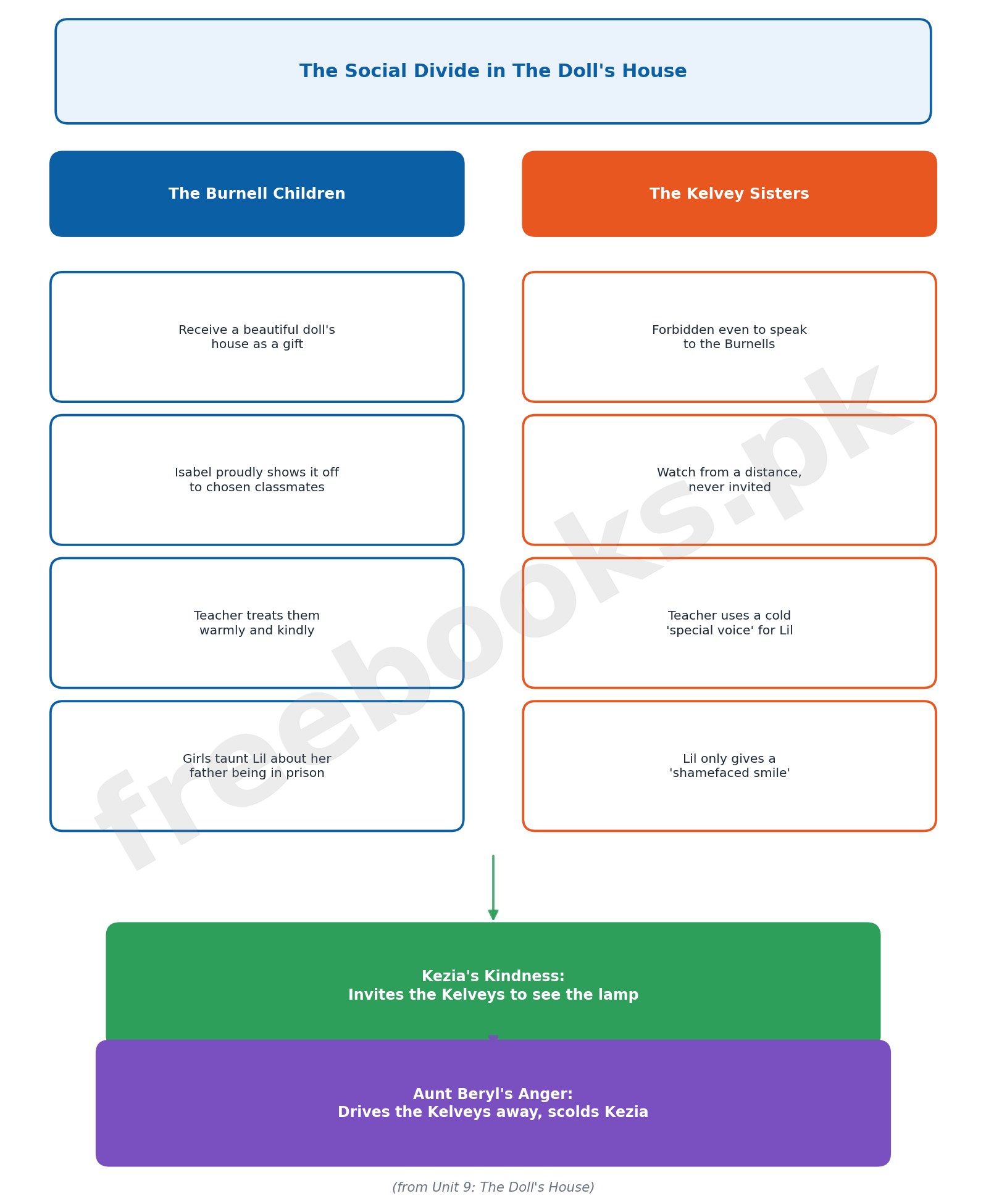
Social Divide in The Doll's House: A diagram contrasting the privileged Burnell children, who display and boast about the doll's house, with the excluded Kelvey sisters, who are shunned by classmates, teacher, and Aunt Beryl — until Kezia's small act of kindness briefly crosses the divide.
Short Questions & Answers
Who sent the Burnell children the doll's house, and how did the children react to it?
Old Mrs. Hay sent the doll's house after staying with the Burnells; the children were overjoyed and amazed, especially by the little amber lamp, which Kezia found more meaningful than anything else in the house.
Why was the little lamp more meaningful to Kezia than the rest of the doll's house?
The lamp felt 'real' to Kezia in a way the stiff, oversized dolls did not — it seemed to genuinely belong and say 'I live here,' representing warmth and authenticity rather than mere material display.
Who were the Kelvey sisters, and why were they excluded by the other children?
Lil and Else Kelvey were the daughters of a poor washerwoman, with a father believed to be in prison; they were excluded and shunned by the other children, and even by adults, because of their low social status and poverty.
How did the teacher's treatment of Lil Kelvey reveal that adults, too, practised social discrimination?
The teacher used a 'special voice' for Lil Kelvey and a different smile for the other children, showing that adults formally modelled and reinforced the same social exclusion practised by the children.
What cruel thing did Lena Logan say to Lil Kelvey, and how did the other girls react?
Lena Logan taunted Lil about her father being in prison; the other girls reacted with wild excitement and joy, since the cruelty reinforced their own sense of social superiority and group solidarity.
What did Kezia do when she saw the Kelvey sisters passing by the gate?
Kezia impulsively invited the Kelvey sisters to come see the doll's house, insisting it didn't matter that they had been forbidden to speak to each other.
How did Aunt Beryl react when she found the Kelveys in the courtyard?
Aunt Beryl was furious, drove the Kelvey sisters away as if they were chickens, and scolded Kezia as a 'wicked, disobedient little girl.'
What does Else's final line, 'I seen the little lamp,' reveal about her character?
It reveals that despite the humiliation and cruelty she faced, Else found genuine joy in the one small, real thing that was shared with her kindly, showing her quiet resilience and appreciation for small kindnesses.
Long Questions & Answers
Discuss how the story 'The Doll's House' portrays social class discrimination through the treatment of the Kelvey sisters.
How are the Kelvey sisters introduced and characterised in the story?
The Kelvey sisters are introduced as the poor daughters of a washerwoman and a father believed to be in prison, dressed in secondhand 'bits' of clothing, and consistently excluded from the other children's activities.
How do the children treat the Kelveys throughout the story?
The other children, led by the Burnells' example, shun the Kelveys entirely, refusing to speak to them, and at one point cruelly taunt Lil about being a servant and her father's imprisonment.
How do adults reinforce this exclusion?
Adults reinforce the exclusion as well: the teacher uses a special, colder voice for Lil, Kezia's mother forbids her from inviting the Kelveys, and Aunt Beryl furiously drives them away when she finds them in the courtyard.
What does this portrayal suggest about the story's broader theme?
It suggests that social class prejudice is deeply embedded in society, practised by both children and adults alike, and that such discrimination causes real pain and humiliation to those excluded, reinforcing the story's central theme of class-based cruelty and injustice.
Explain the significance of the little lamp and Kezia's act of kindness in the story's message about human connection.
Why does the lamp stand out to Kezia among all the doll's house's features?
The lamp stands out because, unlike the stiff, oversized dolls, it feels genuinely 'real' to Kezia, seeming to belong naturally in the house and say 'I live here,' representing something authentic amid the display of wealth.
What does Kezia do that sets her apart from the other children?
Kezia impulsively invites the excluded Kelvey sisters to see the doll's house, disregarding the social rule that forbids speaking to them, showing a moment of genuine kindness and empathy.
How does Else's reaction to the lamp reflect the story's deeper meaning?
Else's quiet, joyful comment, 'I seen the little lamp,' shows that this small act of kindness meant more to her than any material wealth, offering a rare moment of genuine happiness amid constant exclusion.
What does this moment suggest about the story's overall message?
It suggests that small acts of genuine kindness and connection can transcend social barriers, and that true value lies not in material wealth or status, but in authentic human warmth and equality.
Multiple Choice Questions (MCQs)
Why might the author describe the doll's house as having a "dark, oily, spinach green" colour with "lumps of congealed paint"? (A) to show that old Mrs. Hay had poor taste in gifts (B) to suggest the house is slightly ugly and artificial, yet still prized by children who value novelty over beauty (C) to indicate the paint was still wet and stinky (D) to prove that the Burnells usually received better quality presents
Correct answer: (B) to suggest the house is slightly ugly and artificial, yet still prized by children who value novelty over beauty. The description suggests the house is imperfect and artificial in its details, yet the children still prize it purely for its novelty and excitement, not its actual beauty.
How does Isabel's declaration "I'm to tell, because I'm the eldest" function within the family and social structure? (A) It demonstrates her natural leadership abilities. (B) It shows how age-based hierarchies are used to justify power and control over others. (C) It proves she is her mother's favourite child. (D) It reveals her insecurity about being forgotten.
Correct answer: (B) It shows how age-based hierarchies are used to justify power and control over others.. Isabel's declaration shows how age-based hierarchy is used to justify her control and authority over her sisters, reflecting the story's broader theme of arbitrary social hierarchies.
Why does Kezia insist that "The lamp's best of all" when Isabel is showing off the doll's house? (A) because the lamp is the most expensive item in the house (B) because Kezia instinctively values warmth, light over mere material display (C) because she wants to contradict Isabel and assert herself (D) because the lamp was a separate gift just for her
Correct answer: (B) because Kezia instinctively values warmth, light over mere material display. Kezia instinctively values the lamp's warmth and authenticity over the mere material display Isabel emphasises.
Why do the other girls become "wild with joy" after Lena insults Lil about her father being in prison? (A) They genuinely believe Lena has said something brave and clever. (B) The cruelty reinforces their own social superiority and group solidarity against an outsider. (C) They are relieved that Lena didn't target any of them instead. (D) They think Lil will finally fight back and provide entertainment.
Correct answer: (B) The cruelty reinforces their own social superiority and group solidarity against an outsider.. Their excitement stems from the cruelty reinforcing their own sense of social superiority and group solidarity against the excluded Kelveys.
How does the teacher's treatment of Lil Kelvey—using a "special voice" for her—reinforce the story's larger themes? (A) It shows that teachers must be strict to maintain classroom order. (B) It demonstrates how adults formally sanction and model social exclusion for children. (C) It proves Lil was not a very good student. (D) It reveals the teacher's personal dislike of flowers.
Correct answer: (B) It demonstrates how adults formally sanction and model social exclusion for children.. The teacher's differential treatment shows how adults formally sanction and model the same social exclusion practised by the children.
Quick Revision Summary
- 'The Doll's House' is a story by Katherine Mansfield, a New Zealand-born modernist writer known for The Garden Party and Other Stories.
- Mrs. Hay sends the Burnell children an elaborate doll's house; Kezia values the small amber lamp above all its other features.
- The Kelvey sisters, Lil and Else, are shunned by all the children and even by the teacher because of their poverty and their father's imprisonment.
- Lena Logan cruelly taunts Lil about being a servant and her father's imprisonment, delighting the other girls with a sense of social superiority.
- Kezia impulsively invites the Kelveys to see the doll's house, but Aunt Beryl furiously drives them away and scolds Kezia.
- Else's final line, 'I seen the little lamp,' shows her quiet joy at Kezia's small act of kindness despite the surrounding cruelty.
- The central theme is social class discrimination and the cruelty of prejudice, practised by children and adults alike.
Exam Tips
- Learn the contrast between the Burnell children (privileged) and the Kelvey sisters (excluded) — this comparison is central to nearly every long-answer question.
- Practise explaining the symbolic significance of the little lamp, since it represents authenticity and warmth in contrast to material wealth.
- Review the glossary words with their exact textbook meanings; synonym-in-context questions are commonly drawn from unit glossaries.
- Be ready to discuss how both children and adults (the teacher, Aunt Beryl, Kezia's mother) reinforce social exclusion in the story.
- Revise the ending — Else's line about the lamp — as it is the story's most frequently tested reflective moment.
- When answering theme-based questions, connect Kezia's small act of kindness to the story's broader message that human connection matters more than social status.