
This unit presents 'Because I Could Not Stop for Death,' a well-known poem by the American poet Emily Dickinson, in which Death is personified as a kind, polite companion who takes the speaker on a calm carriage ride from life, through key stages of existence, and into eternity.
The poem uses the journey of the carriage to reflect on mortality, presenting death not as something frightening but as a natural, gentle transition, while also exploring how time loses its ordinary meaning once eternity is reached.
These notes summarise the poem as given in the textbook and provide comprehension questions, vocabulary, and exam-oriented material for this unit, including the skill-based Reading (fact vs. opinion, skimming/scanning), Vocabulary/Grammar (parts of speech), Oral Communication (dramatic techniques), and Writing Skills (argumentative writing) sections that accompany it.
Learning Objectives
- Apply dramatic techniques with confidence in a two/three act play, or assembly/class presentation, preferably on the Sustainable Development Goals (SDGs).
- Perform a drama showing different roles and scenarios through deliberate choice of dialogues, speech, gestures, and movements, preferably on SDGs.
- Distinguish cause from effect, fact from opinion, and generalized statements from evidence-based information, with specific reference to informational texts.
- Apply skimming and scanning strategies to identify the writer's purpose and intended audience, and infer the theme or main idea of a text.
- Demonstrate knowledge and application of parts of speech in oral and written communication in varying degrees of complexity.
- Write arguments to support claims in an analysis of substantive topics or texts, using valid reasoning and relevant, sufficient evidence, with a formal style and a concluding statement that follows from the argument presented.
Key Concepts
About the Poetess
Emily Dickinson (1830-1886) was an American poetess, widely regarded as one of the most original voices in English literature. She was born in Amherst, Massachusetts, and spent most of her life in seclusion, rarely leaving her family home.
Despite her reclusive lifestyle, Dickinson produced nearly 1,800 poems, though only a handful were published during her lifetime. Her poetry is known for its unconventional style, with short lines, slant rhymes, and unusual punctuation, particularly her frequent use of dashes. She explored themes such as death, immortality, nature, love, faith, and the search for meaning, and is celebrated today as one of the greatest poets of the 19th century and a pioneer of modern American poetry.
The Carriage Ride Begins
The poem opens with the speaker explaining that she could not stop for Death, so Death 'kindly stopped' for her instead. The carriage holds only the speaker, Death, and Immortality — establishing Death as a personified, courteous companion rather than something to be feared.
The journey proceeds slowly and without haste, since Death 'knew no haste,' and the speaker sets aside her labour and leisure in return for his civility — suggesting a calm, willing acceptance of the journey.
Passing the Stages of Life
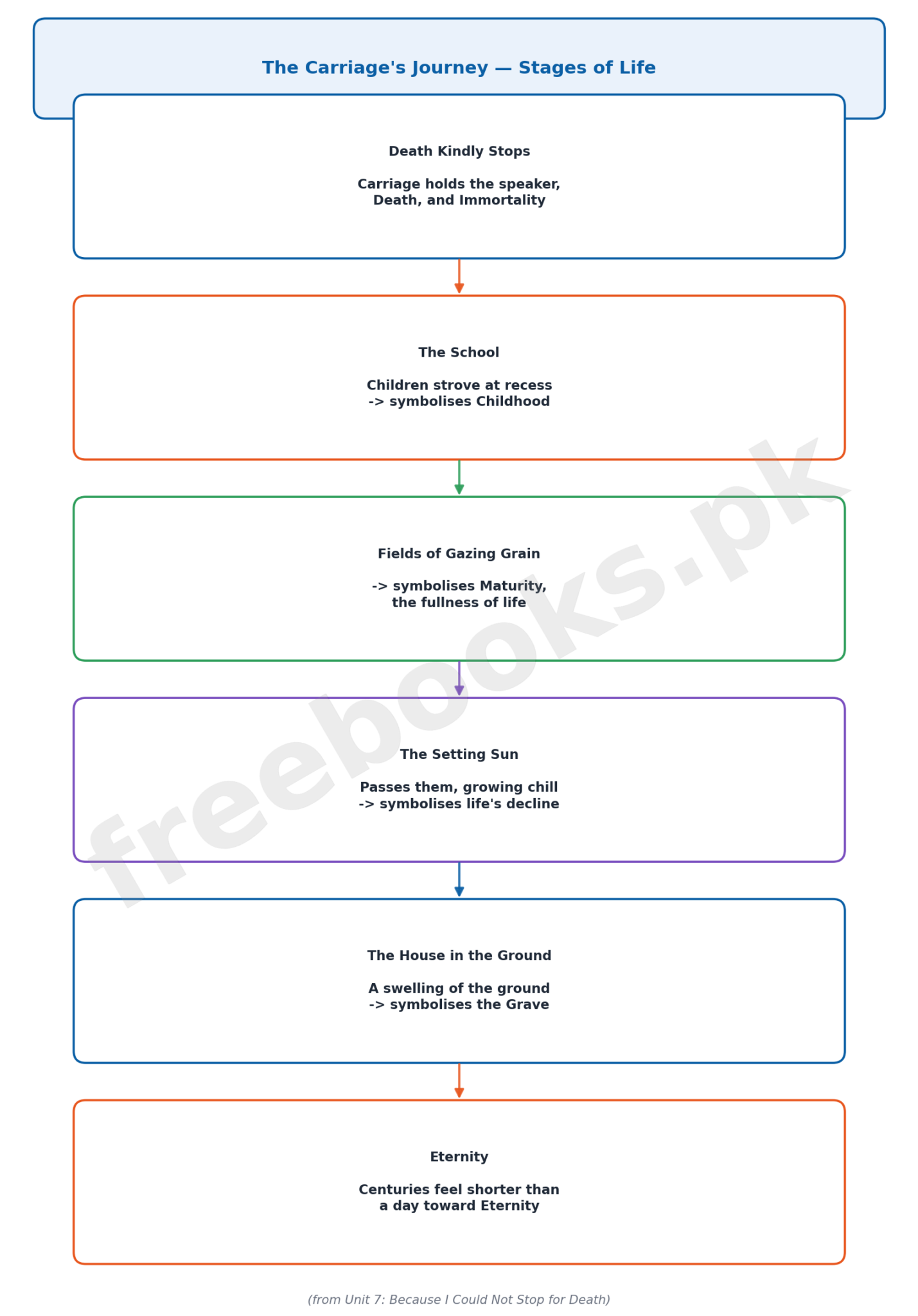
As the carriage travels, they pass a school where children 'strove' at recess, symbolising childhood; the 'Fields of Gazing Grain,' symbolising maturity and the fullness of life; and the 'Setting Sun,' symbolising the decline toward the end of life.
The speaker then notices that it is actually the sun that passes them, rather than the reverse, and the dews grow 'quivering and chill,' since her clothing — only gossamer and tulle — offers little protection, reflecting her vulnerability as death draws near.
The Pause at the Grave
The carriage pauses before a house that 'seemed a Swelling of the Ground,' with a roof scarcely visible and its cornice in the ground — a description that represents a grave, described gently rather than with fear or horror.
Eternity and the Perception of Time
In the final stanza, the speaker reflects that although centuries have passed since that day, it feels shorter than the single day she first realised the horses' heads were turned toward Eternity — showing that, once in eternity, ordinary measures of time lose their meaning.
Theme
The poem explores the theme of death as a calm and inevitable part of life. It presents Death not as something frightening, but as a kind and polite companion who gently leads the speaker toward eternity.
The journey in the carriage symbolises the passage from life to death, highlighting different stages of human life. Through peaceful and reflective imagery, the poem suggests that death is a natural transition rather than an end, and that time loses its meaning after death, as centuries feel shorter than a single day. Overall, the poem emphasises acceptance of mortality and the continuity of existence beyond physical life.
Important Definitions (Glossary)
cornice
the top edge or decorative border of a building or structure
eternity
endless time; life that has no end
haste
great speed or hurry
immortality
the state of living forever; never dying
leisure
free time when one is not working
quivering
shaking or trembling slightly
scarcely
hardly; almost not
strove
tried very hard
surmised
guessed or understood something without full proof
Key Facts
| Item | Detail |
|---|---|
| Poetess | Emily Dickinson (1830-1886), Amherst, Massachusetts, USA |
| Who accompanies the speaker in the carriage | Death and Immortality |
| What the school symbolises | Childhood |
| What the fields of grain symbolise | Maturity / the fullness of life |
| What the setting sun symbolises | The decline toward the end of life |
| What the 'house' in the ground represents | A grave |
| Central theme | Death as a calm, natural, and inevitable transition to eternity |
| Key literary device | Personification of Death as a kind, polite companion |
Diagram
The Carriage's Journey — Stages of Life: A diagram showing the carriage's journey passing key symbolic stages: the school (childhood), the fields of grain (maturity), the setting sun (decline), and the house in the ground (the grave), ending at Eternity.
Short Questions & Answers
Who kindly stops for the speaker in the poem?
Death kindly stops for the speaker, since she 'could not stop' for him herself.
What does the carriage symbolize in the poem?
The carriage symbolises the journey from life to death, carrying the speaker calmly through the stages of life toward eternity.
How does the speaker describe the pace of the journey with Death?
The speaker describes the journey as slow and unhurried, since Death 'knew no haste,' and she willingly sets aside her labour and leisure for his civility.
Which places do they pass on their journey, and what might each represent?
They pass a school where children strove at recess (representing childhood), the Fields of Gazing Grain (representing maturity), and the Setting Sun (representing the decline toward the end of life).
How is the school described, and what could it symbolize about life?
The school is described with children striving at recess in the ring, symbolising the energy and activity of childhood as an early stage of life.
What imagery does Dickinson use to describe the fields of grain?
Dickinson describes 'Fields of Gazing Grain,' imagery suggesting the grain seems to watch or gaze back at the passing carriage, evoking the fullness and maturity of life.
How is the setting sun described, and what could it signify in the poem?
The setting sun is described as passing the carriage rather than the carriage passing it, signifying the decline toward the end of life and the speaker's growing vulnerability as evening (death) approaches.
What does the 'House that seemed a Swelling of the Ground' represent?
It represents a grave, described gently as a low mound in the earth with a scarcely visible roof and its cornice in the ground.
How does the speaker describe her clothing, and what effect does it create?
She describes her clothing as only gossamer and tulle, delicate and thin fabrics that leave her cold and vulnerable to the chill dew, reflecting her fragile state as death approaches.
How does the poem convey the idea of time passing differently after death?
The poem conveys this through the final stanza, where centuries since that day feel shorter than the single day the speaker first realised she was heading toward Eternity, showing that ordinary time loses meaning after death.
Long Questions & Answers
Discuss how Emily Dickinson personifies Death in 'Because I Could Not Stop for Death' and explain the effect of this personification.
How is Death personified at the start of the poem?
Death is personified as a considerate figure who 'kindly' stops his carriage for the speaker, since she could not stop for him herself, immediately establishing him as courteous rather than frightening.
What qualities does Death display throughout the journey?
Death displays patience and calm, since he 'knew no haste' and takes the journey slowly, allowing the speaker to set aside her labour and leisure in exchange for his civility.
How does this personification shape the reader's view of death?
By portraying Death as a gentle, well-mannered companion rather than a frightening figure, the poem reframes death as a natural and peaceful transition rather than something to be feared.
What overall effect does this personification create for the poem's theme?
It reinforces the poem's central theme that death is a calm and inevitable part of life, encouraging acceptance of mortality rather than dread, and framing the journey toward eternity as a continuation rather than an ending.
Explain the symbolic stages of the journey in the poem and what each stage reveals about life and death.
What does the school scene symbolize?
The school where children strove at recess symbolises childhood, an early stage of life full of energy and activity.
What does the fields of grain symbolize?
The 'Fields of Gazing Grain' symbolise maturity, the fullness of adult life, observed calmly as the carriage passes.
What does the setting sun symbolize, and how does the speaker's description of it shift?
The setting sun symbolises the decline toward the end of life; notably, the speaker realises it is the sun that passes them, rather than the reverse, signalling her own passivity as death advances and she grows cold and vulnerable.
What does the final destination — the house in the ground — reveal about the poem's view of death?
The house that is 'a Swelling of the Ground' represents a grave, described gently rather than with horror, reinforcing that the poem views death and burial as a quiet, natural resting point on the larger journey toward eternity.
Multiple Choice Questions (MCQs)
Who accompanies the speaker in the carriage besides Death? (A) a child (B) a friend (C) immortality (D) a teacher
Correct answer: (C) immortality. Immortality accompanies the speaker in the carriage along with Death.
What does the 'setting sun' most likely symbolize? (A) morning (B) birth (C) the end of life (D) happiness
Correct answer: (C) the end of life. The setting sun symbolises the decline toward the end of life.
What kind of journey is described in the poem? (A) a joyful trip (B) a journey to school (C) a journey from life to death (D) a journey through a city
Correct answer: (C) a journey from life to death. The poem describes a calm journey from life to death and into eternity.
How is Death portrayed in the poem? (A) frightening and cruel (B) kind and polite (C) angry and loud (D) weak and helpless
Correct answer: (B) kind and polite. Death is portrayed as a kind and polite companion who 'kindly' stops for the speaker.
What does the 'house' in the ground represent? (A) a palace (B) a school (C) a grave (D) a garden
Correct answer: (C) a grave. The 'house' described as a swelling of the ground represents a grave.
Quick Revision Summary
- 'Because I Could Not Stop for Death' is a poem by Emily Dickinson (1830-1886), an American poetess known for her unconventional style and frequent use of dashes.
- Death is personified as a kind, polite figure who stops his carriage for the speaker, accompanied also by Immortality.
- The journey passes symbolic stages of life: a school (childhood), fields of grain (maturity), and the setting sun (decline toward death).
- The carriage pauses at a house that is 'a Swelling of the Ground' — a grave, described gently rather than fearfully.
- The poem's final stanza shows that time loses ordinary meaning after death, as centuries feel shorter than the single day the journey toward Eternity began.
- The central theme is death as a calm, natural, and inevitable transition rather than something to be feared.
Exam Tips
- Learn the poem's key symbols (the school, the fields of grain, the setting sun, the house in the ground) and what stage of life or death each represents.
- Practise explaining how Dickinson personifies Death as a kind, courteous companion, since this personification is central to the poem's theme.
- Review the glossary words with their exact textbook meanings; synonym-in-context questions are commonly drawn from unit glossaries.
- Revise the eight parts of speech and the example sentence breakdown from the Vocabulary and Grammar section, since this unit's skill focus is grammar-based.
- Be ready to explain the significance of the poem's closing lines about time and eternity, as this is a frequently tested reflective moment.
- When answering theme-based questions, connect the poem's calm, peaceful imagery to its broader message about accepting mortality.