
This unit presents 'The Fun They Had,' a short story by Isaac Asimov set in the futuristic year 2155, in which two children, Margie and Tommy, discover a real printed book and marvel at the old-fashioned schools of the past compared to their own mechanical, screen-based education.
The story contrasts Margie's isolated, machine-taught schooling with the old human-centred schools described in the book, where children learned together in a schoolyard and classroom, sharing homework and friendship — something Margie comes to long for by the story's end.
These notes summarise the story as given in the textbook and provide comprehension questions, vocabulary, and exam-oriented material for this unit, including the skill-based Vocabulary/Grammar, Oral Communication, and Writing Skills (informative/explanatory writing) sections that accompany it.
Learning Objectives
- Speak confidently and fluently in a wide range of contexts (conflict resolution, panel discussion, role-play, dialogue) to fulfil different purposes.
- Comment on implied meaning, such as the writer's viewpoint and relationships between characters.
- Explain whether predictions about the content of a text are acceptable or should be modified, and why.
- Cite strong and thorough textual evidence to support analysis of what the text says explicitly, as well as inferences drawn from the text.
- Acquire and use appropriate words and phrases for reading, writing, speaking, and listening, independently gathering vocabulary important for comprehension or expression.
- Write informative/explanatory texts to examine and convey complex ideas, concepts, and information clearly and accurately, with a formal style, objective tone, and a concluding statement that follows from the information presented.
Key Concepts
About the Author
Isaac Asimov was a famous American writer known for his works in science fiction and popular science. He was born in 1920 and showed great interest in reading and writing from an early age.
Asimov wrote hundreds of books and is especially known for his stories about robots and futuristic worlds. His writing often explores the relationship between humans and technology, making complex ideas easy to understand, and he remains one of the most influential science fiction authors of all time.
Tommy Finds a Real Book
The story opens in the year 2155, when Margie writes in her diary that Tommy found a real, old printed book in his attic. Its pages are yellow and crinkly, and the words 'stood still' instead of moving on a screen as they were used to.
Tommy finds it wasteful that printed books get thrown away once finished, unlike his television screen, which has held a million books and can hold many more. Margie, at eleven, has seen fewer telebooks than thirteen-year-old Tommy.
Margie and Her Mechanical Teacher
Margie hates school because her mechanical teacher had been giving her worse and worse test scores in geography, prompting her mother to call the County Inspector, who took the teacher apart and repaired it, finding that its geography sector had simply been geared too fast for her level.
Margie is disappointed the inspector did not take the teacher away altogether, recalling that Tommy's teacher was once taken away for a month after its history sector blanked out. She dislikes the homework slot most, where she must submit work written in a punch code learned since age six.
Discovering the Old Schools
The book Tommy found is about school — but 'the old kind of school' from centuries ago, where an actual man was the teacher, not a machine. Margie is astonished that a man could be smart enough to teach, and that all children of the same age learned the same lessons together in a special building.
Tommy explains that in the old days, all the neighbourhood kids went to the same schoolhouse, unlike Margie's mechanical teacher, which her mother says must be individually adjusted to fit each child's mind.
Margie's Longing for the Old Days
Called away to her own schoolroom, Margie inserts her homework as instructed by the mechanical teacher's screen. As she works through her arithmetic lesson on fractions, she thinks about the old schools, imagining how much fun the children of the past must have had, laughing and shouting together in the schoolyard, sitting together in the classroom, and helping one another with homework.
The story closes with Margie reflecting wistfully on 'the fun they had' — the human companionship and shared learning of the old schools that her own isolated, machine-taught world lacks.
Theme
The story highlights the contrast between modern, technology-driven education and traditional human-centred learning. It shows how excessive dependence on machines can make learning lonely, mechanical, and less enjoyable.
Through Margie's experiences, the story suggests that personalised digital teaching may lack the warmth, interaction, and emotional connection of real classrooms, while the old schools reflect the importance of social learning, where students learn together, share ideas, and support one another. It emphasises that human teachers provide understanding and encouragement that machines cannot fully replace, reminding readers that progress in technology should not take away the joy and human element of education.
Important Definitions (Glossary)
attic
the space or room just below the roof of a house
betcha
informal way of saying 'I bet you' (used to show certainty)
fractions
numbers that represent parts of a whole, like 1/2, 3/4
insert
to put something into something else
loftily
in a proud or superior manner
nonchalantly
in a calm and unconcerned way, without showing much interest
printed
produced or written on paper using ink
sector
a part or section of something
shaken
past form of 'shake,' meaning moved suddenly or disturbed
ugly
unpleasant to look at
waste
something used carelessly or without value
Key Facts
| Item | Detail |
|---|---|
| Author | Isaac Asimov (born 1920), American science fiction writer |
| Setting | The year 2155 |
| Main characters | Margie (age 11) and Tommy (age 13) |
| What Tommy finds | A real, old printed book, found in his attic |
| Who repairs Margie's teacher | The County Inspector |
| Subject of Margie's arithmetic lesson | Addition of proper fractions |
| Central theme | Contrast between technology-driven education and human-centred, social learning |
| Closing line's significance | Margie imagines 'the fun they had' in the old, human-taught schools |
Diagram
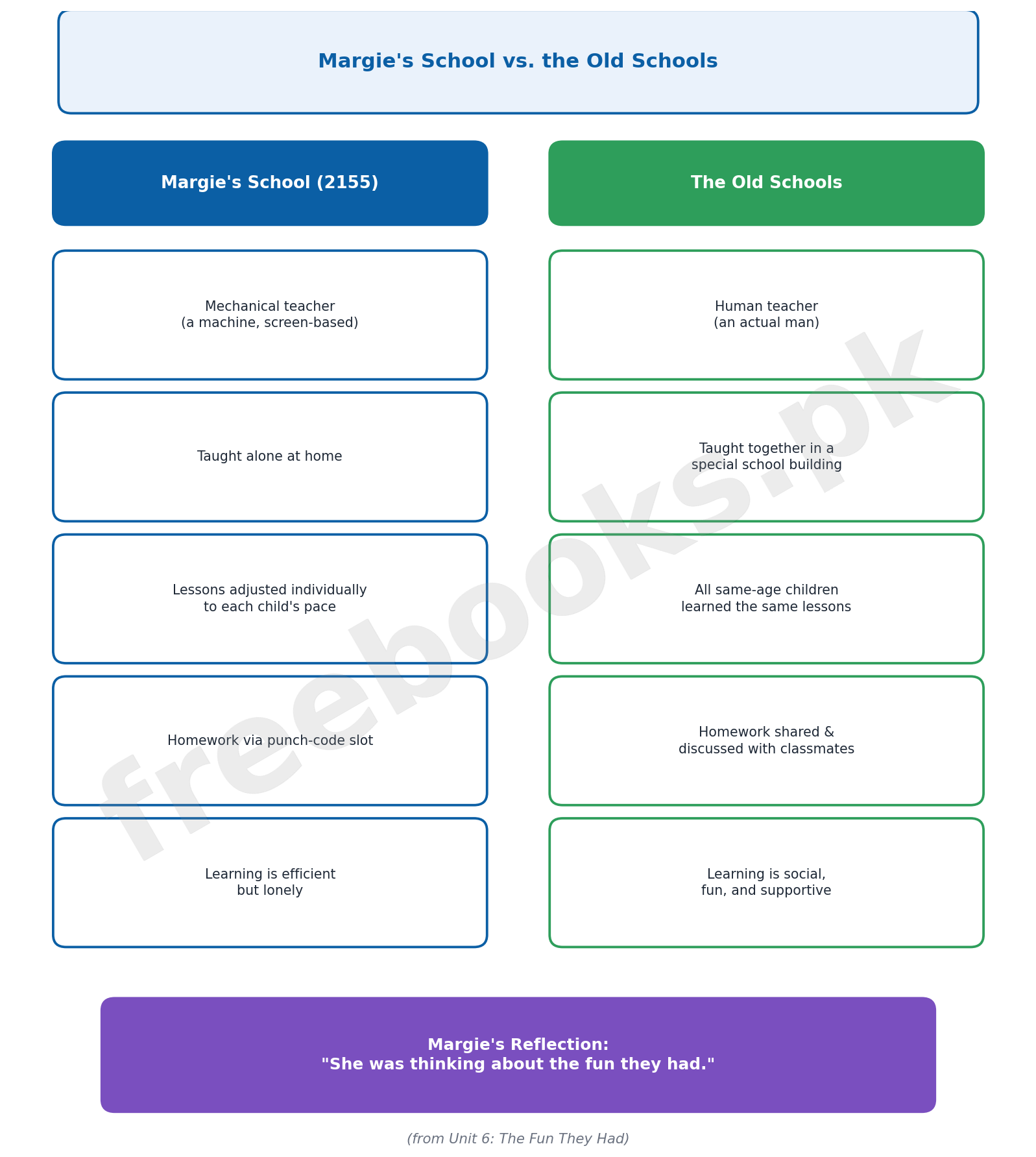
Margie's School vs. the Old Schools: A two-column comparison diagram contrasting Margie's isolated, machine-taught schooling in 2155 with the human-centred, social schools of the past described in Tommy's book.
Short Questions & Answers
What did Margie write in her diary on May 17, 2155?
Margie wrote, 'Today Tommy found a real book!' — describing Tommy's discovery of an old printed book.
Where did Tommy find the real book?
Tommy found the book in the attic of his house.
Why did Margie and Tommy find the book strange and funny?
They found it strange and funny because its pages were yellow and crinkly, and the words stood still instead of moving on a screen as they were used to, and because you could turn back and find the same words still there.
What was the book about, and how did Margie react to it?
The book was about school. Margie was initially scornful, saying she hated school and didn't understand what there was to write about it, but she became curious once Tommy explained it was about an old kind of school from centuries ago.
Why did Margie dislike her mechanical teacher?
Margie disliked her mechanical teacher because it had been giving her test after test in geography with worsening results, and she especially hated the slot where she had to insert her homework and test papers written in punch code.
What did the County Inspector do to Margie's teacher?
The County Inspector took the teacher apart, examined it, and found that its geography sector had been geared too fast for Margie's level; he then slowed it to an average ten-year level and put it back together.
How were old schools different from Margie's school?
In old schools, a human man served as the teacher, all children of the same age learned together in a special school building, and they could talk and help each other with homework — unlike Margie's mechanical teacher, which taught her alone at home.
What did Margie imagine about the children and schools of the past?
Margie imagined the children of the past laughing and shouting together in the schoolyard, sitting together in the schoolroom, and going home together, helping one another with homework — and she thought about 'the fun they had.'
Long Questions & Answers
Compare Margie's mechanical education with the old human-taught schools described in the book Tommy found.
What was Margie's schooling like in the story?
Margie was taught alone at home by a mechanical teacher that displayed lessons on a screen and required homework to be inserted into a slot in punch code, with the teacher individually adjusted to fit her own pace of learning.
What were the old schools like, according to the book Tommy found?
In the old schools, an actual human man served as the teacher; all the neighbourhood children of the same age attended a special building together, sat in the same classroom, and learned the same lessons at the same time.
How did Margie initially react to learning about the old schools, and how did her attitude change?
Margie was initially scornful and doubtful that a man could be smart enough to teach, but she grew increasingly curious and wanted to keep reading the book, eventually imagining how much fun the old-school children must have had together.
What does this comparison suggest about the story's theme?
It suggests that Margie's isolated, machine-taught education, though efficient, lacks the companionship, warmth, and shared experience of the old human-centred schools, reinforcing the theme that technology should not replace the human and social element of learning.
Discuss how the story 'The Fun They Had' reflects on the advantages and disadvantages of a technology-driven education system.
What advantages does Margie's mechanical education offer?
It offers personalised pacing, since the County Inspector adjusted her teacher's geography sector to match her own learning level, ensuring lessons suit her individual progress rather than a fixed group pace.
What disadvantages does the story highlight in this system?
The story highlights loneliness and a lack of companionship, since Margie studies alone at home with a machine, has no classmates to share ideas or homework with, and dislikes the impersonal homework-submission process.
How does the book about old schools contrast with Margie's experience?
It shows a warmer alternative, where children learned together, supported one another, and enjoyed a shared social experience with a human teacher who could understand and encourage them in ways a machine could not.
What overall message does the story convey about technology and education?
The story conveys that while technology can make education more efficient and personalised, it should not come at the cost of the human connection, social learning, and joy that define a truly fulfilling education.
Multiple Choice Questions (MCQs)
What did Tommy find? (A) a robot (B) a real book (C) a computer (D) a diary
Correct answer: (B) a real book. Tommy found a real, old printed book in his attic.
Where was the book found? (A) in the classroom (B) in the basement (C) in the attic (D) in the library
Correct answer: (C) in the attic. The book was found in the attic of Tommy's house.
What was the book about? (A) science (B) space (C) school (D) machines
Correct answer: (C) school. The old book Tommy found was about school.
Who repaired Margie's mechanical teacher? (A) her father (B) Tommy (C) the county inspector (D) her mother
Correct answer: (C) the county inspector. The County Inspector repaired Margie's mechanical teacher after it began giving her worse test scores.
What did Margie dislike most about her school? (A) the subjects (B) the teacher's voice (C) the homework slot (D) the classroom
Correct answer: (C) the homework slot. Margie disliked the slot where she had to insert her homework and test papers most of all.
Quick Revision Summary
- 'The Fun They Had' is a science fiction short story by Isaac Asimov, set in the year 2155.
- Tommy finds a real, old printed book in his attic, which Margie finds strange since its words 'stood still' unlike her screen-based telebooks.
- Margie is taught alone at home by a mechanical teacher; the County Inspector repairs it after its geography sector was geared too fast for her.
- The old book describes schools from centuries ago, where a human man taught all the neighbourhood children together in one building.
- Margie initially doubts a man could be smart enough to teach, but grows curious and wants to keep reading about the old schools.
- The story ends with Margie imagining the companionship and fun the old-school children had together, which her own isolated schooling lacks.
- The central theme is the contrast between technology-driven education and human-centred, social learning.
Exam Tips
- Learn the key characters (Margie, Tommy), the setting (year 2155), and the central object (the old printed book) — these are frequently tested details.
- Practise explaining the contrast between Margie's mechanical schooling and the old human-taught schools, since this comparison is central to most long-answer questions.
- Review the glossary words with their exact textbook meanings; synonym-in-context questions are commonly drawn from unit glossaries.
- Be ready to explain the story's theme about technology's impact on education and the importance of human connection in learning.
- Revise the closing line's significance ('the fun they had'), as it is the story's title and its most frequently tested reflective moment.
- When answering theme-based questions, connect Margie's personal experience to the story's broader message about balancing technology with human warmth in education.