
This unit presents 'The Last Lesson' by Alphonse Daudet, a short story narrated by a French schoolboy, Franz, set in Alsace during the Franco-Prussian War, on the day French is officially replaced by German as the language of instruction in local schools.
The story follows Franz's late arrival at school, his surprise at the unusual solemnity of the classroom, and his growing realisation — through his teacher M. Hamel's final French lesson — of what it means to lose one's own language and identity.
These notes summarise the story as given in the textbook and provide comprehension questions, vocabulary, and exam-oriented material for this unit, including the skill-based Reading, Vocabulary/Grammar, Oral Communication, and Writing sections that accompany it.
Learning Objectives
- Demonstrate attentive listening skills in a class setting, taking turns to speak with standard pronunciation and intonation.
- Evaluate how authors use language, including figurative language, and its impact on the reader; express informed opinions and justify a viewpoint.
- Analyse how an author's structural choices (where to begin or end a story, a comic or tragic resolution) contribute to a text's overall meaning and aesthetic impact.
- Identify and use adjectival, prepositional, and adverbial phrases in reading and writing tasks.
- Apply editing and proofreading skills to a wide range of texts and contexts.
- Apply the techniques of writing a first draft with sufficient detail, followed by proofreading and editing suited to purpose and audience.
Key Concepts
Franz's Late Arrival and the Unusual Quiet
Franz starts for school very late, dreading M. Hamel's questions on participles, which he has not learned. Tempted by the warm, bright morning and the sight of Prussian soldiers drilling near the saw-mill, he nonetheless resists the urge to skip school and hurries on.
Passing the town hall, he notices a crowd reading the bulletin-board, which for two years had only brought bad news — lost battles, drafts, and orders from the commanding officer. Reaching school out of breath, he is struck by an unusual stillness in place of the usual bustling commotion, and has to walk in and take his seat before everybody, expecting a scolding.
The Announcement of the Last Lesson
M. Hamel, instead of scolding him, kindly tells Franz to take his seat quickly. Only then does Franz notice that his teacher is dressed in his best clothes — a green coat, frilled shirt, and black silk cap — usually worn only on inspection and prize days, and that village elders such as old Hauser, the former mayor, and the former postmaster are quietly seated on the back benches.
M. Hamel then announces, in a grave and gentle tone, that this is the last lesson he will give: an order has come from Berlin that only German will be taught in the schools of Alsace and Lorraine from the next day onward, and the new teacher arrives tomorrow. This is Franz's last French lesson, and M. Hamel asks the class to be very attentive.
Franz's Change of Heart
The news strikes Franz like a thunder-clap. He immediately regrets not having learned his lessons properly, and his books — which had felt like such a nuisance before — suddenly become like old friends he cannot bear to give up. His feelings about M. Hamel also change: forgetting the teacher's strict ruler and crankiness, Franz is now saddened at the thought of never seeing him again.
He realises that the village elders are present in class because they, too, regret not having attended school more often, and their presence is their way of thanking M. Hamel for forty years of faithful service and showing respect for a country that is theirs no more.
The Recitation and M. Hamel's Reflection
Called upon to recite the rule for participles, Franz gets mixed up on the first words. Rather than scolding him, M. Hamel gently reflects that everyone in Alsace has been guilty of putting off learning until tomorrow, blaming himself too for having often given Franz holidays or sent him on errands instead of lessons.
M. Hamel then speaks about the French language itself, calling it the most beautiful, clearest, and most logical language in the world, and urging the class to guard it carefully — because, he says, when a people are enslaved, holding fast to their language is like holding the key to their prison.
The Final Lessons of the Day
The class proceeds through a grammar lesson that Franz understands with unusual ease, followed by a writing lesson using new copies reading 'France, Alsace, France, Alsace,' which look like little flags hanging from the desks. The room is completely silent except for the scratching of pens, as even the youngest pupils work diligently.
M. Hamel sits motionless, gazing around the little schoolroom as if trying to fix every detail in his memory after forty years there. The lessons continue through history and the babies' alphabet chant, with old Hauser spelling along tearfully, his voice trembling with emotion.
The Closing Scene: 'Vive La France!'
At noon, the church-clock strikes twelve, followed by the Angelus, as the trumpets of the returning Prussian soldiers sound outside. M. Hamel stands, very pale, and tries to speak to the class but is too choked with emotion to continue.
Turning to the blackboard, he writes with all his strength: 'Vive La France!' ('Long Live France!'). Then, without another word, he leans his head against the wall and gestures with his hand that school is dismissed.
Theme
The theme of 'The Last Lesson' centres on the importance of language as a symbol of identity, culture, and national pride. The story reflects how people often take their language, education, and freedom for granted until they are threatened with losing them.
Through Franz's eyes, the story shows how language binds people to their history and heritage, and M. Hamel's final lesson becomes a moving tribute to the French language and a moment of collective regret for having neglected it — urging readers to appreciate and preserve their own cultural roots before they, too, are taken away.
About the Author
Alphonse Daudet was a French novelist and short story writer known for his vivid portrayals of rural life and deep patriotism. Born in 1840 in Nîmes, France, he began his career as a schoolteacher before turning to journalism and literature.
His works often reflect the struggles of ordinary people and the impact of historical events on their lives, and 'The Last Lesson' captures the pain of losing one's language and identity. Daudet wrote with simplicity, emotion, and a strong sense of place and time, and remains a respected figure in French literature.
Important Definitions (Glossary)
anxious
worried or nervous about something
apprentice
a person learning a trade or skill from someone experienced
blushed
turned red in the face because of embarrassment or shyness
dreadful
very bad, terrible, or causing fear
edge
the outer or farthest point of something
embroidered
decorated with patterns sewn using thread
emotion
a strong feeling like happiness, sadness, anger, or fear
floating
staying or moving on the surface of water
gentle
kind, soft, or not harsh
gesture
a movement of the hand or body to express an idea or feeling
logical
reasonable; making sense; based on facts; rational
motionless
still; not moving
nuisance
something or someone that is annoying or causes trouble
scolding
speaking angrily to someone because they did something wrong
trembled
shook slightly, often from fear, cold, or weakness
Key Facts
| Item | Detail |
|---|---|
| Author | Alphonse Daudet (born 1840, Nîmes, France) |
| Narrator | Franz, a French schoolboy in Alsace |
| Setting | A village school in Alsace, during the Franco-Prussian War |
| Teacher | M. Hamel, who has taught for forty years |
| Subject Franz feared being tested on | Participles (French grammar) |
| Order from Berlin | Only German to be taught in Alsace and Lorraine from the next day |
| Elderly villager present | Old Hauser, with his primer and spectacles |
| Words written on the blackboard | 'Vive La France!' ('Long Live France!') |
| Central theme | Language as a symbol of identity, culture, and national pride |
Diagram
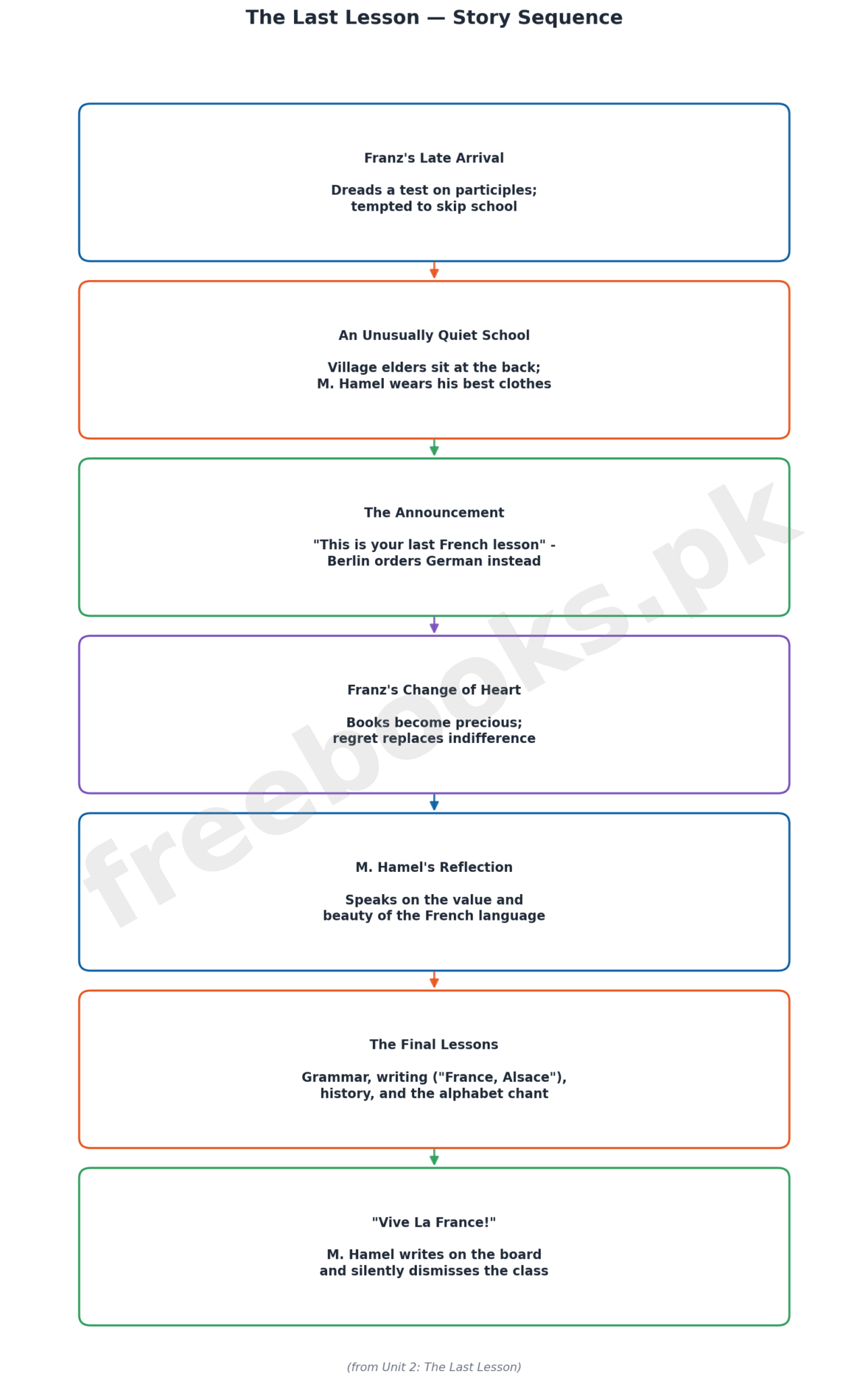
The Last Lesson — Story Sequence: A purely textual/schematic timeline of the key events of the story, from Franz's late arrival through M. Hamel's announcement, the final lessons, and the closing 'Vive La France!' scene, shown as labelled boxes connected by a single line.
Short Questions & Answers
Why was Franz afraid of going to school that morning?
He was in dread of a scolding because M. Hamel had said he would question the class on participles, and Franz did not know the rule at all.
What tempted Franz to skip school and spend the day outside?
The warm, bright weather, the chirping birds at the edge of the woods, and the sight of Prussian soldiers drilling in the open field tempted him more than facing the participle rule.
What unusual things did Franz notice when he reached the school?
Instead of the usual bustle and noise, the school was completely still; M. Hamel was dressed in his fine green coat, frilled shirt, and black silk cap; and village elders were seated quietly on the normally empty back benches.
Why were the village people sitting at the back of the classroom?
They were sitting there because they regretted not having attended school more often, and their presence was their way of thanking M. Hamel for his forty years of faithful service and showing respect for their country, which was theirs no more.
What news had come from the bulletin-board near the town hall?
For the past two years, the bulletin-board had brought only bad news — lost battles, the draft, and orders from the commanding officer; on this day it announced the order from Berlin replacing French with German in local schools.
What did M. Hamel say about the French language?
He said French was the most beautiful language in the world, the clearest and most logical, and that people must guard it carefully, because holding fast to one's language when enslaved is like holding the key to one's prison.
How did Franz's feelings about school, books, and M. Hamel change during the lesson?
His books, once seen as a nuisance, suddenly felt like old friends he could not give up, and his irritation with M. Hamel's strictness turned into sorrow at the thought of never seeing him again.
What emotions did the people in the classroom feel during the last lesson? Give two examples.
Old Hauser cried while spelling along with the alphabet chant, his voice trembling with emotion; M. Hamel himself grew so choked with emotion at the end that he could not finish speaking to the class.
Why did M. Hamel wear his special clothes that day?
He wore his fine Sunday-clothes in honour of this last lesson, marking the solemn importance of the occasion after forty years of teaching.
What was the significance of the phrase 'Vive La France' written on the blackboard?
It was M. Hamel's final, wordless expression of patriotism and love for his country and language, written with all his strength as a farewell tribute at the very end of French instruction in the school.
Long Questions & Answers
Describe how Franz's attitude towards school, his books, and his teacher changes over the course of the story.
How does Franz feel about school at the beginning of the story?
At the start, Franz dreads school because he fears being questioned on participles he has not learned, and he is even tempted to skip school entirely for a day outdoors, seeing his books and lessons as a burden.
What causes Franz's attitude to change?
M. Hamel's announcement that this is the last French lesson, due to the order from Berlin replacing French with German, strikes Franz like a thunder-clap and makes him instantly regret not having learned his lessons properly.
How does Franz's view of his books and M. Hamel change after the announcement?
His books, which had seemed such a nuisance a while before, suddenly feel like old friends he cannot give up, and his frustration with M. Hamel's strict ruler and crankiness is replaced by sorrow at the idea of never seeing him again.
What does this change in Franz reveal about the story's theme?
It shows how people often only realise the value of their language, education, and teachers when faced with losing them, reinforcing the story's central theme of language as a precious part of one's identity and heritage.
Discuss the significance of M. Hamel's final lesson and his closing message to the class.
Why does M. Hamel dress so formally and why are village elders present?
M. Hamel wears his fine Sunday-clothes in honour of the occasion, marking the seriousness of the last lesson after forty years of teaching. The village elders, including old Hauser, sit quietly on the back benches out of regret for not attending school more and to thank M. Hamel for his years of service.
What does M. Hamel say about the French language, and why is it important?
He calls French the most beautiful, clearest, and most logical language in the world, and tells the class to guard it carefully, since holding on to one's own language, even under oppression, is like holding the key to one's prison.
How does M. Hamel conduct the rest of the day's lessons?
He patiently teaches grammar, writing (using copies reading 'France, Alsace'), history, and the youngest pupils' alphabet chant, sitting motionless at times as if trying to memorise every detail of the schoolroom before he must leave it.
How does the story end, and what does M. Hamel's final gesture mean?
At noon, overcome with emotion and unable to speak, M. Hamel writes 'Vive La France!' on the blackboard with all his strength, then gestures silently that school is dismissed — a powerful, wordless expression of patriotism and farewell that captures the story's central message.
Multiple Choice Questions (MCQs)
Who is the narrator of the story? (A) Hamel (B) Franz (C) Hauser (D) Wachter
Correct answer: (B) Franz. Franz, a French schoolboy in Alsace, narrates the story.
What subject was Franz dreading to be questioned on? (A) history (B) grammar (C) participles (D) vocabulary
Correct answer: (C) participles. Franz feared being questioned on the rule for participles, which he had not learned.
French was being replaced with ______ in schools? (A) German (B) Spanish (C) Latin (D) English
Correct answer: (A) German. The order from Berlin required only German to be taught in the schools of Alsace and Lorraine.
What did the bulletin-board usually bring? (A) weather (B) good news (C) bad news (D) holidays
Correct answer: (C) bad news. For two years, the bulletin-board had only brought bad news such as lost battles and drafts.
Who wore a three-cornered hat? (A) Franz (B) M. Hamel (C) Hauser (D) Wachter
Correct answer: (C) Hauser. Old Hauser, the former mayor, wore a three-cornered hat and sat at the back of the classroom.
What did the villagers come to the school for? (A) to protest (B) to say goodbye (C) to show respect (D) to learn German
Correct answer: (C) to show respect. The villagers came to show their respect for M. Hamel's forty years of service and for their country.
What did M. Hamel wear for the last lesson? (A) uniform (B) suit (C) casuals (D) Sunday-clothes
Correct answer: (D) Sunday-clothes. M. Hamel wore his fine Sunday-clothes in honour of the last lesson.
Which language had been taught in the school before the order from Berlin? (A) English (B) Spanish (C) French (D) Prussian
Correct answer: (C) French. French had been the language of instruction before Berlin ordered German to replace it.
What did M. Hamel write on the blackboard? (A) France Forever (B) Long Live France (C) Vive La France (D) Goodbye France
Correct answer: (C) Vive La France. M. Hamel wrote 'Vive La France!' on the blackboard as his final act before dismissing the class.
What time did the church-clock strike at the end? (A) eleven (B) twelve (C) one (D) ten
Correct answer: (B) twelve. The church-clock struck twelve, followed by the Angelus, signalling the end of the last lesson.
Quick Revision Summary
- 'The Last Lesson' is a short story by Alphonse Daudet, narrated by the schoolboy Franz.
- Franz nearly skips school, fearing a test on participles, but arrives to find the classroom unusually quiet and solemn.
- M. Hamel, dressed in his best clothes, announces this is the last French lesson, as Berlin has ordered only German to be taught.
- Village elders, including old Hauser, sit at the back of the room to honour M. Hamel and show regret for not attending school more.
- Franz's attitude changes instantly: his books become precious and his feelings for M. Hamel turn to sorrow and affection.
- M. Hamel calls French the most beautiful and logical language and urges the class to guard it, comparing it to a key to freedom.
- The class works through grammar, writing ('France, Alsace'), history, and the alphabet chant in complete, emotional silence.
- At noon, overcome with emotion, M. Hamel writes 'Vive La France!' on the blackboard and silently dismisses the class.
- The story's theme is language as a symbol of identity, culture, and national pride, often appreciated only when threatened.
Exam Tips
- This unit is a short story — practise identifying narrative structure (beginning, rising action, climax, resolution) since exams often test how the author's structural choices affect meaning.
- Learn the glossary words with their exact textbook meanings; synonym-in-context questions are commonly drawn from unit glossaries.
- Memorise the sequence of events (late arrival, unusual quiet, announcement, recitation, final lessons, 'Vive La France!') so long answers stay in the correct order.
- Review the difference between adjectival, prepositional, and adverbial phrases with your own examples, since this unit's Vocabulary and Grammar section tests all three directly.
- Practise the editing and proofreading exercise style shown in this unit — spotting spelling, grammar, and punctuation errors is a recurring skill-based question type.
- When answering questions about the story's theme, connect specific details (the copies reading 'France, Alsace', M. Hamel's final words) to the broader idea of language as identity.