
This unit presents 'Journey to Taif' by Sayyid Abul Hasan Ali Hasani Nadwi, a non-fictional/biographical account of Hazrat Muhammad's (ﷺ) journey to the city of Taif in 619-620 CE, roughly three years before the Hijrah, during one of the most difficult periods of his (ﷺ) life.
The passage recounts how, after the deaths of his (ﷺ) uncle Hazrat Abu Talib and his (ﷺ) wife Hazrat Khadija-tul-Kubra (رضي الله تعالى عنها) and amid severe persecution in Makkah, Hazrat Muhammad (ﷺ) travelled on foot to Taif with his (ﷺ) adopted son Hazrat Zayd bin Haritha (رضي الله تعالى عنه) to preach Tawheed, only to be rejected, mocked, and stoned by the people there.
These notes summarise the passage as given in the textbook, preserving the honorifics used, and provide comprehension questions, vocabulary, and exam-oriented material for this unit, including the skill-based Reading, Vocabulary/Grammar, Oral Communication, and Writing sections that accompany it.
Learning Objectives
- Listen to texts and critically analyse the situations and events described in them.
- Read with correct pronunciation, appropriate pitch, and voice variation suitable for fictional and nonfictional texts.
- Ask and answer higher-order questions to guide and assess reading (e.g. why the author says something, why a particular word is chosen, how events compare with other readings).
- Comprehend and use contemporary idioms and proverbs in different texts and in speech.
- Produce clear and coherent writing in which development, organisation, and style are appropriate to the task, purpose, and audience.
Key Concepts
Background and Circumstances of the Journey
Hazrat Muhammad (ﷺ) undertook the journey to Taif in 619-620 CE, during the tenth year of his (ﷺ) Nabuwat (prophethood), about three years before the Hijrah (Migration). These were among the most crucial and critical years of his (ﷺ) life, as both his (ﷺ) well-wishers, Hazrat Abu Talib and Hazrat Khadija-tul-Kubra (رضي الله تعالى عنها), had passed away.
The Quraysh of Makkah had subjected Hazrat Muhammad (ﷺ) and his (ﷺ) companions (Sahabah, رضي الله تعالى عنهم) to severe brutality, boycott, blockade, and economic sanctions, making life in Makkah almost impossible. He (ﷺ) was in great need of spiritual peace, consolation, and moral support to continue delivering his (ﷺ) message of Tawheed (the Oneness of Allah).
In these conditions, Hazrat Muhammad (ﷺ), accompanied by his (ﷺ) adopted son Hazrat Zayd bin Haritha (رضي الله تعالى عنه), set out on foot towards Taif in the burning heat of the sun, visiting and preaching Tawheed to different tribes along the way.
Rejection by the Chiefs of Taif
The tribe of Banu Thaqeef resided in Taif, which was known for its rare greenery and cool climate in Arabia, and this had made its people very proud. The city's three chiefs — 'Abdyalayl, Mas'ud, and Habeeb — were brothers, and Hazrat Muhammad (ﷺ) met them first to deliver the message of Islam.
Each chief responded dismissively: one said he would shave his beard in front of the Ka'bah if Hazrat Muhammad (ﷺ) were truly a messenger of Allah; another mocked him for lacking wealth or status befitting a messenger; the third refused to engage at all, saying it was too risky either to accept or reject the claim. Hazrat Muhammad (ﷺ) asked them only to keep their views to themselves so others would not be misguided.
Persecution by the People of Taif
Undeterred, Hazrat Muhammad (ﷺ) began preaching to the people of Taif directly. The three chiefs instigated their slaves and street children to chase him (ﷺ), and when he (ﷺ) began delivering a sermon, they pelted him (ﷺ) with stones, causing severe injuries; blood trickled down to his (ﷺ) shoes and clotted there.
Forced to take refuge inside an orchard belonging to 'Otba and Shayba, sons of Rabi'a, Hazrat Muhammad (ﷺ) received some respite. On one occasion during the ordeal, mischief-mongers called him (ﷺ) names, clapped, and shouted at him (ﷺ) so relentlessly that he was compelled to seek shelter there.
The Episode of Addaas
Seeing his (ﷺ) miserable condition, 'Otba and Shayba took pity on him and sent grapes on a plate through their slave, Addaas. When Hazrat Muhammad (ﷺ) said 'Bismillah' before eating, Addaas was struck by the unfamiliar words and, in conversation, revealed he was a Christian originally from Naynawa (Nineveh).
Hearing this, Hazrat Muhammad (ﷺ) asked if Addaas knew of the pious Hazrat Yunus bin Matta (عليه السلام), and upon learning that Hazrat Muhammad (ﷺ) called him 'my brother' — since both were Rusul (messengers) of Allah — Addaas leaned toward him (ﷺ) in eagerness and kissed his (ﷺ) head, hands, and feet. When Addaas returned, 'Otba and Shayba scolded and rebuked him for this, warning him not to abandon his own faith.
Severe Injury and the Prophet's Supplication (Dua)
On one occasion of preaching in Taif, Hazrat Muhammad (ﷺ) received such serious injuries that he (ﷺ) fell unconscious. Hazrat Zayd bin Haritha (رضي الله تعالى عنه) carried him (ﷺ) on his back out of the city and sprinkled water on his (ﷺ) face until he (ﷺ) regained consciousness.
Although not a single person in Taif accepted Islam despite this immense suffering, his (ﷺ) heart remained full of faith in Allah's grandeur and love. He (ﷺ) offered a supplication expressing the feebleness of his strength, his reliance on Allah as the Protector of the oppressed and helpless, and his hope for Allah's pleasure rather than wrath, seeking refuge in the effulgence of Allah's Being.
The Offer of the Angels and the Prophet's Forgiveness
His (ﷺ) miserable and pathetic condition moved both heaven and earth. Archangel Hazrat Jibreel (عليه السلام), along with the Angel of the Mountains (Malakal-Jibal), appeared and sought his (ﷺ) permission to crush the town by overturning the mountains upon it.
Hazrat Muhammad (ﷺ), an embodiment of mercy and compassion, preferred forgiveness to vengeance and declared that he hoped Allah would instead bring forth from the descendants of the people of Taif those who would worship Allah alone, without associating any partners with Him.
Theme and Significance
The theme of this unit is the unwavering faith, patience, and compassion of Hazrat Muhammad (ﷺ) in the face of extreme hardship and rejection. It highlights his (ﷺ) dedication to spreading the message of Tawheed despite ridicule, insult, and physical harm, and reflects the struggles that often accompany truth and reform.
The episode with Addaas shows how sincerity and truth can touch hearts even in difficult circumstances, while the supplication demonstrates humility, deep reliance on Allah, and spiritual strength. His (ﷺ) forgiveness of the people of Taif, choosing not to curse them despite their cruelty, stands as the unit's central moral lesson — a lesson later vindicated when the people of Madinah embraced the same message that Taif had rejected.
About the Author
Sayyid Abul Hasan Ali Hasani Nadwi was a renowned Islamic scholar, thinker, and writer of the 20th century. Born into a respected scholarly family, he received his early education at home before studying at the famous institution Darul Uloom Nadwatul Ulama.
He dedicated his life to the revival of Islamic thought and the intellectual and spiritual uplift of Muslims worldwide, and as a prolific author wrote many influential books, including Islam and the World and Saviours of Islamic Spirit. Sayyid Nadwi passed away in 1999, leaving behind a lasting legacy as a reformer, educator, and global Islamic leader.
Important Definitions (Glossary)
arrogance
overconfidence with disrespect toward others
befit
to be suitable or appropriate for
brutality
extreme cruelty or violence
eagerness
strong desire or excitement to do something
effulgence
great brightness; shining light
feebleness
weakness; lack of strength
grandeur
greatness; beauty and impressiveness
instigated
provoked
magnanimity
generosity and kindness
miserable
very unhappy or uncomfortable
native
a person associated with a place by birth
oppressed
treated cruelly or unfairly
rebuked
spoke to someone angrily
resided
lived in a place
scolded
angrily criticized someone
serious
thoughtful, important
Key Facts
| Item | Detail |
|---|---|
| Author | Sayyid Abul Hasan Ali Hasani Nadwi |
| Text type | Non-fictional / biographical recount |
| Year of the journey | 619-620 CE, 10th year of Nabuwat, ~3 years before Hijrah |
| Companion on the journey | Hazrat Zayd bin Haritha (رضي الله تعالى عنه) |
| Tribe of Taif | Banu Thaqeef |
| Three chiefs of Taif | 'Abdyalayl, Mas'ud, and Habeeb (brothers) |
| Owners of the orchard | 'Otba and Shayba, sons of Rabi'a |
| Slave who brought grapes | Addaas (a Christian from Naynawa/Nineveh) |
| Angels who appeared | Hazrat Jibreel (عليه السلام) and the Angel of the Mountains |
| Central theme | Patience, faith, and forgiveness in the face of persecution |
Diagram
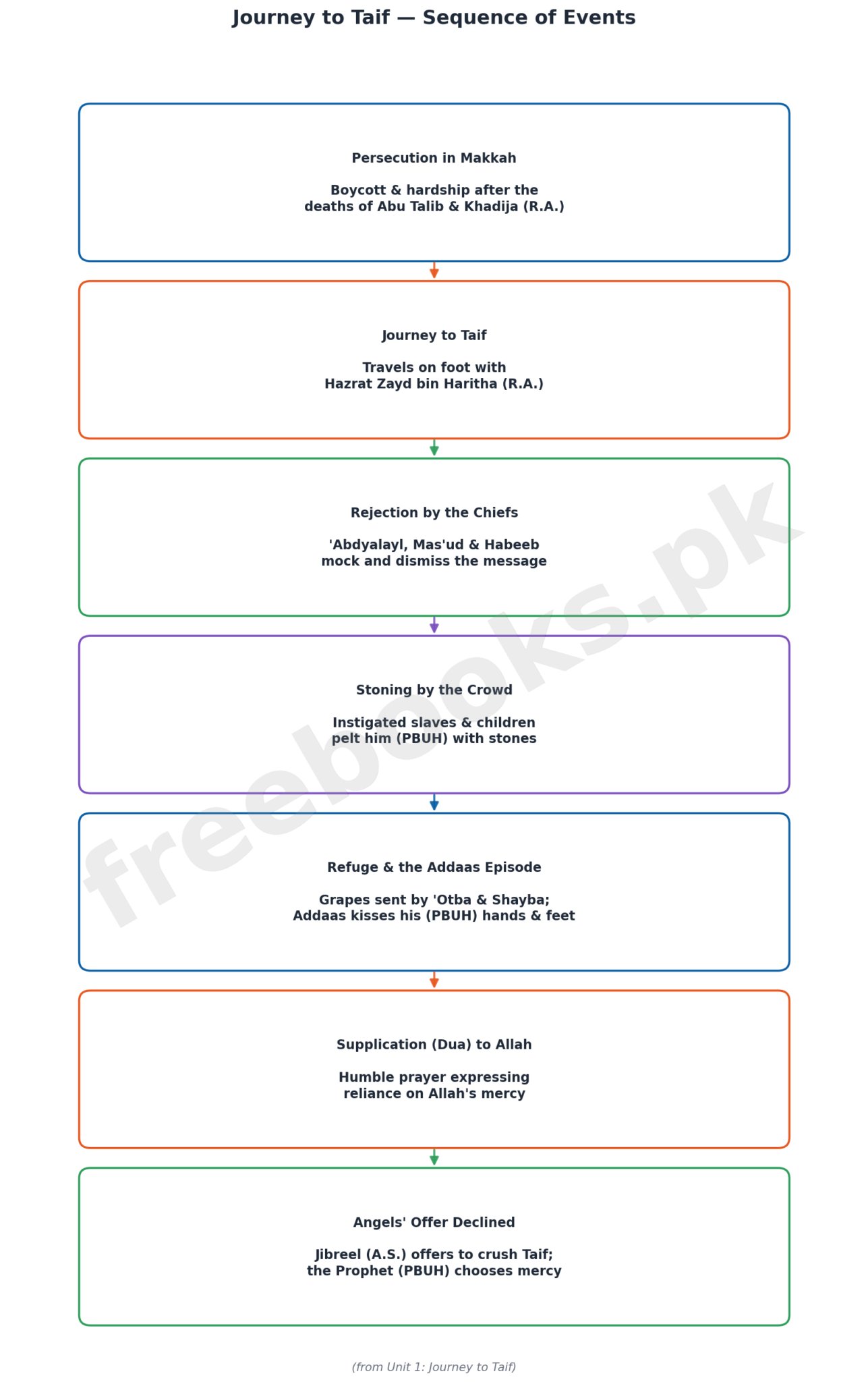
Journey to Taif — Sequence of Events: A purely textual/schematic timeline of the key events of the journey to Taif as described in the passage, from the circumstances that prompted the journey through to the Prophet's (ﷺ) forgiveness of the people of Taif, shown as labelled boxes connected by a single line (no illustrated human figures).
Short Questions & Answers
Why did Hazrat Muhammad (ﷺ) travel to Taif?
After the deaths of Hazrat Abu Talib and Hazrat Khadija-tul-Kubra (رضي الله تعالى عنها) and amid severe persecution, boycott, and economic sanctions by the Quraysh in Makkah, he (ﷺ) was in great need of spiritual peace and support to deliver his (ﷺ) message of Tawheed, so he (ﷺ) travelled to Taif to preach.
How did the chiefs of Taif respond to the message of Islam?
All three chiefs responded dismissively: one mockingly said he would shave his beard in front of the Ka'bah if the claim were true; another mocked him for lacking the wealth or status of a typical messenger; the third refused to engage at all, calling it too risky either to accept or reject the claim.
What did Hazrat Muhammad (ﷺ) ask the chiefs at the end of his meeting with them?
He (ﷺ) asked them only to keep their views to themselves, so that others would not be misguided by their dismissive remarks.
How did the people of Taif treat Hazrat Muhammad (ﷺ) when he (ﷺ) preached to the public?
The chiefs instigated their slaves and street children to chase him (ﷺ), and when he (ﷺ) began delivering a sermon, they pelted him (ﷺ) with stones, causing severe injuries so that blood trickled down to his (ﷺ) shoes and clotted there.
Who was Addaas, and what was his response to his meeting with Hazrat Muhammad (ﷺ)?
Addaas was a Christian slave from Naynawa (Nineveh) belonging to 'Otba and Shayba. On hearing Hazrat Muhammad (ﷺ) call Hazrat Yunus bin Matta (عليه السلام) his brother and identify himself as a Rasool too, Addaas leaned toward him (ﷺ) in eagerness and kissed his (ﷺ) head, hands, and feet.
What happened to Hazrat Muhammad (ﷺ) when he (ﷺ) was severely injured during his (ﷺ) preaching?
He (ﷺ) fell unconscious from his injuries. Hazrat Zayd bin Haritha (رضي الله تعالى عنه) carried him (ﷺ) on his back out of the city and sprinkled water on his (ﷺ) face until he (ﷺ) regained consciousness.
What does the supplication (dua) of Hazrat Muhammad (ﷺ) reveal about his (ﷺ) character and faith?
The dua reveals his (ﷺ) humility, his acknowledgement of the feebleness of his own strength, and his deep reliance on Allah as the Protector of the oppressed and helpless, along with his hope for Allah's mercy and pleasure rather than His wrath.
Why did Hazrat Muhammad (ﷺ) refuse to curse the people of Taif despite their cruel behaviour?
When the angels offered to crush Taif between its mountains, he (ﷺ) declined, saying he hoped instead that Allah would bring forth from their descendants people who would worship Allah alone — choosing forgiveness over vengeance.
Long Questions & Answers
Describe the hardships Hazrat Muhammad (ﷺ) faced during his journey to Taif and explain how he (ﷺ) responded to them.
What circumstances in Makkah led Hazrat Muhammad (ﷺ) to undertake the journey to Taif?
The journey took place in 619-620 CE, about three years before the Hijrah, after the deaths of his (ﷺ) uncle Hazrat Abu Talib and his (ﷺ) wife Hazrat Khadija-tul-Kubra (رضي الله تعالى عنها). The Quraysh had subjected him (ﷺ) and his (ﷺ) companions to severe brutality, boycott, and economic sanctions, making life in Makkah almost impossible, and he (ﷺ) needed spiritual peace and support to continue his (ﷺ) mission.
How did the chiefs and people of Taif treat Hazrat Muhammad (ﷺ)?
The three chiefs of Taif — 'Abdyalayl, Mas'ud, and Habeeb — dismissed and mocked his (ﷺ) message. When he (ﷺ) preached to the wider public, the chiefs instigated slaves and street children to chase and stone him (ﷺ), causing severe injuries, and he (ﷺ) was once forced to take refuge in an orchard to escape the mob.
How did Hazrat Muhammad (ﷺ) respond to this treatment, both at the time and afterwards?
Despite the pain and rejection, he (ﷺ) remained patient and continued preaching wherever possible. When severely injured and left unconscious, he (ﷺ) was carried to safety by Hazrat Zayd bin Haritha (رضي الله تعالى عنه); afterwards, rather than seeking revenge, he (ﷺ) offered a humble supplication to Allah and ultimately chose forgiveness over the angels' offer of punishment.
What does this episode reveal about the character of Hazrat Muhammad (ﷺ)?
It reveals extraordinary patience, spiritual strength, and endurance in the face of extreme suffering, as well as unwavering dedication to his (ﷺ) mission of spreading Tawheed even when met with total rejection. Above all, it reveals his (ﷺ) mercy and compassion, since he (ﷺ) chose to hope for the future guidance of Taif's descendants rather than their destruction.
Discuss the significance of the episode of Addaas and the Prophet's (ﷺ) supplication (dua) at Taif.
Who was Addaas, and what happened when he met Hazrat Muhammad (ﷺ)?
Addaas was a Christian slave from Naynawa (Nineveh), sent by 'Otba and Shayba to bring grapes to Hazrat Muhammad (ﷺ) after they saw his (ﷺ) miserable condition. Struck by hearing 'Bismillah' and by Hazrat Muhammad's (ﷺ) knowledge of Hazrat Yunus bin Matta (عليه السلام), Addaas kissed his (ﷺ) head, hands, and feet in eagerness, though his masters later scolded him for it.
What does the Addaas episode show about the power of sincerity and truth?
It shows that sincerity and truth can touch even a single receptive heart amid a hostile crowd — Addaas's response stands in sharp contrast to the outright rejection of the chiefs and the mob, suggesting that the message of Tawheed could move people regardless of status or nationality.
What did Hazrat Muhammad (ﷺ) express in his (ﷺ) supplication after being injured?
He (ﷺ) expressed the feebleness of his own strength and resources, his complete reliance on Allah as the Protector of the oppressed and helpless, and his hope that Allah's grant of well-being would be immense to him regardless of his hardship, seeking refuge in the effulgence of Allah's Being.
How did Hazrat Muhammad (ﷺ) respond when the angels offered to punish the people of Taif?
When Hazrat Jibreel (عليه السلام) and the Angel of the Mountains sought his (ﷺ) permission to crush Taif between its mountains, Hazrat Muhammad (ﷺ), embodying mercy and forbearance, declined and instead expressed hope that Allah would bring forth from their descendants people who would worship Him alone.
Multiple Choice Questions (MCQs)
Why did Hazrat Muhammad (ﷺ) go to Taif? (A) to trade (B) to visit relatives (C) to preach (D) to fight
Correct answer: (C) to preach. He (ﷺ) travelled to Taif to preach the message of Tawheed after facing severe persecution in Makkah.
Who accompanied Hazrat Muhammad (ﷺ) on this journey? (A) Hazrat Abu Bakr (رضي الله تعالى عنه) (B) Hazrat Umar (رضي الله تعالى عنه) (C) Hazrat Zayd bin Haritha (رضي الله تعالى عنه) (D) Hazrat Ali (رضي الله تعالى عنه)
Correct answer: (C) Hazrat Zayd bin Haritha (رضي الله تعالى عنه). He (ﷺ) was accompanied by his (ﷺ) adopted son, Hazrat Zayd bin Haritha (رضي الله تعالى عنه).
Which tribe lived in Taif? (A) Banu Hashim (B) Banu Quraysh (C) Banu Thaqeef (D) Banu Aws
Correct answer: (C) Banu Thaqeef. The tribe of Banu Thaqeef resided in Taif.
What made the people of Taif proud? (A) their wealth (B) their cool climate (C) their army (D) their trade
Correct answer: (B) their cool climate. The rare greenery and cool climate of Taif, uncommon in Arabia, had made its people very proud.
How did the chiefs of Taif respond to the message? (A) They accepted Islam immediately. (B) They listened respectfully. (C) They ridiculed and rejected him (ﷺ). (D) They asked for time to think.
Correct answer: (C) They ridiculed and rejected him (ﷺ).. All three chiefs responded with mockery and outright rejection of the message.
What did the chiefs do after rejecting the message? (A) They ignored him (ﷺ). (B) They helped him (ﷺ). (C) They ordered people to throw stones at him (ﷺ). (D) They sent him (ﷺ) away politely.
Correct answer: (C) They ordered people to throw stones at him (ﷺ).. The chiefs instigated their slaves and street children to chase and stone Hazrat Muhammad (ﷺ).
Who sent grapes to Hazrat Muhammad (ﷺ)? (A) the chiefs of Taif (B) a group of villagers (C) 'Otba and Shayba (D) Hazrat Zayd (رضي الله تعالى عنه)
Correct answer: (C) 'Otba and Shayba. 'Otba and Shayba, the owners of the orchard, took pity on him (ﷺ) and sent grapes through their slave, Addaas.
Who was Addaas? (A) a chief of Taif (B) a slave who served grapes (C) a soldier (D) a traveler
Correct answer: (B) a slave who served grapes. Addaas was a Christian slave of 'Otba and Shayba who brought grapes to Hazrat Muhammad (ﷺ).
What did the angels offer to do at Taif? (A) Build a mosque (B) Crush the town between its mountains (C) Send rain (D) Guide the chiefs to Islam directly
Correct answer: (B) Crush the town between its mountains. Hazrat Jibreel (عليه السلام) and the Angel of the Mountains offered to crush Taif by overturning the mountains upon it.
What did Hazrat Muhammad (ﷺ) hope for instead of punishing Taif? (A) That the people would be exiled (B) That their descendants would worship Allah alone (C) That Makkah would attack Taif (D) That Taif would be renamed
Correct answer: (B) That their descendants would worship Allah alone. He (ﷺ) declared he hoped Allah would bring forth from their descendants people who would worship Allah alone.
Quick Revision Summary
- 'Journey to Taif' is a non-fictional passage by Sayyid Abul Hasan Ali Hasani Nadwi.
- The journey took place in 619-620 CE, the 10th year of Nabuwat, about 3 years before the Hijrah.
- Hazrat Muhammad (ﷺ) was accompanied by Hazrat Zayd bin Haritha (رضي الله تعالى عنه).
- The tribe of Banu Thaqeef lived in Taif; its three chiefs were 'Abdyalayl, Mas'ud, and Habeeb.
- The chiefs mocked and rejected the message; their slaves and street children stoned Hazrat Muhammad (ﷺ).
- 'Otba and Shayba sent grapes via their slave Addaas, who was moved to kiss the Prophet's (ﷺ) hands and feet.
- Injured and unconscious, Hazrat Muhammad (ﷺ) was carried to safety by Hazrat Zayd bin Haritha (رضي الله تعالى عنه).
- The angels offered to crush Taif, but Hazrat Muhammad (ﷺ) chose forgiveness over vengeance.
- The theme is unwavering faith, patience, and compassion in the face of extreme hardship and rejection.
Exam Tips
- This unit is a non-fictional/biographical recount — practise identifying its structure (context, events, dialogue, dua, resolution) since exams often test recognition of text type and purpose.
- Learn the glossary words with their exact textbook meanings; synonym-in-context questions are commonly drawn from unit glossaries.
- Memorise the sequence of events (background, chiefs' rejection, stoning, Addaas episode, dua, angels' offer, forgiveness) so long answers stay in the correct order.
- Practise reading the Prophet's (ﷺ) dua aloud with appropriate tone and pacing, since this unit's skill focus includes pitch and voice variation for nonfictional texts.
- Review the difference between an idiom and a proverb with your own examples, as this unit's Vocabulary and Grammar section tests that distinction directly.
- Maintain a formal, respectful tone and stick strictly to facts from the text when answering questions about Hazrat Muhammad (ﷺ); avoid inserting personal opinions or unsupported details.