A differential equation is an equation that involves at least one derivative of a dependent variable with respect to an independent variable. First proposed by Newton and Leibniz during the development of calculus, differential equations describe how a quantity changes — velocity is the derivative of position, population growth depends on current population, and cooling depends on the temperature gap with the surroundings. This unit begins by classifying differential equations by order and degree, then shows how real situations (population growth, Newton's law of cooling, inflation, and electrical circuits) are translated into first-order differential equations.
The unit then develops two core solving techniques for first-order, first-degree equations: separable differential equations, which split into an x-only side and a y-only side that can be integrated directly, and homogeneous differential equations, which reduce to a separable equation after the substitution y=vx. The unit closes with a wide range of real-life applications — population growth, radioactive decay, inflation and deflation, Newton's law of cooling, and RL circuit currents — each solved by setting up and solving a first-order differential equation with a given initial condition.
Learning Objectives
- Define a differential equation and identify its order and degree
- Construct first-order differential equations from practical situations such as population growth, Newton's law of cooling, inflation/deflation, and RC/RL circuits
- Recognize and solve separable differential equations by integrating both sides after separating variables
- Recognize and solve homogeneous differential equations using the substitution y=vx
- Solve initial value problems (IVPs) by applying a given condition to find the arbitrary constant
- Apply differential equations to real-life problems: population growth/decay, radioactive decay, inflation/deflation, Newton's law of cooling, and RL circuits
Key Concepts
4.1 Definition, Order, and Degree
A differential equation involves at least one derivative of a dependent variable (commonly y) with respect to an independent variable (commonly x); when only ordinary derivatives are involved, it is called an ordinary differential equation. The order of a differential equation is the order of its highest derivative, while the degree is the greatest exponent (power) of that highest-order derivative once the equation is written as a polynomial in its derivatives.
A differential equation of order 1 is called a first-order differential equation. Constructing such equations from real situations — population growth (dP/dt=kP), Newton's law of cooling (dT/dt=k(T_s-T)), inflation/deflation (dP/dt=kP), and RC/RL circuits (RC dq/dt=CV_S-q and L dI/dt=V_S-RI, from Kirchhoff's voltage law) — is the essential first skill before any solving technique is introduced.
4.2 Separable Differential Equations
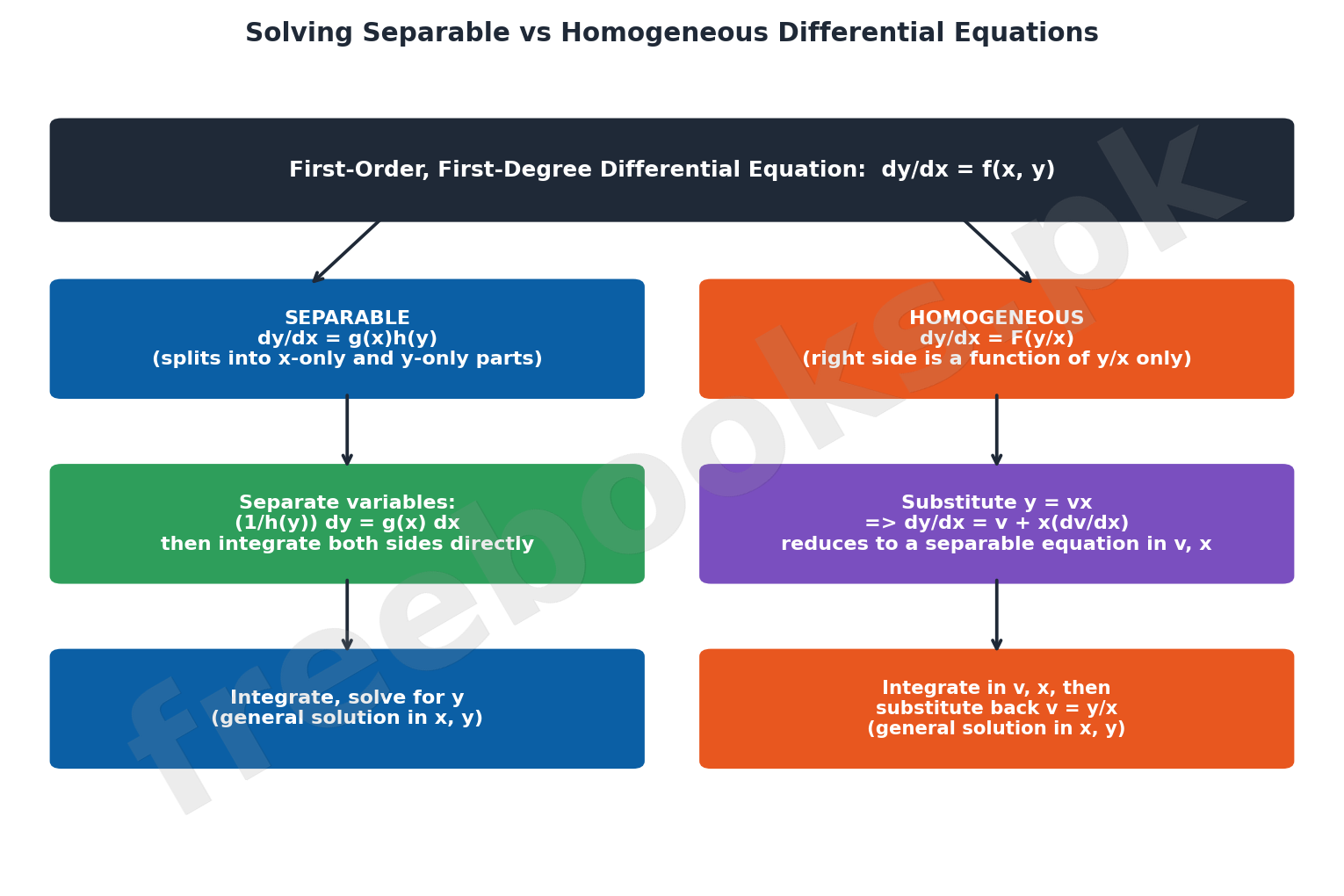
A first-order, first-degree differential equation dy/dx=f(x,y) is separable if it can be written as dy/dx=g(x)h(y), i.e. the right-hand side factors into a function of x only times a function of y only. It is solved by rewriting it as (1/h(y))dy=g(x)dx and integrating both sides independently: integral (1/h(y))dy = integral g(x)dx, giving the general solution.
A condition of the form y(x_0)=y_0 is called an initial value condition, and a differential equation together with such a condition is an Initial Value Problem (IVP); substituting the condition into the general solution pins down the arbitrary constant, giving a unique particular solution.
4.3 Homogeneous Differential Equations
A first-order, first-degree differential equation is homogeneous if it can be written as dy/dx=F(y/x), where the right-hand side depends only on the ratio y/x — every term of the numerator and denominator (if written as a fraction) has the same total degree. Equations like dy/dx=x+y are not homogeneous, since x+y cannot be expressed purely as a function of y/x.
The substitution y=vx converts a homogeneous equation into a separable one: since dy/dx=v+x(dv/dx), the equation v+x(dv/dx)=F(v) rearranges to x(dv/dx)=F(v)-v, which is separable in v and x. After integrating and substituting back v=y/x, the general solution of the original homogeneous equation is obtained.
4.4 Real-Life Applications
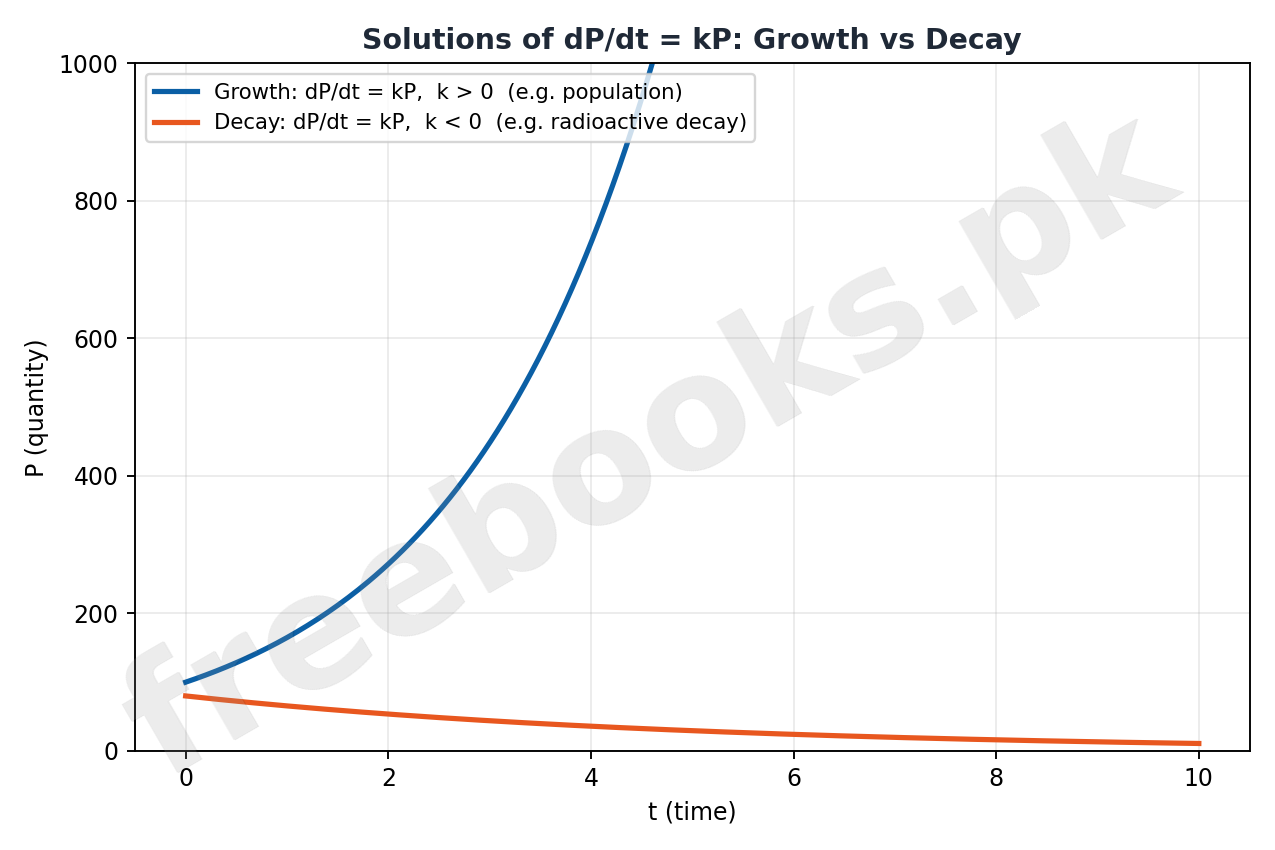
Population growth and decay follows dP/dt=kP, whose solution is P(t)=P_0 e^(kt); k>0 gives growth (e.g. bacteria cultures), k<0 gives decay (e.g. radioactive substances), and two given data points pin down both P_0 and k. The same model describes inflation (k>0) and deflation (k<0) of prices over time.
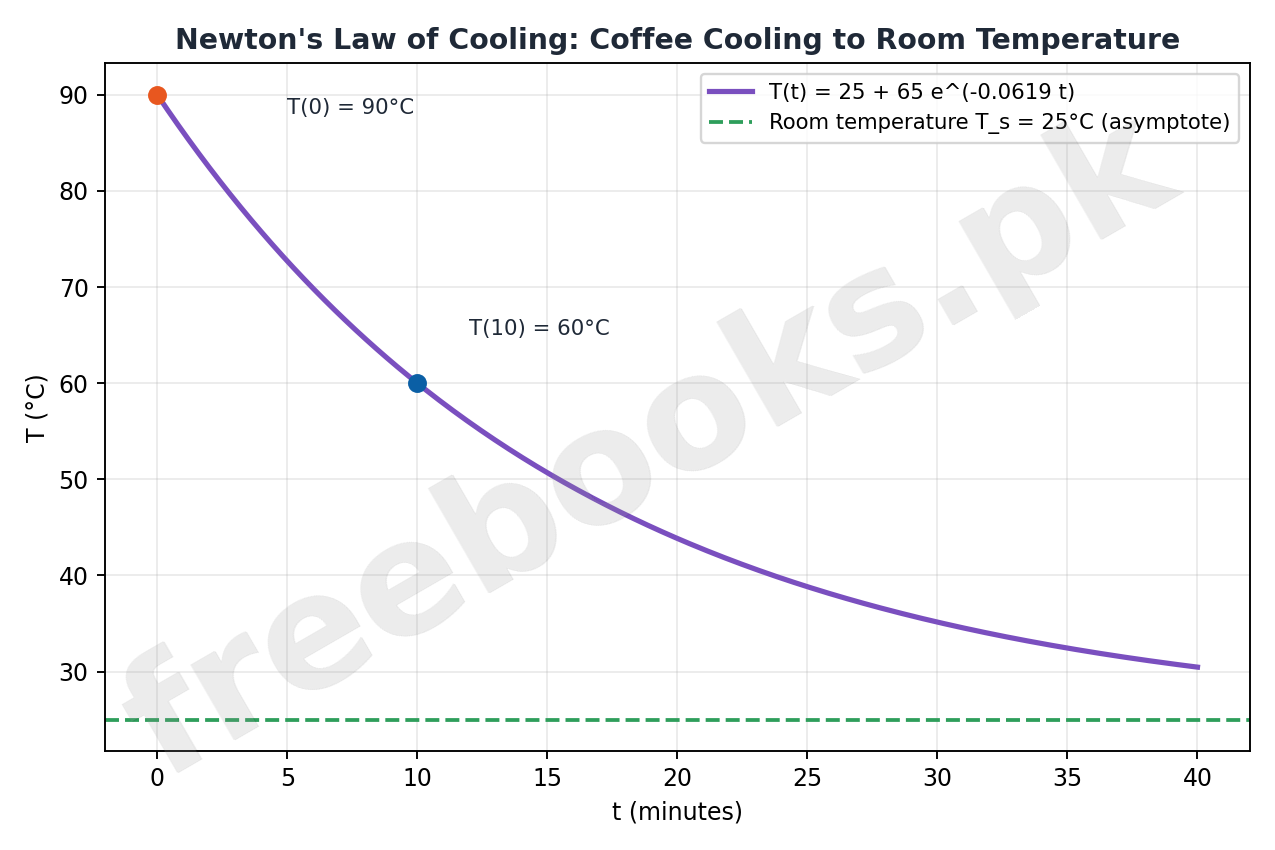
Newton's law of cooling/heating gives dT/dt=-k(T-T_s), whose solution T(t)=T_s+ce^(-kt) approaches the surrounding temperature T_s as t grows; and RL circuits governed by L(dI/dt)=V_S-RI (from Kirchhoff's voltage law) give a current I(t) that approaches the steady-state value V_S/R as t grows — both are separable equations solved the same way, using given initial and later-time data to find the constants.
Important Definitions
What is a differential equation?
An equation that involves at least one derivative of a dependent variable with respect to an independent variable.
What is the order of a differential equation?
The order of the highest derivative that appears in the differential equation.
What is the degree of a differential equation?
The greatest exponent (power) of the highest-order derivative, once the equation is written as a polynomial in its derivatives.
What is an initial value condition?
A condition of the form y(x_0)=y_0, specifying the value of the dependent variable at a particular value of the independent variable.
What is an Initial Value Problem (IVP)?
A differential equation together with an initial value condition, whose solution is a unique particular solution rather than a general family.
What is a separable differential equation?
A first-order, first-degree equation dy/dx=g(x)h(y), where the right-hand side factors into a function of x only times a function of y only.
What is a homogeneous differential equation?
A first-order, first-degree equation dy/dx=F(y/x), where the right-hand side depends only on the ratio y/x.
What substitution solves a homogeneous differential equation?
y=vx, which converts the equation into a separable equation in the variables v and x.
What does Newton's law of cooling state?
The rate of change of a body's temperature is proportional to the difference between the body's temperature and the surrounding temperature: dT/dt=k(T_s-T).
What is half-life?
The time required for a quantity of a radioactive substance to reduce to half of its initial amount due to radioactive decay.
Key Facts and Relations
| Topic | Key Fact / Relation |
|---|---|
| Population/price growth-decay model | dP/dt = kP => P(t) = P_0 e^(kt); k>0 growth, k<0 decay |
| Newton's law of cooling/heating | dT/dt = k(T_s – T) => T(t) = T_s + c e^(-kt) |
| RC circuit (charging) | RC dq/dt = CV_S – q, from V_S = q/C + IR and I = dq/dt |
| RL circuit (charging) | L dI/dt = V_S – RI, from V_S = V_L + V_R = L(dI/dt) + RI |
| Separable equation form and solution | dy/dx = g(x)h(y) => integral (1/h(y))dy = integral g(x)dx |
| Homogeneous equation form | dy/dx = F(y/x), where F depends only on the ratio y/x |
| Homogeneous substitution | y = vx => dy/dx = v + x(dv/dx) |
| Homogeneous reduces to separable | x(dv/dx) = F(v) – v => integral 1/(F(v)-v) dv = integral (1/x) dx |
| Radioactive decay model | dM/dt = -kM => M(t) = c e^(-kt), k>0 the decay constant |
| Initial value condition | y(x_0) = y_0, used to solve for the arbitrary constant in the general solution |
Diagrams
Growth vs Decay Solutions of dP/dt = kP: Two exponential curves illustrating the general solution P(t)=P_0 e^(kt): growth when k>0 (e.g. population, inflation) and decay when k<0 (e.g. radioactive decay, deflation)
Newton's Law of Cooling Curve: The curve T(t)=25+65e^(-0.0619t) for a cooling cup of coffee, approaching the room temperature asymptote T_s=25°C, matching the given data points T(0)=90 and T(10)=60
Solving Separable vs Homogeneous Differential Equations: A flowchart comparing the two solution methods: separating variables directly for a separable equation, versus substituting y=vx to reduce a homogeneous equation to a separable one before integrating
Solved Examples
Example 1: Finding Order and Degree
Problem: Find the order and degree of the differential equation sqrt(xy)(dy/dx) + (dy/dx)^2 = sin y.
- Identify the highest-order derivative present: only dy/dx (a first derivative) appears in the equation, so the order is 1.
- Check that the equation is a polynomial in dy/dx: sqrt(xy)(dy/dx) + (dy/dx)^2 – sin y = 0 is indeed a polynomial in dy/dx (no square roots or fractional powers of the derivative itself).
- Find the greatest exponent of the highest-order derivative dy/dx: the term (dy/dx)^2 has exponent 2, which is the greatest power present.
- Conclude the order and degree.
- Final answer: the differential equation has order 1 and degree 2.
Example 2: Solving a Separable Differential Equation
Problem: Find the general solution of x^2(2y+1)(dy/dx) – 1 = 0.
- Rewrite in the form dy/dx = f(x,y): dy/dx = 1/[x^2(2y+1)].
- Separate the variables by moving all y-terms to one side and x-terms to the other: (2y+1)dy = (1/x^2)dx.
- Integrate both sides: integral (2y+1)dy = integral x^(-2) dx, giving y^2+y = -1/x + C.
- Combine the constant and the 1/x term onto one side for a clean implicit form: y^2+y+1/x = C.
- Final answer: y^2 + y + 1/x = C is the general solution, where C is an arbitrary constant.
Example 3: Solving a Homogeneous Differential Equation
Problem: Find the general solution of dy/dx = (x+y)/(y-x).
- Confirm the equation is homogeneous: every term in the numerator and denominator has degree 1, so the right side is a function of y/x only.
- Substitute y=vx, so dy/dx = v + x(dv/dx): v + x(dv/dx) = (x+vx)/(vx-x) = (1+v)/(v-1).
- Isolate x(dv/dx): x(dv/dx) = (1+v)/(v-1) – v = (-v^2+2v+1)/(v-1), which separates as (v-1)/(-v^2+2v+1) dv = (1/x) dx.
- Integrate both sides: -(1/2) integral (-2v+2)/(-v^2+2v+1) dv = ln|x| + ln|c|, giving -(1/2)ln|-v^2+2v+1| = ln|cx|, i.e. -v^2+2v+1 = 1/(c^2 x^2) (up to sign).
- Substitute back v=y/x and simplify: -y^2/x^2 + 2y/x + 1 = 1/(c^2x^2), which simplifies to x^2+2xy-y^2 = c. Final answer: x^2 + 2xy – y^2 = c.
Example 4: Population Growth (IVP)
Problem: In a culture, there are 100 bacteria initially and they double in 2 hours. Find the number of bacteria 7 hours later.
- Set up the model: dN/dt = kN with N(0)=100 and N(2)=200, since the population is growing (k>0).
- Separate and integrate: integral (1/N)dN = integral k dt gives ln|N| = kt + C.
- Apply N(0)=100: C = ln(100), so N = 100 e^(kt). Apply N(2)=200: 200=100e^(2k), so e^(2k)=2, giving k = (1/2)ln2 = ln(sqrt2).
- Write the particular solution: N(t) = 100 e^((ln sqrt2) t) = 100(sqrt2)^t.
- Substitute t=7: N(7) = 100(2)^(7/2) is approximately 1131.4. Final answer: about 1131 bacteria after 7 hours.
Example 5: Radioactive Decay (Three-Part IVP)
Problem: A radioactive substance has mass 80 grams initially; after 10 hours only 50 grams remain. (a) Find the decay constant. (b) Find the mass after 24 hours. (c) After how many hours will only 20 grams remain?
- Set up the model: dM/dt = -kM, so M(t)=ce^(-kt). Apply M(0)=80 to get c=80, so M(t)=80e^(-kt).
- (a) Apply M(10)=50: 50=80e^(-10k), so k = -(1/10)ln(5/8) is approximately 0.047. This is the decay constant.
- (b) Substitute t=24 into M(t)=80e^(-0.047t): M(24) = 80e^(-0.047(24)) is approximately 25.89, so about 26 grams remain after 24 hours.
- (c) Set M(t)=20 and solve for t: 20=80e^(-0.047t) gives e^(-0.047t)=1/4, so t = ln(4)/0.047 is approximately 29.5.
- Final answer: (a) k is approximately 0.047; (b) about 26 grams remain after 24 hours; (c) 20 grams remain after approximately 29.5 hours.
Example 6: Deflation Problem in Economics
Problem: An economy experiences deflation at 4% per year. If the current price of an item is Rs. 500, find its expected price after 3 years.
- Set up the model: since prices are falling at a rate proportional to the current price, dP/dt = -0.04P.
- Separate and integrate: this is the same growth/decay form as before, so P(t) = Ce^(-0.04t).
- Apply the initial condition P(0)=500: C=500, so P(t) = 500e^(-0.04t).
- Substitute t=3: P(3) = 500e^(-0.04(3)) = 500e^(-0.12).
- Final answer: P(3) is approximately Rs. 443.46, so the expected price after 3 years is about Rs. 443.5.
Example 7: Newton's Law of Cooling
Problem: A cup of coffee is served at 90°C in a room at 25°C. After 10 minutes, it cools to 60°C. Find the temperature after 20 minutes.
- Set up the model: dT/dt = -k(T-25), which is separable: (1/(T-25))dT = -k dt.
- Integrate: ln|T-25| = -kt + ln|c|, which rearranges to T(t) = 25 + ce^(-kt).
- Apply T(0)=90: c=65, so T(t)=25+65e^(-kt). Apply T(10)=60: 60=25+65e^(-10k), giving e^(10k)=13/7, so k is approximately 0.0619.
- Write the particular solution: T(t) = 25 + 65e^(-0.0619t).
- Substitute t=20: T(20) = 25 + 65e^(-0.0619(20)) is approximately 43.85. Final answer: the coffee is about 43.85°C after 20 minutes.
Example 8: RL Circuit Current
Problem: An RL circuit has an emf of 5 volts, resistance 50 ohms, an inductor of 1 henry, and no initial current. Find the current I(t) at any time t.
- Set up the model using L(dI/dt)=V_S-RI with L=1, V_S=5, R=50: dI/dt = 5-50I.
- Separate variables: (1/5) integral 1/(1-10I) dI = integral dt, which simplifies to -(1/50)ln|1-10I| = t + C.
- Apply the initial condition I(0)=0: -(1/50)ln|1|=C, so C=0, giving -(1/50)ln|1-10I| = t.
- Solve for I: ln|1-10I| = -50t, so |1-10I| = e^(-50t); checking the initial condition confirms the positive sign, so 1-10I = e^(-50t).
- Final answer: I(t) = (1/10)(1 – e^(-50t)), which approaches the steady-state current 1/10 A as t grows large.
Short Questions & Answers
What is the order of d^2y/dx^2 + xy(dy/dx)^2 = 0?
2, since the highest derivative present is the second derivative d^2y/dx^2.
Is dy/dx = x+y a homogeneous differential equation?
No, because x+y cannot be written purely as a function of the ratio y/x.
What equation results from Kirchhoff's voltage law for an RL circuit?
L(dI/dt) + RI = V_S, i.e. L(dI/dt) = V_S – RI.
How is a homogeneous differential equation converted into a separable one?
By substituting y=vx, which turns dy/dx into v+x(dv/dx).
What is the general solution form of dP/dt=kP?
P(t) = P_0 e^(kt), where P_0 is the value of P at t=0.
In Newton's law of cooling, what does the constant T_s represent?
The constant temperature of the surrounding medium, which the body's temperature approaches over time.
What condition turns a general solution into a particular (unique) solution?
An initial value condition y(x_0)=y_0, which pins down the value of the arbitrary constant.
Long Questions & Answers
Explain how to recognize and solve a separable differential equation, including the role of the initial value condition.
How is a separable differential equation recognized?
It is a first-order, first-degree equation that can be written as dy/dx=g(x)h(y), where the right-hand side factors into a function of x only multiplied by a function of y only; if it cannot be factored this way, it is not separable.
What are the steps to solve it?
Rewrite the equation as (1/h(y))dy = g(x)dx, separating all y-terms on one side and all x-terms on the other, then integrate both sides independently to obtain the general solution.
What is an initial value condition and why is it needed?
A condition of the form y(x_0)=y_0 specifies the value of y at a particular x; without it, the general solution contains an arbitrary constant C representing an entire family of curves.
How does applying the initial condition give a unique solution?
Substituting x_0 and y_0 into the general solution and solving for C fixes its exact numerical value, turning the family of solutions into one particular solution — this combination of equation plus condition is called an Initial Value Problem (IVP).
Explain how first-order differential equations model real-life growth, decay, and cooling problems, with reference to specific examples.
How is population growth or decay modeled?
The rate of change of population is assumed proportional to the population itself, giving dP/dt=kP; solving this separable equation gives P(t)=P_0e^(kt), where k>0 models growth (e.g. bacteria) and k<0 models decay (e.g. a shrinking population).
How is radioactive decay modeled and why is it always decay?
The same proportional model applies, dM/dt=-kM with k>0 the decay constant, so the mass M(t)=ce^(-kt) always decreases over time — the negative sign is built into the model because radioactive substances only lose mass, never gain it.
How is inflation or deflation modeled in economics?
The price of a good is assumed to change at a rate proportional to its current price, dP/dt=kP, exactly like population growth; k>0 models inflation (rising prices) and k<0 models deflation (falling prices), with the solution P(t)=P_0e^(kt).
How is Newton's law of cooling different from the growth/decay model?
Instead of the rate of change being proportional to the quantity itself, it is proportional to the difference between the body's temperature and the surrounding temperature: dT/dt=k(T_s-T); solving this separable equation gives T(t)=T_s+ce^(-kt), which approaches T_s as t grows rather than approaching zero or infinity.
Multiple Choice Questions (MCQs)
The order of a differential equation is: (A) The number of terms in the equation (B) The order of the highest derivative present (C) The degree of the independent variable (D) The number of arbitrary constants
Correct answer: (B) The order of the highest derivative present. The order is defined as the order of the highest-order derivative appearing in the differential equation.
A differential equation dy/dx=g(x)h(y) is called: (A) Homogeneous (B) Linear (C) Separable (D) Exact
Correct answer: (C) Separable. This form, where the right side factors into a function of x times a function of y, defines a separable differential equation.
A homogeneous differential equation has the form: (A) dy/dx = x+y (B) dy/dx = F(y/x) (C) dy/dx = x^2+y^2 (D) dy/dx = k
Correct answer: (B) dy/dx = F(y/x). A homogeneous equation's right-hand side must be expressible purely as a function of the ratio y/x.
The substitution used to solve a homogeneous differential equation is: (A) y = x + v (B) y = vx (C) x = vy^2 (D) v = dy/dx
Correct answer: (B) y = vx. Setting y=vx converts a homogeneous equation into a separable equation in v and x.
The general solution of dP/dt = kP is: (A) P(t) = kt + C (B) P(t) = P_0 e^(kt) (C) P(t) = P_0 + kt (D) P(t) = k/P_0
Correct answer: (B) P(t) = P_0 e^(kt). Separating and integrating dP/dt=kP gives the exponential solution P(t)=P_0e^(kt).
In Newton's law of cooling dT/dt = k(T_s – T), as t increases, T(t) approaches: (A) Zero (B) Infinity (C) The surrounding temperature T_s (D) The initial temperature T_0
Correct answer: (C) The surrounding temperature T_s. The solution T(t)=T_s+ce^(-kt) has the exponential term decaying to zero, so T(t) approaches T_s.
A condition of the form y(x_0)=y_0 is called: (A) A general solution (B) A differential equation (C) An initial value condition (D) A homogeneous condition
Correct answer: (C) An initial value condition. This is the definition of an initial value (one-point boundary) condition.
For an RL circuit, Kirchhoff's voltage law gives the differential equation: (A) RC dq/dt = CV_S – q (B) L dI/dt = V_S – RI (C) dT/dt = k(T_s-T) (D) dP/dt = kP
Correct answer: (B) L dI/dt = V_S – RI. Summing the voltage across the inductor and resistor and equating to the source voltage gives L dI/dt + RI = V_S, i.e. L dI/dt = V_S – RI.
If k<0 in the model dP/dt = kP, the quantity P is: (A) Growing exponentially (B) Constant (C) Decaying exponentially (D) Oscillating
Correct answer: (C) Decaying exponentially. A negative proportionality constant makes the exponential solution P_0e^(kt) decrease over time, representing decay.
The degree of a differential equation is defined using: (A) The independent variable's highest power (B) The greatest exponent of the highest-order derivative (C) The number of derivatives present (D) The lowest-order derivative's exponent
Correct answer: (B) The greatest exponent of the highest-order derivative. Degree is the greatest exponent (power) to which the highest-order derivative is raised, once the equation is a polynomial in its derivatives.
Quick Revision Summary
- Differential equation: involves at least one derivative of a dependent variable w.r.t. an independent variable
- Order: order of the highest derivative present; Degree: greatest exponent of that highest-order derivative
- First-order models: population/price growth-decay dP/dt=kP; Newton's cooling dT/dt=k(T_s-T); RC/RL circuits from Kirchhoff's voltage law
- Separable: dy/dx=g(x)h(y); solve by (1/h(y))dy=g(x)dx then integrate both sides
- Homogeneous: dy/dx=F(y/x); solve via substitution y=vx, reducing to a separable equation in v, x
- Initial value condition y(x_0)=y_0 plus a differential equation forms an Initial Value Problem (IVP), giving a unique particular solution
- Growth/decay solution: P(t)=P_0e^(kt), k>0 growth, k<0 decay (population, inflation, radioactive decay, deflation)
- Cooling/heating solution: T(t)=T_s+ce^(-kt), approaches surrounding temperature T_s as t grows
- RL circuit current I(t) approaches the steady-state value V_S/R as t grows large
- Always identify which model (growth-decay vs cooling) a word problem matches before setting up the differential equation
Exam Tips
- Before solving, always check whether an equation is separable or homogeneous first — trying to separate a homogeneous equation directly usually fails and wastes time
- For homogeneous equations, replacing x with 1 and y with v in f(x,y) is a fast way to find F(v) without algebraic manipulation of the full fraction
- For growth/decay/cooling word problems, write down which known values represent t=0 and which represent a later time before setting up equations — this avoids mixing up which condition finds P_0/c and which finds k
- Always double check the sign of k: growth and inflation use k>0, decay and deflation use k>0 with a negative sign already built into the model (dM/dt=-kM) — read the model carefully rather than assuming
- When solving for a constant like k from an exponential equation, take the natural log of both sides only after isolating the exponential term completely
- In circuit problems, remember the steady-state current V_S/R is the value I(t) approaches as t becomes large — useful as a quick sanity check on your final answer