A chemistry laboratory is a chemist's workshop, a place where students are trained to observe the physical and chemical characteristics of substances by following definite procedures. Before starting laboratory work, students must follow general safety instructions, understand the three main categories of laboratory hazards (physical, chemical, and biological), know the correct system for chemical waste disposal, and be prepared to give first aid for common laboratory accidents such as cuts, eye injuries, burns, poisoning, and fire.
This chapter also develops core practical skills: performing an acid-base titration using a burette, pipette, and a suitable indicator to locate the end point and calculate an unknown molarity, and carrying out qualitative salt analysis — identifying acid radicals (anions) such as carbonate, chloride, bromide, iodide, nitrate, and sulfate, and basic radicals (cations) such as aluminium, ammonium, calcium, chromium, copper, iron(II), iron(III), and zinc, using characteristic reagent tests, precipitate colours, and confirmatory reactions.
Learning Objectives
- Identify chemical hazards in the lab in the context of the experiment being conducted
- Test that equipment is working properly, without risk of injury, before starting an experiment
- Keep the workspace uncrowded and maintain a safe distance from other investigators handling apparatus
- Identify the bodily harm that can occur from physical, chemical, biological, and safety hazards
- Recognize when to ask the lab instructor for help with unfamiliar apparatus
- Identify the proper waste disposal system for laboratory chemicals
- Set up apparatus following written or diagrammatic instructions, and make careful, repeatable measurements and observations
- Describe acid-base titration, including the use of a burette, volumetric pipette, and suitable indicator, and how to identify the end point
- Select reagents to distinguish between given anions and cations, and describe the standard confirmatory tests for each
Key Concepts
16.1 General Laboratory Instructions
Students must conduct themselves responsibly at all times and should never work alone in the lab; experiments should be performed in the presence of the lab instructor and other staff. Lab coats and safety goggles must always be worn, with long hair and scarves tied back. Potential hazards of any equipment or experiment must be determined before starting work, and appropriate precautions observed.
The lab should never be crowded, and students must keep a safe distance from each other's work areas. Food is not permitted in the lab, and no compound or gas should ever be tasted or smelled directly. Any accident or glassware breakage must be reported immediately to the person in charge. Students who cannot handle an instrument properly must seek help from the instructor rather than risk injury. Chemicals must never be poured down drains or into the sewer system, and all warning signs displayed in the lab must be followed.
16.2 Types of Laboratory Hazards
Laboratory hazards fall into three broad categories. Physical hazards are most commonly slips and falls on wet floors; workers must take precautions against slipping, tripping, and falling, and should wear cut-resistant gloves when handling broken glassware to prevent cuts and abrasions, with broken glass disposed of in a special container to prevent injury.
Chemical hazards require using chemicals strictly according to standard procedures, with attention to the specific hazards and precautions indicated by hazard pictograms for each substance. Biological hazards are most commonly allergens and microbes (viruses and bacteria), which can be transferred to humans from animals, plants, water, and air.
16.3 Waste Disposal and First Aid
Chemical waste cannot be disposed of in ordinary bins or the sewer system; it must follow Environmental Protection Agency (EPA) rules: store wastes in proper containers, label each container with the type of waste, the date, and its place of origin, transfer containers to an allocated treatment site, and treat the waste chemically (neutralization, precipitation, ion exchange, oxidation, or reduction) before disposal.
Every laboratory must have a first aid box. Key treatments include: for minor cuts, apply methylated spirit or tincture iodine as a disinfectant, while serious cuts need firm pressure for about 10 minutes and a doctor's attention; for acid in the eye, wash with water then 1% sodium bicarbonate solution, and for alkali in the eye, wash with water then 1% boric acid solution; for acid burns, wash freely with ice-cold water, then saturated sodium bicarbonate solution, then water again; for alkali burns, wash with water, then 1% acetic acid solution, then water, dry, and apply burnol; for bromine burns, wash fully with 2% ammonia solution and apply glycerin. Swallowed acid calls for plenty of water, lime water, or milk of magnesia; swallowed caustic alkali calls for plenty of water followed by lemon or orange juice; swallowed heavy metal salts call for milk or egg white. For fires: if clothes catch fire, do not run, wrap with a blanket or dry cloth and lie down; for a flask of flammable liquid on fire, smother it with a damp cloth to cut off oxygen; for spirit or oil fires, throw a sand and sodium bicarbonate mixture (never water, which spreads the fire); for electrical fires, switch off the power immediately and use sand, never water.
16.4 Acid-Base Titration
Volumetric analysis finds the concentration of a solution by titration: a solution of unknown concentration is combined slowly with a known volume of a standard solution until a colour change (produced by an indicator) shows the reaction is complete, a moment called the end point. Either the acid or the base is placed in a burette, with the other in a conical (titration) flask.
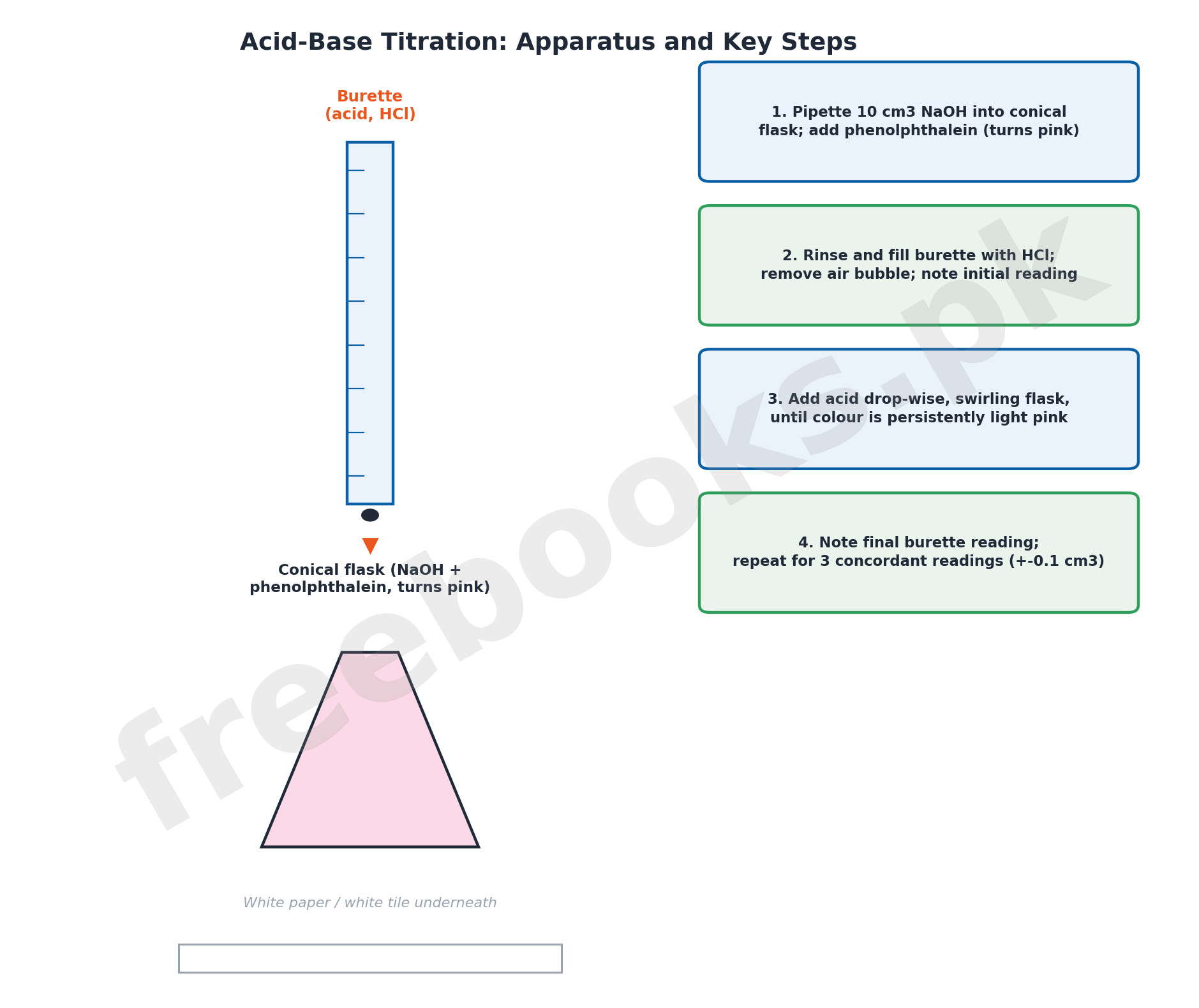
Procedure: rinse the pipette with distilled water then with the NaOH solution, and pipette 10 cm3 of NaOH into a rinsed conical flask; add 1-2 drops of phenolphthalein (solution turns pink); rinse and fill the burette with HCl using a funnel, remove any air bubble from the tip, and note the initial burette reading using an anti-parallax card; place the flask on white paper under the burette, and add acid drop-wise while swirling the flask continuously, until the colour changes to a persistent light pink — this is the end point; note the final burette reading, and repeat the titration to obtain at least three concordant readings agreeing within 0.1 cm3. The volume of acid used is the difference between final and initial burette readings.
The reaction is NaOH(aq) + HCl(aq) -> NaCl(aq) + H2O(l). The unknown molarity is found from M1V1/n1 = M2V2/n2, where M1, V1, n1 are the molarity, volume, and number of moles (in the balanced equation) of the acid, and M2, V2, n2 are the corresponding values for the base.
16.5 Identification of Anions (Acid Radicals)
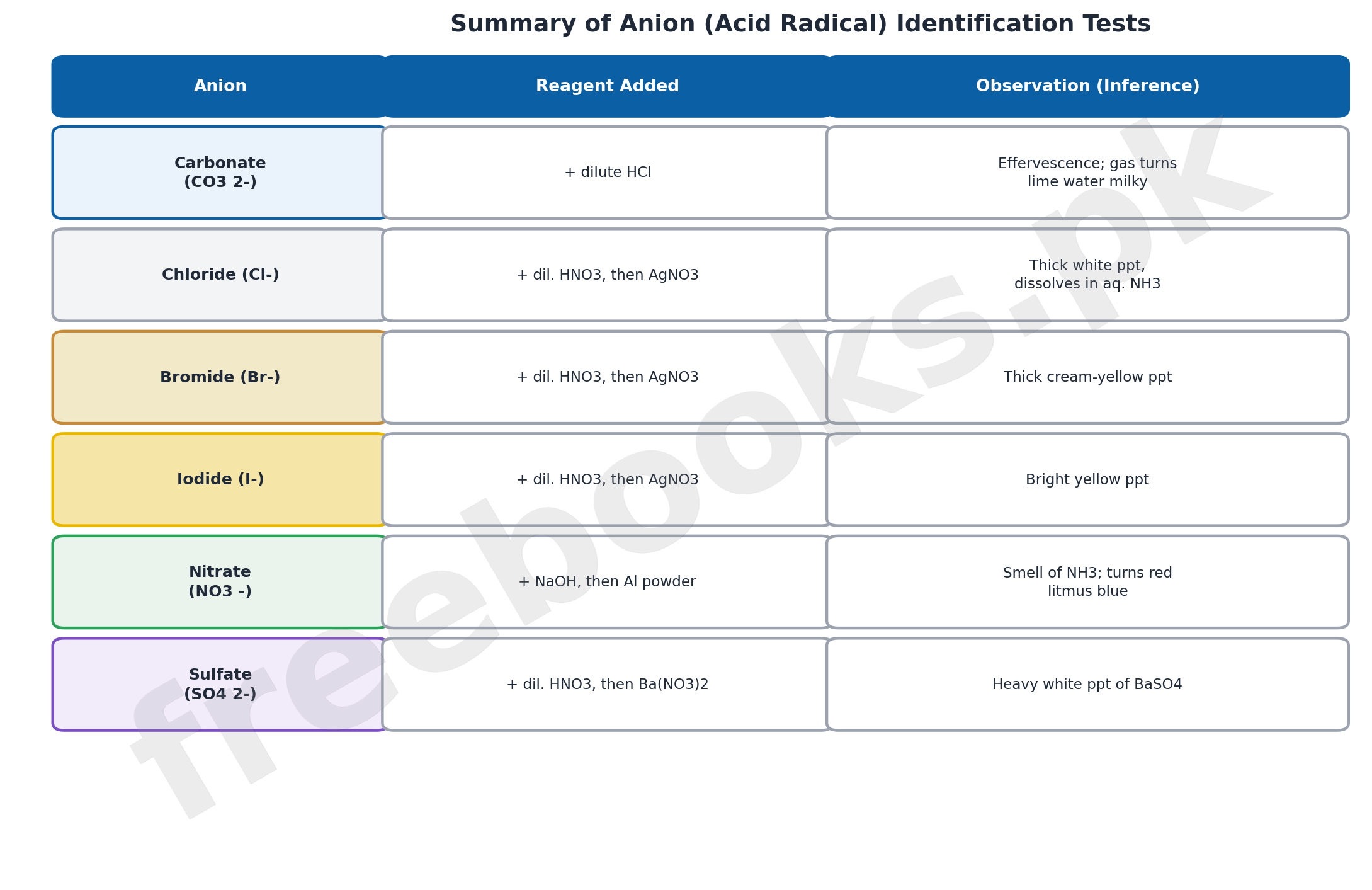
Carbonate (CO3 2-): adding dilute HCl to a solid carbonate sample produces brisk effervescence; the gas evolved turns lime water milky, confirming carbonate (CO3 2- + 2H+ -> H2O + CO2; Ca(OH)2 + CO2 -> CaCO3 + H2O).
Chloride, bromide, and iodide: dissolve the solid sample in water, acidify with dilute HNO3 (to prevent carbonate ions from also precipitating), then add aqueous AgNO3. Chloride gives a thick white precipitate that dissolves in aqueous ammonia (Ag+ + Cl- -> AgCl, white ppt); bromide gives a thick cream-yellow precipitate (Ag+ + Br- -> AgBr); iodide gives a bright yellow precipitate (Ag+ + I- -> AgI).
Nitrate (NO3 -): dissolve the sample, add sodium hydroxide solution, then powdered aluminium metal; a characteristic smell of ammonia is felt and the gas turns red litmus blue, since aluminium reduces nitrate to ammonium, which reacts with NaOH to evolve ammonia gas (3NO3- + 8Al + 5OH- + 18H2O -> 3NH3 + 8[Al(OH)4]-).
Sulfate (SO4 2-): dissolve the sample, acidify with dilute HNO3 (to destroy any carbonate impurity), then add barium nitrate solution; a heavy white precipitate of BaSO4 forms (SO4 2- + Ba2+ -> BaSO4).
16.6 Identification of Cations (Basic Radicals)
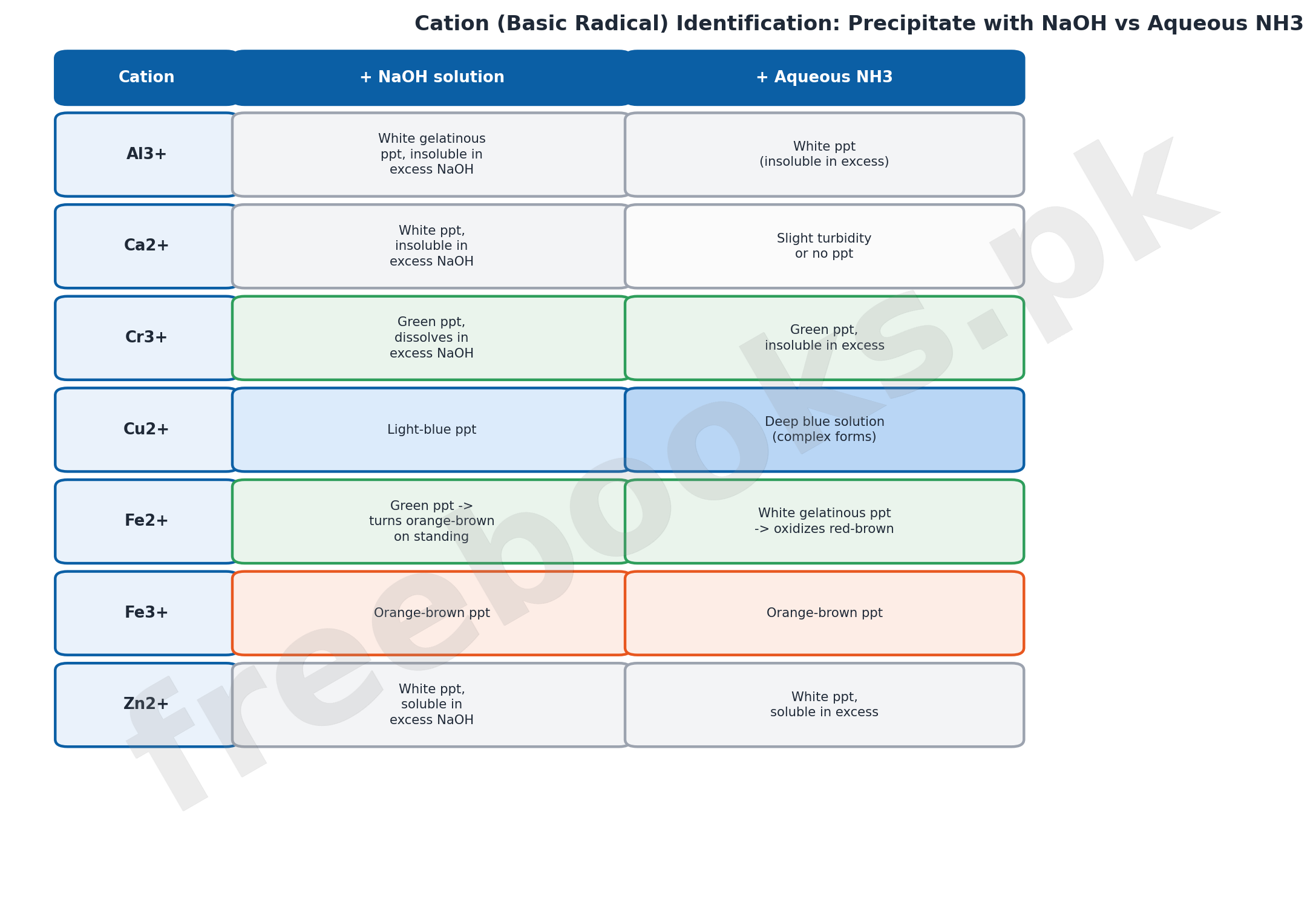
Each cation is tested by dissolving a solid sample in distilled water, dividing it into two portions, and treating one with NaOH solution and the other with aqueous ammonia, comparing the precipitate colour and its behaviour in excess reagent. Al3+ gives a white gelatinous precipitate with NaOH (insoluble in excess) and a white precipitate with aqueous ammonia (Al3+ + 3OH- -> Al(OH)3). NH4+ evolves ammonia gas with a distinct smell on gentle heating with NaOH, turning moist red litmus blue (NH4+ + OH- -> NH3 + H2O).
Ca2+ gives a white precipitate with NaOH that does not dissolve in excess, and only slight turbidity (or no precipitate) with aqueous ammonia (Ca2+ + 2OH- -> Ca(OH)2). Cr3+ gives a green precipitate with NaOH that dissolves in excess NaOH, but a green precipitate insoluble in excess aqueous ammonia (Cr3+ + 3OH- -> Cr(OH)3, green ppt). Cu2+ gives a light-blue precipitate with NaOH (Cu2+ + 2OH- -> Cu(OH)2) but a deep blue solution with aqueous ammonia as a soluble copper-ammonia complex forms.
Fe2+ gives a green precipitate with NaOH that turns orange-brown on standing as it oxidizes, and a white gelatinous precipitate of Fe(OH)2 with aqueous ammonia that quickly oxidizes to red-brown Fe(OH)3 (Fe2+ + 2OH- -> Fe(OH)2, green ppt). Fe3+ gives an orange-brown precipitate with both NaOH and aqueous ammonia (Fe3+ + 3OH- -> Fe(OH)3, orange-brown ppt). Zn2+ gives a white precipitate with NaOH that is soluble in excess NaOH, and a white precipitate with aqueous ammonia that is also soluble in excess ammonia (Zn2+ + 2OH- -> Zn(OH)2, white ppt).
Important Definitions
What is an indicator in a titration?
A substance that shows the completion of a reaction by a visible change in its colour, used to signal when the acid and base in a titration have reacted in stoichiometric proportions.
What is the end point of a titration?
The moment during a titration at which the indicator changes colour, signalling that the reaction between the two solutions is essentially complete.
What is a concordant reading in titration?
Two or more titration readings that agree closely with one another, typically within 0.1 cm3, used to confirm the accuracy and reliability of the titration result.
What are physical hazards in a laboratory?
Hazards such as slips, trips, and falls (often caused by wet floors) and injuries from handling broken glassware, which can be reduced by taking precautions and wearing cut-resistant gloves.
What are biological hazards in a laboratory?
Hazards such as allergens and microbes, including viruses and bacteria, which can be transferred to humans from animals, plants, water, or air present in or around the laboratory.
Why must chemical waste never be poured down the sewer or drains?
Because most chemical wastes are hazardous to the environment and human health if released untreated, so EPA rules require they be stored in labelled containers, transferred to an allocated site, and chemically treated (e.g., neutralization, precipitation, ion exchange, oxidation, or reduction) before disposal.
Why is dilute HNO3 added before testing a solution with AgNO3 for halide ions?
Dilute nitric acid is added to prevent carbonate ions from also precipitating alongside the halide ions when silver nitrate is added, ensuring that any precipitate observed is due specifically to the halide ion being tested for.
What colour precipitates confirm chloride, bromide, and iodide ions with silver nitrate?
Chloride gives a thick white precipitate (AgCl) that dissolves in aqueous ammonia; bromide gives a thick cream-yellow precipitate (AgBr); iodide gives a bright yellow precipitate (AgI).
How is nitrate ion (NO3-) identified in salt analysis?
By dissolving the sample, adding sodium hydroxide solution, then powdered aluminium metal; a characteristic smell of ammonia gas is produced (which turns red litmus blue), since aluminium reduces nitrate ions to ammonium ions that react with the NaOH to release ammonia gas.
How is sulfate ion (SO4 2-) identified in salt analysis?
By dissolving the sample, acidifying with dilute nitric acid, and adding barium nitrate solution; a heavy white precipitate of barium sulfate (BaSO4) confirms the presence of sulfate ions.
Key Facts and Relations
| Topic | Key Fact / Relation |
|---|---|
| Titration end-point equation (acid-base) | NaOH(aq) + HCl(aq) -> NaCl(aq) + H2O(l) |
| Molarity relation for titration calculation | M1V1/n1 = M2V2/n2 (M=molarity, V=volume, n=moles in balanced equation) |
| Concordant reading tolerance | Titration readings should agree within about 0.1 cm3 |
| Carbonate test | CO3 2- + 2H+ -> H2O + CO2 (gas turns lime water milky) |
| Halide + AgNO3 precipitate colours | AgCl = white, AgBr = cream-yellow, AgI = bright yellow |
| Nitrate test (with Al and NaOH) | 3NO3- + 8Al + 5OH- + 18H2O -> 3NH3 + 8[Al(OH)4]- |
| Sulfate test | SO4 2- + Ba2+ -> BaSO4 (heavy white precipitate) |
| Al3+/Ca2+/Cr3+/Fe2+/Fe3+/Zn2+ hydroxide precipitation | Mn+ + nOH- -> M(OH)n (precipitate colour depends on the metal) |
| Distinguishing feature: Cr3+ vs Al3+ with excess NaOH | Both dissolve in excess NaOH, but Cr(OH)3 is green while Al(OH)3 is white |
| Distinguishing feature: Fe2+ vs Fe3+ | Fe2+ gives a green ppt that turns orange-brown on standing; Fe3+ gives an orange-brown ppt immediately |
Diagrams
Acid-Base Titration: Apparatus and Key Steps: A labelled schematic of the burette and conical flask setup, together with the four key procedural steps from pipetting the base to recording concordant burette readings
Summary of Anion (Acid Radical) Identification Tests: A colour-coded reference table listing the reagents added and the resulting observation for carbonate, chloride, bromide, iodide, nitrate, and sulfate ions
Cation (Basic Radical) Identification: Precipitate with NaOH vs Aqueous NH3: A comparison table showing the precipitate colour and behaviour in excess reagent for eight common cations when treated separately with NaOH solution and aqueous ammonia
Short Questions & Answers
Why should students never work alone in a chemistry lab?
Working alone removes the safety net of having a lab instructor or other staff present who can immediately assist if an accident, chemical spill, or equipment malfunction occurs; the presence of others allows for a quick response to injuries, immediate first aid, and someone to fetch help, all of which can be critical in the first moments after a laboratory accident.
Why is dilute nitric acid added before testing for sulfate ions with barium nitrate?
Barium ions would also form an insoluble precipitate with any carbonate ions present as an impurity in the sample, which could be mistaken for the barium sulfate precipitate that confirms sulfate; adding dilute nitric acid first destroys any carbonate impurity by converting it to carbon dioxide and water, ensuring that a white precipitate observed after adding barium nitrate is due specifically to sulfate.
Why must the conical flask be swirled continuously while acid is added during a titration?
Swirling ensures the acid being added drop by drop mixes thoroughly and rapidly throughout the whole volume of solution in the flask, rather than reacting only in the local region where it lands; without thorough mixing, the indicator could show a local, temporary colour change near the point of addition that does not reflect the true, overall state of the reaction, causing the end point to be misjudged.
Why is an anti-parallax card or white paper used when reading the burette scale?
Reading a scale from an angle rather than exactly at eye level introduces a systematic error called parallax, which can make the meniscus appear at a different graduation than its true position; an anti-parallax card, usually marked with a dark line, helps the reader align their eye level exactly with the meniscus, minimizing this reading error and improving the precision of the recorded volume.
Why does copper(II) hydroxide dissolve in excess aqueous ammonia but not in excess NaOH?
Aqueous ammonia can act as a ligand and coordinate directly to the copper(II) ion, forming a soluble deep-blue tetraamminecopper(II) complex ion that redissolves the initially formed light-blue hydroxide precipitate as more ammonia is added; hydroxide ions from NaOH, in contrast, do not form an analogous soluble complex with copper(II) under these conditions, so the light-blue Cu(OH)2 precipitate simply remains once formed.
Why does the green precipitate formed when NaOH is added to an Fe2+ solution turn orange-brown on standing?
The precipitate formed is iron(II) hydroxide, Fe(OH)2, in which iron is in the +2 oxidation state; on standing in air, atmospheric oxygen gradually oxidizes the iron(II) hydroxide to iron(III) hydroxide, Fe(OH)3, which has the characteristic orange-brown colour, so the colour change over time is a direct visible sign of aerial oxidation occurring at the precipitate's surface.
Why are both aluminium hydroxide and zinc hydroxide soluble in excess NaOH, while calcium hydroxide is not?
Aluminium and zinc hydroxides are amphoteric, meaning they can react with excess hydroxide ions to form soluble complex ions (such as [Al(OH)4]- and [Zn(OH)4]2-), allowing the initially formed precipitate to redissolve as more NaOH is added; calcium hydroxide is not amphoteric and does not form an analogous soluble hydroxide complex, so it remains as an insoluble precipitate even in excess NaOH.
Why is a fire caused by burning oil or spirit smothered with sand and sodium bicarbonate rather than extinguished with water?
Oil, spirit, and other flammable liquids are less dense than water and do not mix with it, so pouring water onto such a fire causes the burning liquid to float and spread across the water's surface, actually enlarging the fire rather than extinguishing it; sand and sodium bicarbonate instead smother the fire by physically covering it and cutting off its oxygen supply, which is the safe and effective way to extinguish this type of fire.
Why is it important to rinse the pipette with the solution to be measured (not just distilled water) before use?
Any residual distilled water left inside the pipette from washing would dilute the solution subsequently drawn into it, introducing an error into the measured volume and concentration of that solution; rinsing the pipette first with the actual solution to be measured displaces any remaining water and ensures the solution finally drawn up is at its true, undiluted concentration.
Why does a solid carbonate sample effervesce with dilute HCl while producing a gas that turns lime water milky?
Carbonate ions react with the hydrogen ions from the acid to release carbon dioxide gas, which is seen as brisk effervescence (bubbling) as the gas escapes the solution; when this carbon dioxide gas is passed into lime water (a solution of calcium hydroxide), it reacts to form insoluble calcium carbonate, which appears as a milky, cloudy precipitate suspended in the liquid, confirming the presence of carbonate ions in the original sample.
Long Questions & Answers
Describe the procedure for carrying out an acid-base titration between a standard HCl solution and an NaOH solution of unknown concentration, and explain how the results are used to calculate the unknown molarity.
How is the conical flask prepared before the titration begins?
The pipette is first rinsed with distilled water and then with the NaOH solution to remove any residual water that could dilute it; the conical flask is rinsed with distilled water only (since it will not affect the amount of NaOH once pipetted in); 10 cm3 of NaOH solution is then pipetted into the flask, and one to two drops of phenolphthalein indicator are added, turning the solution pink.
How is the burette prepared and its initial reading recorded?
The burette is rinsed first with distilled water and then with the HCl solution, filled using a funnel (which is then removed), and any air bubble trapped in the nozzle is cleared by briefly allowing acid to flow into a waste beaker; the burette is fixed upright on a clamp stand, and the initial reading is noted carefully using an anti-parallax card or white paper to avoid parallax error.
How is the actual titration carried out to locate the end point?
With the conical flask placed on white paper beneath the burette (to see the colour change clearly) and checked for leaks, acid is first added quickly in a rough titration to get an approximate end point, then in a careful, drop-wise titration while continuously swirling the flask to ensure thorough mixing, until the pink colour turns to a persistent light pink — this is the end point of the reaction.
Why is the titration repeated, and what result is taken forward for calculation?
The titration is repeated to obtain at least three concordant readings that agree with one another within about 0.1 cm3, since a single reading could be affected by an error in judging the end point; taking the volume from concordant readings, rather than a single titration, gives a more reliable and accurate value for the volume of acid actually needed to neutralize the base.
How is the unknown molarity of the NaOH solution calculated from the titration data?
Using the molarity relation M1V1/n1 = M2V2/n2, where M1 and V1 are the known molarity and volume of the acid used and n1 is the number of moles of acid in the balanced equation, while M2, V2, and n2 are the corresponding values for the base, the equation is rearranged to M2 = (M1V1/n1) x (n2/V2); substituting the concordant titration volume, the known acid molarity, and the mole ratio from the balanced equation NaOH + HCl -> NaCl + H2O (where n1 = n2 = 1) gives the unknown molarity of the NaOH solution.
Explain how qualitative salt analysis is used to identify unknown anions and cations, describing the specific tests and observations used to distinguish chloride, bromide, and iodide ions, and to distinguish iron(II) from iron(III) ions.
What is the general strategy behind qualitative salt analysis?
Qualitative salt analysis identifies the ions present in an unknown solid sample by dissolving it and treating separate portions with specific reagents, then observing characteristic changes such as precipitate formation, precipitate colour, gas evolution, or colour change, each of which is uniquely associated with a particular anion or cation and therefore acts as confirmatory evidence for its presence.
What common test distinguishes chloride, bromide, and iodide ions from one another?
All three halide ions are tested by acidifying the sample solution with dilute nitric acid (to prevent interference from carbonate ions) and then adding aqueous silver nitrate; the resulting precipitate's colour differs distinctly between the three ions, allowing them to be told apart using the same basic test.
What specific precipitate colours are observed for chloride, bromide, and iodide with silver nitrate?
Chloride ions produce a thick white precipitate of silver chloride, which notably dissolves when aqueous ammonia is added; bromide ions produce a thick cream-yellow precipitate of silver bromide; and iodide ions produce a bright yellow precipitate of silver iodide, giving three visually distinguishable outcomes from the same basic silver nitrate test.
What test distinguishes Fe2+ (iron II) from Fe3+ (iron III) ions?
Both ions are tested by adding NaOH solution or aqueous ammonia to a sample solution; Fe2+ initially gives a green precipitate of iron(II) hydroxide that gradually turns orange-brown on standing in air as it is oxidized to iron(III) hydroxide, while Fe3+ gives an orange-brown precipitate of iron(III) hydroxide immediately, with no initial green stage, allowing the two iron oxidation states to be distinguished by both the initial precipitate colour and how that colour changes (or does not change) over time.
Why is it useful to test a sample with both NaOH and aqueous ammonia rather than just one reagent?
Different cations can sometimes give a similarly coloured precipitate with just one reagent, but their behaviour in excess of that reagent, or their behaviour with the second reagent, often reveals a clear difference; for example, Al3+ and Zn2+ both give a white precipitate with NaOH, but Al(OH)3 stays insoluble in excess aqueous ammonia while Zn(OH)2 dissolves in excess ammonia, so testing with both reagents and observing behaviour in excess provides more complete and unambiguous confirmatory evidence than either reagent alone.
Multiple Choice Questions (MCQs)
While reading a burette, why is it advisable to read the lower meniscus for colourless liquids and the upper meniscus for coloured liquids? (A) Because it is more convenient (B) Because colourless liquids have more surface tension than coloured liquids (C) Because the lower meniscus does not exist for coloured liquids (D) Because the upper surface of a coloured liquid is easier to see clearly against the lower meniscus, which is often obscured by the liquid's own colour
Correct answer: (D) Because the upper surface of a coloured liquid is easier to see clearly against the lower meniscus, which is often obscured by the liquid's own colour. For coloured liquids, the curve of the lower meniscus can be difficult to see clearly through the coloured solution itself, so the upper meniscus (the top edge of the liquid surface, easier to see against the tube) is read instead; for colourless liquids, the lower meniscus is clearly visible and is the standard reference point.
Why is phenolphthalein indicator particularly appropriate for titrations between a strong acid and a strong base? (A) Because it is itself weakly acidic (B) Because the pH range over which phenolphthalein changes colour matches the pH at the equivalence point of a strong acid-strong base titration (C) Because the solution at the end of titration is acidic (D) Because the solution at the end of titration is basic
Correct answer: (B) Because the pH range over which phenolphthalein changes colour matches the pH at the equivalence point of a strong acid-strong base titration. A strong acid-strong base titration has an equivalence point at pH 7, and the steep pH jump around this point spans a wide pH range that includes phenolphthalein's colour-change range (about pH 8.2-10), making it a suitable and commonly used indicator for this type of titration.
Which cation gives a white gelatinous precipitate upon addition of aqueous ammonia? (A) Cr3+ (B) Cr2+ (C) Zn2+ (D) Al3+
Correct answer: (D) Al3+. Al3+ produces a white gelatinous precipitate of aluminium hydroxide, Al(OH)3, when aqueous ammonia is added, which remains insoluble in excess ammonia, distinguishing it from other cations.
Addition of aqueous ammonia (NH4OH) to a solution of a cation gives a green precipitate that turns brown on standing. Which basic radical is indicated? (A) Cu2+ (B) Cr3+ (C) Fe2+ (D) Fe3+
Correct answer: (C) Fe2+. Fe2+ gives a green precipitate of iron(II) hydroxide with aqueous ammonia (or NaOH), which slowly oxidizes in air to orange-brown iron(III) hydroxide, a characteristic colour change used to identify Fe2+.
The evolution of a colourless, odourless gas that turns lime water milky during salt analysis suggests the presence of: (A) Chloride ion (Cl-) (B) Sulfate ion (SO4 2-) (C) Carbonate ion (CO3 2-) (D) Nitrate ion (NO3-)
Correct answer: (C) Carbonate ion (CO3 2-). Carbonate ions react with acid to release carbon dioxide gas, which is colourless and odourless and turns lime water milky by forming insoluble calcium carbonate, a classic confirmatory test for carbonate.
A thick cream-yellow precipitate forms when aqueous silver nitrate is added to an acidified salt solution. Which anion does this indicate? (A) Chloride (Cl-) (B) Bromide (Br-) (C) Iodide (I-) (D) Sulfate (SO4 2-)
Correct answer: (B) Bromide (Br-). Bromide ions form a thick cream-yellow precipitate of silver bromide (AgBr) with silver nitrate, distinguishing it from the white precipitate of chloride and the bright yellow precipitate of iodide.
What is the correct first-aid treatment for an acid burn on the skin? (A) Apply burnol directly without washing (B) Wash freely with ice-cold water, then a saturated solution of sodium bicarbonate, then water again (C) Wash with 2% ammonia solution and apply glycerin (D) Apply mustard oil directly to the burn
Correct answer: (B) Wash freely with ice-cold water, then a saturated solution of sodium bicarbonate, then water again. An acid burn should first be washed freely with ice-cold water to remove and dilute the acid, then washed with a saturated sodium bicarbonate solution to neutralize any remaining acid, and finally rinsed again with water before further treatment.
Why should water never be used to extinguish a fire caused by burning oil or spirit? (A) Water reacts explosively with oil (B) Water is denser than oil and sinks below it, making no difference to the fire (C) Water does not mix with the flammable liquid and can cause it to float and spread, enlarging the fire (D) Water evaporates too quickly to have any cooling effect
Correct answer: (C) Water does not mix with the flammable liquid and can cause it to float and spread, enlarging the fire. Because oil and spirit are immiscible with and less dense than water, pouring water onto such a fire causes the burning liquid to spread across the water's surface, enlarging rather than extinguishing the fire; sand or a damp cloth is used instead to smother it.
In an acid-base titration, what does a 'concordant reading' refer to? (A) Any single accurate titration reading (B) Two or more titration readings that agree closely with one another, typically within 0.1 cm3 (C) The very first rough titration performed (D) The reading taken only at the exact theoretical equivalence point
Correct answer: (B) Two or more titration readings that agree closely with one another, typically within 0.1 cm3. Concordant readings are two or more titre volumes from repeated titrations that agree closely with each other (usually within 0.1 cm3), providing confidence that the recorded volume is accurate and not affected by a one-off error in judging the end point.
Which basic radical gives a light-blue precipitate with NaOH solution but forms a deep blue solution when aqueous ammonia is added in excess? (A) Fe2+ (B) Cr3+ (C) Cu2+ (D) Zn2+
Correct answer: (C) Cu2+. Cu2+ gives a light-blue precipitate of copper(II) hydroxide with NaOH, but with excess aqueous ammonia, the precipitate dissolves to form a deep blue soluble copper-ammonia complex, a characteristic and easily recognized behaviour for identifying Cu2+.
Quick Revision Summary
- Lab safety: never work alone, wear lab coat/goggles, tie back hair, no food/tasting/smelling chemicals, report accidents immediately, never pour chemicals down the drain
- Three hazard categories: physical (slips, falls, broken glass), chemical (follow standard procedures, hazard pictograms), biological (allergens, viruses, bacteria)
- Chemical waste disposal (EPA rules): store in labelled containers (waste type, date, origin) -> transfer to allocated site -> treat chemically (neutralization, precipitation, ion exchange, oxidation/reduction)
- First aid basics: acid in eye -> water then 1% NaHCO3; alkali in eye -> water then 1% boric acid; acid burn -> ice water then NaHCO3 then water; oil/spirit fire -> sand + NaHCO3, never water
- Titration: indicator shows completion by colour change; end point = moment indicator changes colour; concordant readings agree within 0.1 cm3
- Titration formula: M1V1/n1 = M2V2/n2 (subscript 1 = acid, subscript 2 = base, n = moles in balanced equation)
- Anion tests: CO3 2- (HCl -> effervescence, gas turns lime water milky); Cl-/Br-/I- (AgNO3 -> white/cream-yellow/bright yellow ppt); NO3- (NaOH + Al -> NH3 smell, turns litmus blue); SO4 2- (Ba(NO3)2 -> heavy white ppt)
- Cation tests (NaOH vs aq. NH3): Al3+ white ppt (insoluble both); Ca2+ white ppt with NaOH, slight/no ppt with NH3; Cr3+ green ppt (dissolves in excess NaOH, insoluble in excess NH3); Cu2+ light-blue ppt with NaOH, deep blue solution with NH3; Fe2+ green ppt -> orange-brown; Fe3+ orange-brown ppt immediately; Zn2+ white ppt (soluble in excess of both)
- Amphoteric hydroxides that dissolve in excess NaOH: Al(OH)3, Zn(OH)2, Cr(OH)3 (but Cr(OH)3 does NOT dissolve in excess aqueous ammonia)
Exam Tips
- Memorize the three hazard categories (physical, chemical, biological) with one clear example of each — exam questions often ask for two examples per category
- For eye and burn first aid, always remember the pattern: wash with water first, THEN apply the specific neutralizing/soothing agent, THEN wash with water again — don't skip the initial plain-water wash
- For titration questions, always state that the pipette is rinsed with the solution it will measure (not just distilled water) — this is a commonly tested precaution
- For halide precipitate colours, remember the trend: chloride = white, bromide = cream-yellow, iodide = bright yellow — getting the shade order right (not just 'coloured vs white') is often what's actually tested
- For cation identification, focus on what happens in EXCESS reagent, not just the initial precipitate colour — many cations look similar at first (e.g. white ppt) but behave very differently once excess NaOH or ammonia is added
- Remember Fe2+ gives a green precipitate that slowly turns orange-brown (oxidation over time), while Fe3+ gives orange-brown immediately with no green stage — this timing difference is the key distinguishing feature between the two