
Electrochemistry is the branch of chemistry that studies the interconversion of electrical and chemical energy through redox (reduction-oxidation) reactions, in which oxidation, the loss of electrons, and reduction, the gain of electrons, always occur together. Oxidation numbers provide a bookkeeping system for tracking electron transfer even in covalent compounds, allowing any redox reaction to be identified, its oxidizing and reducing agents pinpointed, and its equation balanced systematically using the oxidation number method.
In an electrolytic cell, an external electrical supply drives an otherwise non-spontaneous redox reaction, and the quantity of substance liberated at each electrode can be calculated precisely using the Faraday constant, which also provides a classic experimental route to the Avogadro constant. In a galvanic (voltaic) cell, by contrast, a spontaneous redox reaction generates electrical energy on its own; comparing the standard electrode potentials of two half-cells, each measured relative to the standard hydrogen electrode, predicts the direction of electron flow, the feasibility of a reaction, and the relative strength of different oxidizing and reducing agents, while the Nernst equation extends these predictions to solutions at non-standard concentrations and underlies practical applications from the activity series of metals to photovoltaic cells and water-quality testing.
Learning Objectives
- Define oxidation, reduction, and disproportionation in terms of electron transfer and changes in oxidation number, and apply oxidation number rules to identify oxidizing and reducing agents
- Balance redox equations using the oxidation number method
- Explain how an electrolytic cell converts electrical energy into chemical energy, with oxidation at the anode and reduction at the cathode
- Apply the relationship between the Faraday constant, the Avogadro constant, and the charge on the electron to calculate the mass or volume of substance liberated during electrolysis
- Describe how the Avogadro constant can be deduced experimentally by an electrolytic method
- Define standard electrode potential and standard cell potential, and describe the standard hydrogen electrode (SHE) used to measure them
- Calculate standard cell potentials by combining two standard electrode potentials, and use them to predict the feasibility of a reaction and the direction of electron flow
- Deduce the relative strength of elements, compounds, and ions as oxidizing or reducing agents from their electrode potential values
- Explain how a galvanic (voltaic) cell converts the chemical energy of a spontaneous redox reaction into electrical energy, using the Cu-Zn cell as an example
- Explain how electrode potential varies with ion concentration using the Nernst equation, and describe the activity series of metals, photovoltaic cells, and the Winkler method for measuring biochemical oxygen demand
Key Concepts
10.1 Oxidation, Reduction, and Redox Reactions
Oxidation is a process involving the loss of one or more electrons, as when Fe2+ loses an electron to form Fe3+, or a zinc atom loses two electrons to form Zn2+; reduction is a process involving the gain of one or more electrons, as when a chlorine atom gains an electron to form Cl-, or Cu2+ gains two electrons to form copper metal. Oxidation and reduction always occur together in the same reaction, since electrons lost by one species must be gained by another; reactions in which this simultaneous electron transfer occurs are called redox reactions, and familiar examples include photosynthesis, which provides food for the entire planet, and respiration, which keeps living organisms alive. Whether a substance has been oxidized or reduced during a reaction can be determined in two equivalent ways: by tracking electron transfer directly, or by tracking the resulting change in oxidation number.
10.2 Oxidation Number and Its Rules
An oxidation number, or oxidation state, is the apparent charge assigned to a single atom in a compound, molecule, or ion, and can be positive, negative, or zero; a higher positive oxidation number means an atom is more oxidized, while a higher negative oxidation number means it is more reduced. Several rules allow oxidation numbers to be deduced systematically: the oxidation number of any uncombined element is zero; the more electronegative element in a compound or ion is assigned the negative oxidation number; many elements have fixed oxidation numbers (group 1 metals are always +1, group 2 metals always +2, halogens in binary compounds always -1, hydrogen is usually +1 except -1 in metal hydrides, and oxygen is usually -2 except -1 in peroxides and +2 in F2O); the oxidation number of an element in a monatomic ion equals the charge on that ion; the algebraic sum of oxidation numbers in a neutral compound is zero; and the algebraic sum of oxidation numbers in a polyatomic ion equals the charge on that ion. Transition metals and many non-metals show variable oxidation states that cannot be assumed and must instead be calculated for each specific compound.
10.3 Disproportionation and Balancing Redox Equations by the Oxidation Number Method
A disproportionation reaction is a special redox reaction in which a single substance acts as both the oxidizing agent and the reducing agent, being simultaneously oxidized and reduced to give two different products with different oxidation states; the decomposition of hydrogen peroxide, 2H2O2(l) -> 2H2O(l) + O2(g), is a classic example, in which oxygen (starting at -1 in H2O2) is simultaneously reduced to -2 in H2O and oxidized to 0 in O2.
Redox equations are balanced by the oxidation number method in a fixed sequence: write the skeleton equation; identify the elements whose oxidation number changes; record these oxidation numbers above the relevant atoms and connect them with arrows showing the change; multiply species by suitable numbers so the total increase in oxidation number equals the total decrease; and finally balance every remaining atom by inspection, usually balancing all elements except nitrogen, oxygen, and hydrogen first, then nitrogen, then oxygen, then hydrogen last. If a species undergoes both an increase and a decrease in oxidation number in the same reaction, as in a disproportionation, or if some of a species reacts while some does not change oxidation state at all, that species is written twice on the appropriate side of the equation to keep each contribution distinct.
10.4 Electrolytic Cells and Redox Reactions in Electrolysis
An electrolytic cell is a device that uses an external electrical supply to convert electrical energy into chemical energy through electrolysis; it consists of two electrodes immersed in an electrolyte, a molten ionic compound or concentrated solution of ions, connected to a source of direct current. Under this applied current, one electrode becomes the negatively charged cathode and the other the positively charged anode; positive ions (cations) migrate to the cathode, where they gain electrons and are reduced, while negative ions (anions) migrate to the anode, where they lose electrons and are oxidized, so reduction always occurs at the cathode and oxidation always occurs at the anode.
For the electrolysis of molten zinc chloride, the cathode reaction, Zn2+(l) + 2e- -> Zn(s), is a reduction, and the anode reaction, 2Cl-(l) -> Cl2(g) + 2e-, is an oxidation; the electrons lost at the anode exactly balance the electrons gained at the cathode, giving the overall reaction ZnCl2(l) -> Zn(s) + Cl2(g). Electrolytic cells have wide industrial use, including the electrolysis of sodium chloride to produce sodium metal and chlorine gas, the refining and electroplating of metals, and the manufacture of chemicals such as caustic soda.
10.5 Faraday's Laws: Mass Deposited During Electrolysis
The mass of a substance produced or removed at an electrode during electrolysis is proportional to the quantity of electric charge, Q, passed through the electrolyte, where Q = I x t, with I the current in amperes and t the time in seconds, giving Q in coulombs. This quantity of electricity is conveniently expressed in Faradays: one Faraday (F) is the charge carried by one mole of electrons, or one mole of singly charged ions, equal to 96,500 C mol-1; in general, the number of Faradays passed equals the number of moles of electrons gained or lost in the electrode reaction.
Because the half-equation for each electrode reaction shows exactly how many moles of electrons are needed per mole of product, the mass of product deposited can be calculated directly: depositing one mole of silver, Ag+ + e- -> Ag, requires only 1 Faraday (96,500 C), while depositing one mole of copper, Cu2+ + 2e- -> Cu, requires 2 Faradays (2 x 96,500 C), since twice as many electrons are needed per mole of product. For example, a current of 1.50 A passed through molten lead(II) bromide for 20.0 minutes transfers a charge of Q = 1.50 x 20 x 60 = 1800 C; since 2 Faradays (193,000 C) are needed to deposit one mole (207 g) of lead, 1800 C deposits (207/193,000) x 1800, approximately 1.93 g of lead.
10.6 Avogadro's Constant by the Electrolytic Method
The Avogadro constant, NA, the number of particles in one mole, can be determined experimentally from electrolysis, using the relationship NA = (charge on one mole of electrons) / (charge on one electron), where the charge on a single electron, found by separate experiment, is approximately 1.60 x 10^-19 C. In a typical experiment, a pure copper anode and cathode are weighed, a small constant current (around 0.20 A) is passed through aqueous copper(II) sulfate for a measured time, and the electrodes are washed, dried, and reweighed; because copper may not deposit evenly on the cathode, the more reliable measurement is the decrease in mass of the anode, from which copper dissolves as Cu2+ ions.
In a sample calculation, a current of 0.20 A passed for 34 minutes (2040 s) transfers a charge Q = I x t = 408 C, and dissolves 0.136 g of copper from the anode; scaling up, 63.5 g of copper (one mole) would require (408/0.136) x 63.5, approximately 190,500 C, and since the half-equation Cu2+ + 2e- -> Cu shows that 2 moles of electrons are needed per mole of copper, the charge on one mole of electrons is 190,500/2, approximately 95,250 C. Dividing this by the known charge on a single electron, approximately 1.60 x 10^-19 C, gives an experimental estimate for NA that agrees closely with the accepted value of 6.02 x 10^23 mol-1.
10.7 Electrode Potentials and the Standard Hydrogen Electrode
When a metal is placed in a solution of its own ions, a redox equilibrium is established between metal atoms leaving the electrode as ions (releasing electrons onto the electrode) and metal ions in solution gaining electrons and depositing back onto the electrode; the resulting difference in electric potential between the metal and the solution is called the electrode potential, and it indicates how easily that species is oxidized or reduced. For unreactive metals such as copper, this equilibrium favours the reduced, metallic form, making Cu2+ ions relatively easy to reduce, while for reactive metals such as vanadium, the equilibrium favours the oxidized, ionic form, making the metal ions comparatively difficult to reduce.
The absolute electrode potential of a single half-cell cannot be measured directly, because an electrical double layer forms at the metal surface (a thin layer of excess electrons on the metal attracting a layer of cations in solution) whose potential is not independently accessible; what can be measured is the potential difference between one half-cell and a reference half-cell. The universal reference is the standard hydrogen electrode (SHE), consisting of hydrogen gas at 101 kPa in equilibrium with 1.00 mol dm-3 H+ ions over an inert platinum-black electrode, with half-equation 2H+(aq) + 2e- <=> H2(g), assigned a standard electrode potential of exactly 0.00 V, meaning hydrogen gas and hydrogen ions are defined as having an equal tendency to gain and lose electrons.
10.8 Standard Electrode Potentials and Galvanic (Voltaic) Cells
Because a half-cell's measured voltage also depends on concentration, temperature, and gas pressure, standard electrode potentials, E°, are always measured under standard conditions: 1.00 mol dm-3 ion concentration, 25 degrees C, 1 atmosphere gas pressure, and connection to a standard hydrogen electrode. Connecting a Cu2+/Cu half-cell to the SHE gives E° = +0.34 V, showing Cu2+ is easier to reduce than H+, while a Zn2+/Zn half-cell gives E° = -0.76 V, showing Zn2+ is harder to reduce than H+; in general, reduction occurs at a cell's positive terminal and oxidation at its negative terminal.
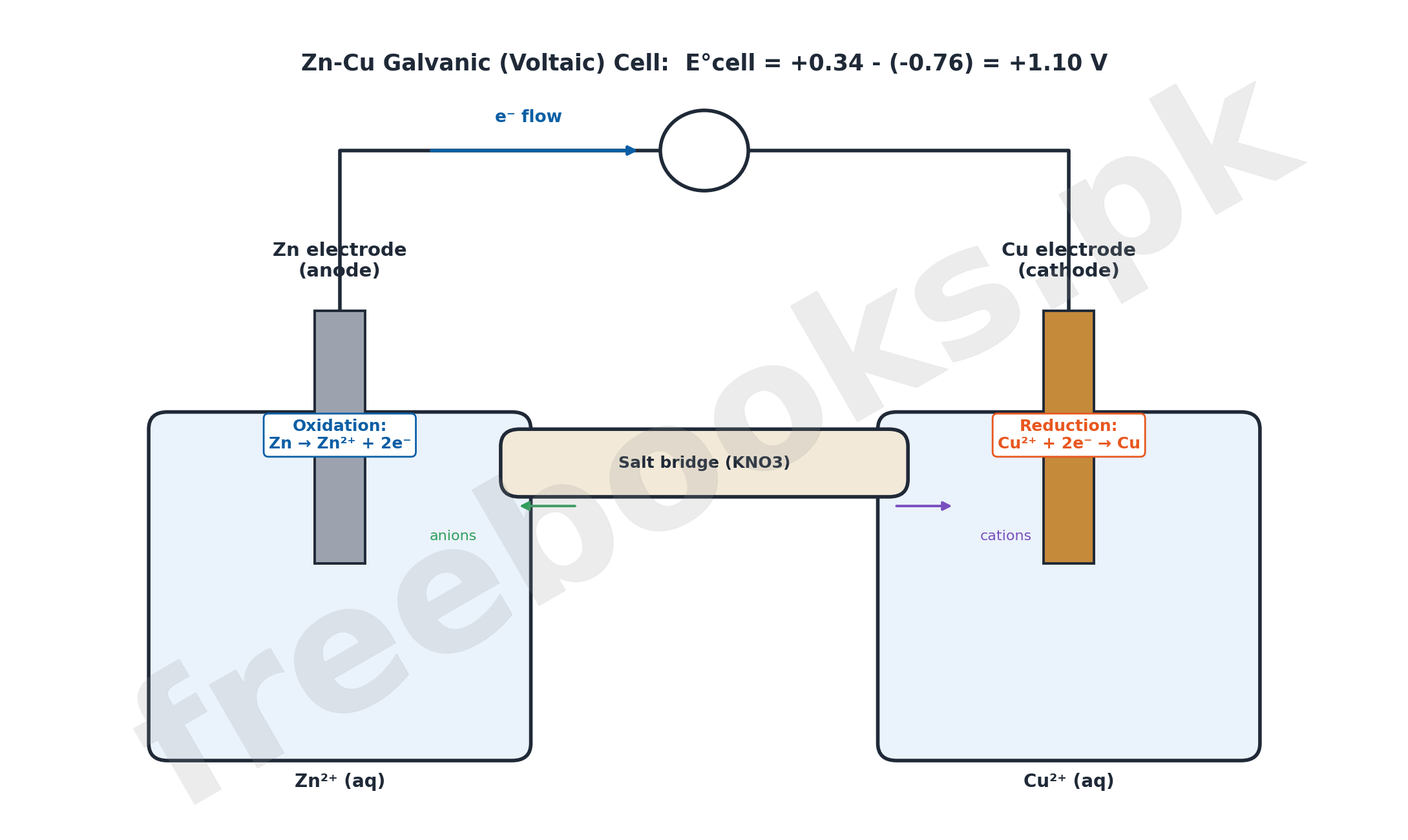
A galvanic (voltaic) cell converts the chemical energy of a spontaneous, exothermic redox reaction directly into electrical energy, again with oxidation at the anode and reduction at the cathode; connecting a Zn2+/Zn half-cell to a Cu2+/Cu half-cell via wires (through a voltmeter) and a salt bridge, a strip of inert porous material soaked in saturated KNO3 solution that maintains ionic balance without allowing electron flow, makes a complete Cu-Zn galvanic cell. Zinc, with the more negative E°, is oxidized at the anode, Zn(s) -> Zn2+(aq) + 2e-, while Cu2+ is reduced at the cathode, Cu2+(aq) + 2e- -> Cu(s), giving the overall reaction Zn(s) + Cu2+(aq) -> Zn2+(aq) + Cu(s) and a standard cell potential E°cell = E°red – E°ox = (+0.34) – (-0.76) = +1.10 V.
10.9 Applications of E° Values: Feasibility, Electron Flow, and Oxidizing/Reducing Strength
Comparing the E° values of two half-cells immediately predicts the direction of electron flow in the external circuit: electrons flow from the half-cell with the more negative (or less positive) E° to the half-cell with the more positive (or less negative) E°, that is, from the negative pole to the positive pole of the cell. The feasibility of a proposed redox reaction can be checked by calculating E°cell = E°red – E°ox for the reduction and oxidation half-reactions actually taking place: a positive E°cell means the reaction is feasible, while a negative E°cell means it is not. For example, Mg2+ + Ag cannot react spontaneously to reduce Mg2+ (E°cell = -2.32 – 0.80 = -1.52 V, not feasible), but the reverse combination, Ag+ with Mg, is feasible (E°cell = -0.80 – (-2.32) = +1.52 V).
The more positive a half-cell's E° value, the greater its tendency to proceed in the forward (reduction) direction, meaning the species on the left of its half-equation is a stronger oxidizing agent; the more negative the E° value, the greater its tendency to proceed in reverse (oxidation), meaning the species on the right is a stronger reducing agent. Since Zn2+/Zn (E° = -0.76 V) is more negative than Mg2+/Mg (E° = -2.37 V) is even more negative still, magnesium is a stronger reducing agent than zinc and can reduce Zn2+ ions to zinc metal; compounds such as KMnO4 and K2Cr2O7, with high positive E° values, act as strong oxidizing agents, while compounds such as KI and FeSO4, with low E° values, act as reducing agents.
10.10 The Nernst Equation and the Activity Series of Metals
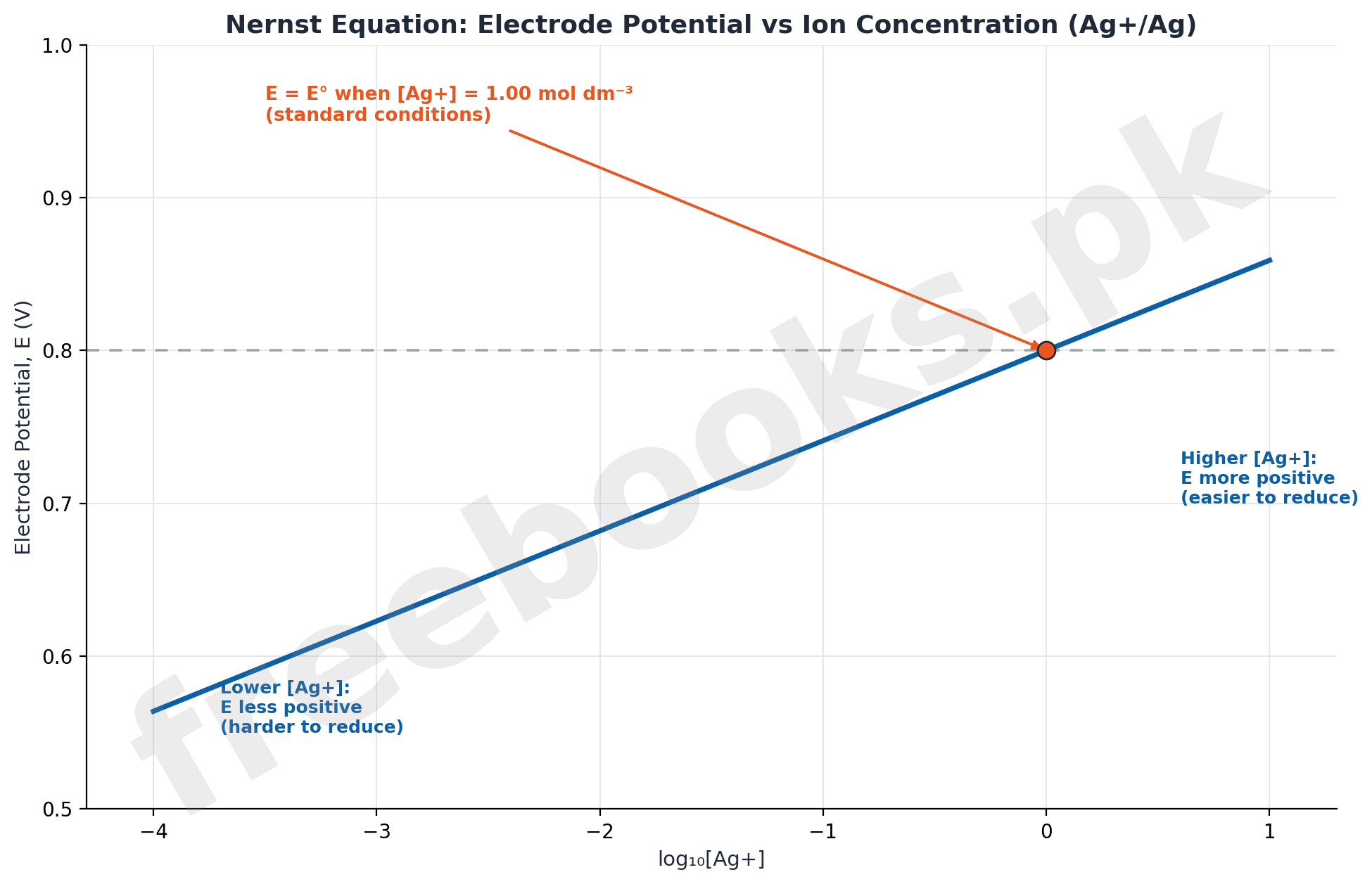
Electrode potential varies with ion concentration, temperature, and pressure exactly as any equilibrium does; under non-standard conditions the symbol E (without the degree sign) is used, and Le Chatelier's principle predicts that increasing the concentration of the oxidized species shifts the reduction equilibrium forward, making E more positive, while increasing the concentration of the reduced species makes E less positive. This relationship is expressed quantitatively by the Nernst equation, E = E° + (RT/zF) ln([oxidized]/[reduced]), which at standard temperature simplifies to E = E° + (0.059/z) log([oxidized]/[reduced]), where z is the number of electrons transferred; for example, a zinc electrode in 0.1 M Zn2+ has E = -0.76 + (0.059/2) log(0.1) = -0.76 – 0.03, approximately -0.78 V, slightly more negative than standard because the lower Zn2+ concentration shifts the equilibrium away from the reduced (metallic) form.
The activity series of metals ranks metals by their standard reduction potential, from the most negative (most reactive, most easily oxidized, strongest reducing agents, such as lithium and potassium, which react vigorously even with cold water) to the most positive (least reactive, hardest to oxidize, such as the noble metals silver, platinum, and gold, which resist reaction with water or dilute acid). A metal higher in the series will displace, in a single displacement reaction, any metal lower in the series from a solution of its ions, and the feasibility of any such displacement can be confirmed the same way as any redox reaction, by checking that the resulting E°cell is positive; for example, Fe(s) + 2Ag+(aq) -> Fe2+(aq) + 2Ag(s) has E°cell = -0.80 – (-0.44) is incorrect ordering, and using E°cell = E°red – E°ox = (+0.80) – (-0.44) = +1.24 V, confirming the reaction is feasible.
10.11 Photovoltaic Cells and the Winkler Method (BOD and DO)
A photovoltaic cell converts light energy directly into electrical energy through the photovoltaic effect, in which photons excite electrons from a semiconductor's valence band into its conduction band; a PN junction within the cell separates these excited electrons from the positive holes left behind, generating a voltage that drives an electric current for as long as light continues to fall on the cell. As a renewable, sustainable energy source independent of fossil fuels, the photovoltaic effect underlies solar power generation, converting an essentially inexhaustible supply of sunlight into usable electricity.
Biochemical oxygen demand (BOD) is the amount of dissolved oxygen consumed by microorganisms as they biologically oxidize organic matter in a water sample over five days at a constant 25 degrees C in the dark, and is used as a measure of water pollution: dissolved oxygen (DO), normally between 5 and 8 mg/dm3 and never healthily below 5 mg/dm3, falls as BOD rises, since the same bacterial decomposition that consumes oxygen to produce a high BOD also depletes the water's available DO, giving the two quantities an inverse relationship. The Winkler method measures DO by exploiting its oxidizing properties: dissolved oxygen reacts with iodide ion to liberate iodine, and the amount of iodine formed, proportional to the original DO, is measured by titrating against sodium thiosulfate using starch as an indicator, which turns from dark blue to colourless at the endpoint.
Important Definitions
What is oxidation?
A process involving the loss of one or more electrons by a species, resulting in an increase in its oxidation number.
What is reduction?
A process involving the gain of one or more electrons by a species, resulting in a decrease in its oxidation number.
What is a disproportionation reaction?
A redox reaction in which a single substance is simultaneously oxidized and reduced, producing two different products with different oxidation states.
What is an oxidizing agent?
A substance that oxidizes another substance by accepting electrons from it, and is itself reduced in the process.
What is an electrolytic cell?
A device that uses an external electrical supply to drive a non-spontaneous redox reaction, converting electrical energy into chemical energy.
What is the Faraday constant?
The quantity of electric charge carried by one mole of electrons (or one mole of singly charged ions), equal to 96,500 C mol-1.
What is the standard hydrogen electrode (SHE)?
A reference half-cell consisting of hydrogen gas at 101 kPa in equilibrium with 1.00 mol dm-3 H+ ions over an inert platinum electrode, assigned E° = 0.00 V.
What is standard electrode potential (E°)?
The voltage of a half-cell measured under standard conditions relative to the standard hydrogen electrode.
What is a galvanic (voltaic) cell?
A cell in which a spontaneous, exothermic redox reaction converts chemical energy directly into electrical energy, with oxidation at the anode and reduction at the cathode.
What is the activity series of metals?
A ranking of metals by their standard reduction potentials, from most reactive (most easily oxidized) to least reactive (hardest to oxidize).
Key Facts and Relations
| Topic | Key Fact / Relation |
|---|---|
| Charge passed during electrolysis | Q = I x t (coulombs) |
| Faraday constant | 1 F = 96,500 C mol-1 (charge on 1 mole of electrons) |
| Number of Faradays | No. of Faradays = No. of moles of electrons gained or lost |
| Avogadro constant from electrolysis | NA = (charge on 1 mole of electrons) / (charge on 1 electron) |
| Standard hydrogen electrode potential | 2H+(aq) + 2e- <=> H2(g), E° = 0.00 V |
| Standard cell potential | E°cell = E°red – E°ox |
| Feasibility criterion | E°cell positive: reaction feasible; E°cell negative: reaction not feasible |
| Nernst equation (general) | E = E° + (RT/zF) ln([oxidized]/[reduced]) |
| Nernst equation (25 degrees C) | E = E° + (0.059/z) log([oxidized]/[reduced]) |
| Cu-Zn galvanic cell potential | E°cell = (+0.34) – (-0.76) = +1.10 V |
Diagrams
Zn-Cu Galvanic (Voltaic) Cell: A labelled schematic of a complete Cu-Zn galvanic cell, showing the zinc anode undergoing oxidation, the copper cathode undergoing reduction, electron flow through the external wire, and ion flow through the salt bridge
Activity Series of Metals (Ranked by E°): A ranked bar chart of standard electrode potentials for common metals, from the most reactive, strongest reducing agents at the negative end to the least reactive, strongest oxidizing agents at the positive end

Nernst Equation: Electrode Potential vs Ion Concentration: A plot of electrode potential against the logarithm of ion concentration for an Ag+/Ag half-cell, showing how E becomes more positive as ion concentration increases, consistent with the Nernst equation
Short Questions & Answers
Why must oxidation and reduction always occur together in the same reaction?
Electrons lost by the species being oxidized cannot simply disappear; they must be gained by another species, which is thereby reduced, so oxidation and reduction are always two halves of a single electron-transfer process occurring simultaneously in what is called a redox reaction.
Why is the oxidation number of an element in its uncombined state always zero?
Oxidation number represents the apparent charge an atom would have if all bonds to different elements were fully ionic; when an element is uncombined, or bonded only to identical atoms of itself, there is no electronegativity difference to assign that apparent charge to, so the oxidation number defaults to zero.
Why is hydrogen peroxide's decomposition into water and oxygen classified as a disproportionation reaction?
In H2O2, oxygen has an oxidation number of -1; in the products, oxygen ends up as -2 in water (reduced) and as 0 in O2 gas (oxidized); because the same element, oxygen, from the same starting compound is simultaneously oxidized and reduced to give two different products, this is a disproportionation reaction.
Why does reduction always occur at the cathode, in both electrolytic and galvanic cells?
The cathode is defined as the electrode at which reduction, the gain of electrons, takes place; this definition applies consistently to both electrolytic cells, where an external current forces positive ions to migrate there and be reduced, and to galvanic cells, where the spontaneous reaction directs electrons there to reduce the oxidized species.
Why does depositing one mole of copper from Cu2+ require twice as many Faradays as depositing one mole of silver from Ag+?
The half-equation Cu2+ + 2e- -> Cu shows that two moles of electrons must be supplied to reduce one mole of Cu2+ ions to copper metal, whereas Ag+ + e- -> Ag requires only one mole of electrons per mole of silver; since one Faraday equals the charge on one mole of electrons, depositing copper requires 2 Faradays for every 1 Faraday needed for silver.
Why can the absolute electrode potential of a single half-cell, such as Cu2+/Cu, not be measured directly?
Placing a metal in a solution of its ions creates an electrical double layer, a thin region of charge separation between the metal surface and the surrounding solution, whose own potential cannot be isolated and measured on its own; only the potential difference between this half-cell and a second reference half-cell, such as the standard hydrogen electrode, can actually be measured.
Why is the standard hydrogen electrode assigned an electrode potential of exactly 0.00 V?
The standard hydrogen electrode is defined, by convention, as the universal reference point against which every other standard electrode potential is measured; assigning it a value of exactly 0.00 V under standard conditions gives every other half-cell's E° value a consistent, comparable meaning relative to this single fixed reference.
Why is magnesium able to reduce Zn2+ ions to zinc metal, even though copper cannot?
Magnesium's standard electrode potential, E° = -2.37 V, is far more negative than that of zinc, E° = -0.76 V, making magnesium a much stronger reducing agent that readily releases electrons to Zn2+; copper's E° = +0.34 V is more positive than zinc's, meaning copper is a weaker reducing agent than zinc and therefore cannot reduce Zn2+ ions.
Why does increasing the concentration of Zn2+ ions around a zinc electrode make its electrode potential more positive?
By Le Chatelier's principle, increasing [Zn2+] shifts the reduction equilibrium Zn2+ + 2e- <=> Zn further toward the reduced, metallic form, favouring reduction; the Nernst equation captures this directly, since a higher [oxidized]/[reduced] ratio makes the logarithmic term, and therefore E, more positive.
Why is dissolved oxygen (DO) low in water with a high biochemical oxygen demand (BOD)?
A high BOD means a large amount of organic matter is present that microorganisms are actively oxidizing, a process that consumes dissolved oxygen from the water; because this biological oxidation and the water's oxygen supply are directly linked, heavy consumption of oxygen for a high BOD necessarily leaves less dissolved oxygen remaining in the water.
Long Questions & Answers
Explain how an electrolytic cell works and how the Faraday constant is used to calculate the mass of substance liberated during electrolysis, including how this method can determine the Avogadro constant.
What happens at the cathode and anode of an electrolytic cell during electrolysis?
Positive ions (cations) in the electrolyte migrate to the negatively charged cathode, where they gain electrons and are reduced, often depositing as a layer of metal or forming a gas; negative ions (anions) migrate to the positively charged anode, where they lose electrons and are oxidized, so reduction always occurs at the cathode and oxidation always occurs at the anode.
How is the quantity of charge passed during electrolysis calculated and expressed?
The charge passed, Q, is calculated from Q = I x t, where I is the current in amperes and t is the time in seconds, giving Q in coulombs; this charge is often expressed in Faradays, where one Faraday equals 96,500 C, the charge carried by exactly one mole of electrons.
How is the mass of substance deposited at an electrode calculated from the charge passed?
The half-equation for the electrode reaction shows how many moles of electrons are needed to produce one mole of product; dividing the total charge passed by the charge needed per mole of product (the number of Faradays per mole, multiplied by 96,500 C) gives the number of moles of product, which is then converted to mass using its molar mass.
How does an electrolytic experiment provide an experimental value for the Avogadro constant?
By measuring the mass of copper lost from an anode during a timed electrolysis at a known current, the charge required to deposit one mole of copper can be calculated; dividing this charge by two, since two moles of electrons are needed per mole of copper, gives the charge on one mole of electrons, which is then divided by the independently known charge on a single electron to give NA.
Why is the decrease in mass of the anode a more reliable measurement than the increase in mass of the cathode in this experiment?
Copper deposited on the cathode does not always adhere evenly or completely to the electrode surface, introducing error into a mass-increase measurement there; the copper lost from the anode, by contrast, simply dissolves into solution as Cu2+ ions, giving a cleaner and more reliable measurement of the mass actually involved in the electron transfer.
Describe how standard electrode potentials are measured and used to predict the feasibility of redox reactions, and explain how the Nernst equation extends these predictions to non-standard conditions.
What are the standard conditions under which a standard electrode potential, E°, is measured?
Standard electrode potentials are measured with all ion concentrations at 1.00 mol dm-3, a temperature of 25 degrees C (298 K), any gases at a pressure of 1 atmosphere (101 kPa), and the half-cell connected to a standard hydrogen electrode, which is assigned a reference value of exactly 0.00 V.
How is the standard cell potential of a galvanic cell calculated from two standard electrode potentials?
The standard cell potential is calculated as E°cell = E°red – E°ox, where E°red is the standard electrode potential of the half-reaction undergoing reduction (at the cathode) and E°ox is the standard electrode potential of the half-reaction undergoing oxidation (at the anode); a positive result confirms the combination is thermodynamically feasible as written.
How can E° values be used to predict the direction of electron flow in a galvanic cell?
Electrons in the external circuit always flow from the half-cell with the more negative (or less positive) E° value to the half-cell with the more positive (or less negative) E° value, that is, from the negative terminal of the cell to the positive terminal, since the more positive electrode has the greater tendency to accept electrons.
How does the Nernst equation adjust electrode potential for concentrations other than the standard 1.00 mol dm-3?
The Nernst equation, E = E° + (0.059/z) log([oxidized]/[reduced]) at 25 degrees C, adds a correction term to the standard potential based on the actual ratio of oxidized to reduced species present; when this ratio is greater than 1, E becomes more positive than E°, and when it is less than 1, E becomes less positive (more negative) than E°.
How is the activity series of metals related to standard electrode potentials, and how is it used to predict displacement reactions?
The activity series simply ranks metals by their standard reduction potential, from most negative (most reactive, easiest to oxidize) to most positive (least reactive, hardest to oxidize); a metal higher in the series, with a more negative E°, will spontaneously displace, from solution, the ions of any metal lower in the series, which can be confirmed by checking that E°cell = E°red – E°ox for the displacement reaction is positive.
Multiple Choice Questions (MCQs)
In the reaction Zn(s) + Cu2+(aq) -> Zn2+(aq) + Cu(s), which species is the reducing agent? (A) Cu2+, because it is reduced (B) Zn, because it is oxidized and donates electrons (C) Cu, because it is the product of reduction (D) Zn2+, because it is the product of oxidation
Correct answer: (B) Zn, because it is oxidized and donates electrons. The reducing agent is the species that gets oxidized, losing electrons to reduce another species; Zn loses electrons to become Zn2+, reducing Cu2+ to Cu in the process, making Zn the reducing agent.
What is the oxidation number of chromium in the dichromate ion, Cr2O7^2-? (A) +3 (B) +6 (C) +7 (D) +2
Correct answer: (B) +6. Setting 2(Cr) + 7(-2) = -2 and solving gives 2(Cr) = 12, so each Cr atom has an oxidation number of +6.
In electrolysis, which of the following always occurs at the anode? (A) Reduction of cations (B) Oxidation of anions (C) Deposition of metal (D) Formation of hydrogen gas
Correct answer: (B) Oxidation of anions. By definition, oxidation, the loss of electrons, always occurs at the anode in both electrolytic and galvanic cells; anions migrating to the anode lose electrons there.
How many Faradays of charge are required to deposit 1 mole of aluminium from Al3+ ions? (A) 1 Faraday (B) 2 Faradays (C) 3 Faradays (D) 4 Faradays
Correct answer: (C) 3 Faradays. The half-equation Al3+ + 3e- -> Al shows that 3 moles of electrons, and therefore 3 Faradays of charge, are needed to deposit 1 mole of aluminium metal.
The standard hydrogen electrode (SHE) is assigned a standard electrode potential of: (A) +1.00 V (B) -1.00 V (C) 0.00 V (D) It varies with temperature
Correct answer: (C) 0.00 V. The SHE is defined by convention as the universal reference electrode with E° = 0.00 V, against which every other standard electrode potential is measured.
Given E°(Ag+/Ag) = +0.80 V and E°(Zn2+/Zn) = -0.76 V, what is E°cell for a Zn-Ag galvanic cell? (A) +0.04 V (B) +1.56 V (C) -1.56 V (D) +0.76 V
Correct answer: (B) +1.56 V. E°cell = E°red – E°ox = (+0.80) – (-0.76) = +1.56 V, since Ag+ is reduced at the cathode and Zn is oxidized at the anode.
Which of the following metals is the strongest reducing agent, based on standard electrode potentials? (A) Cu (E° = +0.34 V) (B) Fe (E° = -0.44 V) (C) Mg (E° = -2.37 V) (D) Ag (E° = +0.80 V)
Correct answer: (C) Mg (E° = -2.37 V). The more negative the standard electrode potential, the stronger the reducing agent; magnesium's E° = -2.37 V is the most negative of the four, making it the strongest reducing agent listed.
According to the Nernst equation, increasing the concentration of the oxidized species in a half-cell will: (A) Decrease E, making it more negative (B) Increase E, making it more positive (C) Have no effect on E (D) Change E° but not E
Correct answer: (B) Increase E, making it more positive. The Nernst equation shows E = E° + (0.059/z) log([oxidized]/[reduced]); increasing [oxidized] increases the log term, making E more positive.
A reaction has E°cell = -0.62 V as written. What can be concluded? (A) The reaction is feasible as written (B) The reaction is not feasible as written, but the reverse reaction is feasible (C) The reaction proceeds very quickly (D) No conclusion can be drawn without more data
Correct answer: (B) The reaction is not feasible as written, but the reverse reaction is feasible. A negative E°cell means the reaction as written is not thermodynamically feasible; since reversing a reaction reverses the sign of E°cell, the reverse reaction would have E°cell = +0.62 V and would be feasible.
The Winkler method for measuring dissolved oxygen (DO) is based on which type of titration? (A) Acid-base titration (B) Complexometric titration (C) Iodometric titration (D) Precipitation titration
Correct answer: (C) Iodometric titration. The Winkler method relies on dissolved oxygen oxidizing iodide ions to liberate iodine, which is then titrated against sodium thiosulfate using starch indicator, an iodometric titration technique.
Quick Revision Summary
- Oxidation = loss of electrons (oxidation number increases); reduction = gain of electrons (oxidation number decreases); redox reactions involve both together
- Oxidation number rules: uncombined element = 0; more electronegative element gets negative sign; group 1 = +1, group 2 = +2, halogens (binary) = -1, H usually +1, O usually -2; monatomic ion = its charge; neutral compound sums to 0, polyatomic ion sums to its charge
- Disproportionation: one substance is simultaneously oxidized and reduced (e.g. H2O2 -> H2O + O2)
- Redox equations balanced by oxidation number method: identify oxidation number changes, equalize electrons gained/lost, balance rest by inspection
- Electrolytic cell: external current drives non-spontaneous reaction; reduction at cathode, oxidation at anode
- Q = I x t; 1 Faraday = 96,500 C mol-1 = charge on 1 mole of electrons; No. of Faradays = moles of electrons transferred
- Avogadro constant: NA = (charge on 1 mole of electrons) / (charge on 1 electron), found via anode mass loss in electrolysis
- Standard hydrogen electrode (SHE): 1.00 mol dm-3 H+, 101 kPa H2, Pt electrode, E° = 0.00 V, universal reference
- Standard electrode potential (E°): measured at 1.00 mol dm-3, 25 degrees C, 1 atm, relative to SHE
- Galvanic (voltaic) cell: spontaneous redox reaction generates electricity; oxidation at anode, reduction at cathode; connected via wire + salt bridge
- E°cell = E°red – E°ox; positive E°cell = feasible reaction; electrons flow from more negative to more positive E° half-cell
- More positive E° = stronger oxidizing agent (species on left of half-equation); more negative E° = stronger reducing agent (species on right)
- Nernst equation: E = E° + (0.059/z) log([oxidized]/[reduced]) at 25 degrees C; higher [oxidized] makes E more positive
- Activity series: metals ranked by E°, most negative (most reactive) to most positive (least reactive); higher metal displaces lower metal's ions
- Photovoltaic cells convert light to electricity via the photovoltaic effect in a PN junction; Winkler method (iodometric titration) measures DO, which is inversely related to BOD
Exam Tips
- When assigning oxidation numbers, apply the fixed-value rules first (group 1, group 2, halogens, H, O), then solve algebraically for the one remaining unknown element using the sum-to-zero (compound) or sum-to-charge (ion) rule
- When balancing redox equations by the oxidation number method, always check that the total increase in oxidation number equals the total decrease before balancing the remaining atoms by inspection
- Remember reduction always happens at the cathode and oxidation always happens at the anode, in both electrolytic cells and galvanic cells — this rule never flips, even though which electrode is positive or negative does differ between the two cell types
- For electrolysis mass calculations, always start by writing the electrode half-equation to find how many moles of electrons (and therefore Faradays) are needed per mole of product, before using Q = I x t
- For E°cell calculations, always use E°cell = E°red – E°ox (reduction half-cell minus oxidation half-cell), never simply add the two values without regard to which one is being reduced and which is being oxidized
- In Nernst equation problems, always identify which species is the oxidized form and which is the reduced form from the half-equation before substituting into the log term — reversing them flips the sign of the correction to E°