Acid-base chemistry extends the everyday idea of sour-tasting acids and bitter-tasting bases into a precise, quantitative framework. The Bronsted-Lowry concept defines acids and bases as proton donors and proton acceptors, introducing the idea of conjugate acid-base pairs, while the broader Lewis concept defines them instead by the donation and acceptance of an electron pair, extending acid-base behaviour to reactions that do not involve protons at all. Water's own self-ionization defines the ionic product of water, Kw, from which the pH and pOH scales are built to conveniently express the very low ion concentrations found in aqueous solutions.
The chapter then applies this framework to weak acids, whose ionization constant, Ka, measures how far they dissociate, and shows how adding a common ion suppresses the ionization of a weak electrolyte, an effect exploited in buffer solutions that resist changes in pH. The same equilibrium ideas explain why sparingly soluble salts have a fixed solubility product, Ksp, that governs their solubility and can be used to predict precipitation, why aqueous solutions of certain salts are acidic or basic due to hydrolysis, and how acid-base indicators and titration curves are used together to determine the concentration of an unknown acid or base experimentally.
Learning Objectives
- Define conjugate acid-base pairs according to the Bronsted-Lowry concept and identify them in given reactions
- Distinguish Lewis acids, which accept an electron pair, from Lewis bases, which donate an electron pair to form a coordinate covalent bond
- Define Kw, pH, Ka, and pKa mathematically and use them in calculations
- Calculate [H+(aq)] and pH values for strong acids, strong alkalis, weak acids, and weak alkalis
- Calculate the [H3O+] of a weak acid solution given its Ka and molar concentration
- Apply the common ion effect to explain why the solubility of a substance changes in a solution containing a common ion
- Calculate the pH of a buffer solution given appropriate data, using the Henderson equation
- Construct the expression for a solubility product, Ksp, and use it to calculate ionic concentrations and predict precipitation
- Use the concept of hydrolysis, and of conjugate acids and bases, to explain why aqueous solutions of certain salts are acidic or basic
- Select a suitable indicator for an acid-base titration given appropriate data, and interpret acid-base titration curves
Key Concepts
9.1 Bronsted-Lowry Concept and Conjugate Acid-Base Pairs
In 1923, Bronsted and Lowry independently extended the Arrhenius theory, which was limited to acid-base reactions in water, by describing acid-base reactions as proton-transfer reactions: a Bronsted-Lowry acid is the species that donates a proton (H+) in a reaction, and a Bronsted-Lowry base is the species that accepts it. When HCl dissolves in water, HCl (the acid) donates a proton to H2O (the base), forming H3O+(aq) and Cl-(aq): HCl(g) + H2O(l) <=> H3O+(aq) + Cl-(aq). The species formed when a base accepts a proton is called its conjugate acid, so H3O+ is the conjugate acid of H2O, and the species formed when an acid donates a proton is called its conjugate base, so Cl- is the conjugate base of HCl; HCl-Cl- and H2O-H3O+ are conjugate acid-base pairs.
When ammonia dissolves in water, NH3(g) + H2O(l) <=> NH4+(aq) + OH-(aq), the roles reverse: H2O now donates a proton and acts as the acid, while NH3 accepts it and acts as the base, producing the conjugate pairs NH3-NH4+ and H2O-OH-. Because water can act as either an acid or a base depending on the other species present, it is described as amphoteric. The Bronsted-Lowry concept also applies beyond aqueous solution: in the solventless reaction HCl(g) + NH3(g) -> NH4Cl(s), HCl still acts as the acid, donating a proton directly to NH3, which acts as the base, even though no hydroxide ion is present anywhere in the reaction.
9.2 Lewis Concept of Acids and Bases
In 1923, G.N. Lewis proposed a still more general definition of acid-base behaviour based on electron pairs rather than protons: a Lewis acid is any species that can accept a pair of electrons, and a Lewis base is any species that can donate a pair of electrons, with a Lewis acid-base reaction occurring when the base donates its electron pair to the acid to form a coordinate covalent bond. In the reaction of silver ions with ammonia, each of two NH3 molecules, acting as Lewis bases, donates a lone pair to the positively charged Ag+ ion, the Lewis acid, forming the complex ion [Ag(NH3)2]+.
Boron trifluoride, BF3, has only six electrons around boron and an incomplete octet, so it readily accepts an electron pair and behaves as a strong Lewis acid, reacting with Lewis bases such as the fluoride ion, which donates one of its lone pairs to form BF4-. Every Bronsted-Lowry acid and base is also a Lewis acid and base, since donating or accepting a proton always involves an electron pair, but the Lewis concept is broader, since it also classifies species such as BF3 as acids even though no proton is transferred at all.
9.3 Ionic Product of Water (Kw)
Pure water conducts electricity only very weakly, but measurably, because it undergoes self-ionization: 2H2O(l) <=> H3O+(aq) + OH-(aq), or more simply H2O(l) <=> H+(aq) + OH-(aq). The equilibrium constant for this reaction, Kc = [H+][OH-]/[H2O], has a value of 1.8 x 10^-16 mol dm-3; since the concentration of water itself, about 55.5 mol dm-3 (1000 g dm-3 divided by 18 g mol-1), remains essentially constant because only a tiny fraction of water molecules ever ionize, this constant concentration can be combined with Kc to give a new constant, Kw = Kc[H2O] = [H+][OH-], equal to 1.0 x 10^-14 at 25 degrees C.
Kw, the ionic product of water, or dissociation constant of water, increases roughly 75-fold between 0 and 100 degrees C, since ionization, like most equilibria, is temperature dependent. In neutral water, [H+] = [OH-], so [H+]^2 = 10^-14 and [H+] = [OH-] = 10^-7 mol dm-3 at 25 degrees C. Adding an acid or a base to water changes the relative concentrations of H+ and OH-, making [H+] > [OH-] in acidic solution or [OH-] > [H+] in basic solution, but the value of Kw itself remains constant at 1.0 x 10^-14 at a given temperature regardless of what has been dissolved.
9.4 pH and pOH
Because the concentrations of H+ and OH- in aqueous solutions are usually far too small to be conveniently written or used in calculations, the biochemist Sorenson introduced the pH and pOH scales in 1909: pH = -log[H+] and pOH = -log[OH-]. For neutral water, [H+] = [OH-] = 10^-7 mol dm-3, so pH = pOH = 7; taking the logarithm of the Kw expression gives the general relationship pH + pOH = 14 at 25 degrees C, and pH normally ranges from 0 to 14 at this temperature, though solutions with pH below 0 or above 14 do exist.
Given the pH of a solution, both [H+] and [OH-] can be recovered: for a solution of pH 9.2, pOH = 14 – 9.2 = 4.8, so [H+] = 10^-9.2, approximately 6.3 x 10^-10 mol dm-3, and [OH-] = 10^-4.8, approximately 1.6 x 10^-5 mol dm-3, giving Kw = (6.3 x 10^-10)(1.6 x 10^-5), approximately 1.0 x 10^-14, consistent with the known value of Kw at 25 degrees C. Conversely, if [H+] = 1.0 x 10^-7 mol dm-3, then [OH-] = Kw/[H+] = 1.0 x 10^-7 mol dm-3, and pH = pOH = 7, confirming the solution is neutral.
9.5 Ionization Constant of Acids (Ka) and Calculating [H3O+] for Weak Acids
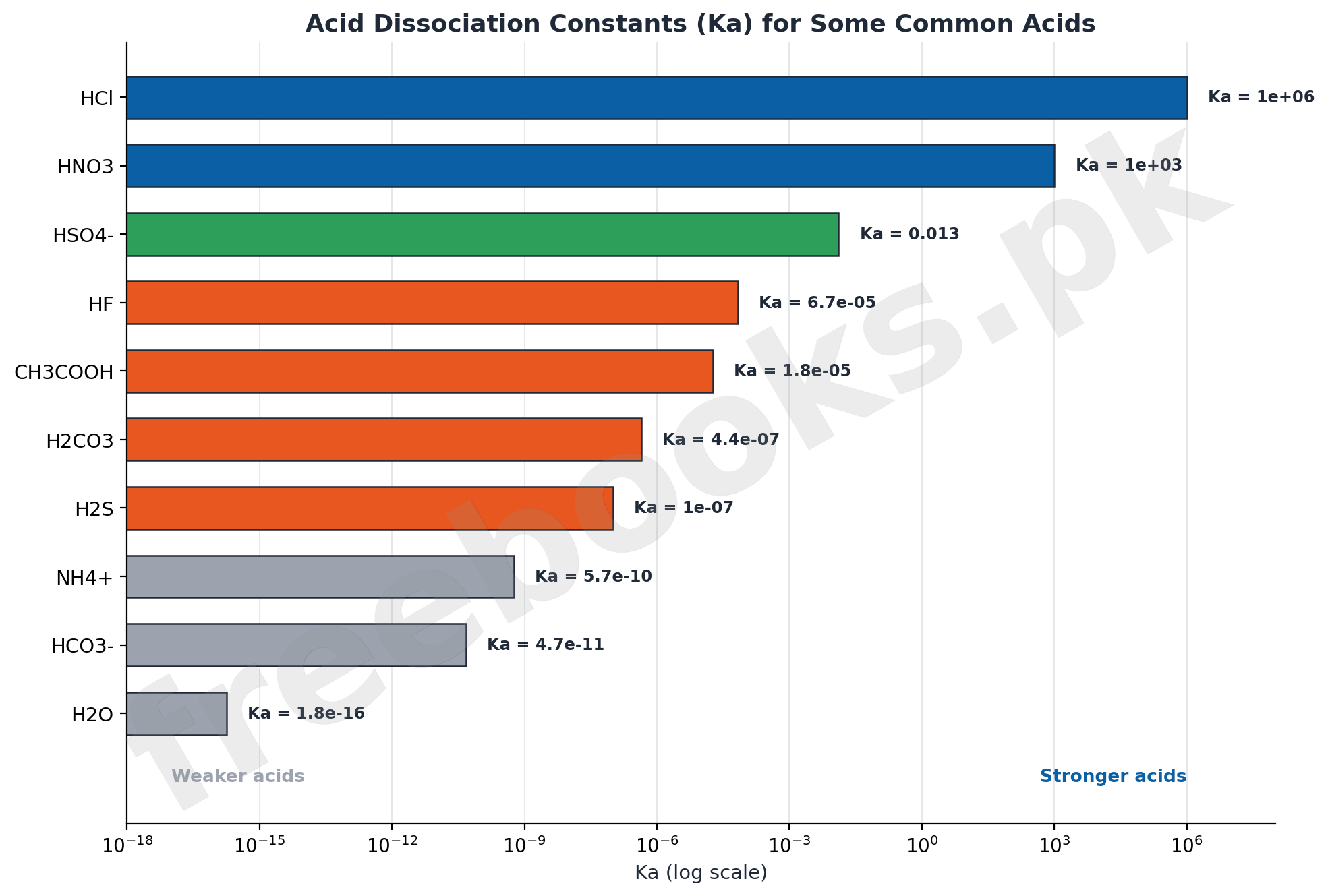
Many acids are weak electrolytes that ionize far less than 100 percent when dissolved in water; the ionization constant, Ka, is the quantitative measure of how strong or weak such an acid is. For a weak acid HA, HA + H2O <=> H3O+ + A-, and following the same reasoning used for Kw, the equilibrium constant Kc = [H3O+][A-]/([HA][H2O]) is combined with the near-constant concentration of water to give Ka = [H3O+][A-]/[HA]. Acids are classified by their Ka value: Ka less than 10^-3 indicates a weak acid, Ka between 1 and 10^-3 indicates a moderately strong acid, and Ka greater than 1 indicates a strong acid; HCl (Ka roughly 10^6) is very strong, while HF (Ka = 6.7 x 10^-5) and acetic acid (Ka = 1.85 x 10^-5) are weak.
For a weak acid of initial concentration C, at equilibrium [H3O+] = [A-] = x and [HA] = C – x, so Ka = x^2/(C – x); since x is usually very small compared with C for a weak acid, this simplifies to Ka is approximately x^2/C, so x, the equilibrium [H3O+], is approximately the square root of (Ka multiplied by C). For example, a 0.1 M solution of acetic acid with Ka = 1.8 x 10^-5 gives [H3O+] approximately equal to the square root of (1.8 x 10^-5 x 0.1), approximately 1.34 x 10^-3 mol dm-3.
9.6 Common Ion Effect
The common ion effect is the suppression of the ionization of a weak electrolyte caused by adding to the solution an ion that it already produces. Sodium chloride, which is fully ionized in solution, can be purified from brine by passing hydrogen chloride gas through it: the added Cl- from HCl increases the total [Cl-] in solution, and to keep the equilibrium constant for NaCl(s) <=> Na+(aq) + Cl-(aq) unchanged, the system responds by crystallizing NaCl out of solution.
The same principle has several important applications: the solubility of sparingly soluble potassium chlorate, KClO3, is suppressed by adding more soluble potassium chloride, KCl, since K+ is the common ion; the dissociation of weak hydrogen sulfide, H2S, is suppressed by adding hydrochloric acid, since H+ is the common ion, which lowers [S2-] enough to selectively precipitate only the group II basic radicals during qualitative salt analysis; and adding ammonium chloride, NH4Cl, to an ammonia solution suppresses [OH-], since NH4+ is the common ion, a combination used as the group reagent for group III basic radicals. The common ion effect is central to both qualitative analysis and the preparation of buffer solutions.
9.7 Buffer Solutions and the Henderson Equation
A buffer solution is one that resists changes in its pH when a small amount of acid or base is added to it, and whose pH does not significantly change on dilution or standing. Buffers are usually prepared in one of two ways: mixing a weak acid with its salt of a strong base gives an acidic buffer, pH less than 7, such as acetic acid with sodium acetate; mixing a weak base with its salt of a strong acid gives a basic buffer, pH greater than 7, such as ammonium hydroxide with ammonium chloride. In an acetic acid-sodium acetate buffer, the added CH3COO- from the fully-ionized salt suppresses the already limited ionization of the weak acetic acid by the common ion effect, and the buffer then acts as a large reservoir of both CH3COOH and CH3COO-: added H3O+ reacts with the reservoir of CH3COO- to reform CH3COOH, while added OH- reacts with H3O+ to form water, replenished from further ionization of CH3COOH, so in both cases the pH changes only very slightly.
The pH of a buffer is calculated using the Henderson equation, pH = pKa + log([Salt]/[Acid]), which shows that the buffer's pH depends on two factors: the pKa of the acid used, and the ratio of the concentrations of salt to acid. When the salt and acid concentrations are equal, the log term becomes log(1) = 0, so pH = pKa exactly; for an acetic acid-sodium acetate buffer with equal concentrations of both components, this gives pH = pKa = 4.74. This is why buffers are usually prepared with roughly equal concentrations of acid and salt, since it makes pKa, a fixed property of the chosen acid, the dominant factor controlling the buffer's pH. The body's own bicarbonate buffering system keeps blood pH stable, and injectable medicines are formulated as buffers for the same reason.
9.8 Solubility Product (Ksp) and Its Applications
Unlike freely soluble salts such as NaCl, which dissociate essentially completely, sparingly soluble salts such as PbSO4 reach an equilibrium between the undissolved solid and its dissolved ions: PbSO4(s) <=> Pb2+(aq) + SO4^2-(aq). Because the concentration of the undissolved solid remains constant, it is combined with Kc to give the solubility product, Ksp = [Pb2+][SO4^2-], equal to 1.6 x 10^-8 at 25 degrees C for PbSO4; in general, Ksp is the product of the molar concentrations of a sparingly soluble salt's ions at equilibrium, each raised to its coefficient in the balanced equation, and is usually a very small, temperature-dependent quantity.
The solubility product has three major applications. First, it allows the molar solubility, S, of a salt to be calculated: for Ca(OH)2, Ksp = [Ca2+][OH-]^2 = S(2S)^2 = 4S^3, and with Ksp = 6.5 x 10^-6, solving gives S approximately 1.18 x 10^-2 mol dm-3. Second, the common ion effect reduces the solubility of a sparingly soluble salt: adding soluble Na2CrO4 to a saturated solution of PbCrO4 increases [CrO4^2-], shifting the equilibrium to the left and decreasing solubility to keep Ksp constant. Third, comparing the ionic product of a mixture (the concentrations of the ions actually present, multiplied together in the same way as Ksp) with the true Ksp value predicts whether precipitation will occur: if the ionic product exceeds Ksp, the solution is supersaturated and precipitation occurs; if it equals Ksp, the solution is exactly saturated; and if it is less than Ksp, the solution is unsaturated and no precipitation occurs. For example, mixing 10^-2 mol dm-3 Ca2+ with 10^-2 mol dm-3 SO4^2- gives an ionic product of 2.5 x 10^-5, which exceeds the Ksp of CaSO4 (2 x 10^-5), so CaSO4 precipitates.
9.9 Salt Hydrolysis
When a salt dissolves in water, its ions can react with water in a process called hydrolysis, which may make the resulting solution acidic, basic, or neutral depending on the strength of the acid and base from which the salt was originally formed. A salt of a strong acid and a strong base, such as NaCl, gives a neutral solution, since neither the conjugate base of the strong acid (Cl-) nor the conjugate acid of the strong base (Na+) reacts significantly with water. A salt of a strong acid and a weak base, such as NH4Cl, gives an acidic solution, since the conjugate acid of the weak base, NH4+, hydrolyzes to produce H3O+: NH4+(aq) + H2O(l) <=> NH3(aq) + H3O+(aq), while Cl- again does not react.
A salt of a weak acid and a strong base, such as sodium acetate, CH3COONa, gives a basic solution, since the conjugate base of the weak acid, CH3COO-, hydrolyzes to produce OH-: CH3COO-(aq) + H2O(l) <=> CH3COOH(aq) + OH-(aq), while Na+ does not react. A salt of a weak acid and a weak base, such as ammonium acetate, produces both a hydrolyzing cation (NH4+, producing H3O+) and a hydrolyzing anion (CH3COO-, producing OH-) at the same time, so the resulting pH, which may be acidic, basic, or nearly neutral, depends on the relative strengths of the two conjugate species involved.
9.10 Acid-Base Indicators and Titration Curves
An acid-base indicator is a substance, usually a weak organic acid or base, that changes colour to mark a titration's endpoint; a weak-acid indicator, HIn <=> H+ + In-, has different colours in its unionized (HIn) and ionized (In-) forms. In acidic solution, the equilibrium shifts toward HIn, showing the acid colour; in basic solution, OH- removes H+ and the equilibrium shifts toward In-, showing the base colour. Each indicator changes colour over a characteristic pH range of about 2 units; for example, methyl red changes from red to yellow between pH 4.4 and 6.2. A suitable indicator for a given titration should have a colour-change range close to the equivalence point, the point at which the amount of titrant added exactly matches the amount of analyte present, and should show a sharp, easily observed colour change there; the endpoint, where the indicator visibly changes colour, should be as close as possible to this true equivalence point.
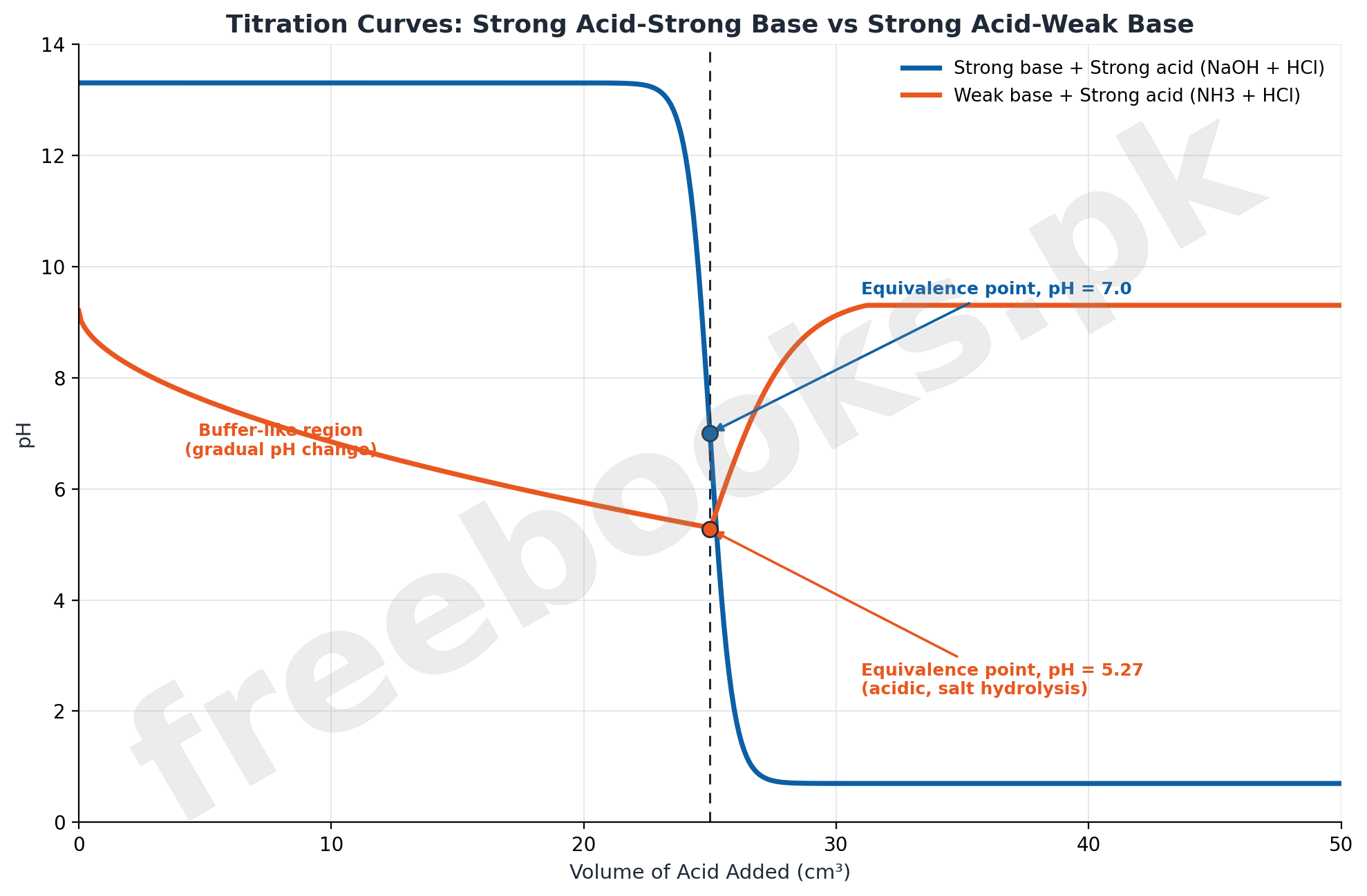
A titration curve, a plot of pH against volume of titrant added, shows how the pH changes throughout a titration and helps in choosing a suitable indicator. In a strong acid-strong base titration, such as HCl with NaOH, the pH starts very low, rises gradually, then rises very steeply through pH 7.0 exactly at the equivalence point, so an indicator such as phenolphthalein, which changes colour between pH 8.2 and 10.0, works well. In a strong acid-weak base titration, such as HCl with aqueous NH3, the initial pH is only moderately basic, the curve passes through a buffer-like region of gradual pH change before the equivalence point, and the equivalence point itself falls below pH 7 (around pH 5.27) because the conjugate acid, NH4+, formed at that point hydrolyzes and makes the solution acidic; methyl orange, which changes colour between pH 3.2 and 4.5, is a suitable indicator for this type of titration.
Important Definitions
What is a Bronsted-Lowry acid?
A species that donates a proton (H+) in a proton-transfer reaction.
What is a Bronsted-Lowry base?
A species that accepts a proton (H+) in a proton-transfer reaction.
What is a conjugate acid-base pair?
Two species that differ from each other by the gain or loss of a single proton.
What is a Lewis acid?
Any species that can accept a pair of electrons to form a coordinate covalent bond.
What is a Lewis base?
Any species that can donate a pair of electrons to form a coordinate covalent bond.
What is the ionic product of water (Kw)?
The equilibrium constant [H+][OH-] for the self-ionization of water, equal to 1.0 x 10^-14 at 25 degrees C.
What is pH?
The negative logarithm (base 10) of the hydrogen ion concentration, pH = -log[H+].
What is the ionization constant of an acid (Ka)?
The equilibrium constant [H3O+][A-]/[HA] that measures how far a weak acid HA dissociates in water.
What is the common ion effect?
The suppression of the ionization of a weak electrolyte caused by adding an ion that it has in common with another dissolved substance.
What is the solubility product (Ksp)?
The product of the molar concentrations of the ions of a sparingly soluble salt at equilibrium, each raised to its stoichiometric coefficient.
Key Facts and Relations
| Topic | Key Fact / Relation |
|---|---|
| Ionic product of water | Kw = [H+][OH-] = 1.0 x 10^-14 (at 25 degrees C) |
| pH | pH = -log[H+] |
| pOH | pOH = -log[OH-] |
| Relationship between pH and pOH | pH + pOH = 14 (at 25 degrees C) |
| Acid dissociation constant | Ka = [H3O+][A-] / [HA] |
| [H3O+] for a weak acid of concentration C | [H3O+] approximately equal to square root of (Ka x C) |
| Henderson equation (buffer pH) | pH = pKa + log([Salt]/[Acid]) |
| Buffer pH when [Salt] = [Acid] | pH = pKa |
| Solubility product (general) | Ksp = [Cation]^m [Anion]^n |
| Precipitation criterion | Ionic product > Ksp: precipitates; = Ksp: saturated; < Ksp: unsaturated, no precipitate |
Diagrams
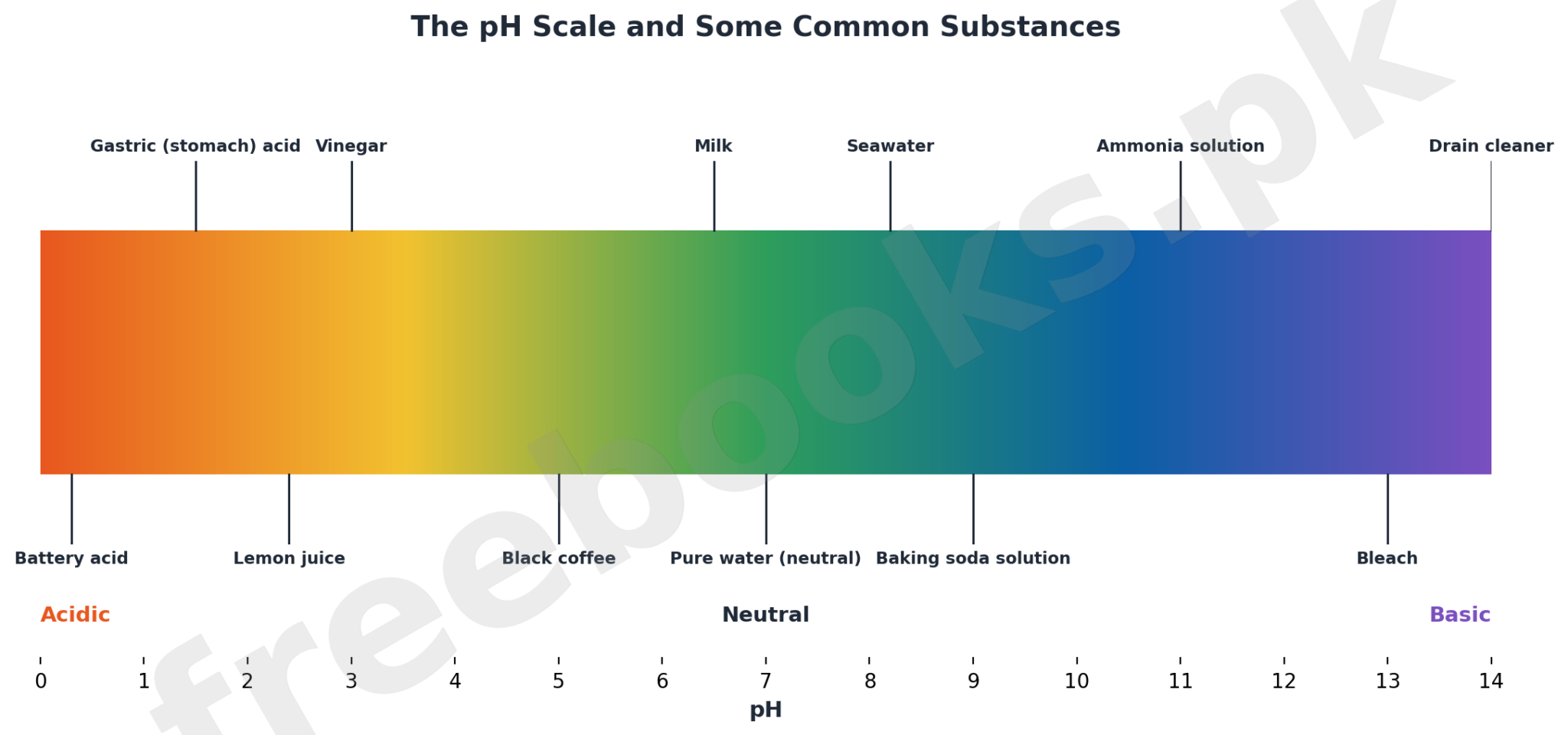
The pH Scale and Some Common Substances: A colour-graded pH scale from 0 to 14 showing where common household and biological substances fall, from strongly acidic battery acid to strongly basic drain cleaner
Titration Curves: Strong Acid-Strong Base vs Strong Acid-Weak Base: A comparison of pH vs volume of titrant curves for a strong acid-strong base titration and a strong acid-weak base titration, showing their different equivalence point pH values and the buffer-like region before the weak base's equivalence point
Acid Dissociation Constants (Ka) for Some Common Acids: A log-scale bar chart comparing the Ka values of several common acids, from very strong acids like HCl to the very weak self-ionization of water, illustrating the huge range of acid strengths
Short Questions & Answers
Why is water described as amphoteric?
Water can act as either a Bronsted-Lowry acid or a Bronsted-Lowry base depending on what it reacts with; it donates a proton to ammonia, acting as an acid, but accepts a proton from HCl, acting as a base, so it can behave either way depending on the strength of the other reactant.
Why is BF3 considered a Lewis acid even though it contains no hydrogen and cannot donate a proton?
The Lewis definition of an acid depends only on the ability to accept a pair of electrons to form a coordinate covalent bond, not on proton transfer; because boron in BF3 has an incomplete octet and can accept a lone pair from a Lewis base such as F-, BF3 qualifies as a Lewis acid despite having no proton-donating ability at all.
Why does the value of Kw stay the same when an acid or a base is added to water, even though [H+] and [OH-] individually change?
Kw is an equilibrium constant that depends only on temperature, not on the specific concentrations of H+ and OH- present; adding acid or base shifts the relative amounts of H+ and OH- away from equality, but their product, [H+][OH-], remains fixed at Kw as long as the temperature does not change.
Why was the pH scale introduced instead of simply using [H+] directly?
The concentrations of H+ in aqueous solutions typically range across many powers of ten, from around 1 mol dm-3 down to 10^-14 mol dm-3 or smaller, making them awkward to write and compare directly; taking the negative logarithm compresses this huge range into small, easily comparable numbers, usually between 0 and 14.
Why does the approximation [H3O+] is approximately equal to the square root of (Ka x C) only work for weak acids?
This approximation assumes that x, the amount of acid that ionizes, is negligible compared with C, the initial concentration, so that C – x can be replaced with C; this is a good assumption only when the acid ionizes to a very small extent, which is true for weak acids but not for strong acids, which ionize almost completely.
Why does passing HCl gas through a saturated NaCl solution cause solid NaCl to crystallize out?
The added HCl greatly increases the concentration of Cl-, a common ion also produced by NaCl; to keep the equilibrium constant for NaCl(s) <=> Na+(aq) + Cl-(aq) unchanged, the equilibrium shifts to the left, converting dissolved Na+ and Cl- back into solid NaCl and crystallizing it out of solution.
Why does a mixture of a weak acid and its salt resist changes in pH when a small amount of strong acid is added?
The buffer contains a large reservoir of the conjugate base (from the salt) that can react with the added H3O+ to reform the weak acid, consuming most of the added acid before it can significantly raise the free [H3O+] concentration; because this reservoir is large compared with the small amount of acid added, the pH changes only slightly.
Why is the pH of a buffer equal to the pKa of its acid when the salt and acid concentrations are equal?
The Henderson equation, pH = pKa + log([Salt]/[Acid]), reduces to pH = pKa + log(1) when the salt and acid concentrations are equal, and log(1) = 0, so the entire salt/acid ratio term vanishes, leaving the buffer's pH equal to the fixed pKa value of the acid being used.
Why does adding Na2CrO4 to a saturated PbCrO4 solution decrease the solubility of PbCrO4 rather than increase it?
Na2CrO4 supplies additional CrO4^2- ions, a common ion also produced by dissolving PbCrO4; to keep the solubility product, Ksp = [Pb2+][CrO4^2-], constant despite the higher [CrO4^2-], the equilibrium must shift toward the solid, decreasing [Pb2+] and therefore decreasing how much PbCrO4 remains dissolved.
Why does a solution of ammonium chloride (NH4Cl) turn out to be acidic rather than neutral?
NH4Cl is the salt of a strong acid (HCl) and a weak base (NH3); its chloride ion, the conjugate base of a strong acid, does not react with water, but its ammonium ion, the conjugate acid of a weak base, does hydrolyze, NH4+ + H2O <=> NH3 + H3O+, producing excess H3O+ and making the solution acidic.
Long Questions & Answers
Explain the Bronsted-Lowry and Lewis concepts of acids and bases, and describe how each defines conjugate acid-base pairs and coordinate covalent bond formation.
What is the key difference between how the Bronsted-Lowry and Lewis concepts define an acid?
The Bronsted-Lowry concept defines an acid specifically as a proton (H+) donor, while the Lewis concept defines an acid more broadly as any species that can accept a pair of electrons to form a coordinate covalent bond; every Bronsted-Lowry acid is also a Lewis acid, but the Lewis concept additionally covers species, such as BF3, that have no proton to donate at all.
How are conjugate acid and conjugate base defined in the Bronsted-Lowry concept?
When an acid donates a proton, the species left behind is called its conjugate base; when a base accepts that proton, the species formed is called its conjugate acid; together, the original acid and its conjugate base, or the original base and its conjugate acid, make up a conjugate acid-base pair.
Why is water considered amphoteric under the Bronsted-Lowry concept?
Water can either donate a proton, acting as an acid, as when it reacts with ammonia to form OH- and NH4+, or accept a proton, acting as a base, as when it reacts with HCl to form H3O+ and Cl-; because it can behave as either an acid or a base depending on what it reacts with, water is described as amphoteric.
How does a Lewis acid-base reaction differ chemically from a Bronsted-Lowry proton-transfer reaction?
A Bronsted-Lowry reaction transfers a proton from the acid to the base; a Lewis acid-base reaction instead transfers a pair of electrons from the base to the acid, forming a new coordinate covalent bond between them, as when ammonia donates a lone pair to a silver ion or a fluoride ion donates a lone pair to boron trifluoride.
Why is boron trifluoride, BF3, described as a very good Lewis acid?
The boron atom in BF3 has only six electrons in its valence shell, leaving it with an incomplete octet and a strong tendency to accept an additional electron pair to complete its octet; this makes BF3 a highly effective electron pair acceptor, and therefore a strong Lewis acid, readily reacting with electron pair donors such as the fluoride ion.
Describe how the pH and pOH scales are derived from the ionic product of water, and explain how the ionization constant Ka is used to calculate the pH of a weak acid solution.
How is the ionic product of water, Kw, obtained from the self-ionization equilibrium of water?
The equilibrium constant for water's self-ionization, Kc = [H+][OH-]/[H2O], is combined with the essentially constant concentration of water itself (about 55.5 mol dm-3) to give a new constant, Kw = Kc[H2O] = [H+][OH-], which has the value 1.0 x 10^-14 at 25 degrees C.
Why do pH and pOH always add up to 14 at 25 degrees C?
Since Kw = [H+][OH-] = 10^-14, taking the negative logarithm of both sides gives -log[H+] + (-log[OH-]) = -log(10^-14) = 14; because pH = -log[H+] and pOH = -log[OH-], this shows directly that pH + pOH = 14 at 25 degrees C.
How is the ionization constant, Ka, of a weak acid defined and derived?
For a weak acid HA dissociating as HA + H2O <=> H3O+ + A-, the equilibrium constant Kc = [H3O+][A-]/([HA][H2O]) is combined with the constant concentration of water in the same way Kw is derived, giving Ka = [H3O+][A-]/[HA], a constant that measures how far the acid dissociates at a given temperature.
How is [H3O+] calculated for a weak acid of known initial concentration and Ka?
Setting up an equilibrium table shows that [H3O+] = [A-] = x and [HA] = C – x, so Ka = x^2/(C – x); because x is small relative to C for a weak acid, this simplifies to Ka approximately equal to x^2/C, which rearranges to give x, the equilibrium [H3O+], as approximately the square root of (Ka multiplied by C).
Why does a stronger acid, such as HCl, not follow this same square-root approximation for calculating [H3O+]?
The square-root approximation depends on the ionized amount, x, being small compared with the initial concentration, C, which is only true for weak acids that dissociate to a small extent; a strong acid like HCl dissociates almost completely, so x is nearly equal to C rather than negligible compared with it, and [H3O+] is instead found directly from the acid's initial concentration.
Multiple Choice Questions (MCQs)
In the reaction NH3(g) + H2O(l) <=> NH4+(aq) + OH-(aq), which species acts as the Bronsted-Lowry base? (A) H2O, because it donates a proton (B) NH3, because it accepts a proton (C) NH4+, because it is positively charged (D) OH-, because it is negatively charged
Correct answer: (B) NH3, because it accepts a proton. NH3 accepts a proton from H2O to form NH4+, making NH3 the Bronsted-Lowry base and H2O the Bronsted-Lowry acid in this reaction.
Which of the following best describes a Lewis acid? (A) A species that donates a proton (B) A species that donates a pair of electrons (C) A species that accepts a pair of electrons (D) A species that accepts a proton
Correct answer: (C) A species that accepts a pair of electrons. A Lewis acid is defined as any species that can accept a pair of electrons to form a coordinate covalent bond, regardless of whether a proton is involved.
If the pH of a solution is 3, what is its [H+]? (A) 3 mol dm-3 (B) 1 x 10^-3 mol dm-3 (C) 1 x 10^3 mol dm-3 (D) 0.3 mol dm-3
Correct answer: (B) 1 x 10^-3 mol dm-3. Since pH = -log[H+], [H+] = 10^-pH = 10^-3 mol dm-3.
Which combination correctly describes the relationship between pH and pOH at 25 degrees C? (A) pH – pOH = 14 (B) pH x pOH = 14 (C) pH + pOH = 14 (D) pH + pOH = 7
Correct answer: (C) pH + pOH = 14. Because Kw = [H+][OH-] = 10^-14 at 25 degrees C, taking negative logarithms of both concentrations gives pH + pOH = 14.
A weak acid has Ka = 4.0 x 10^-4 and an initial concentration of 0.10 mol dm-3. Its approximate [H3O+] is closest to: (A) 4.0 x 10^-5 mol dm-3 (B) 2.0 x 10^-3 mol dm-3 (C) 6.3 x 10^-3 mol dm-3 (D) 4.0 x 10^-3 mol dm-3
Correct answer: (C) 6.3 x 10^-3 mol dm-3. [H3O+] is approximately the square root of (Ka x C) = square root of (4.0 x 10^-4 x 0.10) = square root of (4.0 x 10^-5), approximately 6.3 x 10^-3 mol dm-3.
Adding solid NaCl to a saturated solution of AgCl will: (A) Increase the solubility of AgCl (B) Decrease the solubility of AgCl due to the common ion effect (C) Have no effect on the solubility of AgCl (D) Convert all AgCl into a soluble complex
Correct answer: (B) Decrease the solubility of AgCl due to the common ion effect. Cl- is a common ion produced by both NaCl and AgCl; increasing [Cl-] shifts the AgCl dissolution equilibrium to the left by Le Chatelier's principle (the common ion effect), decreasing the solubility of AgCl.
A buffer solution is best prepared by mixing: (A) A strong acid and a strong base (B) A weak acid and its salt with a strong base (C) Two different strong acids (D) A weak acid and a weak base of unrelated identity
Correct answer: (B) A weak acid and its salt with a strong base. An effective buffer is made from a weak acid together with its salt (its conjugate base) of a strong base, since this combination provides a reservoir of both HA and A- that can absorb small additions of acid or base.
If the ionic product of a mixture of ions exceeds the Ksp of the corresponding salt, the solution is: (A) Unsaturated, and no precipitate forms (B) Exactly saturated, at equilibrium (C) Supersaturated, and precipitation occurs (D) Impossible to characterize without more data
Correct answer: (C) Supersaturated, and precipitation occurs. When the ionic product exceeds Ksp, the solution contains more dissolved ions than the equilibrium allows, so it is supersaturated and the excess salt precipitates out until the ionic product falls back to Ksp.
A solution of sodium acetate (CH3COONa) in water is expected to be: (A) Acidic, because Na+ hydrolyzes (B) Basic, because CH3COO- hydrolyzes to form OH- (C) Neutral, because both ions are spectators (D) Acidic, because CH3COO- hydrolyzes to form H3O+
Correct answer: (B) Basic, because CH3COO- hydrolyzes to form OH-. Sodium acetate is the salt of a weak acid (acetic acid) and a strong base (NaOH); its acetate ion, the conjugate base of a weak acid, hydrolyzes to produce OH-, making the solution basic, while Na+ does not react with water.
Which indicator is most suitable for a strong acid-weak base titration, where the equivalence point occurs below pH 7? (A) Phenolphthalein (range 8.2-10.0) (B) Methyl orange (range 3.2-4.5) (C) An indicator with a range centered exactly at pH 7 (D) Any indicator, since the choice does not matter
Correct answer: (B) Methyl orange (range 3.2-4.5). The equivalence point of a strong acid-weak base titration occurs below pH 7, in the acidic region, so methyl orange, which changes colour between pH 3.2 and 4.5, gives a sharp colour change close to that equivalence point.
Quick Revision Summary
- Bronsted-Lowry: acid = proton donor, base = proton acceptor; conjugate acid/base pairs differ by one proton; water is amphoteric
- Lewis concept: acid = electron pair acceptor, base = electron pair donor, forming a coordinate covalent bond; broader than Bronsted-Lowry (e.g. BF3)
- Kw = [H+][OH-] = 1.0 x 10^-14 at 25 degrees C; constant at a given temperature regardless of acid/base added; increases with temperature
- pH = -log[H+]; pOH = -log[OH-]; pH + pOH = 14 at 25 degrees C; neutral water has pH = pOH = 7
- Ka = [H3O+][A-]/[HA]; Ka < 10^-3 weak, 10^-3 to 1 moderately strong, > 1 strong
- For a weak acid of concentration C: [H3O+] approximately equal to square root of (Ka x C), valid when x is small relative to C
- Common ion effect: adding a common ion suppresses ionization of a weak electrolyte (used in NaCl purification, qualitative analysis, buffers)
- Buffer solution resists pH change on adding small amounts of acid/base; acidic buffer = weak acid + its salt; basic buffer = weak base + its salt
- Henderson equation: pH = pKa + log([Salt]/[Acid]); pH = pKa when [Salt] = [Acid]
- Ksp = product of ion concentrations at equilibrium, each raised to its coefficient; used to find solubility, apply the common ion effect, and predict precipitation
- Precipitation rule: ionic product > Ksp precipitates; = Ksp saturated; < Ksp unsaturated
- Salt hydrolysis: strong acid + strong base -> neutral; strong acid + weak base -> acidic (cation hydrolyzes); weak acid + strong base -> basic (anion hydrolyzes); weak acid + weak base -> depends on relative strengths
- Acid-base indicators are weak acids/bases with different colours for HIn and In-; choose an indicator whose colour-change range is close to the titration's equivalence point
- Strong acid-strong base titration: equivalence point pH = 7.0 (phenolphthalein suitable); strong acid-weak base titration: equivalence point pH < 7 (methyl orange suitable)
Exam Tips
- Always double check whether a question asks about the Bronsted-Lowry acid/base (proton transfer) or the Lewis acid/base (electron pair transfer) role of a species — some species, like BF3, only make sense under the Lewis definition
- Remember Kw only changes with temperature — it is the same 1.0 x 10^-14 in acidic, neutral, and basic solutions at 25 degrees C, even though [H+] and [OH-] individually differ
- For weak acid pH calculations, always check that x is genuinely small compared with C before using the square-root approximation; for strong acids, assume complete dissociation instead
- For buffer pH calculations, use the Henderson equation directly with [Salt] and [Acid] as given — do not confuse which one goes in the numerator, since salt over acid, not acid over salt, gives the correct sign
- When comparing an ionic product with Ksp to predict precipitation, make sure the exponents on each ion concentration match the salt's actual formula (e.g. Ksp = [Ca2+][OH-]^2 for Ca(OH)2, not [Ca2+][OH-])
- For salt hydrolysis questions, first identify whether the salt's parent acid and base were strong or weak — this alone determines whether the solution will be neutral, acidic, or basic, before doing any calculation