
Chemical equilibrium describes the state reached by a reversible reaction, one that proceeds in both the forward and reverse directions rather than going to completion, when it is carried out in a closed container: the concentrations of reactants and products stop changing, and the rate of the forward reaction becomes exactly equal to the rate of the reverse reaction. Although the system appears static from the outside, at the molecular level both reactions continue indefinitely at equal rates, which is why this state is called a dynamic, rather than a static, equilibrium; the same idea applies to purely physical changes, such as the equilibrium between a liquid and its vapour in a closed container.
The chapter introduces the equilibrium constant, Kc, which measures the position of an equilibrium under a given set of conditions and depends only on temperature, and shows how it can equivalently be expressed in terms of partial pressures (Kp), moles (Kn), or mole fractions (Kx). It then applies Le Chatelier's principle, that a system at equilibrium responds to any imposed change by shifting to counteract that change, to predict how altering concentration, pressure, volume, or temperature shifts the position of an equilibrium, and closes by using these ideas to explain how industrial processes such as the Haber process and the contact process are optimized to maximize product yield.
Learning Objectives
- Distinguish between macroscopic events, observable with the naked eye, and microscopic events, occurring at the molecular level, in a chemical system approaching equilibrium
- Describe a reversible reaction and define dynamic chemical equilibrium in terms of equal forward and reverse rates and constant reactant/product concentrations
- Define dynamic equilibrium between two physical states, such as a liquid and its vapour, or a solid and its liquid
- State the necessary conditions for chemical equilibrium and describe the characteristic features by which it can be recognized
- Deduce the equilibrium constant expression, Kc, for a homogeneous reaction from its balanced chemical equation
- Write equilibrium expressions in terms of concentration (Kc), partial pressure (Kp), number of moles (Kn), and mole fraction (Kx), and relate these constants to one another
- Distinguish between homogeneous equilibria, where all species share one phase, and heterogeneous equilibria, where more than one phase is present
- State Le Chatelier's principle and apply it to predict the effect of changes in concentration, pressure, volume, temperature, or catalyst on a system at equilibrium
- Determine whether Kc increases or decreases with a change in temperature, given whether a reaction is exothermic or endothermic
- Explain how Le Chatelier's principle is applied industrially in the Haber process and the contact process to maximize product yield
Key Concepts
8.1 Reversible Reactions and Chemical Equilibrium
Reactions in which the reactants are completely consumed and converted into products are called irreversible reactions; such reactions stop once the limiting reactant is used up. Reversible reactions, by contrast, proceed continuously in both the forward and reverse directions without the concentrations of reactants and products ever falling to zero, and are written with a double arrow, such as N2(g) + 3H2(g) <=> 2NH3(g), 2NO2(g) <=> N2O4(g), and PCl5(g) <=> PCl3(g) + Cl2(g). When a reversible reaction takes place in a closed container, so that none of the reacting substances can escape, the reaction eventually reaches a stage called chemical equilibrium, at which the concentrations of all reactants and products become constant and the rates of the forward and reverse reactions become equal.
8.2 Macroscopic and Microscopic Events; Dynamic Equilibrium
Macroscopic events are phenomena that can be observed with the naked eye without considering individual particles, such as a change in colour, the evolution or absorption of heat, the formation of a precipitate, the evolution of a gas, or a change in volume, pressure, or composition. Microscopic events, by contrast, cannot be observed directly and include collisions between molecules, the breaking and forming of bonds, the rearrangement of atoms, and the loss or gain of electrons; macroscopic changes are simply the combined, observable result of huge numbers of simultaneous microscopic events.
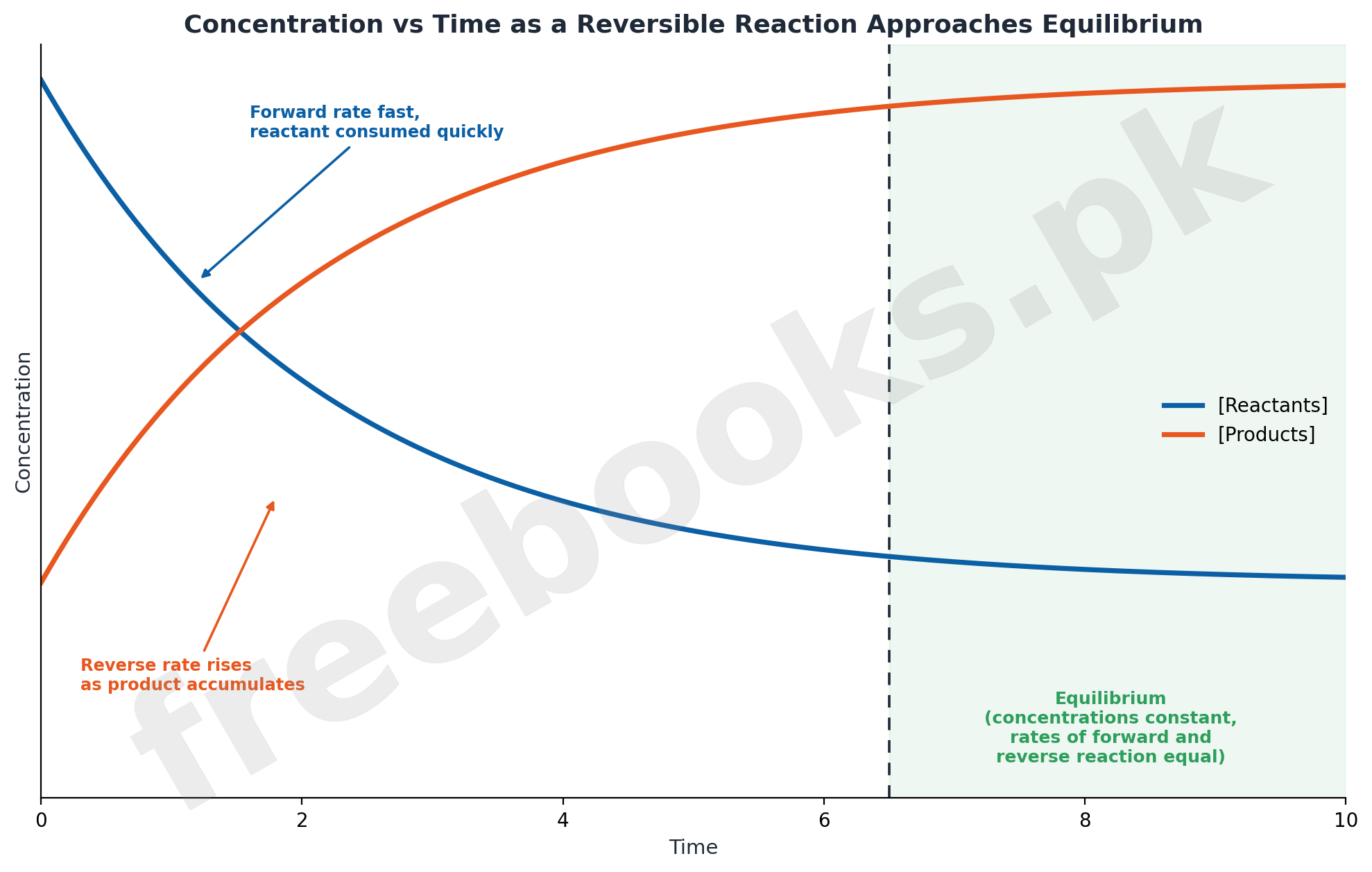
Consider steam and carbon monoxide reacting to form hydrogen and carbon dioxide, H2O(g) + CO(g) -> H2(g) + CO2(g): when the gases are first mixed, the maximum possible number of collisions between H2O and CO molecules occurs, so the forward reaction proceeds at its fastest rate, and this rate gradually slows as the reactants are consumed. At the same time, as H2 and CO2 molecules accumulate, collisions between them become more frequent, and the reverse reaction, which starts at a low rate, gradually speeds up. Eventually the forward and reverse rates become equal, and the reaction reaches chemical equilibrium; although the concentrations of reactants and products then stay constant, and the reaction may appear to have stopped, at the microscopic level both the forward and reverse reactions continue indefinitely at equal rates, making this a dynamic equilibrium rather than a static one.
8.3 Dynamic Equilibrium Between Two Physical States
Dynamic equilibrium also applies to purely physical changes: when a reversible phase change occurs, such as ice and water coexisting at 0 degrees C, water converts to ice at exactly the same rate that ice converts back to water, so no net change occurs even though both processes continue. A similar dynamic equilibrium exists between a liquid and its vapour in a closed container: molecules near the liquid's surface with enough energy escape into the gas phase, a process called evaporation, while gas-phase molecules that collide with the liquid surface are recaptured, a process called condensation.
As evaporation and condensation continue, their rates eventually become equal, establishing a dynamic equilibrium at which the vapour pressure remains constant at a given temperature as long as the system is undisturbed. Raising the temperature increases the average kinetic energy of the liquid's molecules, increasing both the rate of evaporation and, once more vapour is present, the rate of condensation, until a new dynamic equilibrium is reached at a higher equilibrium vapour pressure.
8.4 Conditions and Characteristics of Chemical Equilibrium
Chemical equilibrium can only be studied when two conditions are satisfied: the state of equilibrium applies only to reversible reactions, and equilibrium can only be established in a closed system, one from which no reactant or product is allowed to escape; a reversible reaction carried out in an open container never reaches equilibrium, since escaping gas continuously shifts the system in one direction. Several important characteristics follow from this: at equilibrium, the concentrations of reactants and products remain constant; the equilibrium state can be approached from either direction, starting from pure reactants or from pure products; a catalyst does not change the position of equilibrium or the value of the equilibrium constant, it only helps the system reach equilibrium more quickly; and the value of the equilibrium constant does not depend on the initial concentrations used, but depends only on temperature.
If pure solids or pure liquids take part in an equilibrium system, their concentrations are not included in the equilibrium constant expression, because the concentration of a pure solid or liquid, essentially its density, does not change and therefore has no effect on the value of the equilibrium constant.
8.5 Types of Equilibrium: Homogeneous and Heterogeneous
With respect to the physical states of the species involved, equilibria are classified into two types. A homogeneous equilibrium is one in which all reactants and products exist in the same phase, as in the synthesis of ammonia, N2(g) + 3H2(g) <=> 2NH3(g), the formation of sulfur trioxide, 2SO2(g) + O2(g) <=> 2SO3(g), or the esterification of ethanoic acid with ethanol, in which every species is a liquid. A heterogeneous equilibrium is one in which the reactants and products exist in more than one phase, as in the thermal decomposition of calcium carbonate, CaCO3(s) <=> CaO(s) + CO2(g), the reaction of carbon with steam, C(s) + H2O(g) <=> CO(g) + H2(g), or the reaction of iron with steam, 3Fe(s) + 4H2O(g) <=> Fe3O4(s) + 4H2(g).
8.6 The Equilibrium Constant (Kc) and the Law of Mass Action
In 1864, the chemists Guldberg and Waage measured the compositions of many reaction systems at equilibrium and found that, for any reversible reaction, the ratio of the product of the equilibrium concentrations of the products, each raised to its coefficient in the balanced equation, to the equivalent product of reactant concentrations, is always constant under a given set of conditions. For the general reaction aA + bB <=> cC + dD, this equilibrium constant expression is written Kc = [C]^c[D]^d / ([A]^a[B]^b), where square brackets denote molar concentration in mol dm-3.
This expression can be derived from the law of mass action, which states that the rate of a reaction is proportional to the active masses (concentrations) of the reacting substances: for A + B <=> C + D, the forward rate is kf[A][B] and the reverse rate is kr[C][D], and since these two rates are equal at equilibrium, kf[A][B] = kr[C][D], so kf/kr = [C][D]/[A][B] = Kc, a new constant called the equilibrium constant. Applying this to real reactions gives, for example, Kc = [NH3]^2 / ([N2][H2]^3) for the synthesis of ammonia, and Kc = [NO2]^4[O2] / [N2O5]^2 for the decomposition of dinitrogen pentoxide; a worked example using equilibrium concentrations of 0.470 mol dm-3 ethanoic acid, 0.070 mol dm-3 ethanol, and 0.364 mol dm-3 each of ethyl ethanoate and water gives Kc = 4.03 for the esterification reaction, while a propanone-hydrogen cyanide addition reaction with equilibrium concentrations of 0.0267 mol dm-3 for each reactant and 0.0233 mol dm-3 for the product gives Kc = 32.7 dm3 mol-1.
8.7 Units of Kc and Relationships Between Equilibrium Constants
When the total number of moles of reactants and products in the balanced equation are equal, the concentration units in the Kc expression cancel completely, leaving Kc with no units, as in the ester formation reaction; when the number of moles are unequal, as in ammonia synthesis, the units do not cancel, giving Kc units such as dm6 mol-2 that depend on the specific reaction. Four different quantities can be used to express an equilibrium constant: Kc, based on molar concentrations; Kp, based on the partial pressures of gaseous species; Kn, based on numbers of moles; and Kx, based on mole fractions.
These four constants are related by Kp = Kc(RT)^Delta n, Kp = Kx(P)^Delta n, and Kp = Kn(N)^Delta n, where R is the gas constant, T is the absolute temperature, P is the total pressure, N is the total number of moles present, and Delta n is the difference between the number of moles of gaseous products and gaseous reactants in the balanced equation. If Delta n = 0, meaning the balanced equation has equal moles of gaseous reactants and products, then Kp = Kc = Kx = Kn, and the value of the equilibrium constant is the same regardless of which concentration units are used; a worked example converts Kc = 6.0 x 10^-2 at 500 degrees C for ammonia synthesis (Delta n = -2) into Kp = 1.4 x 10^-5, showing that Kp is smaller than Kc for this reaction.
8.8 Le Chatelier's Principle
The position of equilibrium refers to the relative amounts of reactants and products present in an equilibrium mixture; if a system at equilibrium is disturbed so that the position shifts toward more product, the equilibrium is said to have shifted to the right, and if it shifts toward more reactant, it is said to have shifted to the left. Le Chatelier's principle, proposed by the French chemist Henry-Louis Le Chatelier, states that if a system at equilibrium is disturbed, it responds in such a way as to counteract, or partially nullify, the effect of that disturbance. This principle is most commonly applied to four types of disturbance: a change in concentration, a change in pressure or volume, a change in temperature, and the addition of a catalyst.
8.9 Effects of Concentration, Pressure/Volume and Catalyst on Equilibrium
Adding or removing a reactant or product disturbs an equilibrium, and the system shifts to partially counteract the change. This is illustrated by the reversible hydrolysis of bismuth(III) chloride, BiCl3 + H2O <=> BiOCl + 2HCl: adding more BiCl3 or water pushes the reaction forward, producing more BiOCl and HCl, while adding more BiOCl or HCl pushes the reaction in reverse, producing more BiCl3; conversely, removing BiCl3 shifts the reaction in reverse, and removing BiOCl or HCl shifts it forward. In every case, the equilibrium position changes, but the value of Kc itself remains constant, since Kc depends only on temperature.
A change in pressure or volume only affects the position of a gas-phase equilibrium when the number of moles of gaseous reactants differs from the number of moles of gaseous products; if these numbers are equal, changing pressure or volume has no effect on the equilibrium position. In the synthesis of ammonia, N2(g) + 3H2(g) <=> 2NH3(g), four moles of gaseous reactants form two moles of gaseous product, so increasing the pressure, or decreasing the volume, shifts the equilibrium toward the side with fewer gas molecules, favouring the forward reaction and producing more ammonia; decreasing the pressure, or increasing the volume, shifts the equilibrium the other way, favouring the reactants.
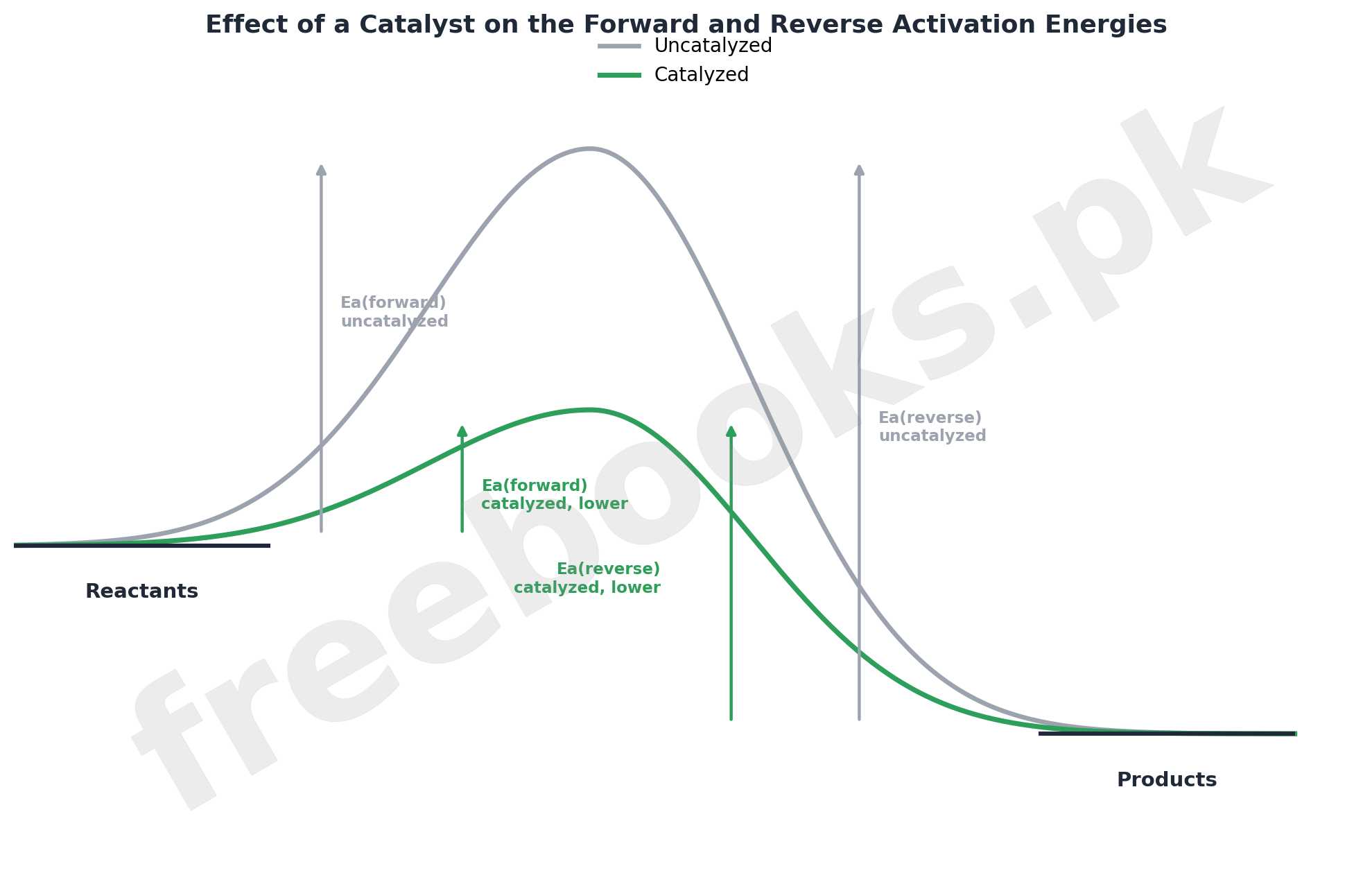
A catalyst provides an alternative reaction pathway with a lower activation energy for both the forward and the reverse reaction equally, so it speeds up the rate at which equilibrium is reached without changing the equilibrium position or the value of the equilibrium constant; the overall yield of the reaction therefore stays the same, whether or not a catalyst is used, though a catalyst allows that same yield to be reached in far less time.
8.10 Effect of Temperature on Equilibrium
Temperature is the only factor that changes the actual numerical value of the equilibrium constant, Kc, rather than simply shifting the position of equilibrium while Kc stays fixed. For an exothermic reaction, such as 2SO2(g) + O2(g) <=> 2SO3(g), Delta H° = -198 kJ, increasing the temperature favours the reverse, heat-absorbing reaction, shifting the equilibrium to the left, decreasing the concentration of SO3, and decreasing the value of Kc, which falls from about 1 x 10^26 at 298 K to about 2.8 x 10^2 at 1000 K; decreasing the temperature has the opposite effect, favouring the forward reaction and increasing Kc, which is why SO3 production is favoured at lower temperature.
For an endothermic reaction, such as N2O4(g) <=> 2NO2(g), Delta H° = +57.2 kJ, increasing the temperature favours the forward, heat-absorbing reaction, shifting the equilibrium to the right, increasing the concentration of NO2, and increasing the value of Kc, which rises from about 7.7 x 10^-5 at 273 K to about 0.4 at 373 K; decreasing the temperature favours the reverse reaction and decreases Kc. In general, raising the temperature always favours whichever direction of a reaction is endothermic, regardless of whether that happens to be the forward or the reverse direction.
8.11 Industrial Applications: Haber's Process and the Contact Process
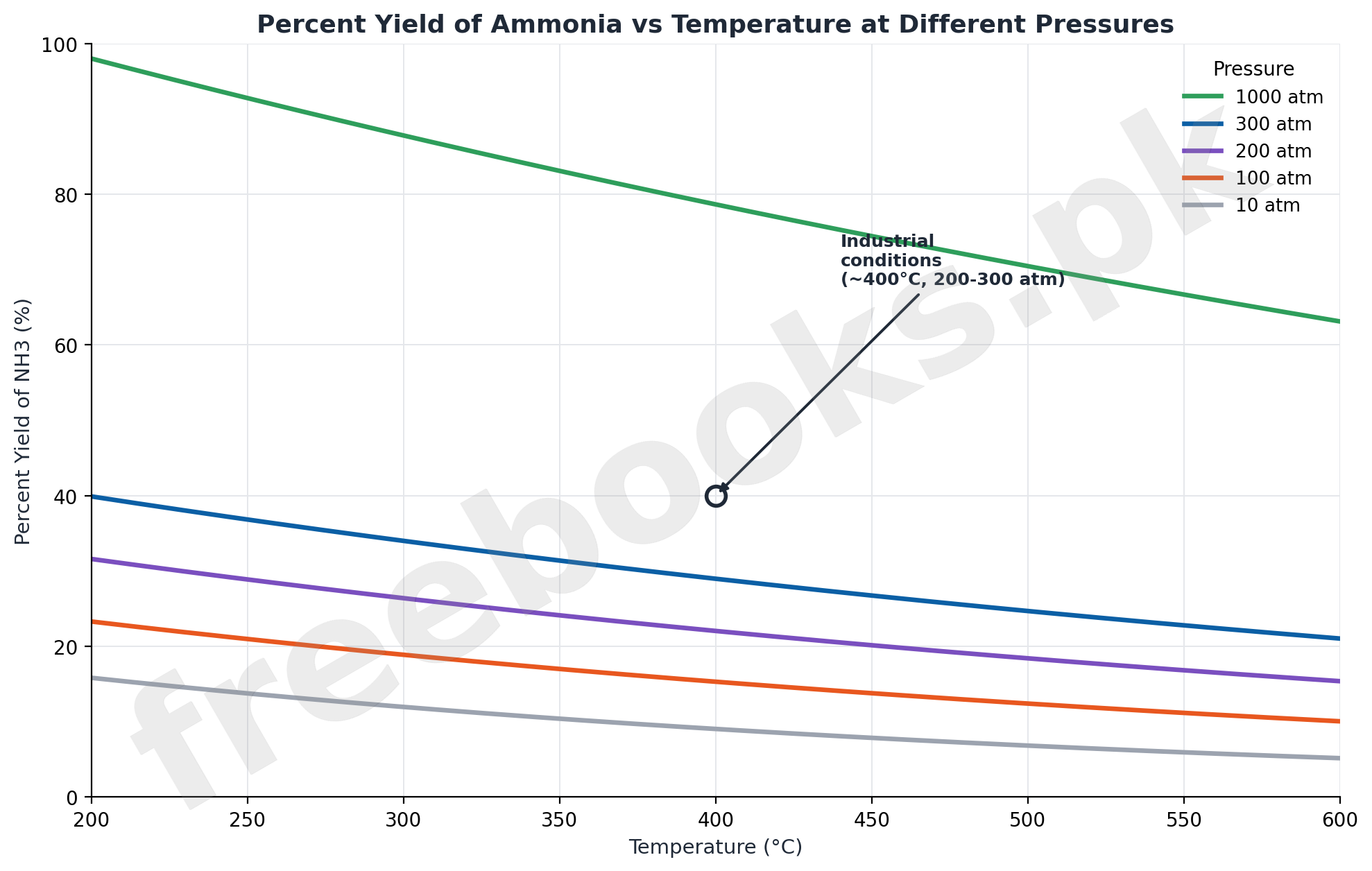
The synthesis of ammonia by the Haber process, N2(g) + 3H2(g) <=> 2NH3(g), Delta H = -46.11 kJ/mol, is exothermic and proceeds with a decrease in the number of gas moles, so Le Chatelier's principle predicts that maximum yield is favoured by continuously removing ammonia as it forms, by using high pressure, and by using low temperature. In practice, very low temperature makes the reaction far too slow to be economical, so industrial plants instead use a moderate temperature of around 673 K (400 degrees C) together with an iron catalyst, promoted with MgO, Al2O3 and SiO2, to speed up the approach to equilibrium, combined with a high pressure of 200 to 300 atmospheres; under these compromise conditions, useful yields of ammonia are obtained at a commercially practical rate, even though the very highest possible yield, up to 98.3 percent, would require far more extreme, and far less economical, conditions of very low temperature and very high (1000 atmosphere) pressure.
A similar compromise governs the production of sulfur trioxide in the contact process for making sulfuric acid, 2SO2(g) + O2(g) <=> 2SO3(g), Delta H = -97.9 kJ/mol: Le Chatelier's principle predicts that high pressure and low temperature favour the highest yield of SO3, but at low temperature the equilibrium is reached only very slowly. Industrially, a mixture of SO2 and O2 (as air) at about 1 atmosphere pressure is passed over a solid vanadium(V) oxide catalyst; because the reaction is exothermic, the gas temperature rises to around 600 degrees C as it reacts, so the mixture is cooled and recycled at the more favourable temperature of 400 to 500 degrees C to increase the final yield of SO3.
Important Definitions
What is a reversible reaction?
A reaction that proceeds continuously in both the forward and reverse directions, never going fully to completion, and is written with a double arrow (<=>).
What is an irreversible reaction?
A reaction in which the reactants are completely consumed and converted into products, stopping once the limiting reactant is used up.
What is chemical (dynamic) equilibrium?
The state of a reversible reaction in a closed system at which the concentrations of reactants and products are constant and the forward and reverse reaction rates are equal.
What are macroscopic events?
Observable phenomena, such as colour change, heat evolution, or precipitate formation, that occur without reference to individual particles.
What are microscopic events?
Molecular-level phenomena, such as collisions and the breaking or forming of bonds, that cannot be observed directly but underlie macroscopic change.
What is the equilibrium constant (Kc)?
The constant ratio of product concentrations to reactant concentrations, each raised to its stoichiometric coefficient, at equilibrium, for a given reaction at a given temperature.
What is the law of mass action?
The principle that the rate of a chemical reaction is proportional to the active masses (molar concentrations) of the reacting substances.
What is a homogeneous equilibrium?
An equilibrium system in which all reactants and products exist in the same physical phase.
What is a heterogeneous equilibrium?
An equilibrium system in which the reactants and products exist in more than one physical phase.
What is Le Chatelier's principle?
The principle that if a system at equilibrium is disturbed, it shifts in a way that counteracts, or partially nullifies, the effect of that disturbance.
Key Facts and Relations
| Topic | Key Fact / Relation |
|---|---|
| General equilibrium constant expression | Kc = [C]^c[D]^d / ([A]^a[B]^b) for aA + bB <=> cC + dD |
| Equilibrium constant from rate constants | Kc = kf / kr |
| Partial pressure equilibrium constant | Kp = (pC^c . pD^d) / (pA^a . pB^b) |
| Relating Kp and Kc | Kp = Kc (RT)^Delta n |
| Relating Kp and Kx | Kp = Kx (P)^Delta n |
| Relating Kp and Kn | Kp = Kn (N)^Delta n |
| Special case when Delta n = 0 | Kp = Kc = Kx = Kn |
| Le Chatelier's principle | A system at equilibrium shifts to counteract any imposed disturbance |
| Effect of pressure increase (unequal gas moles) | Equilibrium shifts toward the side with fewer moles of gas |
| Effect of temperature | Exothermic reaction: T up shifts equilibrium left, Kc decreases; Endothermic reaction: T up shifts equilibrium right, Kc increases |
Diagrams
Concentration vs Time as a Reversible Reaction Approaches Equilibrium: A plot showing reactant concentration falling and product concentration rising as a reversible reaction proceeds, both becoming constant once the forward and reverse reaction rates become equal at equilibrium
Effect of a Catalyst on the Forward and Reverse Activation Energies: An energy profile diagram showing that a catalyst lowers the activation energy of both the forward and reverse reactions by the same amount, speeding up the approach to equilibrium without changing its position
Percent Yield of Ammonia vs Temperature at Different Pressures: A set of curves showing how the percentage yield of ammonia in the Haber process decreases with increasing temperature and increases with increasing pressure, with the industrial compromise conditions marked
Short Questions & Answers
Why is the equilibrium reached by a reversible reaction described as dynamic rather than static?
Although the concentrations of reactants and products stop changing at equilibrium, individual molecules never stop reacting; the forward and reverse reactions both continue indefinitely at the molecular level, but because they proceed at exactly equal rates, there is no net change in the bulk concentrations, making the equilibrium dynamic rather than static.
Why can chemical equilibrium only be established in a closed system?
Equilibrium requires the forward and reverse reactions to reach equal rates while none of the reacting substances escape; in an open system, a gaseous reactant or product can continuously leave the reaction vessel, preventing the concentrations from ever stabilizing and so preventing equilibrium from being established.
Why does a catalyst not change the position of equilibrium or the value of Kc?
A catalyst lowers the activation energy of the forward and reverse reactions by the same amount, so it speeds up both reactions equally; because it accelerates the approach to equilibrium without favouring one direction over the other, the final equilibrium position, and therefore the value of Kc, remains unchanged.
Why are pure solids and pure liquids left out of the equilibrium constant expression?
The concentration of a pure solid or liquid, essentially its density, is a fixed physical property that does not change no matter how much of the solid or liquid is present; since it cannot vary, including it in the Kc expression would add nothing, so only species whose concentrations can actually change are included.
Why does the equilibrium constant Kc for the ester formation reaction have no units, while Kc for ammonia synthesis does?
In the ester formation reaction, the total number of moles of reactants equals the total number of moles of products, so every mol dm-3 unit in the numerator of the Kc expression is cancelled by an identical unit in the denominator; in ammonia synthesis, the moles of reactants and products are unequal, so the units do not fully cancel, leaving Kc with units such as dm6 mol-2.
Why does increasing the pressure on the Haber process equilibrium shift it toward producing more ammonia?
Four moles of gaseous reactants form only two moles of gaseous product in this reaction, so the product side occupies a smaller volume at the same pressure and temperature; increasing the pressure disturbs the equilibrium, and by Le Chatelier's principle the system shifts toward the side with fewer gas molecules, the product side, to partially counteract the pressure increase.
Why does increasing temperature decrease the value of Kc for an exothermic reaction but increase it for an endothermic reaction?
Raising temperature always favours whichever direction of a reaction absorbs heat; for an exothermic reaction, this is the reverse direction, so the equilibrium shifts toward reactants and Kc falls, while for an endothermic reaction, this is the forward direction, so the equilibrium shifts toward products and Kc rises.
Why is a moderate rather than a very low temperature used industrially in the Haber process, even though the reaction is exothermic?
Although Le Chatelier's principle shows that low temperature favours a higher equilibrium yield of ammonia, at very low temperature the rate at which equilibrium is reached becomes far too slow to be commercially practical; a moderate temperature, combined with a catalyst, is used instead as a compromise that gives an acceptable yield within an economically reasonable time.
Why is the hot gas mixture cooled and recycled during the contact process for making sulfur trioxide?
The oxidation of SO2 to SO3 is exothermic, so the reacting gas mixture heats up to around 600 degrees C as it passes over the catalyst, a temperature at which the equilibrium yield of SO3 is relatively low; cooling the mixture to 400-500 degrees C before recycling it shifts the equilibrium back toward a higher yield of SO3 without needing to run the whole process at an uneconomically low temperature throughout.
Why does removing a product from an equilibrium mixture shift the reaction further toward that product?
Removing a product lowers its concentration below the equilibrium value, and by Le Chatelier's principle the system responds by shifting in the direction that replaces some of what was removed; since the forward reaction produces more of that product, the equilibrium shifts forward, converting more reactant into product until a new equilibrium position is established.
Long Questions & Answers
Explain the difference between macroscopic and microscopic events in a reversible reaction, and describe how the concept of dynamic equilibrium follows from this distinction.
What is the difference between a macroscopic and a microscopic event in a chemical system?
A macroscopic event is a change that can be observed directly with the naked eye, such as a colour change or the evolution of a gas, while a microscopic event is a molecular-level occurrence, such as a collision between particles or the breaking of a bond, that cannot be observed directly but is what actually causes the macroscopic change.
How does the rate of the forward reaction change as steam and carbon monoxide are first mixed?
At the moment of mixing, the concentrations of both reactants are at their highest, so the frequency of effective collisions between H2O and CO molecules, and therefore the rate of the forward reaction, is at its maximum; as the reactants are gradually consumed, this rate steadily decreases.
How does the rate of the reverse reaction change as the forward reaction proceeds?
At the start, essentially no product molecules are present, so the reverse reaction proceeds extremely slowly; as H2 and CO2 accumulate from the forward reaction, collisions between them become more frequent, so the rate of the reverse reaction gradually increases.
What happens once the forward and reverse rates become equal?
Once the two rates are equal, the amount of reactant being converted to product each second exactly balances the amount of product being converted back to reactant, so the concentrations of every species stop changing; the system has reached chemical equilibrium.
Why is this equilibrium described as dynamic rather than as the reaction having stopped?
Even though the bulk concentrations no longer change, individual reactant and product molecules are still continuously colliding and reacting in both directions at the microscopic level; the system only appears unchanging because these two ongoing processes occur at exactly equal rates, which is the defining feature of a dynamic, rather than a static, equilibrium.
State Le Chatelier's principle and explain how it is used to predict the effect of changes in concentration, pressure, and temperature on a system at equilibrium.
What does Le Chatelier's principle state?
It states that if a system at equilibrium is disturbed by an external change, the system responds in a way that counteracts, or partially nullifies, the effect of that disturbance, shifting the position of equilibrium until a new balance is established.
How does adding more of a reactant affect the position of equilibrium?
Adding more reactant increases its concentration above the equilibrium value, so the system shifts in the forward direction, consuming some of the added reactant and producing more product, until a new equilibrium position is established at which the rates of the forward and reverse reactions are again equal.
How does increasing the pressure on a gaseous equilibrium affect its position?
If the numbers of moles of gas differ between the reactant and product sides, increasing pressure shifts the equilibrium toward whichever side has fewer moles of gas, since that side occupies less volume and partially relieves the increased pressure; if the moles of gas are equal on both sides, changing pressure has no effect on the equilibrium position.
How does increasing the temperature affect an exothermic equilibrium differently from an endothermic one?
Because raising temperature always favours whichever direction of a reaction absorbs heat, increasing temperature shifts an exothermic reaction's equilibrium toward the reactants, decreasing Kc, while it shifts an endothermic reaction's equilibrium toward the products, increasing Kc.
Why is temperature different from concentration and pressure in how it affects equilibrium?
Changing concentration or pressure shifts the position of equilibrium while leaving the numerical value of the equilibrium constant unchanged, since Kc depends only on temperature; changing temperature, however, actually changes the value of Kc itself, which is why temperature is described as the only factor that alters the equilibrium constant rather than simply shifting the equilibrium position around a fixed Kc.
Multiple Choice Questions (MCQs)
A reaction that proceeds continuously in both directions without going to completion in a closed container is called: (A) An irreversible reaction (B) A reversible reaction (C) A spontaneous reaction (D) A catalyzed reaction
Correct answer: (B) A reversible reaction. A reversible reaction proceeds in both the forward and reverse directions simultaneously and is written with a double arrow; it never goes fully to completion in a closed system.
At chemical equilibrium, which of the following is true? (A) The forward reaction has stopped completely (B) The reverse reaction has stopped completely (C) The forward and reverse reaction rates are equal (D) The concentrations of reactants and products are always equal to each other
Correct answer: (C) The forward and reverse reaction rates are equal. Equilibrium is defined by the forward and reverse reaction rates becoming equal, not by either reaction stopping and not by the concentrations of reactants and products necessarily being equal to one another.
Why is chemical equilibrium impossible to establish in an open container? (A) The reaction proceeds too quickly (B) Reactants or products can escape, preventing concentrations from stabilizing (C) Catalysts cannot function in open containers (D) Open containers always favour the reverse reaction
Correct answer: (B) Reactants or products can escape, preventing concentrations from stabilizing. Equilibrium requires the concentrations of every species to stabilize; if a gaseous reactant or product can escape from an open container, the concentrations keep changing and equilibrium can never be reached.
Which of the following correctly gives the equilibrium constant expression for CaCO3(s) <=> CaO(s) + CO2(g)? (A) Kc = [CaO][CO2]/[CaCO3] (B) Kc = [CO2] (C) Kc = [CaCO3]/[CaO][CO2] (D) Kc = [CaO]/[CaCO3]
Correct answer: (B) Kc = [CO2]. Pure solids are left out of the equilibrium constant expression because their concentration does not change; only the gaseous CO2 is included, giving Kc = [CO2].
For a reaction in which the total moles of gaseous reactants equal the total moles of gaseous products, which statement is correct? (A) Kp is always larger than Kc (B) Kp is always smaller than Kc (C) Kp equals Kc (D) Kp cannot be calculated
Correct answer: (C) Kp equals Kc. When Delta n = 0, the relationship Kp = Kc(RT)^Delta n reduces to Kp = Kc(RT)^0 = Kc, so the two constants are equal.
Increasing the pressure on the equilibrium N2(g) + 3H2(g) <=> 2NH3(g) shifts the position of equilibrium: (A) To the left, favouring reactants (B) To the right, favouring products (C) It has no effect on this equilibrium (D) It only affects the rate, not the position
Correct answer: (B) To the right, favouring products. Four moles of gaseous reactants form two moles of gaseous product in this reaction; increasing pressure shifts the equilibrium toward the side with fewer gas moles, the product side, favouring ammonia formation.
For the exothermic reaction 2SO2(g) + O2(g) <=> 2SO3(g), increasing the temperature will: (A) Increase the value of Kc (B) Decrease the value of Kc (C) Leave Kc unchanged but shift the position of equilibrium (D) Have no effect on Kc or the position of equilibrium
Correct answer: (B) Decrease the value of Kc. Raising the temperature favours the endothermic, reverse direction of an exothermic reaction, shifting equilibrium toward reactants and decreasing the numerical value of Kc.
What effect does adding a catalyst have on a system at equilibrium? (A) It shifts the equilibrium toward more product (B) It shifts the equilibrium toward more reactant (C) It increases the value of Kc (D) It has no effect on the equilibrium position or Kc, but speeds up how quickly equilibrium is reached
Correct answer: (D) It has no effect on the equilibrium position or Kc, but speeds up how quickly equilibrium is reached. A catalyst lowers the activation energy of the forward and reverse reactions equally, so it speeds up the approach to equilibrium without changing the equilibrium position or the value of Kc.
In the industrial Haber process, a moderate temperature of about 400 degrees C is used, together with a catalyst, mainly because: (A) Very low temperature would give the highest yield but make the reaction too slow to be economical (B) High temperature always gives the highest yield of ammonia (C) Temperature has no effect on the rate of ammonia synthesis (D) The catalyst only works efficiently at high temperature
Correct answer: (A) Very low temperature would give the highest yield but make the reaction too slow to be economical. Although lower temperature favours a higher equilibrium yield for this exothermic reaction, at very low temperature the reaction becomes too slow to be commercially useful, so a moderate temperature with a catalyst is used as a practical compromise.
If the concentration of a product is decreased at equilibrium, the reaction will: (A) Shift in the reverse direction (B) Shift in the forward direction to replace the product (C) Remain at the same equilibrium position (D) Stop occurring entirely
Correct answer: (B) Shift in the forward direction to replace the product. By Le Chatelier's principle, removing product disturbs the equilibrium; the system responds by shifting in the forward direction, converting more reactant into product to partially replace what was removed.
Quick Revision Summary
- Reversible reaction: proceeds in both directions, written with a double arrow (<=>); irreversible reaction: goes to completion
- Chemical equilibrium: reached in a closed system when forward and reverse rates become equal and concentrations become constant
- Macroscopic events (observable, e.g. colour change) result from countless microscopic events (molecular-level, e.g. collisions, bond breaking/forming)
- Dynamic equilibrium: both forward and reverse reactions continue indefinitely at equal rates; applies to chemical reactions and physical changes (e.g. liquid-vapour, ice-water)
- Conditions for equilibrium: reaction must be reversible; system must be closed
- Characteristics: constant concentrations; approachable from either direction; catalyst does not change position/Kc, only speeds attainment; Kc depends only on temperature
- Pure solids/liquids excluded from Kc expression (their concentration does not change)
- Homogeneous equilibrium: all species same phase; heterogeneous equilibrium: species in more than one phase
- Kc = [C]^c[D]^d / ([A]^a[B]^b) for aA+bB<=>cC+dD; derived from Kc = kf/kr using the law of mass action
- Four equilibrium constants: Kc (concentration), Kp (partial pressure), Kn (moles), Kx (mole fraction); Kp=Kc(RT)^Deltan, Kp=Kx(P)^Deltan, Kp=Kn(N)^Deltan; all equal when Delta n = 0
- Le Chatelier's principle: a system at equilibrium shifts to counteract any imposed disturbance
- Concentration change: shifts position to consume the addition/replace the removal; pressure/volume change: only matters if gas moles differ, shifts toward fewer gas moles side under higher pressure
- Temperature is the only factor that changes Kc itself: exothermic reaction, T up -> Kc down; endothermic reaction, T up -> Kc up
- Haber process (exothermic, moles decrease forward): industrial compromise of ~400°C, 200-300 atm, iron catalyst; Contact process (exothermic): ~1 atm, V2O5 catalyst, 400-500°C after cooling
Exam Tips
- Remember Kc depends only on temperature — changes in concentration, pressure, or volume shift the position of equilibrium but never change the numerical value of Kc itself
- Always leave pure solids and pure liquids out of an equilibrium constant expression — only include species whose concentration can actually change (gases and species in solution)
- When converting between Kp and Kc, calculate Delta n (moles of gaseous products minus moles of gaseous reactants) from the balanced equation first, and double check its sign before substituting into Kp = Kc(RT)^Delta n
- For pressure/volume questions, first check whether the total moles of gas differ between reactants and products — if they are equal, pressure and volume changes have no effect on the equilibrium position at all
- For temperature questions, first identify whether the given reaction is exothermic or endothermic from its Delta H sign, then apply the rule that raising temperature always favours whichever direction absorbs heat
- When explaining industrial conditions (Haber process, contact process), remember the answer is almost always a compromise between the yield favoured by Le Chatelier's principle and the reaction rate needed for the process to be economically practical