
Chemical energetics, also called thermochemistry, is the study of the heat absorbed or released during chemical and physical changes, and rests on the idea of enthalpy, a substance's heat content. Every reaction is either exothermic, releasing heat as products end up with lower enthalpy than reactants, or endothermic, absorbing heat as products end up with higher enthalpy; standard enthalpy changes of reaction, combustion, formation, atomization, and neutralization let chemists compare these heat effects on a common footing, and can be calculated from bond energies, measured directly with a calorimeter, or, for reactions that cannot be measured directly, calculated indirectly using Hess's law.
The chapter extends this framework to ionic solids through the Born-Haber cycle, which uses Hess's law to calculate lattice energy from measurable quantities like ionization energy and electron affinity, and to the process of dissolution, where lattice energy and hydration energy together determine whether dissolving a solid in water releases or absorbs heat. It closes by introducing entropy, a measure of disorder that governs whether a process happens spontaneously, and Gibbs free energy, Delta G = Delta H – TDelta S, the single quantity that combines enthalpy and entropy to predict, at any temperature, whether a reaction will occur on its own.
Learning Objectives
- Describe chemical reactions as exothermic (Delta H negative) or endothermic (Delta H positive), and interpret an energy profile diagram in terms of Delta H and activation energy
- Define standard conditions and the standard enthalpy changes of reaction, formation, combustion, atomization, and neutralization
- Explain that energy transfer during reactions is due to the breaking and making of bonds, and calculate Delta H from bond energies
- Calculate enthalpy changes from experimental calorimetry results using q = mcDelta T and Delta H = -mcDelta T/n
- State and apply Hess's law to calculate enthalpy changes for reactions carried out in multiple steps
- Define lattice energy and enthalpy of hydration, and explain how ionic charge and ionic radius affect their magnitude
- Construct and perform calculations using Born-Haber cycles and energy cycles for enthalpy of solution
- Define entropy and explain how it changes during a change of state, temperature change, or a change in the number of gaseous molecules
- Calculate entropy change for a reaction from standard entropies, and calculate Gibbs free energy change to predict spontaneity
- Explain how enthalpy of combustion relates to the calorie content of food
Key Concepts
6.1 Enthalpy Change: Exothermic and Endothermic Reactions
Enthalpy, denoted H, is the total heat content of a substance, and since every substance has its own characteristic enthalpy, the enthalpy of a reaction's products is never exactly equal to that of its reactants; the difference, Delta H = Hproducts – Hreactants, is the enthalpy change of the reaction. When products have lower enthalpy than reactants, Delta H is negative and heat is released to the surroundings, an exothermic process, as in the combustion of carbon in oxygen, Delta H = -393.7 kJ/mol; when products have higher enthalpy than reactants, Delta H is positive and heat is absorbed from the surroundings, an endothermic process, as in the dissolution of ammonium chloride in water, Delta H = +16.2 kJ/mol, the basis of instant cold packs.
6.2 Energy Profile Diagrams and Activation Energy
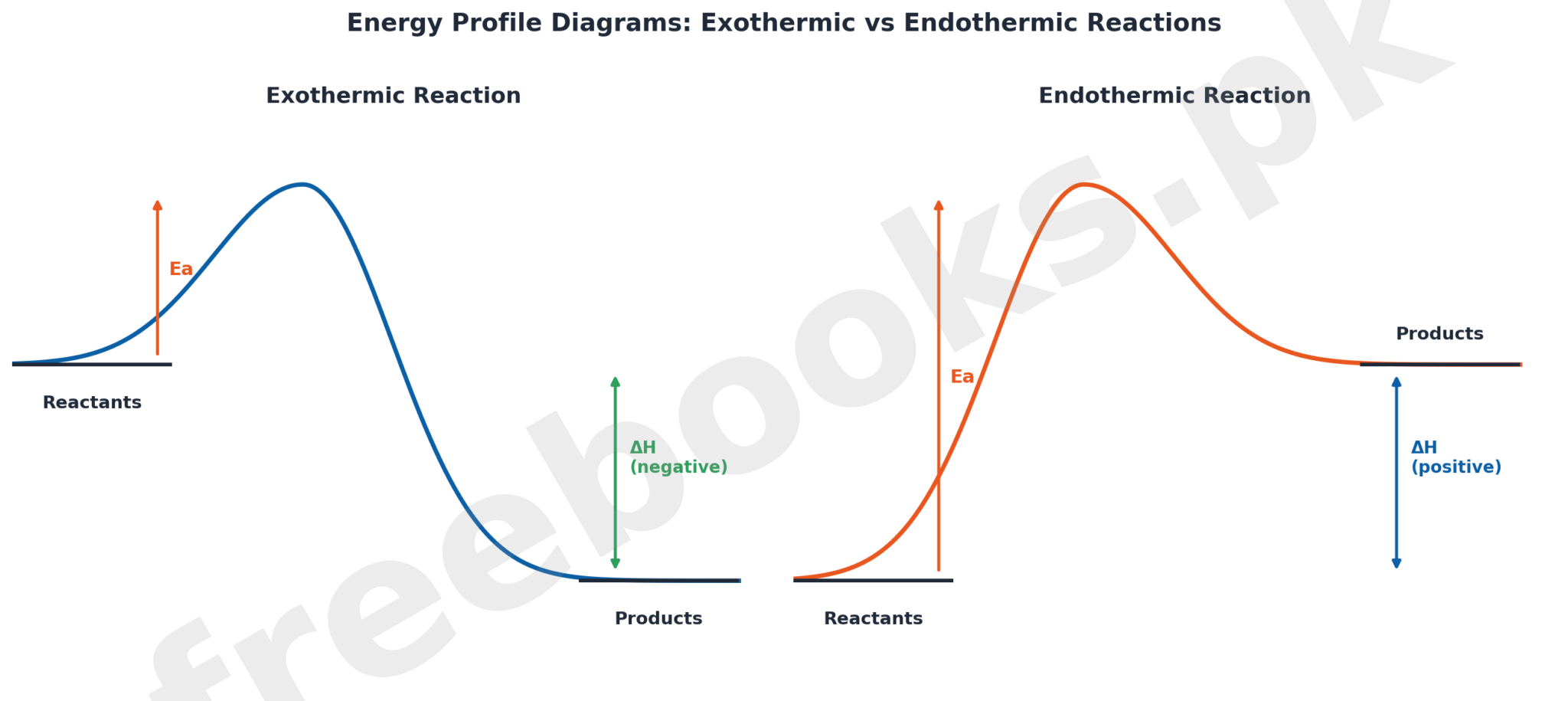
Before reactant bonds can break and product bonds can form, colliding reactant molecules must possess a minimum amount of energy, called the activation energy (Ea), needed to cross an energy barrier; an energy profile diagram plots this journey, showing reactants rising to a high-energy transition state before falling to products, with the overall height difference between reactants and products representing Delta H. In an exothermic reaction, the products sit at lower energy than the reactants on this diagram, while in an endothermic reaction the products sit higher, but both reactions still require an initial input of activation energy to get started.
6.3 Standard Enthalpy Changes
Because enthalpy depends on physical state, temperature, and pressure, meaningful comparisons require standard conditions, a temperature of 25 degrees C (298 K) and a pressure of 1 atm (101 kPa); the standard state of an element is its most stable form under these conditions, for example graphite rather than diamond for carbon, and by definition the standard enthalpy of formation of any element in its standard state is zero. Several named standard enthalpy changes are used throughout thermochemistry: standard enthalpy of reaction (Delta H°r), the enthalpy change when stoichiometric amounts of reactants in their standard states react completely to form products; standard enthalpy of combustion (Delta H°c), always exothermic, the enthalpy change when one mole of a substance burns completely in excess oxygen; and standard enthalpy of formation (Delta H°f), the enthalpy change when one mole of a compound forms from its elements.
Two further standard enthalpy changes complete the set: standard enthalpy of atomization (Delta H°at), the enthalpy change when one mole of gaseous atoms forms from an element, such as 1/2 H2(g) -> H(g), Delta H°at = +218 kJ/mol; and standard enthalpy of neutralization (Delta H°n), always exothermic, the enthalpy change when one mole of water forms from the reaction of an acid with an alkali, which is essentially the same for every strong acid-strong base reaction, close to -57.1 kJ/mol, because the only chemical change occurring is H+(aq) + OH-(aq) -> H2O(l), with the other ions remaining as spectators in solution. First electron affinity, the enthalpy change when one mole of electrons is added to one mole of gaseous atoms to form one mole of gaseous uni-negative ions, is also measured under standard conditions and is usually negative, since energy is released.
6.4 Bond Energy and Enthalpy Changes
Bond dissociation energy is the average energy required to break one mole of a particular bond; because breaking bonds always absorbs energy (Delta H positive) while forming bonds always releases it (Delta H negative), the overall sign of a reaction's enthalpy change depends on which effect wins, with a reaction being exothermic if more energy is released forming new bonds than was absorbed breaking old ones. Bond energies for a specific bond in a specific molecule, called exact bond energies, vary slightly from compound to compound, so tabulated values are usually average bond energies; the enthalpy change of a gas-phase reaction can then be estimated as Delta H°r = (sum of bond energies broken in reactants) – (sum of bond energies formed in products).
6.5 Measuring Enthalpy Change: Calorimetry
The heat evolved or absorbed during a reaction can be measured using a calorimeter, an insulated vessel fitted with a stirrer and thermometer; a simple glass calorimeter is suitable for reactions in solution, though not for reactions involving gases or very high temperatures, and works by measuring the temperature change of the solution, whose heat capacity is approximated by that of water, using q = m x c x Delta T, where c is specific heat capacity, 4.18 J/g K for water, often rounded to 4.2. The enthalpy change per mole is then found using Delta H = -q/n, or equivalently -mcDelta T/n, where n is the number of moles of the limiting reactant or product formed, with the negative sign reflecting that a temperature rise, heat evolved by the reaction, corresponds to an exothermic, negative Delta H.
6.6 Enthalpy and the Calorie Content of Food
Food acts as a fuel: the chemical energy released when food is digested in the body is the same as the energy released when it is burned outside the body, so a food's calorie content can be found from its standard enthalpy of combustion, typically measured in a bomb calorimeter, using calorie content (kcal/g) = Delta H° (kJ/g) / 4.184. For glucose, whose combustion releases 2803 kJ per mole, 180 g, this works out to about 15.57 kJ/g, or roughly 3.72 kcal/g; because the body must balance the calories it takes in from food with the energy it expends through activity, this enthalpy-based calorie content underlies the basic principle of energy balance in nutrition.
6.7 Hess's Law of Heat Summation
Hess's law, a direct consequence of the first law of thermodynamics, conservation of energy, states that the total enthalpy change of a reaction is independent of the route by which it occurs, as long as the initial and final conditions are the same; this makes it possible to calculate Delta H for reactions that cannot be measured directly, such as the formation of CCl4 from carbon and chlorine, by combining the enthalpy changes of a series of steps that connect the same reactants and products, often visualized as an enthalpy cycle. If a reaction can proceed by a direct route or by an indirect route through intermediates, the sum of the enthalpy changes around the indirect route must equal the enthalpy change of the direct route.
Hess's law has several standard applications: calculating an enthalpy of formation from enthalpies of combustion, as for carbon monoxide, where Delta Hf = Delta Hcombustion(C) – Delta Hcombustion(CO) = -393.5 – (-283) = -110.5 kJ/mol; calculating an enthalpy of reaction from enthalpies of formation of reactants and products; and calculating an enthalpy of reaction from bond energies, treating bond-breaking and bond-forming as a hypothetical two-step process. In every case, the same underlying principle applies: Delta H for the direct reaction equals the sum of the Delta H values for any indirect path connecting the same starting and ending points.
6.8 Energetics of Solution: Hydration and Lattice Energy
Dissolving an ionic solid involves two opposing energy effects: breaking apart the ionic lattice, which requires energy equal in magnitude to the lattice energy, and hydrating the freed ions, which releases energy equal to the enthalpy of hydration; the standard enthalpy of solution (Delta H°sol) is the net heat absorbed or released when one mole of a substance dissolves to form an infinitely dilute solution, and the three quantities are related by Delta H°latt + Delta H°sol = Delta H°hyd. Hydration is the process in which water molecules surround and interact with solute ions through ion-dipole forces, and its magnitude depends on the ion's charge density, charge per unit surface area, with smaller, more highly charged ions having larger, more exothermic, hydration energies.
Lattice energy, the enthalpy change when one mole of an ionic compound forms from its gaseous ions, similarly depends on ionic charge and ionic radius: lattice energy becomes less exothermic, weaker, as ionic size increases, since larger ions cannot pack as closely together, and becomes more exothermic, stronger, as ionic charge increases, which is why magnesium oxide, Delta H°latt = -3923 kJ/mol, from doubly-charged ions, has a far larger lattice energy than lithium fluoride, Delta H°latt = -1049 kJ/mol, from singly-charged ions of similar size. The balance between these two competing factors also explains solubility trends down a group: for group 2 hydroxides, lattice energy falls faster than hydration energy down the group, making Delta H°sol more exothermic and solubility increase, while for group 2 sulfates, hydration energy falls faster, making Delta H°sol more endothermic and solubility decrease.
6.9 The Born-Haber Cycle
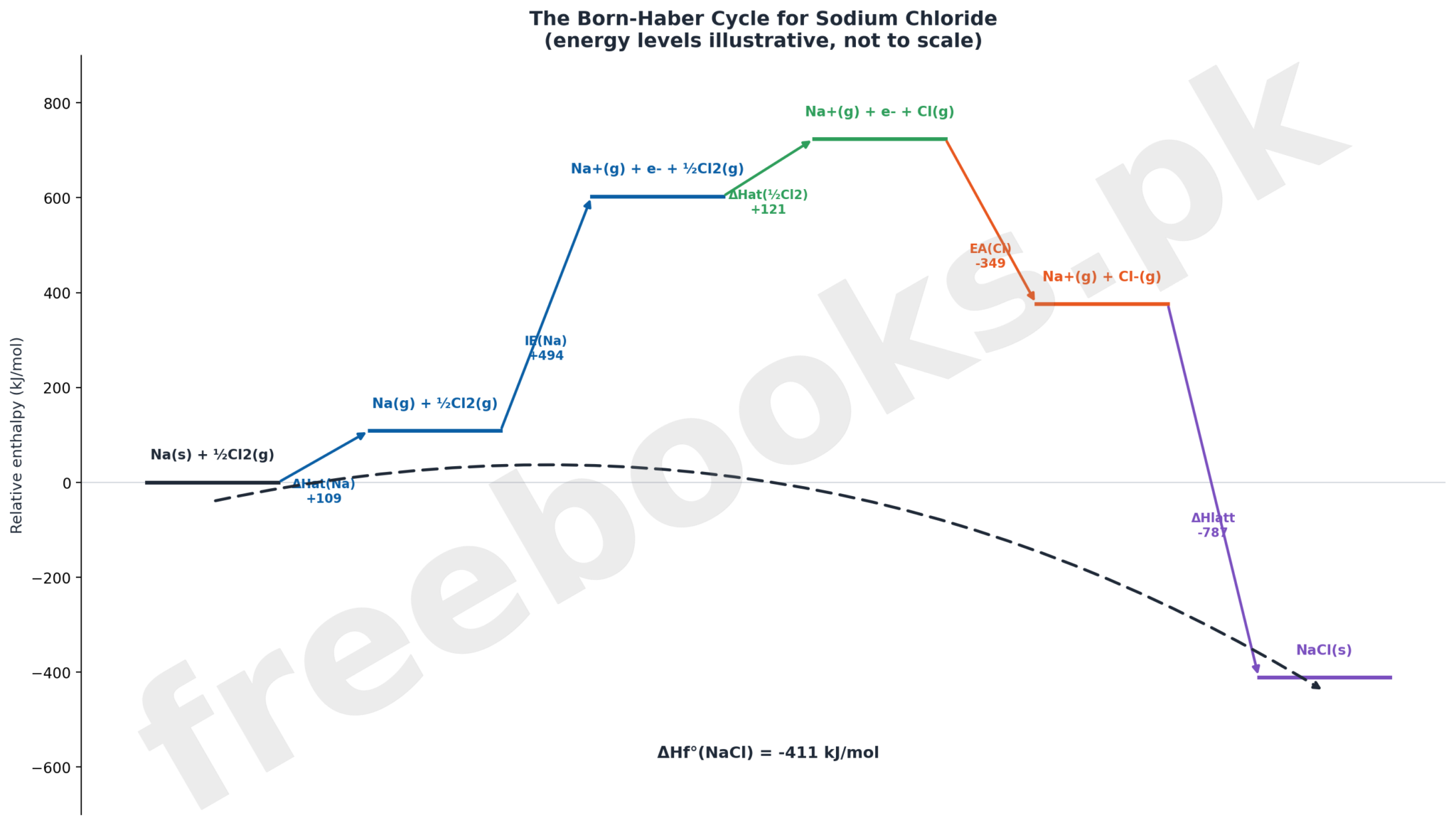
Lattice energy cannot be measured directly in a single experiment, but it can be calculated indirectly using the Born-Haber cycle, an application of Hess's law that connects the standard enthalpy of formation of an ionic compound to a sequence of measurable steps: atomization of the metal, ionization of the metal atom, atomization of the nonmetal, and electron affinity of the nonmetal, followed by the formation of the solid lattice from gaseous ions. Applying Hess's law around the complete cycle, Delta H°f = Delta Hx + Delta H°latt, where Delta Hx is the sum of the atomization, ionization, and electron affinity steps, lets the otherwise unmeasurable lattice energy be calculated once every other quantity in the cycle is known, as for sodium chloride, where Delta H°latt = Delta H°f – Delta Hx = -411 – 376 = -787 kJ/mol.
6.10 Entropy
Entropy (S) is a measure of the number of ways in which the energy and particles of a system can be arranged, and is often described as a measure of disorder or randomness; a system becomes energetically more stable as it becomes more disordered, since a greater number of possible arrangements is statistically more probable. This can be shown by counting arrangements directly: if 3 gas molecules initially confined to one jar are allowed to diffuse between two connected jars, there are 2 cubed, or 8, possible arrangements, and in general, x^y possible arrangements exist for y particles distributed among x locations, so entropy rises sharply as the number of particles increases.
Entropy values can be compared using a few general rules: substances with more particles have higher entropy than those with fewer, CaCO3, with more atoms per formula unit, has higher standard entropy than CaO; harder, more rigid substances have lower entropy than softer ones with the same chemical composition, diamond has lower entropy than graphite; and a substance has progressively higher entropy as it moves from solid to liquid to gas, ice, liquid water, and steam have standard entropies of 48.0, 69.9, and 188.7 J/K/mol respectively. In a chemical reaction, entropy tends to increase whenever a solid converts to a liquid or gas, or whenever the number of moles of gas increases from reactants to products, since gas molecules have far more possible arrangements than the same number of particles in a liquid or solid.
6.11 Calculating Entropy Change and Predicting Spontaneity
The entropy change of a reaction system is calculated the same way as enthalpy change, Delta S°system = (sum of S° of products) – (sum of S° of reactants), using standard molar entropies weighted by the stoichiometric coefficients in the balanced equation. However, the entropy change of the system alone does not determine spontaneity; the entropy change of the surroundings, calculated as Delta S°surroundings = -Delta H°reaction/T, with Delta H°reaction converted to joules, must be added to it to give the total entropy change, Delta S°total = Delta S°system + Delta S°surroundings, and a reaction is spontaneous only if Delta S°total is positive.
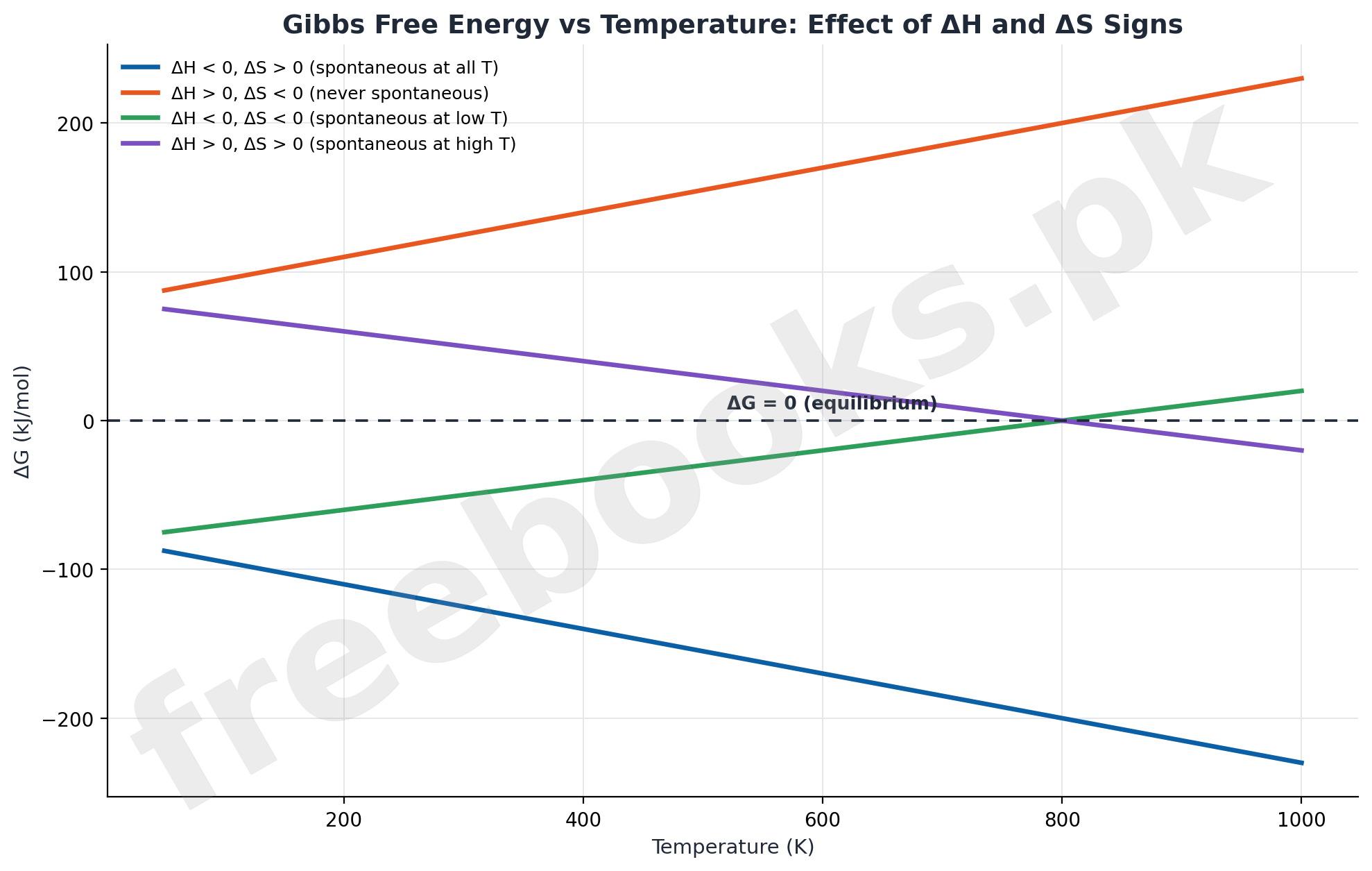
Multiplying the total entropy change by -T gives the Gibbs free energy change, Delta G° = Delta H° – TDelta S°, a single quantity that predicts spontaneity without needing to separately calculate the entropy change of the surroundings: a reaction is spontaneous if Delta G° is negative, non-spontaneous if Delta G° is positive, and at equilibrium if Delta G° is exactly zero. Because Delta G° depends on temperature through the -TDelta S° term, the sign combinations of Delta H° and Delta S° determine four possible temperature behaviors: a reaction with negative Delta H° and positive Delta S° is spontaneous at all temperatures, one with positive Delta H° and negative Delta S° is never spontaneous, and reactions with matching signs of Delta H° and Delta S°, both negative or both positive, switch from spontaneous to non-spontaneous, or vice versa, at some particular temperature.
Important Definitions
What is enthalpy (H)?
The total heat content of a substance, comprising all its potential and kinetic energies.
What is an exothermic process?
A reaction or physical change in which heat is evolved from the system to the surroundings (Delta H negative).
What is an endothermic process?
A reaction or physical change in which heat is absorbed by the system from the surroundings (Delta H positive).
What is activation energy (Ea)?
The minimum energy that colliding reactant molecules must possess to cross the energy barrier and react.
What is standard enthalpy of formation (Delta H°f)?
The enthalpy change when one mole of a compound is formed from its elements in their standard states under standard conditions.
What is bond dissociation energy?
The average energy required to break one mole of a particular bond in a substance.
What is Hess's law?
The principle that the total enthalpy change of a reaction is independent of the route taken, provided the initial and final conditions are the same.
What is lattice energy (Delta H°latt)?
The enthalpy change when one mole of an ionic compound is formed from its gaseous ions under standard conditions.
What is entropy (S)?
A measure of the number of possible arrangements of the particles and energy of a system; often described as a measure of disorder.
What is Gibbs free energy change (Delta G)?
A quantity, Delta G = Delta H – TDelta S, whose sign predicts whether a process can occur spontaneously.
Key Facts and Relations
| Topic | Key Fact / Relation |
|---|---|
| Enthalpy change | Delta H = Hproducts – Hreactants |
| Enthalpy from bond energies | Delta H°r = sum(E, bonds broken) – sum(E, bonds formed) |
| Calorimetry heat | q = m x c x Delta T |
| Calorimetry enthalpy change | Delta H = -q/n = -mcDelta T/n |
| Calorie content of food | Calorie content (kcal/g) = Delta H° (kJ/g) / 4.184 |
| Hess's law (enthalpy cycle) | Delta H (direct route) = sum of Delta H (indirect route steps) |
| Enthalpy of solution cycle | Delta H°latt + Delta H°sol = Delta H°hyd |
| Born-Haber cycle | Delta H°f = Delta Hx + Delta H°latt |
| Entropy change of system | Delta S°system = sum S°products – sum S°reactants |
| Gibbs free energy | Delta G° = Delta H° – T Delta S° |
Diagrams
Energy Profile Diagrams: Exothermic vs Endothermic Reactions: A comparison of reaction-coordinate diagrams for exothermic and endothermic reactions, showing activation energy (Ea) as the barrier height and Delta H as the difference between reactant and product energy levels
The Born-Haber Cycle for Sodium Chloride: A step-by-step energy cycle showing how the standard enthalpy of formation of NaCl relates to atomization, ionization, electron affinity, and lattice energy, illustrating how lattice energy is calculated indirectly using Hess's law
Gibbs Free Energy vs Temperature: Effect of Delta H and Delta S Signs: A plot of Delta G against temperature for the four possible sign combinations of Delta H and Delta S, showing which reactions are spontaneous at all temperatures, never spontaneous, or spontaneous only above or below a particular temperature
Short Questions & Answers
Why is the combustion of carbon in oxygen described as exothermic?
The reaction releases heat to the surroundings because the total enthalpy of the products, carbon dioxide, is lower than the total enthalpy of the reactants, carbon and oxygen; this lowering of enthalpy, Delta H = -393.7 kJ/mol, is evolved as heat, making the reaction exothermic.
Why do both exothermic and endothermic reactions require activation energy?
Regardless of whether the overall reaction releases or absorbs energy, the colliding reactant molecules must still possess enough energy to overcome an energy barrier before their bonds can break and new bonds can form; this minimum required energy, the activation energy, must be supplied at the start of any reaction.
Why is the standard enthalpy of formation of an element in its standard state defined as zero?
Standard enthalpy of formation measures the enthalpy change of forming a substance from its elements; since an element in its own standard state is already the reference starting material for itself, there is no chemical change and therefore no enthalpy change involved, giving a value of zero by definition.
Why is the enthalpy of neutralization nearly the same, about -57.1 kJ/mol, for every strong acid-strong base reaction?
For a strong acid and a strong base, the only chemical change occurring on mixing is the combination of H+ and OH- ions to form water, H+(aq) + OH-(aq) -> H2O(l); the other ions present remain as spectator ions in solution, so the same fundamental reaction, and therefore essentially the same enthalpy change, occurs regardless of which strong acid or base is used.
Why does an average, rather than exact, bond energy have to be used in most calculations?
The energy of a particular type of bond, such as C-C, varies slightly depending on which other atoms and bonds are present in the rest of the molecule, so an exact bond energy is only valid for one specific compound; an average bond energy, calculated across many different molecules containing that bond, gives a more generally applicable value for estimating enthalpy changes.
Why is Hess's law useful for reactions like the formation of CCl4 from carbon and chlorine, which cannot be measured directly by a calorimeter?
Hess's law states that the total enthalpy change of a reaction depends only on the initial and final states, not on the route taken; this means the enthalpy change of a reaction that cannot be carried out or measured directly can instead be calculated by combining the enthalpy changes of a series of other, measurable reactions that connect the same starting reactants and final products.
Why does the lattice energy of magnesium oxide (Delta H°latt = -3923 kJ/mol) greatly exceed that of lithium fluoride (Delta H°latt = -1049 kJ/mol), despite similar ion sizes?
Lattice energy rises sharply with increasing ionic charge; magnesium oxide is built from doubly-charged Mg2+ and O2- ions, which attract each other far more strongly through electrostatic force than the singly-charged Li+ and F- ions of lithium fluoride, giving MgO a much larger, more exothermic lattice energy.
Why can lattice energy not be measured directly in a single experiment?
Lattice energy is defined as the enthalpy change when an ionic solid forms from free gaseous ions, a process that cannot be carried out or observed directly in the laboratory; instead, it must be calculated indirectly using a Born-Haber cycle, which relates it to a series of other quantities that can each be measured experimentally.
Why does the entropy of water vapour exceed that of liquid water, which in turn exceeds that of ice?
Entropy reflects the number of ways a substance's particles and energy can be arranged; a gas has far more freedom of motion and far more possible arrangements than a liquid, which in turn has more freedom and possible arrangements than the fixed, ordered positions of a solid, so entropy rises in the order solid, liquid, gas.
Why is a reaction with negative Delta H and negative Delta S spontaneous only at low temperature?
In Delta G° = Delta H° – TDelta S°, a negative Delta S° makes the -TDelta S° term positive and this positive contribution grows larger as temperature increases; at low temperature this term is small enough that the negative Delta H° still dominates, making Delta G° negative and the reaction spontaneous, but at high temperature the growing positive -TDelta S° term eventually overtakes Delta H°, making Delta G° positive and the reaction non-spontaneous.
Long Questions & Answers
Explain the different standard enthalpy changes used in thermochemistry, and describe how Hess's law allows enthalpy changes to be calculated indirectly.
Why must standard conditions be specified when comparing enthalpy changes?
Enthalpy depends on a substance's physical state, temperature, and pressure, so different measurements of the same reaction could give different results unless these conditions are fixed; standard conditions, a temperature of 25 degrees C, 298 K, and a pressure of 1 atm, provide a common reference point that allows enthalpy changes of different reactions to be meaningfully compared.
What is the difference between standard enthalpy of formation and standard enthalpy of combustion?
Standard enthalpy of formation is the enthalpy change when one mole of a compound forms from its elements in their standard states, and can be positive or negative; standard enthalpy of combustion is the enthalpy change when one mole of a substance burns completely in excess oxygen, and is always exothermic, always negative.
What is standard enthalpy of atomization, and why is it always positive?
Standard enthalpy of atomization is the enthalpy change when one mole of gaseous atoms is formed from an element under standard conditions; it is always positive because breaking the bonds holding an element's atoms together, whether covalent bonds in a molecule or metallic bonding in a solid, always requires an input of energy.
What is Hess's law, and why does it follow from the conservation of energy?
Hess's law states that the total enthalpy change of a reaction is independent of the route taken, as long as the initial and final conditions are the same; this follows directly from the conservation of energy, since if two different routes between the same starting and ending points gave different total enthalpy changes, energy could be created or destroyed simply by choosing one route over the other, which is impossible.
How is Hess's law applied to calculate an enthalpy of formation from enthalpies of combustion?
An enthalpy cycle is drawn connecting the elements, the target compound, and the final combustion products by two different routes, one direct and one indirect via combustion; since the total enthalpy change must be the same by either route, the unknown enthalpy of formation can be found by rearranging the equation relating the known combustion enthalpies to the direct enthalpy of combustion of the target compound.
Describe the Born-Haber cycle and explain how entropy and Gibbs free energy together determine whether a reaction occurs spontaneously.
What is the Born-Haber cycle, and why is it needed to find lattice energy?
The Born-Haber cycle is an energy cycle, based on Hess's law, that connects the standard enthalpy of formation of an ionic compound to a sequence of measurable steps, atomization, ionization, and electron affinity, followed by lattice formation; it is needed because lattice energy itself, the enthalpy change of forming a solid from gaseous ions, cannot be measured directly in any single experiment.
What is entropy, and how is it related to the number of possible arrangements of a system?
Entropy is a measure of the number of ways the particles and energy of a system can be arranged; systems with more possible arrangements, more disorder, are statistically more probable and therefore more stable, which is why gases, with far more freedom of movement, have higher entropy than liquids or solids of the same substance.
Why is the entropy change of the system alone not enough to predict spontaneity?
A reaction's overall spontaneity depends on the total entropy change of both the system and its surroundings, not the system alone; some reactions, like the formation of calcium oxide, have a negative entropy change in the system but proceed spontaneously anyway because they release enough heat to the surroundings to increase the surroundings' entropy by an even larger amount, making the total entropy change positive.
How does the Gibbs free energy equation combine enthalpy and entropy to predict spontaneity?
The Gibbs free energy change, Delta G° = Delta H° – TDelta S°, is derived by multiplying the total entropy change by -T, so it captures the combined effect of the reaction's own enthalpy change and its entropy change without needing to separately calculate the entropy change of the surroundings; a reaction is spontaneous if Delta G° is negative, non-spontaneous if positive, and at equilibrium if exactly zero.
Why can a reaction with positive Delta H and positive Delta S become spontaneous only at high temperature?
In Delta G° = Delta H° – TDelta S°, a positive Delta S° makes the -TDelta S° term negative, and this negative contribution grows larger in magnitude as temperature rises; at low temperature this term is too small to outweigh the positive Delta H°, keeping Delta G° positive and the reaction non-spontaneous, but at sufficiently high temperature the growing negative -TDelta S° term overtakes Delta H°, making Delta G° negative and the reaction spontaneous.
Multiple Choice Questions (MCQs)
Which of the following equations represents the standard enthalpy of formation of C2H4? (A) 2C (diamond) + 2H2(g) -> C2H4(g) (B) 2C (graphite) + 2H2(g) -> C2H4(g) (C) C (graphite) + H2(g) -> 1/2 C2H4(g) (D) 2C (diamond) + 4H(g) -> C2H4(g)
Correct answer: (B) 2C (graphite) + 2H2(g) -> C2H4(g). Standard enthalpy of formation requires elements in their standard states; carbon's standard state is graphite, not diamond, and the equation must form exactly one mole of the compound from whole numbers of moles of elements, matching only option B.
Which equation correctly defines the lattice energy of MgCl2? (A) Mg(s) + Cl2(g) -> MgCl2 (B) Mg2+(g) + 2Cl-(g) -> MgCl2(g) (C) Mg2+(s) + 2Cl-(g) -> MgCl2(s) (D) Mg2+(g) + 2Cl-(g) -> MgCl2(s)
Correct answer: (D) Mg2+(g) + 2Cl-(g) -> MgCl2(s). Lattice energy is defined as the enthalpy change when one mole of an ionic solid forms from its gaseous ions; only option D shows gaseous Mg2+ and Cl- ions combining to form solid MgCl2.
If 100 molecules of a gas are initially confined to jar A, connected to an evacuated jar B, the number of possible arrangements once the stopcock is opened is: (A) 100 (B) 1/100 (C) 2^100 (D) 1/2^100
Correct answer: (C) 2^100. The number of possible arrangements of y particles among x available locations is x^y; with 2 jars available to 100 molecules, this gives 2^100 possible arrangements.
For a reaction to occur spontaneously, which condition must be satisfied? (A) (Delta H – TDelta S) must be negative (B) (Delta H + TDelta S) must be negative (C) Delta H must be negative (D) Delta S must be negative
Correct answer: (A) (Delta H – TDelta S) must be negative. A reaction is spontaneous when Delta G is negative, and Delta G = Delta H – TDelta S, so it is this combined quantity, not Delta H or Delta S alone, that must be negative.
The calorie content of food is fundamentally related to which thermodynamic quantity? (A) Entropy change (Delta S) (B) Gibbs free energy change (Delta G) (C) Enthalpy change (Delta H) (D) Specific heat capacity (c)
Correct answer: (C) Enthalpy change (Delta H). Calorie content is calculated directly from a food's standard enthalpy of combustion, Delta H°, converted from kJ/g into kcal/g.
Which of the following is NOT typically determined using Hess's law? (A) Enthalpy change of formation (B) Enthalpy change of combustion (C) Activation energy (D) Enthalpy change of reaction
Correct answer: (C) Activation energy. Hess's law relates different enthalpy changes, Delta H values, to one another through enthalpy cycles; activation energy is a kinetic quantity related to reaction rate, not an enthalpy change, and is not calculated using Hess's law.
Which combination of factors would give the most exothermic (greatest magnitude) enthalpy of hydration? (A) A larger ionic radius and a smaller charge (B) A smaller ionic radius and a smaller charge (C) A larger ionic radius and a larger charge (D) A smaller ionic radius and a larger charge
Correct answer: (D) A smaller ionic radius and a larger charge. Hydration energy rises with charge density, charge per unit surface area; a smaller ion with a larger charge has the highest charge density of the four combinations, giving the most exothermic enthalpy of hydration.
The enthalpy of solution can be expressed in terms of which combination of enthalpy changes? (A) Delta Hlattice + Delta Hhydration (B) Delta Hlattice – Delta Hhydration (C) -Delta Hlattice + Delta Hhydration (D) -Delta Hlattice – Delta Hhydration
Correct answer: (A) Delta Hlattice + Delta Hhydration. The energy cycle relating these quantities gives Delta H°latt + Delta H°sol = Delta H°hyd, which rearranges to Delta H°sol = Delta H°hyd – Delta H°latt; written the other way, Delta H°hyd = Delta H°latt + Delta H°sol, matching option A's combination of the two enthalpy changes.
Which of the following reactions has an enthalpy change equal to the standard enthalpy of formation of liquid water? (A) 2H(g) + O(g) -> H2O(l) (B) H2(g) + 1/2 O2(g) -> H2O(g) (C) H2(g) + 1/2 O2(g) -> H2O(l) (D) 2H+(aq) + O2-(aq) -> H2O(l)
Correct answer: (C) H2(g) + 1/2 O2(g) -> H2O(l). Standard enthalpy of formation requires the elements in their standard states, gaseous H2 and O2, combining to form one mole of the compound in its standard state, liquid water; only option C matches both requirements.
Which of the following processes would typically result in an increase in the entropy of the system? (A) Freezing of water (B) Condensation of steam (C) Dissolving a solid in a liquid (D) Formation of a crystal from a saturated solution
Correct answer: (C) Dissolving a solid in a liquid. Dissolving a solid disperses its ordered particles throughout the solvent, greatly increasing the number of possible arrangements and therefore the entropy of the system, unlike freezing, condensation, or crystallization, which all decrease disorder.
Quick Revision Summary
- Enthalpy change: Delta H = Hproducts – Hreactants; exothermic (Delta H negative, heat released) vs endothermic (Delta H positive, heat absorbed)
- Energy profile diagrams show activation energy (Ea) as the barrier height and Delta H as reactant-product energy difference
- Standard conditions: 25 degrees C (298 K), 1 atm; standard enthalpy of formation of an element in its standard state = 0
- Named standard enthalpy changes: reaction, combustion (always exothermic), formation, atomization (always endothermic), neutralization (always exothermic, ~-57.1 kJ/mol), electron affinity
- Delta H°r from bond energies = sum(E, bonds broken) – sum(E, bonds formed)
- Calorimetry: q = mcDelta T; Delta H = -q/n = -mcDelta T/n
- Calorie content (kcal/g) = Delta H° (kJ/g) / 4.184
- Hess's law: total Delta H is route-independent; used to find Delta Hf from combustion data, Delta Hr from formation data, and Delta Hr from bond energies
- Enthalpy of solution cycle: Delta H°latt + Delta H°sol = Delta H°hyd; hydration and lattice energy both rise with charge density (charge/size)
- Born-Haber cycle: Delta H°f = Delta Hx + Delta H°latt, used to calculate the otherwise unmeasurable lattice energy
- Entropy (S): measure of possible arrangements/disorder; solid < liquid < gas; rises with more particles, more gas moles, softer substances
- Delta S°system = sum S°products – sum S°reactants; Delta S°surroundings = -Delta H°reaction/T; Delta S°total = Delta S°system + Delta S°surroundings
- Reaction spontaneous if Delta S°total is positive, equivalently if Delta G° = Delta H° – TDelta S° is negative
- 4 sign combinations of Delta H/Delta S determine temperature-dependence of spontaneity (see Gibbs free energy vs temperature diagram)
Exam Tips
- Always double-check that an equation matches the exact definition of the named enthalpy change being asked about (formation, combustion, atomization, neutralization) — exam questions often test whether the equation uses the correct standard states and exactly 1 mole of the right substance
- When calculating Delta H from bond energies, always subtract energy of bonds formed from energy of bonds broken, not the other way around — getting this backwards flips the sign of the answer
- For calorimetry questions, convert q from J to kJ before dividing by moles, and remember the negative sign in Delta H = -q/n reflects that a temperature rise (heat released by the reaction) means the reaction itself is exothermic
- When solving Hess's law problems, draw the enthalpy cycle first and label every arrow with its direction and value before writing any equation — this prevents sign errors when combining steps
- Remember hydration energy and lattice energy both become more exothermic with smaller ionic radius and greater ionic charge — use charge density (charge per unit size) as the single factor that predicts both
- For spontaneity questions, always convert Delta H to the same energy units as TDelta S (usually kJ) before combining them in Delta G = Delta H – TDelta S, since Delta S is normally given in J/K, not kJ/K