Matter exists in four states, solid, liquid, gas, and plasma, and the physical differences between them come down to a single variable: how strongly the particles inside attract one another and how much freedom they have to move. Gases have negligible intermolecular forces and expand to fill any container; the ideal gas equation, PV = nRT, captures how their pressure, volume, temperature, and amount are related, and can even be rearranged to calculate a gas's relative molecular mass from measurable quantities.
Liquids and solids, by contrast, are held together by intermolecular forces whose strength directly explains everyday behavior: London dispersion forces, permanent dipole-dipole forces, and hydrogen bonding together determine a substance's boiling point, viscosity, and surface tension, and hydrogen bonding in particular gives water its unusual, life-sustaining properties, from ice floating on water to its unusually high boiling point. The chapter closes by comparing crystalline and amorphous solids, and introducing liquid crystals, a state of matter between liquid and solid that underlies technologies from LCD screens to medical diagnostics.
Learning Objectives
- Describe the physical properties of gases, including compressibility, expandability, and pressure exerted by gases
- Describe the origin of gas pressure in terms of molecular collisions with the container walls
- State and use the ideal gas equation, PV = nRT, in calculations including the determination of relative molecular mass
- Describe simple properties of liquids using kinetic molecular theory
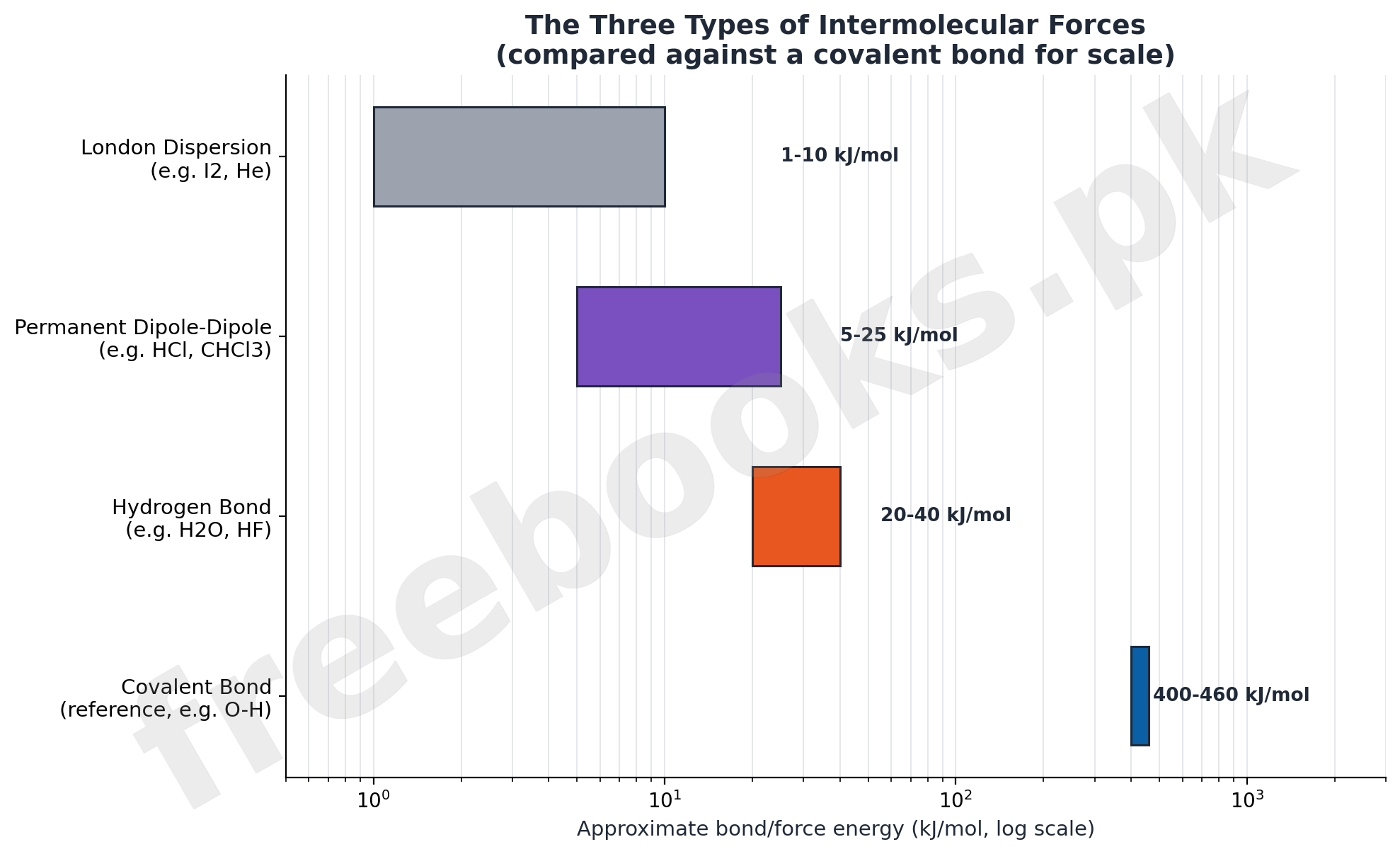
- Describe the three types of intermolecular forces and explain the strength and applications of dipole-dipole forces, hydrogen bonding, and London forces
- Describe physical properties of liquids such as evaporation, vapour pressure, boiling point, viscosity, and surface tension
- Apply the concept of hydrogen bonding to explain the unique properties of water
- Define molar heat of fusion and molar heat of vaporization, and describe their effect on matter particles
- Describe liquid crystals, their properties, and their uses in daily life
- Differentiate between amorphous and crystalline solids, and describe the properties of crystalline solids
Key Concepts
5.1 Properties of Gases and the Ideal Gas Equation
Gases have no definite shape or volume, expanding to fill whatever container holds them, because their molecules are widely separated, occupying only about 0.1% of the total volume, with the rest being empty space; this is why gases can be compressed so easily, and why sudden expansion of a gas causes cooling, an effect known as the Joule-Thomson effect. Gas pressure arises entirely from the collisions of gas molecules with the walls of their container, and in an ideal gas, intermolecular forces and particle volume are both taken as negligible.
Combining Boyle's law, V proportional to 1/P, Charles's law, V proportional to T, and Avogadro's law, V proportional to n, gives the ideal gas equation, PV = nRT, where R, the ideal gas constant, equals 0.0821 atm dm3 K-1 mol-1. Substituting n = m/M into this equation and rearranging gives M = mRT/PV, allowing the relative molecular mass of an unknown gas to be calculated directly from its measured mass, pressure, volume, and temperature.
5.2 Properties of Liquids and Intermolecular Forces
Liquids diffuse, like gases, but far more slowly, since their molecules are held closer together by comparatively strong intermolecular forces; they are about 100,000 times less compressible than gases but about 10 times more compressible than solids, and their molecules remain in constant, though slower, random motion, which is why liquids can flow and mix by diffusion. Three types of intermolecular force act between liquid molecules: instantaneous dipole-induced dipole forces, also called London dispersion forces, permanent dipole-permanent dipole forces, and hydrogen bonding.
London dispersion forces arise when the moving electrons of one molecule momentarily create an instantaneous dipole, which induces a temporary dipole in a neighboring molecule, producing a brief mutual attraction; these are the only intermolecular forces present between nonpolar molecules, and they strengthen with increasing molecular mass and size, as seen going down the halogen and noble gas families, and with increasing molecular surface area, as seen comparing straight-chain and branched isomers of pentane. Permanent dipole-permanent dipole forces, by contrast, arise when the positive end of one polar molecule is attracted to the negative end of a neighboring polar molecule, as between HCl or chloroform molecules.
5.3 Hydrogen Bonding
Hydrogen bonding is a special, unusually strong type of dipole-dipole force, weaker than covalent, ionic, or metallic bonds but stronger than any other intermolecular force; it forms when a hydrogen atom covalently bonded to a small, highly electronegative atom, F, O, or N, is attracted to a lone pair on a nearby electronegative atom of the same kind. The number of hydrogen bonds a molecule can form on average depends on both the number of hydrogen atoms bonded to F, O, or N and the number of available lone pairs; water, with two hydrogen atoms and two lone pairs on oxygen, forms an average of two hydrogen bonds per molecule and is extensively hydrogen bonded in three dimensions, while ammonia, despite having three hydrogen atoms, has only one lone pair on nitrogen and so can form only one hydrogen bond, giving it a much lower boiling point, -33 degrees C, than water, 100 degrees C.
5.4 Hydrogen Bonding and the Anomalous Properties of Water
Water's extensive three-dimensional hydrogen bonding gives it a set of unusual properties essential to life. When water freezes, its molecules arrange into a regular, extensively hydrogen-bonded tetrahedral lattice that contains more empty space than liquid water, so ice occupies about 9% more volume and is less dense than liquid water, causing ice to float; this insulates the water beneath frozen lakes and oceans, letting aquatic life survive winter. Water's strong hydrogen bonding also gives it an unusually high specific heat capacity, 4.18 J/g degrees C, letting it absorb or release large amounts of heat with only small temperature changes.
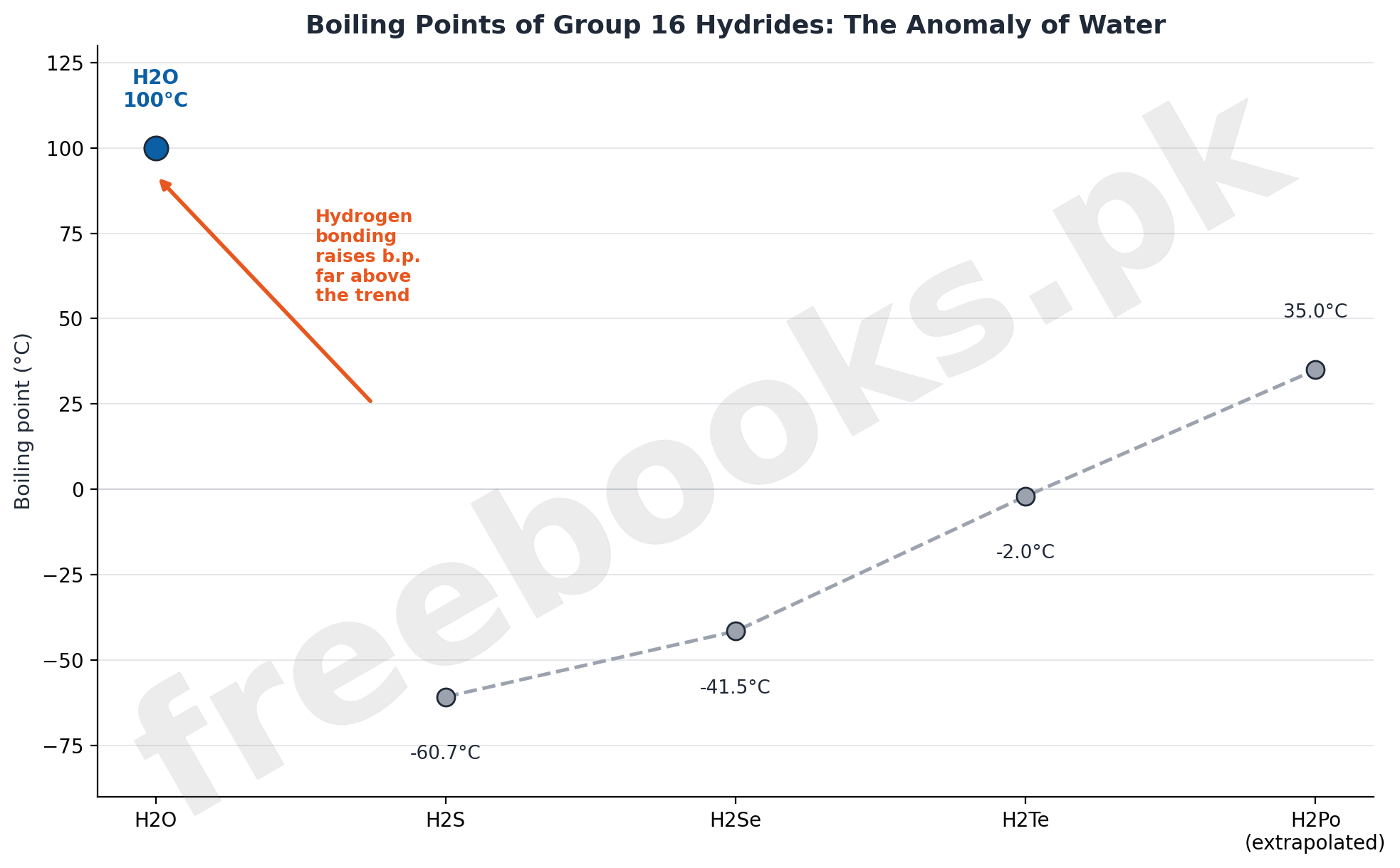
Water's molar heat of vaporization, 40.6 kJ/mol, is the highest among the group 16 hydrides, breaking the trend of steadily increasing heat of vaporization from H2S to H2Po that would otherwise be expected from London dispersion forces alone, because its extensive hydrogen bonding makes its molecules unusually difficult to separate; this same hydrogen bonding gives water its remarkably high boiling point relative to the other group 16 hydrides. Hydrogen bonding is also responsible for water's high surface tension, from the strong inward pull of hydrogen-bonded surface molecules, and its comparatively high viscosity, which exceeds that of many hydrocarbons and alcohols whose molecules form fewer or no hydrogen bonds.
5.5 Surface Tension and Viscosity of Liquids
Surface tension is the downward, inward pull exerted on molecules at a liquid's surface by the molecules beneath it, arising from unbalanced intermolecular attraction and causing the liquid surface to behave like a stretched skin that tends to minimize its area, which is why droplets form spheres; surface tension decreases as temperature rises and increases with stronger intermolecular forces. Viscosity, a liquid's resistance to flow, similarly rises with stronger intermolecular forces, since strongly attracted molecules cannot move past one another as freely, and falls as temperature rises, since molecules gain enough kinetic energy to overcome their attractive forces more easily.
5.6 Evaporation, Vapour Pressure, and Boiling Point
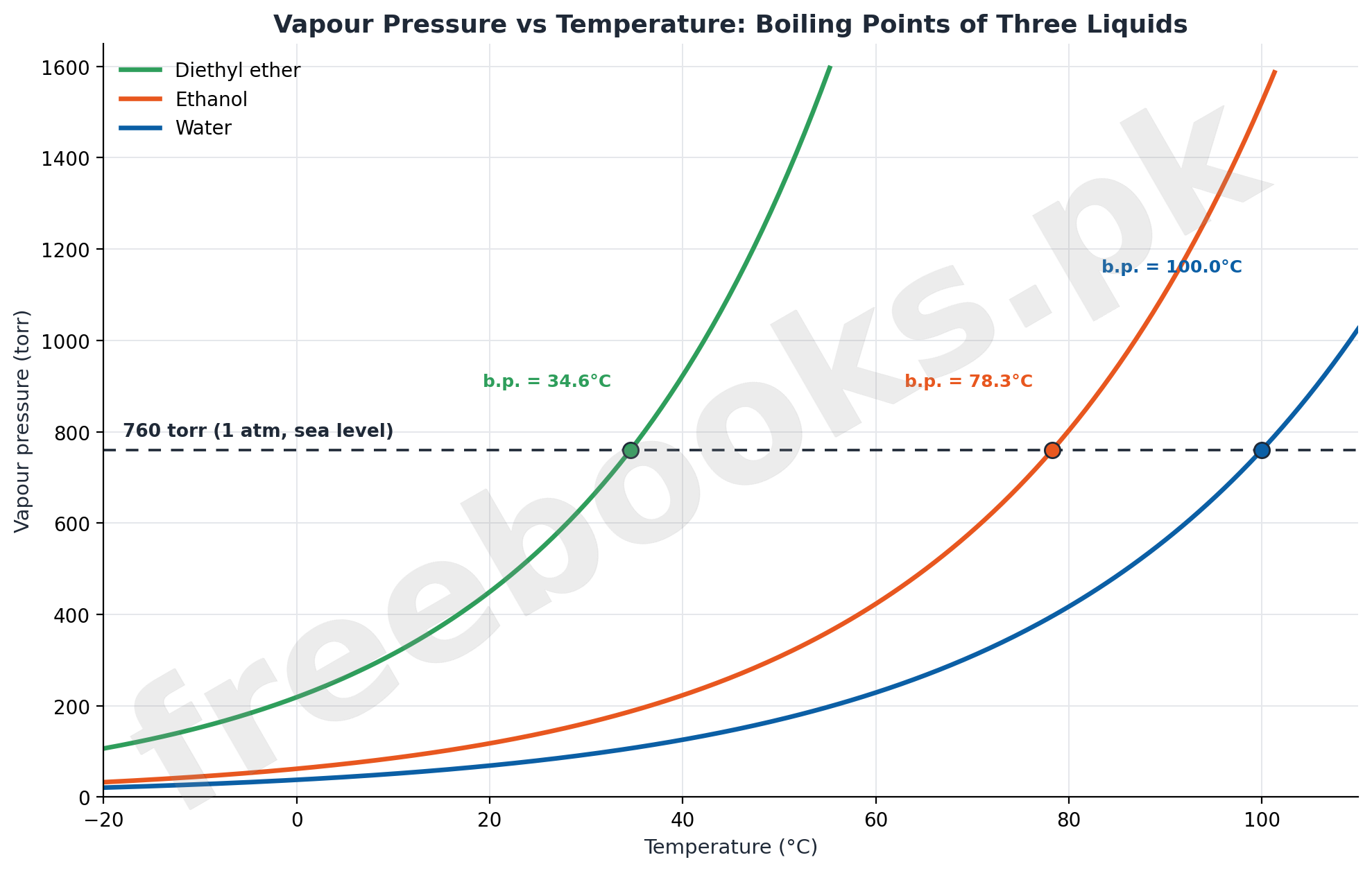
Evaporation is the spontaneous escape of high-energy molecules from a liquid's surface into the vapour phase at any temperature; because only the highest-energy molecules escape, the average kinetic energy, and therefore the temperature, of the remaining liquid falls, which is why evaporation causes cooling, as felt after a bath or from water kept in a porous earthenware vessel. In a closed container, escaped vapour molecules can also return to the liquid by condensation, and once the rate of evaporation equals the rate of condensation, a dynamic equilibrium is reached; the pressure exerted by the vapour at this equilibrium is called the vapour pressure, which rises with temperature and is lower for liquids with stronger intermolecular forces.
A liquid boils once its vapour pressure becomes equal to the external, atmospheric, pressure, allowing bubbles of vapour to form throughout the liquid and escape at the surface; boiling point therefore rises with stronger intermolecular forces, which lower vapour pressure at a given temperature, and with higher external pressure, since more heat is then needed to raise the vapour pressure to match it, which is why water boils at a lower temperature on a high mountain and at a higher temperature inside a sealed pressure cooker.
5.7 Energetics of Phase Changes
The molar heat of fusion is the heat absorbed by one mole of a solid to melt into liquid at its melting point, and the molar heat of vaporization is the heat absorbed by one mole of a liquid to become vapour at its boiling point; both quantities rise with stronger intermolecular forces, since more energy is needed to separate more strongly attracted particles, which is why water's heat of vaporization, 40.6 kJ/mol, far exceeds that of ammonia, 21.7 kJ/mol, or hydrogen chloride, 15.6 kJ/mol. Water's unusually high heat of fusion, 4.6 kJ/mol, is central to the stability of glaciers, ice sheets, and polar ice caps, since it means a large amount of energy is needed to melt ice, and it plays an important role in moderating sea level and reflecting sunlight to help regulate Earth's temperature.
5.8 Properties of Solids and Types of Solids
Solids are rigid substances with definite shape and volume, whose closely packed particles are held in place by strong ionic, covalent, metallic, or van der Waals forces; because these particles can only vibrate about fixed mean positions rather than move or rotate freely, solids resist compression and expand very little on heating compared to liquids and gases, and their only form of kinetic energy is vibrational. Solids are classified as either crystalline, with a definite, regular, three-dimensional geometric arrangement of particles, such as diamond, sodium chloride, and ice, or amorphous, lacking any such long-range order, such as glass, wood, and charcoal.
Crystalline solids share several distinctive properties: a definite geometrical shape with constant interfacial angles, sharp, well-defined melting points, characteristic cleavage planes along which they break, and a specific habit, the shape in which a crystal characteristically grows under given conditions, that can change if growth conditions are altered. Amorphous solids, by contrast, melt gradually over a range of temperatures rather than sharply, can be molded and blown into different shapes, and are isotropic, meaning their properties are the same in every direction, unlike the anisotropic, direction-dependent properties of crystalline solids.
5.9 Liquid Crystals
Liquid crystals are substances that, over a certain temperature range, exist in a phase between fully liquid and fully solid: their typically rigid, rod-like molecules can migrate through the fluid and spin around their long axis like a liquid, yet remain roughly parallel to one another and cannot rotate end over end, giving them some of the ordered, anisotropic optical properties of a crystalline solid. This unusual combination of properties makes liquid crystals useful in electro-optic devices that control light, most familiarly in liquid crystal displays used in televisions, computers, and mobile phones, and also in diagnostic devices that detect tumors by their characteristically higher temperature and in temperature sensors that identify faulty circuit connections.
Important Definitions
What is the ideal gas constant, R?
The proportionality constant in the ideal gas equation, PV = nRT, equal to 0.0821 atm dm3 K-1 mol-1.
What is a London dispersion force?
A weak, momentary force of attraction between an instantaneous dipole in one molecule and an induced dipole in a neighboring molecule.
What is a permanent dipole-dipole force?
The force of attraction between the positive end of one polar molecule and the negative end of a neighboring polar molecule.
What is a hydrogen bond?
A strong dipole-dipole attraction between a hydrogen atom bonded to F, O, or N and a lone pair on a nearby F, O, or N atom.
What is vapour pressure?
The pressure exerted by a liquid's vapour when it is in dynamic equilibrium with its liquid at a given temperature.
What is boiling point?
The temperature at which a liquid's vapour pressure becomes equal to the external, atmospheric, pressure.
What is molar heat of fusion?
The heat absorbed by one mole of a solid to melt into liquid at its melting point at 1 atmosphere pressure.
What is molar heat of vaporization?
The heat absorbed by one mole of a liquid to convert into vapour at its boiling point at 1 atmosphere pressure.
What is a crystal lattice?
The regular, repeating three-dimensional arrangement of ions, atoms, or molecules in a crystalline solid.
What is a liquid crystal?
A substance existing in a phase between liquid and solid, with molecules that flow like a liquid but retain some ordered, crystal-like orientation.
Key Facts and Relations
| Topic | Key Fact / Relation |
|---|---|
| Ideal gas equation | PV = nRT |
| Ideal gas constant | R = 0.0821 atm dm3 K-1 mol-1 |
| Relative molecular mass from gas data | M = mRT / PV |
| Boyle's law | V is proportional to 1/P (n, T constant) |
| Charles's law | V is proportional to T (n, P constant) |
| Avogadro's law | V is proportional to n (P, T constant) |
| Molar heat of fusion of water | H2O(s) -> H2O(l), delta Hf = 4.6 kJ/mol |
| Molar heat of vaporization of water | H2O(l) -> H2O(g), delta Hv = 40.6 kJ/mol |
| Specific heat capacity of water | 4.18 J/g degrees C |
| Ice expansion on freezing | Ice occupies about 9% more volume than the liquid water it forms from |
Diagrams
The Three Types of Intermolecular Forces: A comparison of London dispersion forces, permanent dipole-dipole forces, and hydrogen bonding by approximate strength, shown against a covalent bond for scale
Vapour Pressure vs Temperature: Boiling Points of Three Liquids: A graph of vapour pressure against temperature for diethyl ether, ethanol, and water, showing each liquid's boiling point as the temperature where its vapour pressure reaches 760 torr
Boiling Points of Group 16 Hydrides: The Anomaly of Water: A comparison of the boiling points of H2S, H2Se, H2Te, and extrapolated H2Po against water, showing how hydrogen bonding raises water's boiling point far above the trend expected from London dispersion forces alone
Short Questions & Answers
Why can gases be compressed much more easily than liquids or solids?
In a gas, molecules are widely separated and about 99.9% of the gas's volume is empty space, so there is a huge amount of space between particles that can be squeezed out under pressure; in liquids and solids, particles are already closely packed together with very little empty space remaining.
Why does the temperature of a gas fall during sudden expansion, the Joule-Thomson effect?
As a gas expands suddenly, its molecules move apart and must do work against the weak attractive forces between them, using up some of their kinetic energy in the process; since temperature is a measure of average kinetic energy, this loss of kinetic energy causes the gas to cool.
Why are London dispersion forces the only intermolecular forces present between nonpolar molecules?
London dispersion forces arise from momentary, randomly fluctuating electron distributions that create instantaneous and induced dipoles in any molecule, polar or nonpolar, while permanent dipole-dipole forces and hydrogen bonding both require a fixed, permanent charge separation that nonpolar molecules do not have.
Why does iodine exist as a solid at room temperature while fluorine and chlorine are gases, even though all three are halogens held together only by London dispersion forces?
London dispersion forces strengthen as molecular size and mass increase, since larger electron clouds are more easily polarized; iodine's much greater molecular mass gives it far stronger London dispersion forces than fluorine or chlorine, strong enough to hold its molecules together as a solid at room temperature.
Why can water form an average of two hydrogen bonds per molecule while ammonia can only form one?
The average number of hydrogen bonds a molecule forms depends on both its number of hydrogen atoms bonded to F, O, or N and its number of available lone pairs; water has two hydrogen atoms and two lone pairs on oxygen, giving an average of two hydrogen bonds, while ammonia has three hydrogen atoms but only one lone pair on nitrogen, limiting it to one hydrogen bond on average.
Why does ice float on liquid water?
As water freezes, its molecules arrange into a regular, extensively hydrogen-bonded tetrahedral lattice that contains more empty space than liquid water does, so the same mass of water occupies about 9% more volume as ice, making ice less dense than liquid water and causing it to float.
Why does water have a much higher boiling point than hydrogen sulfide, even though both are hydrides of group 16 elements?
Oxygen is far more electronegative than sulfur, so water molecules form strong hydrogen bonds with one another, while hydrogen sulfide molecules are held together only by weaker London dispersion and dipole-dipole forces, since sulfur cannot support hydrogen bonding as effectively; overcoming water's stronger intermolecular forces requires much more thermal energy, giving it a far higher boiling point.
Why does surface tension decrease as the temperature of a liquid increases?
Higher temperature gives liquid molecules more kinetic energy, which lets them partially overcome the intermolecular forces of attraction pulling surface molecules inward; with these attractive forces less effective at higher temperature, the inward pull responsible for surface tension weakens.
Why does water boil at a lower temperature at the top of Mount Everest than at sea level?
A liquid boils once its vapour pressure equals the external atmospheric pressure, and atmospheric pressure at high altitude is much lower than at sea level; water's vapour pressure therefore only needs to rise to this lower value to begin boiling, which happens at a correspondingly lower temperature.
Why do crystalline solids have sharp, definite melting points while amorphous solids melt gradually over a range of temperatures?
Crystalline solids have a highly regular, repeating three-dimensional arrangement of particles held together by uniform forces of the same strength throughout, so all the particles are able to break free and melt at essentially the same temperature; amorphous solids lack this long-range order, so different regions of the solid experience slightly different local forces and melt at somewhat different temperatures.
Long Questions & Answers
Explain the different types of intermolecular forces present in liquids, and describe how hydrogen bonding accounts for the unusual, life-sustaining properties of water.
What are London dispersion forces, and what factors affect their strength?
London dispersion forces are momentary forces of attraction that arise when the fluctuating electron cloud of one molecule creates an instantaneous dipole, which induces a temporary dipole in a neighboring molecule; they are the only intermolecular force present between nonpolar molecules, and their strength increases with greater molecular mass and size and with greater molecular surface area, since both make the electron cloud easier to polarize.
What conditions must be met for a hydrogen bond to form, and what determines how many a molecule can form?
A hydrogen bond forms when a hydrogen atom is covalently bonded to a small, highly electronegative atom, fluorine, oxygen, or nitrogen, and is attracted to a lone pair of electrons on a nearby atom of the same type; the average number of hydrogen bonds a molecule can form depends on both the number of hydrogen atoms bonded to F, O, or N and the number of lone pairs available on those atoms.
Why does ice float on liquid water, and why does this matter for aquatic life?
When water freezes, its molecules lock into a regular, extensively hydrogen-bonded tetrahedral lattice containing more empty space than liquid water, so ice occupies about 9% more volume and is less dense than the liquid it forms from, causing it to float; this floating ice layer insulates the water beneath frozen lakes and oceans from the cold air above, letting fish and other aquatic creatures survive through winter.
Why does water have an unusually high heat of vaporization and boiling point compared to other group 16 hydrides?
Based on the trend of increasing London dispersion forces down group 16, water would be expected to have the lowest heat of vaporization and boiling point among the group 16 hydrides, but its extensive hydrogen bonding makes its molecules unusually difficult to separate, giving it the highest heat of vaporization, 40.6 kJ/mol, and boiling point, 100 degrees C, in the group, breaking the expected trend.
How does hydrogen bonding explain water's high surface tension and viscosity?
Water's strong hydrogen bonds create an unusually strong inward pull on molecules at its surface, giving water a high surface tension that lets it form rounded droplets and support small objects like insects; these same strong hydrogen bonds also resist the free movement of water molecules past one another, giving water a higher viscosity than many hydrocarbons and alcohols whose molecules form weaker or no hydrogen bonds.
Describe the properties of gases and derive the ideal gas equation, and explain the differences between crystalline and amorphous solids.
What are the key physical properties of gases, and why do they arise?
Gases have no definite shape or volume and expand to fill their container, because their molecules are widely separated with roughly 99.9% of the gas's volume being empty space; this wide separation also makes gases easy to compress, while gas pressure itself arises entirely from the constant collisions of gas molecules against the walls of their container.
How is the ideal gas equation derived from Boyle's, Charles's, and Avogadro's laws?
Boyle's law states that V is proportional to 1/P at constant n and T, Charles's law states that V is proportional to T at constant n and P, and Avogadro's law states that V is proportional to n at constant P and T; combining all three gives V proportional to nT/P, which becomes the ideal gas equation, PV = nRT, once a constant of proportionality, R, the ideal gas constant, is introduced.
How can the ideal gas equation be used to calculate a gas's relative molecular mass?
Substituting n = m/M, where m is the given mass and M is the molar mass, into PV = nRT and rearranging gives M = mRT/PV; since the mass, pressure, volume, and temperature of a gas sample can all be measured experimentally, this rearranged equation lets the gas's relative molecular mass be calculated directly.
What distinguishes a crystalline solid from an amorphous solid?
Crystalline solids have a definite, regular, three-dimensional geometric arrangement of particles, giving them a characteristic shape, sharp melting point, definite cleavage planes, and anisotropic properties that depend on measurement direction; amorphous solids lack this long-range order, melting gradually over a range of temperatures, lacking definite cleavage planes, and behaving isotropically, with properties that are the same in every direction.
What is meant by the 'habit' of a crystal, and how can it change?
The habit of a crystal is the characteristic shape in which it usually grows under a given set of conditions; this shape remains consistent as long as the growth conditions stay the same, but it can change if those conditions change, for example, a cubic crystal of sodium chloride grows in a needle-like shape instead if 10% urea is present as an impurity in its solution.
Multiple Choice Questions (MCQs)
Which of the following is held together only by London dispersion forces? (A) Water molecules in liquid state (B) Helium atoms in gaseous state (C) Hydrogen chloride gas molecules (D) Ammonia molecules in liquid state
Correct answer: (B) Helium atoms in gaseous state. Helium is a nonpolar, monoatomic noble gas, so its atoms can only attract one another through weak, temporary London dispersion forces; water, HCl, and ammonia are all polar and additionally experience dipole-dipole forces or hydrogen bonding.
When the vapour pressure of a liquid becomes equal to the external pressure, the liquid: (A) Sublimes (B) Condenses (C) Boils (D) Freezes
Correct answer: (C) Boils. A liquid boils once its vapour pressure rises to match the external pressure on its surface, allowing bubbles of vapour to form throughout the liquid and escape.
When water freezes at 0 degrees C, its density decreases mainly because of: (A) A cubic crystal structure (B) Empty spaces created in the hydrogen-bonded ice structure (C) A decrease in molecular size (D) A decrease in viscosity
Correct answer: (B) Empty spaces created in the hydrogen-bonded ice structure. As water freezes, its molecules form a regular, extensively hydrogen-bonded tetrahedral lattice that contains more empty space than liquid water, so the same mass occupies a larger volume, lowering the density of ice.
Which sequence correctly ranks these substances in increasing order of molar heat of vaporization? (A) H2O > NH3 > F2 (B) F2 > NH3 > H2O (C) NH3 > H2O > F2 (D) F2 < NH3 < H2O
Correct answer: (D) F2 < NH3 < H2O. Molar heat of vaporization rises with the strength of intermolecular forces; F2 has only weak London dispersion forces, NH3 has weaker hydrogen bonding than water since it has only one lone pair on N, and water's extensive hydrogen bonding gives it the highest heat of vaporization of the three.
Surface tension of a liquid arises mainly from: (A) An inward pull on surface molecules by molecules below them (B) An outward push from the liquid's interior (C) Collisions between vapour molecules (D) Repulsion between surface molecules
Correct answer: (A) An inward pull on surface molecules by molecules below them. Molecules at a liquid's surface are pulled inward by the molecules beneath them through intermolecular attraction, causing the surface to contract and behave like a stretched skin.
Sublimation of solid iodine into iodine vapour involves overcoming mainly: (A) Ionic bonds (B) Hydrogen bonds (C) London dispersion forces (D) Covalent bonds within the I2 molecule
Correct answer: (C) London dispersion forces. Iodine molecules, I2, are nonpolar, so they are held to one another in the solid only by London dispersion forces; sublimation only needs to overcome these intermolecular forces, not the strong covalent bond within each I2 molecule.
Which property is characteristic of crystalline solids but not amorphous solids? (A) A range of melting temperatures (B) Isotropic properties (C) A definite, sharp melting point (D) Absence of a regular particle arrangement
Correct answer: (C) A definite, sharp melting point. Crystalline solids have a definite, regular three-dimensional arrangement of particles held by uniform forces, so they melt sharply at one definite temperature, unlike amorphous solids, which melt gradually over a range of temperatures.
Which of these liquids would be expected to have the highest viscosity at a given temperature? (A) Water (B) Ethanol (C) Diethyl ether (D) Glycerol, which has three -OH groups per molecule
Correct answer: (D) Glycerol, which has three -OH groups per molecule. Viscosity rises with the strength and extent of intermolecular forces; glycerol has three -OH groups per molecule, allowing far more extensive hydrogen bonding than water, ethanol, or diethyl ether, giving it the highest viscosity of the four.
Which type of intermolecular force is present between all molecules, regardless of polarity? (A) Dipole-dipole forces (B) Hydrogen bonds (C) London dispersion forces (D) Ion-dipole forces
Correct answer: (C) London dispersion forces. London dispersion forces arise from momentary, randomly fluctuating electron distributions present in every atom and molecule, so they act between all particles, polar or nonpolar, while dipole-dipole forces, hydrogen bonds, and ion-dipole forces all require a permanent or ionic charge.
Liquid crystals exhibit properties that are: (A) Only like solids (B) Only like liquids (C) Between those of solids and liquids (D) Unlike either solids or liquids
Correct answer: (C) Between those of solids and liquids. Liquid crystals occupy a phase between fully liquid and fully solid: their molecules can migrate and spin like a liquid, but remain roughly parallel to one another in an ordered, crystal-like arrangement rather than moving completely at random.
Quick Revision Summary
- Ideal gas equation: PV = nRT, R = 0.0821 atm dm3 K-1 mol-1; relative molecular mass: M = mRT/PV
- Gas pressure arises from molecular collisions with container walls; ideal gases have negligible particle volume and intermolecular forces
- 3 types of intermolecular force: London dispersion (all molecules), permanent dipole-dipole (polar molecules), hydrogen bonding (H bonded to F/O/N with a nearby lone pair)
- London dispersion forces strengthen with greater molecular mass/size and greater surface area
- Hydrogen bonds: strongest intermolecular force, but weaker than ionic/covalent/metallic bonds; number formed depends on H atoms bonded to F/O/N and available lone pairs
- Water forms ~2 H-bonds per molecule (2 H atoms, 2 lone pairs); ice is less dense than water due to empty spaces in its hydrogen-bonded lattice (~9% more volume)
- Water has an anomalously high heat of vaporization (40.6 kJ/mol), boiling point, surface tension, and viscosity, all due to hydrogen bonding
- Surface tension: inward pull on surface molecules; decreases with temperature, increases with stronger IMFs
- Viscosity: resistance to flow; decreases with temperature, increases with stronger IMFs
- Vapour pressure: pressure of vapour in dynamic equilibrium with its liquid; rises with temperature, lower for liquids with stronger IMFs
- Boiling point: temperature where vapour pressure = external pressure; rises with stronger IMFs and higher external pressure
- Molar heat of fusion (solid to liquid) and molar heat of vaporization (liquid to gas) both rise with stronger IMFs
- Crystalline solids: regular geometric shape, sharp melting point, definite cleavage planes, anisotropic; amorphous solids: no long-range order, melt over a range, isotropic
- Liquid crystals: flow and show viscosity like liquids, but have ordered, anisotropic optical properties like solids; used in LCDs, diagnostics, temperature sensors
Exam Tips
- When calculating M from PV = nRT, always convert temperature to Kelvin and keep pressure and volume in units matching R, atm and dm3, before substituting
- To identify which intermolecular force dominates in a substance, check first for hydrogen bonding, H directly bonded to F, O, or N, then for polarity, permanent dipole-dipole, and only conclude London dispersion forces alone if the molecule is nonpolar
- When comparing boiling points, remember that stronger intermolecular forces always mean a higher boiling point and a lower vapour pressure at a given temperature
- Remember that ice being less dense than water is explained by empty spaces in its hydrogen-bonded lattice, not by any change in the mass or size of the water molecules themselves
- Distinguish crystalline solids from amorphous solids using three quick tests: sharp vs range of melting point, definite cleavage planes vs none, and anisotropic vs isotropic properties
- For boiling point ranking questions, always identify the strongest intermolecular force present in each substance first, since it usually determines the overall order