
Chemical bonding explains why substances have the properties they do, and this chapter builds a full toolkit for understanding it. It starts with the three core Lewis-theory bond types, ionic, covalent, and dative, and with polyatomic ions whose central atoms expand beyond a normal octet, before turning to electronegativity as the single quantity that predicts whether a bond will be nonpolar covalent, polar covalent, or ionic, and to dipole moment as the measurable consequence of that polarity.
The second half develops three complementary models used to explain and predict molecular structure and bonding: Valence Bond Theory, which describes covalent bonds as the overlap of atomic orbitals into sigma and pi bonds, often after hybridization into sp, sp2, or sp3 orbitals; the VSEPR model, which predicts a molecule's three-dimensional shape and bond angles purely from the number of bonding and lone electron pairs around its central atom, with real applications in drug design; and Molecular Orbital Theory, which explains subtler effects such as oxygen's paramagnetism that simpler theories cannot, using the concept of bond order.
Learning Objectives
- Analyze the formation of dative bonds in CO, ozone, and the H3O+ ion
- Recognize that polyatomic ions such as sulfate and nitrate can have expanded octets
- Use electronegativity differences to predict whether a bond is ionic or covalent
- Use electronegativity to explain bond polarity and the dipole moments of molecules
- Describe the shapes and bond angles of molecules and ions using VSEPR theory, including its role in drug design
- Explain valence bond theory and describe covalent bonding using sp, sp2, and sp3 hybridization
- Explain the salient features of molecular orbital theory and the paramagnetic nature of the oxygen molecule
- Calculate the bond order of N2, O2, F2, and He2
- Describe van der Waals forces and hydrogen bonding, and use hydrogen bonding to explain the anomalous properties of water
- Use bond energy and bond length values to compare the reactivity and strength of covalent molecules
Key Concepts
3.1 Types of Chemical Bonds: Ionic, Covalent, and Dative
According to Lewis theory, atoms bond to complete their outermost shell with a noble-gas-like configuration, usually an octet. An ionic bond forms by the complete transfer of one or more electrons from an atom of low ionization energy to an atom of high electron affinity, as when sodium (2,8,1) loses its outer electron to become Na+ (2,8), matching neon's configuration, while chlorine (2,8,7) gains that electron to become Cl- (2,8,8), matching argon's; the oppositely charged ions then attract each other strongly in the crystal lattice. A covalent bond, by contrast, forms by the mutual sharing of an electron pair between two atoms, each completing its own valence shell; the bond is nonpolar when the two atoms have identical electronegativity, as in Cl2, and polar when they differ, as in H-Cl.
A dative, or coordinate covalent, bond forms when one atom alone supplies both electrons of the shared pair: an electron-rich donor atom with a lone pair bonds to an electron-deficient acceptor. In the hydronium ion, H3O+, a lone pair on the oxygen of water is donated to a bare proton; in carbon monoxide, oxygen forms a normal double bond to carbon and then donates a further lone pair to satisfy carbon's octet; and in ozone, O3, one oxygen atom donates a lone pair to a second oxygen atom, bonded as a free radical, forming a coordinate bond that leaves the donor atom with a formal positive charge and the acceptor atom a formal negative charge.
3.2 Expanded Octets in Polyatomic Ions
Polyatomic ions are composed of more than one type of atom and mostly carry a negative charge, common examples being carbonate, sulfate, and nitrate. In some of these ions, such as sulfate (SO4 2-), the central atom exceeds the normal octet by using its available d orbitals to accommodate extra electron density; the number of valence electrons around the central atom can be counted directly from its Lewis structure as 2 times the number of double-bond electron pairs plus 2 times the number of single-bond electron pairs or lone pairs, and for sulfate this comes to 12 electrons, four more than a normal octet. This expansion, seen also in ions such as ClO4- and the tri-iodide ion I3- which expands to 10 electrons around its central iodine, is only possible for elements from period 3 onward, since period 2 elements have no accessible d orbitals to expand into.
3.3 Electronegativity, Bond Type, and Bond Polarity
The difference in electronegativity between two bonded atoms is a reliable predictor of bond type: a difference below about 0.4 gives a nonpolar covalent bond, a difference between 0.4 and 1.8 gives a polar covalent bond, and a difference above 1.8 gives an ionic bond. This scale is illustrated by the electronegativity differences of H-H (0, nonpolar), H-Cl (0.9, polar covalent), and NaCl (2.1, ionic) — exactly matching their observed bonding character.
3.4 Dipole Moment and Molecular Polarity
When two bonded atoms differ in electronegativity, the shared electron density shifts toward the more electronegative atom, leaving a partial positive charge on one atom and a partial negative charge on the other; a molecule with this separation of charge is called a dipole, and the size of the separation is its dipole moment, measured in Debye units, with a higher value indicating greater polarity. For molecules of more than two atoms, the overall dipole moment depends on molecular geometry: water's V-shaped structure gives it a net dipole moment of 1.85 D directed from the hydrogen end toward the oxygen end, and the fact that this value is nonzero is itself evidence that water is bent rather than linear.
Some molecules have individually polar bonds yet a net dipole moment of zero, because their symmetric geometry causes the individual bond moments to cancel exactly: BeCl2 is linear with its two Be-Cl moments pointing in opposite directions, BF3 is trigonal planar with its three B-F moments cancelling, and CCl4 is perfectly tetrahedral with its four C-Cl moments cancelling, making all three molecules nonpolar overall despite having polar bonds. As a general rule, a molecule with identical ligands arranged in a regular, symmetric geometry around the central atom will have zero net dipole moment.
3.5 Bond Energy, Bond Length, and Relative Bond Strengths
Bond energy is the average energy required to break one mole of a particular bond, and it measures both bond strength and reactivity; it rises with increasing electronegativity difference between the bonded atoms, for example H-F at 565 kJ/mol is far stronger than H-I at 295 kJ/mol, and multiple bonds are always stronger than single bonds between the same two atoms (C triple-bond C is stronger than C=C, which is stronger than C-C). Bond length, the distance between two bonded nuclei, generally increases with the size of the bonded atoms, C-Cl at 180 pm is longer than C-F at 135 pm, and decreases as electronegativity difference increases, since the resulting ionic character pulls the atoms closer together.
Comparing bond energies across bond types confirms that true chemical bonds are far stronger than intermolecular forces: the ionic bond in NaCl (760 kJ/mol) and the covalent O-H bond in water (464 kJ/mol) both dwarf hydrogen bonding (20-50 kJ/mol), permanent dipole-dipole forces (5-20 kJ/mol), and London dispersion forces (1-20 kJ/mol); the metallic bond, at around 100-150 kJ/mol, sits between these two groups, its relative weakness attributed to the extensive delocalization of electrons throughout the metallic crystal.
3.6 Valence Bond Theory: Sigma and Pi Bonds
Valence Bond Theory (VBT) explains covalent bond formation, not just molecular shape: a bond forms when two half-filled atomic orbitals of similar energy, one from each atom, overlap along the line joining their nuclei, and a greater degree of overlap produces a stronger, more directional bond. A sigma bond forms by this kind of head-on, linear overlap, s-s overlap as in H2, s-p overlap as in HCl, or p-p overlap along the same axis as in Cl2, and is the only type of bond present in every single covalent bond, single or multiple.
A pi bond forms differently: when two p orbitals on adjacent atoms are aligned parallel to each other rather than head-on, their sideways overlap creates two regions of electron density, one above and one below the line joining the nuclei. A double bond, such as in O2, therefore consists of one sigma bond, from head-on overlap of one pair of p orbitals, plus one pi bond, from sideways overlap of a second, perpendicular pair; a triple bond, such as in N2, consists of one sigma bond plus two pi bonds, using all three p orbitals on each atom.
3.7 Atomic Orbital Hybridization
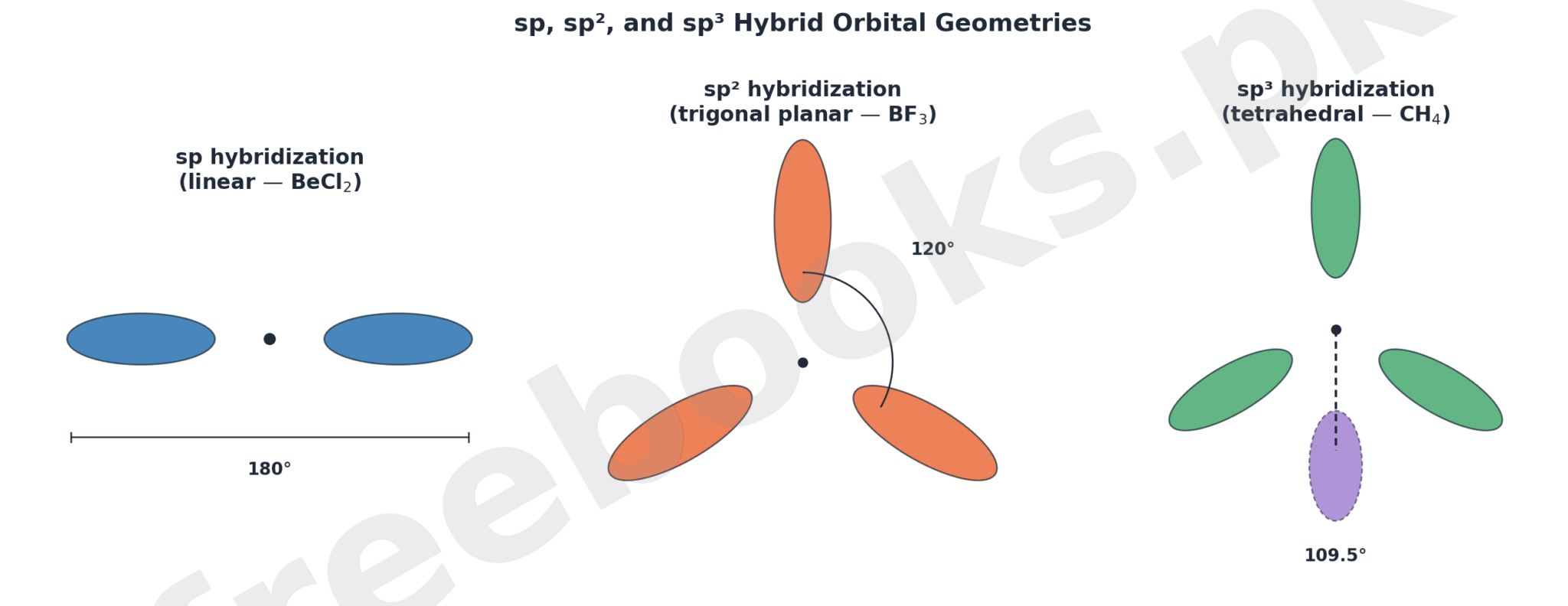
Hybridization is the mixing of atomic orbitals of comparable energy within a single atom to form a new set of equivalent orbitals of identical energy and shape, with the number of hybrid orbitals produced always equal to the number of atomic orbitals mixed. In sp hybridization, one s and one p orbital mix to give two sp orbitals arranged linearly at 180 degrees, explaining the linear geometry of BeCl2; in sp2 hybridization, one s and two p orbitals mix to give three sp2 orbitals arranged in a trigonal plane at 120 degrees, explaining the shape of BF3.
In sp3 hybridization, one s and three p orbitals mix to give four sp3 orbitals arranged tetrahedrally, explaining the shape of methane, CH4, where each of the four sp3 orbitals of carbon overlaps with a hydrogen 1s orbital to form a sigma bond directed toward a corner of a regular tetrahedron. In every case, hybrid orbitals have lower energy than the unhybridized atomic orbitals they replace, and the resulting hybrid-orbital geometry, linear for sp, trigonal planar for sp2, tetrahedral for sp3, directly matches the electron-pair geometry predicted independently by the VSEPR model.
3.8 VSEPR Theory: Predicting Molecular Shapes
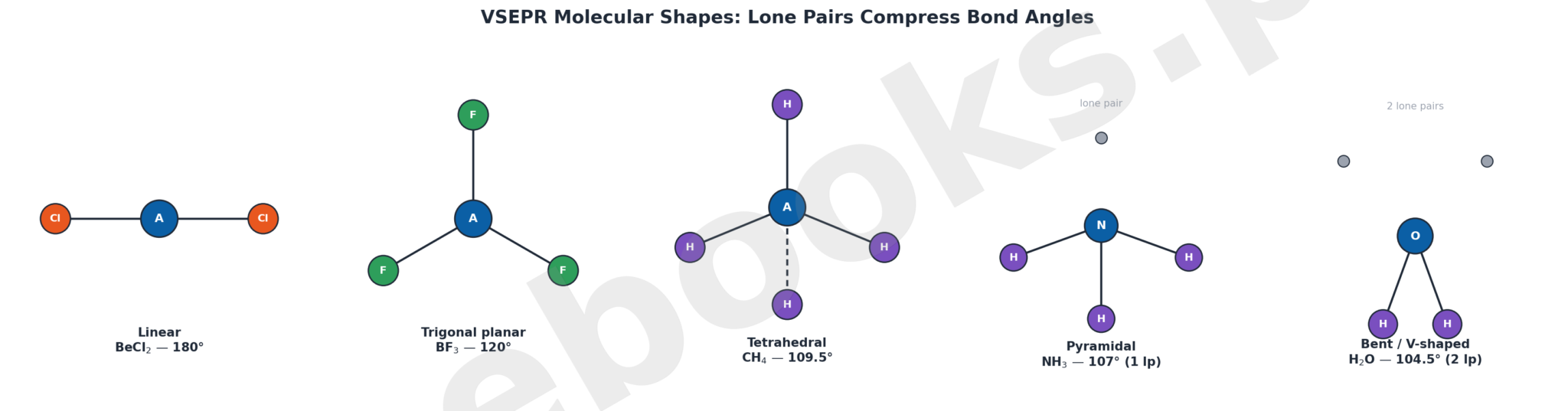
The Valence Shell Electron Pair Repulsion (VSEPR) model, proposed by Sidgwick and Powell, predicts a molecule's shape from the idea that all electron pairs around a central atom, bonding and lone pairs alike, arrange themselves as far apart as possible to minimize repulsion. Because lone pairs occupy more space than bond pairs, the strength of repulsion follows the order lone pair-lone pair greater than lone pair-bond pair greater than bond pair-bond pair, so a lone pair always compresses the bond angles around it below the ideal geometric value: ammonia's bond angle is compressed from the ideal 109.5 degrees to 107 degrees by one lone pair, and water's is compressed further, to 104.5 degrees, by two.
The total number of electron pairs around the central atom sets the electron-pair geometry, 2 pairs give linear, 3 give trigonal planar, 4 give tetrahedral, 5 give trigonal bipyramidal, and 6 give octahedral, while the molecule's actual shape is this same geometry with any lone-pair positions left out of the description — so four electron pairs give a tetrahedral shape with zero lone pairs (CH4), a pyramidal shape with one lone pair (NH3), and a bent, V-shaped molecule with two lone pairs (H2O). A double or triple bond, despite containing two or three electron pairs, is still treated as a single region of electron density for VSEPR purposes.
3.9 VSEPR in Drug Design
Drugs act on specific biological targets, such as enzyme active sites, through bioactive molecules called ligands, and a drug's effectiveness depends heavily on its molecular shape fitting its target the way a key fits a lock, a property called specificity. Because VSEPR theory predicts the three-dimensional shape and bond angles of a molecule directly from its structure, it is a practical tool in drug design for judging whether a candidate ligand's shape is compatible with a target's active site; aspirin, for example, binds to and blocks the enzyme cyclooxygenase (COX) because the shape of its acetyl group is complementary to the shape of COX's active site.
3.10 Molecular Orbital Theory: Bond Order and Paramagnetism
Molecular Orbital Theory (MOT) treats a molecule's electrons as occupying molecular orbitals belonging to the whole molecule, formed when atomic orbitals of matching sign overlap. Two atomic orbitals always combine to give two molecular orbitals: a lower-energy bonding orbital, sigma or pi, when same-sign lobes overlap, and a higher-energy antibonding orbital, sigma-star or pi-star, when opposite-sign lobes overlap. Bond order, a measure of the number of bonds between two atoms, is calculated as half the difference between the number of electrons in bonding orbitals and the number in antibonding orbitals; a bond order of zero, as calculated for He2, means the molecule does not form at all.
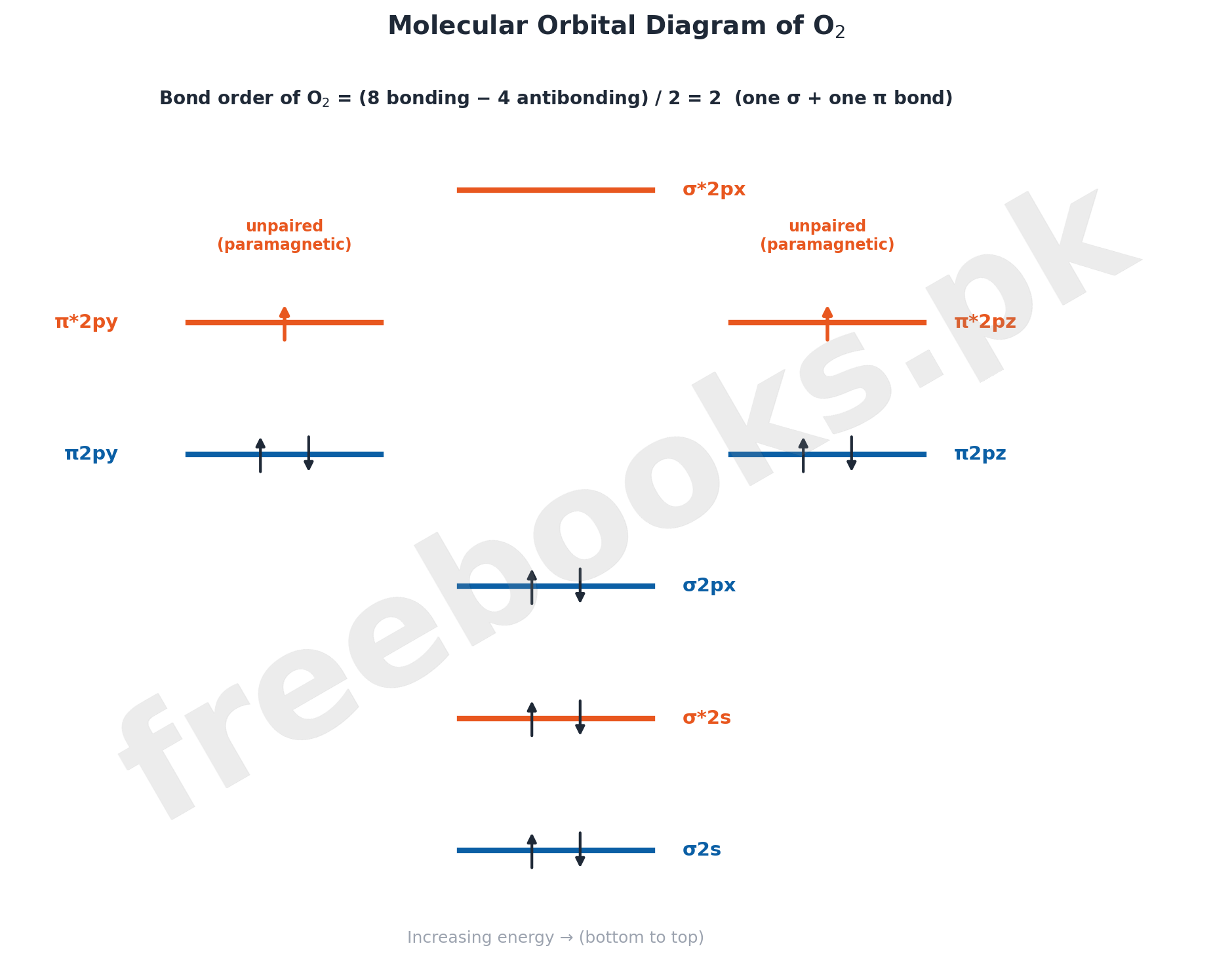
Applying this method to N2 gives a bond order of 3, one sigma and two pi bonds, consistent with its known triple bond and very high bond energy, while O2 gives a bond order of 2, one sigma and one pi bond, a double bond, but MOT reveals something VBT cannot: oxygen's molecular orbital diagram places two of its electrons singly, with parallel spins, in two separate antibonding pi-star orbitals. These two unpaired electrons make O2 paramagnetic, meaning it is attracted into a magnetic field, a real, experimentally observed property, liquid oxygen visibly clings between the poles of a strong magnet, that simpler bonding theories fail to predict.
Important Definitions
What is a dative (coordinate covalent) bond?
A covalent bond in which both shared electrons are donated by only one of the two bonding atoms.
What is an expanded octet?
A central atom having more than eight electrons in its valence shell, made possible by involvement of available d orbitals, as in SO4 2-.
What is a dipole moment?
A quantitative measure, in Debye units, of the separation of partial positive and partial negative charge in a polar bond or molecule.
What is bond energy?
The average energy required to break all bonds of a particular type in one mole of a substance.
What is bond length?
The distance between the nuclei of two atoms joined by a covalent bond.
What is a sigma bond?
A covalent bond formed by the head-on, linear overlap of two atomic orbitals along the axis joining their nuclei.
What is a pi bond?
A covalent bond formed by the sideways overlap of two parallel p orbitals, with electron density above and below the internuclear axis.
What is hybridization?
The mixing of atomic orbitals of comparable energy within one atom to form a new set of equivalent orbitals of identical energy and shape.
What is bond order in molecular orbital theory?
Half the difference between the number of electrons in bonding molecular orbitals and the number in antibonding molecular orbitals.
What does it mean for a substance to be paramagnetic?
It has one or more unpaired electrons and is therefore attracted into an external magnetic field.
Key Facts and Relations
| Topic | Key Fact / Relation |
|---|---|
| Bond-type prediction by electronegativity difference | Below 0.4: nonpolar covalent | 0.4-1.8: polar covalent | above 1.8: ionic |
| Valence electrons around a central atom (Lewis structure) | 2 x (double-bond electron pairs) + 2 x (single-bond pairs or lone pairs) |
| Bond order (MOT) | Bond order = (bonding electrons – antibonding electrons) / 2 |
| Bond order of N2 | 3 (one sigma + two pi bonds) |
| Bond order of O2 | 2 (one sigma + one pi bond); paramagnetic, 2 unpaired electrons in pi* orbitals |
| Bond order of He2 | 0 (molecule does not form) |
| VSEPR: 4 pairs, 0 lone pairs | Tetrahedral shape, 109.5 degrees, e.g. CH4 |
| VSEPR: 4 pairs, 1 lone pair | Pyramidal shape, about 107 degrees, e.g. NH3 |
| VSEPR: 4 pairs, 2 lone pairs | Bent/V-shaped, about 104.5 degrees, e.g. H2O |
| Relative bond strength (kJ/mol) | Ionic (NaCl, 760) > covalent (O-H, 464) > hydrogen bond (20-50) > dipole-dipole (5-20) > London dispersion (1-20) |
Diagrams
VSEPR Molecular Shapes: A comparison of five VSEPR shapes, linear (BeCl2), trigonal planar (BF3), tetrahedral (CH4), pyramidal (NH3), and bent (H2O), showing how lone pairs progressively compress the bond angle
sp, sp2, and sp3 Hybrid Orbital Geometries: Three panels showing the linear arrangement of sp orbitals in BeCl2, the trigonal planar arrangement of sp2 orbitals in BF3, and the tetrahedral arrangement of sp3 orbitals in CH4
Molecular Orbital Diagram of Oxygen (O2): An energy-level diagram showing bonding and antibonding molecular orbitals of O2, with two unpaired electrons in the pi* orbitals responsible for its paramagnetism
Short Questions & Answers
Why does BF3 have zero net dipole moment even though each B-F bond is polar?
BF3 has a symmetric trigonal planar shape with three identical B-F bonds arranged 120 degrees apart; the individual bond dipole moments are equal in magnitude and point outward symmetrically, so their vector sum cancels exactly to zero, making the molecule nonpolar overall despite its polar bonds.
Why is CO2 nonpolar while a bent triatomic molecule like SO2 is polar?
CO2 is linear, so its two identical, oppositely-directed C=O bond moments cancel exactly; SO2 is bent, with a lone pair on sulfur, so its two S=O bond moments do not point in exactly opposite directions and their vector sum leaves a net dipole moment.
Why can period 2 elements not form expanded octets, while period 3 elements such as sulfur can?
Expanding an octet requires using empty d orbitals to hold the extra electron density, and period 2 elements have no d orbitals available in their valence shell, only 2s and 2p, while period 3 elements have accessible 3d orbitals that period 2 elements lack.
Why is the H-F bond energy much higher than H-I?
Bond energy rises with increasing electronegativity difference between the bonded atoms; fluorine is far more electronegative than iodine, so the H-F bond has greater polarity and additional electrostatic attraction that strengthens it well beyond the weaker, less polar H-I bond.
Why is ammonia's bond angle smaller than the ideal tetrahedral angle?
Ammonia's central nitrogen atom has one lone pair in addition to three bond pairs; because a lone pair occupies more space and repels more strongly than a bond pair, it compresses the three N-H bond pairs closer together, reducing the bond angle below the ideal tetrahedral value.
Why does water have an even smaller bond angle than ammonia?
Water's central oxygen atom has two lone pairs rather than one; with two space-occupying, strongly repelling lone pairs instead of one, the remaining two O-H bond pairs are compressed even further than in ammonia, giving a smaller bond angle.
How is the sp3 hybridization of carbon in methane related to its bond geometry?
One 2s and three 2p orbitals of carbon mix to give four equivalent sp3 hybrid orbitals arranged tetrahedrally at 109.5 degrees; each overlaps with a hydrogen 1s orbital to form a sigma bond, so the resulting molecule adopts the same tetrahedral shape as the hybrid orbitals themselves.
Why is the oxygen molecule paramagnetic according to molecular orbital theory?
The molecular orbital diagram of O2 places one electron each, with parallel spins, into two separate antibonding pi-star orbitals rather than pairing them in one orbital; these two unpaired electrons give the molecule a net magnetic moment, making it paramagnetic and attracted into an external magnetic field.
Why does He2 not exist, according to molecular orbital theory?
Combining the 1s orbitals of two helium atoms places two electrons in the bonding sigma orbital and two in the antibonding sigma-star orbital, giving a bond order of (2-2)/2 = 0; a bond order of zero means no net bonding, so the He2 molecule simply does not form.
Why is the ionic bond in NaCl stronger than hydrogen bonding in water?
The ionic bond in NaCl has a bond energy of about 760 kJ/mol, arising from the strong electrostatic attraction between fully-charged Na+ and Cl- ions, while hydrogen bonding is a much weaker intermolecular force, only about 20-50 kJ/mol, arising from a comparatively weak dipole-type attraction rather than a full charge transfer.
Long Questions & Answers
Explain how Valence Bond Theory and orbital hybridization together account for the shapes and bonding of covalent molecules such as BeCl2, BF3, and CH4.
What does Valence Bond Theory say about how a covalent bond forms?
VBT states that a covalent bond forms when two half-filled atomic orbitals of similar energy, one from each atom, overlap along the axis joining their nuclei; greater orbital overlap produces a stronger bond, and the bond's direction is fixed by the shape and orientation of the overlapping orbitals.
What is the difference between a sigma bond and a pi bond?
A sigma bond forms by head-on, linear overlap of two orbitals along the internuclear axis and is present in every covalent bond; a pi bond forms by sideways overlap of two parallel p orbitals, giving electron density above and below the internuclear axis, and appears only in double and triple bonds alongside a sigma bond.
What is hybridization, and why is it needed to explain molecular shapes?
Hybridization is the mixing of atomic orbitals of comparable energy within a single atom into a new set of equivalent orbitals of the same energy and shape; it is needed because the shapes of pure, unmixed atomic orbitals, spherical s, dumbbell p, cannot by themselves account for the observed bond angles of real molecules.
How does sp hybridization explain the linear shape of BeCl2?
Beryllium's one 2s and one 2p orbital mix to form two sp hybrid orbitals arranged at 180 degrees; each overlaps with a half-filled p orbital of a chlorine atom to form a sigma bond, so BeCl2 adopts the same 180-degree linear arrangement as the hybrid orbitals themselves.
How do sp2 and sp3 hybridization explain the shapes of BF3 and CH4?
In BF3, boron's one 2s and two 2p orbitals mix to form three sp2 orbitals arranged in a trigonal plane at 120 degrees, matching BF3's trigonal planar shape; in CH4, carbon's one 2s and three 2p orbitals mix to form four sp3 orbitals arranged tetrahedrally at 109.5 degrees, matching methane's tetrahedral shape, with each hybrid orbital overlapping a hydrogen 1s orbital to form a sigma bond.
Describe the postulates of the VSEPR model and explain, using molecular orbital theory, why simple bonding theories fail to predict the paramagnetism of oxygen.
What are the key postulates of the VSEPR model?
Both lone pairs and bond pairs around a central atom determine molecular geometry; electron pairs arrange themselves as far apart as possible to minimize repulsion; lone pairs occupy more space and repel more strongly than bond pairs, so repulsion strength follows lone pair-lone pair greater than lone pair-bond pair greater than bond pair-bond pair; and a multiple bond, despite containing more than one electron pair, is treated as a single region of electron density.
How does the number of electron pairs around a central atom determine electron-pair geometry?
Two electron pairs give a linear geometry, three give trigonal planar, four give tetrahedral, five give trigonal bipyramidal, and six give octahedral; this electron-pair geometry is then adjusted for the molecule's actual shape by considering only the positions of the bonded atoms, excluding any lone pairs.
What are the postulates of molecular orbital theory?
Atomic orbitals of the combining atoms overlap to form new molecular orbitals belonging to the whole molecule; same-sign orbital overlap produces a lower-energy bonding orbital, while opposite-sign overlap produces a higher-energy antibonding orbital; and bond order, a measure of the number of bonds formed, equals half the difference between the number of electrons in bonding and antibonding orbitals.
What does the molecular orbital diagram of O2 show about its electron arrangement?
Filling O2's molecular orbitals in order of increasing energy leaves two electrons to occupy the degenerate pi-star (2py) and pi-star (2pz) antibonding orbitals; following Hund's rule, these two electrons occupy the two orbitals singly, with parallel spins, rather than pairing up in one.
Why can Valence Bond Theory not explain oxygen's paramagnetism, while molecular orbital theory can?
VBT depicts the oxygen-oxygen double bond simply as one sigma and one pi bond, formed from fully-paired shared electrons, and provides no way to represent unpaired electrons within that picture; MOT, by contrast, explicitly tracks how many electrons occupy each individual bonding and antibonding orbital, correctly revealing the two unpaired electrons in oxygen's antibonding pi-star orbitals that are directly responsible for its observed paramagnetism.
Multiple Choice Questions (MCQs)
A dative (coordinate covalent) bond differs from a normal covalent bond because: (A) It involves ionic character (B) Both shared electrons are donated by one atom only (C) It is weaker than a normal covalent bond (D) It only forms between identical atoms
Correct answer: (B) Both shared electrons are donated by one atom only. In a dative bond, one atom, the donor, supplies both electrons of the shared pair, while in a normal covalent bond each atom contributes one electron.
The central sulfur atom in the sulfate ion, SO4 2-, has how many electrons in its valence shell? (A) 8 (B) 10 (C) 12 (D) 14
Correct answer: (C) 12. Calculating from its Lewis structure, sulfate's central S atom has 12 valence electrons, four more than a normal octet, an expanded octet made possible by its accessible 3d orbitals.
An electronegativity difference of 2.1 between two bonded atoms indicates: (A) A nonpolar covalent bond (B) A polar covalent bond (C) An ionic bond (D) No bond forms
Correct answer: (C) An ionic bond. An electronegativity difference above about 1.8 indicates an ionic bond, as seen in NaCl, which has a difference of 2.1.
CCl4 has four individually polar C-Cl bonds but zero net dipole moment because: (A) Carbon and chlorine have equal electronegativity (B) Its tetrahedral symmetry causes the bond moments to cancel (C) It has no lone pairs on carbon (D) Chlorine atoms repel each other
Correct answer: (B) Its tetrahedral symmetry causes the bond moments to cancel. CCl4's perfectly tetrahedral, symmetric geometry causes the four equal C-Cl bond moments to cancel exactly, giving zero net dipole moment despite polar individual bonds.
Which bond type is generally the strongest, based on typical bond energies? (A) London dispersion forces (B) Hydrogen bonding (C) Covalent bond (D) Ionic bond
Correct answer: (D) Ionic bond. Ionic bonds, such as in NaCl at about 760 kJ/mol, are typically the strongest, well above covalent bonds, hydrogen bonds, and van der Waals forces.
A sigma bond is formed by: (A) Sideways overlap of parallel p orbitals (B) Head-on overlap of orbitals along the internuclear axis (C) Overlap of only d orbitals (D) Transfer of electrons between atoms
Correct answer: (B) Head-on overlap of orbitals along the internuclear axis. A sigma bond forms from head-on, linear overlap of two atomic orbitals along the axis joining the two nuclei.
Which hybridization explains the trigonal planar shape of BF3? (A) sp (B) sp2 (C) sp3 (D) sp3d
Correct answer: (B) sp2. sp2 hybridization mixes one s and two p orbitals into three orbitals arranged in a trigonal plane at 120 degrees, matching BF3's shape.
According to VSEPR theory, a central atom with 4 bond pairs and 2 lone pairs has a molecular shape that is: (A) Tetrahedral (B) Pyramidal (C) Bent/V-shaped (D) Linear
Correct answer: (C) Bent/V-shaped. Four electron pairs give a tetrahedral electron-pair geometry, but with 2 lone pairs excluded from the shape description, the actual molecular shape is bent or V-shaped, as in water.
The bond order of N2, calculated from its molecular orbital diagram, is: (A) 1 (B) 2 (C) 3 (D) 4
Correct answer: (C) 3. N2 has 6 more bonding than antibonding valence electrons, giving a bond order of (6-0)/2 = 3, consistent with its triple bond.
Oxygen (O2) is paramagnetic because its molecular orbital diagram shows: (A) All electrons paired in bonding orbitals (B) Two unpaired electrons in antibonding pi-star orbitals (C) No electrons in antibonding orbitals (D) A bond order of zero
Correct answer: (B) Two unpaired electrons in antibonding pi-star orbitals. O2's molecular orbital diagram places two electrons singly, with parallel spins, in separate antibonding pi-star orbitals, and these unpaired electrons cause its paramagnetism.
Quick Revision Summary
- Ionic bond: complete electron transfer, low-IE metal + high-EA nonmetal (e.g. NaCl)
- Covalent bond: mutual electron sharing; nonpolar if electronegativities equal, polar if different
- Dative (coordinate) bond: both shared electrons donated by one atom (e.g. H3O+, CO, O3)
- Expanded octet: central atom exceeds 8 valence electrons using d orbitals, period 3 or later only, e.g. SO4 2-, I3-
- Electronegativity difference predicts bond type: below 0.4 nonpolar covalent | 0.4-1.8 polar covalent | above 1.8 ionic
- Dipole moment measures charge separation (Debye units); symmetric molecules (BeCl2, BF3, CCl4) can have polar bonds but zero net dipole moment
- Bond energy rises with electronegativity difference and bond multiplicity; bond length rises with atom size, falls with electronegativity difference
- Bond strength order: ionic > covalent > hydrogen bonding > dipole-dipole > London dispersion
- VBT: sigma bond = head-on overlap; pi bond = sideways overlap of parallel p orbitals; double bond = 1 sigma + 1 pi; triple bond = 1 sigma + 2 pi
- Hybridization: sp = linear (180 degrees), sp2 = trigonal planar (120 degrees), sp3 = tetrahedral (109.5 degrees)
- VSEPR: electron pairs arrange to minimize repulsion; lp-lp > lp-bp > bp-bp; lone pairs compress bond angles
- VSEPR shapes: 2 pairs = linear, 3 = trigonal planar, 4 = tetrahedral/pyramidal/bent, 5 = trigonal bipyramidal, 6 = octahedral
- MOT bond order = (bonding electrons – antibonding electrons) / 2; bond order 0 means no molecule (He2)
- MOT explains O2 paramagnetism, 2 unpaired electrons in pi* orbitals, something VBT cannot show
Exam Tips
- When predicting bond type, always compute the electronegativity difference first — most 'ionic vs covalent' exam questions reduce to comparing this single number against 0.4 and 1.8
- For dipole moment questions, check symmetry before anything else: a molecule with identical ligands in a fully symmetric geometry (linear, trigonal planar, tetrahedral) always has zero net dipole moment even if every bond is polar
- Count electron pairs first, then look up the geometry, then subtract lone pairs for the actual shape — this three-step VSEPR method avoids most shape-prediction errors
- Match hybridization to geometry directly: sp = linear, sp2 = trigonal planar, sp3 = tetrahedral — if you know one, you know the other
- For MOT bond-order questions, write out the molecular orbital filling order first (sigma2s, sigma*2s, then the 2p orbitals) before counting bonding vs antibonding electrons
- Remember that MOT, not VBT, is the theory that explains paramagnetism — if a question asks why a substance is attracted to a magnet, look for unpaired electrons in antibonding orbitals