The periodic table is often called the ‘symbol of chemistry’ — a single chart that organizes all 118 known elements by atomic number and, in doing so, predicts and explains an enormous range of chemical behaviour. This chapter traces how that organization was built, from early 19th-century attempts to group elements by similarity through to Mendeleev's landmark mass-based table and Moseley's decisive shift to atomic number, and then examines the modern table's structure: its periods, groups, blocks, and the six families of elements that share closely related properties.
The second half of the chapter turns to periodicity itself — the systematic way atomic radius, ionic radius, ionization energy, electron affinity, electronegativity, and metallic character all rise or fall in predictable patterns across periods and down groups. These trends are then applied directly to the chemistry of Period 3: the contrasting reactions of sodium and magnesium with water, oxygen, and chlorine, and the shift from ionic, basic oxides and neutral chlorides at the metal end of the period to covalent, acidic oxides and hydrolysing chlorides at the nonmetal end.
Learning Objectives
- Explain the arrangement of elements in the periodic table and identify the positions of metals, nonmetals, and metalloids
- Explain that the periodic table is arranged into four blocks (s, p, d, f) associated with the four subshells
- Deduce an element's electron configuration from its position in the periodic table, and vice versa
- State that the principal energy level and number of valence electrons can be deduced from an element's position in the table
- Predict the characteristic properties of an element in a given group using knowledge of chemical periodicity
- Explain the vertical and horizontal trends in atomic radius, ionic radius, ionization energy, electron affinity, and electronegativity
- Recognize that trends in metallic and nonmetallic behaviour arise from trends in valence electrons
- Suggest the type of chemical bonding present in oxides and chlorides from their physical and chemical properties
- Describe, with equations, the reactions of oxides and chlorides with water, including the likely pH of the resulting solutions
- Write equations for the reactions of sodium and magnesium with oxygen, chlorine, and water, and explain the variation in oxidation number of their oxides and chlorides
Key Concepts
1.1 Historical Background of the Periodic Table
Early classification attempts began with Lavoisier separating known elements into metals and nonmetals, followed by Dobereiner's Law of Triads (1829), which grouped elements such as lithium, sodium and potassium where the middle element's atomic weight was roughly the average of the other two. Newlands' Law of Octaves (1864) arranged the 62 elements then known by increasing atomic mass and noticed that every eighth element resembled the first, while in the same year Lothar Meyer plotted atomic volume against atomic weight and found a similar periodicity.
Mendeleev's 1869 table, arranging 63 elements by increasing atomic mass, succeeded where earlier attempts fell short because he deliberately left gaps for undiscovered elements and predicted their properties — predictions later confirmed by discovery. This success established him as the father of the periodic table, though mass-based ordering still produced a handful of inconsistencies. In 1913, Moseley used X-ray emission data to determine each element's true atomic number, resolving these anomalies and reformulating the Periodic Law: the properties of elements are periodic functions of their atomic number, not atomic mass — the version used today.
1.2 Structure of the Modern Periodic Table
The modern periodic table arranges 118 known elements in order of increasing atomic number across seven horizontal periods and eighteen vertical groups. Elements in the same group share the same number of valence electrons and therefore similar chemical behaviour, while physical properties change gradually down a group; elements across a period show a steady left-to-right change in properties as electrons fill the same outer shell.
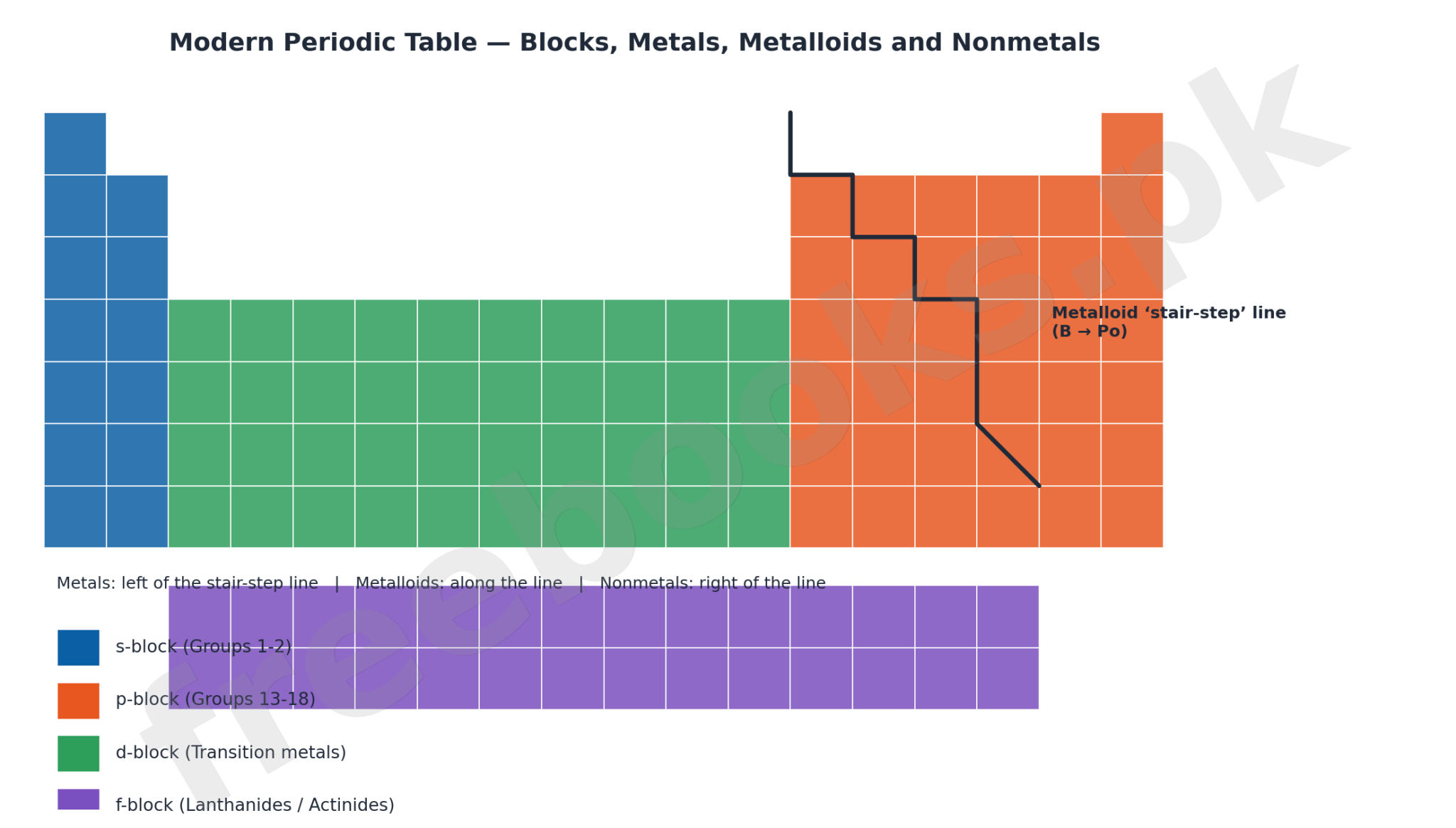
Elements are also classified as metals (which lose electrons to form positive ions, occupying the left and centre of the table), nonmetals (which gain electrons to form negative ions, occupying the upper right), and metalloids (elements straddling the zig-zag ‘stair-step’ line running from boron down to polonium, showing mixed metallic and nonmetallic behaviour). A second classification divides the table into four blocks — s, p, d and f — named for the subshell holding the atom's last-added valence electron: Groups 1-2 form the s-block, Groups 13-18 the p-block, the transition elements the d-block, and the lanthanides and actinides beneath the main table the f-block.
1.3 Element Families
Six families of elements share closely related properties. Alkali metals (Group 1: Li, Na, K, Rb, Cs, Fr) have a single valence electron and are the most reactive metals, forming alkalis in water. Alkaline earth metals (Group 2: Be, Mg, Ca, Sr, Ba, Ra) have two valence electrons and are less reactive than alkali metals. Transition metals occupy the d-block, plus the f-block lanthanides and actinides below the main table, show variable oxidation states, and typically form coloured compounds.
Chalcogens (Group 16: O, S, Se, Te, Po, Lv) range from nonmetals (O, S) through metalloids (Se, Te, Po) to a metal (Lv). Halogens (Group 17: F, Cl, Br, I, At, Ts) are highly reactive nonmetals with strong electron affinities that readily accept one electron to complete their outer shell, forming salts with metals — the origin of the name ‘halogen’, meaning salt-former. Noble gases (Group 18) have completely filled outer shells and are almost entirely unreactive, though a small number of noble-gas compounds, such as xenon hexafluoroplatinate, do exist.
1.4 Periodic Arrangement and Electron Configuration
An element's position in the periodic table directly encodes its electron configuration. The period number equals the highest occupied shell number (n), while the group number indicates the number of valence electrons — for a main-group element, its block identifies which subshell those valence electrons occupy. For example, an element in period 3, group 2 has two electron shells filled plus a third shell containing two valence electrons in the 3s subshell (s-block), identifying it as magnesium.
This relationship works in both directions: given an element's group and period, its full or valence electron configuration can be deduced without consulting a table, and conversely, an element's group and period can be identified from a given configuration. This deduction is central to predicting chemical behaviour, since valence electron count and arrangement determine how readily an atom loses, gains, or shares electrons.
1.5 Atomic Radius, Ionic Radius, and Ionization Energy
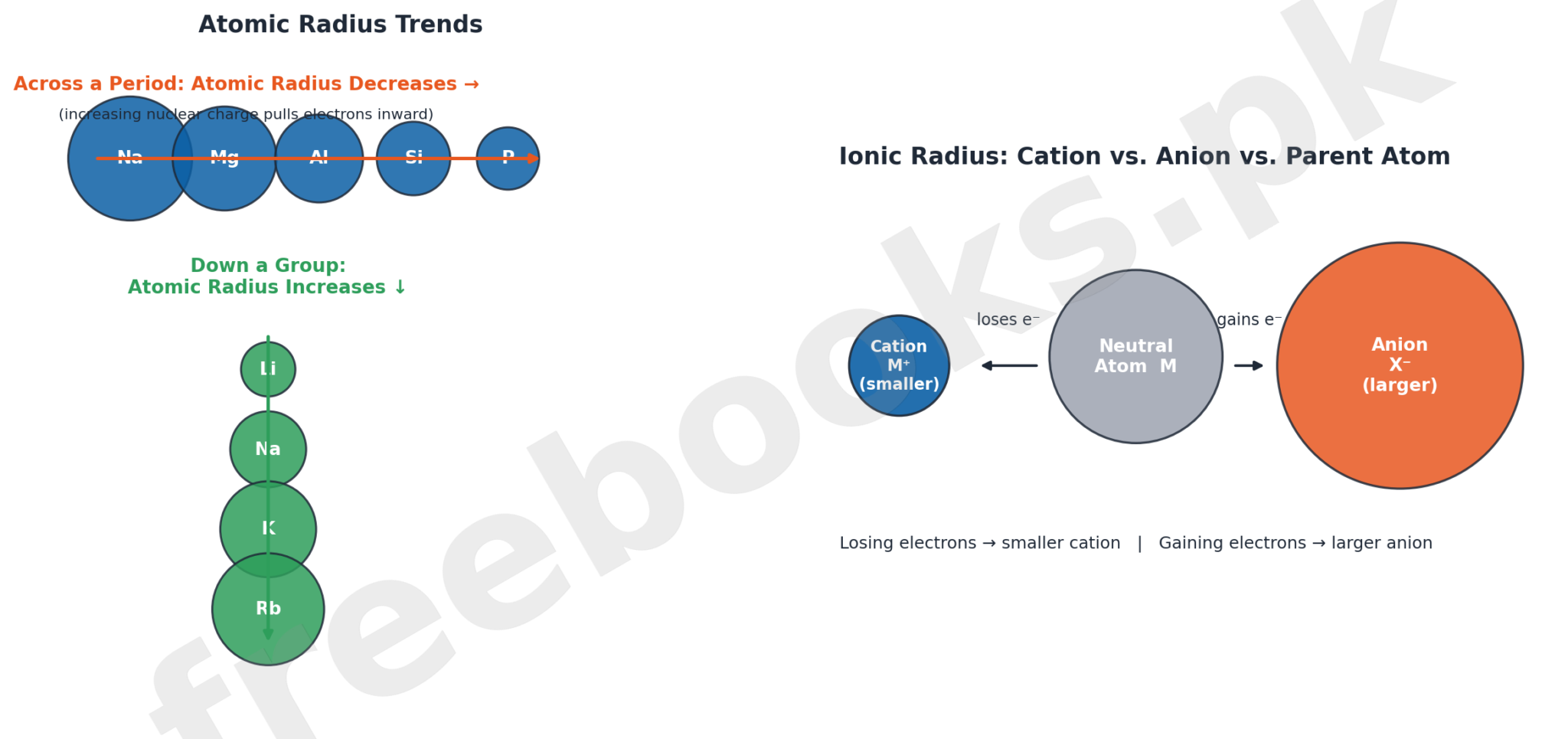
Atomic radius, half the distance between two identical bonded atoms, depends on the number of electron shells, effective nuclear charge, and the shielding effect of inner electrons. It decreases across a period, since increasing nuclear charge pulls the electron cloud inward, and increases down a group, since additional shells outweigh the increased nuclear charge. Ionic radius follows a related but distinct pattern: cations are smaller than their parent atom, having lost an entire outer shell, anions are larger, since added electrons increase inter-electron repulsion and expand the electron cloud, and both cations and anions increase in size down a group.
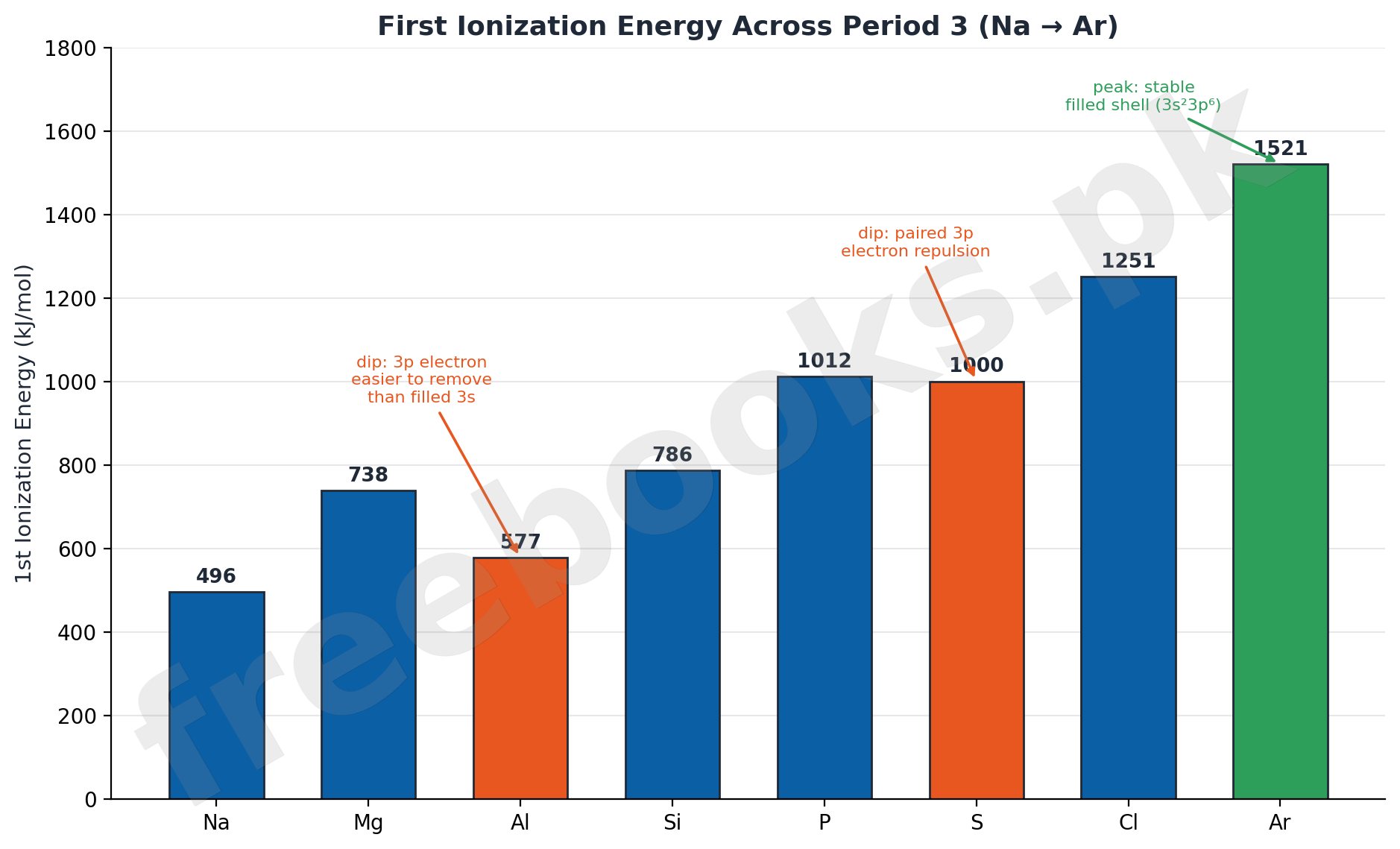
Ionization energy is the energy needed to remove an electron from a gaseous atom or ion; each successive ionization energy for the same element is larger than the last, since removing an electron from an increasingly positive ion requires more energy. It is governed by nuclear charge, atomic or ionic size, and electron arrangement — half-filled and fully-filled subshells are extra stable, giving elements like nitrogen or beryllium anomalously high first ionization energies compared with their immediate neighbours oxygen or boron. Ionization energy increases across a period, peaking at the noble gases with their stable filled shells and reaching a minimum at the alkali metals, and decreases down a group as atomic size and shielding both increase.
1.6 Electron Affinity, Electronegativity, and Metallic Character
Electron affinity is the energy change when an electron is added to a gaseous atom; first electron affinities are usually negative, meaning energy is released, because the nucleus attracts the incoming electron, while second electron affinities are positive, since energy must be supplied to overcome repulsion from the existing negative charge. Electron affinity becomes more negative across a period, reflecting smaller atoms and higher nuclear charge, and less negative down a group, as larger atoms weaken the attraction, though half-filled subshells such as those in nitrogen and phosphorus give unexpectedly low values.
Electronegativity measures an atom's power to attract a shared pair of electrons in a bond, and on the Pauling scale it rises from about 0.8 for alkali metals to 4.0 for fluorine. It increases across a period, driven by rising nuclear charge and shrinking size, and decreases down a group, as added shells and shielding weaken the pull on bonding electrons. Metallic character — the tendency to lose electrons — follows the reverse of electronegativity: it decreases across a period as atoms hold their valence electrons more tightly, and increases down a group as atomic size and shielding make electron loss easier, explaining why caesium is far more reactive than sodium or lithium.
1.7 Reactions of Sodium and Magnesium
Sodium reacts vigorously with cold water to form sodium hydroxide and hydrogen gas, while magnesium reacts only slowly with cold water but much more vigorously with steam, forming magnesium oxide and hydrogen instead. Both metals burn in oxygen: sodium forms a mixture of sodium oxide and sodium peroxide with a golden-yellow flame, and is stored under kerosene to prevent this reaction occurring in air, while magnesium burns with an intense white flame to form magnesium oxide — a reaction vigorous enough to be used in flares and fireworks.
Both metals also react directly and exothermically with chlorine gas to form their respective chlorides: sodium chloride and magnesium chloride, both white ionic solids. Across all three reactions, sodium is consistently the more reactive of the two metals, consistent with alkali metals being more reactive than alkaline earth metals of the same period.
1.8 Bonding and Acid-Base Trends in Period 3 Oxides and Chlorides
Moving across period 3, the oxides change character from strongly ionic (Na2O, MgO — giant ionic lattices) to increasingly covalent (SO2, SO3, P2O5 — discrete covalent molecules), a shift driven by increasing electronegativity and decreasing ionic character. Oxides are classified by their reaction with water: basic oxides, formed by metals such as Na2O and CaO, produce alkaline solutions; acidic oxides, formed by nonmetals such as SO2 and P2O5, produce acidic solutions; and amphoteric oxides, such as Al2O3, react with both acids and bases, forming a salt and water in each case.
Chlorides show a parallel pattern: NaCl and MgCl2 dissolve in water to give solutions close to neutral, a simple hydration of ions, while AlCl3 and the chlorides of silicon and phosphorus undergo hydrolysis, reacting with water to release HCl and produce acidic solutions. The oxidation number of a period 3 element in its oxide or chloride matches its group number, since oxygen and chlorine are more electronegative and the element itself is always assigned the positive oxidation state, rising from +1 in sodium to +6 in sulfur's oxide; elements such as phosphorus and sulfur show variable oxidation numbers because they can expand their octet using empty 3d orbitals.
Important Definitions
What is the Modern Periodic Law?
The physical and chemical properties of elements are periodic functions of their atomic numbers — established by Moseley in 1913 using X-ray emission data.
What is atomic radius?
Half the distance between the nuclei of two identical atoms bonded together, typically measured in picometers (pm) or angstroms (Å).
What is ionic radius?
The distance from the nucleus of an ion to its outermost electron shell in a crystal lattice; cations are smaller and anions are larger than their parent atoms.
What is first ionization energy?
The energy needed to remove one electron from each atom in one mole of gaseous atoms of an element, forming one mole of gaseous 1+ ions.
What is first electron affinity?
The enthalpy change when one mole of electrons is added to one mole of gaseous atoms to form one mole of gaseous uni-negative ions.
What is electronegativity?
The power of an atom to attract a shared pair of electrons toward itself within a covalent bond, measured on the dimensionless Pauling scale.
What is metallic character?
An element's tendency to lose electrons and form positive ions; it decreases across a period and increases down a group.
What is a basic oxide?
An oxide, usually formed by a metal, that reacts with water to produce an alkaline (basic) solution, such as Na2O or CaO.
What is an acidic oxide?
An oxide, usually formed by a nonmetal and held together by covalent bonds, that reacts with water to produce an acidic solution, such as SO2 or P2O5.
What is an amphoteric oxide?
An oxide that can react with both acids and bases, behaving as either depending on conditions — aluminium oxide (Al2O3) is the standard example.
Key Facts and Relations
| Topic | Key Fact / Relation |
|---|---|
| General first ionization energy | M(g) → M+(g) + e-, always endothermic (energy absorbed) |
| Sodium, 1st ionization energy | Na(g) → Na+(g) + e-, ΔHi1 = +494 kJ/mol |
| Calcium, 2nd ionization energy | Ca+(g) → Ca2+(g) + e-, ΔHi2 = +1150 kJ/mol |
| Chlorine, 1st electron affinity | Cl(g) + e- → Cl-(g), ΔH°ea1 = -348.8 kJ/mol (energy released) |
| Oxygen, 2nd electron affinity | O-(g) + e- → O2-(g), ΔH°ea2 = +798 kJ/mol (energy absorbed, due to repulsion) |
| Electronegativity range (Pauling scale) | Alkali metals lowest (about 0.8) up to fluorine highest (4.0) |
| Sodium with water | 2Na(s) + 2H2O(l) → 2NaOH(aq) + H2(g) |
| Magnesium with steam | Mg(s) + 2H2O(g) → MgO(s) + 2H2(g) |
| Basic oxide with water | Na2O(s) + H2O(l) → 2NaOH(aq) |
| Amphoteric oxide with acid and base | Al2O3 + 6HCl → 2AlCl3 + 3H2O ; Al2O3 + 2NaOH → 2NaAlO2 + H2O |
Diagrams
Periodic Table Blocks and the Metal-Metalloid-Nonmetal Divide: A schematic periodic table grid showing the s-block, p-block, d-block and f-block regions in different colours, together with the zig-zag stair-step line running from boron to polonium that separates metals from nonmetals, with metalloids straddling the line
Atomic Radius and Ionic Radius Trends: Two panels comparing atom sizes: the left panel shows atomic radius shrinking across a period and growing down a group; the right panel compares a neutral atom with its cation, which is smaller, and its anion, which is larger
First Ionization Energy Across Period 3: A bar chart of the first ionization energies of the Period 3 elements from sodium to argon, showing the overall increasing trend from left to right with a dip at aluminium and at sulfur due to subshell stability, and a peak at argon
Short Questions & Answers
Which scientist first observed periodicity among the elements, and how?
English chemist John Newlands, in 1864, arranged the then-known 62 elements in increasing order of atomic mass and noticed that every eighth element resembled the first — an early form of periodicity later named the Law of Octaves.
Why did Moseley's atomic-number-based arrangement succeed where Mendeleev's mass-based table had inconsistencies?
Moseley used X-ray emission data to determine each element's true atomic number, showing that atomic number, not atomic mass, is the property periodic law depends on, resolving several ordering anomalies in Mendeleev's table.
Why are Group 1 and Group 2 elements called s-block elements?
Because their valence, outermost electrons occupy the s subshell of their highest energy shell — one electron in Group 1, two in Group 2.
Why is sulfur's first ionization energy lower than phosphorus's, even though sulfur has a higher nuclear charge?
Phosphorus has a stable, half-filled 3p3 subshell that resists losing an electron; sulfur's 3p4 configuration has one paired electron, and the extra repulsion between the paired electrons makes that electron easier to remove, lowering sulfur's ionization energy below phosphorus's despite sulfur's greater nuclear charge.
Why does aluminium chloride form an acidic solution in water while sodium chloride does not?
AlCl3 is small and highly charged, so its Al3+ ion polarises water molecules strongly and undergoes hydrolysis, releasing H+ ions and lowering the pH; NaCl simply dissociates into hydrated Na+ and Cl- ions without reacting further, leaving the solution neutral.
What determines whether an oxide of a period 3 element is basic, acidic, or amphoteric?
Basic oxides are formed by metals on the left of the period, such as Na2O and MgO, and react with water to form alkalis; acidic oxides are formed by nonmetals on the right, such as P2O5 and SO3, and react with water to form acids; amphoteric oxides such as Al2O3, near the metal-nonmetal boundary, react with both acids and bases.
Why do halogens have very high electron affinities compared with other groups?
Halogens have seven valence electrons and need only one more to complete a stable noble-gas configuration; their relatively small size and high effective nuclear charge attract the incoming electron strongly, releasing a large amount of energy and giving a highly negative electron affinity.
Why is the electron affinity of fluorine slightly less negative than that of chlorine, despite fluorine being smaller?
Fluorine's very small atomic size concentrates its existing electrons closely together, so the incoming electron experiences significant repulsion from this compact electron cloud, partially offsetting the effect of fluorine's high attraction and small size, making chlorine's electron affinity slightly more negative than fluorine's.
How does effective nuclear charge explain why ionization energy generally increases across a period?
Across a period the number of shielding inner shells stays the same while the nuclear charge increases with each added proton, so each additional electron feels a stronger net pull from the nucleus, making it progressively harder to remove an electron from left to right.
Why do noble gases have positive first electron affinities?
Noble gases already have a completely filled, highly stable outer shell; adding an extra electron would force it into a new, higher-energy shell with little nuclear attraction, so energy must be supplied rather than released, giving a positive, unfavourable electron affinity.
Long Questions & Answers
Discuss the periodic trends in atomic radius, ionic radius, and ionization energy, explaining the factors that influence each property.
What factors determine atomic radius, and how does it vary across a period and down a group?
Atomic radius depends on the number of electron shells, the effective nuclear charge, and the shielding provided by inner electrons. Across a period, the number of shells stays constant while nuclear charge increases, pulling the electron cloud inward and steadily shrinking the radius. Down a group, each new element gains an entire additional shell, and the resulting increase in distance and shielding outweighs the simultaneous rise in nuclear charge, so atomic radius increases.
How does ionic radius compare with atomic radius for cations and anions?
A cation is smaller than its parent atom because losing electrons often removes an entire outer shell and leaves the remaining electrons under a stronger relative pull from the nucleus. An anion is larger than its parent atom because the added electrons increase electron-electron repulsion, causing the electron cloud to expand outward. Both cations and anions still increase in size down a group, for the same shell-addition reason that governs atomic radius.
What is ionization energy and what factors affect its magnitude?
Ionization energy is the energy required to remove an electron from a gaseous atom or ion. Its magnitude depends on effective nuclear charge, since stronger attraction raises it; atomic or ionic size, since larger size lowers it as outer electrons are held less tightly; electron arrangement, since half-filled and fully-filled subshells are extra stable and resist electron removal; the shielding effect of inner electrons, which lowers it; and spin-pair repulsion, where removing one of two paired electrons in the same orbital requires slightly less energy than removing an unpaired electron.
How does ionization energy vary across a period and down a group?
Across a period, nuclear charge increases while the number of shells stays fixed, so successive elements hold their electrons more tightly and ionization energy generally rises, reaching a maximum at the noble gas with its stable filled shell. Down a group, ionization energy decreases because atomic size and the number of shielding shells both increase, weakening the nucleus's grip on the outermost electron — for example, in Group 1 the order is Li > Na > K > Rb > Cs.
Why do elements like boron and oxygen show exceptions to the general ionization energy trend?
Boron's first ionization energy is lower than beryllium's because beryllium has a stable, fully-filled 2s2 subshell, while boron's extra electron enters the higher-energy 2p subshell and is more easily removed. Similarly, oxygen's first ionization energy is lower than nitrogen's because nitrogen has a stable, half-filled 2p3 subshell, whereas oxygen's fourth p-electron must pair up in an already-occupied orbital, and the resulting electron-electron repulsion makes that paired electron easier to remove.
Explain the reactions of sodium and magnesium with water, oxygen, and chlorine, and describe how the oxides and chlorides of Period 3 elements vary in bonding character and acid-base behaviour.
How do sodium and magnesium react with water?
Sodium reacts vigorously with cold water, forming sodium hydroxide and hydrogen gas: 2Na + 2H2O → 2NaOH + H2. Magnesium reacts only slowly with cold water to form magnesium hydroxide and hydrogen, but reacts much more vigorously with steam, forming magnesium oxide and hydrogen gas instead: Mg + 2H2O(g) → MgO + 2H2. This difference reflects sodium's greater reactivity as an alkali metal compared with the alkaline earth metal magnesium.
How do sodium and magnesium react with oxygen and chlorine?
Sodium burns in oxygen with a golden-yellow flame to form a mixture of sodium oxide and sodium peroxide, and is normally stored under kerosene to prevent this reaction occurring in air. Magnesium burns in oxygen with an intense white flame to form magnesium oxide, a reaction vigorous enough to be used in flares and fireworks. Both metals react exothermically and directly with chlorine gas to form white ionic solids: sodium chloride and magnesium chloride respectively.
How does bonding character change across the oxides and chlorides of Period 3?
Oxides and chlorides of the metals at the start of Period 3 — sodium, magnesium, aluminium — are predominantly ionic, existing as giant lattices held together by strong electrostatic attraction between oppositely charged ions. Moving right toward the nonmetals — silicon, phosphorus, sulfur, chlorine — both oxides and chlorides become increasingly covalent, existing instead as discrete molecules with comparatively weak intermolecular forces, a shift driven by the rising electronegativity of the period 3 element and the shrinking electronegativity difference with oxygen or chlorine.
What distinguishes basic, acidic, and amphoteric oxides?
A basic oxide, typically formed by a metal, reacts with water to produce an alkaline solution, as in Na2O + H2O → 2NaOH. An acidic oxide, typically formed by a nonmetal, reacts with water to produce an acidic solution, as in SO2 + H2O → H2SO3, and also reacts with bases. An amphoteric oxide, such as Al2O3, sits at the metal-nonmetal boundary and reacts with both acids and bases — forming aluminium chloride and water with hydrochloric acid, and sodium aluminate and water with sodium hydroxide.
How are the chlorides of Period 3 classified as neutral or acidic?
Sodium chloride and magnesium chloride dissolve in water to give solutions close to neutral, since their ions simply become hydrated without reacting further with water. From aluminium chloride onward, the chlorides undergo hydrolysis: AlCl3 + 3H2O → Al(OH)3 + 3HCl, releasing HCl and producing an acidic solution, a pattern that continues through silicon and phosphorus chlorides as covalent character increases.
Multiple Choice Questions (MCQs)
Which scientist arranged elements into triads, noting that the atomic weight of the middle element was roughly the average of the outer two? (A) John Newlands (B) Johann Dobereiner (C) Lothar Meyer (D) Dmitri Mendeleev
Correct answer: (B) Johann Dobereiner. Dobereiner's Law of Triads (1829) grouped elements such as lithium, sodium and potassium this way.
What did Moseley's X-ray work establish about the ordering of the periodic table? (A) Elements should be ordered by atomic mass (B) Elements should be ordered by atomic number (C) Elements should be ordered alphabetically (D) Elements should be ordered by density
Correct answer: (B) Elements should be ordered by atomic number. Moseley showed atomic number, not atomic mass, is the property the periodic law depends on, resolving ordering flaws in Mendeleev's table.
The stair-step line separating metals from nonmetals in the periodic table runs from which two elements? (A) Carbon to lead (B) Boron to polonium (C) Nitrogen to bismuth (D) Silicon to antimony
Correct answer: (B) Boron to polonium. The metalloid dividing line runs from boron (B) down to polonium (Po), passing through Si, Ge, As, Sb and Te.
An element in period 3 with 2 valence electrons in the s-block is: (A) Sodium (B) Magnesium (C) Aluminium (D) Calcium
Correct answer: (B) Magnesium. Period 3, s-block, 2 valence electrons identifies magnesium (3s2).
Which family of elements is described as 'salt-formers' because of their reaction with alkali and alkaline earth metals? (A) Chalcogens (B) Noble gases (C) Halogens (D) Transition metals
Correct answer: (C) Halogens. Halogens (Group 17) readily form salts with reactive metals, giving them the name 'salt-formers'.
Ionization energy generally increases across a period mainly because: (A) Atomic size increases (B) Shielding increases sharply (C) Effective nuclear charge increases while shielding stays roughly constant (D) The number of electron shells increases
Correct answer: (C) Effective nuclear charge increases while shielding stays roughly constant. Across a period, added protons increase nuclear charge while the number of inner shielding shells stays the same, so electrons are held more tightly.
Which of the following has an unusually low first ionization energy because it involves removing one of two paired electrons from the same orbital? (A) Nitrogen (B) Oxygen (C) Fluorine (D) Neon
Correct answer: (B) Oxygen. Oxygen's 2p4 configuration pairs one electron, and the resulting repulsion makes that electron easier to remove than nitrogen's stable half-filled 2p3.
The second electron affinity of oxygen is positive (energy absorbed) mainly because: (A) Oxygen's nucleus is too small (B) The incoming electron is repelled by the existing negative charge on O- (C) Oxygen has a full outer shell (D) Electron affinity is always positive for nonmetals
Correct answer: (B) The incoming electron is repelled by the existing negative charge on O-. Adding a second electron to an already negatively charged O- ion requires overcoming electrostatic repulsion, so energy must be supplied.
Which oxide is amphoteric, reacting with both hydrochloric acid and sodium hydroxide? (A) Na2O (B) MgO (C) Al2O3 (D) SO3
Correct answer: (C) Al2O3. Aluminium oxide (Al2O3) reacts with acids to form aluminium salts and with bases to form aluminates, making it amphoteric.
Which chloride of period 3 produces a solution closest to neutral (pH near 7) when dissolved in water? (A) AlCl3 (B) SiCl4 (C) PCl3 (D) NaCl
Correct answer: (D) NaCl. Sodium chloride simply forms hydrated ions in water without hydrolysis, giving a near-neutral solution, unlike AlCl3, SiCl4, and PCl3, which undergo hydrolysis to give acidic solutions.
Quick Revision Summary
- Modern Periodic Law: properties of elements are periodic functions of atomic number (established by Moseley, 1913)
- Dobereiner's triads (1829), Newlands' octaves (1864), Meyer's curves (1864), and Mendeleev's mass-ordered table (1869) were the key earlier attempts
- 118 elements, 7 periods, 18 groups; same group = same valence electron count = similar chemistry
- Metals (lose electrons) sit on the left and centre, nonmetals (gain electrons) on the right, metalloids along the boron-to-polonium stair-step line
- Four blocks: s-block (Groups 1-2), p-block (Groups 13-18), d-block (transition metals), f-block (lanthanides/actinides)
- Six families: alkali metals, alkaline earth metals, transition metals, chalcogens, halogens, noble gases
- Period number = shell number (n); group number = number of valence electrons for main-group elements
- Atomic radius: decreases across a period, increases down a group
- Ionic radius: cations smaller than the parent atom, anions larger; both increase down a group
- Ionization energy: increases across a period (peaking at noble gases), decreases down a group; exceptions at Be/B and N/O from subshell stability
- Electron affinity: generally more negative across a period, less negative down a group; positive for noble gases
- Electronegativity: increases across a period, decreases down a group (Pauling scale: about 0.8 for alkali metals to 4.0 for fluorine)
- Metallic character: decreases across a period, increases down a group
- Period 3 oxides and chlorides: ionic at the metal end (Na, Mg), covalent toward the nonmetal end (P, S, Cl); oxidation number matches group number
Exam Tips
- Learn the historical order (Dobereiner, then Newlands and Meyer together, then Mendeleev, then Moseley) as a timeline — exam questions often ask 'who first…' style questions
- Remember the block-group correspondence: s-block = Groups 1-2, p-block = Groups 13-18, d-block = transition metals, f-block = lanthanides/actinides — this single fact unlocks most electron configuration questions
- For any periodicity trend, identify which factor is changing: number of shells (down a group) or effective nuclear charge (across a period) — most trend questions reduce to one of these two
- Watch for the two standard exceptions in ionization energy — Be above B, and N above O — they come from subshell stability (fully-filled and half-filled subshells), not from the general trend
- For oxide and chloride acid-base questions, classify the element first: metals at the start of a period give basic, ionic compounds; nonmetals at the end give acidic, covalent compounds; elements near the metal-nonmetal boundary, like aluminium, are often amphoteric
- Practice writing balanced equations for the reactions of Na and Mg with water, oxygen, and chlorine — these appear directly in descriptive exam questions