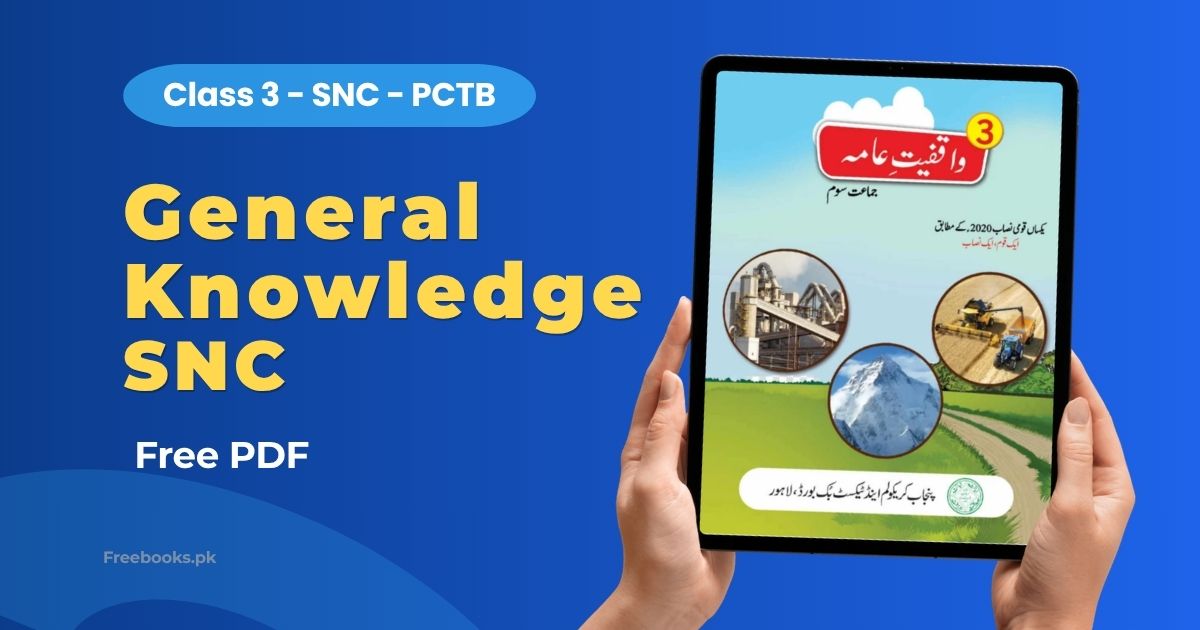
General Knowledge for Class 3 is part of the official Punjab Curriculum and Textbook Board (PCTB) syllabus, based on the Single National Curriculum (SNC) 2020. This page covers all 16 chapters of the book, from the sun and natural resources to national heroes, habitats, matter, energy, and safety.
For Class 3 students, this book links science, civics, and everyday life through simple activities and observations instead of long definitions. Each chapter summary and its important questions on this page make revision quicker before class tests, so key facts stay clear without re-reading the whole chapter.
Book Overview
| Class | 3 |
| Subject | General Knowledge |
| Board | Punjab Curriculum and Textbook Board (PCTB) |
| Curriculum | Single National Curriculum (SNC) 2020 |
| Total Chapters | 16 |
| Total Pages | 114 |
| Format | PDF (Free Download) |
Chapter List
Chapter 1: The Sun
This chapter explains that the earth spins on its axis from west to east, which is why the sun appears to rise in the east and set in the west, and that this spin also creates day and night. It teaches the four cardinal directions using the sun’s position, and covers how shadows form when light is blocked, why shadows point opposite to the light source, and how shadow length changes between morning, noon, and evening.
Important Questions:
- Why does the sun appear to rise in the east and set in the west? Answer: Because the earth spins on its axis from west to east.
- What are the four cardinal directions named in this chapter? Answer: East, west, north, and south.
- What is needed for a shadow to form? Answer: Light, and an opaque object blocking its path.
- When are shadows longest during the day, according to this chapter? Answer: In the morning and evening; shadows are shortest at noon.
Chapter 2: Resources and their Types
This chapter defines resources as things people use to meet their needs, and divides them into natural resources (water, forests, minerals), human resources (skills like farming or nursing), and capital resources (human-made things like machines and factories). It also introduces goods and services, buyers and sellers, why people depend on one another, scarcity when resources fall short of needs, and economic choice, picking a cheaper alternative when the preferred option is too costly or unavailable.
Important Questions:
- What are the three types of resources named in this chapter? Answer: Natural resources, human resources, and capital resources.
- What is the difference between goods and services, according to this chapter? Answer: Goods are physical items like bread or shoes, while services are tasks people do for others, like teaching or treating patients.
- What is scarcity, according to this chapter? Answer: A situation where resources, goods, or services fall short of people’s needs.
- What is an economic choice, and what example does the chapter give? Answer: Choosing a cheaper alternative when resources are limited, such as riding a bicycle instead of using expensive petrol.
Chapter 3: Conservation of Natural Resources
This chapter explains how human activities like deforestation, factory smoke, dirty water, and garbage change and pollute the natural environment, and lists ways to conserve resources such as using water and electricity carefully, planting trees, and treating wastewater. It also introduces endangered animals like the Indus dolphin, markhor, and snow leopard, which are at risk due to habitat loss and illegal hunting, along with extinct animals like the dinosaur and dodo bird, which have disappeared from the earth forever.
Important Questions:
- What is Pakistan’s national animal, mentioned in this chapter as an endangered species? Answer: The markhor.
- What is the difference between an endangered animal and an extinct animal, according to this chapter? Answer: An endangered animal’s numbers are dropping quickly, while an extinct animal’s species no longer exists anywhere in the world.
- What two main causes of environmental change does this chapter mention? Answer: Deforestation to meet the needs of a growing population, and smoke from factories and vehicles.
- Name one way this chapter suggests to conserve natural resources. Answer: Planting new trees to replace ones that are cut down.
Chapter 4: Quaid-e-Azam Muhammad Ali Jinnah
This chapter introduces Quaid-e-Azam Muhammad Ali Jinnah as the founder of Pakistan, covering his birth in Karachi on 25 December 1876, his legal education in England, his early political career with the Congress, and his 1940 Lahore Resolution demand for a separate homeland for Muslims, which led to the creation of Pakistan on 14 August 1947. It also covers his role as Pakistan’s first Governor-General, his vision for a strong and welfare-oriented Islamic state, and his death on 11 September 1948.
Important Questions:
- When was Quaid-e-Azam Muhammad Ali Jinnah born, and where? Answer: 25 December 1876, in Karachi.
- In which resolution did the Quaid-e-Azam demand a separate country for Muslims? Answer: The Lahore Resolution of 1940.
- What position did the Quaid-e-Azam hold after Pakistan came into being? Answer: He became Pakistan’s first Governor-General.
- What three principles did the Quaid-e-Azam give the nation, according to this chapter? Answer: Faith, unity, and discipline (Iman, Ittehad, Tanzeem).
Chapter 5: Allama Muhammad Iqbal
This chapter introduces Allama Muhammad Iqbal as Musawwir-e-Pakistan, the thinker who first presented the idea of a separate homeland for the Muslims of India. It covers his birth in Sialkot on 9 November 1877, his education in Lahore, England, and Germany, his title Shair-e-Mashriq (Poet of the East) for his Urdu and Persian poetry, his well-known poems for children such as Bachay Ki Dua, and his death on 21 April 1938, with his tomb located near the Badshahi Mosque in Lahore.
Important Questions:
- Why is Allama Iqbal called Musawwir-e-Pakistan? Answer: Because he first presented the idea of a separate country for the Muslims of India.
- What title was Allama Iqbal given for his poetry? Answer: Shair-e-Mashriq, meaning Poet of the East.
- Name one of Allama Iqbal’s poems for children mentioned in this chapter. Answer: Bachay Ki Dua (A Child’s Prayer).
- Where is Allama Iqbal’s tomb located? Answer: In Lahore, near the Badshahi Mosque.
Chapter 6: Changes in Living Things
This chapter explains the life cycle, the journey from birth to producing offspring of one’s own, and shows that some animals like lions and goats resemble their parents from birth while others like frogs and butterflies look completely different at first. It covers the life cycle stages of plants (seed, sprout, growth, flowering), birds (egg, hatchling, grown bird), insects (egg, larva, pupa, adult), and frogs (egg, tadpole, adult frog).
Important Questions:
- What is a life cycle, according to this chapter? Answer: The time from an organism’s birth to when it becomes able to produce offspring like itself.
- How many stages are in the life cycle of a plant? Answer: Four stages: sowing the seed, sprouting, growth, and flowering with new seeds.
- What are the stages in a frog’s life cycle? Answer: Egg, tadpole, and then a fully grown frog.
- Give an example of an animal that looks like its parents from birth. Answer: A lion, goat, or cat.
Chapter 7: Habitat
This chapter defines habitat as the natural place where living things get everything they need to survive, and divides habitats into land habitats, forests, deserts, and grasslands, and water habitats, fresh water, marine, coastal, and polar regions. It describes the animals and plants suited to each, such as camels in the desert, the blue whale in the ocean, and polar bears and penguins in polar regions, and explains that light, temperature, and water are the key factors that support life in any habitat.
Important Questions:
- What is a habitat, according to this chapter? Answer: The natural environment where a living thing finds everything it needs to survive.
- What are the two major types of habitat named in this chapter? Answer: Land habitat and water habitat.
- Which animal does this chapter say is the largest living thing in the world, and where does it live? Answer: The blue whale, which lives in the ocean.
- Name Pakistan’s three deserts mentioned in this chapter. Answer: Thar, Kharan, and Thal.
Chapter 8: Food
This chapter explains that plants make their own food through photosynthesis while animals depend on plants directly or indirectly, and divides animals by diet into herbivores, carnivores, and omnivores. It covers the basic food groups, fruits and vegetables, grains, dairy, meat, and dry fruit, explains what makes a balanced diet, and lists cleanliness, proper sleep, and regular exercise as the other key factors for healthy living.
Important Questions:
- What is the process by which plants make their own food called? Answer: Photosynthesis.
- What are the three groups animals are divided into based on diet? Answer: Herbivores (plant-eaters), carnivores (meat-eaters), and omnivores (both plants and meat).
- What is a balanced diet, according to this chapter? Answer: A diet that includes all the basic food groups, such as fruit, vegetables, grains, meat, and milk.
- Besides a balanced diet, what other factors does this chapter list for healthy living? Answer: Cleanliness, proper sleep, and regular exercise.
Chapter 9: The Role of the Government and Citizens
This chapter explains how people living and working together for mutual benefit form a community, and covers common problems like shortage of clean drinking water, lack of health and education facilities, and poor sewerage systems. It describes the government’s role in setting up institutions like schools, hospitals, and police to serve people’s needs, and lists the qualities of a good citizen, including honesty, respecting the law, taking responsibility, and respecting others’ rights.
Important Questions:
- What three basic problems does this chapter list for many areas? Answer: Shortage of clean drinking water, lack of health and education facilities, and a poor sewerage system.
- What institutions does this chapter say the government sets up to serve people? Answer: Schools, hospitals, police, post offices, and banks.
- Name two qualities of a good citizen listed in this chapter. Answer: Being honest and respecting the law (also: being responsible, caring for the environment, and respecting others’ rights).
- How can citizens help the government solve problems, according to this chapter? Answer: By cooperating with government institutions, such as following traffic rules or disposing of waste properly.
Chapter 10: Working out Disagreements
This chapter explains that disagreements are a normal part of daily life at home and school, and lists common causes such as not listening to others, not respecting opinions, and misunderstandings. It teaches a five-step problem-solving method for resolving conflict through calm discussion: stay calm, talk and listen, think of solutions, and choose the best one, stressing that getting angry only makes a disagreement worse.
Important Questions:
- Name two causes of disagreements listed in this chapter. Answer: Not listening carefully to others, and not respecting others’ opinions.
- What does this chapter say happens to a disagreement if we get angry? Answer: It increases instead of decreasing.
- What are the steps of the problem-solving method taught in this chapter? Answer: Calm down, talk and listen, think of solutions, and choose the best one.
- What should you do if you are not satisfied with a proposed solution, according to this chapter? Answer: Ask an elder or responsible adult for help resolving the issue.
Chapter 11: Matter
This chapter defines matter as anything that takes up space and has weight, and explains its three states: solid (fixed shape and volume), liquid (fixed volume but takes the shape of its container), and gas (no fixed shape or volume). It covers how matter changes state with temperature, using ice, water, and water vapour as an example, and introduces melting point and freezing point, noting that water freezes at 0°C.
Important Questions:
- What is matter, according to this chapter? Answer: Anything that takes up space and has weight.
- What are the three states of matter named in this chapter? Answer: Solid, liquid, and gas.
- What example does this chapter give of water in all three states of matter? Answer: Ice (solid), water (liquid), and water vapour (gas).
- At what temperature does water freeze, according to this chapter? Answer: 0°C.
Chapter 12: Energy and its Sources
This chapter explains that all devices need energy to work, and introduces the natural sources of energy: the sun (the largest source, called solar energy), flowing water used to generate electricity at dams like Tarbela and Mangla, air used in windmills, coal, natural gas, and crude oil. It explains how each source is used in daily life, from heating and cooking to running vehicles and generating electricity.
Important Questions:
- What is the largest natural source of energy, according to this chapter? Answer: The sun.
- What is the energy from the sun called? Answer: Solar energy.
- Name two dams in Pakistan mentioned in this chapter that generate electricity from flowing water. Answer: Tarbela and Mangla.
- List three natural sources of energy besides the sun, named in this chapter. Answer: Flowing water, air, coal, natural gas, or crude oil (any three).
Chapter 13: Changing World
This chapter compares life in ancient times, when people lived in caves and made tools from stone and animal bones, with life today, showing how learning to use fire, grow crops, and raise animals made life easier over time. It compares old and new schools, homes, and modes of transport through pictures, and credits the invention of money and the discovery of metals as major turning points in human progress.
Important Questions:
- Where did people live in ancient times, according to this chapter? Answer: In caves.
- What materials did ancient people use to make their tools? Answer: Stones and animal bones.
- What two discoveries does this chapter credit with opening the way for human progress? Answer: The invention of money and the discovery of metals.
- How does this chapter describe life today compared to the past? Answer: Much easier, more comfortable, and safer, as a result of continuous human effort.
Chapter 14: Inventions
This chapter defines an invention as something created that did not exist before, made to reduce effort and solve problems, going back to early tools like the bow and arrow that made hunting easier and safer. It highlights the computer, mobile phone, and internet as major modern inventions that have transformed education, communication, business, and daily life by making distant tasks and information instantly accessible.
Important Questions:
- What is an invention, according to this chapter? Answer: Something created that did not exist before.
- What term does this chapter use for a person who invents something new? Answer: An inventor.
- Name the three modern inventions highlighted in this chapter. Answer: The computer, the mobile phone, and the internet.
- What early invention made hunting easier and safer for ancient humans? Answer: The bow and arrow.
Chapter 15: Force and Machines
This chapter introduces tools as objects that make a specific task easier, and defines a simple machine as a device that changes the force applied to make work easier, listing the lever, wheel and axle, inclined plane, pulley, wedge, and screw. It explains push and pull as forces that can start, stop, speed up, slow down, or change the direction of an object’s motion, and compares old means of transport like the horse cart with modern engine-powered vehicles.
Important Questions:
- What is a simple machine, according to this chapter? Answer: A tool or device that changes the applied force to make work easier.
- Name the six types of simple machines listed in this chapter. Answer: Lever, wheel and axle, inclined plane, pulley, wedge, and screw.
- What effects can push and pull have on an object, according to this chapter? Answer: They can start, stop, speed up, slow down, or change the direction and shape of an object.
- What two benefits does this chapter say simple machines give us? Answer: More work can be done with less force, and in less time.
Chapter 16: Safety
This chapter covers indoor safety rules for electrical appliances, such as never touching bare wires or using switches with wet hands, and outdoor safety rules like crossing roads carefully and staying away from electric poles and lines. It also introduces natural disasters like earthquakes, floods, and cyclones, explaining that while they cannot be prevented their effects can be reduced, and gives personal safety advice such as not going out alone, staying away from strangers, and telling a parent or teacher right away if something feels wrong.
Important Questions:
- Name one indoor safety rule for electrical appliances given in this chapter. Answer: Never touch bare electrical wires (or: never use electrical switches with wet hands).
- What is a natural disaster, according to this chapter? Answer: A large-scale destructive event with no human cause, such as an earthquake, flood, or cyclone.
- Can natural disasters be prevented, according to this chapter? Answer: No, they cannot be prevented, but their effects can be reduced.
- What should a child do if they feel unsafe around a stranger, according to this chapter? Answer: Immediately tell their parents or teacher.
Download General Knowledge Class 3 SNC PDF
Click the button below to download the free PDF of General Knowledge Class 3 SNC for Punjab Board (PCTB).
Who Should Read This
This book is meant for Class 3 students studying under the Punjab Board (PCTB) SNC syllabus. Parents and tutors helping with homework or early exam preparation will also find the chapter summaries and important questions useful for quick revision.
Applicable Boards
This book is designed for the Punjab Curriculum and Textbook Board (PCTB). Since it follows the Single National Curriculum (SNC) 2020, students from other boards that have also adopted the SNC syllabus for Class 3 General Knowledge can use this book too.
FAQs
Is this General Knowledge book for Class 3 students only?
Yes, this book is designed for Class 3 students under the Punjab Board SNC 2020 syllabus.
Can other students use this book?
Yes, students from other boards following the SNC syllabus for Class 3 General Knowledge can also use it.
Is this the latest edition?
Yes, this is the latest SNC 2020 edition approved by the Punjab Curriculum and Textbook Board.
Does the PDF include all 16 chapters?
Yes, the PDF covers all 16 chapters of the book, from the sun and natural resources to safety and force and machines.
Is the download free?
Yes, the PDF download is completely free.
Does this book include exercises and questions?
Yes, each chapter includes exercises, and this page also lists important questions with short answers for quick revision.
Related Books
- Urdu Class 3 SNC PDF Download – Punjab Board (PCTB)
- English Class 3 SNC PDF Download – Punjab Board (PCTB)
- Mathematics Class 3 SNC PDF Download – Punjab Board (PCTB)
- Islamiat Class 3 SNC PDF Download – Punjab Board (PCTB)
- Ethics (Ikhlaqiat) Class 3 PDF Download – Punjab Board (PCTB)
Related Books
© Copyright Policy
Freebooks.pk is an educational resource for students in Pakistan. Textbooks and other books belong to their respective boards, authors and publishers, and all rights remain with them. If you are the copyright holder of any material on this page and want it changed or removed, please contact us or file a request under our DMCA policy. We review every request and remove reported content promptly.