
This chapter covers Electromagnetism from the 2nd Year (FSc Part-II) Physics syllabus of the Punjab Curriculum and Textbook Board (PTB/PCTB). It studies the magnetic field produced by a current, the force on a current-carrying conductor and on a moving charge, magnetic flux and flux density, Ampere’s law, the field of a solenoid, e/m of the electron, the cathode ray oscilloscope, torque on a coil and the galvanometer. These notes are prepared by freebooks.pk.
Electromagnetism links electricity and magnetism: a current produces a magnetic field, and a magnetic field exerts a force on a current. These ideas run the motors, meters and measuring instruments we use every day.
Learning Objectives
- Describe the magnetic field produced by a current.
- Find the force on a current-carrying conductor and on a moving charge.
- Define magnetic flux and flux density.
- State Ampere’s law and find the field of a solenoid.
- Describe the determination of e/m of an electron and the cathode ray oscilloscope.
- Find the torque on a current-carrying coil and explain the galvanometer.
Key Concepts
Magnetic Field of a Current
Oersted discovered that an electric current produces a magnetic field in the space around it: a compass needle placed near a current-carrying wire is deflected. The magnetic field around a long straight wire forms concentric circles whose direction is given by the right-hand rule (grip the wire with the thumb pointing along the current and the fingers curl in the direction of the field). This link between current and magnetism is the basis of all electromagnetism.
Force on a Current-Carrying Conductor
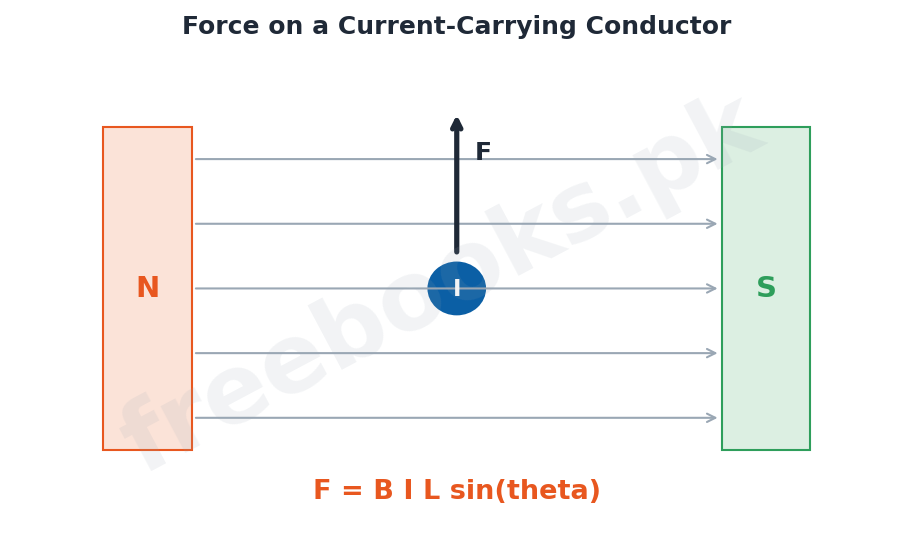
When a conductor carrying a current is placed in a magnetic field it experiences a force. The magnitude of this force is F = B I L sin theta, where B is the magnetic flux density, I the current, L the length of the conductor in the field and theta the angle between the conductor and the field. The force is greatest when the conductor is perpendicular to the field and zero when it is parallel. Its direction is given by the right-hand rule and is perpendicular to both the current and the field; this force drives electric motors.
Magnetic Flux and Flux Density
The magnetic flux density B (also called the magnetic induction) measures the strength of a magnetic field and has the unit tesla (T). The magnetic flux through an area is the product of the flux density and the area perpendicular to the field, Phi = B . A = B A cos theta, and is measured in webers. Flux density can be thought of as the number of field lines passing through unit area, so a stronger field has more closely packed lines.
Ampere’s Law and the Solenoid
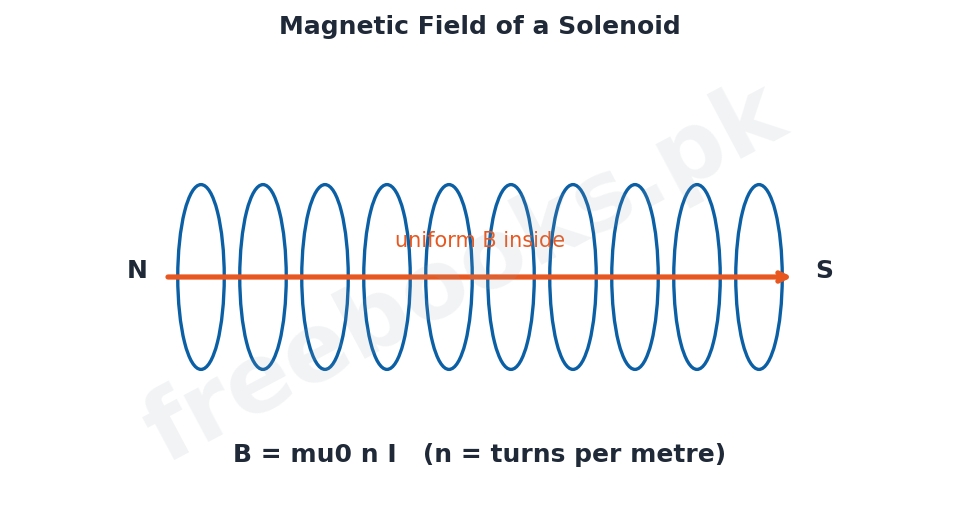
Ampere’s law provides a way of finding the magnetic field of symmetrical current distributions; it states that the sum of the product of the field and length element around a closed path equals mu0 times the current enclosed. Applying it to a long solenoid (a closely wound coil), the field inside is uniform and directed along the axis, B = mu0 n I, where n is the number of turns per unit length and I the current. A solenoid therefore behaves like a bar magnet and is the basis of the electromagnet.
Force on a Moving Charge
A charge moving through a magnetic field also experiences a force, F = q v B sin theta, where q is the charge, v its speed and theta the angle between the velocity and the field. The force is perpendicular to both the velocity and the field, so it changes the direction of motion but not the speed; a charged particle moving at right angles to a uniform field therefore travels in a circle. This principle is used in devices that control and measure charged particles.
Motion of a Charge in Fields; e/m of the Electron
In an electric field a charge experiences a force qE along the field, while in a magnetic field it experiences the force q v B perpendicular to its motion. By passing a beam of electrons through known electric and magnetic fields and balancing or measuring their deflection, the ratio of the charge to the mass of the electron, e/m, can be determined. This measurement, first made by J. J. Thomson, was an important step in establishing the properties of the electron.
Cathode Ray Oscilloscope
The cathode ray oscilloscope (CRO) is an instrument that displays how a voltage varies with time on a screen. An electron gun produces a fine beam of electrons which is deflected by voltages applied to two pairs of plates (horizontal and vertical) before striking a fluorescent screen, where it makes a bright spot. By feeding the signal to the vertical plates and a time-base to the horizontal plates, the CRO traces the waveform of the signal and can measure voltage, time and frequency.
Torque on a Coil and the Galvanometer
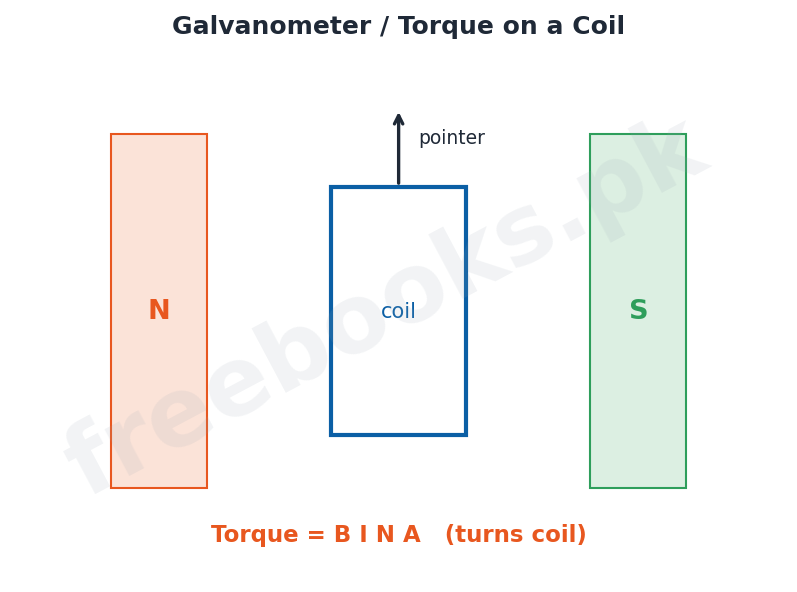
A current-carrying coil placed in a magnetic field experiences a torque that tends to rotate it, given by torque = B I N A, where N is the number of turns and A the area of the coil. This turning effect is used in the galvanometer, a sensitive instrument that detects and measures small currents: the coil rotates against a spring until the torque is balanced, and a pointer shows the current. A galvanometer can be converted into an ammeter by connecting a low resistance (shunt) in parallel, or into a voltmeter by connecting a high resistance in series.
Important Definitions
Magnetic flux density
The strength of a magnetic field, B, measured in tesla.
Magnetic flux
The product of flux density and perpendicular area, Phi = B A cos theta.
Ampere’s law
The sum of B times length around a closed path = mu0 times the current enclosed.
Tesla
The SI unit of magnetic flux density.
Force on a conductor
F = B I L sin theta on a current in a field.
Force on a moving charge
F = q v B sin theta on a charge moving in a field.
e/m of electron
The ratio of the charge to the mass of the electron.
Galvanometer
A sensitive instrument that detects and measures small currents.
Formulas & Rules
| Item | Fact |
|---|---|
| Force on a conductor | F = B I L sin theta |
| Force on a moving charge | F = q v B sin theta |
| Magnetic flux | Phi = B A cos theta |
| Field of a solenoid | B = mu0 n I |
| Torque on a coil | torque = B I N A |
| Ammeter from galvanometer | low shunt resistance in parallel |
| Voltmeter from galvanometer | high resistance in series |
Diagrams & Illustrations
Force on a conductor: a current-carrying conductor between the poles of a magnet, experiencing a force F = B I L sin theta perpendicular to both the current and the field.
Magnetic field of a solenoid: a solenoid carrying a current with a uniform magnetic field along its axis, B = mu0 n I, behaving like a bar magnet.
Galvanometer: a coil between the poles of a magnet experiencing a torque B I N A that rotates it against a spring, the principle of the galvanometer.
Solved Examples & Numericals
Force on a conductor
A wire of length 0.2 m carrying 5 A lies perpendicular to a field of 0.4 T. F = B I L = 0.4 x 5 x 0.2 = 0.4 N.
Force on a moving charge
An electron (q = 1.6×10^-19 C) moves at 2×10^6 m/s perpendicular to a 0.5 T field. F = q v B = 1.6×10^-19 x 2×10^6 x 0.5 = 1.6×10^-13 N.
Solenoid field
A solenoid has 1000 turns per metre and carries 2 A. B = mu0 n I = 4 pi x 10^-7 x 1000 x 2 = 2.5×10^-3 T.
Torque on a coil
A coil of 50 turns and area 0.01 m^2 carries 0.2 A in a 0.3 T field. Torque = B I N A = 0.3 x 0.2 x 50 x 0.01 = 0.03 N m.
Short Questions & Answers
What did Oersted discover?
That an electric current produces a magnetic field around it, deflecting a nearby compass needle.
Write the force on a current-carrying conductor.
F = B I L sin theta, perpendicular to both the current and the field.
Define magnetic flux density.
The strength of a magnetic field, B, measured in tesla; flux per unit perpendicular area.
Write the field inside a solenoid.
B = mu0 n I, where n is the number of turns per unit length and I the current.
Why does a magnetic force not change a charge’s speed?
Because it acts perpendicular to the velocity, so it changes only the direction of motion, not the speed.
How is a galvanometer converted into an ammeter?
By connecting a low resistance (shunt) in parallel with it.
Long Questions & Answers
Q1: Describe the force on a current-carrying conductor in a magnetic field and how it depends on the quantities involved.
When a conductor carrying an electric current is placed in a magnetic field, the moving charges in the conductor experience forces, and their combined effect is a force on the whole conductor. Experiment shows that the magnitude of this force is F = B I L sin theta, where B is the magnetic flux density of the field, I is the current in the conductor, L is the length of the conductor lying in the field and theta is the angle between the direction of the current and the direction of the field. The force is therefore directly proportional to the flux density, the current and the length, and depends on the orientation through sin theta: it is a maximum when the conductor is perpendicular to the field (theta = 90 degrees) and zero when it is parallel to the field (theta = 0). The direction of the force is perpendicular to the plane containing both the current and the field and is found using the right-hand rule. This force is the operating principle of the electric motor, in which a current-carrying coil in a magnetic field is made to rotate, and of moving-coil meters.
Q2: State Ampere’s law and use it to describe the magnetic field of a solenoid, and explain its uses.
Ampere’s law is a general relation for the magnetic field produced by currents; it states that when we take the sum of the product of the magnetic field and the small length element along any closed path, the result equals mu0 (the permeability of free space) times the total current enclosed by that path. This law is especially useful for current distributions that have symmetry, because it lets us find the field without adding up the contributions of each part of the current. Applying it to a long solenoid, which is a wire wound into a large number of closely spaced turns, shows that the magnetic field inside the solenoid is uniform, directed along the axis, and given by B = mu0 n I, where n is the number of turns per unit length and I the current; the field outside a long solenoid is very weak. A solenoid therefore behaves like a bar magnet, with a north pole at one end and a south pole at the other, and forms the basis of the electromagnet. Electromagnets made from solenoids are used in relays, electric bells, cranes for lifting scrap iron and in many other devices, and the strength of the field can be controlled simply by changing the current.
Q3: Explain the torque on a current-carrying coil and describe the galvanometer and its adaptation into an ammeter and voltmeter.
When a coil carrying a current is placed in a magnetic field, the two sides of the coil that are perpendicular to the field carry currents in opposite directions and therefore experience equal and opposite forces; these forces form a couple that produces a torque tending to rotate the coil. The magnitude of this torque is torque = B I N A, where B is the flux density, I the current, N the number of turns and A the area of the coil, so a coil with many turns and a large area gives a large turning effect. This is the principle of the moving-coil galvanometer, a sensitive instrument used to detect and measure small currents: the coil is pivoted between the poles of a magnet and rotates until the magnetic torque is balanced by the restoring torque of a spring, and a pointer attached to the coil moves over a scale to indicate the current. A galvanometer can be adapted to measure larger currents by connecting a small resistance, called a shunt, in parallel with it so that most of the current bypasses the coil; it then acts as an ammeter. It can be adapted to measure potential difference by connecting a high resistance in series with it, so that only a small current flows for a given voltage; it then acts as a voltmeter. In this way a single basic instrument becomes the heart of the multi-purpose AVO meter.
MCQs with Answers
A current produces around it a: (a) gravitational field (b) magnetic field (c) sound field (d) no field
Correct Answer: (b) magnetic field.
The force on a conductor is: (a) B I L sin theta (b) B I L tan theta (c) B/(I L) (d) I L / B
Correct Answer: (a) B I L sin theta.
The SI unit of magnetic flux density is the: (a) weber (b) tesla (c) henry (d) farad
Correct Answer: (b) tesla.
Magnetic flux is: (a) B A cos theta (b) B/A (c) A/B (d) B A tan theta
Correct Answer: (a) B A cos theta.
The field inside a long solenoid is: (a) zero (b) mu0 n I (c) mu0 I/n (d) n I/mu0
Correct Answer: (b) mu0 n I.
The force on a moving charge is: (a) q v B sin theta (b) q/vB (c) vB/q (d) q + v + B
Correct Answer: (a) q v B sin theta.
A magnetic force on a charge changes its: (a) speed (b) direction (c) mass (d) charge
Correct Answer: (b) direction.
The torque on a coil is: (a) B I N A (b) B I/N A (c) N A/B I (d) B/(I N A)
Correct Answer: (a) B I N A.
A galvanometer becomes an ammeter with a: (a) high series R (b) low parallel shunt (c) capacitor (d) diode
Correct Answer: (b) low parallel shunt.
A galvanometer becomes a voltmeter with a: (a) low parallel R (b) high series R (c) shunt (d) inductor
Correct Answer: (b) high series R.
Quick Revision Summary
- Oersted: current produces a magnetic field (right-hand rule).
- Force on conductor F = B I L sin theta; drives motors.
- Flux density B (tesla); flux Phi = B A cos theta (weber).
- Ampere’s law -> solenoid field B = mu0 n I (like a bar magnet).
- Force on moving charge F = q v B sin theta (perpendicular; circular path).
- Torque on coil = B I N A; galvanometer -> ammeter (shunt) or voltmeter (series R). Notes by freebooks.pk.
Exam Tips
- Remember Oersted’s discovery links current and magnetism.
- Learn F = B I L sin theta and F = q v B sin theta and when each is maximum/zero.
- State units: tesla (B) and weber (flux).
- Memorise B = mu0 n I for a solenoid.
- Torque on a coil = B I N A.
- Know how a galvanometer is converted to an ammeter and a voltmeter.