
This chapter covers Electrostatics from the 2nd Year (FSc Part-II) Physics syllabus of the Punjab Curriculum and Textbook Board (PTB/PCTB). It studies Coulomb’s law, the electric field and field lines, electric flux and Gauss’s law, electric potential, capacitors and the energy stored in them. These notes are prepared by freebooks.pk.
Electrostatics is the study of electric charges at rest and the forces, fields and potentials they produce. The same electric force holds atoms and molecules together, so it underlies all of matter.
Learning Objectives
- State and apply Coulomb’s law.
- Describe the electric field and electric field lines.
- Define electric flux and state Gauss’s law with its applications.
- Define electric potential and relate it to the electric field.
- Explain capacitance and the parallel-plate capacitor.
- Find the energy stored in a capacitor and describe charging through a resistor.
Key Concepts
Coulomb’s Law
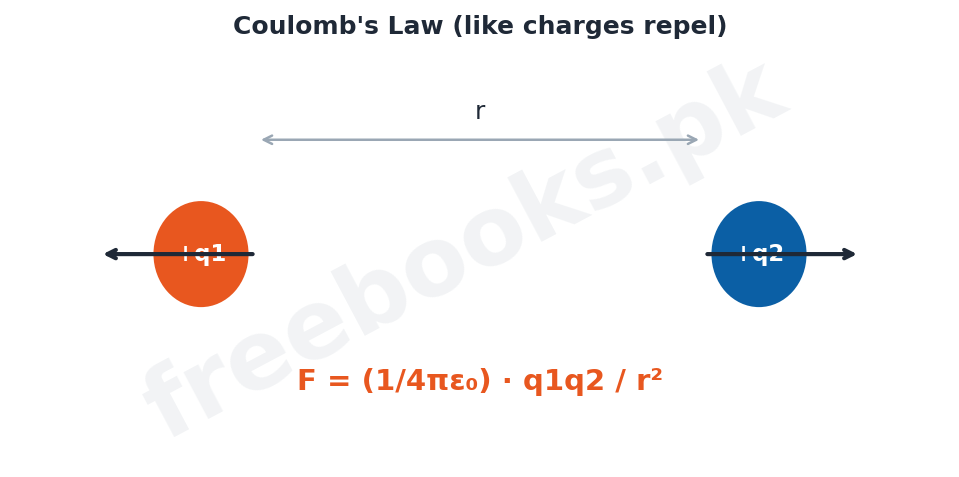
Coulomb’s law states that the electrostatic force between two point charges is directly proportional to the product of the magnitudes of the charges and inversely proportional to the square of the distance between them, F = (1/4 pi epsilon0) q1 q2 / r^2, where epsilon0 is the permittivity of free space. The force acts along the line joining the charges: like charges repel and unlike charges attract. In a medium other than vacuum the force is reduced by a factor equal to the relative permittivity (dielectric constant) of the medium.
Electric Field and Field Lines
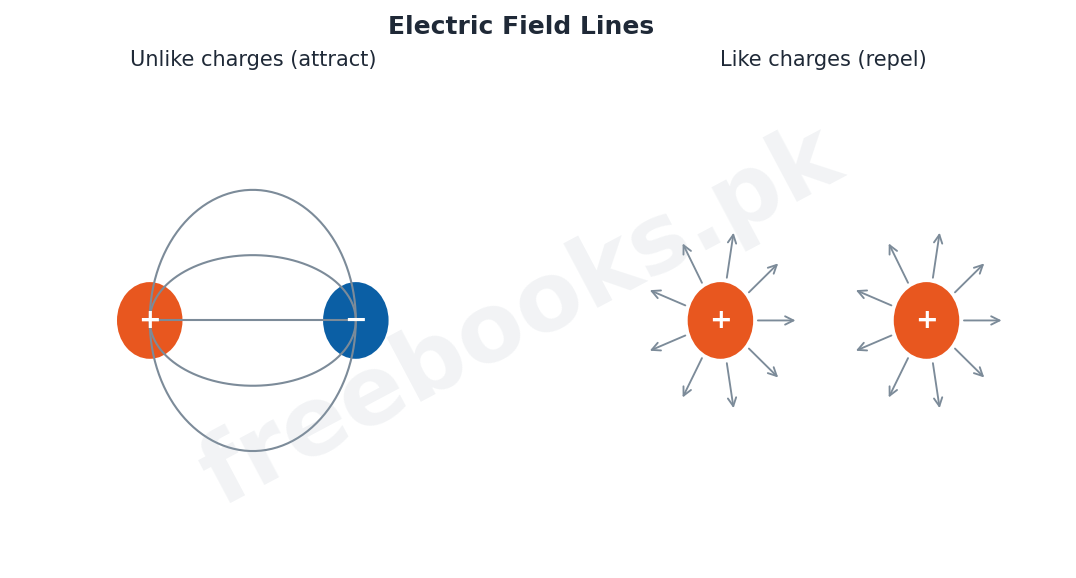
A charge sets up an electric field in the space around it, and any other charge placed in that field experiences a force. The electric field intensity E at a point is the force per unit positive charge placed at that point, E = F/q, a vector directed away from a positive charge and towards a negative one. Electric field lines are imaginary lines drawn so that the tangent at any point gives the direction of the field; they start on positive charges and end on negative charges, and where they are closer together the field is stronger.
Electric Flux and Gauss’s Law
Electric flux is the number of field lines passing through an area, given by Phi = E . A = E A cos theta, where theta is the angle between the field and the normal to the surface. Gauss’s law states that the total electric flux through any closed surface is 1/epsilon0 times the total charge enclosed by the surface, Phi = Q/epsilon0. Gauss’s law makes it easy to find the field for symmetrical charge distributions; for example the field between two oppositely charged parallel plates is E = sigma/epsilon0, where sigma is the surface charge density.
Electric Potential
The electric potential at a point is the work done in bringing a unit positive charge from infinity to that point against the electric field, V = W/q, measured in volts. The potential due to a point charge q at distance r is V = (1/4 pi epsilon0) q/r. The electric field is related to the potential by E = -delta V / delta r, that is, the field points in the direction of decreasing potential and equals the negative of the potential gradient. A convenient small unit of energy is the electron volt (eV), the energy gained by an electron moving through a potential difference of one volt (1 eV = 1.6 x 10^-19 J).
Capacitors and Capacitance
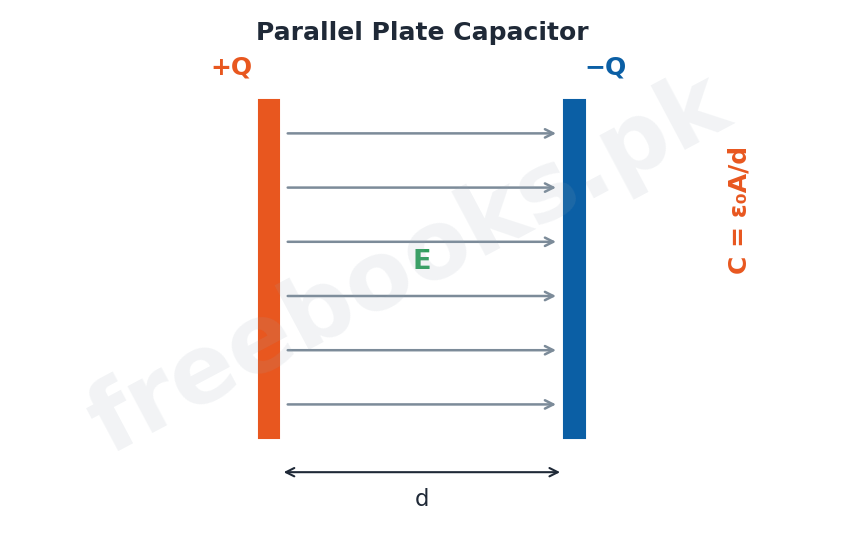
A capacitor is a device that stores electric charge and energy; it consists of two conductors separated by an insulator. The capacitance is the charge stored per unit potential difference, C = Q/V, measured in farads. For a parallel-plate capacitor with plate area A and separation d, C = epsilon0 A / d in vacuum. Placing a dielectric (insulator) between the plates increases the capacitance, because the dielectric becomes polarised and partly cancels the field; the capacitance increases by the factor of the dielectric constant.
Energy Stored and Charging a Capacitor
A charged capacitor stores energy in the electric field between its plates, given by E = (1/2) C V^2 = (1/2) Q V = Q^2 / (2C). When a capacitor is charged through a resistor R, the charge does not build up instantly but grows gradually; the product RC is called the time constant and measures how quickly the capacitor charges or discharges. After a time equal to the time constant the capacitor reaches about 63% of its final charge.
Important Definitions
Coulomb’s law
The force between two point charges is proportional to q1q2 and inversely to r^2.
Electric field intensity
The force per unit positive charge at a point, E = F/q.
Electric field lines
Imaginary lines whose tangent gives the direction of the field.
Electric flux
The number of field lines through an area, Phi = E A cos theta.
Gauss’s law
Total flux through a closed surface = Q/epsilon0.
Electric potential
Work done in bringing a unit positive charge from infinity to a point, V = W/q.
Capacitance
The charge stored per unit potential difference, C = Q/V.
Time constant
The product RC, the time for a capacitor to reach ~63% of final charge.
Formulas & Rules
| Item | Fact |
|---|---|
| Coulomb’s law | F = (1/4 pi epsilon0) q1 q2 / r^2 |
| Electric field intensity | E = F/q |
| Electric flux | Phi = E A cos theta |
| Gauss’s law | Phi = Q / epsilon0 |
| Field between parallel plates | E = sigma / epsilon0 |
| Potential due to point charge | V = (1/4 pi epsilon0) q / r |
| Parallel-plate capacitance | C = epsilon0 A / d |
| Energy stored | E = (1/2) C V^2 |
Diagrams & Illustrations
Coulomb’s law: two point charges with the electrostatic forces of repulsion acting along the line joining them, separated by a distance r.
Electric field lines: field lines for a pair of unlike charges (attracting) and a pair of like charges (repelling).
Parallel plate capacitor: a parallel-plate capacitor with charges +Q and -Q on the plates, a uniform field E between them and separation d.
Solved Examples & Numericals
Coulomb’s law
Two charges of 2 x 10^-6 C and 3 x 10^-6 C are 0.1 m apart. F = 9×10^9 x (2×10^-6 x 3×10^-6)/(0.1)^2 = 9×10^9 x 6×10^-12 / 0.01 = 5.4 N.
Electric field
A charge of 5 x 10^-6 C experiences a force of 0.2 N in a field. The field intensity is E = F/q = 0.2 / 5×10^-6 = 4 x 10^4 N/C.
Capacitance
A capacitor stores 6 x 10^-6 C at 3 V. Its capacitance is C = Q/V = 6×10^-6 / 3 = 2 x 10^-6 F = 2 microfarad.
Energy stored
A 2 microfarad capacitor charged to 100 V stores E = (1/2) C V^2 = 0.5 x 2×10^-6 x (100)^2 = 0.01 J.
Short Questions & Answers
State Coulomb’s law.
The force between two point charges is proportional to the product of the charges and inversely proportional to the square of the distance, F = (1/4 pi epsilon0) q1 q2 / r^2.
Define electric field intensity.
The force per unit positive charge placed at a point, E = F/q; a vector quantity.
State Gauss’s law.
The total electric flux through any closed surface equals 1/epsilon0 times the charge enclosed.
What is electric potential?
The work done in bringing a unit positive charge from infinity to a point against the field, V = W/q.
Define capacitance.
The charge stored per unit potential difference, C = Q/V, measured in farads.
How does a dielectric affect capacitance?
It increases the capacitance, because the polarised dielectric partly cancels the field between the plates.
Long Questions & Answers
Q1: State Coulomb’s law and explain the electric field and electric field lines.
Coulomb’s law describes the force between two stationary point charges. It states that this electrostatic force is directly proportional to the product of the magnitudes of the two charges and inversely proportional to the square of the distance between them, so that F = (1/4 pi epsilon0) q1 q2 / r^2, where epsilon0 is the permittivity of free space. The force acts along the straight line joining the charges; like charges (both positive or both negative) repel one another while unlike charges attract. To explain how one charge exerts a force on another without touching it, we use the idea of an electric field: every charge sets up a field in the space around it, and a second charge placed in this field feels a force. The strength of the field, called the electric field intensity, is the force per unit positive charge, E = F/q, and points away from a positive charge and towards a negative one. The field can be pictured using electric field lines, imaginary lines drawn so that the tangent to a line at any point gives the direction of the field there. These lines begin on positive charges and end on negative charges, never cross, and are drawn closer together where the field is stronger, giving a clear picture of both the direction and the strength of the field.
Q2: Define electric flux and state Gauss’s law, and use it to find the field between parallel plates.
Electric flux measures the number of electric field lines passing through a given area. For a uniform field E passing through a flat area A, the flux is Phi = E . A = E A cos theta, where theta is the angle between the field lines and the normal (perpendicular) to the surface; the flux is greatest when the field is perpendicular to the surface and zero when it is parallel. Gauss’s law relates the total flux through a closed surface to the charge inside it: the total electric flux through any closed surface equals 1/epsilon0 times the net charge enclosed by that surface, Phi = Q/epsilon0. This law is very powerful for charge distributions with symmetry, because it lets us find the field without adding up the contributions of individual charges. Applying it to two large, oppositely charged parallel plates, we find that the field between the plates is uniform and equal to E = sigma/epsilon0, where sigma is the surface charge density (charge per unit area) on the plates. This uniform field is the basis of the parallel-plate capacitor.
Q3: Explain capacitance, derive the capacitance of a parallel-plate capacitor and find the energy stored in a capacitor.
A capacitor is a device for storing electric charge and energy, made of two conductors separated by an insulator. When connected to a battery, equal and opposite charges appear on the two conductors and a potential difference is set up between them. The capacitance is defined as the amount of charge stored per unit potential difference, C = Q/V, and is measured in farads. For a parallel-plate capacitor the plates have area A and are separated by a distance d; the uniform field between them is E = sigma/epsilon0 and the potential difference is V = E d, which on combining with C = Q/V gives the capacitance in vacuum as C = epsilon0 A / d. Thus the capacitance is larger for bigger plates and smaller separation. If a dielectric is inserted between the plates it becomes polarised and reduces the field, so the same charge is held at a lower voltage and the capacitance rises by the dielectric constant. A charged capacitor stores energy in the electric field between its plates; by considering the work done in charging it, this energy is found to be E = (1/2) C V^2, which can also be written as (1/2) Q V or Q^2/(2C). This stored energy is released when the capacitor is discharged.
MCQs with Answers
The force between two point charges varies as: (a) 1/r (b) 1/r^2 (c) r (d) r^2
Correct Answer: (b) 1/r^2.
Electric field intensity is: (a) q/F (b) F/q (c) F q (d) F + q
Correct Answer: (b) F/q.
The SI unit of capacitance is the: (a) volt (b) coulomb (c) farad (d) joule
Correct Answer: (c) farad.
Electric flux is given by: (a) E A cos theta (b) E/A (c) A/E (d) E A tan theta
Correct Answer: (a) E A cos theta.
Gauss’s law gives total flux = (a) Q epsilon0 (b) Q/epsilon0 (c) epsilon0/Q (d) Q^2
Correct Answer: (b) Q/epsilon0.
The field inside a hollow charged sphere is: (a) maximum (b) zero (c) infinite (d) negative
Correct Answer: (b) zero.
Electric potential is measured in: (a) newton (b) volt (c) farad (d) tesla
Correct Answer: (b) volt.
The capacitance of a parallel-plate capacitor is: (a) epsilon0 A/d (b) epsilon0 d/A (c) A d/epsilon0 (d) epsilon0 A d
Correct Answer: (a) epsilon0 A/d.
Energy stored in a capacitor is: (a) C V (b) (1/2) C V^2 (c) C V^2 (d) Q/V
Correct Answer: (b) (1/2) C V^2.
A dielectric between the plates ___ the capacitance: (a) decreases (b) increases (c) zeroes (d) reverses
Correct Answer: (b) increases.
Quick Revision Summary
- Coulomb’s law: F = (1/4 pi epsilon0) q1 q2 / r^2; like repel, unlike attract.
- Electric field E = F/q; field lines start on + and end on – charges.
- Electric flux Phi = E A cos theta; Gauss’s law: flux = Q/epsilon0.
- Field between parallel plates E = sigma/epsilon0; inside hollow sphere E = 0.
- Potential V = W/q; point charge V = (1/4 pi epsilon0) q/r; E = -delta V/delta r.
- Capacitor: C = Q/V; parallel plate C = epsilon0 A/d; energy = (1/2) C V^2; time constant RC. Notes by freebooks.pk.
Exam Tips
- Write Coulomb’s law with the constant 1/4 pi epsilon0.
- Remember E = F/q and its direction rules.
- State Gauss’s law as flux = Q/epsilon0.
- Learn E = sigma/epsilon0 for parallel plates.
- Memorise C = epsilon0 A/d and energy = (1/2) C V^2.
- Know that a dielectric increases capacitance and that RC is the time constant.