This chapter covers Physical Optics from the 1st Year (FSc Part-I) Physics syllabus of the Punjab Curriculum and Textbook Board (PTB/PCTB). It treats the wave nature of light, Huygens principle, interference (Young’s double-slit experiment), diffraction, the diffraction grating and polarisation. These notes are prepared by freebooks.pk.
Physical optics explains those properties of light that only make sense if light behaves as a wave, such as interference and diffraction, which cannot be explained by treating light merely as rays.
Learning Objectives
- State Huygens principle and the concept of a wavefront.
- Explain interference of light and Young’s double-slit experiment.
- Describe diffraction and the diffraction grating.
- Use d sin(theta) = n lambda for a grating.
- Explain polarisation and what it tells us about light.
Key Concepts
Wavefronts and Huygens Principle
A wavefront is a surface joining all points of a wave that are in the same phase (for example all the crests). Huygens principle states that every point on a wavefront may be regarded as a source of secondary wavelets, and the new wavefront a moment later is the surface that touches all these wavelets. This idea explains how waves travel and how they reflect and refract.
Interference of Light
Interference is the superposition of two light waves. To see steady interference the two sources must be coherent, meaning they have the same frequency and a constant phase difference; in practice this is achieved by taking the two waves from a single source. Where the waves meet in phase they reinforce to give a bright region (constructive interference) and where they meet out of phase they cancel to give a dark region (destructive interference).
Young’s Double-Slit Experiment
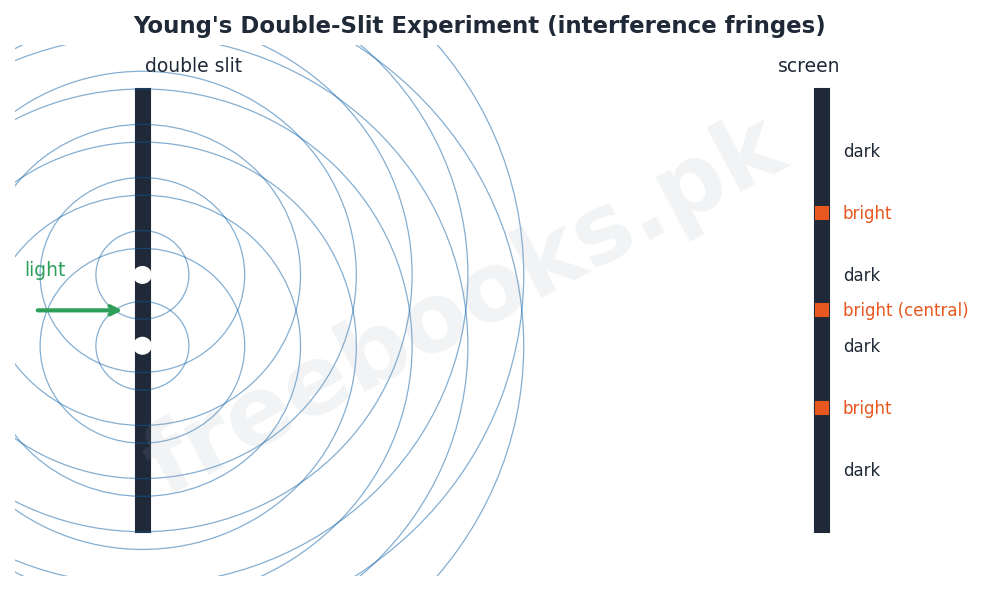
In Young’s experiment light from a single source passes through two narrow, closely spaced slits. The two slits act as coherent sources, and the light spreading from them overlaps to produce a pattern of alternate bright and dark bands, called interference fringes, on a screen. This experiment was historic evidence that light is a wave. The spacing of the fringes depends on the wavelength of the light, the separation of the slits and the distance to the screen.
Diffraction of Light
Diffraction is the bending or spreading of light as it passes the edge of an obstacle or through a narrow opening. It becomes noticeable when the size of the opening is comparable with the wavelength of the light. Diffraction, like interference, is a property that only waves show, and it confirms the wave nature of light.
The Diffraction Grating
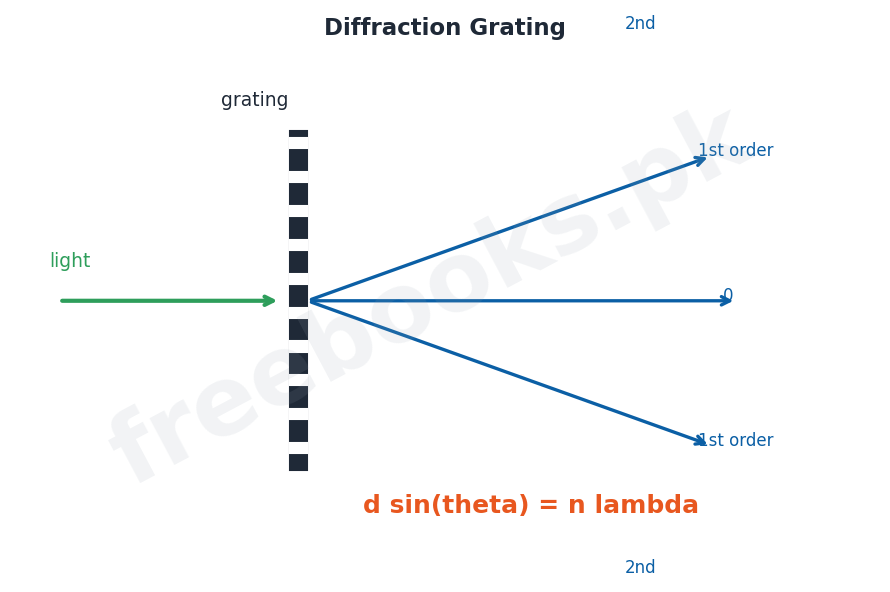
A diffraction grating is a plate ruled with a very large number of equally spaced parallel slits (lines). When light passes through it, the many slits produce sharp, bright beams in particular directions given by d sin(theta) = n lambda, where d is the spacing between the slits (the grating element), theta the angle of the beam, n the order and lambda the wavelength. Because different wavelengths are sent in different directions, a grating spreads white light into its spectrum and is used to measure wavelengths accurately.
Polarisation
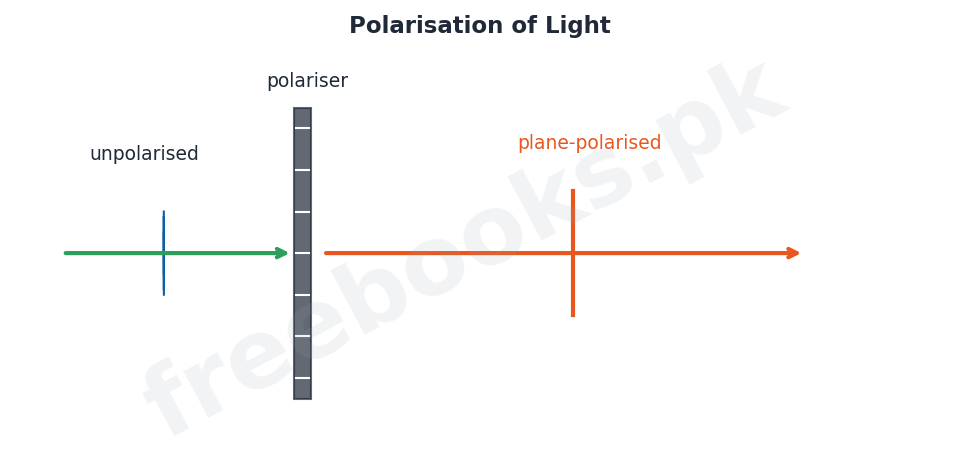
In an ordinary beam of light the vibrations of the electric field occur in all directions perpendicular to the direction of travel; such light is unpolarised. When the vibrations are confined to a single plane the light is said to be plane-polarised. Light can be polarised by passing it through a polarising material (such as Polaroid) or by reflection. The fact that light can be polarised proves that it is a transverse wave, because only transverse waves can be polarised.
Important Definitions
Wavefront
A surface joining all points of a wave that are in the same phase.
Huygens principle
Every point on a wavefront acts as a source of secondary wavelets.
Coherent sources
Sources of the same frequency with a constant phase difference.
Interference
The superposition of two light waves giving bright and dark regions.
Diffraction
The bending or spreading of light around edges or through narrow openings.
Diffraction grating
A plate with many equally spaced parallel slits used to disperse light.
Polarisation
Restriction of the vibrations of light to a single plane.
Plane-polarised light
Light whose vibrations are confined to one plane.
Formulas & Rules
| Item | Fact |
|---|---|
| Grating equation | d sin(theta) = n lambda |
| Grating element | d = 1 / (lines per metre) |
| Constructive interference | path difference = n lambda |
| Destructive interference | path difference = (n + 1/2) lambda |
Diagrams & Illustrations
Young’s double-slit experiment: light from a single source passing through two slits and forming alternate bright and dark interference fringes on a screen.
Diffraction grating: a diffraction grating splitting an incoming beam into several sharp orders at angles given by d sin(theta) = n lambda.
Polarisation of light: unpolarised light passing through a polariser and emerging as plane-polarised light vibrating in a single plane.
Solved Examples & Numericals
Grating equation
A grating with 5000 lines per cm has d = 1/(5000 x 100) m = 2 x 10^-6 m. For first-order (n=1) light of wavelength 5 x 10^-7 m, sin(theta) = n lambda / d = 5×10^-7 / 2×10^-6 = 0.25, so theta = 14.5 degrees.
Grating element
A grating has 2000 lines per centimetre. Its grating element is d = 1/2000 cm = 5 x 10^-4 cm = 5 x 10^-6 m.
Order of spectrum
Using d sin(theta) = n lambda, as n increases the angle theta increases, so higher orders are diffracted through larger angles.
Coherence
Two independent bulbs cannot produce steady interference because they are not coherent; that is why Young’s experiment uses a single source split into two.
Short Questions & Answers
What is a wavefront?
A surface joining all points of a wave that are in the same phase.
State Huygens principle.
Every point on a wavefront acts as a source of secondary wavelets, and the new wavefront is the surface touching all the wavelets.
What are coherent sources?
Sources that have the same frequency and a constant phase difference.
What is diffraction?
The bending or spreading of light as it passes an edge or a narrow opening.
Write the grating equation.
d sin(theta) = n lambda, where d is the grating element, theta the angle, n the order and lambda the wavelength.
What does polarisation prove about light?
That light is a transverse wave, since only transverse waves can be polarised.
Long Questions & Answers
Q1: Describe Young’s double-slit experiment and explain how it demonstrates the wave nature of light.
In Young’s double-slit experiment light from a single monochromatic source is first passed through a single narrow slit and then through two very narrow, closely spaced slits placed side by side. Because both sets of waves come from the same original source, the two slits behave as coherent sources, that is, they emit waves of the same frequency with a constant phase difference. The light spreading out from the two slits overlaps in the region beyond them and, by the principle of superposition, produces interference. On a screen placed in this region a pattern of equally spaced bright and dark bands, called interference fringes, is seen: bright fringes appear where the waves from the two slits arrive in phase (path difference a whole number of wavelengths, n lambda) and dark fringes appear where they arrive exactly out of phase (path difference (n + 1/2) lambda). Such a steady pattern of alternate bright and dark bands can only be explained if light travels as a wave; a stream of particles could not cancel out to give darkness. The experiment was therefore historic evidence for the wave nature of light, and measuring the fringe spacing allows the wavelength of the light to be found.
Q2: What is a diffraction grating? State its equation and describe its uses.
A diffraction grating is an optical plate on which a very large number of equally spaced, parallel slits (or lines) have been ruled, often several thousand per centimetre. When a parallel beam of light falls on the grating, each slit diffracts the light, and the many diffracted beams interfere. Reinforcement occurs only in certain sharply defined directions where the path difference between light from adjacent slits is a whole number of wavelengths, giving the grating equation d sin(theta) = n lambda, where d is the distance between the centres of neighbouring slits (the grating element), theta is the angle at which a bright beam is seen, n is the order of the spectrum (0, 1, 2, …) and lambda is the wavelength. Because the angle depends on the wavelength, light of different colours is sent in different directions, so a grating spreads white light into a spectrum. Gratings are widely used in spectrometers to measure wavelengths very accurately and to study the composition of light from different sources.
Q3: Explain polarisation of light and describe how it shows that light is a transverse wave.
In an ordinary beam of light the electric-field vibrations take place in all possible directions at right angles to the direction in which the light travels; such light is said to be unpolarised. If, by some means, these vibrations are restricted so that they occur in only one plane, the light is called plane-polarised. Light can be polarised in several ways, the simplest being to pass it through a sheet of polarising material such as Polaroid, which transmits only the vibrations parallel to a particular direction and absorbs the rest; light can also be partly polarised by reflection from a surface such as water or glass. The crucial point is that polarisation is only possible for transverse waves, in which the vibrations are perpendicular to the direction of travel and so can be confined to a plane; longitudinal waves such as sound, whose vibrations are along the direction of travel, cannot be polarised. The fact that light can be polarised is therefore direct experimental proof that light is a transverse wave. Polarising materials are used in sunglasses and camera filters to cut down glare.
MCQs with Answers
A surface of points in the same phase is a: (a) ray (b) wavefront (c) node (d) fringe
Correct Answer: (b) wavefront.
Sources with a constant phase difference are: (a) coherent (b) incoherent (c) polarised (d) diffracted
Correct Answer: (a) coherent.
Young’s experiment demonstrates the ___ of light: (a) particle nature (b) wave nature (c) speed (d) colour
Correct Answer: (b) wave nature.
Bright fringes occur where the path difference is: (a) (n+1/2) lambda (b) n lambda (c) lambda/4 (d) zero only
Correct Answer: (b) n lambda.
The bending of light around edges is: (a) reflection (b) refraction (c) diffraction (d) dispersion
Correct Answer: (c) diffraction.
The grating equation is: (a) d sin(theta) = n lambda (b) n d = lambda (c) d = n lambda tan (d) lambda = d cos
Correct Answer: (a) d sin(theta) = n lambda.
Polarisation proves light is a ___ wave: (a) longitudinal (b) transverse (c) stationary (d) sound
Correct Answer: (b) transverse.
Which cannot be polarised? (a) light (b) radio waves (c) sound (d) X-rays
Correct Answer: (c) sound (longitudinal).
A diffraction grating is used to measure: (a) mass (b) wavelength (c) current (d) temperature
Correct Answer: (b) wavelength.
Ordinary light is: (a) polarised (b) unpolarised (c) coherent (d) monochromatic
Correct Answer: (b) unpolarised.
Quick Revision Summary
- Wavefront = points in same phase; Huygens: each point emits secondary wavelets.
- Interference needs coherent sources; bright at n lambda, dark at (n+1/2) lambda.
- Young’s double slit = proof of wave nature of light (fringes).
- Diffraction = bending around edges/openings ~ wavelength size.
- Grating: d sin(theta) = n lambda; disperses light, measures wavelength.
- Polarisation proves light is transverse; sound cannot be polarised. Notes by freebooks.pk.
Exam Tips
- Define wavefront and state Huygens principle.
- Explain why interference needs coherent sources.
- Remember bright = n lambda, dark = (n+1/2) lambda.
- Memorise the grating equation d sin(theta) = n lambda.
- State that polarisation proves light is transverse.
- Give a practical use of polarisation (sunglasses).