This chapter covers Optical Instruments from the 1st Year (FSc Part-I) Physics syllabus of the Punjab Curriculum and Textbook Board (PTB/PCTB). It explains magnifying power, the simple and compound microscope, the astronomical telescope, resolving power and the optical fibre. These notes are prepared by freebooks.pk.
Optical instruments use lenses (and total internal reflection) to help us see things that are too small or too far away for the unaided eye. This chapter explains how the common ones work.
Learning Objectives
- Define least distance of distinct vision and magnifying power.
- Explain the working of a simple and a compound microscope.
- Explain the working of an astronomical telescope.
- State what is meant by resolving power.
- Describe the optical fibre and total internal reflection.
Key Concepts
Magnifying Power and Least Distance of Distinct Vision
The least distance of distinct vision is the closest distance at which a normal eye can see an object clearly without strain, taken as 25 cm. The magnifying power (or angular magnification) of an instrument is the ratio of the angle subtended at the eye by the image seen through the instrument to the angle subtended by the object when placed at the least distance of distinct vision. It tells us how much larger an object appears through the instrument.
The Simple Microscope
A simple microscope, or magnifying glass, is a single convex lens of short focal length. When an object is placed inside the focal length of the lens, the lens forms an enlarged, erect, virtual image on the same side as the object. Its magnifying power is M = 1 + d/f, where d = 25 cm is the least distance of distinct vision and f is the focal length of the lens; a shorter focal length gives a greater magnification.
The Compound Microscope
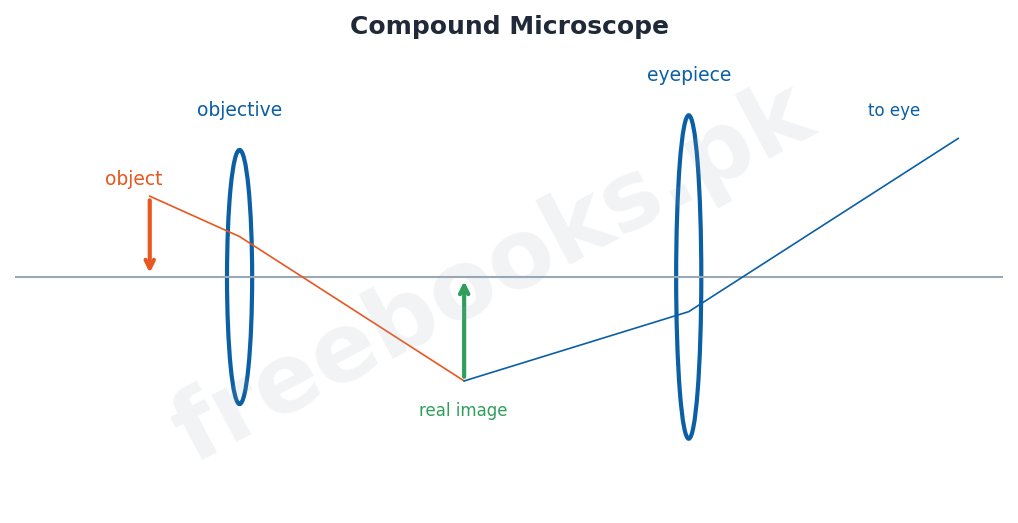
A compound microscope uses two convex lenses: an objective of very short focal length near the object and an eyepiece near the eye. The objective forms a real, magnified image of the object, and the eyepiece then acts as a magnifying glass to further enlarge this image, producing a large, virtual final image. Because the magnification takes place in two stages, a compound microscope gives much greater magnification than a simple one and is used to view tiny objects such as cells.
The Astronomical Telescope
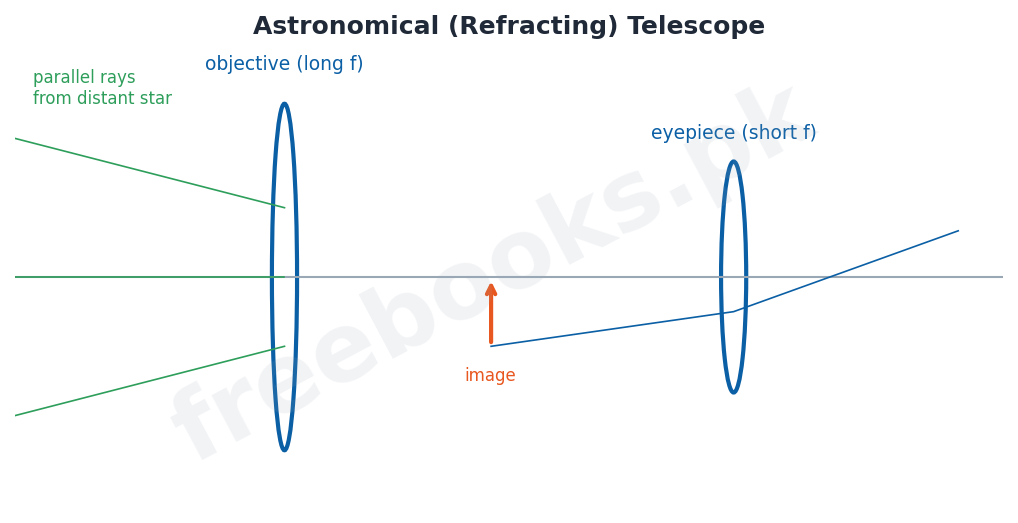
An astronomical (refracting) telescope is used to view distant objects such as stars and planets. It has an objective lens of large focal length that collects light from the distant object and forms a real image of it, and an eyepiece of short focal length that magnifies this image. In normal adjustment the final image is formed at infinity and the magnifying power is M = f_o / f_e, the ratio of the focal lengths of the objective and the eyepiece; a long objective and a short eyepiece give high magnification.
Resolving Power
The resolving power of an instrument is its ability to show two closely spaced objects as separate. A microscope or telescope with high resolving power can distinguish fine detail. Resolving power increases with the size (aperture) of the objective and decreases with the wavelength of the light used, which is one reason large telescopes have large objective lenses or mirrors.
The Optical Fibre
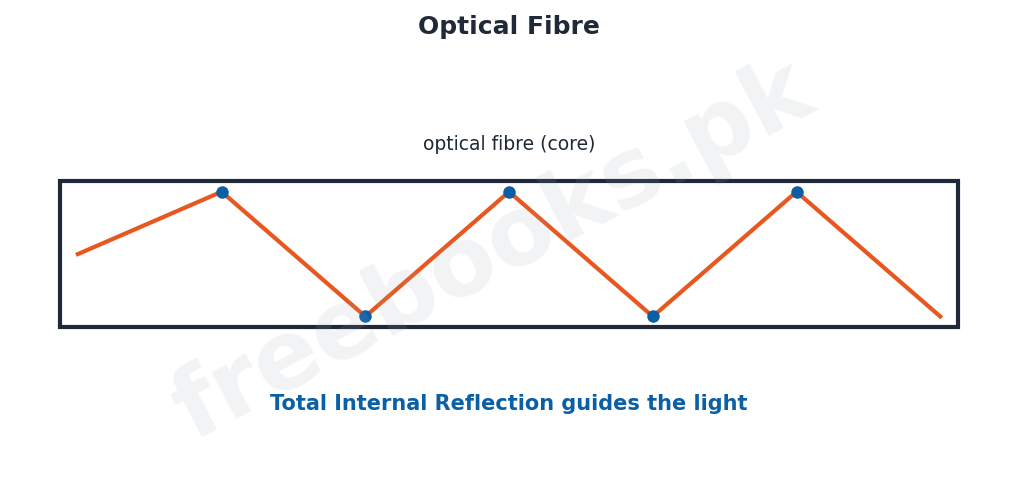
An optical fibre is a thin, flexible strand of very pure glass (or plastic) that carries light along its length. Light entering one end strikes the walls at an angle greater than the critical angle and is repeatedly reflected by total internal reflection, so it travels along the fibre with very little loss even when the fibre is bent. Optical fibres are used to carry telephone and internet signals as pulses of light and in medical endoscopes to look inside the body.
Important Definitions
Least distance of distinct vision
The nearest distance (25 cm) at which a normal eye sees clearly without strain.
Magnifying power
The ratio of the angle subtended by the image to that subtended by the object at 25 cm.
Simple microscope
A single convex lens used as a magnifying glass.
Compound microscope
An instrument using an objective and eyepiece to give large magnification.
Astronomical telescope
An instrument using two lenses to view distant objects.
Resolving power
The ability of an instrument to show two close objects as separate.
Optical fibre
A thin glass strand that guides light by total internal reflection.
Total internal reflection
Complete reflection of light at a boundary when the angle exceeds the critical angle.
Formulas & Rules
| Item | Fact |
|---|---|
| Least distance of distinct vision | d = 25 cm |
| Simple microscope | M = 1 + d/f |
| Compound microscope | M = M_objective x M_eyepiece |
| Astronomical telescope | M = f_o / f_e |
Diagrams & Illustrations
Compound microscope: a compound microscope with an objective forming a real image and an eyepiece magnifying it to give a large virtual final image.
Astronomical telescope: an astronomical telescope with a long-focus objective and a short-focus eyepiece viewing a distant object.
Optical fibre: light travelling along an optical fibre by repeated total internal reflection at its walls.
Solved Examples & Numericals
Simple microscope
A magnifying glass has focal length 5 cm. Its magnifying power is M = 1 + d/f = 1 + 25/5 = 1 + 5 = 6.
Telescope
A telescope has an objective of focal length 100 cm and an eyepiece of focal length 5 cm. Its magnifying power is M = f_o/f_e = 100/5 = 20.
Length of telescope
In normal adjustment the length of a telescope is about f_o + f_e = 100 + 5 = 105 cm for the example above.
Effect of focal length
For a simple microscope a smaller focal length gives a larger M; a 2.5 cm lens gives M = 1 + 25/2.5 = 11.
Short Questions & Answers
What is the least distance of distinct vision?
The closest distance, about 25 cm, at which a normal eye can see an object clearly without strain.
What is a simple microscope?
A single convex lens of short focal length used as a magnifying glass; M = 1 + d/f.
How does a compound microscope give high magnification?
It magnifies in two stages: the objective forms a real magnified image which the eyepiece magnifies again.
Write the magnifying power of a telescope in normal adjustment.
M = f_o / f_e, the ratio of the focal lengths of the objective and eyepiece.
What is resolving power?
The ability of an instrument to show two closely placed objects as separate.
How does light travel along an optical fibre?
By repeated total internal reflection at the walls of the fibre.
Long Questions & Answers
Q1: Describe the construction and working of a compound microscope and write its magnifying power.
A compound microscope is used to view very small objects and consists of two convex lenses mounted at the ends of a tube. The lens nearer the object is the objective and has a very short focal length; the lens nearer the eye is the eyepiece and has a somewhat longer focal length. The object to be examined is placed just outside the focal length of the objective, which therefore forms a real, inverted and magnified image inside the tube. This real image lies within the focal length of the eyepiece, so the eyepiece acts as a simple magnifying glass and forms a still larger, virtual image which the observer sees. Because the magnification is produced in two stages, one by the objective and one by the eyepiece, the overall magnifying power is the product of the two, M = M_objective x M_eyepiece, and is much greater than that of a single lens. This is why a compound microscope can reveal fine detail such as the structure of cells.
Q2: Describe the astronomical telescope and state its magnifying power in normal adjustment.
An astronomical telescope is used to view distant objects such as stars, planets and the Moon. It consists of two convex lenses: an objective of large aperture and long focal length facing the object, and an eyepiece of short focal length near the eye. Light from the distant object arrives as an almost parallel beam, and the objective brings it to a focus, forming a small, real, inverted image just inside its focal point. This real image is arranged to lie at the focal point of the eyepiece, so that the eyepiece produces a final image at infinity, which the relaxed eye can view without strain; this arrangement is called normal adjustment. In normal adjustment the magnifying power is the ratio of the focal length of the objective to that of the eyepiece, M = f_o / f_e. Therefore a telescope with a long objective focal length and a short eyepiece focal length gives high magnification, and its overall length is about f_o + f_e.
Q3: Explain the optical fibre and the principle of total internal reflection on which it works, and give its uses.
An optical fibre is a very thin, flexible thread of extremely pure glass (or transparent plastic) used to guide light from one end to the other. Its working depends on total internal reflection, which occurs when light inside a denser medium meets the boundary with a less dense medium at an angle of incidence greater than a certain critical angle; instead of passing out, all the light is reflected back into the denser medium. In an optical fibre light entering one end strikes the walls at angles greater than the critical angle and so is completely reflected again and again, zig-zagging along the fibre with almost no loss of energy even when the fibre is curved. Because they carry information as fast, low-loss pulses of light, optical fibres are the backbone of modern telephone and internet communication, carrying far more data than ordinary wires. They are also used in medical endoscopes, which let doctors see inside the body, and in decorative and lighting applications.
MCQs with Answers
The least distance of distinct vision is about: (a) 25 cm (b) 2.5 cm (c) 1 m (d) infinity
Correct Answer: (a) 25 cm.
A simple microscope is a: (a) convex lens (b) concave lens (c) prism (d) mirror
Correct Answer: (a) convex lens.
The magnifying power of a simple microscope is: (a) 1 + d/f (b) f/d (c) d/f only (d) f_o/f_e
Correct Answer: (a) 1 + d/f.
A compound microscope uses: (a) one lens (b) two convex lenses (c) a mirror (d) a prism
Correct Answer: (b) two convex lenses.
The objective of a compound microscope has a ___ focal length: (a) very long (b) very short (c) infinite (d) zero
Correct Answer: (b) very short.
The magnifying power of a telescope (normal adjustment) is: (a) f_o/f_e (b) f_e/f_o (c) f_o x f_e (d) 1 + d/f
Correct Answer: (a) f_o/f_e.
A telescope objective has a ___ focal length: (a) short (b) long (c) zero (d) negative
Correct Answer: (b) long.
Light travels along an optical fibre by: (a) refraction (b) diffraction (c) total internal reflection (d) dispersion
Correct Answer: (c) total internal reflection.
The ability to see two close objects separately is: (a) magnifying power (b) resolving power (c) focal power (d) refractive index
Correct Answer: (b) resolving power.
Optical fibres are mainly used in: (a) cooking (b) communication (c) weighing (d) heating
Correct Answer: (b) communication.
Quick Revision Summary
- Least distance of distinct vision d = 25 cm; magnifying power = angle ratio.
- Simple microscope (convex lens): M = 1 + d/f.
- Compound microscope: objective (real image) + eyepiece (magnifies); M = product.
- Astronomical telescope (normal adjustment): M = f_o/f_e; length ~ f_o + f_e.
- Resolving power = ability to separate close objects; larger aperture is better.
- Optical fibre guides light by total internal reflection; used in communication. Notes by freebooks.pk.
Exam Tips
- Remember d = 25 cm for the least distance of distinct vision.
- Learn M = 1 + d/f for the simple microscope.
- State the two-stage magnification of a compound microscope.
- Learn M = f_o/f_e for the telescope.
- Optical fibre works by total internal reflection.
- Link resolving power to aperture size.