This chapter covers Work and Energy from the 1st Year (FSc Part-I) Physics syllabus of the Punjab Curriculum and Textbook Board (PTB/PCTB). It defines work and power, introduces kinetic and potential energy, and states the work-energy principle and the law of conservation of energy. These notes are prepared by freebooks.pk.
Energy is the capacity to do work, and it can change from one form to another but is never destroyed. You will learn how to calculate work and power, the two main forms of mechanical energy, and how energy is conserved.
Learning Objectives
- Define work and calculate it for a constant and a variable force.
- Define power and relate it to force and velocity.
- Define kinetic energy and potential energy and calculate them.
- State and apply the work-energy principle.
- State the law of conservation of energy and describe energy interconversion.
- Describe some non-conventional sources of energy.
Key Concepts
Work Done by a Constant Force
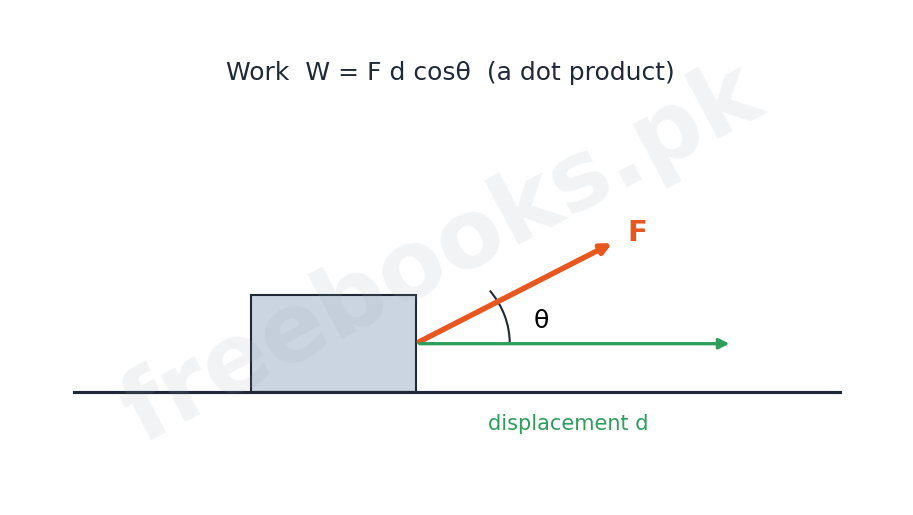
Work is done when a force moves its point of application in the direction of the force. For a constant force F acting on a body that moves a displacement d at an angle theta to the force, the work done is W = F d cos(theta); this is the scalar (dot) product of force and displacement. Work is a scalar and its SI unit is the joule (J). No work is done if the displacement is zero or if the force is perpendicular to the displacement (theta = 90 degrees).
Work Done by a Variable Force
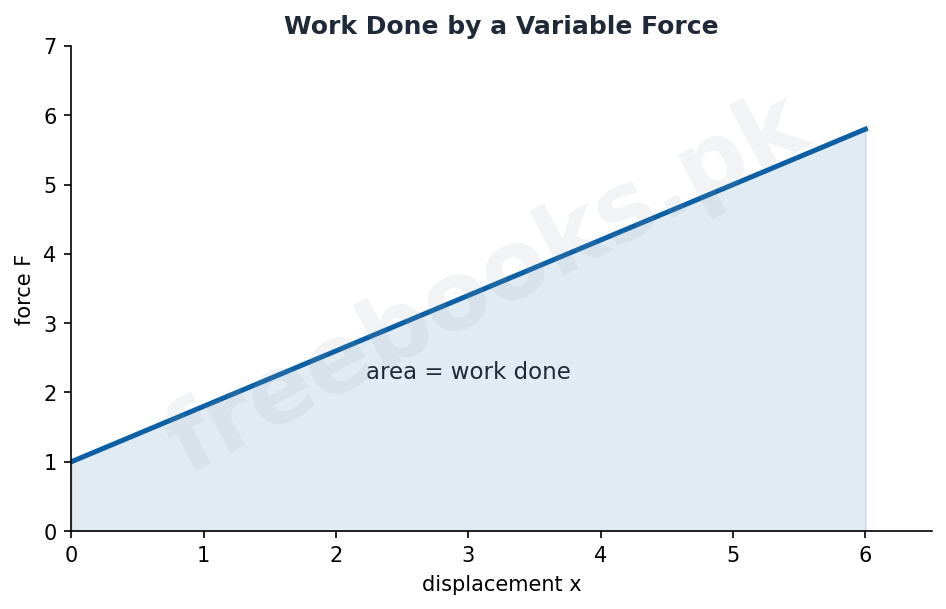
When a force varies with position, the work done is found from the area under the force-displacement (F-x) graph. The total displacement is divided into very small steps in each of which the force is nearly constant, and the small amounts of work are added; graphically this equals the area between the curve and the x-axis.
Power
Power is the rate of doing work, P = W/t, and its SI unit is the watt (W), equal to one joule per second. If a constant force F moves a body at velocity v, the power delivered is P = F v (the dot product of force and velocity). Power tells us how quickly energy is transferred.
Kinetic and Potential Energy
Energy is the capacity to do work. Kinetic energy is the energy a body has because of its motion and is given by KE = (1/2)mv^2. Potential energy is the energy a body has because of its position or state; gravitational potential energy near the Earth’s surface is PE = mgh, where h is the height above a reference level.
Work-Energy Principle
The work-energy principle states that the net work done on a body equals the change in its kinetic energy: W(net) = change in KE = (1/2)mv^2 – (1/2)mu^2. This links the ideas of force, work and motion, and is often the quickest way to solve problems involving speed and distance.
Conservation of Energy
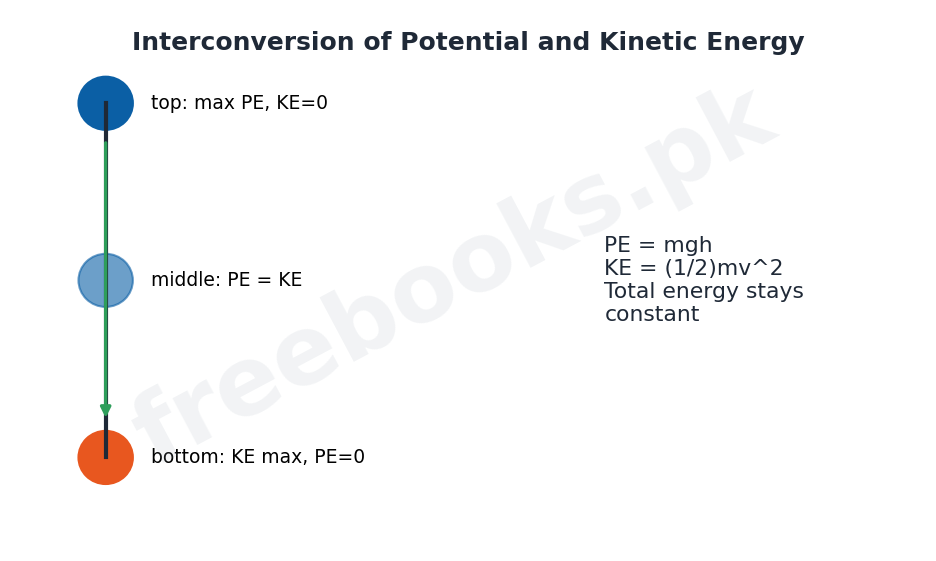
The law of conservation of energy states that energy can neither be created nor destroyed but only changed from one form to another; the total energy of an isolated system remains constant. For a freely falling body, potential energy is steadily converted into kinetic energy while their sum stays the same. Besides conventional sources, non-conventional (renewable) sources of energy include solar energy, wind energy, tidal energy, geothermal energy and biomass.
Important Definitions
Work
The product of a force and the displacement in the direction of the force; W = F d cos(theta).
Power
The rate of doing work, P = W/t; SI unit the watt.
Energy
The capacity of a body to do work.
Kinetic energy
The energy of a body due to its motion, KE = (1/2)mv^2.
Potential energy
The energy of a body due to its position or state, PE = mgh for gravity.
Work-energy principle
The net work done on a body equals the change in its kinetic energy.
Conservation of energy
Energy cannot be created or destroyed, only changed in form.
Joule
The SI unit of work and energy; one joule is one newton-metre.
Formulas & Rules
| Item | Fact |
|---|---|
| Work (constant force) | W = F d cos(theta) |
| Work (variable force) | area under the force-displacement graph |
| Power | P = W/t = F v |
| Kinetic energy | KE = (1/2)mv^2 |
| Potential energy | PE = mgh |
| Work-energy principle | W(net) = (1/2)mv^2 – (1/2)mu^2 |
| Units | work and energy in joule (J); power in watt (W) |
Diagrams & Illustrations
Work by a force at an angle: a block pulled by a force F at angle theta to the horizontal displacement d, with the work given by W = F d cos theta.
Interconversion of energy: a body falling from a height showing potential energy at the top converting into kinetic energy at the bottom while the total energy stays constant.
Work by a variable force: a force-displacement graph in which the area under the curve equals the work done by a varying force.
Solved Examples & Numericals
Work done
A force of 15 N pulls a box 4 m along the direction of the force. The work done is W = F d cos0 = 15 x 4 x 1 = 60 J.
Work at an angle
A force of 20 N acts at 60 degrees to a displacement of 3 m. The work done is W = F d cos60 = 20 x 3 x 0.5 = 30 J.
Kinetic energy
A 2 kg body moves at 5 m/s. Its kinetic energy is KE = (1/2)mv^2 = (1/2)(2)(25) = 25 J.
Power
A motor does 6000 J of work in 30 s. Its power is P = W/t = 6000/30 = 200 W.
Short Questions & Answers
When is the work done by a force zero?
When the displacement is zero, or when the force is perpendicular to the displacement (theta = 90 degrees).
Define power and give its SI unit.
Power is the rate of doing work, P = W/t; its SI unit is the watt.
Write the expression for kinetic energy.
KE = (1/2)mv^2, where m is mass and v is speed.
State the work-energy principle.
The net work done on a body equals the change in its kinetic energy.
State the law of conservation of energy.
Energy cannot be created or destroyed, only changed from one form to another; the total energy stays constant.
Name two non-conventional sources of energy.
Solar energy and wind energy (also tidal, geothermal and biomass).
Long Questions & Answers
Q1: Define work and explain the work done by a constant force and by a variable force.
Work is done when a force moves its point of application in the direction of the force. For a constant force F acting on a body that undergoes a displacement d at an angle theta to the force, the work done is the dot product W = F d cos(theta); it is a scalar measured in joules. The work is maximum when the force and displacement are parallel (theta = 0) and zero when they are perpendicular (theta = 90 degrees) or when there is no displacement. When the force varies with position, it is not possible to use a single value of F; instead the displacement is divided into very small intervals in each of which the force is almost constant, the small amounts of work are added, and the total work equals the area under the force-displacement graph. This method allows the work done by any varying force, such as that of a stretched spring, to be found.
Q2: Define kinetic and potential energy and state the work-energy principle.
Energy is the capacity of a body to do work, and mechanical energy has two forms. Kinetic energy is the energy a body possesses because of its motion; a body of mass m moving with speed v has kinetic energy KE = (1/2)mv^2. Potential energy is the energy a body possesses because of its position or configuration; a body of mass m raised to a height h above a reference level has gravitational potential energy PE = mgh. The work-energy principle connects work and motion: the net work done on a body equals the change in its kinetic energy, W(net) = (1/2)mv^2 – (1/2)mu^2. This principle shows that doing positive work on a body increases its kinetic energy (speeds it up), while negative work decreases it.
Q3: State the law of conservation of energy and illustrate it with a freely falling body.
The law of conservation of energy states that energy can neither be created nor destroyed; it can only be transformed from one form into another, so the total energy of an isolated system remains constant. A freely falling body illustrates this well. At the top of its fall the body is momentarily at rest and has maximum gravitational potential energy (mgh) and zero kinetic energy. As it falls, its height decreases so its potential energy decreases, while its speed increases so its kinetic energy increases by exactly the same amount; at every point the sum of potential and kinetic energy is the same. Just before it hits the ground its potential energy is almost zero and its kinetic energy is maximum. Thus energy is continuously converted from potential to kinetic form while the total stays constant.
MCQs with Answers
The work done by a force is maximum when the angle between force and displacement is: (a) 0 degrees (b) 45 degrees (c) 90 degrees (d) 180 degrees
Correct Answer: (a) 0 degrees. cos0 = 1.
The SI unit of work is the: (a) watt (b) joule (c) newton (d) pascal
Correct Answer: (b) joule.
Power is the rate of doing: (a) force (b) work (c) distance (d) mass
Correct Answer: (b) work.
The SI unit of power is the: (a) joule (b) newton (c) watt (d) volt
Correct Answer: (c) watt.
The kinetic energy of a body is given by: (a) mgh (b) (1/2)mv^2 (c) mv (d) Fd
Correct Answer: (b) (1/2)mv^2.
The potential energy of a body at height h is: (a) (1/2)mv^2 (b) mgh (c) mv (d) Fd cos theta
Correct Answer: (b) mgh.
The work-energy principle relates net work to the change in: (a) momentum (b) kinetic energy (c) power (d) force
Correct Answer: (b) kinetic energy.
When force is perpendicular to displacement, the work done is: (a) maximum (b) zero (c) negative (d) infinite
Correct Answer: (b) zero. cos90 = 0.
Which is a non-conventional source of energy? (a) coal (b) petroleum (c) solar (d) natural gas
Correct Answer: (c) solar.
If a constant force F moves a body at velocity v, the power is: (a) F/v (b) F + v (c) F v (d) F – v
Correct Answer: (c) F v.
Quick Revision Summary
- Work W = F d cos(theta) (dot product); unit joule; zero if force is perpendicular to displacement.
- Variable force: work = area under the force-displacement graph.
- Power P = W/t = F v; unit watt.
- Kinetic energy = (1/2)mv^2; potential energy = mgh.
- Work-energy principle: net work = change in kinetic energy.
- Conservation of energy: total energy stays constant; non-conventional sources include solar and wind. Notes by freebooks.pk.
Exam Tips
- Always include cos(theta) when force and displacement are not parallel.
- Use the work-energy principle for speed-distance problems; it is quick.
- Remember units: joule for work/energy, watt for power.
- For a falling body, PE lost = KE gained.
- P = F v is handy when velocity is given.
- List renewable sources (solar, wind, tidal, geothermal, biomass) for energy questions.