
This chapter covers Fluid Dynamics from the 1st Year (FSc Part-I) Physics syllabus of the Punjab Curriculum and Textbook Board (PTB/PCTB). It studies viscosity and viscous drag, the terminal velocity of a falling body, types of fluid flow, the equation of continuity and Bernoulli’s equation with its applications. These notes are prepared by freebooks.pk.
Fluids (liquids and gases) can flow, and their motion follows simple and beautiful rules. You will learn why some bodies reach a steady falling speed, how the speed of a fluid changes when a pipe narrows, and how Bernoulli’s principle explains lift and many everyday effects.
Learning Objectives
- Define viscosity and viscous drag and state Stokes’ law.
- Explain terminal velocity and how it arises.
- Distinguish streamline (laminar) and turbulent flow.
- State and apply the equation of continuity.
- State Bernoulli’s equation and describe its applications.
Key Concepts
Viscosity and Viscous Drag
Viscosity is the internal friction of a fluid that opposes the relative motion of its layers; thick fluids such as honey have high viscosity while thin fluids such as water have low viscosity. When a body moves through a fluid it experiences a retarding force called viscous drag. For a small sphere of radius r moving slowly with speed v through a fluid of viscosity eta, Stokes’ law gives the drag force as F = 6 pi eta r v.
Terminal Velocity
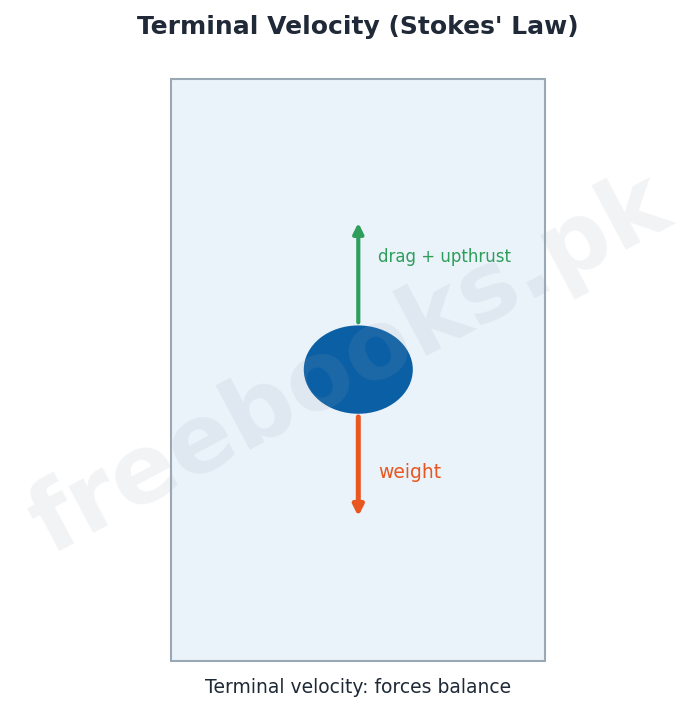
When a small sphere falls through a fluid, its weight acts downward while the upthrust and the viscous drag act upward. As the sphere speeds up, the drag increases until the upward and downward forces balance; after this the sphere falls with a constant maximum speed called the terminal velocity. A raindrop and a parachutist both reach a terminal velocity.
Types of Fluid Flow
Fluid flow is of two kinds. In streamline (laminar) flow the fluid moves in smooth layers and every particle passing a point follows the same path; this happens at low speeds. In turbulent flow the motion is irregular with eddies and whirls; this happens at high speeds. Streamline flow becomes turbulent when the speed exceeds a certain critical value.
Equation of Continuity
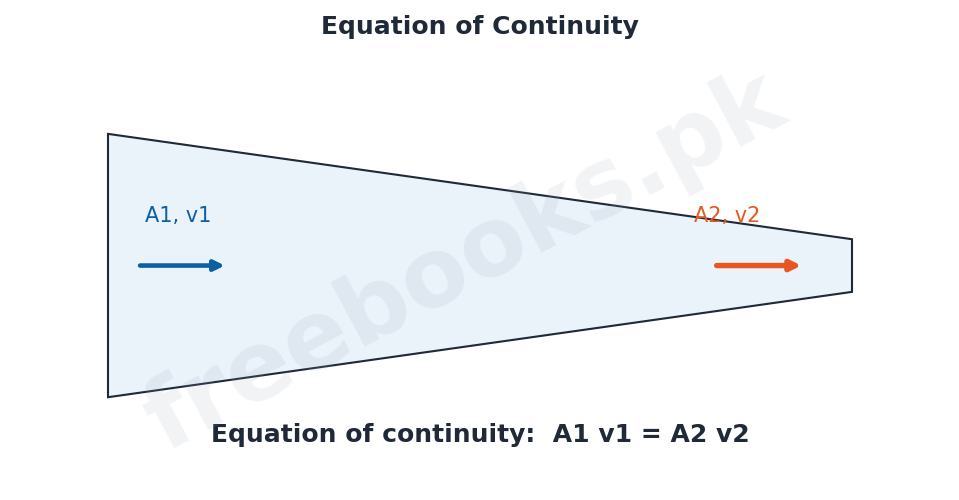
For an incompressible fluid flowing steadily through a pipe, the mass entering any section per second equals the mass leaving it. This gives the equation of continuity, A1 v1 = A2 v2, where A is the cross-sectional area and v the speed. It shows that a fluid speeds up when the pipe narrows and slows down when it widens; this is why water from a hose speeds up when the nozzle is squeezed.
Bernoulli’s Equation and Its Applications
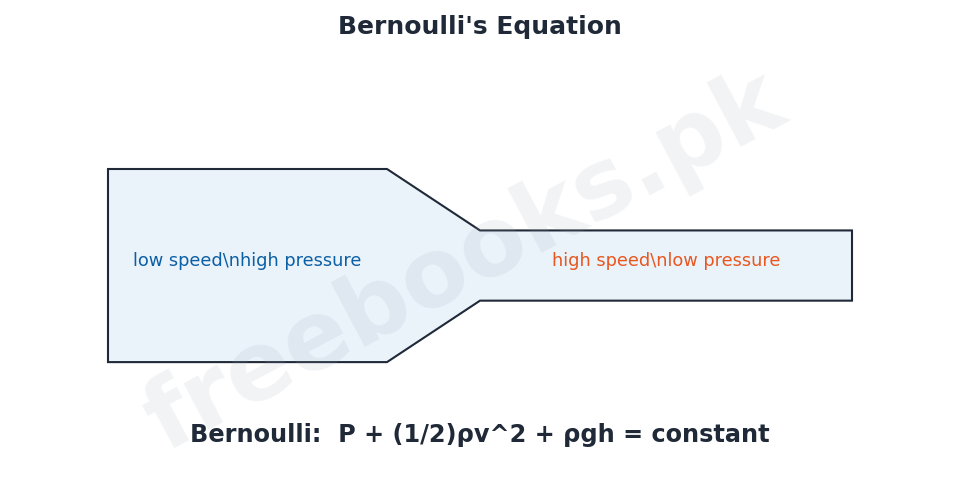
Bernoulli’s equation is a statement of the conservation of energy for a flowing fluid: P + (1/2) rho v^2 + rho g h = constant, where P is pressure, rho the density, v the speed and h the height. It shows that where a fluid moves faster its pressure is lower, and where it moves slower its pressure is higher. Applications include the lift on an aeroplane wing, the working of a carburettor and an atomiser, the swing of a spinning ball, and Torricelli’s theorem for the speed of liquid leaving a hole in a tank.
Important Definitions
Viscosity
The internal friction of a fluid that opposes the relative motion of its layers.
Viscous drag
The retarding force on a body moving through a fluid.
Stokes’ law
The drag on a small sphere moving slowly in a fluid, F = 6 pi eta r v.
Terminal velocity
The constant maximum speed of a body falling through a fluid when the forces balance.
Streamline flow
Smooth, layered fluid flow in which particles follow the same path.
Turbulent flow
Irregular fluid flow with eddies and whirls at high speed.
Equation of continuity
A1 v1 = A2 v2 for an incompressible fluid.
Bernoulli’s equation
P + (1/2) rho v^2 + rho g h = constant for a flowing fluid.
Formulas & Rules
| Item | Fact |
|---|---|
| Stokes’ law | F = 6 pi eta r v |
| Terminal velocity | reached when weight = upthrust + drag |
| Equation of continuity | A1 v1 = A2 v2 |
| Bernoulli’s equation | P + (1/2) rho v^2 + rho g h = constant |
| Torricelli’s theorem | v = sqrt(2 g h) for liquid leaving a hole at depth h |
Diagrams & Illustrations
Terminal velocity: a sphere falling through a fluid with its weight acting downward and the upthrust and viscous drag acting upward, balancing at the terminal velocity.
Equation of continuity: a pipe that narrows, showing that the fluid speeds up where the area is smaller, with A1 v1 = A2 v2.
Bernoulli’s equation: flow through a pipe that narrows, showing high pressure where the speed is low and low pressure where the speed is high.
Solved Examples & Numericals
Equation of continuity
Water flows through a pipe whose area falls from 6 cm^2 to 2 cm^2. If the speed in the wide part is 1 m/s, then A1 v1 = A2 v2 gives 6 x 1 = 2 x v2, so v2 = 3 m/s.
Stokes’ law
The drag on a sphere increases with speed, so as a falling sphere speeds up the drag grows until it balances the weight, giving a constant terminal velocity.
Torricelli’s theorem
Water leaves a hole 0.2 m below the surface of a tank. Its speed is v = sqrt(2 g h) = sqrt(2 x 10 x 0.2) = 2 m/s.
Bernoulli effect
Air moves faster over the curved top of an aeroplane wing than under it, so by Bernoulli’s principle the pressure on top is lower, giving an upward lift.
Short Questions & Answers
Define viscosity.
The internal friction of a fluid that opposes the relative motion of its layers.
State Stokes’ law.
The viscous drag on a small sphere moving slowly through a fluid is F = 6 pi eta r v.
What is terminal velocity?
The constant maximum speed of a body falling through a fluid, reached when the upward and downward forces balance.
Differentiate streamline and turbulent flow.
In streamline flow the fluid moves in smooth layers; in turbulent flow the motion is irregular with eddies.
State the equation of continuity.
For an incompressible fluid, A1 v1 = A2 v2; the fluid speeds up where the pipe narrows.
Why does an aeroplane wing experience lift?
Air moves faster over the top than the bottom, so the pressure on top is lower (Bernoulli’s principle), giving an upward lift.
Long Questions & Answers
Q1: Explain viscous drag, Stokes’ law and terminal velocity.
When a body moves through a fluid, the layers of fluid resist the motion and exert a retarding force on the body called viscous drag; the drag increases with the speed of the body. For a small sphere of radius r moving slowly with speed v through a fluid of viscosity eta, the drag is given by Stokes’ law, F = 6 pi eta r v. Consider a small sphere falling through a fluid: its weight acts downward while the upthrust of the fluid and the viscous drag act upward. At first the weight is greater, so the sphere accelerates; but as it speeds up the drag grows, until the total upward force (upthrust plus drag) becomes equal to the weight. After this the net force is zero, the sphere stops accelerating, and it falls with a constant maximum speed called the terminal velocity. Raindrops and parachutists reach a terminal velocity in this way.
Q2: State and explain the equation of continuity.
The equation of continuity expresses the conservation of mass for a fluid flowing steadily through a pipe. If the fluid is incompressible, the mass of fluid entering any cross-section per second must equal the mass leaving it, otherwise fluid would build up. Since the mass per second at a section equals density times area times speed, and the density is constant, the product of area and speed must be the same everywhere: A1 v1 = A2 v2, where A1 and A2 are the cross-sectional areas at two points and v1 and v2 the corresponding speeds. This equation shows that where the pipe is narrow the fluid moves fast, and where the pipe is wide the fluid moves slowly, which is why the water from a hose speeds up when the nozzle opening is made smaller.
Q3: State Bernoulli’s equation and describe two of its applications.
Bernoulli’s equation is a statement of the conservation of energy for a fluid in streamline flow, and states that P + (1/2) rho v^2 + rho g h = constant along a streamline, where P is the pressure, rho the density, v the speed and h the height of the fluid. The key idea is that where a fluid flows faster its pressure is lower, and where it flows slower its pressure is higher. One application is the lift on an aeroplane wing: the wing is shaped so that air flows faster over the curved top than under the flatter bottom, so the pressure on top is lower and the wing is pushed up. Another application is the carburettor or atomiser, in which fast-moving air creates a region of low pressure that draws liquid up and sprays it out. Torricelli’s theorem, which gives the speed of liquid leaving a hole in a tank as v = sqrt(2 g h), is also derived from Bernoulli’s equation.
MCQs with Answers
The internal friction of a fluid is called: (a) pressure (b) viscosity (c) density (d) upthrust
Correct Answer: (b) viscosity.
Stokes’ law for the drag on a small sphere is: (a) 6 pi eta r v (b) eta r v (c) pi r^2 v (d) eta v/r
Correct Answer: (a) 6 pi eta r v.
Terminal velocity is reached when the net force on the falling body is: (a) maximum (b) zero (c) upward (d) increasing
Correct Answer: (b) zero.
Smooth, layered fluid flow is called: (a) turbulent (b) streamline (c) random (d) rotational
Correct Answer: (b) streamline.
The equation of continuity is: (a) A1 v1 = A2 v2 (b) P1 = P2 (c) v1 = v2 (d) A1 = A2
Correct Answer: (a) A1 v1 = A2 v2.
When a pipe narrows, the speed of the fluid: (a) decreases (b) increases (c) stays same (d) becomes zero
Correct Answer: (b) increases.
Bernoulli’s equation is based on the conservation of: (a) mass (b) momentum (c) energy (d) charge
Correct Answer: (c) energy.
Where a fluid moves faster, its pressure is: (a) higher (b) lower (c) the same (d) zero
Correct Answer: (b) lower.
The lift on an aeroplane wing is explained by: (a) Stokes’ law (b) Bernoulli’s principle (c) Newton’s first law (d) continuity only
Correct Answer: (b) Bernoulli’s principle.
Torricelli’s theorem gives the efflux speed as: (a) sqrt(g h) (b) sqrt(2 g h) (c) 2 g h (d) g h
Correct Answer: (b) sqrt(2 g h).
Quick Revision Summary
- Viscosity = internal friction; viscous drag opposes motion; Stokes’ law F = 6 pi eta r v.
- Terminal velocity: constant speed when weight = upthrust + drag.
- Flow: streamline (smooth) versus turbulent (irregular).
- Equation of continuity: A1 v1 = A2 v2 (fluid speeds up where narrow).
- Bernoulli: P + (1/2) rho v^2 + rho g h = constant; faster flow = lower pressure.
- Applications: wing lift, carburettor, Torricelli v = sqrt(2 g h). Notes by freebooks.pk.
Exam Tips
- Remember Stokes’ law F = 6 pi eta r v.
- Terminal velocity means zero net force (constant speed).
- Use A1 v1 = A2 v2 for pipe-flow numericals.
- Bernoulli: faster fluid has lower pressure; use it to explain lift.
- Learn Torricelli v = sqrt(2 g h).
- State applications of Bernoulli’s principle for full marks.