This final chapter steps back from specific physics topics to examine the nature of physics itself: its scope as the fundamental science of matter, energy, space, and time, and its many branches and interdisciplinary connections with fields ranging from biology to computer science.
It also explains the scientific method — the systematic process of observation, hypothesis, experiment, theory, and law by which scientific knowledge is built and tested — and clarifies how science, technology, and engineering relate to and depend upon one another.
Learning Objectives
- Describe physics as the study of matter, energy, space, time, and their mutual connections and interactions
- Explain, with examples, the many sub-fields and interdisciplinary fields of physics
- Explain how physics is a subset of the physical sciences and of the natural sciences
- Explain that science is a collaborative field requiring interdisciplinary researchers to share knowledge and critique ideas
- Understand the terms hypothesis, theory, and law in the context of physics research
- Explain falsifiability as the idea that a theory is scientific only if it makes assertions that can be disproven
- Differentiate between the terms science, technology, and engineering, with suitable examples
Key Concepts
9.1 Scope of Physics
Science is the collective, organized knowledge about natural phenomena, built by asking how and why things behave as they do and searching for order and regularity in apparently diverse phenomena. As scientific knowledge grew rapidly in the nineteenth century, the study of nature was classified into biological sciences (the study of living things) and physical sciences (the study of non-living things), with physics forming a fundamental part of the physical sciences alongside chemistry and geology.
Physics is the fundamental science dealing with the constituents of the universe — matter, energy, space, and time — and their mutual relationships and interactions, seeking to understand everything from subatomic particles to galaxies. Space is the three-dimensional extent in which objects and events occur, providing a framework for describing position and motion; time measures the sequence and duration of events and is often considered a fourth dimension (for example, the special theory of relativity describes time dilation, where time passes more slowly for an observer moving at very high speed relative to one at rest). Physics explores how these concepts connect — general relativity describes how space and time are influenced by gravity and speed (such as light bending around massive stars), while quantum mechanics explains the behaviour of particles at the atomic and subatomic scale.
9.2 Branches of Physics
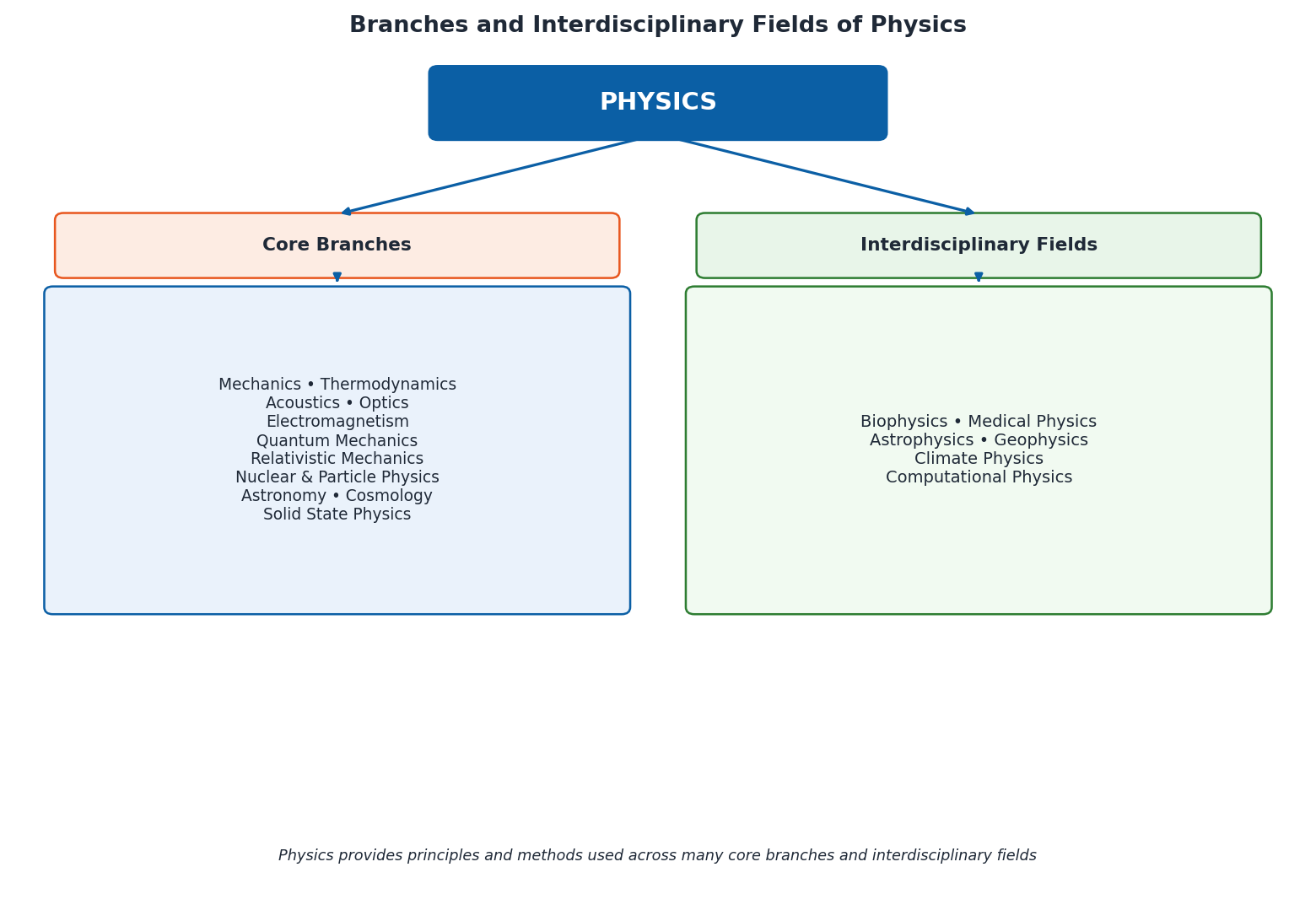
As physics research has expanded, it has grown into several major branches. Mechanics studies motion and its causes, based on Newton's laws (classical mechanics). Heat and thermodynamics deals with thermal energy and its flow between bodies. Acoustics studies the physical nature of audible sound. Optics studies the physical behaviour of visible light. Electromagnetism studies electromagnetic phenomena and the relationship between electric current and magnetic fields.
Quantum mechanics explains the behaviour of particles at atomic and subatomic scales. Relativistic mechanics explains how space and time are not absolute but relative to the observer, and how they are influenced by gravity and speed. Nuclear physics studies the properties of atomic nuclei, while particle physics studies subatomic and elementary particles — the fundamental building blocks of matter. Astronomy studies the distribution of celestial bodies such as planets, stars, and galaxies, cosmology explores the large-scale structure and evolution of the universe, and solid state physics studies the specific properties of matter in solid form.
9.3 Interdisciplinary Nature of Physics
The interdisciplinary nature of physics refers to its integration with other fields of study, since physics provides fundamental principles, techniques, and methods that are useful across many disciplines. Biophysics applies physics principles and techniques to biological systems, such as the mechanics of biological structures and the physical properties of cells and tissues. Medical physics applies physical principles to health diagnosis and treatment, including imaging techniques (X-rays, ultrasound, MRI, CT scans) and radiation therapy for cancer.
Astrophysics studies the physical properties and processes of celestial bodies and phenomena, such as how matter and energy interact in space. Geophysics applies physical principles to study the Earth's internal structure, magnetic and gravitational fields, and phenomena such as earthquakes and volcanoes. Climate physics studies physical processes in the environment, including atmospheric dynamics, climate change, and weather. Computational physics uses computational techniques and methods to solve complex physical problems that are otherwise difficult to analyse directly.
9.4 Why Interdisciplinary Collaboration Matters
Modern science depends on collaboration because complex issues require expertise from multiple fields at once — for example, understanding and mitigating climate change requires knowledge from meteorology, oceanography, physics, chemistry, and environmental science together, while combating health crises such as recent epidemics required combined expertise from biology, chemistry, physics, medical technology, and data science.
Interdisciplinary approaches also foster innovation, since combining different perspectives and methods often produces novel breakthroughs that would not emerge from any single field working alone — nanotechnology, for instance, blends physics, chemistry, materials science, and engineering to create materials and devices at the nanoscale, while artificial intelligence draws on computer science, mathematical logic, and neuroscience together. Rapid global sharing of knowledge — through the internet, conferences, workshops, collaborative research projects, and journals — further accelerates scientific progress by allowing researchers from different fields to exchange fresh findings and ideas quickly.
9.5 The Scientific Method: Observation, Hypothesis, and Experiment
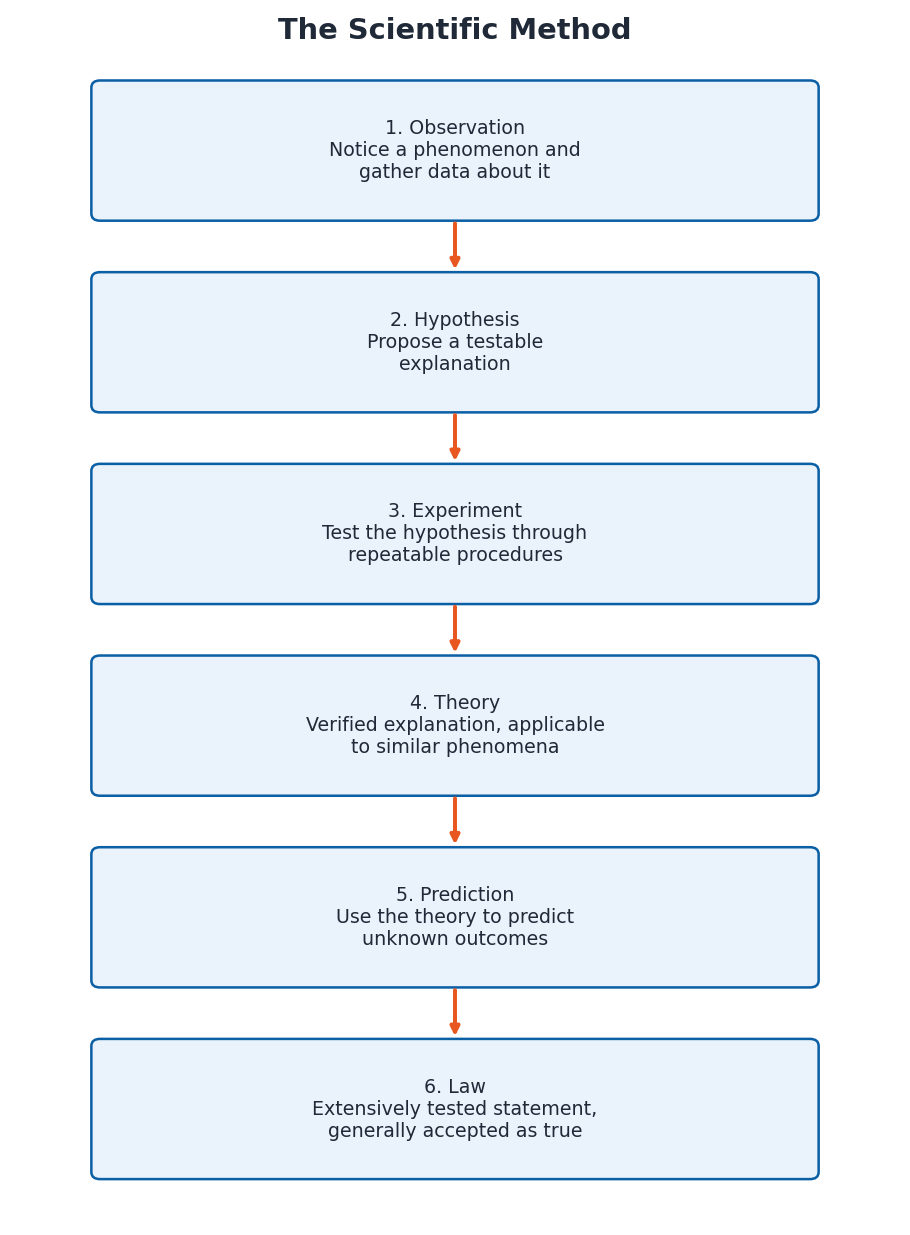
The scientific method is a systematic approach for investigating natural and physical phenomena and solving problems about them. It generally proceeds through the following steps: identifying an issue or problem, gathering information through observation, proposing a hypothesis (a possible explanation), testing the hypothesis through experiment or evidence, analysing the resulting data to reach a conclusion (a theory), and — after extensive repeated testing across a wide range of related situations — formulating a law.
Observation is the first step: collecting data about a natural process through ordinary observation or experimentation — for example, observing that an opaque object placed in a light path produces a shadow. A hypothesis is then proposed as a testable explanation based on the observed data — for example, hypothesising that shadows form because light travels in a straight line. An experiment is an organized, repeatable procedure designed to test the truth of a hypothesis — for example, aligning several cards each with a small hole so that light from a torch is visible only when all the holes line up in a straight line, confirming that light travels in straight lines.
9.6 Theory, Falsifiability, and Law
Once a hypothesis has been successfully and repeatedly verified through careful experimentation, it becomes a theory — a logical explanation of the causes and effects of a natural event or issue, applicable to similar phenomena. A theory allows scientists to make predictions about previously unknown aspects of nature, which are then tested through further experiments; if test results disagree with the prediction, the hypothesis is revised or rejected.
Falsifiability is the principle that a theory can only be considered scientific if it makes assertions that could, in principle, be tested and shown to be false. This requirement ensures scientific theories are built on specific, testable claims rather than vague or untestable beliefs, distinguishing genuine science from pseudo-science. When a theory has been tested extensively across many situations and is generally accepted as true, it becomes a law — a statement about the behaviour of nature that both explains past observations and predicts future ones (for example, the law that light travels in a straight line, from which the shape of shadows can be predicted). It is important to remember that scientific theories and laws are human ideas about how nature works, and remain open to being revised or disproven as new evidence and insights emerge.
9.7 Science, Technology, and Engineering
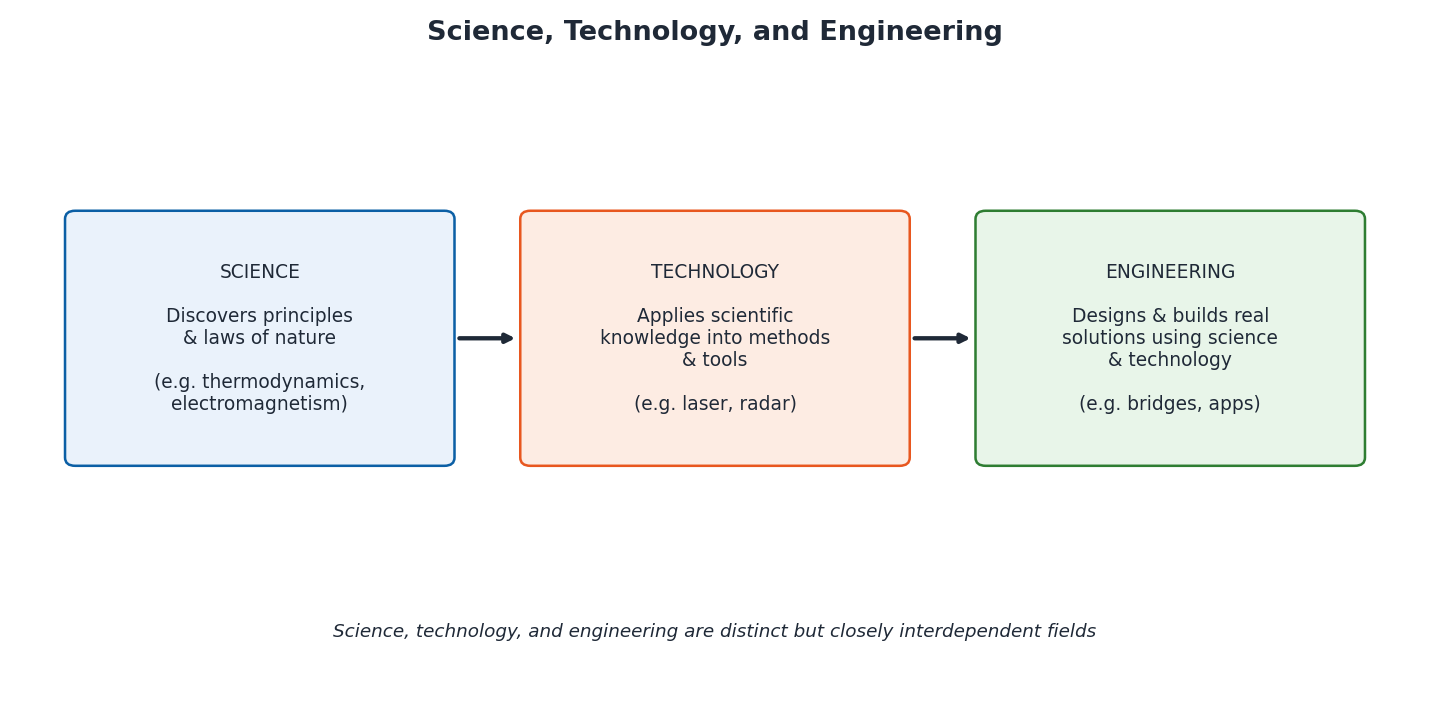
Physics is often the scientific core underlying inventions and technologies. Technology refers to the methods and techniques (whether machines or software) developed using scientific knowledge — for example, automobile technology is based on the principles of thermodynamics, radar technology is based on the detection and reflection of electromagnetic waves, and laser technology is based on the principles of atomic physics, with applications in medicine, industry, telecommunication, and space exploration.
Engineering is the process of applying scientific principles and technologies to design instruments, tools, and structures that meet specific real-world needs, while balancing factors such as cost and safety — for example, a civil engineer designs bridges that withstand wind, earthquakes, and heavy traffic; a software engineer designs user-friendly smartphone applications; and an aviation engineer selects lightweight materials that can withstand the stresses of flight. Although science, technology, and engineering are distinct fields, they work closely together: scientific discoveries lead to new technologies, and engineers rely on scientific knowledge to design solutions that shape and improve everyday life.
Important Definitions
What is science?
The collective, organized knowledge about natural phenomena, processes, and events, built through observation, questioning, and systematic study.
Define physics.
The fundamental science that studies matter, energy, space, time, and their mutual relationships and interactions.
What is a hypothesis?
A proposed, testable explanation of an observed phenomenon, put forward to be tested through experiment or evidence.
What is a theory in science?
A logical explanation of the causes and effects of a natural event, developed after a hypothesis has been successfully and repeatedly verified through experimentation.
What is a scientific law?
A statement about the behaviour of nature that has been extensively tested and generally accepted as true, capable of explaining past observations and predicting future ones.
Define falsifiability.
The principle that a theory is scientific only if it makes assertions that can, in principle, be tested and potentially shown to be false.
Differentiate between technology and engineering.
Technology refers to the methods and techniques developed using scientific knowledge (e.g. laser technology); engineering is the process of applying scientific principles and technologies to design and build things that meet specific practical needs.
What is interdisciplinary research?
Research that combines expertise, methods, and perspectives from multiple academic fields to address complex problems that no single discipline could adequately solve alone.
Key Ideas & Relationships
| Topic | Summary |
|---|---|
| Scientific method sequence | Observation → Hypothesis → Experiment → Theory → Prediction → Law |
| Falsifiability requirement | A scientific theory must make testable predictions that could be proven false |
| Two main branches of science | Biological sciences (living things) and Physical sciences (non-living things) |
| Science–Technology–Engineering relationship | Science (discovery) → Technology (methods/tools) → Engineering (applied design & building) |
Diagrams
The Scientific Method: The sequence of steps from observation through hypothesis, experiment, and theory, to an established law
Branches and Interdisciplinary Fields of Physics: Major branches of physics and its interdisciplinary connections with fields such as biophysics, medical physics, and geophysics
Science, Technology, and Engineering: How scientific discovery leads to technology, which engineering applies to design real-world solutions
Short Questions & Answers
What is science? Name its two main groups.
Science is the collective, organized knowledge about natural phenomena; its two main groups are the biological sciences (study of living things) and the physical sciences (study of non-living things).
What is physics all about? Name some of its branches.
Physics is the fundamental science of matter, energy, space, and time and their interactions; its branches include mechanics, heat and thermodynamics, optics, electromagnetism, quantum mechanics, and nuclear physics.
What is meant by interdisciplinary fields? Give a few examples.
Interdisciplinary fields combine physics with other disciplines to study specific problems, such as biophysics (physics applied to biology), medical physics (physics applied to diagnosis and treatment), and geophysics (physics applied to Earth's structure).
List the main steps of the scientific method.
Identifying a problem, gathering information through observation, proposing a hypothesis, testing it through experiment, analysing data to form a theory, and repeated testing to establish a law.
What is a hypothesis? Give an example.
A hypothesis is a testable proposed explanation for an observation; for example, hypothesising that shadows form because light travels in a straight line.
Distinguish between a theory and a law of physics.
A theory is a logical explanation of a phenomenon that has been verified through experimentation; a law is a statement that has been tested extensively across many situations and is generally accepted as always true, both explaining past observations and predicting future ones.
What is the basis of laser technology?
Laser technology is based on the principles of atomic physics.
What is the falsifiability concept? How is it important?
Falsifiability is the requirement that a scientific theory must make assertions that could potentially be proven false through testing; it is important because it distinguishes genuine, testable scientific theories from vague or untestable claims.
Long Questions & Answers
Describe the main steps of the scientific method, using the example of demonstrating that light travels in a straight line.
The scientific method begins with observation: noting, for example, that an opaque object placed in a beam of light produces a shadow. From this observation, a hypothesis is proposed — that shadows form because light travels in a straight line. This hypothesis is then tested through an experiment: aligning several cards, each with a small hole, in a straight line in front of a torch; light is visible through the holes only when all the cards are properly aligned, and moving any card out of line blocks the light. After the hypothesis is confirmed through careful, repeatable experimentation, it becomes a theory — a logical explanation applicable to similar phenomena. From this theory, predictions can be made and tested further, such as predicting that the shadow of a round object will be round and that of a rectangular object will be rectangular. Once the theory has been tested extensively across many different situations and consistently holds true, it becomes an accepted law of science: light travels in a straight line.
Explain what is meant by falsifiability, and why it is an essential requirement for a scientific theory.
Falsifiability is the principle that a theory can only be considered scientific if it makes specific assertions or predictions that could, in principle, be tested and shown to be false. This requirement is essential because it forces scientific theories to be precise and testable rather than vague or unfalsifiable — a claim that can never be disproven under any circumstances cannot be meaningfully tested, and therefore cannot be considered scientific, no matter how appealing it may seem. Falsifiability is what distinguishes genuine scientific theories, which are open to being challenged and potentially overturned by new evidence, from pseudo-scientific or unfounded beliefs that are structured to avoid ever being disproven. It also underlies the provisional nature of scientific knowledge: theories and laws are the best current explanations supported by available evidence, but remain open to revision or replacement if future experiments reveal results that contradict them.
Explain the interdisciplinary nature of physics and why collaboration across scientific disciplines is important, with examples.
Physics, as a fundamental science, provides principles, methods, and techniques that are applied across many other fields of study, giving rise to interdisciplinary branches such as biophysics (applying physics to biological systems), medical physics (applying physics to diagnosis and treatment, such as MRI and radiation therapy), astrophysics (studying the physical processes of celestial bodies), geophysics (studying the Earth's internal structure and processes), and computational physics (using computational methods to solve complex physical problems). Collaboration across these and other disciplines is essential because many of today's most pressing challenges are too complex for any single field to address alone — for instance, addressing climate change requires combined expertise from meteorology, oceanography, physics, chemistry, and environmental science, while responding to health crises requires combined efforts from biology, chemistry, physics, medical technology, and data science. Interdisciplinary collaboration also drives innovation, since combining different perspectives and methods can produce breakthroughs that would not emerge from any single field working in isolation — as seen in nanotechnology (blending physics, chemistry, and materials science) and artificial intelligence (blending computer science, mathematics, and neuroscience). Rapid global sharing of research through the internet, conferences, and journals further accelerates the pace of scientific progress made possible by such collaboration.
Differentiate between science, technology, and engineering, explaining how they relate to and depend on one another, with examples.
Science, and physics in particular, is the systematic pursuit of knowledge about how the natural world works, developing theories and laws that explain and predict natural phenomena. Technology refers to the methods, techniques, machines, or software developed by applying scientific knowledge to practical ends — for example, automobile technology applies the principles of thermodynamics, radar technology applies the principles of electromagnetic wave detection and reflection, and laser technology applies the principles of atomic physics. Engineering is the process of applying scientific principles and existing technologies to design and build specific instruments, structures, or systems that meet real-world needs, while carefully balancing factors such as cost, safety, and practicality — for example, a civil engineer designs bridges able to withstand wind, earthquakes, and traffic loads, a software engineer designs user-friendly smartphone applications, and an aviation engineer selects lightweight materials able to withstand the stresses of flight. Although these three fields are distinct in focus, they are deeply interconnected: scientific discoveries make new technologies possible, and engineers depend on both scientific principles and existing technologies to design solutions that improve everyday life.
Multiple Choice Questions (MCQs)
Physics is a branch of: (A) social science (B) life science (C) physical science (D) biological science
Correct answer: (C) physical science. Physics belongs to the physical sciences, which study non-living things, alongside chemistry and geology.
Which branch of science plays a vital role in technology and engineering? (A) Biology (B) Chemistry (C) Geology (D) Physics
Correct answer: (D) Physics. Physics provides the fundamental principles that underlie most technological and engineering advances.
Automobile technology is primarily based on the principles of: (A) acoustics (B) electromagnetism (C) optics (D) thermodynamics
Correct answer: (D) thermodynamics. Automobile engines and related technology are based on the principles of thermodynamics, dealing with heat and its conversion to work.
A user-friendly smartphone software application is an example of: (A) laser technology (B) information technology (C) medical technology (D) electronic technology
Correct answer: (B) information technology. Software applications fall under information technology, which develops methods and tools for processing and managing information.
The working of refrigeration and air conditioning primarily involves: (A) electromagnetism (B) mechanics (C) climate science (D) thermodynamics
Correct answer: (D) thermodynamics. Refrigeration and air conditioning rely on thermodynamic principles governing the transfer and flow of heat energy.
According to the scientific method, the final, most rigorously tested outcome is a: (A) Hypothesis (B) Experimentation (C) Theory (D) Law
Correct answer: (D) Law. A law represents the most extensively tested and generally accepted outcome of the scientific method, built up from repeated confirmation of a theory.
The statement 'If I do not study for this test, then I will not get a good grade' is an example of a: (A) theory (B) observation (C) prediction (D) law
Correct answer: (C) prediction. This statement forecasts a specific outcome based on a condition, making it a prediction rather than an established theory or law.
Which of the following are recognized methods of scientific investigation? (A) Observation (B) Experimentation (C) Research (D) All of these
Correct answer: (D) All of these. Observation, experimentation, and research are all valid and commonly used methods of scientific investigation.
A hypothesis is best described as: (A) An assertion that may or may not be testable (B) A possible, testable answer to a question, supported by initial evidence (C) A universally accepted fact (D) The final stage of the scientific method
Correct answer: (B) A possible, testable answer to a question, supported by initial evidence. A hypothesis is a proposed, testable explanation put forward based on available evidence, meant to be tested through further experimentation.
Noting that 'the colour of a door is brown' is an example of: (A) observation (B) hypothesis (C) prediction (D) law
Correct answer: (A) observation. Simply noting a directly observable fact, without proposing an explanation or making a forecast, is an observation.
Quick Revision Summary
- Science = organized knowledge of nature; two branches: biological sciences (living) and physical sciences (non-living)
- Physics = study of matter, energy, space, time, and their interactions
- Major branches: mechanics, thermodynamics, acoustics, optics, electromagnetism, quantum mechanics, relativistic mechanics, nuclear/particle physics, astronomy, cosmology, solid state physics
- Interdisciplinary fields: biophysics, medical physics, astrophysics, geophysics, climate physics, computational physics
- Interdisciplinary collaboration is essential for complex problems (climate change, health crises) and drives innovation (nanotechnology, AI)
- Scientific method: observation → hypothesis → experiment → theory → prediction → law
- Falsifiability: a scientific theory must make testable, potentially disprovable predictions
- Science = knowledge; Technology = methods/tools from science; Engineering = applying science & technology to build solutions
- Theories and laws are human explanations, always open to revision with new evidence
Exam Tips
- Keep the sequence of the scientific method (observation → hypothesis → experiment → theory → law) firmly memorised — exam questions often test correct ordering
- Practice classifying example statements as observation, hypothesis, prediction, or law — this is a very common MCQ style in this chapter
- Learn at least 2-3 named branches of physics and 2-3 interdisciplinary fields with one real-world example each
- When explaining falsifiability, always mention that a theory must be capable of being proven wrong to count as scientific
- For science vs technology vs engineering questions, use the chain: science discovers → technology enables → engineering builds/applies
- Use the concrete 'light travels in a straight line' example as a model answer for scientific-method questions