Mechanics is the branch of physics dealing with motion and the forces that cause it. It is divided into kinematics, the study of motion without considering the forces that cause it, and dynamics, which deals with forces and their effect on motion.
This chapter covers scalar and vector quantities, vector addition using the head-to-tail rule, types of motion, distance versus displacement, speed versus velocity, acceleration, distance-time and speed-time graphs and their gradients, the equations of motion, and free fall acceleration under gravity.
Learning Objectives
- Differentiate between scalar and vector quantities and represent vectors graphically
- Determine the resultant of two or more vectors graphically using the head-to-tail rule
- Differentiate between translatory, rotatory and vibratory motion
- Differentiate between distance and displacement, and between speed and velocity
- Define and calculate average speed, average velocity and acceleration
- Sketch, plot and interpret distance-time and speed-time graphs, and calculate gradients
- Determine distance travelled from the area under a speed-time graph
- Apply the three equations of motion, including motion under gravity using g ≈ 10 m s⁻²
Key Concepts
2.1 Scalars and Vectors
A scalar is a physical quantity completely described by its magnitude only — examples include distance, length, time, speed, energy and temperature; scalars are added like ordinary numbers (5 m + 3 m = 8 m). A vector is a physical quantity that needs both magnitude and direction to describe it completely — examples include displacement, velocity, acceleration, weight and force. A vector is written as a bold letter or a letter with an arrow (v→), and is represented graphically as a straight line with an arrowhead, whose length (to scale) shows magnitude and whose direction shows the vector's direction, measured as an angle θ from the x-axis (anticlockwise from the positive x-axis).
Two or more vectors can be combined into a single resultant vector using the head-to-tail rule: representative lines of the vectors are redrawn so the head of one coincides with the tail of the next; the resultant is the single vector drawn from the tail of the first vector to the head of the last vector. This graphical method gives both the magnitude and direction of the resultant, unlike simple scalar addition.
2.2 Rest and Motion
A body is at rest if it does not change its position with respect to its surroundings, and in motion if it continuously changes its position with respect to its surroundings. Rest and motion are always relative — a passenger seated in a moving train is at rest relative to other passengers but in motion relative to an observer standing on the platform.
2.3 Types of Motion
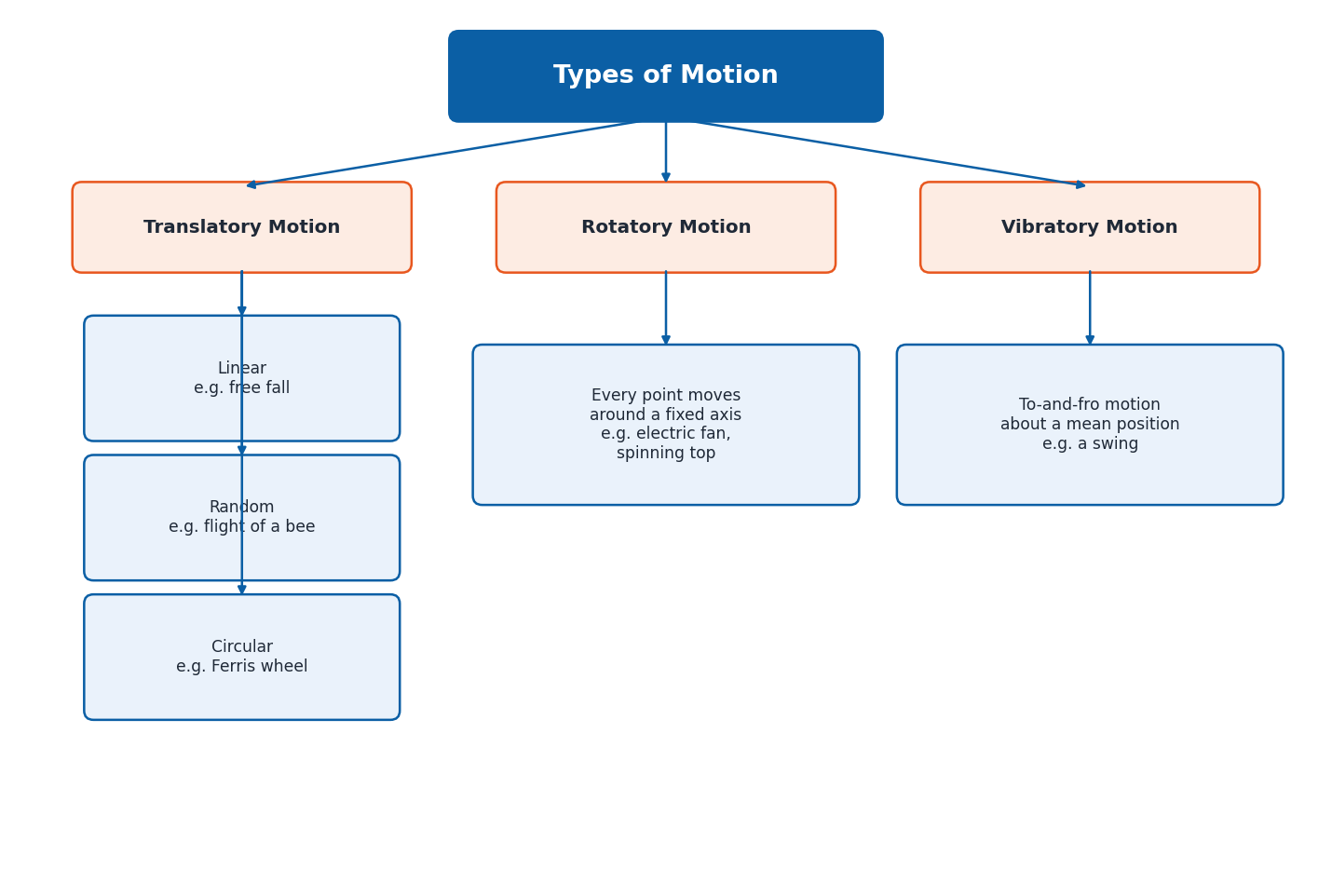
There are three general types of motion. Translatory motion occurs when every particle of a body moves uniformly in the same direction (e.g. a moving car or train); it has three sub-types — linear motion (along a straight line, e.g. a freely falling body), random motion (along an irregular path, e.g. the flight of a bee), and circular motion (along a circle, e.g. a Ferris wheel). Rotatory motion occurs when every point of a body moves around a fixed axis (e.g. an electric fan or a spinning top). Vibratory motion occurs when a body repeats a to-and-fro motion about a fixed mean position (e.g. a swing).
2.4 Distance and Displacement
Distance is the length of the actual path travelled during motion; it is a scalar quantity. Displacement is a vector quantity whose magnitude is the shortest distance between the initial and final positions, directed from the initial to the final position. For motion along a curved path from A to B, the distance equals the length of the curved path, while the displacement is the straight line from A to B. The SI unit of both is the metre.
2.5 Speed and Velocity
Speed is the distance covered in unit time: v = S/t (a scalar quantity, SI unit m s⁻¹). The instantaneous speed is the speed shown by a speedometer at a given instant, while average speed = total distance covered ÷ total time taken. Velocity is the net displacement of a body in unit time: v_av = d/t (a vector quantity, direction same as displacement); it distinguishes direction of motion, unlike speed. Velocity is uniform if both the speed and direction of a moving body remain unchanged; if either changes, the velocity is non-uniform (variable).
2.6 Acceleration
Acceleration is the time rate of change of velocity: a_av = (v_f − v_i)/t = Δv/t (a vector quantity, SI unit m s⁻²). Acceleration is positive when velocity increases and negative when velocity decreases; negative acceleration is also called deceleration or retardation. If the rate of change of velocity is constant, the acceleration is uniform; otherwise it is non-uniform (this chapter deals only with uniform acceleration).
2.7 Graphs of Motion
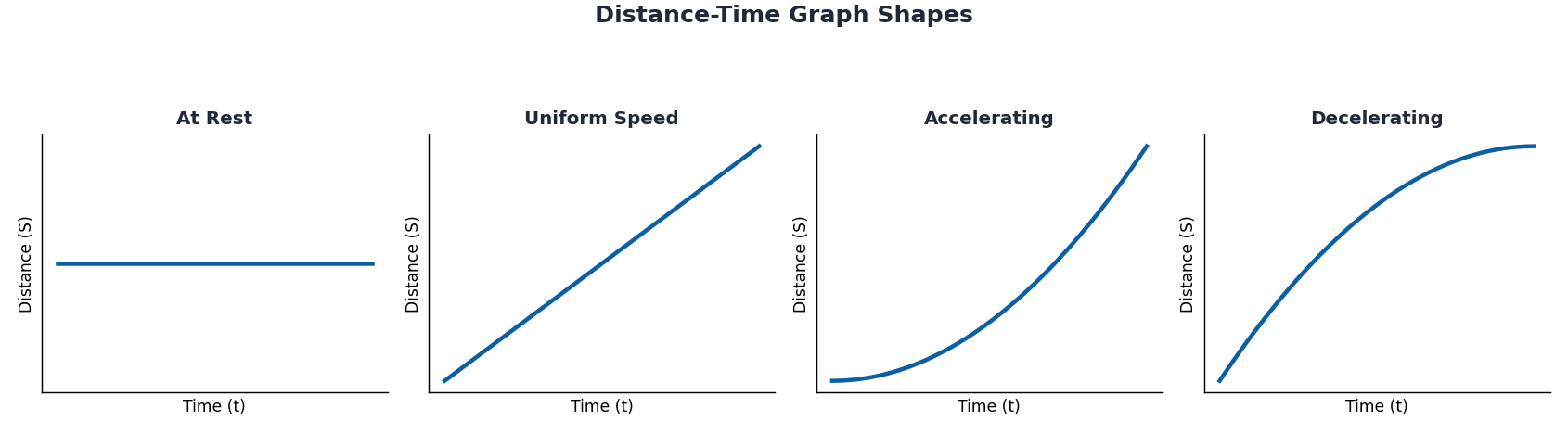
A distance-time graph plots distance S (y-axis, dependent variable) against time t (x-axis, independent variable). A straight line indicates motion with uniform speed; a line curving upward indicates increasing speed (acceleration); a line curving downward indicates decreasing speed (deceleration); and a horizontal line indicates the body is at rest. The gradient (slope) of a distance-time graph equals the average speed of the body: slope = (S₂ − S₁)/(t₂ − t₁) = S/t = v_av.
A speed-time graph plots speed v against time t. A straight line rising uniformly indicates motion with uniform acceleration; a horizontal line indicates constant speed (zero acceleration). The gradient of a speed-time graph equals the average acceleration of the body: slope = (v₂ − v₁)/(t₂ − t₁) = Δv/t = a_av.
2.8 Area Under a Speed-Time Graph
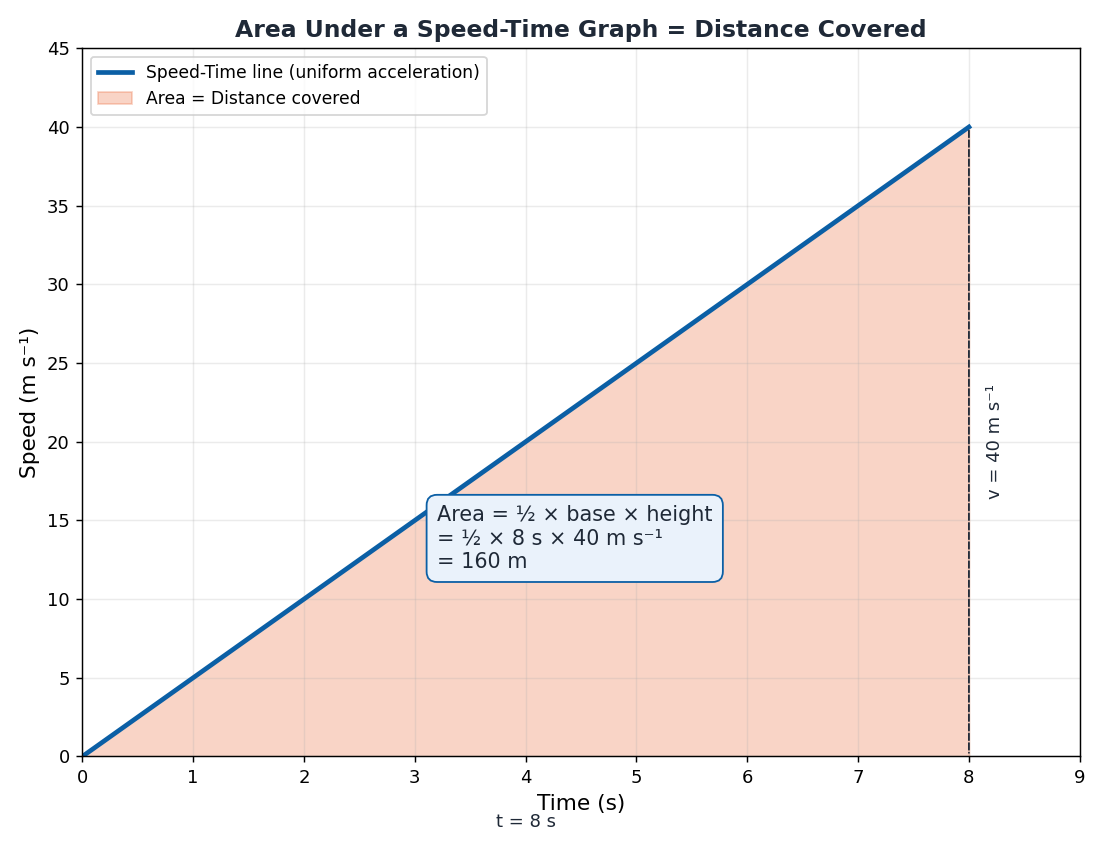
The distance moved by an object equals the area under its speed-time graph, measured up to the time axis. For constant speed v over time t, the area is a rectangle = v × t, matching S = vt. For speed increasing uniformly from 0 to v over time t (uniform acceleration from rest), the area is a right triangle = ½ × base × perpendicular = ½ v t, matching the average speed (0+v)/2 multiplied by time.
2.9 Equations of Motion and Free Fall
For a body with initial velocity v_i, final velocity v_f, time t, distance S, and uniform acceleration a, the three equations of motion are: v_f = v_i + at; S = v_i t + ½at²; and 2aS = v_f² − v_i². These assume motion along a straight line, use only magnitudes of vectors (with sign convention for direction), and assume uniform acceleration; the direction of initial velocity is taken as positive.
A freely falling body under Earth's gravity experiences gravitational acceleration g, directed downward, with a value of 9.8 m s⁻² (approximated as 10 m s⁻² for calculations). Since free fall is straight-line motion with uniform acceleration, the equations of motion apply with a replaced by g: v_f = v_i + gt; S = v_i t + ½gt²; and 2gS = v_f² − v_i². If a body is released from rest, v_i = 0; g is taken as positive in the downward direction; if a body is thrown vertically upward, g is taken as negative and the final velocity is zero at the highest point.
Important Definitions
What is a scalar quantity?
A physical quantity that can be described completely by its magnitude only, such as distance, time, speed or temperature.
What is a vector quantity?
A physical quantity that needs both magnitude and direction to describe it completely, such as displacement, velocity, acceleration or force.
What is displacement?
A vector quantity whose magnitude is the shortest distance between the initial and final positions of a motion, directed from the initial to the final position.
What is average speed?
The total distance covered divided by the total time taken: v_av = S/t.
What is velocity?
The net displacement of a body in unit time; a vector quantity with the same direction as the displacement.
What is acceleration?
The time rate of change of velocity of a body: a = Δv/t.
What does the gradient of a distance-time graph represent?
The average speed of the body.
What does the gradient of a speed-time graph represent?
The average acceleration of the body.
Key Formulas
| Topic | Formula |
|---|---|
| Average speed | v_av = Total distance covered ÷ Total time taken = S/t |
| Average velocity | v_av = Displacement ÷ Time = d/t |
| Average acceleration | a_av = (v_f − v_i) ÷ t = Δv/t |
| 1st equation of motion | v_f = v_i + at |
| 2nd equation of motion | S = v_i t + ½ a t² |
| 3rd equation of motion | 2aS = v_f² − v_i² |
| Free fall equations | Same as above with a replaced by g ≈ 10 m s⁻² (downward positive) |
| Distance from speed-time graph | Distance = Area under the speed-time graph |
Diagrams
Types of Motion: Translatory (linear, random, circular), rotatory and vibratory motion with examples
Distance-Time Graph Shapes: How the shape of a distance-time graph shows rest, uniform speed, acceleration and deceleration
Area Under Speed-Time Graph: Distance covered equals the shaded area under a speed-time graph for uniformly accelerated motion from rest
Short Questions & Answers
Define scalar and vector quantities with one example each.
A scalar has magnitude only, e.g. speed. A vector has both magnitude and direction, e.g. velocity.
State the head-to-tail rule for vector addition.
Representative lines of the vectors are redrawn so the head of one coincides with the tail of the next; the resultant is drawn from the tail of the first vector to the head of the last vector.
What is the difference between distance and displacement?
Distance is the total length of the actual path travelled (a scalar); displacement is the shortest straight-line distance between initial and final positions, with direction (a vector).
What are distance-time and speed-time graphs?
A distance-time graph shows how the distance covered by a body varies with time; a speed-time graph shows how its speed varies with time.
Will a body moving with uniform speed always have uniform velocity? Give a reason.
Not necessarily — if the direction of motion keeps changing (e.g. circular motion at constant speed), the velocity is non-uniform even though the speed is constant, because velocity also depends on direction.
Can a body have acceleration while moving with constant speed?
Yes, if its direction is continuously changing (e.g. circular motion), since acceleration depends on the change in velocity, which is a vector.
What is the value of g used for calculations in this chapter, and in which direction does it act?
g ≈ 10 m s⁻², and it always acts vertically downward, toward the centre of the Earth.
What quantity does the area under a speed-time graph represent?
The distance covered by the object during that time interval.
Long Questions & Answers
Explain the three types of motion with examples.
Translatory motion occurs when every particle of a body moves uniformly in the same direction, such as a moving train or car; it includes linear motion (straight-line, e.g. a falling body), random motion (irregular path, e.g. a bee in flight), and circular motion (along a circle, e.g. a Ferris wheel). Rotatory motion occurs when every point of a body moves around a fixed axis, such as an electric fan or a spinning top. Vibratory motion occurs when a body repeats a to-and-fro motion about a fixed mean position, such as a swing.
Differentiate between speed and velocity, and between uniform and non-uniform velocity.
Speed is a scalar quantity equal to distance covered per unit time (v = S/t) and gives no information about direction. Velocity is a vector quantity equal to displacement per unit time (v = d/t) and has the same direction as the displacement. Velocity is uniform if both the speed and direction of motion remain unchanged; if either the speed or the direction (or both) changes, the velocity is non-uniform.
Explain what the gradients of a distance-time graph and a speed-time graph represent, using diagrams to support your answer.
The gradient (slope) of a distance-time graph, calculated as (S₂ − S₁)/(t₂ − t₁), equals the average speed of the body over that interval — a straight line gives uniform speed, an upward curve gives acceleration, a downward curve gives deceleration, and a horizontal line means the body is at rest. The gradient of a speed-time graph, calculated as (v₂ − v₁)/(t₂ − t₁), equals the average acceleration of the body — a straight rising line indicates uniform acceleration, while a horizontal line indicates zero acceleration (constant speed).
Prove that the area under a speed-time graph is equal to the distance covered by an object.
For an object moving with constant speed v over time t, the speed-time graph is a horizontal line, and the area under it up to the time axis is a rectangle of sides t and v, giving area = v × t, which matches the distance formula S = vt. For an object accelerating uniformly from rest to speed v over time t, the speed-time graph is a straight rising line from the origin, and the area under it is a right-angled triangle with base t and height v, giving area = ½ × v × t. This matches the distance found using average speed: distance = average speed × time = (0+v)/2 × t = ½vt. In both cases, the area under the speed-time graph numerically equals the distance covered.
Multiple Choice Questions (MCQs)
The numerical ratio of displacement to distance is: (A) always less than one (B) always equal to one (C) always greater than one (D) equal to or less than one
Correct answer: (D) equal to or less than one. Displacement (the shortest path) can equal distance (a straight path) or be less than it (a curved/indirect path), so the ratio is equal to or less than one.
If a body does not change its position with respect to a fixed point, it is in a state of: (A) rest (B) motion (C) uniform motion (D) variable motion
Correct answer: (A) rest. Not changing position relative to a fixed point/surroundings defines a state of rest.
A ball is dropped from a tower; the distance covered in the first second is: (A) 5 m (B) 10 m (C) 50 m (D) 100 m
Correct answer: (A) 5 m. Using S = v_i t + ½gt² with v_i=0, g=10 m s⁻², t=1 s: S = ½ × 10 × 1² = 5 m.
The area under the speed-time graph is numerically equal to: (A) velocity (B) uniform velocity (C) acceleration (D) distance covered
Correct answer: (D) distance covered. The area under a speed-time graph, up to the time axis, gives the distance covered.
Gradient of the speed-time graph is equal to: (A) speed (B) velocity (C) acceleration (D) distance covered
Correct answer: (C) acceleration. The slope of a speed-time graph gives the average acceleration.
Gradient of the distance-time graph is equal to the: (A) speed (B) velocity (C) distance covered (D) acceleration
Correct answer: (A) speed. The slope of a distance-time graph gives the average speed.
A body accelerates uniformly from rest to 144 km h⁻¹ in 20 s. The distance it covers is: (A) 100 m (B) 400 m (C) 1400 m (D) 1440 m
Correct answer: (B) 400 m. v_f = 144 km h⁻¹ = 40 m s⁻¹. Using S = v_i t + ½at² with a = v_f/t = 2 m s⁻²: S = ½ × 2 × 20² = 400 m.
Which physical quantity is measured by the gradient of a distance-time graph at rest (horizontal line)? (A) Non-zero constant speed (B) Zero speed (C) Constant acceleration (D) Increasing speed
Correct answer: (B) Zero speed. A horizontal distance-time graph line means distance is not changing, so speed = 0 (the body is at rest).
Which of the following is a vector quantity? (A) distance (B) speed (C) displacement (D) time
Correct answer: (C) displacement. Displacement has both magnitude and direction, making it a vector; the others are scalars.
An object falls freely from rest. Using g = 10 m s⁻², its velocity after 4 s is: (A) 10 m s⁻¹ (B) 20 m s⁻¹ (C) 40 m s⁻¹ (D) 80 m s⁻¹
Correct answer: (C) 40 m s⁻¹. v_f = v_i + gt = 0 + 10 × 4 = 40 m s⁻¹.
Quick Revision Summary
- Scalar = magnitude only; Vector = magnitude + direction
- Vector addition: head-to-tail rule gives the resultant vector
- 3 types of motion: translatory (linear/random/circular), rotatory, vibratory
- Distance = path length (scalar); Displacement = shortest path with direction (vector)
- Speed = S/t (scalar); Velocity = d/t (vector)
- Acceleration = Δv/t; positive = speeding up, negative = deceleration
- Gradient of distance-time graph = average speed; gradient of speed-time graph = average acceleration
- Area under speed-time graph = distance covered
- 3 equations of motion: v_f=v_i+at; S=v_it+½at²; 2aS=v_f²−v_i²
- Free fall: g ≈ 10 m s⁻² downward; negative if body thrown upward
Exam Tips
- Always identify given values (v_i, v_f, a or g, t, S) first, then choose the matching equation of motion
- Remember the sign convention: direction of initial velocity is positive; opposite direction is negative
- For free fall problems, check whether the body starts from rest (v_i = 0) or is thrown upward (g is negative, v_f = 0 at the highest point)
- Practice reading distance-time and speed-time graph shapes — rest, uniform motion, acceleration, and deceleration each has a distinct shape
- Memorise that area under a speed-time graph = distance, and be ready to calculate it for rectangles and triangles
- Draw a clear vector diagram with a scale and angle when solving vector representation questions