Work is done when a force acting on an object moves it through some distance. Energy is the ability to do work, and is transferred between systems whenever work is done. This chapter defines work, kinetic and potential energy, and the principle of conservation of energy.
It then surveys renewable and non-renewable sources of energy used for electricity generation, and defines power and efficiency, explaining why no real machine can reach 100% efficiency.
Learning Objectives
- Define work done and use W = F × d (and W = FS cos θ) to solve problems
- Define energy, and describe how energy can be stored in different forms
- Derive and apply Kinetic Energy = ½mv² and Gravitational Potential Energy = mgh
- State and apply the principle of conservation of energy
- Differentiate between and list renewable and non-renewable energy sources
- Describe how useful energy is obtained from various natural resources, with their advantages and disadvantages
- Define and calculate power (P = W/t) and efficiency (% efficiency = useful output/total input × 100)
- Explain why a system cannot have 100% efficiency and why perpetual energy machines are impossible
Key Concepts
5.1 Work
Work is defined as the product of the magnitude of a force and the distance covered in the direction of the force: W = F × S. If a force acts but produces no displacement (e.g. pushing against a fixed wall), or if the displacement occurs with zero applied force, the work done is zero. When a force F acts at angle θ to the direction of motion, only its component along the motion, F cos θ, does work: W = FS cos θ. If θ = 0°, W = FS (maximum); if θ = 90°, W = 0 (e.g. carrying a bag horizontally does zero work against gravity, since the upward supporting force is perpendicular to the horizontal displacement). Work is a scalar quantity, since it carries no directional information. Graphically, the area under a force-distance graph represents the work done. The SI unit of work is the joule (J): one joule is the work done when a force of one newton moves a body through one metre in the direction of the force (1 J = 1 N m).
5.2 Energy: Kinetic and Potential
Energy is the ability of a body to do work; like work, it is a scalar quantity with SI unit joule (J). There are two basic forms of mechanical energy: kinetic energy and potential energy. Kinetic energy is the energy a body possesses due to its motion. It can be derived by finding the work needed to bring a moving body to rest: for a body of mass m moving with velocity v, Ek = ½mv². Doubling the speed of a body quadruples its kinetic energy, since Ek depends on v².
Potential energy is the energy a body possesses due to its position or state of deformation. Gravitational potential energy is the energy a body has due to its height above a reference level: raising a body of mass m through height h requires work equal to its weight times height, so Ep = mgh. Other forms of stored (potential) energy include elastic (strain) potential energy in a compressed or stretched spring, chemical potential energy stored in a battery or fuel, nuclear energy hidden in atomic nuclei (released during nuclear fission), electrostatic energy, and thermal (internal) energy released by burning fossil fuels.
5.3 Conservation of Energy
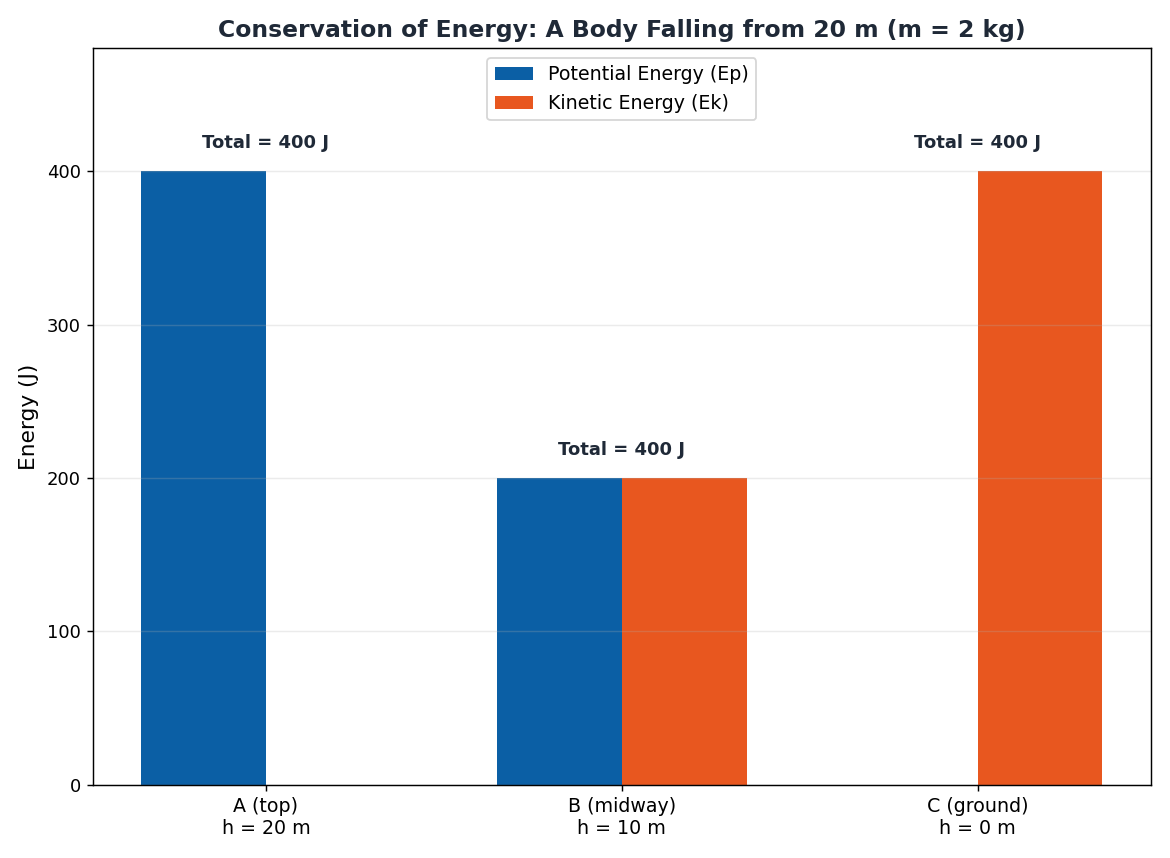
The principle of conservation of energy states that energy cannot be created or destroyed; it may be transformed from one form to another, but the total amount of energy in an isolated system remains constant. For a body of mass m falling freely from height h (with negligible air resistance), the sum of potential and kinetic energy stays equal to mgh at every point of the fall: at the top, Ep = mgh and Ek = 0; partway down at height x remaining, Ep = mgx and Ek = mg(h − x); and just before hitting the ground, Ep = 0 and Ek = mgh. On impact, this kinetic energy is dissipated as heat and sound into the surroundings. Energy that is 'lost' during real processes (such as friction) is not actually destroyed — it is converted to heat that dissipates into the environment and becomes unavailable for useful work (waste energy).
5.4 Sources of Energy
Fossil fuel energy comes from burning coal, oil, and natural gas; the heat produced generates steam that drives turbines connected to electric generators. Hydroelectric generation converts the gravitational potential energy of water stored behind a dam into kinetic energy as it falls, which spins a turbine to generate electricity. Solar energy from the Sun can be used directly for heating (via solar panels with blackened metal plates) or converted to electricity using photovoltaic (solar) cells connected in series to form panels, or by concentrating sunlight to boil water for steam turbines.
Nuclear energy is released as heat when the nucleus of a heavy atom (e.g. uranium, plutonium) splits apart in nuclear fission inside a reactor; the heat produces steam that drives turbine generators (Pakistan operates nuclear power stations at Karachi and Chashma). Geothermal energy uses heat from hot rocks deep underground (heated by radioactive decay) to convert pumped-down water into steam that drives generators; where such water reaches the surface naturally, it appears as hot springs or geysers. Wind energy uses windmills/wind turbines to convert the kinetic energy of moving air into electricity, typically using wind farms of many turbines. Tidal energy captures the rise and fall of sea levels (caused by the Moon's gravity) by trapping water behind a dam and releasing it through turbines. Wave energy uses floating devices (such as Salter's duck) that move with sea waves to drive generators. Biofuel energy is obtained from biomass (plants, food waste, animal dung, sewage) either by direct combustion to produce steam, or by anaerobic digestion in a sealed digester to produce methane-rich biogas, or by fermentation to produce ethanol as a petrol substitute.
5.5 Renewable vs Non-Renewable Sources
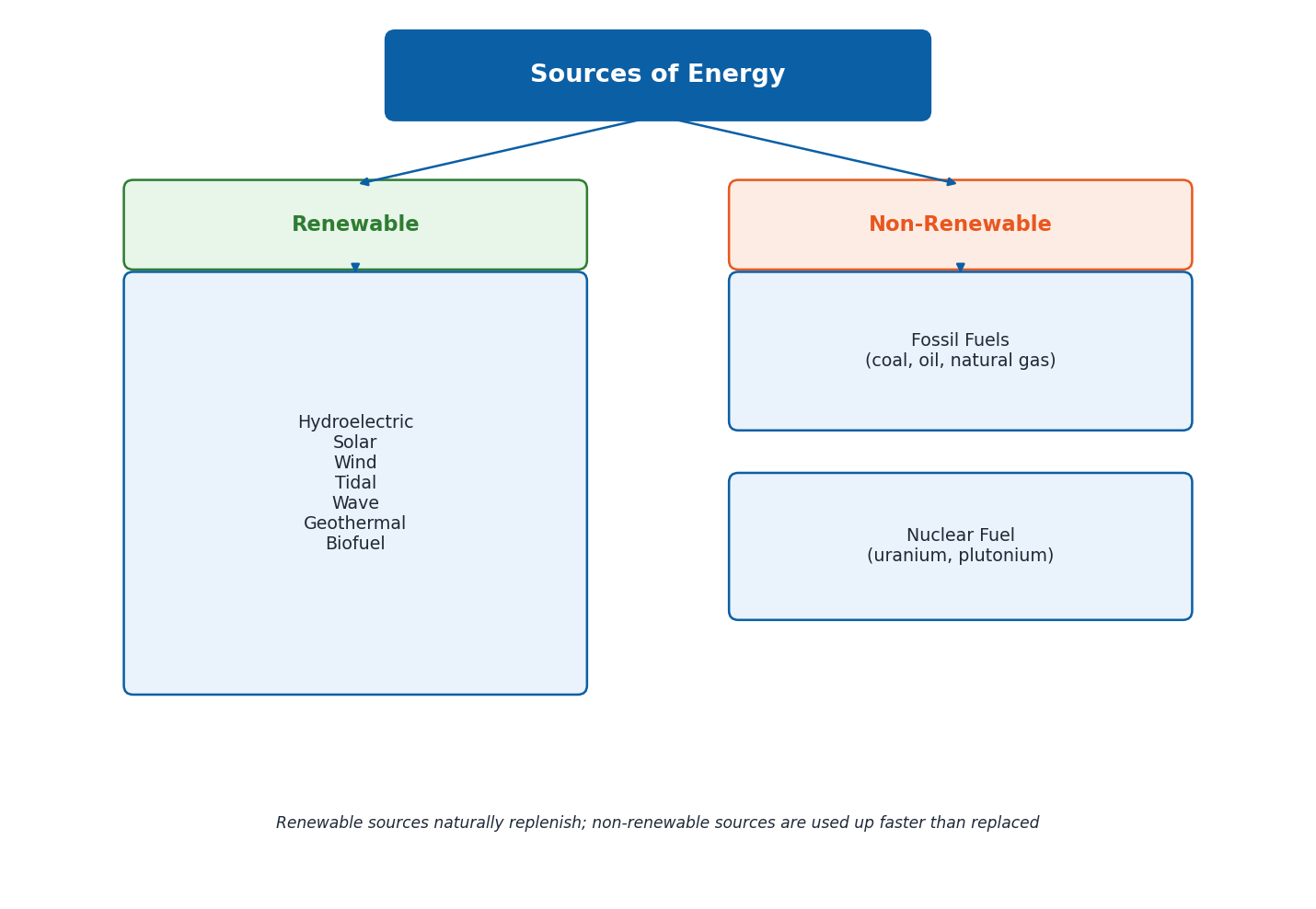
Renewable energy sources are naturally replenished after use and will not run out — these include hydroelectric, solar, wind, tidal, wave, and geothermal energy. Non-renewable energy sources are depleted with continued use and cannot be quickly replaced once exhausted — these include fossil fuels (which took millions of years to form from buried organic remains) and nuclear fuel (limited in quantity).
Fossil fuels are a widely used but expensive energy source that also cause air pollution harmful to human health. Hydroelectric energy is the cheapest and pollution-free, though it can cause waterlogging of nearby land by raising the water table. Solar, wind, tidal, and wave energy are pollution-free but have high initial setup costs. Nuclear energy is relatively cheap and can meet large energy demands, but carries the risk of radioactive leakage and the challenge of safely disposing of nuclear waste; wind turbines can be noisy and are sometimes considered visually intrusive. All wasted energy from any energy conversion process ultimately becomes thermal pollution, contributing to global warming.
5.6 Power
Power is the time rate of doing work (or equivalently, the rate of energy transfer): P = W/t. It is a scalar quantity. The SI unit of power is the watt (W): one watt equals one joule of work done per second (1 W = 1 J s⁻¹). Larger units include the kilowatt (1 kW = 10³ W) and megawatt (1 MW = 10⁶ W); the horsepower (British engineering unit) equals 746 W.
5.7 Efficiency and Perpetual Machines
Efficiency measures what fraction of the input energy supplied to a system is converted into useful output energy, with the rest wasted (usually as heat). Percentage efficiency = (Useful output energy ÷ Total input energy) × 100, which can equivalently be expressed using power: % Efficiency = (Useful power output ÷ Total power input) × 100. Since some energy is always lost to friction, air resistance, and heat in any real machine, no system can achieve 100% efficiency; a hypothetical machine with output equal to input (100% efficiency) is called an ideal machine, which does not exist in practice.
A perpetual energy machine is a hypothetical device that could run forever and do work indefinitely without any external energy source — this is impossible because it would require generating more energy than it consumes, violating the principle of conservation of energy; real mechanical systems always lose some energy as heat due to friction and air resistance.
Important Definitions
Define work.
The product of the magnitude of a force and the distance covered in the direction of the force: W = F × S.
Define energy.
The ability of a body to do work; measured in joules, the same unit as work.
Define kinetic energy.
The energy a body possesses due to its motion: Ek = ½mv².
Define gravitational potential energy.
The energy a body possesses due to its position/height above a reference level: Ep = mgh.
State the principle of conservation of energy.
Energy cannot be created or destroyed; it can only be transformed from one form to another, and the total amount of energy remains constant.
Define power.
The time rate of doing work: P = W/t, measured in watts.
Define efficiency of a working system.
The ratio of useful output energy to total input energy, usually expressed as a percentage.
Why can't any real machine reach 100% efficiency?
Because some input energy is always lost as heat due to friction, air resistance, and other unavoidable dissipative effects during operation.
Key Formulas
| Topic | Formula |
|---|---|
| Work (force along motion) | W = F × S |
| Work (force at angle θ) | W = F S cos θ |
| Kinetic energy | Ek = ½ m v² |
| Gravitational potential energy | Ep = m g h |
| Conservation of mechanical energy | Ep + Ek = constant (mgh, in free fall) |
| Power | P = W/t = Energy transferred / time |
| Horsepower | 1 hp = 746 W |
| Percentage efficiency | % Efficiency = (Useful output energy / Total input energy) × 100 |
Diagrams
Renewable and Non-Renewable Energy Sources: Classification of common energy sources into renewable and non-renewable categories
Conservation of Energy in Free Fall: Potential and kinetic energy at three points of a fall, showing their sum stays constant
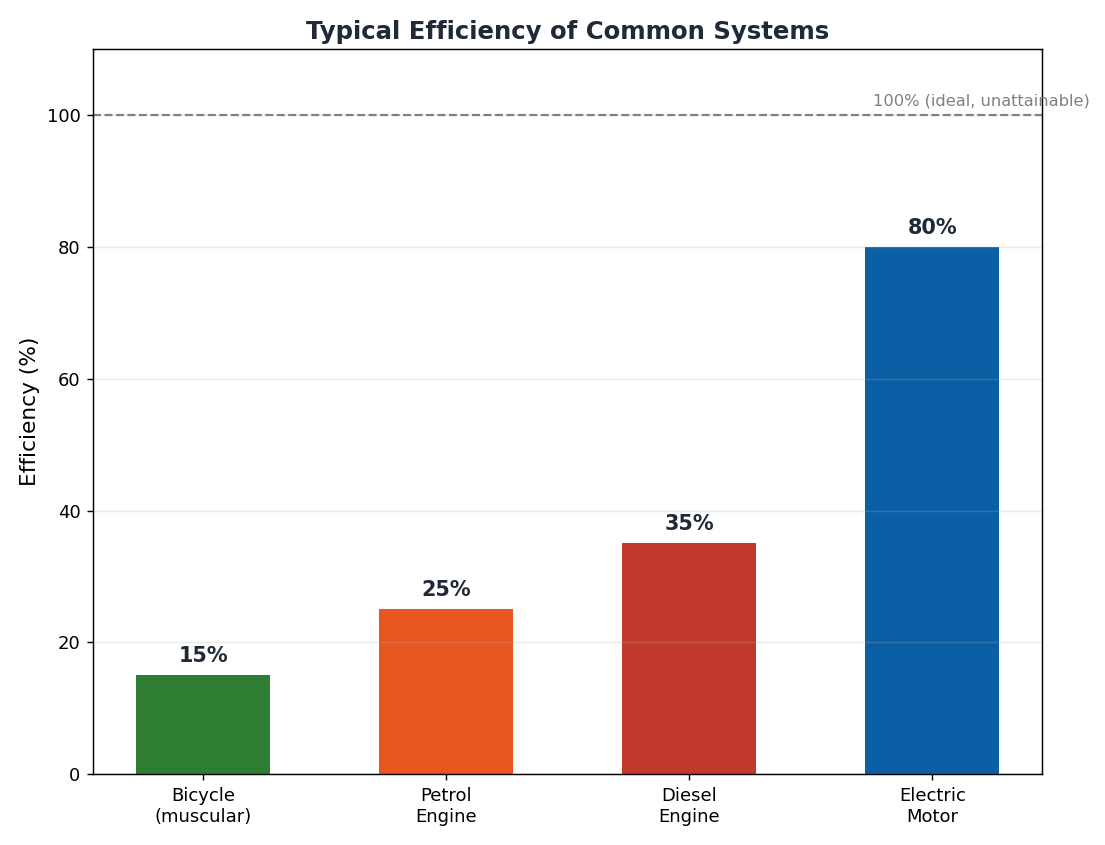
Efficiency of Common Systems: Typical percentage efficiency of a diesel engine, petrol engine, electric motor, and bicycle
Short Questions & Answers
What is the work done on an object that remains at rest when a force is applied on it?
Zero — since work requires displacement in the direction of the force, and the object does not move, no work is done.
How can a slow-moving car have more kinetic energy than a fast-moving motorcycle?
Because kinetic energy depends on both mass and the square of velocity (Ek=½mv²); if the car's mass is large enough, it can have greater kinetic energy than a lighter, faster motorcycle.
Define work and state its SI unit.
Work is the product of force and the distance moved in the direction of the force; its SI unit is the joule (J).
What is the potential energy of a body of mass m raised through height h?
Ep = mgh.
Define efficiency of a working system. Why can't a system have 100% efficiency?
Efficiency is the ratio of useful output energy to total input energy; a system can't reach 100% because some energy is always lost as heat due to friction and other unavoidable effects.
What is power? Name its SI unit.
Power is the time rate of doing work; its SI unit is the watt (W), equal to one joule per second.
Differentiate between renewable and non-renewable energy sources.
Renewable sources (e.g. solar, wind, hydro) are naturally replenished and won't run out; non-renewable sources (e.g. fossil fuels, nuclear fuel) are depleted with use and take an extremely long time (or cannot) be replaced.
Can the kinetic energy of a body ever be negative?
No — since Ek = ½mv² depends on v² (always positive or zero) and mass is always positive, kinetic energy can never be negative.
Long Questions & Answers
Derive the expression for kinetic energy of a moving body, and explain how doubling velocity affects it.
The kinetic energy of a body equals the work done by an opposing force F to bring it to rest over distance S: Ek = F × S. Using F = ma and, from a velocity-time graph, S = (v+0)/2 × t = vt/2 with a = v/t, substitution gives Ek = ma × (vt/2) = ½m(v/t)(vt) = ½mv². Since kinetic energy depends on the square of velocity, doubling the velocity of a body increases its kinetic energy by a factor of four (2² = 4), not just double.
State the law of conservation of energy and explain it using the example of a freely falling body.
The law states that energy cannot be created or destroyed, only transformed from one form to another, with the total amount remaining constant. For a body of mass m dropped from height h with negligible air resistance: at the top, all its energy is potential (Ep = mgh, Ek = 0); partway down, at a distance x below the start, it has lost potential energy mgx which has become kinetic energy (Ep = mg(h−x), Ek = mgx), and the total Ep + Ek still equals mgh; just before hitting the ground, all the energy has become kinetic (Ep = 0, Ek = mgh). At every stage, the total mechanical energy remains mgh, confirming the conservation of energy — upon impact, this energy converts to heat and sound dissipated into the environment.
Differentiate between renewable and non-renewable sources of energy, giving three examples of each.
Renewable energy sources are naturally replenished after use and effectively never run out — examples include hydroelectric energy (from falling water), solar energy (from sunlight), and wind energy (from moving air); tidal and wave energy are further examples. Non-renewable energy sources are used up faster than they can be replaced and exist in limited quantities — examples include fossil fuels like coal, oil, and natural gas (which took millions of years to form), and nuclear fuel such as uranium (limited in supply). Renewable sources are generally pollution-free but have higher initial setup costs, while non-renewable sources like fossil fuels are cheaper to access initially but cause significant air pollution and environmental harm.
Explain what is meant by the efficiency of a machine, how it is calculated, and why there is a limit to it.
Efficiency measures how much of the energy put into a machine (input energy) is converted into useful output energy, expressed as a percentage: % Efficiency = (Useful output energy ÷ Total input energy) × 100. It can also be calculated using power instead of energy when the process rate matters. There is always a limit to efficiency because some input energy is inevitably lost as heat due to friction between moving parts, air resistance, and other dissipative effects; this lost energy is not available to do useful work. Since no machine can eliminate all such losses, no real machine can achieve 100% efficiency, and a perpetual motion machine (one that keeps working forever without an external energy source) is impossible, as it would violate the principle of conservation of energy.
Multiple Choice Questions (MCQs)
Work done is maximum when the angle between force F and displacement d is: (A) 0° (B) 30° (C) 60° (D) 90°
Correct answer: (A) 0°. W = FS cosθ is maximum when cosθ = 1, i.e. when θ = 0° (force and displacement in the same direction).
A joule can also be written as: (A) kg m s⁻² (B) kg m s⁻¹ (C) kg m² s⁻³ (D) kg m² s⁻²
Correct answer: (D) kg m² s⁻². 1 J = 1 N·m = 1 kg m s⁻² × m = 1 kg m² s⁻².
The SI unit of power is: (A) joule (B) newton (C) watt (D) second
Correct answer: (C) watt. Power is measured in watts (W), equal to one joule per second.
A bullet of mass 0.05 kg has a speed of 300 m s⁻¹. Its kinetic energy is: (A) 2250 J (B) 4500 J (C) 1500 J (D) 1125 J
Correct answer: (A) 2250 J. Ek = ½mv² = ½ × 0.05 kg × (300)² = ½ × 0.05 × 90000 = 2250 J.
If a car doubles its speed, its kinetic energy will be: (A) the same (B) doubled (C) increased to three times (D) increased to four times
Correct answer: (D) increased to four times. Since Ek ∝ v², doubling speed quadruples (increases four times) the kinetic energy.
The energy possessed by a body due to its position is: (A) kinetic energy (B) potential energy (C) chemical energy (D) solar energy
Correct answer: (B) potential energy. Energy due to position (e.g. height) is potential energy.
If the momentum of an object is doubled while its mass stays the same, its kinetic energy will: (A) double (B) increase to four times (C) reduce to one-half (D) remain the same
Correct answer: (B) increase to four times. Since p=mv and Ek=p²/2m, doubling p (at constant m) quadruples Ek.
Which of the following is NOT a renewable energy source? (A) Hydroelectric energy (B) Fossil fuels (C) Wind energy (D) Solar energy
Correct answer: (B) Fossil fuels. Fossil fuels are non-renewable, as they take millions of years to form and are used up much faster than they are replaced.
A machine with output energy equal to input energy would have efficiency of: (A) 50% (B) 75% (C) 90% (D) 100%
Correct answer: (D) 100%. A hypothetical 'ideal machine' with no energy losses would have 100% efficiency, though this is not achievable in practice.
The power of a 2 kW water pump raising water to a height of 5 m in one minute is used to lift approximately: (A) 1000 litres (B) 1200 litres (C) 2000 litres (D) 2400 litres
Correct answer: (D) 2400 litres. Energy in 1 min = 2000 W × 60 s = 120000 J = mgh = m × 10 × 5, so m = 2400 kg ≈ 2400 litres of water.
Quick Revision Summary
- Work W = F×S (same direction) or W = FScosθ (at angle θ); SI unit: joule (N·m)
- Kinetic energy Ek = ½mv²; doubling v quadruples Ek
- Gravitational potential energy Ep = mgh
- Conservation of energy: total energy constant, only transforms between forms
- Renewable: hydro, solar, wind, tidal, wave, geothermal, biofuel
- Non-renewable: fossil fuels (coal, oil, gas), nuclear fuel
- Power P = W/t; SI unit: watt (1 W = 1 J/s); 1 hp = 746 W
- % Efficiency = useful output energy ÷ total input energy × 100
- No machine reaches 100% efficiency; perpetual motion machines are impossible
Exam Tips
- Always check the angle between force and displacement before applying W=FScosθ — a common exam trap is assuming W=FS even when θ≠0
- Remember Ek depends on v² — practice 'what happens if speed doubles/triples' style questions
- Practice energy conservation numericals for falling bodies: identify Ep and Ek at each labelled point and confirm their sum is constant
- Memorise which energy sources are renewable vs non-renewable, and be ready to justify why (regeneration time)
- Be comfortable converting between W, kW, MW, and hp in power problems
- For efficiency questions, clearly identify 'useful output energy' vs 'total input energy' before applying the formula