This unit presents 'The Impact of Globalisation on Culture and Economy', an expository (informative) prose passage that explains what globalisation is and examines its effects on Pakistan's economy and culture, from expanded trade and job creation to digital cultural exchange and concerns about the erosion of tradition.
The passage defines globalisation as the process by which countries, economies, and cultures become interconnected and interdependent through communication, trade, and the exchange of ideas, and explores both its economic benefits (trade, foreign investment, job creation) and its cultural effects (cross-cultural learning through digital platforms, alongside the risk of cultural homogenisation).
These notes summarise the passage as given in the textbook and provide comprehension questions, vocabulary, and exam-oriented material for this unit, including the skill-based Reading, Vocabulary/Grammar, Oral Communication, and Writing (precis writing) sections that accompany it.
Learning Objectives
- Ask and answer questions of personal relevance, information, and a variety of communicative purposes
- Construct sentences using the sentence patterns and structures learnt in earlier classes
- Construct complex sentences and paragraphs using main and subordinate clauses with appropriate transitional devices and correct punctuation
- Develop precis writing skills and write precis effectively
- Write multiple paragraphs of free writing for fluency, creativity, brainstorming, or pleasure
- Proofread and edit texts for errors in sentence structure, subject/verb agreement, noun/pronoun agreement, reference words, connectives/transitional devices, punctuation, and spelling
Key Concepts
What Is Globalisation?
Globalisation is the process by which countries, economies, and cultures become interconnected and interdependent through increased communication, trade, and exchange of ideas. It involves the integration of markets, technologies, and policies, leading to a more connected world where events in one region can significantly affect others.
Advances in technology, transportation, and communication have accelerated globalisation, making it easier for people and goods to move across borders. Globalisation has opened up new markets for Pakistani products such as textiles, rice, and sports goods, boosting the economy and creating jobs, while foreign companies have invested capital and technology that improved local industries.
Globalisation's Impact on Pakistan's Economy
Globalisation impacts Pakistan's economy through enhanced trade and investment: it opens up international markets for exports like textiles and agricultural products while giving consumers and industries access to imported goods. Foreign direct investment, especially through initiatives like CPEC, brings crucial capital, technology, and job opportunities.
Globalisation also expands industries by providing access to larger markets, leading many multinational companies to set up operations in Pakistan and create new jobs in sectors like information technology, telecommunication, and manufacturing — often with better pay and working conditions. It also increases demand for skilled labour, leading to higher wages and better job prospects for skilled workers.
Digital Globalisation and Cultural Exchange
Digital globalisation allows instant access to information worldwide, significantly impacting cultural exchange, especially for young learners, who can learn about different cultures, traditions, and histories through websites, videos, and online articles.
Social media platforms like Instagram, Facebook, Twitter, and TikTok let people from different cultures interact and share their daily lives, promoting empathy and understanding. TV shows, documentaries, and video games from various countries are now easily accessible, and digital tools like language learning apps make it easier to learn new languages and understand other cultures' literature and values. Exposure to global fashion trends and international cuisines has also diversified local tastes.
Concerns: Erosion of Traditional Culture
On the flip side, there is concern that globalisation might lead to the erosion of traditional Pakistani culture, as adopting global trends risks overshadowing unique cultural practices, languages, and heritage. It is important to find a balance where global influences are embraced while preserving cultural identity.
Digital platforms also allow individuals and communities to create and share content reflecting their own cultures, traditions, and stories, which can help preserve and promote local cultures globally, and have expanded access to education through online courses, webinars, and virtual classrooms.
Balancing Opportunity and Challenge
Digital globalisation has transformed media and communication, creating opportunities for enhanced cultural exchange and understanding, while also posing challenges related to cultural homogenisation, misinformation, and inequality. By promoting digital literacy, supporting local content, ensuring ethical standards, and bridging the digital divide, societies can harness the positive aspects of digital globalisation while mitigating its negative effects.
Globalisation is a powerful force that has brought significant changes to Pakistan's economy and culture. While it opens up new opportunities for trade, investment, and cultural exchange, it also presents challenges that must be carefully managed so Pakistan can benefit from globalisation while maintaining its unique cultural identity and economic stability.
Theme
Globalisation has significantly reshaped Pakistan's economy by enhancing trade and creating job opportunities, yet it poses challenges for local businesses facing international competition. Culturally, it fosters a rich exchange of ideas and lifestyles, though it also risks overshadowing traditional practices. Balancing these influences is crucial for maintaining economic stability and cultural identity.
Important Definitions (Glossary)
appreciate
to recognize the good qualities of somebody/something
communication
the activity or process of expressing ideas and feelings or of giving people information
complexities
the state of being formed of many parts; the state of being difficult to understand
crucial
extremely important
economy
the relationship between production, trade, and the supply of money in a particular country or region
empathy
the ability to understand another person's feelings, experience, etc.
erosion
the process by which the surface of something is gradually destroyed through the action of wind, rain, etc.
globalisation
the fact that different cultures and economic systems around the world are becoming connected and similar to each other because of the influence of large multinational companies and of improved communication
harness
a set of narrow pieces of leather and metal pieces put around the head and body of an animal so that it can be controlled and fastened to a carriage, etc.
homogenisation
the process of making things uniform or similar
integration
the act or process of combining two or more things so that they work together
interconnected
to connect similar things; to be connected to or with similar things
misinformation
the act of giving wrong information about something; the wrong information that is given
opportunities
a time when a particular situation makes it possible to do or achieve something
preserve
to keep a particular quality, feature, etc.; to make sure that something is kept
technology
scientific knowledge used in practical ways in industry, for example in designing new machines
trade
the activity of buying and selling or of exchanging goods or services between people or countries
tradition
a belief, custom, or way of doing something that has existed for a long time among a particular group of people
wages
a regular amount of money that you earn, usually every week or every month, for work or services
Key Facts
| Item | Detail |
|---|---|
| Text type | Expository (informative) prose |
| Definition of globalisation | Countries, economies, and cultures becoming interconnected through communication, trade, and exchange of ideas |
| Key Pakistani exports mentioned | Textiles, rice, sports goods, agricultural products |
| Key investment initiative mentioned | CPEC (China-Pakistan Economic Corridor) |
| Job sectors expanded by globalisation | Information technology, telecommunication, manufacturing |
| Social media platforms mentioned | Instagram, Facebook, Twitter, TikTok |
| Main cultural risk highlighted | Erosion of traditional Pakistani culture / cultural homogenisation |
| Strategies to balance digital globalisation | Promoting digital literacy, supporting local content, ensuring ethical standards, bridging the digital divide |
Diagram
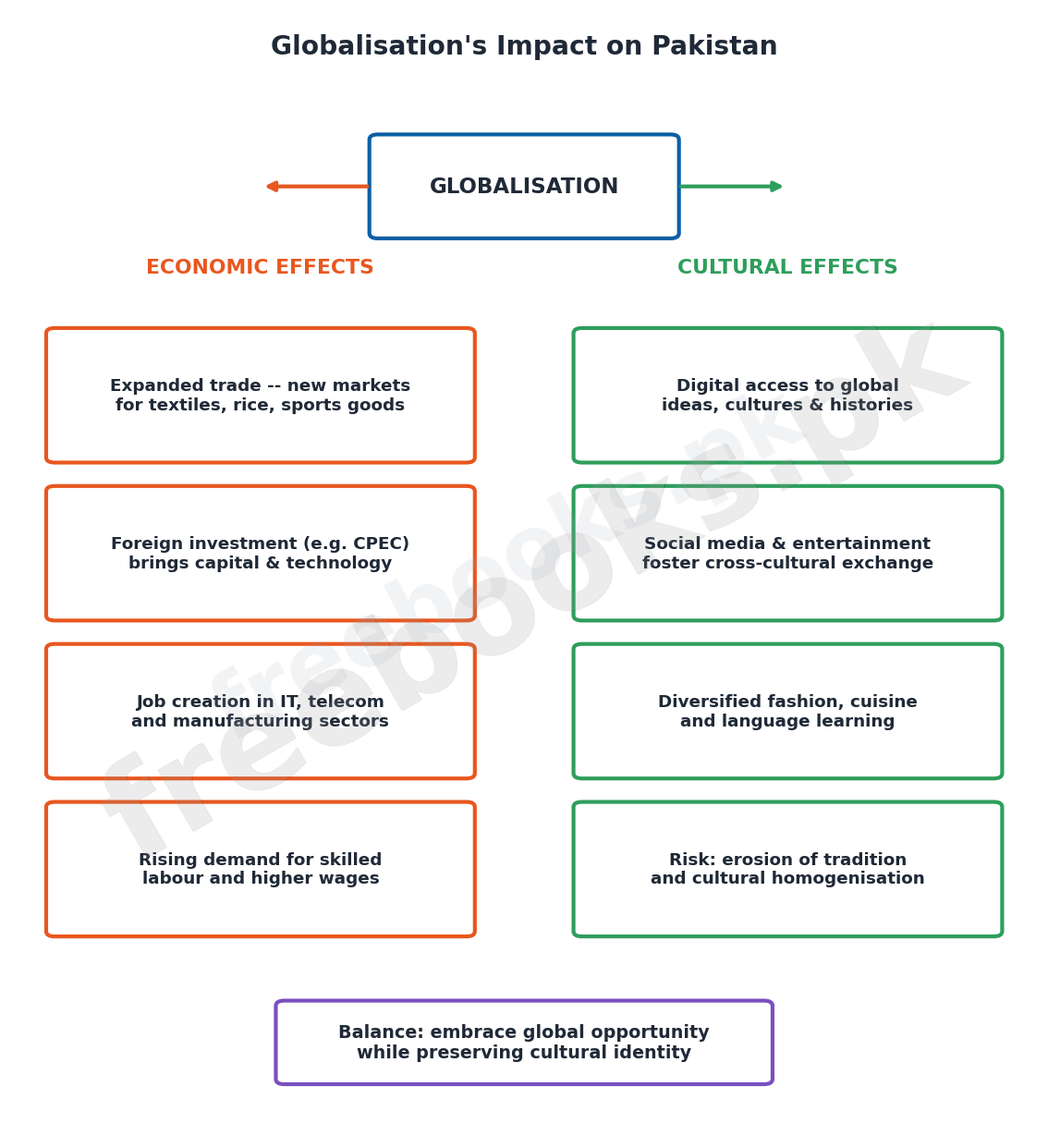
Globalisation's Impact — Economy and Culture: A purely textual/schematic diagram showing globalisation at the centre, branching into its economic effects (trade, foreign investment, job creation) on one side and its cultural effects (digital cultural exchange, education access, and the risk of eroding tradition) on the other, shown as labelled boxes connected by lines (no illustrated human figures).
Short Questions & Answers
What is globalisation, according to the passage?
Globalisation is the process by which countries, economies, and cultures become interconnected and interdependent through increased communication, trade, and exchange of ideas.
How has globalisation affected Pakistan's exports?
It has opened up new markets for Pakistani products such as textiles, rice, and sports goods, helping to boost the economy and create jobs.
What role does foreign direct investment, such as through CPEC, play in Pakistan's economy?
It brings crucial capital, technology, and job opportunities, contributing to infrastructure development and economic growth.
Which job sectors have expanded in Pakistan due to globalisation?
Sectors such as information technology, telecommunication, and manufacturing have expanded, often offering better pay and working conditions than local companies.
How has digital globalisation affected cultural exchange for young learners?
It allows students to learn about different cultures, traditions, and histories through websites, videos, and online articles, broadening their understanding and promoting cultural awareness.
How do social media platforms contribute to globalisation?
Platforms like Instagram, Facebook, Twitter, and TikTok let people from different cultures interact and share their daily lives, promoting empathy and understanding.
What concern does the passage raise about globalisation and Pakistani culture?
There is concern that globalisation might lead to the erosion of traditional Pakistani culture, as unique practices, languages, and heritage risk being overshadowed by global trends.
How can digital platforms help preserve local cultures despite globalisation?
They allow individuals and communities to create and share content reflecting their own cultures, traditions, and stories, helping preserve and promote local cultures globally.
What strategies does the passage suggest for managing the challenges of digital globalisation?
Promoting digital literacy, supporting local content, ensuring ethical standards, and bridging the digital divide can help harness the positive aspects of digital globalisation while mitigating its negative effects.
What is the central theme of this unit?
Globalisation has reshaped Pakistan's economy through trade and job creation while posing cultural challenges, and balancing these influences is crucial for maintaining both economic stability and cultural identity.
Long Questions & Answers
Explain how globalisation has affected Pakistan's economy, according to the passage.
How has globalisation affected Pakistan's trade?
It has opened up international markets for Pakistani exports like textiles and agricultural products, while giving consumers and industries access to a wide range of imported goods.
What role does foreign investment play?
Foreign direct investment, especially through initiatives like CPEC, brings crucial capital, technology, and job opportunities, contributing to infrastructure development and growth.
How has globalisation affected industries and jobs?
Many multinational companies have set up operations in Pakistan, creating new jobs in sectors like IT, telecommunication, and manufacturing, often with better pay than local companies.
What effect does globalisation have on skilled labour?
It increases the demand for skilled labour to manage advanced technologies and systems, leading to higher wages and better job prospects for skilled workers.
Describe how globalisation affects culture in Pakistan, including both benefits and concerns.
How has digital globalisation expanded cultural exchange?
It allows people to access information instantly worldwide, letting students learn about different cultures, traditions, and histories through websites, videos, and online articles.
How do social media and digital tools contribute to this exchange?
Social media platforms let people from different cultures interact and share daily life, while language learning apps and access to global fashion, cuisine, and entertainment diversify local tastes and understanding.
What concern does the passage raise about this cultural exchange?
There is a concern that adopting global trends might lead to the erosion of traditional Pakistani culture, overshadowing unique practices, languages, and heritage.
How does the passage suggest managing this challenge?
It suggests finding a balance — embracing global influences while preserving cultural identity — and using digital platforms to actively share and promote local culture and traditions.
Multiple Choice Questions (MCQs)
What is globalisation based on the text? (A) Increased isolation of countries (B) Enhanced connectivity and interdependence (C) Strict regulation of international trade (D) Limited exchange of ideas and technologies
Correct answer: (B) Enhanced connectivity and interdependence. The text defines globalisation as enhanced connectivity and interdependence between countries, economies, and cultures.
How does globalisation primarily impact Pakistan's economy, according to the text? (A) By increasing barriers to international trade (B) By reducing access to imported goods (C) By opening up international markets for exports (D) By decreasing foreign direct investment
Correct answer: (C) By opening up international markets for exports. Globalisation opens up international markets for Pakistani exports like textiles and agricultural products.
How do digital tools primarily impact students, according to the text? (A) By restricting access to language learning (B) By promoting cultural isolation (C) By facilitating easier language learning (D) By limiting exposure to global trends
Correct answer: (C) By facilitating easier language learning. Digital tools like language learning apps and online dictionaries make it easier for students to learn new languages.
What is a potential concern regarding the impact of globalisation on Pakistani culture? (A) Increased preservation of cultural practices (B) Enriching cultural exchange (C) Erosion of traditional Pakistani culture (D) Limited exposure to global influences
Correct answer: (C) Erosion of traditional Pakistani culture. The text raises the concern that globalisation might lead to the erosion of traditional Pakistani culture.
How have digital platforms primarily contributed to globalisation, according to the text? (A) By limiting international communication (B) By restricting access to education (C) By enabling instant global communication (D) By reducing cultural exchange
Correct answer: (C) By enabling instant global communication. Digital platforms like social media and video conferencing tools enable instant communication across the globe.
What are the strategies to harness the positive aspects of digital globalisation while mitigating its negative effects? (A) Promoting digital literacy and supporting local content (B) Encouraging cultural homogenisation and spreading misinformation (C) Ignoring ethical standards and widening the digital divide (D) Limiting opportunities for cultural exchange
Correct answer: (A) Promoting digital literacy and supporting local content. The text suggests promoting digital literacy, supporting local content, ensuring ethical standards, and bridging the digital divide.
What is the key challenge for Pakistan in managing the effects of globalisation? (A) Ignoring new opportunities for trade and investment (B) Finding a balance between benefiting from globalisation and maintaining cultural identity and economic stability (C) Completely avoiding cultural exchange with other countries (D) Focusing solely on cultural changes while neglecting economic opportunities
Correct answer: (B) Finding a balance between benefiting from globalisation and maintaining cultural identity and economic stability. The key challenge is finding a balance between benefiting from globalisation and maintaining Pakistan's unique cultural identity and economic stability.
Which investment initiative is mentioned as bringing capital and technology to Pakistan? (A) SAARC (B) CPEC (C) ASEAN (D) BRICS
Correct answer: (B) CPEC. The passage mentions CPEC (China-Pakistan Economic Corridor) as bringing crucial capital, technology, and job opportunities.
Which sectors are mentioned as expanding due to globalisation in Pakistan? (A) Agriculture only (B) Information technology, telecommunication, and manufacturing (C) Tourism only (D) Mining only
Correct answer: (B) Information technology, telecommunication, and manufacturing. The passage mentions IT, telecommunication, and manufacturing as sectors that have expanded due to globalisation.
What is the central theme of this unit? (A) The history of Pakistan's independence (B) Globalisation's impact on Pakistan's economy and culture, and the need for balance (C) The rules of international trade law (D) The geography of Pakistan
Correct answer: (B) Globalisation's impact on Pakistan's economy and culture, and the need for balance. The theme is that globalisation has reshaped Pakistan's economy and culture, and balancing these influences is crucial.
Quick Revision Summary
- Globalisation is the interconnection of countries, economies, and cultures through communication, trade, and exchange of ideas
- Pakistan's exports (textiles, rice, sports goods) have found new markets through globalisation
- Foreign investment, especially through CPEC, brings capital, technology, and jobs
- New job sectors expanded: IT, telecommunication, manufacturing, often with better pay
- Digital globalisation enables cultural exchange via social media, videos, and online learning
- Concern: globalisation risks eroding traditional Pakistani culture and languages
- Digital platforms can also help preserve and promote local culture globally
- Theme: balancing global opportunity with cultural identity and economic stability is essential
Exam Tips
- Learn the glossary words with their exact textbook meanings — synonym-in-context and spelling MCQs are drawn directly from unit glossaries
- Memorise the specific examples given (CPEC, textiles/rice/sports goods, IT/telecom/manufacturing, Instagram/Facebook/Twitter/TikTok), since MCQs often test these details
- Be ready to explain both sides of globalisation's cultural impact: the benefits of cultural exchange and the risk of eroding tradition
- Practice identifying subject, verb, and object in simple sentences, and dependent/independent clauses in complex sentences, from this unit's Grammar section
- Review the precis-writing rules (condense to about one-third, use your own words, write in third person, avoid personal opinions) since this unit's Writing Skills task focuses on precis
- When answering 'how does X impact Y' questions, structure your answer with a clear cause (the globalisation trend) and effect (the specific impact on Pakistan)