
This unit presents 'The Value of Time', a short fictional narrative about a cheerful, kind-hearted but poorly time-managed boy named Taseer, who learns to prioritise his responsibilities after his wise grandfather teaches him a memorable lesson using a jar, big rocks, pebbles, and sand.
The story follows a classic plot structure — exposition, rising action, climax, falling action, and resolution — as Taseer moves from constant procrastination and rushed, incomplete work to becoming a confident, reliable, and well-balanced individual who continues to apply his grandfather's lesson throughout his life.
These notes summarise the story and provide comprehension questions, vocabulary, and exam-oriented material for this unit, including the skill-based Reading/Plot Development, Vocabulary/Grammar, Oral Communication, and Writing (story-writing) sections that accompany it.
Learning Objectives
- Engage in extended discussions
- Examine how an author develops and contrasts the points of view of different characters or narrators in a text
- Critique the plot development with respect to different aspects of the story
- Examine the particular elements of a story or drama (e.g., how the setting shapes the characters or plot)
- Examine stages of plot development in a fictional text (exposition, setting, climax, character development, resolution)
- Analyse how complex characters develop over the course of a text, interact with other characters, and advance the plot or develop the theme
- Apply editing and proofreading skills to a wide range of texts and contexts
- Apply the techniques of writing a first draft with sufficient detail, then proofread and edit to suit purpose and audience
Key Concepts
Exposition: Taseer's Struggle with Time Management
Taseer was well known for his cheerful nature and kind-heartedness and was adored by all, but he had one flaw: he was terribly weak at managing his time. He often procrastinated, spending hours on video games, chatting with friends, and daydreaming while his schoolwork and chores piled up.
Despite his good intentions, he always seemed to run out of time, leading to rushed assignments and incomplete tasks. His teachers were concerned and his parents were perpetually worried, but Taseer was not ready to change his ways.
Rising Action: The Grandfather's Lesson
Taseer's wise grandfather noticed his struggle and invited him to his house to teach him a valuable lesson. In the kitchen, there was an empty glass jar and a basket filled with big rocks, pebbles, and sand.
His grandfather asked him to fill the jar with everything in the basket. Taseer poured the sand in first, then the pebbles, but the big rocks would not fit — leaving him puzzled.
Climax: Understanding the Big Rocks, Pebbles, and Sand
His grandfather then emptied the jar and methodically placed the large rocks in first, then the pebbles (which filled the gaps between the rocks), and finally the sand (which filled the remaining gaps) — and everything fit perfectly.
He elucidated the meaning: the jar represents Taseer and his time; the big rocks are significant things like schoolwork, family, and health; the pebbles are other priorities like hobbies and friendships; and the sand represents small, trivial things. If you fill your time with small things first, there is no room left for what matters — but if you prioritise the big rocks, everything else finds its proper place.
Falling Action: Applying the Lesson
The grandfather helped Taseer make a schedule, setting aside time for schoolwork, chores, and family activities, and only allocating time for hobbies and relaxation after the important tasks were completed.
At first it was challenging, as Taseer was used to seeking immediate gratification, but with practice and determination he began to see improvements: he felt more in control of his time, less stressed about deadlines, his grades improved, and he had more time for family and friends.
Resolution: A Changed Life
When Taseer's teacher asked him to share his secret, he told the story of the jar, rocks, pebbles, and sand, and many of his classmates decided to try the same approach. His improved time management also strengthened his relationships — his parents were proud, and his friends appreciated that he had become more reliable.
Taseer remembered his grandfather's wise words for the rest of his life and became a master of time management, growing up to be a successful and happy individual who always made time for what truly mattered. His story became a cherished tale reminding everyone of the importance of managing time wisely and prioritising what matters most.
Theme
Through the development and contrast of different characters' perspectives, the author explores themes of responsibility, growth, and the importance of time management. Each character's viewpoint — Taseer's struggle, his grandfather's wisdom, and the reactions of his teachers, parents, and friends — contributes to a comprehensive understanding of the challenges and lessons Taseer faces as he learns to prioritise and manage his time effectively.
Important Definitions (Glossary)
cherished
cherish somebody/something: to love somebody/something very much and want to protect them or it
elucidate
to make something clearer by explaining it more fully
gratification
the state of feeling pleasure when something goes well for you or when your desires are satisfied; something that gives you pleasure
intrigued
very interested in something/somebody and wanting to know more about it/them
methodically
in a careful and logical way
perpetually
in a way that continues for a long time without stopping
prioritising
giving importance
reliable
able to be trusted
significant
large or important enough to have an effect or to be noticed
Key Facts
| Item | Detail |
|---|---|
| Text type | Fictional narrative (short story) |
| Main character | Taseer |
| Mentor character | Taseer's grandfather |
| Central object/symbol | A glass jar filled with big rocks, pebbles, and sand |
| Big rocks represent | Significant things: schoolwork, family, health |
| Pebbles represent | Other priorities: hobbies, friendships |
| Sand represents | Small, trivial things |
| Plot stages | Exposition, Rising Action, Climax, Falling Action, Resolution |
Diagram
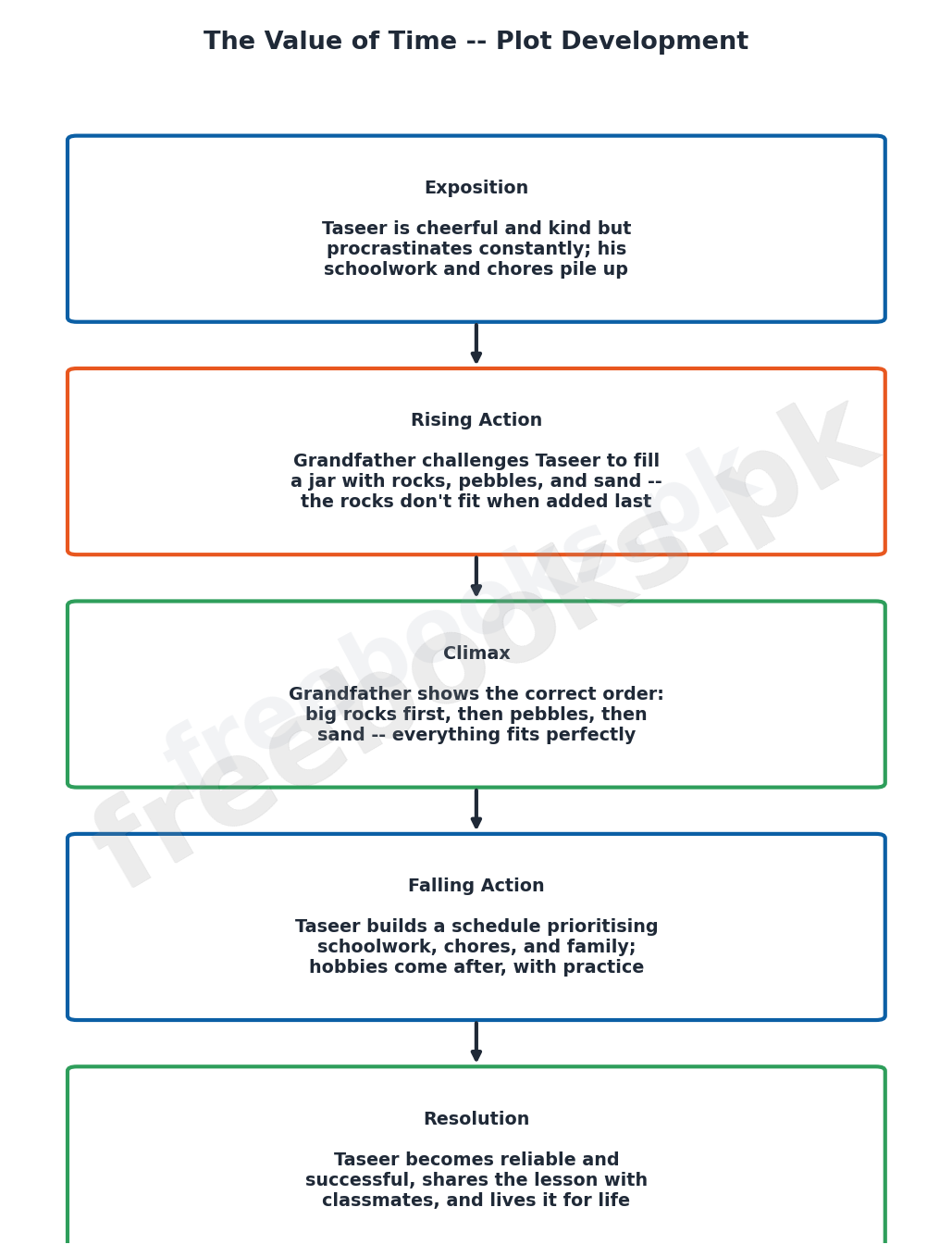
The Value of Time — Plot Development: A purely textual/schematic diagram showing the five stages of plot development in the story — Exposition (Taseer's poor time management), Rising Action (the jar challenge), Climax (understanding the rocks/pebbles/sand lesson), Falling Action (building a schedule), and Resolution (Taseer becomes a reliable, successful time-manager) — shown as labelled boxes connected by a single line (no illustrated human figures).
Short Questions & Answers
What was Taseer's main flaw despite his cheerful and kind-hearted nature?
Despite being adored by all for his cheerful nature and kind-heartedness, Taseer was terribly weak at managing his time.
How had Taseer been wasting his time before visiting his grandfather?
He often procrastinated, spending hours on video games, chatting with friends, and daydreaming, letting his schoolwork and chores pile up.
What object did Taseer's grandfather use to teach him about time management?
He used an empty glass jar along with big rocks, pebbles, and sand from a basket.
What happened when Taseer tried to fill the jar with sand and pebbles first?
When he poured in the sand and then the pebbles, the big rocks no longer fit in the jar, leaving him puzzled.
How did the grandfather demonstrate the correct way to fill the jar?
He emptied the jar, placed the big rocks in first, then added the pebbles (which filled the gaps between rocks), and finally poured in the sand (which filled the remaining gaps) — everything fit perfectly.
What do the big rocks, pebbles, and sand symbolise in the grandfather's lesson?
The big rocks symbolise significant things like schoolwork, family, and health; the pebbles symbolise other priorities like hobbies and friendships; and the sand symbolises small, trivial things.
What steps did Taseer take after learning the lesson?
With his grandfather's help, he made a schedule that prioritised schoolwork, chores, and family activities, allocating time for hobbies and relaxation only after important tasks were done.
How did Taseer's life change after applying the lesson?
He felt more in control of his time and less stressed, his grades improved, he had more time for family and friends, and he became more reliable and successful.
How did Taseer's story affect his classmates?
When he shared the story of the jar, rocks, pebbles, and sand with his class, many classmates decided to try the same approach for themselves.
What is the central theme of this unit?
The theme explores responsibility, growth, and the importance of time management, showing through different characters' perspectives how prioritising significant things over trivial ones leads to a balanced, fulfilling life.
Long Questions & Answers
Explain the lesson Taseer's grandfather taught him using the jar, rocks, pebbles, and sand.
What problem was Taseer's grandfather trying to solve?
He noticed that Taseer struggled badly with time management, procrastinating and leaving schoolwork and chores incomplete, so he decided to teach him a valuable lesson.
What happened when Taseer first tried to fill the jar?
He poured in the sand first, then the pebbles, but the big rocks did not fit afterward, leaving him puzzled about why his approach failed.
How did the grandfather demonstrate the correct approach?
He emptied the jar and placed the big rocks in first, then the pebbles to fill the gaps between them, and finally the sand to fill the remaining spaces — and everything fit perfectly.
What did the grandfather explain the jar represented?
He explained the jar represents Taseer and his time: the big rocks are significant things (schoolwork, family, health), the pebbles are other priorities (hobbies, friendships), and the sand is small, trivial things — prioritising the big rocks first makes room for everything else.
Describe how Taseer's life changed after learning his grandfather's lesson.
What difficulty did Taseer initially face in applying the lesson?
At first it was challenging, as he was used to putting off important tasks and seeking immediate gratification instead of following his new schedule.
What did Taseer's grandfather help him create?
His grandfather helped him make a schedule that set aside time for schoolwork, chores, and family activities, with hobbies and relaxation only after the important tasks were finished.
What improvements did Taseer experience?
He felt more in control of his time and less stressed about deadlines, his grades improved, and he had more time to spend with family and friends.
How did this change affect his relationships and future?
His parents were proud of his progress, his friends appreciated his new reliability, and he grew into a successful, happy individual who always made time for what truly mattered.
Multiple Choice Questions (MCQs)
What was Taseer's main weakness, according to the story? (A) Being unkind (B) Poor time management (C) Being disrespectful (D) Lack of intelligence
Correct answer: (B) Poor time management. Despite his cheerful, kind-hearted nature, Taseer was terribly weak at managing his time.
Who taught Taseer the valuable lesson about time management? (A) His teacher (B) His grandfather (C) His friend (D) His father
Correct answer: (B) His grandfather. Taseer's wise old grandfather noticed his struggle and taught him the lesson.
What items did the grandfather use to teach the lesson? (A) Books and a shelf (B) A jar, big rocks, pebbles, and sand (C) A clock and a calendar (D) A notebook and a pen
Correct answer: (B) A jar, big rocks, pebbles, and sand. The grandfather used an empty glass jar along with big rocks, pebbles, and sand from a basket.
What happened when Taseer poured the sand and pebbles into the jar first? (A) Everything fit perfectly (B) The big rocks did not fit (C) The jar broke (D) Nothing happened
Correct answer: (B) The big rocks did not fit. When Taseer filled the jar with sand and pebbles first, the big rocks no longer fit.
What do the big rocks represent in the grandfather's lesson? (A) Trivial things (B) Hobbies and friendships (C) Significant things like schoolwork, family, and health (D) Free time
Correct answer: (C) Significant things like schoolwork, family, and health. The big rocks represent the significant things in life: schoolwork, family, and health.
What do the pebbles represent in the lesson? (A) Significant things (B) Other priorities like hobbies and friendships (C) Trivial things (D) Nothing important
Correct answer: (B) Other priorities like hobbies and friendships. The pebbles represent other priorities such as hobbies and friendships.
What did Taseer's grandfather help him create after teaching the lesson? (A) A new video game (B) A daily schedule prioritising important tasks (C) A shopping list (D) A story book
Correct answer: (B) A daily schedule prioritising important tasks. The grandfather helped Taseer make a schedule that prioritised schoolwork, chores, and family activities.
How did Taseer's life change after applying the lesson? (A) His grades got worse (B) He became more stressed (C) His grades improved and he felt more in control (D) He stopped spending time with family
Correct answer: (C) His grades improved and he felt more in control. His grades improved, he felt more in control of his time, and he had more time for family and friends.
What did Taseer's classmates do after hearing his story? (A) Ignored it (B) Many decided to try the same approach (C) Made fun of him (D) Forgot about it immediately
Correct answer: (B) Many decided to try the same approach. Many of his classmates decided to try the same jar approach after hearing his story.
What is the central theme of 'The Value of Time'? (A) The importance of video games (B) Responsibility, growth, and the importance of time management (C) The history of Pakistan (D) The rules of cricket
Correct answer: (B) Responsibility, growth, and the importance of time management. The theme explores responsibility, growth, and the importance of managing time wisely.
Quick Revision Summary
- 'The Value of Time' is a fictional narrative about Taseer, a boy who struggles with time management
- His grandfather teaches him a lesson using a jar, big rocks, pebbles, and sand
- Big rocks = significant things (schoolwork, family, health); pebbles = other priorities (hobbies, friendships); sand = trivial things
- Filling the jar with sand/pebbles first leaves no room for the big rocks — prioritising big rocks first makes everything fit
- Taseer builds a schedule prioritising important tasks, with hobbies/relaxation afterward
- His grades improve, his stress decreases, and his relationships strengthen
- He shares the lesson with his classmates, many of whom adopt the same approach
- Theme: responsibility, growth, and the importance of managing time and priorities wisely
Exam Tips
- Learn the glossary words with their exact textbook meanings — synonym-in-context and spelling MCQs are drawn directly from unit glossaries
- Memorise what each element (big rocks, pebbles, sand) symbolises, as this is the heart of the story and frequently tested
- Be ready to identify and explain the five plot stages (exposition, rising action, climax, falling action, resolution) using this specific story as an example
- Practice explaining how different characters' perspectives (Taseer, his grandfather, his teachers/parents/friends) contribute to the story's theme
- Review coordinating, subordinating, and correlative conjunctions and transition words from this unit's Grammar section, since MCQ Part D draws from grammar across most units
- When writing your own short story for the Writing Skills task, use the same structure (setting, characters, conflict, resolution, theme) modelled in this unit