This unit presents 'Hazrat Asma (RA)', an expository (informative) and narrative prose passage recounting the courage, wisdom, and generosity of Hazrat Asma bint Abu Bakr (RA) during the migration (Hijrah) of Hazrat Muhammad (PBUH) and Hazrat Abu Bakr Siddique (RA) from Makkah Mukarramah to Madinah Munawwarah in 622 A.D.
The passage describes how Hazrat Asma (RA) prepared and secretly delivered food to the travellers hiding in the Cave of Thawr, tying it with her own belt (earning her the title Zaat-un-Nitaqain), how she bravely faced Abu Jehl's anger without revealing her father's whereabouts, and how she cleverly reassured her blind grandfather about the family's wealth.
These notes summarise the passage as given in the textbook, preserving the honorifics used, and provide comprehension questions, vocabulary, and exam-oriented material for this unit, including the skill-based Reading, Vocabulary/Grammar, Oral Communication, and Writing sections that accompany it.
Learning Objectives
- Engage effectively in a range of collaborative discussions (one-on-one, in groups, and teacher-led) with diverse partners
- Explain whether predictions about the content of a text are acceptable or should be modified, and why
- Use all types of tenses correctly in speech and writing; use gerunds, infinitives, and participles; use the aspect of time correctly in speech and writing
- Write narratives to develop real or imagined experiences or events using effective techniques, well-chosen details, and well-structured event sequences
Key Concepts
The Migration and the Danger Facing the Travellers
Rasoolullah (PBUH) and his close companion Hazrat Abu Bakr Siddique (RA) migrated from Makkah Mukarramah to Madinah Munawwarah in 622 A.D. When the chiefs of the Makkan tribes learned of the migration, they became furious and offered huge rewards and bounties for the travellers' capture, dead or alive.
The preparation for this dangerous journey was made at Hazrat Abu Bakr Siddique's (RA) house, and Hazrat Asma (RA) rendered vital services in getting the travellers ready to leave safely.
Zaat-un-Nitaqain: Preparing and Delivering Food
Hazrat Asma (RA) prepared food for the journey and, finding nothing else available, tied it to the camel's back using her own belt. For this service, the Rasoolullah (PBUH) gave her the title Zaat-un-Nitaqain (the woman of the two belts/girdles).
During the perilous journey, it was extremely difficult and dangerous for anyone to supply food to the travellers hidden in the Cave of Thawr. Every night, Hazrat Asma (RA) quietly ventured with a pack of food towards the rugged mountains where the cave was located, carefully managing every detail despite the constant fear of being detected and caught.
Confronting Abu Jehl
On the night of the migration, the disbelieving tribal chief Abu Jehl, furious, went to Hazrat Abu Bakr Siddique's (RA) home and violently demanded of Hazrat Asma (RA), 'Where is your father?' She calmly replied, 'How would I know?' — a wise, careful answer that gave him no clue at all.
Her composed counter-question infuriated Abu Jehl so much that he slapped her face hard enough to make her earring fall off, yet she remained steadfast and did not reveal the secret, showing remarkable courage and self-discipline under pressure.
Reassuring Her Blind Grandfather
Her grandfather, Hazrat Abu Quhafaa (RA), who was a disbeliever at the time and was old and blind, worried aloud that Hazrat Abu Bakr had taken all the family's wealth and left them helpless.
Hazrat Asma (RA) quickly gathered some pebbles, placed them where her father used to keep his money and jewels, and covered them with cloth, telling her grandfather to feel it and see that her father had left plenty for them. Believing the cloth was full of gold and jewels, he was relieved — showing her quick thinking, compassion, and care for her family's peace of mind.
Family, Character, and Legacy
Hazrat Asma (RA) was among the earliest people to accept Islam. She was the daughter of Hazrat Abu Bakr Siddique (RA), the stepsister of Hazrat Ayesha Siddiqa (RA), the wife of Hazrat Zubair bin al-Awwam (RA), and the mother of Hazrat Abdullah bin Zubair (RA). She lived to about a hundred years of age.
Hazrat Abdullah bin Zubair (RA) said he had never seen anyone more generous and open-hearted than his aunt Hazrat Ayesha (RA) and his mother. Hazrat Asma (RA) was so generous that she sold her inherited garden and gave away all the money to the poor and needy; nobody ever left her doorstep empty-handed. She will always be remembered for her courage, generosity, and wisdom, with resolute faith in Allah.
Theme
The theme of the unit is to appreciate the integrity and valour of Hazrat Asma (RA) for the cause of Islam. She is a role model for the Muslim Ummah due to her modesty, truthfulness, honesty, piety, bravery, and generosity.
Important Definitions (Glossary)
alleviate
to make less severe
beacon
a light
bounties
generous actions
constant
happening repeatedly, incessant
detect
to discover or notice
furious
in an extreme anger
infuriated
extremely angry
migrate
to move from one town, country, etc., to go to another area
perilous
dangerous
render
to present/provide a service/help
resolute
strong and determined
reveal
to make something known to somebody
traverse
to cross an area of land or water
venture
a project that involves taking risks
Key Facts
| Item | Detail |
|---|---|
| Text type | Expository and narrative prose |
| Migration (Hijrah) | Makkah Mukarramah to Madinah Munawwarah, 622 A.D. |
| Title given to Hazrat Asma (RA) | Zaat-un-Nitaqain (the woman of the two belts) |
| Hiding place of the travellers | Cave of Thawr |
| Tribal chief who confronted her | Abu Jehl |
| Her grandfather | Hazrat Abu Quhafaa (RA), old, blind, a disbeliever at the time |
| Her father | Hazrat Abu Bakr Siddique (RA) |
| Her husband and son | Hazrat Zubair bin al-Awwam (RA); Hazrat Abdullah bin Zubair (RA) |
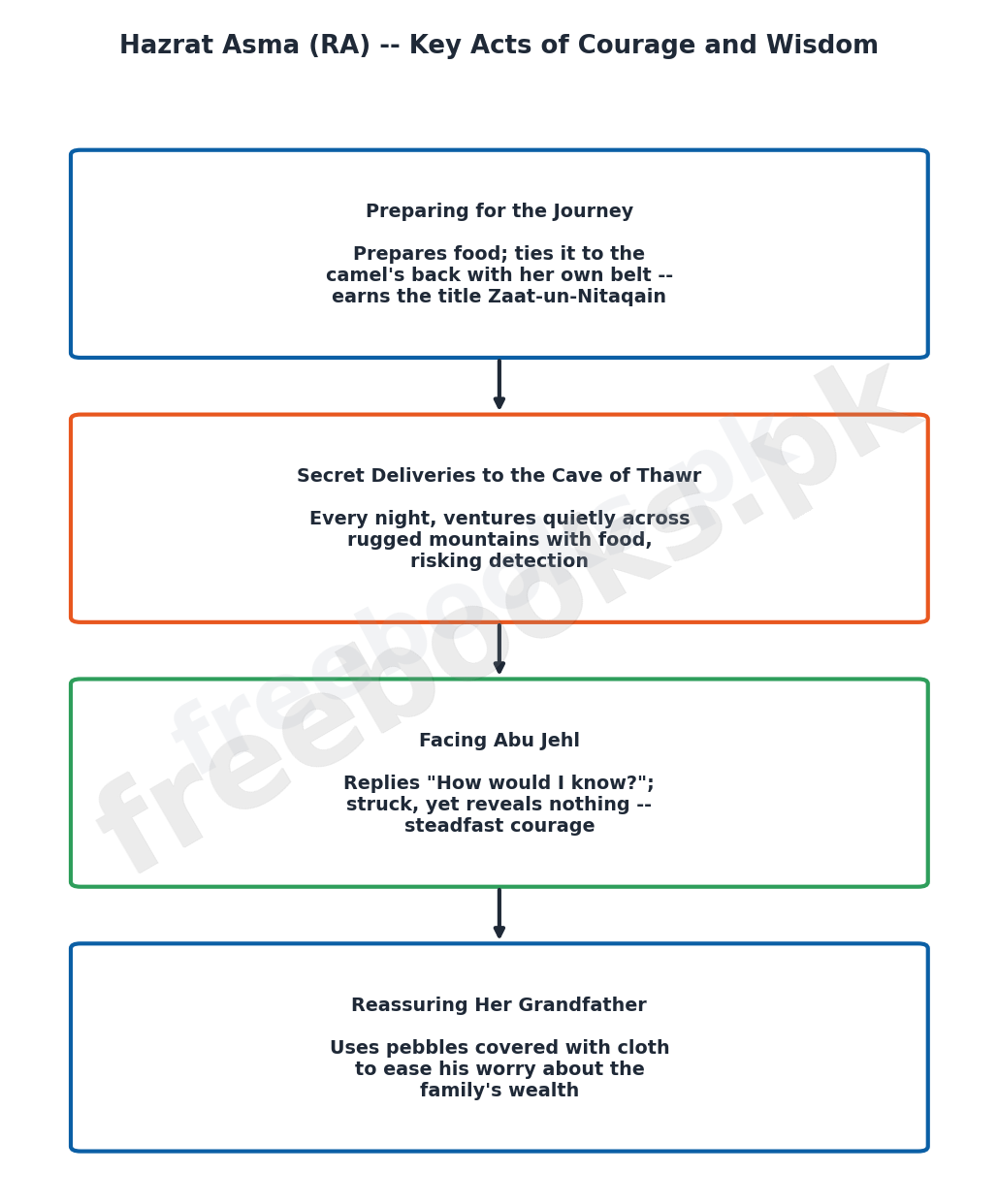
Diagram
Hazrat Asma (RA) — Key Acts of Courage and Wisdom: A purely textual/schematic diagram showing four key episodes — preparing and tying food for the journey, secretly delivering food to the Cave of Thawr, facing Abu Jehl without revealing the secret, and reassuring her blind grandfather — shown as labelled boxes connected by lines (no illustrated human figures).
Short Questions & Answers
Why did the Makkan tribal chiefs offer rewards for the capture of the Rasoolullah (PBUH) and Hazrat Abu Bakr Siddique (RA)?
When the chiefs learned of the migration to Madinah, they became furious and offered huge rewards and bounties to have the travellers captured, dead or alive.
How did Hazrat Asma (RA) earn the title Zaat-un-Nitaqain?
She prepared food for the journey and, finding nothing else to secure it with, tied it to the camel's back using her own belt, for which the Rasoolullah (PBUH) gave her this title.
What made the nightly food deliveries to the Cave of Thawr so dangerous?
She had to quietly traverse rugged, rocky mountain paths at night with the constant fear of being detected and caught, which could have endangered the Rasoolullah's (PBUH) life.
How did Hazrat Asma (RA) respond when Abu Jehl demanded to know her father's whereabouts?
She calmly replied, 'How would I know?', a wise answer that revealed nothing and instead infuriated Abu Jehl with its composure.
What happened after Hazrat Asma's (RA) reply angered Abu Jehl?
He slapped her face so hard that her earring fell off, but she remained steadfast and did not reveal the secret of her father's location.
How did Hazrat Asma (RA) reassure her blind grandfather about the family's wealth?
She placed pebbles where her father kept his money, covered them with cloth, and let him feel it, so he believed wealth had been left behind and felt relieved.
What does the pebble episode reveal about Hazrat Asma's (RA) character?
It shows her quick thinking, resourcefulness, and compassion, as she found a gentle, comforting way to ease her grandfather's worry without revealing the truth that could endanger her father.
What was Hazrat Asma's (RA) relationship to Hazrat Ayesha Siddiqa (RA)?
Hazrat Asma (RA) was the stepsister of Hazrat Ayesha Siddiqa (RA), as both were daughters of Hazrat Abu Bakr Siddique (RA).
How did Hazrat Asma (RA) show generosity later in her life?
She sold her inherited garden and gave away all the money to the poor and needy, and nobody ever left her doorstep empty-handed.
What is the central theme of this unit?
The theme is to appreciate the integrity and valour of Hazrat Asma (RA), who is a role model for the Muslim Ummah because of her modesty, truthfulness, honesty, piety, bravery, and generosity.
Long Questions & Answers
Describe how Hazrat Asma (RA) supported the migration of the Rasoolullah (PBUH) and Hazrat Abu Bakr Siddique (RA).
How did Hazrat Asma (RA) help prepare for the journey?
She prepared food for the journey, and since nothing else was available to secure it, she tied it to the camel's back using her own belt.
What title did she receive for this service, and why?
She was given the title Zaat-un-Nitaqain (the woman of the two belts) by the Rasoolullah (PBUH) in recognition of her resourcefulness.
What was her role once the travellers were hidden in the Cave of Thawr?
Every night, she quietly carried a pack of food to the rugged mountains where the cave was located, ensuring the travellers were fed despite the danger.
What risks did she face while doing this?
She had to traverse rocky, difficult paths at night under constant fear of being detected and caught, which could have endangered the Rasoolullah's (PBUH) life.
Explain how Hazrat Asma (RA) demonstrated courage and wisdom when confronted by Abu Jehl and her grandfather.
What did Abu Jehl demand from Hazrat Asma (RA)?
In a fit of fury, he went to her home on the night of the migration and violently demanded to know where her father was.
How did she respond, and what did this reveal about her?
She calmly replied, 'How would I know?', a composed counter-question that revealed nothing and showed her wisdom and courage under pressure.
What was the consequence of her response, and how did she react?
Abu Jehl, infuriated, slapped her hard enough to make her earring fall off, but she remained steadfast and never revealed the secret.
How did she separately handle her blind grandfather's worry about the family's wealth?
She placed pebbles where her father's money used to be kept, covered them with cloth, and let her grandfather feel it, easing his concern by letting him believe wealth had been left behind.
Multiple Choice Questions (MCQs)
In which year did the migration (Hijrah) from Makkah to Madinah take place? (A) 610 A.D. (B) 622 A.D. (C) 632 A.D. (D) 570 A.D.
Correct answer: (B) 622 A.D.. The passage states the migration took place in 622 A.D.
What title was given to Hazrat Asma (RA) for tying food to the camel's back with her belt? (A) Umm-ul-Mumineen (B) Zaat-un-Nitaqain (C) Siddiqa (D) Khatun-e-Jannat
Correct answer: (B) Zaat-un-Nitaqain. She was given the title Zaat-un-Nitaqain (the woman of the two belts) by the Rasoolullah (PBUH).
Where were the Rasoolullah (PBUH) and Hazrat Abu Bakr Siddique (RA) hiding during the migration? (A) Cave of Hira (B) Cave of Thawr (C) Masjid al-Haram (D) Mount Uhud
Correct answer: (B) Cave of Thawr. They were hidden in the Cave of Thawr, to which Hazrat Asma (RA) delivered food at night.
Who confronted Hazrat Asma (RA) demanding to know her father's whereabouts? (A) Abu Jehl (B) Abu Sufyan (C) Abu Lahab (D) Utbah
Correct answer: (A) Abu Jehl. Abu Jehl violently confronted her, demanding to know where her father was.
How did Hazrat Asma (RA) respond to Abu Jehl's demand? (A) She told him the truth (B) She said, 'How would I know?' (C) She refused to speak (D) She fainted
Correct answer: (B) She said, 'How would I know?'. She calmly replied, 'How would I know?', revealing nothing about her father's location.
What did Hazrat Asma (RA) use to reassure her blind grandfather about the family's wealth? (A) Real gold coins (B) Pebbles covered with cloth (C) A letter from her father (D) Nothing, she told him the truth
Correct answer: (B) Pebbles covered with cloth. She placed pebbles where the money used to be kept and covered them with cloth so he would believe wealth had been left behind.
Who was Hazrat Asma's (RA) father? (A) Hazrat Umar (RA) (B) Hazrat Abu Bakr Siddique (RA) (C) Hazrat Ali (RA) (D) Hazrat Uthman (RA)
Correct answer: (B) Hazrat Abu Bakr Siddique (RA). She was the daughter of Hazrat Abu Bakr Siddique (RA).
Who was Hazrat Asma's (RA) stepsister? (A) Hazrat Fatimah (RA) (B) Hazrat Ayesha Siddiqa (RA) (C) Hazrat Umm-e-Salma (RA) (D) Hazrat Zainab (RA)
Correct answer: (B) Hazrat Ayesha Siddiqa (RA). She was the stepsister of Hazrat Ayesha Siddiqa (RA), as both were daughters of Hazrat Abu Bakr Siddique (RA).
How did Hazrat Asma (RA) show generosity later in her life? (A) She built a mosque (B) She sold her inherited garden and gave the money to the poor (C) She wrote books (D) She travelled to teach
Correct answer: (B) She sold her inherited garden and gave the money to the poor. She sold her inherited garden and gave away all the money to the poor and needy.
What is the central theme of this unit? (A) The history of Makkah (B) The courage, wisdom, and generosity of Hazrat Asma (RA) (C) The architecture of the Cave of Thawr (D) The rules of migration
Correct answer: (B) The courage, wisdom, and generosity of Hazrat Asma (RA). The theme is to appreciate Hazrat Asma's (RA) integrity and valour as a role model for the Muslim Ummah.
Quick Revision Summary
- 'Hazrat Asma (RA)' recounts her courage during the Hijrah (migration) of 622 A.D.
- She tied food to the camel's back with her own belt, earning the title Zaat-un-Nitaqain
- She secretly delivered food each night to the Cave of Thawr, risking detection on rugged mountain paths
- When Abu Jehl demanded her father's whereabouts, she calmly replied, 'How would I know?' and did not reveal the secret, even after being struck
- She reassured her blind grandfather about the family's wealth using pebbles covered with cloth
- She was the daughter of Hazrat Abu Bakr Siddique (RA), stepsister of Hazrat Ayesha Siddiqa (RA), wife of Hazrat Zubair bin al-Awwam (RA), and mother of Hazrat Abdullah bin Zubair (RA)
- She was known for generosity, giving away money from her inherited garden to the poor and needy
- Theme: her modesty, truthfulness, honesty, piety, bravery, and generosity make her a role model for the Muslim Ummah
Exam Tips
- Learn the glossary words with their exact textbook meanings — synonym-in-context and spelling MCQs are drawn directly from unit glossaries
- Memorise the sequence of events (preparation, food-tying, nightly deliveries, Abu Jehl's confrontation, the pebble episode) so long answers stay in order
- Learn the exact family relationships (father, stepsister, husband, son) as these are frequently tested in short-answer and MCQ form
- Learn her two famous quoted lines — her reply to Abu Jehl, and the pebble episode's explanation — as these often appear in comprehension questions
- Review gerunds, infinitives, and participles from this unit's Grammar section, since MCQ Part D draws from grammar across most units
- When writing about Hazrat Asma (RA), maintain a formal, respectful tone and stick strictly to facts from the text without inserting personal opinions